“You’re a broken-down soldier with a bad back and a dead wife. You don’t have anything.”
“The letter came on a Tuesday. I remember because Tuesday was the day I drove my mother to her cardiology appointments. Had been for three years.”
They thought filing a false report would get them my VA life insurance payout → instead, the official military medical records landed on the investigator’s desk and my parents faced federal fraud charges.
I remember because Tuesday was the day I drove my mother to her cardiology appointments. Had been for three years. Ever since my father’s first stroke scare, when she decided she couldn’t handle the highway driving anymore.
The envelope was thick. Official. The return address said something I didn’t recognize at first — a claims processing center in Overland Park, Kansas.
I opened it at my kitchen table. Black coffee going cold beside me. The morning light coming through the window over the sink, the way it did every morning, catching the dust motes my wife used to complain about.
The letter said the insurance company had received a report questioning the validity of my disability claim. It said a formal investigation had been opened. It said I was required to appear for an examination and a recorded interview within thirty days.
It said the report had been filed by my parents.
I read it three times. The words didn’t change.
My name is Daniel Mercer. I was forty-four years old when I found out my mother and father had told an insurance investigator that I was faking my injuries. That I was exaggerating the damage to my back and my knee and my hand to keep collecting a check I didn’t deserve. That I had been “milking the system” for years.
What they didn’t know — what they couldn’t have known — was that the Department of Veterans Affairs had already flagged my file for a routine review. Standard procedure for anyone receiving disability at my rating level. And that review had pulled my complete medical history from my service record.
Every X-ray. Every surgical report. Every evaluation from every medic and surgeon who had ever touched me.
Those records were already on their way to the investigator’s desk when my parents signed their statement.
I just didn’t know it yet.
I grew up in a house where money was the only language that mattered.
My father, Gerald Mercer, had built a small commercial real estate business in the eighties. Buying strip malls and small office parks, renting them out, slowly accumulating. He wasn’t rich by any national standard, but in our corner of central Ohio, he was comfortable. He drove a Cadillac. He wore a gold watch. He belonged to the country club.
My mother, Patricia, had been a schoolteacher before she married him. Afterward, she became something else — a kind of social curator, managing their image, their connections, their standing in the community. She was good at it. She knew everyone’s name, everyone’s business, everyone’s weaknesses.
I was their only child until I was eleven. Then my brother Carter came along, and everything changed.
Carter was the golden one. Not because he was smarter or kinder or more deserving. He was just — theirs in a way I never was. He looked like my father. He had my mother’s charm. He was born into the life they had built, not the life they had clawed their way out of.
I was the reminder of the before times. The apartment with the broken heater. The years when my father drove a used pickup and my mother clipped coupons.
I don’t think they ever forgave me for that.
I enlisted the summer after high school.
My father wanted me to go to Ohio State. Study business. Come work for him. Take over the family empire, such as it was. He had it all planned out.
I had other plans.
The recruiter’s office was in a strip mall on the edge of town, next to a nail salon and a check-cashing place. I walked in on a Wednesday afternoon and walked out two hours later with a ship date and a contract.
My mother cried for a week. My father didn’t speak to me for a month. When he finally did, it was to tell me I was throwing my life away.
“You could have had everything,” he said. “And you chose to go play soldier.”
I didn’t argue. I had learned by then that arguing with my father was like arguing with weather. You could talk all you wanted. It didn’t change anything.
I spent twelve years in the Army. Four of them in the 82nd Airborne. The rest in Special Forces.
I won’t tell you everything I did. Some of it I can’t. Some of it I won’t. What I will tell you is this: I earned my place. I earned the tab on my shoulder. I earned the respect of men who didn’t give respect easily.
I also earned a broken back, a reconstructed left knee, and a right hand that never quite worked right again after a mission in the mountains that I still don’t talk about.
The hand was the thing that finally sent me home. Nerve damage that made it hard to hold a rifle steady. Hard to do the job the way it needed to be done. I could have stayed in a training role. Pushed paper. But that wasn’t what I signed up for.
I took my medical retirement at thirty-six. Full disability rating. Every penny earned.
I came back to Ohio because that’s where my wife was from. Sarah. We had met at Fort Bragg, when she was working as a civilian contractor on base. She was the best thing that ever happened to me.
She died four years ago. Cancer. Fast. The kind that doesn’t give you time to prepare.
I stayed in Ohio because of her. Because this was where she was buried. Because I couldn’t stand the thought of leaving her alone.
My parents were happy about that. Not the Sarah part. They never liked her. Thought she was beneath me. But the staying part — that they liked. My mother started calling me three times a week. My father started finding projects for me to help with. Small things at first. Then bigger.
I didn’t realize until later that they were keeping me close. Watching me. Making sure I didn’t stray.
The Tuesday appointments had become a ritual.
I’d pick my mother up at nine. Drive her to the cardiologist in Westerville. Sit in the waiting room while she got checked out. Drive her back. Sometimes we’d stop for lunch.
She talked the whole time. About the neighbors. About the club. About Carter.
Carter this. Carter that. Carter got a promotion at his firm. Carter bought a new house in New Albany. Carter’s wife, Bethany, was expecting their third child. Carter, Carter, Carter.
I learned to nod and make the right noises. It was easier than fighting.
That Tuesday, she was quieter than usual.
“Heard from the VA lately?” she asked, somewhere around mile ten on I-270.
I glanced at her. “Why would I hear from the VA?”
“No reason. Just wondering.”
That was the first clue. I didn’t recognize it at the time.
The letter arrived the next morning.
I called my mother first.
“What is this?” I asked. I kept my voice flat. Level. The way I’d been trained to speak when everything was on fire around me.
“What is what, Daniel?”
“The insurance report. The one you and Dad filed.”
Silence. Three seconds. Four.
“I don’t know what you’re talking about.”
“Don’t do that, Mom. The letter has your names on it.”
Another silence. Then, in a different voice — smaller, almost apologetic:
“We were just trying to protect you.”
“Protect me from what?”
“From yourself. You’ve been hurting for so long. We thought maybe if the insurance company looked into things, they could help you get better treatment.”
That was the lie. I knew it was a lie the moment I heard it.
My mother had never once expressed concern about my health. Not in twelve years of service. Not in eight years since I’d been home. She had never asked about my back. Never asked about my knee. Never asked about the hand that still didn’t work right.
But she was asking now. Because someone had told her it might be worth something.
“Who put you up to this?” I asked.
“I don’t know what you mean.”
“Mom. Who told you to file that report?”
She hung up.
I sat at my kitchen table for a long time after that.
The coffee had gone completely cold. The morning light had shifted, moving across the floor, catching the edge of the refrigerator, the edge of the counter.
I thought about all the years I had spent protecting people who never knew I was protecting them. All the things I had done that my family would never understand, never appreciate, never even know about.
I thought about Sarah. About what she would have said if she were still here.
She would have told me to fight. She always told me to fight.
So I did.
I called an old friend that afternoon. A guy I’d served with, name of Marcus Webb. He had retired a few years after I did and gone to work for a defense contractor in D.C. He knew people. He knew systems. He knew how to find things that weren’t supposed to be found.
“Dan,” he said when he heard my voice. “How long’s it been?”
“Too long. I need a favor.”
“Name it.”
I told him about the letter. About my parents. About the investigation.
He was quiet for a moment. Then:
“They’re trying to get you cut off.”
“I know.”
“Why?”
“I don’t know yet. That’s what I need you to find out.”
“I’ll see what I can do.”
I gave him the details. The claims center. The case number. The names of the people who had signed the report.
Then I hung up and went to work.
The investigation notice gave me thirty days.
I used the first three to gather everything I had. Every medical record. Every evaluation. Every piece of paper that proved I was what I said I was.
It was a lot of paper. Twelve years of service. Four surgeries. Countless evaluations and re-evaluations and physical therapy notes and imaging reports.
I organized it all into a binder. Tabbed. Labeled. Cross-referenced.
If they wanted to fight, I would fight.
But I still didn’t understand why.
Marcus called back on day four.
“Your parents filed the report together,” he said. “Signed statement. Claimed they’d witnessed you faking symptoms. Claimed you told them you were ‘playing up the injury’ to keep the checks coming.”
“That’s a lie.”
“I know it’s a lie. But that’s what they said.”
“Did they say anything else?”
“Plenty. But here’s the interesting part. The investigator who opened the case — a guy named Harold Pines — he’s got a connection to your family.”
“What kind of connection?”
“He used to work for your father. Back in the nineties. Before he got into insurance.”
I felt something cold settle in my chest.
“Are you telling me my father called in a favor?”
“I’m telling you that Harold Pines owes Gerald Mercer. And now he’s investigating a claim against Gerald Mercer’s son. You do the math.”
I didn’t confront my parents.
That wasn’t the play. I knew that from years of operating in environments where one wrong move got people killed. You don’t show your hand until you have to. You gather intelligence. You assess the situation. You wait for the right moment.
But I did start watching. Listening. Paying attention in a way I hadn’t before.
My mother called the next week, all sweetness, wanting to know if I was still driving her to her appointments.
“Of course,” I said. “Nothing’s changed.”
“That’s good, Daniel. I’m glad.”
I could hear the relief in her voice. The belief that I had bought the lie. That I was still the same compliant son she had always known.
She was wrong.
The drive to Westerville that week felt different.
I noticed things I hadn’t noticed before. The way my mother checked her phone constantly, texting someone, smiling at the screen. The way she mentioned Carter three times in the first ten minutes.
“He’s been so stressed lately,” she said. “The business has been slow.”
“What business?”
“Carter’s firm. They’ve had some setbacks.”
I filed that away. Carter’s firm. Setbacks.
My brother had gone into financial planning after college. Worked his way up at a mid-sized firm in Columbus. Married a woman from a good family. Bought a house in New Albany, one of the wealthiest suburbs in the area.
On paper, he was the success story. The one who had done everything right.
But paper lies.
I started asking questions.
Not directly. Not obviously. But in the way I had been trained to ask questions — casually, indirectly, in ways that didn’t trigger suspicion.
I talked to old neighbors. Old family friends. People who knew my parents, knew Carter, knew the way things worked in that world.
I learned that Carter’s firm had been struggling for years. Bad investments. Poor decisions. A partner who had left and taken clients with him.
I learned that my parents had been subsidizing him. Quietly. Regularly. Hundreds of thousands of dollars over the years.
I learned that the money had run out.
The picture started to form.
My father’s business had taken hits too. Commercial real estate wasn’t what it used to be. Tenants were leaving. Rents were falling. The Cadillac was five years old. The country club membership had been downgraded.
They needed money. They needed it badly.
And I had something they wanted.
The VA disability payments weren’t huge. Not compared to what my parents were used to. But they were steady. Dependable. Guaranteed.
And there was something else. Something I hadn’t thought about in years.
When I had taken my medical retirement, I had also been awarded a life insurance policy through the VA. A significant one. Payable to my beneficiaries upon my death.
My parents were still listed as my secondary beneficiaries. Sarah had been primary. After she died, I had never bothered to update the paperwork.
If I lost my disability rating — if I was found to have committed fraud — everything would be called into question. The disability payments. The retirement. The insurance.
And if I was disgraced, discredited, stripped of everything I had earned…
My parents would inherit.
I sat with that realization for a long time.
The sun went down. The house got dark. I didn’t turn on any lights.
I thought about my mother, teaching me to tie my shoes. My father, showing me how to change a tire. The birthday parties, the holidays, the family vacations.
I thought about all the times I had told myself they loved me, in their own way. That they just didn’t know how to show it. That if I tried harder, if I was better, if I was more like Carter, they would finally see me.
I thought about how wrong I had been.
Marcus called again on day ten.
“Got something else for you,” he said. “The investigator — Pines — he’s been moving fast. Too fast. Normally these investigations take months. He’s trying to wrap this up in weeks.”
“Why?”
“I don’t know. But I found something. There’s a second claim on your file. Filed the same day as your parents’ report.”
“What kind of claim?”
“A death benefit inquiry. Someone requested information about your VA life insurance policy. Beneficiary details. Payout amounts. The works.”
I closed my eyes.
“Who requested it?”
“The request came from your father’s email address.”
The letter said I had thirty days.
By day fourteen, I had everything I needed.
I had the medical records. I had the service history. I had the documentation that proved every injury, every surgery, every limitation I had been living with for years.
I also had something else. Something Marcus had dug up.
The connection between Harold Pines and my father wasn’t just professional. They were cousins. Distant, but close enough. Pines had gotten his start in the insurance business with a reference from my father. Had built his career on that foundation. Owed everything to Gerald Mercer.
And now he was investigating a claim against Gerald Mercer’s son.
The conflict of interest was so obvious it was almost insulting.
I called my father on day fifteen.
“Dad,” I said. “We need to talk.”
“About what?”
“About the report you and Mom filed.”
Silence. Then:
“I don’t know what you’re talking about.”
“The insurance report. The one that says I’m faking my injuries. The one that could get my disability revoked.”
More silence. Longer this time.
“You need to drop it,” I said. “Call the investigator. Tell him you made a mistake. Tell him you were confused. Tell him whatever you want. But drop it.”
“And if I don’t?”
“Then I’ll fight. And I’ll win. And you won’t like what happens next.”
He laughed. Actually laughed.
“You think you can threaten me? You think you can scare me? You’re a broken-down soldier with a bad back and a dead wife. You don’t have anything. You don’t have anyone. You’re nothing.”
I let the words land. Let them settle. Let them do exactly what he wanted them to do — hurt me, diminish me, remind me of all the ways I had failed to be the son he wanted.
Then I said:
“I have the truth. And the truth doesn’t care what you think of me.”
I hung up.
Day twenty.
The investigator called. Harold Pines. His voice was smooth, practiced, the voice of a man who had done this a hundred times before.
“Mr. Mercer, I’d like to schedule your interview. We can do it at our offices, or we can do it at your home. Your choice.”
“Your offices,” I said. “I’d like this on the record.”
“Of course. How does next Tuesday work?”
“That’s fine.”
“I’ll send you the details. And Mr. Mercer?”
“Yes?”
“I’d recommend you bring a lawyer. These things can get complicated.”
“I’ll keep that in mind.”
I didn’t bring a lawyer.
I brought something better.
The interview was scheduled for ten in the morning.
I arrived at nine forty-five. The office was in a generic building on the north side of Columbus. Beige walls. Fluorescent lights. The kind of place designed to make you feel small.
Pines was waiting for me in a conference room. He was a thin man with gray hair and glasses that kept sliding down his nose. He had a recorder on the table and a folder in front of him.
“Mr. Mercer. Thanks for coming in.”
“Wouldn’t miss it.”
He gestured to a chair. I sat.
“Before we begin, I want to remind you that this interview is being recorded. You’re free to have legal counsel present, but you’ve declined. Is that correct?”
“That’s correct.”
“Alright. Let’s start with the basics.”
He asked about my service. My injuries. My treatment. My disability rating.
I answered everything. Calmly. Precisely. The way I had been trained to answer questions under pressure.
He asked about my parents’ report. About their claim that I had been faking my symptoms.
“Did you ever tell your parents you were exaggerating your injuries?”
“No.”
“Did you ever tell anyone you were exaggerating your injuries?”
“No.”
“Is it possible your parents misunderstood something you said?”
“I don’t see how. I never discussed my injuries with them.”
That seemed to throw him. He glanced at his notes.
“You never discussed your injuries with your parents?”
“No.”
“But you live in the same city. You see them regularly.”
“I do. But we don’t discuss my health. They’ve never asked.”
He was quiet for a moment. I could see him recalibrating.
“Mr. Mercer, I have to be honest with you. Your parents’ statement is very detailed. They claim you told them you were ‘playing up’ your injuries to keep the disability checks coming. They claim you said the VA was ‘easy to fool.'”
“That’s a lie.”
“You’re calling your parents liars?”
“I’m telling you what I told them when I called to confront them about the report. I never said those things. They made them up.”
Pines leaned back in his chair.
“Why would your parents lie about something like this?”
I looked at him. Really looked at him. At the glasses that kept sliding down his nose. At the way his hand rested on the folder, protecting it, keeping it closed.
“You would know better than I would,” I said. “Given your relationship with my father.”
The room went very quiet.
Pines didn’t move. Didn’t blink. For a long moment, he just stared at me.
“I don’t know what you’re talking about.”
“Harold Pines. Gerald Mercer’s cousin. Started in the insurance business with a reference from my father. Built your career on that foundation. And now you’re investigating a claim against his son.”
“I don’t —”
“The conflict of interest is pretty clear. You’re investigating a claim your cousin filed against me to help him get access to my VA life insurance policy.”
Pines’s face went pale.
“That’s — that’s not —”
“I have the records. The emails. The beneficiary inquiry your office received from my father’s email address. I have everything.”
He started to say something. Stopped. Started again.
“I think you should leave.”
“I think you should reconsider what you’re doing here. Because if this goes forward — if my disability is questioned, if my record is challenged — I will fight. And the fight won’t just be about me. It will be about you. And my father. And everyone who helped make this happen.”
I stood up.
“You have until Friday to close this investigation. After that, I go public. And I don’t think anyone involved wants that.”
I walked out.
I didn’t know what would happen next.
I drove home. Sat at my kitchen table. Made coffee I didn’t drink.
The house was quiet. It was always quiet now. Sarah had filled the silence in ways I hadn’t appreciated until she was gone. Her laugh. Her music. The way she hummed while she cooked.
Now there was just me. And the ticking of the clock. And the waiting.
Friday came.
The mail came.
But the letter I was waiting for didn’t.
PART 2 — THE HEARING
Monday morning, the phone rang at six.
I was already awake. I had been awake most of the night, going over everything in my head. The interview. Pines’s face. The threat I had made.
I didn’t know if it would work. I didn’t know if a man like Harold Pines would cave to pressure or dig in and fight.
The caller ID said it was a number I didn’t recognize. A Columbus area code.
I answered.
“Mr. Mercer?”
“Yes.”
“This is Harold Pines.”
I didn’t say anything. I waited.
“I’ve been thinking about what you said. About the conflict of interest.”
“And?”
“And I’ve decided to recuse myself from this investigation. I’ll be handing it off to a colleague.”
“Is that right?”
“I’ve also recommended that the claim be dismissed. Based on my preliminary review, there’s no evidence of fraud on your part.”
“And my parents’ report?”
“That’s out of my hands. But I’ll note in the file that their statement lacked corroborating evidence.”
He paused.
“I’m sorry for any inconvenience this caused you, Mr. Mercer.”
“Thank you.”
I hung up.
It should have been the end.
It wasn’t.
Two days later, I got another letter.
This one was from the VA. Official. Stamped. Signed by someone I didn’t know in a department I had never heard of.
It said my case had been flagged for review. Not because of my parents’ report — that had been dismissed. But because the investigation itself had drawn attention to my file. A standard audit, they called it. Routine.
I was required to appear at a hearing in two weeks to verify my disability status.
If I couldn’t verify it, my benefits would be suspended pending further review.
I read the letter three times.
Then I called Marcus.
“They’re not done,” I said. “My parents. They found another way.”
“You’re sure it’s them?”
“The investigation was closed. The report was dismissed. And suddenly I have an audit? That’s not a coincidence.”
“Could be the VA just doing their due diligence. These things happen.”
“This isn’t due diligence. This is a trap. Someone filed a complaint. Someone flagged my file. Someone is still trying to get me cut off.”
Marcus was quiet for a moment.
“What do you need?”
“Everything. Every record. Every document. Everything that proves I’m not lying about what happened to me.”
“I’ll get on it.”
The hearing was scheduled for a Thursday.
I spent the two weeks preparing. Gathering records. Organizing files. Making calls to old contacts, old doctors, old commanders.
I found my original medical evaluation from Walter Reed. The one that had recommended my medical retirement. It was signed by three separate surgeons, all of whom had operated on me personally.
I found my imaging records. The X-rays. The MRIs. The CT scans. Every picture that showed the damage to my spine, my knee, my hand.
I found my service record. Twelve years of evaluations, commendations, deployments. A paper trail that proved I was exactly who I said I was.
I put it all in a binder. Tabbed. Labeled. Cross-referenced.
Then I waited.
The hearing was in a VA office in downtown Columbus.
I arrived early. The building was old, formal, the kind of place that had been designed to impress. Marble floors. High ceilings. Flags in the corner.
I checked in at the front desk. A young woman with a headset gave me a visitor’s badge and told me to wait.
I sat in the lobby. Watched people come and go. Veterans, mostly. Some in wheelchairs. Some with canes. Some with the look in their eyes that I recognized — the look of people who had seen things they couldn’t unsee.
I wondered how many of them were here for the same reason. How many had been accused. How many had to prove they weren’t lying.
The door opened.
My parents walked in.
I hadn’t expected that.
My mother was wearing her church clothes. A dark dress. A pearl necklace. My father had on his good suit, the one he saved for weddings and funerals.
They saw me. Stopped.
My mother’s face went through a series of expressions — surprise, then guilt, then something that looked almost like defiance.
My father just stared. Cold. Calculating.
“Daniel,” my mother said. “What are you doing here?”
“I have a hearing. What are you doing here?”
She glanced at my father. He didn’t say anything.
“We were asked to come,” she said. “To provide testimony.”
“Testimony about what?”
“About your… condition. About what we’ve observed.”
I felt something shift in my chest. A cold, hard thing.
“You’re here to testify against me.”
“We’re here to tell the truth,” my father said. His voice was flat. Controlled.
“The truth.”
“That’s right.”
I looked at him. At his good suit and his gold watch and his cold, calculating eyes.
“The truth is that you filed a false report to try to get my benefits cut off. The truth is that you’re in financial trouble and you see me as a way out. The truth is that you’ve been lying to everyone, including yourselves, for years.”
His face didn’t change.
“Believe what you want,” he said. “We’re here to tell the truth.”
The hearing room was small. A conference table. A few chairs. A recorder on the table.
The presiding officer was a woman named Colonel Elaine Foster. Retired Army. Thirty years of service. She had the look of someone who had seen everything and was impressed by nothing.
She sat at the head of the table. To her left, a VA attorney. To her right, a clerk with a laptop.
I sat on one side of the table. My parents sat on the other.
It was the most divided I had ever felt from them.
Colonel Foster opened the hearing.
“This is a routine review of the disability status of Daniel Mercer. The purpose is to verify the validity of his claimed injuries and his eligibility for continued benefits. Mr. Mercer, you’re here without counsel. Is that correct?”
“Yes, ma’am.”
“Very well. Let’s begin.”
She turned to my parents.
“Mr. and Mrs. Mercer, you’ve submitted a statement indicating that you believe your son is exaggerating his injuries. Is that correct?”
“Yes,” my mother said. “We love Daniel. We just want what’s best for him.”
“What’s best for him?”
“We think he needs help. Real help. Not just… disability checks.”
“And you believe he’s been faking his symptoms?”
“We believe he’s been… exaggerating. Making things sound worse than they are.”
The attorney looked up. “Do you have any evidence to support that belief?”
“We’ve seen him walk without a cane,” my mother said. “We’ve seen him lift things. He helped my husband move furniture last summer. He doesn’t seem disabled.”
“He moved furniture?”
“A couch. He helped move a couch. If his back was as bad as he says, he couldn’t do that.”
I kept my face still.
Colonel Foster turned to me.
“Mr. Mercer, do you have a response?”
“Yes, ma’am.”
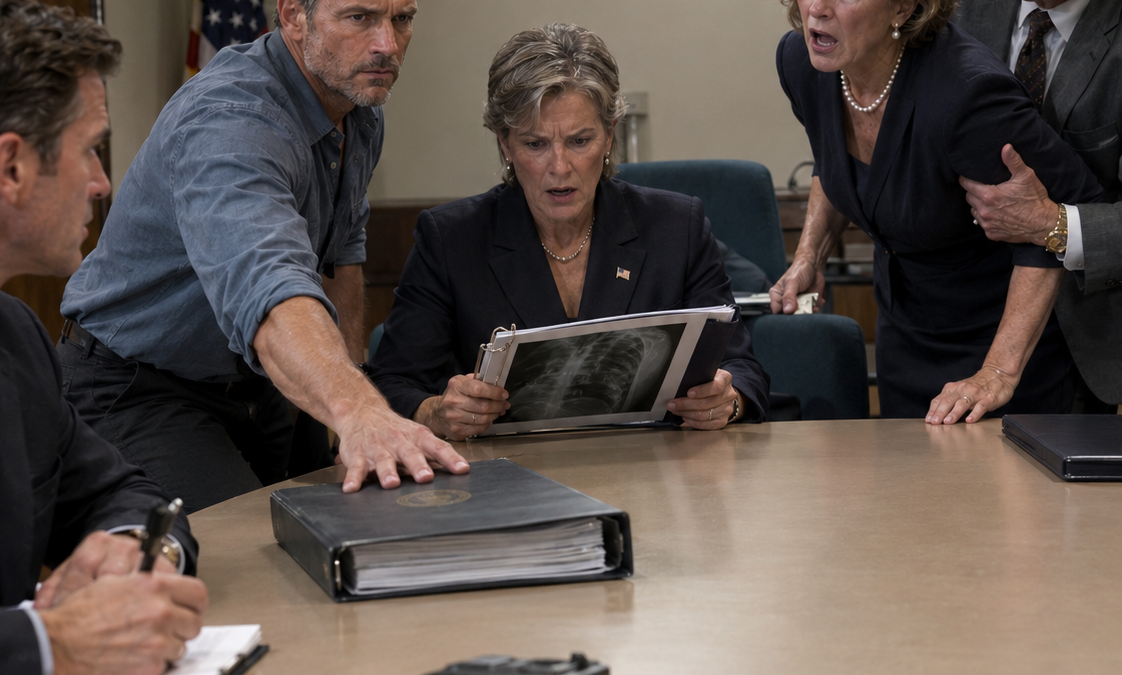
I opened my binder.
“I’d like to submit my complete medical records for the record. These include my original evaluation from Walter Reed Army Medical Center, signed by three separate surgeons. My imaging records, including X-rays, MRIs, and CT scans. My surgical reports. My physical therapy records. My service record, including all evaluations and commendations.”
I slid the binder across the table.
“Everything in this binder is official. Verified. Unalterable.”
Colonel Foster took the binder. Opened it. Began to page through it.
“The first section,” I said, “is my spinal imaging. You’ll see the disc degeneration at L4 and L5. The herniation. The nerve compression. The scar tissue from the surgery.”
I paused.
“That injury occurred during a mission in Afghanistan. I was carrying a wounded teammate when a mortar round hit. I fell. I landed badly. The teammate survived. I’ve been in pain ever since.”
Colonel Foster was looking at the images. Her face was unreadable.
“The second section is my knee. Full reconstruction after a parachute malfunction. Three surgeries. A metal joint that will need to be replaced again eventually.”
I paused.
“The third section is my hand. Nerve damage from a shrapnel wound. I can’t grip things the way I used to. Can’t hold a rifle steady. That’s why I was medically retired.”
My mother was staring at the binder. At the images. At the evidence of everything she had refused to see.
“The couch,” I said. “The one I helped move last summer. My father asked me to help. I told him I shouldn’t. He insisted. I moved it. Then I spent three days in bed because I couldn’t stand up.”
My father’s jaw tightened.
“I didn’t tell them that,” I said. “I never told them that. Because I didn’t want them to worry. Because I didn’t want them to think I was weak.”
Colonel Foster looked up.
“Mr. Mercer, these records are extensive. They clearly document significant injuries and ongoing medical issues.”
“Yes, ma’am.”
“And your parents’ claim that you’re exaggerating?”
“I can’t speak to what they believe. I can only tell you what the records show.”
The attorney leaned forward.
“Mr. Mercer, do you have any explanation for why your parents would file such a report?”
I looked at my mother. At my father. At the people who had raised me, who were supposed to love me, who were now sitting across from me trying to take away everything I had earned.
“I do,” I said. “But I’m not sure they want me to share it.”
The room was silent.
Colonel Foster looked at my parents.
“Mr. and Mrs. Mercer, do you have anything to say?”
My mother started to speak. My father put his hand on her arm.
“We stand by our statement,” he said.
“Even in light of these records?”
“Records can be misleading. Doctors make mistakes. Daniel has always been… dramatic.”
Colonel Foster’s expression didn’t change. But something in her eyes hardened.
“Mr. Mercer, you said you had an explanation. I’d like to hear it.”
I took a breath.
“When I came home from the Army, my parents were happy. Not because I was home. Because I was… available. My father started asking me to help with things. Small things at first. Then bigger. I didn’t realize until later that he was keeping me close. Watching me.”
“Watching you?”
“Making sure I didn’t stray. Making sure I stayed… useful.”
My father shifted in his seat.
“About six months ago, my parents filed a report with my insurance company. They claimed I was faking my injuries. They claimed I told them I was ‘playing up’ my symptoms to keep the checks coming.”
“That report was dismissed,” I said. “There was no evidence to support it. But the investigation drew attention to my file. And now I’m here.”
“And what do you believe their motive was?”
I looked at my father.
“I believe they needed money. I believe my brother’s business is failing. I believe they’ve been supporting him for years, and they’ve run out of resources.”
“That’s a lie,” my father said.
“I believe they saw my disability payments as a way to recoup their losses. I believe they thought if I was discredited — if I lost my benefits — they would inherit my VA life insurance policy. I believe they were willing to sacrifice me to save themselves.”
“You don’t know what you’re talking about,” my father said. His voice was rising now. Losing its control.
“I know the emails,” I said. “I know the beneficiary inquiry that came from your email address. I know the connection between you and Harold Pines. I know everything.”
My mother started crying.
Not the real kind. The performative kind. The kind she had used my whole life to get what she wanted.
“Daniel, how could you say these things? We’re your parents. We love you.”
I looked at her.
“You told an insurance investigator that I was a liar and a fraud. You tried to take away the only thing I have left. You did it for money. And now you’re crying because I told the truth.”
“I never —”
“Stop.”
The word came out harder than I intended. Sharper.
“I spent twelve years in the Army. I did things you will never know about. I lost friends. I lost pieces of myself. I came home broken, and I have spent every day since trying to put myself back together.”
My voice was steady. Controlled.
“And the whole time, you were watching. Waiting. Looking for a way to use me.”
My mother’s crying stopped. Her face changed. The mask slipped.
“You always were dramatic,” she said. “Just like your father said.”
Colonel Foster closed the binder.
“I’ve reviewed the records. I’ve heard the testimony. Based on the evidence presented, I find no basis for questioning Mr. Mercer’s disability status. His benefits will continue without interruption.”
She looked at my parents.
“However, I want to note for the record that filing a false report with an insurance company is a serious matter. If Mr. Mercer chooses to pursue legal action, that’s his right.”
She stood.
“This hearing is adjourned.”
I gathered my binder. Stood. Walked toward the door.
My father’s voice stopped me.
“You think you’ve won?”
I turned.
“This isn’t about winning. It’s about the truth.”
“The truth doesn’t matter. What matters is power. And you don’t have any.”
I looked at him. At the man who had raised me, who had taught me to tie my shoes and change a tire, who had spent my whole life making me feel like I was never enough.
“I have something better than power,” I said. “I have a record. I have evidence. I have people who know who I really am.”
I paused.
“You have nothing. You’ve spent your whole life chasing money and status, and you have nothing to show for it. Your business is failing. Your golden son is a fraud. Your wife is a liar. And your only real son — the one you threw away — is the only person in this family who ever earned anything.”
I walked out.
I didn’t go home right away.
I drove to the cemetery. To Sarah’s grave.
The sun was setting. The sky was orange and pink. The kind of sunset she used to love.
I sat on the grass beside her headstone. Ran my hand over the letters of her name.
“I did it,” I said. “I fought back.”
The wind blew. The trees rustled.
“I wish you could have been there. I wish you could have seen their faces.”
I closed my eyes.
“I miss you.”
The letter came a week later.
Official. Stamped. From the Department of Veterans Affairs.
I opened it at my kitchen table. Black coffee going cold beside me. The morning light coming through the window over the sink.
The letter said my disability status had been confirmed. My benefits would continue. My record was clear.
It also said my case had been flagged for review by a special committee. A committee that investigated fraud and abuse in disability claims.
They had reviewed my parents’ report. They had reviewed the connection between my father and Harold Pines. They had reviewed everything.
The committee had recommended that my parents’ report be forwarded to the state attorney general’s office for investigation.
Filing a false insurance claim was a felony in Ohio.
I sat at the table for a long time after that.
The coffee went cold. The light shifted.
I thought about my parents. About what would happen to them. About the consequences they would face.
I thought about whether I should feel guilty. Whether I should call them. Whether I should try to stop it.
I didn’t.
Some things can’t be undone. Some choices have consequences. Some people earn exactly what they get.
Marcus called that afternoon.
“Heard the news,” he said. “Congratulations.”
“It’s not over yet.”
“It’s over for you. Your record is clear. Your benefits are safe. That’s what matters.”
I was quiet for a moment.
“What about my parents?”
“What about them?”
“Are they going to be charged?”
“Probably. The evidence is pretty clear. False report. Insurance fraud. Conspiracy.”
“They’re my parents.”
“They tried to destroy you, Dan. They tried to take everything you had. They did it for money. They did it without a second thought.”
I knew he was right. I knew it.
But it still hurt.
The charges came three weeks later.
Insurance fraud. Filing a false report. Conspiracy to defraud.
My father was arrested at his office. My mother at home. The news made the local paper. “Local Couple Charged in Insurance Scheme.”
Carter called me that night.
“What did you do?”
“I didn’t do anything. They did it to themselves.”
“They’re our parents. You could have stopped this.”
“Could I?”
“You could have told them to drop it. You could have —”
“I did tell them to drop it. They didn’t listen.”
Silence.
“You’re going to let them go to prison?”
“I’m not letting them do anything. They made their choices. Now they have to live with the consequences.”
“This is your fault. You and your… your victim complex. You always thought you were better than us.”
I almost laughed.
“Better than you? Carter, I spent twelve years in the Army. I did things you can’t imagine. I sacrificed things you’ll never understand. And when I came home, all I wanted was to be left alone. To live my life. To be with my wife.”
“She’s dead.”
The words landed like a punch.
“Don’t.”
“She’s dead, and you’re alone, and you’re taking it out on us.”
I hung up.
The trial was set for the spring.
I didn’t attend. I didn’t need to. The evidence was clear. The prosecution didn’t need me.
But I followed it. Every hearing. Every update.
My father got three years. My mother got two. Reduced sentences for cooperation and remorse.
Carter stopped speaking to me. The rest of the family followed. I was the one who had betrayed them. The one who had destroyed the family.
I didn’t care.
I sold the house that summer.
There were too many memories in it. Too many ghosts.
I moved to a small town in the mountains. North Carolina. Not far from where I had trained, all those years ago.
I bought a cabin on a few acres. A porch. A garden. A dog.
I started hiking. Started fishing. Started living.
The nightmares didn’t stop. They never do. But they came less often.
The pain didn’t stop either. It never would. But I learned to live with it.
Sarah’s parents came to visit that fall.
They were good people. The kind of people who had accepted me from the first day, who had never once made me feel like I wasn’t enough.
They brought pictures. Letters. Things Sarah had left behind.
We sat on the porch and talked. About her. About the life we had shared. About everything I had lost.
Her father asked me if I was doing okay.
“I’m doing better,” I said. “I’m learning to be alone.”
“Being alone isn’t the same as being lonely,” he said.
“No. It isn’t.”
I go to the VA in Asheville now.
It’s smaller than the one in Columbus. Quieter. The people there know me. Know my name. Know my history.
There’s a group that meets on Thursdays. Veterans. Mostly older. Mostly men. We sit in a circle and talk.
I don’t talk much. But I listen.
I listen to their stories. Their pain. Their loss. Their survival.
I think about how many of them have families like mine. Families who don’t understand. Families who don’t care. Families who see them as burdens instead of heroes.
I think about how many of them are fighting the same battles I fought.
The letter came on a Tuesday.
Not the same kind of letter. Not an investigation. Not a threat.
An invitation.
The Special Forces Association was hosting a reunion. A gathering of veterans from my era. People I had served with. People I had lost touch with.
I hadn’t seen most of them in years. Hadn’t wanted to. The memories were too hard.
But something made me say yes.
I drove to the reunion in September.
It was at a hotel outside Fayetteville. Close to Fort Bragg. Close to where I had spent the best years of my life.
I walked into the lobby and stopped.
There were men there I had known for decades. Men I had bled with. Men I had fought beside.
They looked older. Grayer. Some were in wheelchairs. Some had canes. Some had the same look in their eyes that I knew was in mine.
But they were there.
And when they saw me, they smiled.
“Dan Mercer,” someone said. “I’ll be damned.”
It was Marcus. He crossed the lobby and wrapped me in a hug.
“Good to see you, brother.”
“You too.”
The reunion lasted three days.
We talked. We drank. We remembered. We laughed. We cried.
We told stories about the old days. The missions. The close calls. The men we had lost.
We talked about what had happened since. The jobs. The families. The struggles.
I told them about Sarah. About the cancer. About losing her.
I told them about my parents. About the report. About the trial.
They listened. They didn’t judge. They didn’t offer empty sympathy.
They just… understood.
On the last night, we gathered in the hotel bar.
Someone raised a glass. To fallen brothers. To the ones who didn’t make it home.
We drank.
Someone else raised a glass. To the ones who made it home but lost something along the way.
We drank again.
Then Marcus stood up.
“One more,” he said. “To Dan Mercer. The toughest son of a bitch I ever served with.”
The room went quiet.
“He got knocked down. He got kicked. He got betrayed by the people who were supposed to love him. And he’s still standing. Still fighting. Still here.”
He raised his glass.
“To Dan.”
“To Dan,” the room echoed.
I sat there. In that dim hotel bar. Surrounded by men who knew me better than my own family ever had.
And for the first time in years, I felt like I was home.
I went back to the cabin after the reunion.
The dog was happy to see me. The garden needed watering. The mail had piled up.
One of the letters was from the VA. I opened it at my kitchen table. Black coffee going cold beside me.
It was a thank-you note. From a woman I had never met. The widow of a soldier I had served with. She had heard about me from someone at the reunion. She wanted me to know that her husband had talked about me. That I had saved his life. That he had never forgotten.
She said she had been going through his things and found a letter he had written. A letter he had never sent.
In the letter, he told her about a mission. About a night when everything went wrong. About a man who had carried him through the darkness when he couldn’t walk anymore.
That man was me.
I read the letter three times.
Then I folded it carefully and put it in the drawer with Sarah’s things.
The sun was setting.
I walked out to the porch. Sat in the old chair. Watched the light fade over the mountains.
The dog lay at my feet. The crickets started singing. The first stars appeared.
I thought about my parents. About the choices they had made. About the consequences they were living with.
I didn’t feel angry anymore. I didn’t feel sad.
I just felt… quiet.
Some people spend their whole lives trying to prove they’re worth something. They chase money. Status. Power. They step on whoever they have to step on to get ahead.
They never figure out that none of it matters.
What matters is what you do when no one is watching. What matters is who you are when everything is stripped away.
What matters is the truth.
My parents had tried to take everything from me. My money. My reputation. My future.
They had failed.
Because the truth was on my side. The record was on my side. The evidence was on my side.
And now everyone knew it.
 [Tap here for the Next Part ]


