“I thought you were just trying to seem interesting.”
“The ocean doesn’t care how much money you have.” That’s what I told my boyfriend’s mother, Diana Vandermeer, the first time she asked about my job. She laughed. Not a mean laugh, not yet. A polite one, the kind you give a child who says they want to be an astronaut.
They thought she was a nice girl from Vermont with a made-up story → She turned out to be the only person standing between them and disaster — twice.
That’s what I told my boyfriend’s mother, Diana Vandermeer, the first time she asked about my job. She laughed. Not a mean laugh, not yet. A polite one, the kind you give a child who says they want to be an astronaut.
“How charming,” she said, and turned to pour herself another glass of Chardonnay.
That was two years ago. I should have known then.
What Diana Vandermeer didn’t know — what none of them knew — was that I had pulled eleven people out of the water in my career. Some alive. Some not. I had done it in conditions that would make her lake house look like a bathtub. I had done it with broken ribs and a fractured wrist and hypothermia so deep I couldn’t feel my own fingers. I had done it because that was the job. That was always the job.
My name is Casey Mercer. I was thirty-four years old when I met the Vandermeers. Former Air Force Pararescueman. PJ. The ones who jump out of perfectly good aircraft into bad situations to pull people out of worse ones.
They thought I was a liar.
No. That’s not quite right. They thought I was exaggerating. They thought “para- what?” was a cute story I told to seem interesting. They thought I was a nice girl from a modest background who had maybe done something vaguely military-adjacent and was now dressing it up for effect.
They never asked. Not once. Not a single follow-up question. Not a “where were you stationed?” or “what was that like?” or “did you see anything bad over there?”
Just that polite laugh. And then they moved on.
I let them.
That was my mistake. I let them because I loved their son, and because I had spent twelve years learning that the loudest person in the room is rarely the most dangerous. I had learned to be quiet. I had learned to watch. I had learned that the people who matter don’t need you to prove anything.
But there’s a difference between being quiet and being erased. It took me a long time to understand that. And by the time I did, it was almost too late.
The lake house was in the Adirondacks. Diana’s father had bought it in the seventies, back when you could buy lakefront property for the price of a used car. Now it was worth more than most people’s retirement accounts, and Diana never let anyone forget it.
“It’s not much,” she said every year, standing on the wraparound deck, looking out at the water. “But it’s ours.”
It was a lie. It was a lot. It was ten bedrooms and a private dock and a boathouse with a Chris-Craft that hadn’t been in the water in fifteen years. It was the kind of place that made you feel small and lucky at the same time.
I had been coming here for three summers. Three summers of watching Diana’s eyes slide past me at dinner. Three summers of her son, Nathan, squeezing my hand under the table and whispering, “She’ll come around.”
She never came around.
Nathan was the youngest of three. His older brother, Preston, was a real estate developer in Connecticut. His older sister, Margot, was a corporate attorney in Manhattan. Both were married. Both had children. Both had done exactly what Diana expected them to do — married well, reproduced strategically, and never embarrassed the family.
Nathan was different. Nathan was a high school history teacher. Nathan drove a twelve-year-old Subaru. Nathan had met me at a rock-climbing gym in Burlington, Vermont, where I was teaching a weekend safety course, and he had fallen in love with me before he even knew my name.
“What do you do?” he had asked, breathless, halfway up a wall.
“Search and rescue,” I said. “Mostly.”
That was true. It was just not the whole truth.
The whole truth was that I had spent twelve years in the United States Air Force as a Pararescueman, attached to units that don’t get named in press releases. I had deployed to places I can’t tell you about. I had jumped into water at night, in storms, in conditions that would make most people freeze. I had held a dying man’s hand in a life raft and told him he was going to be okay. I had lied to him. I had lied to a lot of people. It was part of the job.
I had been awarded the Air Force Cross. I had been awarded the Purple Heart twice. I had a shadow box in my closet with medals I never wore and citations I never read. I had a scar on my left forearm from a rotor blade and a scar on my right thigh from a piece of shrapnel that I had pulled out of my own leg with a pair of pliers.
None of that mattered at the Vandermeer dinner table.
At the Vandermeer dinner table, what mattered was that I hadn’t gone to an Ivy League school. That I didn’t have a trust fund. That I had spent my twenties in places Diana couldn’t pronounce and didn’t want to think about.
“She’s sweet,” I overheard Diana say once, through the bathroom door, to Margot. “But honestly. The military thing? It’s a little… much.”
“She’s probably just trying to seem interesting,” Margot said.
“She doesn’t need to try so hard,” Diana said. “Nathan’s already smitten.”
I stood in that bathroom for a long time. I looked at myself in the mirror. Same face. Same scar. Same calm eyes that had seen things Diana Vandermeer would never understand.
I didn’t cry. I had learned not to cry a long time ago. I had learned to swallow it and move on and do the job.
But something shifted that night. Something small and permanent, like a hairline fracture in a bone.
I didn’t tell Nathan. I never told Nathan. He loved his mother. He loved his family. He wanted so badly for all of us to get along that I couldn’t bear to be the one who broke it.
So I smiled. I helped with the dishes. I played with Preston’s kids. I sat through another dinner of Diana talking about her charity gala and Margot talking about her latest case and Preston talking about his new development in Greenwich.
And I waited.
I didn’t know what I was waiting for. But I knew something was coming.
The first summer, I tried to tell them.
We were sitting on the dock, watching the sun go down. Diana was in her usual spot, the Adirondack chair with the faded cushion that no one else was allowed to sit in. Preston was grilling. Margot was on her phone. Nathan was next to me, his hand on my knee.
“So,” Diana said, in that way she had, “Nathan tells me you were in the Air Force.”
“Yes,” I said.
“What did you do?”
“I was a Pararescueman. PJ.”
She blinked. “A what?”
“Pararescue. We’re the ones who go in when other people can’t. We jump out of planes, we dive, we climb. We get people out.”
“Sounds dangerous,” she said, in the same tone you’d use to describe a roller coaster.
“It was.”
“Did you see any action?”
The question was casual. Almost bored. I could have said yes. I could have told her about the night I spent in the Hindu Kush, holding pressure on a wound while a helicopter took fire above me. I could have told her about the time I swam two miles in the Gulf of Aden with a broken collarbone to reach a sinking vessel. I could have told her about the twelve men and women I had pulled out of places they should never have been.
I didn’t.
“Some,” I said.
She nodded. “How interesting.”
And that was it. That was the whole conversation. She picked up her wine glass and asked Margot about her dress for the gala, and I sat there with my heart in my throat, realizing that I had just been dismissed.
Nathan squeezed my knee. “You okay?” he whispered.
“Yeah,” I said. “Fine.”
I was not fine. But I was used to not being fine. I was used to compartmentalizing. I was used to putting things in boxes and closing the lids and moving on.
That’s what PJs do. We put things in boxes. We put the fear in a box. We put the pain in a box. We put the memories in a box and we seal it tight and we never open it again.
But sometimes the box opens itself. Sometimes it doesn’t give you a choice.
The second summer, I stopped trying.
It wasn’t a decision I made consciously. It was just what happened. I stopped volunteering information about my past. I stopped correcting people when they got the details wrong. I let Margot call me “Nathan’s girlfriend, the one who does something with boats” and I didn’t say a word.
I didn’t correct Preston when he told his kids I was “in the Navy or something.”
I didn’t correct Diana when she introduced me to her friends as “Nathan’s friend from Vermont.”
I just smiled. I helped with the dishes. I played with the kids. I sat on the dock and watched the sun go down and pretended I was someone else.
Someone who hadn’t seen a man die in front of her. Someone who hadn’t held a child in her arms while waiting for a helicopter that might not come. Someone who hadn’t spent years of her life in places that would make Diana Vandermeer’s charity galas look like what they were — pretty distractions for pretty people.
But here’s the thing about pretending. It works. It works so well that after a while, you start to forget who you really are.
I started to believe the lie.
I started to believe I was just Nathan’s girlfriend. Just a nice girl from Vermont who taught rock climbing and did a little search and rescue on the side. Just someone who was lucky to be included in the Vandermeer family vacations.
I stopped thinking of myself as a PJ. I stopped thinking of myself as someone who had earned the right to respect. I stopped thinking of myself as someone who could handle anything.
I forgot.
That was my mistake. I forgot what I was capable of. I forgot what I had done. I forgot that the calm I carried wasn’t just a personality trait — it was a hard-won skill. It was something I had built, piece by piece, in the worst conditions imaginable.
I forgot that I was dangerous.
Not in the way that Diana would understand. Not in the way that Margot would recognize. But in the way that mattered. In the way that meant when everything went to hell, I was the one who would know what to do.
I forgot.
But the body never forgets. The training never forgets. And when the moment came — when the water rose and the screams started and everyone turned to each other with terror in their eyes — the body remembered.
The body always remembers.
The third summer, Diana made the joke.
We had just arrived. Nathan and I had driven up from Burlington, six hours in his old Subaru, and I was tired. My back was hurting, the way it always hurt after long drives — an old injury, a parachute landing that hadn’t gone right in a country I couldn’t name. I was carrying our bags up the stairs to the porch when Diana stepped out of the screen door.
“Casey!” she said, with that smile that never quite reached her eyes. “So good to see you.”
“You too, Diana.”
She looked at my bags. “You travel light.”
“Habit.”
She laughed. “Of course. Military habit. How charming.”
I set the bags down. “Something like that.”
She followed me into the house. The others were already there — Preston and his wife, Karen, their two kids, Margot and her husband, David, their little girl. The house smelled like pine and lemon cleaner and something baking in the kitchen.
“Everyone’s out on the deck,” Diana said. “We’re having a little welcome dinner.”
“Sounds nice.”
I followed her through the house, past the photos on the wall — generations of Vandermeers, all of them smiling, all of them looking like they had never known a day of hardship in their lives. There was a photo of Diana as a young woman, standing in front of a sailboat, her hair blowing in the wind. There was a photo of her father, the one who had bought the house, in a suit that probably cost more than my first car.
We stepped out onto the deck. The lake was flat and blue, stretching out to the mountains. The sun was warm on my face. For a moment, I let myself relax.
That was when Diana said it.
“So, Casey,” she said, loud enough for everyone to hear. “I was telling some friends about you the other day. They didn’t believe me when I said you were in the military.”
I felt Nathan tense beside me. He knew this tone. We both did.
“What did you tell them?” I asked.
“I said you were in the Air Force. Some kind of rescue thing.” She smiled. “They thought I was making it up. They said, ‘Diana, that sounds like a movie.'”
I said nothing.
“I mean, honestly,” Diana continued, “it does sound a little… dramatic. ‘Pararescue.’ Like something out of a Tom Cruise movie.”
The table went quiet. Even the kids stopped talking. Preston looked at his plate. Margot looked at her wine.
Nathan opened his mouth. I put my hand on his knee.
“It’s a real job,” I said, quietly. “It’s just not a very well-known one.”
“Oh, I’m sure it is,” Diana said. “I’m sure you did something very important. It’s just hard to imagine you — little Casey from Vermont — jumping out of planes and rescuing people.”
She laughed again. That same polite laugh from two years ago. The one that said, You’re not really one of us, and you never will be.
The one that said, I don’t believe you.
I looked at her. I looked at all of them — Preston, with his uncomfortable smile; Margot, with her cool, appraising eyes; Karen and David, who barely knew me; the kids, who were just waiting for the tension to pass.
And I made a decision.
I decided to let it go.
Not because I was weak. Not because I was afraid. But because I had spent twelve years learning that some battles aren’t worth fighting. That some people will never understand. That some truths are wasted on those who don’t want to hear them.
I let it go.
I smiled. I picked up my fork. I asked Margot about her daughter’s ballet recital.
And I told myself it didn’t matter.
It mattered.
That night, I couldn’t sleep.
I lay in bed next to Nathan, listening to the loons call across the lake. The window was open, and the air was cool and smelled like pine. It was beautiful. It was peaceful.
I hated it.
I hated the way Diana’s laugh echoed in my head. I hated the way she had looked at me — not with malice, but with something worse: with pity. With the kind of pity you reserve for someone who is trying too hard to be something they’re not.
I hated that I had let her do it. I hated that I had smiled and nodded and changed the subject. I hated that I had spent three summers pretending to be smaller than I was just so I could fit into a family that had never wanted me.
Nathan stirred beside me. “You awake?” he mumbled.
“Yeah.”
He rolled over, his eyes half-closed. “What’s wrong?”
“Nothing.”
“You’re lying.”
I didn’t answer.
He sighed. “I’m sorry about my mom. She’s… she’s not good with people.”
“She’s good with people,” I said. “She’s just not good with me.”
He was quiet for a moment. Then he reached out and took my hand.
“I know what you did,” he said. “I know who you are. That’s what matters.”
I looked at him. His face was soft in the moonlight. He was a good man. He was kind and gentle and he loved me in a way that I had never expected to be loved.
But he didn’t understand.
He didn’t understand what it felt like to be erased. To be told, over and over, without words, that your life’s work was a joke. To be looked at with that polite pity and that polite laugh and that polite disbelief.
He didn’t understand that I had spent my entire adult life fighting for people who would never know my name — and now the people I loved most couldn’t even be bothered to remember my job.
“It’s fine,” I said. “It’s late. Go back to sleep.”
He kissed my hand. “I love you.”
“I love you too.”
He turned over. Within minutes, he was asleep.
I lay there for a long time, staring at the ceiling. The loons called. The wind moved through the pines. The lake lapped against the dock.
And somewhere deep inside me, something that had been dormant for years began to stir.
The next morning, Diana announced the hike.
“There’s a trail up to the ridge,” she said, over breakfast. “It’s beautiful this time of year. We should all go.”
Preston groaned. “Mom, it’s supposed to rain.”
“Not until later. We’ll be back by lunch.”
“I don’t know,” Karen said, looking at her phone. “The weather app says—”
“The weather app is always wrong,” Diana said. “It’s a beautiful day. We’re going.”
I looked out the window. The sky was gray, low clouds hanging over the mountains. The lake was choppy, whitecaps forming on the surface. A storm was coming. I could feel it in the air, that pressure change that always meant something was about to break.
“Maybe we should skip it,” I said. “The trail can get dangerous when it’s wet.”
Diana looked at me. “Dangerous?”
“Flash floods. Rockslides. It’s not a good idea if there’s rain coming.”
She smiled. That smile. “Casey, I’ve been hiking that trail since I was a girl. I think I know it a little better than you do.”
I said nothing.
Nathan squeezed my hand under the table. “Maybe we can do something else,” he said. “Go into town, or—”
“Nonsense,” Diana said. “We’re going. Everyone, get your shoes on.”
The kids cheered. Preston shrugged. Margot rolled her eyes but stood up.
I looked at the sky again. The clouds were darker now. The wind was picking up. Somewhere in the distance, I heard a rumble.
“Casey?” Nathan said, quietly. “You okay?”
“Yeah,” I said. “I’m fine.”
I wasn’t fine. But I had learned a long time ago that being fine wasn’t the point.
The point was being ready.
We left at ten. Twelve of us, including the kids. Diana led the way, her hiking poles clicking against the rocks. Preston and Karen followed, their kids running ahead. Margot and David brought up the rear, their daughter on David’s shoulders. Nathan and I walked in the middle.
I didn’t like it.
The trail was narrow, carved into the side of a steep ridge. Below us, a creek rushed through a gorge, swollen from the recent rain. Above us, the clouds were thickening, dark and heavy. The wind was cold.
I kept my eyes on the sky. I kept my ears open. I counted the minutes since the last rumble of thunder.
Twenty minutes. Then fifteen. Then ten.
“Nathan,” I said, quietly. “We need to turn around.”
He looked at me. “What?”
“The storm. It’s coming fast. We need to get off this trail.”
He looked up at the sky. “It doesn’t look that bad.”
“It’s going to be bad. Trust me.”
He hesitated. Then he nodded. “Okay. Let me tell my mom.”
He walked ahead. I watched him approach Diana, saw him gesture at the sky, saw her shake her head.
“He says we should turn back,” Nathan said, returning.
“What did she say?”
“She said we’re almost at the top. She said we can wait out the storm in the shelter up there.”
I looked up the trail. The shelter was another half-mile. In good conditions, it would take twenty minutes. In a storm, it would take longer. And the trail was already slick.
“We don’t have twenty minutes,” I said.
“Casey—”
“Nathan, listen to me. I’ve seen this before. The creek is going to rise. The trail is going to wash out. We need to go back. Now.”
He looked at me. For a moment, I saw something in his eyes — a flicker of doubt. Not doubt in me. Doubt in his mother. Doubt in the family that had never quite accepted either of us.
“Okay,” he said. “Let’s go.”
He turned to walk back. I turned to follow.
That was when the rain started.
It came down like a wall.
One second, the sky was gray. The next, it was black, and the rain was falling so hard I couldn’t see ten feet in front of me. The trail turned to mud. The creek below us roared.
“Everyone stay together!” I shouted. “We need to get back to the house!”
I could hear the kids crying. I could hear Karen screaming. I could hear Diana shouting something, but I couldn’t make out the words.
I grabbed Nathan’s hand. “Stay with me.”
“I’ve got you.”
We started back down the trail. It was slow going. The mud was slick, and the rocks were loose. Every step felt like it might be the last.
I kept my eyes on the path. I kept my ears open. I counted the people around me.
Twelve. Twelve people. I had to get twelve people off this mountain.
We made it fifty yards. Then a hundred. Then two hundred.
Then the trail disappeared.
One moment, there was a path. The next, there was nothing but a wall of water, rushing down from above, carrying rocks and branches and mud.
“Get back!” I shouted. “Get up the slope!”
I pushed Nathan toward the hillside. I grabbed the nearest kid — Preston’s youngest, a boy named Aiden — and hauled him up onto a ledge. I turned to grab the next one.
That was when I saw Diana.
She was standing at the edge of the trail, frozen. The water was rising around her feet. She was staring at it, her face white, her mouth open.
She wasn’t moving.
“Diana!” I shouted. “Diana, move!”
She didn’t move.
I looked at Nathan. I looked at the kids. I looked at the wall of water rushing toward us.
I had a choice to make. I had a split second to make it.
I made it.
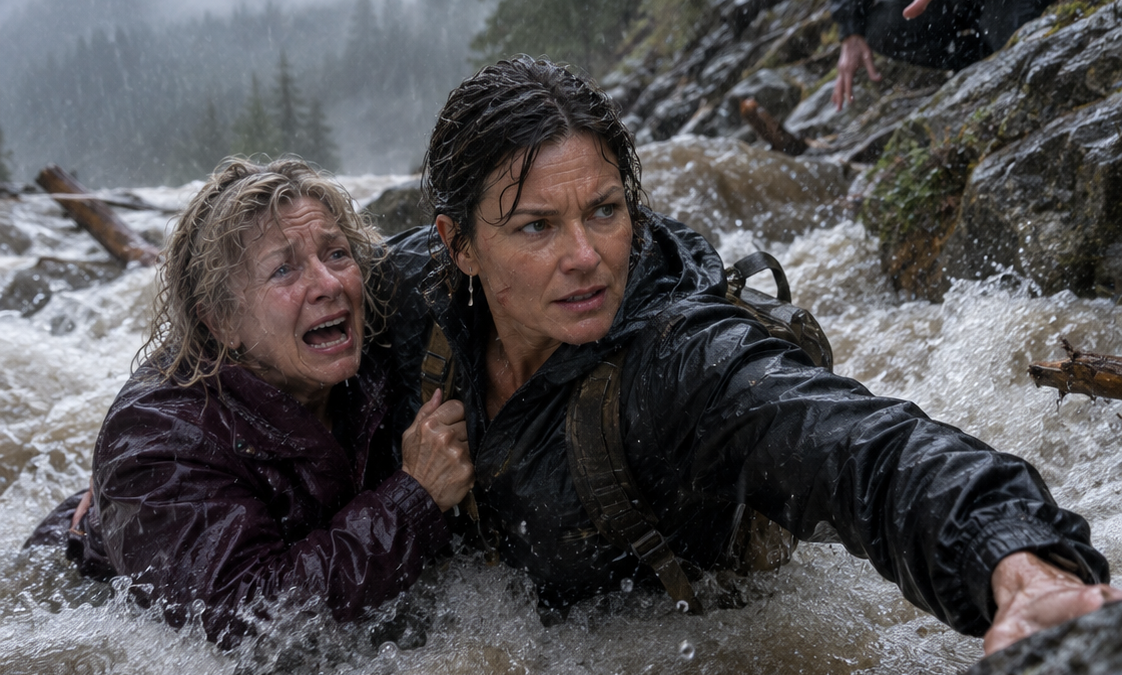
I let go of the ledge. I slid down the slope, my boots skidding on the wet rock. I hit the water and it was cold, so cold it took my breath away. I fought against the current, swimming toward Diana, my arms and legs burning with the effort.
She was still frozen. Still staring. Still not moving.
I reached her just as the water hit.
It hit like a truck. It lifted her off her feet and threw her against a rock. I grabbed her arm and pulled her toward me, wrapping my body around hers, trying to shield her from the worst of it.
The current dragged us downstream. I could feel rocks scraping against my back. I could feel branches tearing at my clothes. I could feel the cold seeping into my bones.
I didn’t let go.
I never let go.
That was the job. That was always the job.
I kicked. I clawed. I fought. I found a rock and I held on to it with one hand while I held Diana with the other. The water rushed past us, trying to tear us away.
“Hold on!” I shouted. “Hold on to me!”
She grabbed my jacket. Her fingers were white. Her eyes were wide.
“Casey—” she gasped.
“I’ve got you. I’ve got you.”
I looked up the slope. Nathan was there, his face pale, his eyes terrified. He was holding Aiden. He was shouting something.
I couldn’t hear him. The water was too loud.
But I could see what he was doing. He was pointing. He was trying to tell me something.
I looked where he was pointing.
There was a ledge. A shelf of rock, just above the water line, maybe twenty feet away. If I could get us there, we would be safe.
I took a breath. I tightened my grip on Diana.
“On three,” I said. “We’re going to swim to that ledge. You understand?”
She nodded. Her teeth were chattering.
“One. Two. Three.”
I pushed off the rock. I swam. I dragged her with me. The current fought me, but I was stronger. I had always been stronger.
We reached the ledge. I shoved her up onto it, then pulled myself up beside her. We lay there, gasping, shivering, alive.
Above us, the storm raged on.
It took two hours for the rain to stop.
Two hours of huddling on that ledge, Diana and me, while the water rushed past below us. Two hours of shouting up to Nathan, telling him to stay put, telling him we were okay. Two hours of watching the creek slowly recede, revealing the damage it had done.
The trail was gone. Washed out in three places. The shelter at the top was unreachable. The only way back to the house was to wait for the water to drop enough to cross the creek.
So we waited.
Diana didn’t speak for the first hour. She just sat there, her arms wrapped around her knees, her eyes fixed on the water. I watched her. I watched the way her hands shook. I watched the way her breath came in short, shallow gasps.
I knew what she was feeling. I had felt it myself, a hundred times. The shock. The disbelief. The slow realization that you had almost died.
It would pass. It always passed.
But it would leave a mark.
“You saved my life,” she said, finally.
I looked at her. “Yes.”
She was quiet for a moment. Then she laughed. A different laugh. A small, broken one.
“I didn’t believe you,” she said. “I thought you were making it up. The whole thing. The rescue stuff. I thought you were just trying to seem interesting.”
I said nothing.
“I’m sorry.”
I looked out at the water. The rain had stopped, but the sky was still gray. The mountains were shrouded in mist. Somewhere above us, I could hear Nathan’s voice, calling down to us.
“It’s okay,” I said.
“It’s not okay. I treated you like — like you didn’t matter. Like your whole life was a joke.”
“It’s okay,” I said again. “You didn’t know.”
She looked at me. Her eyes were red. Her face was streaked with tears and mud.
“I know now,” she said.
I nodded. “Yeah. You do.”
We sat there in silence. The water rushed past. The mist swirled around us. And somewhere, deep inside me, that hairline fracture began to heal.
Not completely. Not yet. But a little.
Enough.
That was two hours ago.
Now, I’m sitting on the deck of the lake house, wrapped in a blanket, watching the sun set over the mountains. The storm has passed. The lake is calm. The loons are calling.
Nathan is inside, making tea. Diana is in the kitchen, on the phone with Preston, who made it back to the house with the others before the trail washed out. Everyone is safe. Everyone is alive.
Because of me.
I can hear them talking inside. I can hear Diana’s voice, low and serious. I can hear Nathan’s voice, answering.
I don’t know what they’re saying. I don’t need to know.
I know what I did. I know who I am.
And now, so do they.
I take a sip of tea. I look out at the water. The sun is sinking behind the mountains, painting the sky in shades of orange and pink.
It’s beautiful. It’s peaceful.
It’s the kind of moment that makes you forget, just for a second, that anything bad ever happened.
But I don’t forget. I never forget.
That’s the job. That was always the job.
 [Tap here for the Next Part ]


