Single Dad Ex-SEAL Was Leaving Forever—Then a Billionaire Arrived and Revealed Her Daughter’s Secret (Part 1)
Single Dad Ex-SEAL Was Leaving Forever—Then a Billionaire Arrived and Revealed Her Daughter’s Secret (Part 1)
PART 1
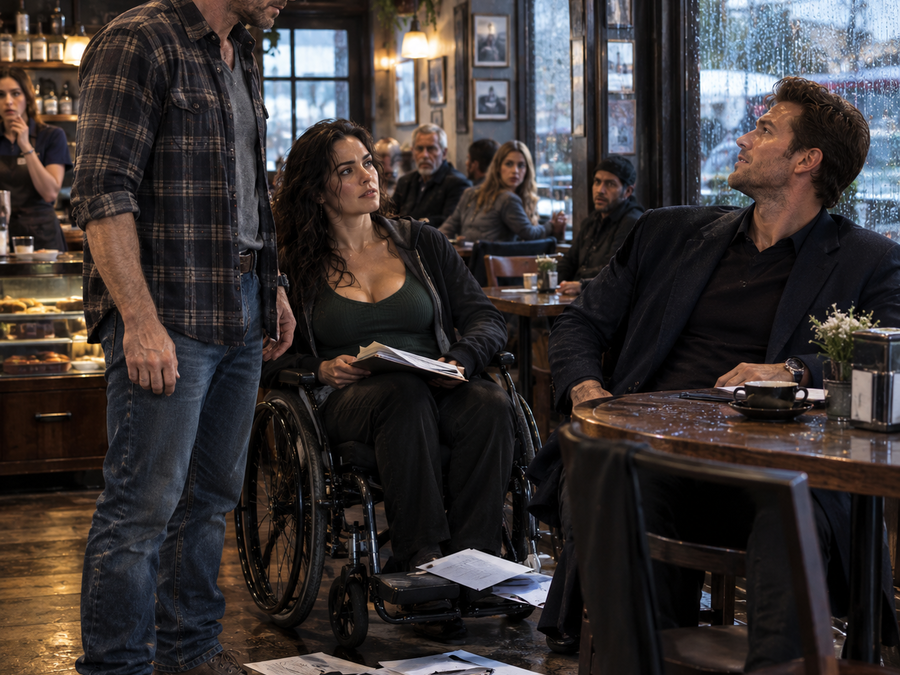
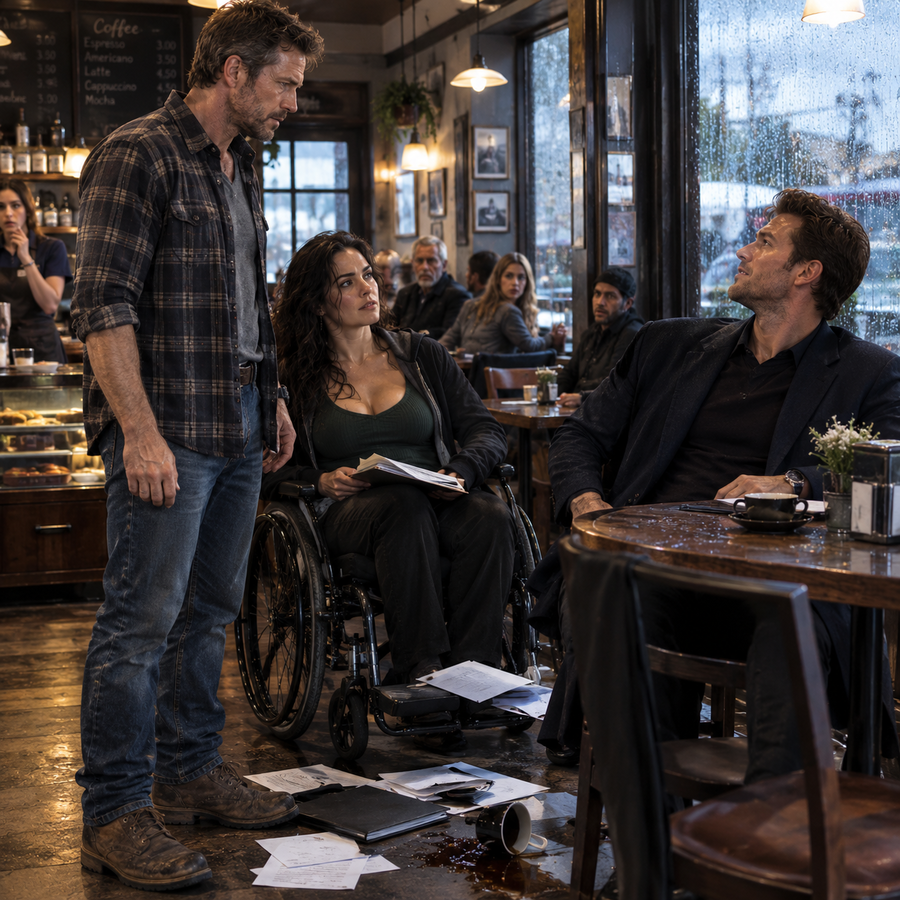
He didn’t raise his voice. He didn’t reach for a weapon. He just stood up slowly, deliberately, and the three men who had just shoved a woman in a wheelchair across a cafe floor suddenly forgot how to breathe. At one second, the room was full of laughter. The next, it was a grave. Nobody in Clearwater Ridge knew who Ryan Cole really was.
They thought he fixed boats. They thought he was just a quiet dad raising his son alone. They were wrong. And the man smiling across that cafe, the one who had just knocked Clare Bennett’s wheelchair into a wall, was about to find out exactly how wrong they all were.
Not the soft kind of rain that makes people feel reflective and peaceful. The hard kind. The kind that hammers against windows and turns parking lots into shallow lakes and makes everybody just a little bit meaner than they’d normally be. It was the kind of morning where people kept their heads down and their patience short.
Clare Bennett had learned over the years to pay attention to mornings like this one. She had learned to read rooms the way some people read weather. She could feel tension before it had a name. She could sense when a space was about to turn on her, not because she was paranoid, but because it had happened enough times that her body had started keeping score.
She pulled her wheelchair up to the only table in Delmare’s cafe that had enough room on both sides for her to sit comfortably. The table near the window in the back left corner. She had been coming to Delmare’s for two years. She always sat at that table. The staff knew it. Most of the regulars knew it. It was just an unspoken thing, the kind of small accommodation that cost nobody anything and meant everything to her.
She ordered her usual black coffee, eggs over easy, wheat toast. She pulled out the folder she’d been carrying around for three weeks, a thick battered manila envelope stuffed with documents she’d been studying and restudying, trying to find something useful inside them, something that could help her fight back. She didn’t look up when the bell above the front door rang. She should have.
There were three of them. The kind of men who walk into a room like they own it, not because they’re physically imposing, though two of them were broad across the shoulders, but because they’ve spent their whole lives being told that rooms belong to people like them. That the bends for people like them. That discomfort, inconvenience, and other people’s needs are problems that simply don’t apply to people like them.
The one in front was named Derek Hail. He was 31 years old. He wore a jacket that probably cost more than Clare’s monthly disability check. His hair was the kind of effortlessly styled that actually takes 20 minutes and $80 worth of product. He had the loose, easy smile of someone who had never once in his life been told no in a way that actually stuck.
His two companions, a thick-necked man named Garrett, who played semi-professional lacrosse in college and never let anyone forget it, and a quieter one named Price, who wore expensive sneakers and checked his phone constantly, followed just half a step behind, the way men do when they’re with someone who considers himself the main character.
They were looking for a table. There weren’t many options. Delmare’s was small, seven tables total, and five of them were occupied. A retired couple near the door. A young mother with a stroller and a toddler who was methodically destroying a pancake. Two women in scrubs who worked the overnight shift at the hospital. A man in the corner with a cup of coffee and a boat repair manual. And Clare.
Derek Hail spotted her table immediately. He walked straight toward it. “Hey,” he said. He said it the way people say hey when they don’t actually want your attention, they want your space. Short, flat, like he was already bored by the interaction. “We need this table.”
Clare looked up from her folder. She took him in quickly, assessed him the way she’d learned to assess situations. Fast, accurate, without letting anything show on her face. “There’s a table open over there,” she said, nodding toward the two-top near the restroom hallway. Perfectly functional table. A little cramped maybe, but fine.
Derek didn’t look at it. “We need this table,” he said again. “The four-top.” “I’m using this table.” He smiled. It wasn’t a nice smile. It was the kind of smile that was really just a weapon wearing a friendly face. “Come on, you’re one person. We’re three. It makes more sense for us to be here, right?”
“It’s the only accessible table in the restaurant,” Clare said. Her voice was steady. She had practiced being steady. It had taken years. “The others don’t leave enough room for my chair, so I’m going to stay here.”
Derek looked at her wheelchair. He looked at the table. He looked back at her, and something shifted in his face. Not anger exactly, but something uglier than anger. Something like amusement, like he had just been handed a puzzle he found entertaining. “That’s not really my problem,” he said.
“Derek.” This was Garrett behind him, already pulling out his phone to film something. Already positioning himself at the angle that would make whatever happen next look best. “Come on, just know it’s fine,” Derek said, cutting him off, still smiling. “I’m sure she understands, don’t you?” He looked at Clare again. “We’ll just grab a spot.”
And then he reached out and gripped the handle of her wheelchair casually like it was furniture, like she wasn’t a person attached to it. And he shoved it sideways. Not hard enough to tip it over. Hard enough to make her grab the wheels to stop herself from rolling into the corner. Hard enough to scatter her folder. Enough to send papers sliding across the floor. Hard enough that the coffee she’d barely touched went sideways and soaked the sleeve of her jacket.
The entire cafe went silent. Not the way rooms go quiet when something good happens. The way they go quiet when something wrong just occurred. And every single person in the room knows it. And nobody, nobody, has moved yet.
Derek stepped around her and pulled out the chair at the head of the table she’d just been displaced from. He sat down. Garrett slid into the seat across from him. Still filming, smirking now. Price took the third chair, his eyes fixed on his phone like he decided to simply not witness this.
Clare sat very still. Her hands were on her wheels. Her jaw was tight. She was looking at a point in the middle distance, not at Derek, not at the floor, not at anyone, because she was doing what she had learned to do in moments like this. She was breathing. She was calculating. She was deciding what she had the energy to fight and what would cost her too much.
The retired couple near the door looked at their plates. The nurses looked at each other and then at their coffee. The young mother pulled her toddler a little closer. The man in the corner with the boat repair manual and the coffee. He didn’t look away. He watched, but he didn’t move either. Not yet. Nobody moved.
The waitress who came over was a 22-year-old named Becca who had been working at Delmare’s for eight months. She was sweet and overwhelmed, and she had seen what happened. And she stood at the edge of the table with her order pad and her pen, and her expression was the most honest thing in the room, a perfect mixture of helpless and ashamed. “Can I, can I get you gentlemen something to start?”
“Coffee,” Derek said. “And can somebody get this up?” He gestured loosely toward the papers on the floor. Clare’s papers, the folder she’d been carrying for three weeks. Becca looked at the papers. She looked at Clare. She opened her mouth. She closed it. She wrote down coffee on her pad and walked back to the counter.
Clare bent forward in her chair slowly and began gathering the papers herself, one by one. Some of them had been stepped on. She could see the muddy outline of a shoe print across a document she’d spent two hours last week trying to find online. She picked it up anyway. She kept her face down. She kept her breathing even.
“You need some help with that?” Derek called over. His voice theatrical, pitched for an audience. “We could get you a box for your stuff so you can, you know, find another spot.” Garrett laughed.
One of the nurses stood up and then stopped because the man in the corner was already standing. Ryan Cole set his coffee cup down on the table. He did it slowly, deliberately. The way you set something down when you want the sound of it to carry. It carried.
He was not a physically dramatic man in the way that action movies have trained people to expect. He wasn’t enormous. He wasn’t tattooed up to his neck or built like a linebacker. He was lean, the kind of lean that comes from actual use rather than performance. 43 years old, sandy brown hair going gray at the temples, a face that had seen weather and sun and things he’d never told anyone about. He wore a flannel shirt and work boots and he looked exactly like what the town believed him to be. A boat repair man, a single dad, a quiet man living a quiet life.
But the way he stood up, the quality of it, the completeness of it was different from any other standing up that had happened in that cafe that morning. He didn’t push back his chair. He didn’t huff or prepare or announce himself in any way. He was sitting and then he was standing. And it was the most natural and certain movement in the room. Like water reaching its level.
He walked toward Clare’s table. His footsteps were even. He stopped at the edge of the scattered papers. He looked down at them. He crouched, not self-consciously, not making a production of it, and began to pick them up one at a time, the same way Clare had been doing, straightening each page, organizing them without looking at them because they weren’t his to read.
“Thank you,” Clare said quietly. “Yeah,” he said. Just that. No performance in it. He gathered the last of the papers and stood and held them out to her. She took them. He looked at her sleeve, the coffee stain soaking into the fabric. “Are you hurt?” “No,” she said. He nodded once.
Then he turned around and he looked at Derek Hail. Derek had been watching all of this with the particular expression of someone who expects to find things entertaining and has not yet been given reason to revise that expectation. He was still half smiling, still comfortable. He had his arm thrown over the back of the chair like he’d been sitting there for years. “Help you with something?” Derek said.
Ryan didn’t answer right away. He just looked at him. That was the thing nobody in the cafe could quite explain afterward. Not the nurse who talked about it at work the next day. Not Becca who told her roommates that night. Not the retired couple who mentioned it to their daughter over Sunday dinner. It wasn’t anger. That’s what everyone kept saying when they tried to describe it. It wasn’t anger on Ryan Cole’s face. It was something quieter than anger. And somehow that made it worse, more serious, more absolute. Like watching a door close that you suddenly realize leads somewhere you do not want to go.
“You need to apologize to her,” Ryan said. His voice was level, not loud, not theatrical, not designed to impress anyone in the room, just stated, clean, like a fact being entered into a record.
Derek’s smile flickered, a micro expression, barely there, gone almost before it arrived. Then the smile came back, wider, carrying with it all the protective armor of someone who has never once been held to account for anything. “I’m sorry,” Derek said, looking at Clare with theatrical sympathy. “Did I bump your chair? I didn’t mean to.”
“That’s not what happened,” Ryan said. “I think we remember it differently.” “You put your hands on her wheelchair without her permission. You moved it. You caused her to spill her coffee. You knocked her documents on the floor and then sat down at her table without asking.” He paused. “I don’t think we remember it differently. I think you’re hoping I’ll accept a version that lets you keep sitting where you are.”
Garrett stood up. He was a big man and he used his size the way he’d always used it, as punctuation, as a statement before any words were said. “Hey, you want to step back, man?” Ryan looked at Garrett. Just looked at him. Garrett sat back down.
Nobody in the cafe made a sound. The toddler had gone completely still in his mother’s arms, sensing, whatever children sense in these moments, that something old and serious was happening nearby. Derek’s jaw tightened. The smile was gone now. In its place was something harder. The expression of someone who is recalculating, who is running numbers he doesn’t like the results of, who is trying to determine whether this quiet man in the flannel shirt is real.
“You have no idea who you’re talking to,” Derek said. “I know exactly who I’m talking to,” Ryan said. “And that’s the problem.”
It was Becca who broke the spell. Or rather, it was the sound of her coming back with the coffee, the cups rattling on the tray, her footsteps stopping short when she rounded the counter and saw the tableau in front of her. Derek looked at the waitress. He looked at the room. He looked at Ryan.
And in the calculation he ran in that moment, whatever equation he used to determine what this quiet man was willing to do and what he himself was willing to risk in a small town cafe on a rainy Tuesday morning, something came up wrong. Something didn’t add up the way it was supposed to. He pushed back his chair. “Forget it,” he said. To Garrett, to Price, to no one in particular. “This place isn’t worth it.”
He stood. He adjusted his jacket. He did it slowly enough to signal that he was choosing to leave, that this was his decision. Made for his own reasons, not driven by anything this stranger in the work boots had said or done. He walked past Ryan without looking at him. Garrett followed, jaw tight, eyes forward. Price had already pocketed his phone. He didn’t make eye contact with anyone.
The bell above the door rang. Then it was quiet. Then all at once, the cafe seemed to exhale. The retired couple. The nurses. The young mother. Becca with her tray. All of them breathing again, shoulders dropping, the pressure that had filled the room for the last four minutes releasing like air from a valve.
Ryan turned back to Clare. She was looking at him with an expression he couldn’t entirely read. Part of it was gratitude. Yes. But under that there was something more complicated. Something she’d been carrying a long time. Something he recognized because he’d worn something like it himself. That particular exhaustion of someone who has spent years handling things alone and had just watched someone handle a thing for them and wasn’t sure yet how to feel about that.
“You didn’t have to do that,” she said. “I know,” he said. He went back to his table. He sat down. He picked up his coffee, which had gone cold by now, and he took a sip and went back to his boat repair manual. And for a moment, everything was almost normal again.
Almost. But Clare was watching him. Not in an obvious way, in the way she’d learned to observe from the periphery, reading details. He’d moved with a kind of economy she recognized from somewhere. She couldn’t place it immediately. The way he’d crouched for those papers without any of the self-consciousness that most people carry in their bodies. The way he’d looked at that big man, Garrett, and nothing had happened. That was the thing. Nothing had happened.
Garrett had just sat down. She had been in enough situations in her life before and after the accident to know that most men who tried to diffuse confrontations either talked too much or tensed up so visibly that they escalated whatever they were trying to stop. Ryan had done neither. He’d just been present. Completely unflappably present.
She looked at the boat manual on his table. She looked at his hands, work-scarred, steady. She looked at the way he sat, comfortable but not relaxed, aware without being watchful in the paranoid sense. The posture of someone who had learned to occupy space efficiently. She thought, “Who are you?”
She found out partly about 20 minutes later. She was getting ready to leave, packing up her folder, maneuvering her chair toward the door when she heard the sound. A small metallic complaint from the left wheel of her chair. Not the first time she’d heard it, but worse than before. She stopped. She reached down and examined the wheel. The frame where it met the axle had a stress fracture in it. She could see it even without touching it. A thin dark line in the metal.
She hadn’t noticed it before, but the impact of Derek Hail shoving her chair into the wall had done something to it. She sat there looking at it, doing the math. She couldn’t drive with this. Well, she could, but it was dangerous. The wheel could collapse under enough pressure, and the nearest wheelchair repair shop was 40 minutes away in Brenton, and her van’s hand controls were already having issues, and the last thing she needed was to be 40 minutes from home on a highway with a chair that might give out under her.
“Mind if I take a look?” She looked up. Ryan was standing a respectful distance away. He had his jacket in one hand. He was clearly on his way out. He hadn’t approached her immediately. She had the sense he’d been waiting, watching from a distance, making sure she was all right before he left.
“I’m not sure it’s—” she started. “I repair things for a living,” he said. “Mostly boats, but metal is metal.” He paused. “I won’t touch it without your permission.” She looked at him for a moment. “Okay,” she said.
He crouched down. He looked at the fracture without touching the chair. He was quiet for a moment, just looking, and she watched his eyes move across the damage with a focused precision that reminded her of—she still couldn’t place it. “I can fix this,” he said. “Not here. But if you’ve got an hour, I’ve got tools in my truck and a shop five minutes away. I can have you riding safe in 45 minutes. You don’t have to.”
“I know,” he said again. “Just that.” She looked at him again, trying to read his face. People offered to help her all the time in the way people offer help that’s really about making themselves feel better. There was always something in the offer that reminded her she was a problem to be solved. A charity case. A situation. There was none of that in his face. He was just asking. The way you ask someone if they want directions, the way you ask someone if they need a hand with a box. Neutral, functional, respectful.
“Five minutes,” she said. “Five minutes,” he confirmed. He stood. “I’m Ryan. Ryan Cole.” “Clare Bennett,” she said. They shook hands. His grip was firm, but not performative. “I’ll pull my truck round to the accessible exit,” he said. “Take your time.” He walked out.
She sat there for a moment. Alone in the half-empty cafe, the rain still hammering outside, the folder of documents in her lap. And she thought about the last hour, about the way Derek Hail had shoved her chair like she was furniture, about the way the room had gone silent and stayed that way, about the one man who had stood up. She thought about the look on Derek Hail’s face when Ryan had looked at him. The recalculation, the backing down. She thought, “There’s a story behind that man, a real one.” She thought, “I’d like to know what it is.”
She pushed herself toward the door. Outside, beyond the rain-streaked glass, Ryan Cole’s truck was already pulling around to the accessible entrance. He’d said five minutes. He was already there.
The shop smelled like oil and sea salt and sawdust. There were boat hulls in various states of repair lined along the walls. There was a workbench so organized it looked almost surgical. Every tool in its place, labeled, sorted, the way only someone who had spent years in environments where misplaced equipment cost lives would ever arrange a workspace.
Clare noticed that. She noticed the organization before she noticed anything else. Before the photographs on the side shelf, a teenage boy, 12 or 13, dark-haired and serious-eyed, caught mid-laugh in one of them, before the small wooden cross near the door, before the handwritten note pinned above the workbench that she couldn’t quite read from where she was.
Ryan had already put on a work apron and was examining her wheelchair with two different tools, checking the extent of the fracture, testing the surrounding metal. “How bad?” she asked. “Fixable,” he said. “That guy hit you harder than he meant to, I think. Or maybe exactly as hard as he meant to.” His voice didn’t change when he said it. Same even tone. Just reporting a fact.
“You know who he is,” she said. It wasn’t a question. He paused for a fraction of a second, just long enough to be honest. “Derek Hail,” he said. “Victor Hail’s son.” The name landed in the room. Victor Hail. The name that had been sitting in the middle of Clare’s folder for three weeks. The name attached to the development group that had been sending her letters, increasingly less polite letters, about the property she lived on. The coastal parcel that had been in her family since before she was born.
The home she had moved back to after the accident because there was nowhere else she could afford to live that had already been built to accommodate her needs. The home that Victor Hail apparently needed. “You know Victor Hail,” she said. Ryan was quiet for a moment. He set down one tool and picked up another. “Everyone knows Victor Hail,” he said carefully. “This is a small town.”
“That’s not what I asked.” He looked up at her then. Something in his expression settled. A decision being made behind his eyes. Quiet but definitive. “I grew up here,” he said. “Left for a long time. Came back about four years ago.” He paused. “Victor Hail has been buying up properties on this coastline for a long time. He’s not somebody who gives up easily.”
“I know,” she said. He looked at her, then back at the chair. “He’s also not somebody who sends his son and his son’s friends to sit in a cafe with someone who’s blocking a real estate deal,” he said. He said it quietly, like he was working something out as he spoke. “That was a message.”
The word landed in Clare’s chest. “I know,” she said again, but quieter this time. Ryan went back to work. For a while, neither of them spoke. The rain hammered the roof of the shop. Somewhere outside, a boat bumped against its moorings. “Can I ask you something?” Clare said. “Yeah.” “The way you stood up in there,” she said. “The way you looked at them. The big one, Garrett. He sat down without you saying a word. He just—” She stopped. “Where does that come from?”
Ryan was quiet for a long moment. His hands didn’t stop moving. Still working, still precise. “From a long time ago,” he said finally. “And a long way from here.” She waited. He looked up. “I used to do a different kind of work,” he said. “Before the boats.” She held his gaze. She waited. He gave her the shortest possible version of the truth. “Navy special operations. Twelve years.”
She nodded slowly. That explained the posture, the stillness, the way Garrett had looked at him and sat down. Some things the body communicates without language. And this was one of them. A particular quality of groundedness that certain men carry home from certain kinds of work that cannot be performed or faked. That other men recognize whether they understand why they recognize it or not.
“Why’d you leave?” she asked. He looked at the photograph of the boy on the shelf. “Family,” he said. One word. She understood it completely. “Who’s raising your son? His mother?” she asked, and then immediately, “I’m sorry.” “She died,” he said. Not harshly, just cleanly, the way you state a thing you’ve learned. “Four years ago. Before I came back here. Jake was nine.” “I’m sorry,” Clare said. “Yeah,” he said. Then after a pause, “He’s a good kid.”
She looked at the photograph again. The boy mid-laugh, dark-haired, something open and bright in his face despite the serious eyes. “He looks like you,” she said. Ryan looked at the photo, too. For the first time since she’d met him, something shifted in his face. Not the professional calm, not the even steadiness. Something warmer and more vulnerable, the kind of thing that appears on a person’s face when they love something they’re terrified of losing. “Yeah,” he said softly. “He does.”
He bent back over the wheelchair frame. Clare sat quietly and let him work. And somewhere in the back of her mind, the thoughts about Victor Hail and the development project and the letters she’d been ignoring and the folder full of documents she didn’t know what to do with—somewhere under all of that, something small and unfamiliar had started. Not hope exactly. Not yet. But something like the space where hope might eventually grow if the conditions were right. If the rain ever stopped. If the right people kept standing up.
Forty-three minutes later, Clare Bennett rolled out of Ryan Cole’s shop on a repaired wheelchair frame. She checked both wheels before she moved. She looked at the weld he’d made. It was perfect, cleaner than the original. She looked at him. “You do good work,” she said. “I try,” he said. She nodded. She started toward her van. Then she stopped. “Ryan,” she said. He looked at her. “Derek Hail, his father.” She paused. “I don’t think this morning was the beginning of anything. I think it was a warning.”
Ryan said nothing. But the look in his eyes told her he’d already arrived at the same conclusion. “I think you’re right,” he said. She held his gaze. “What do people like that do?” she said carefully. “When warnings don’t work.” Ryan was quiet for a long moment. The rain had begun to ease. Through the shop’s open door, pale morning light was starting to cut through the clouds. “They escalate,” he said. She nodded. She already knew that. She just needed to hear someone else say it.
She pushed toward her van. Behind her, Ryan Cole stood in the doorway of his shop, watching her go, and felt something that he hadn’t felt in a long time. Not since the last time he’d stood in front of something that was badly wrong and known with absolute clarity that walking away was not a choice he was willing to make.
He watched until her van was out of sight. Then he went back inside. He had work to do.
Three days passed before Ryan saw Clare again. He didn’t go looking for her. That wasn’t his way. He had learned over years of working in environments where patience wasn’t just a virtue, but a survival skill. That pushing too fast into something you didn’t fully understand was how people got hurt. So, he went back to his boats.
He picked up Jake from school on Thursday. Made dinner. Nothing fancy. Pasta and jarred sauce and garlic bread that Jake always ate three pieces of before Ryan could tell him to slow down. And he sat across from his son at the kitchen table and listened to the boy talk about a history test. He was pretty sure he’d failed.
“How sure?” Ryan asked. “Like moderately sure,” Jake said, which Ryan had learned translated to almost certainly. “Did you study?” “I studied some.” “How much is some?” Jake looked at the ceiling. “Enough to feel okay about it beforehand and then walk in and see the test and immediately feel not okay about it.”
Ryan looked at his son, this 13-year-old person who had his mother’s dark eyes and Ryan’s terrible habit of underestimating things until they were right in front of him, and he felt the familiar quiet collision of love and worry that had lived in his chest since the day he’d first held this kid in a military hospital on the other side of the world. “You’ll study more next time,” Ryan said. “Probably,” Jake agreed.
That was the kind of conversation Ryan had built his quiet life around. Small, real, the kind that mattered because it didn’t matter at all. Except that it did. Because this was what he’d come home for. This ordinary thing.
He went to bed that night thinking about Clare Bennett. He went to bed thinking about the folder of documents, the stress fracture in her chair that shouldn’t have been there before Derek Hail put his hands on it. The way she’d said, standing at the door of his shop, “What do people like that do when warnings don’t work?” And his own answer. “They escalate.”
He lay in the dark and thought about Victor Hail. And he thought about the kind of man Victor Hail was. Not the official version, the charitable donations, and the ribbon cuttings and the smoothly delivered speeches at town hall meetings, but the actual version. The version Ryan had pieced together in four years of living in a small town and listening carefully.
Victor Hail was the kind of man who never did the ugly thing himself. He was the kind of man who created conditions in which ugly things happened and then stood 20 steps away from them with clean hands and a concerned expression. He’d sent his son to a cafe to push a disabled woman out of her chair. Ryan stared at the ceiling. He thought, “This isn’t over.” He was right.
It took three days for him to find out exactly how not over it was. On a Friday morning, he was at the harbor when his phone buzzed. Unknown number. He almost didn’t answer. He answered. “Mr. Cole,” a woman’s voice. Controlled, but with something underneath it that was not quite controlled. “This is Deborah Mays. I live next door to Clare Bennett. She asked me to—she said if I called anyone to call you. I’m not sure why she said that. She doesn’t really know you, but she was pretty insistent.”
Ryan was already moving toward his truck. “What happened?” “She’s fine,” Deborah said quickly. “Physically. But someone last night, sometime, someone damaged the ramp on her property. The wooden access ramp to her front door. The bolts were removed. She didn’t know. This morning when she went out, the whole thing came—it shifted. She went sideways. She caught herself on the railing.”
Ryan stopped walking for one second. One second. Then he kept moving faster. “What’s the address?” Deborah gave it to him. “Tell her I’m 20 minutes away.” He said. “She told me to tell you she didn’t need—and I’m quoting her—a rescue.” “Tell her I know,” Ryan said. “Tell her I’m bringing coffee.” He hung up and got in his truck.
He was there in 14 minutes. Clare was in her driveway when he pulled up. She had positioned her chair near the side of the house where the ramp met the structure. And she was looking at the damage with the cold focused expression of someone who is making themselves stay practical because the alternative, what lives behind the practical, is too large to look at directly right now.
Ryan got out of the truck. He’d stopped at the gas station on Route 9 and picked up two coffees. Bad coffee. Gas station coffee. The kind that tastes like it was brewed by someone who gave up caring about coffee specifically, but still wanted to keep the lights on. He held one out to Clare. She looked at it. She took it.
“Bolts,” she said. “I heard.” He said, “Not loose bolts, not corroded bolts. Someone took them out. There’s no corrosion on the threading. Someone removed them deliberately, put the ramp back in place, and left it looking normal.” She took a sip of the coffee. Her hand was steady. Everything about her was steady. “This was calculated.” “Yes,” Ryan said.
He crouched down near the ramp and looked at the hardware. The threading—she was right about clean. No deterioration. The kind of precision that meant someone had taken their time. Someone who knew what they were doing. Someone who wanted the ramp to fail not immediately but at a moment of use. If her neighbor hadn’t been there. If Deborah Mays hadn’t been at her window when the ramp shifted. If Clare had gone all the way over instead of catching the railing—he stopped that line of thinking. He stood up.
“Have you called the police?” he asked. “Yes,” Clare said. “Deputy Holt came out this morning. He took a report. He was very professional and very thorough and he told me these things sometimes happen with older wooden structures, and he couldn’t rule out natural deterioration.”
Ryan looked at her. She looked back at him with the flattest expression he had ever seen on a human face. “Deputy Holt,” Ryan said carefully. “Has a brother-in-law who works in property management.” “Does he now?” Clare said. “For a company called Coastal Development Partners,” Ryan said. A beat. “Victor Hail’s company,” Clare said. “The same one that’s been sending you letters about your property,” Ryan confirmed.
Clare sat down her coffee on the arm of her chair. She was very quiet for a moment. Ryan could see something working in her face. Not falling apart. Not rage exactly, but a kind of recalibration. The expression of someone who has just had a suspicion confirmed and is now reconfiguring their understanding of how much danger they are actually in.
“He owns the police,” she said. “Not all of it,” Ryan said. “But enough of it to make a report disappear into a drawer.” “How do you know all this?” Ryan was quiet for a moment. He turned away from the ramp and looked at her directly. “Because when I came back to this town four years ago, I made it my business to understand how it worked. After what happened to my wife, after the accident—” He stopped. Something moved across his face briefly. He got control of it. “I needed to understand how things worked here. So, I paid attention.”
Clare looked at him carefully. “What accident?” Ryan was quiet for three full seconds. She counted them. And then he said, “Not today. Let me fix your ramp today. Can we talk about the rest of it later?” She held his gaze. She was reading him. She could feel herself doing it, looking for the angle, the performance, the hidden thing. There wasn’t one. There was just a man who had just told her more than he’d meant to, and who was now asking for a small amount of time before he told her the rest. “Okay,” she said. “Fix the ramp.”
He spent 40 minutes on it. He’d brought his tool kit, the full one, not the roadside emergency kit, the real one. And he replaced the bolts with better hardware than what had been there originally. And he reinforced two additional points in the structure that he didn’t love the look of. And when he was done, he stood on the ramp himself and rocked his weight from foot to foot, and the whole thing was absolutely solid.
He got off the ramp. “Don’t use anything on this property that you haven’t personally inspected before you use it,” he said. “Your van, the ramp, the path, light switches, anything structural.” She looked at him. The words landed like stones in water, the ripples expanding outward into territory she hadn’t thought to examine yet. “You think there’s more?” she said.
“I think if someone is willing to remove bolts from a wheelchair ramp,” he said, “I think they have a specific outcome they’re hoping for.” She was very still. Then she said, “What was the accident, Ryan? The one you started to tell me about.”
He sat down on her front step. It was not a calculated gesture. It was the gesture of a man who has decided to stop carrying something alone for a moment. He sat down and he put his forearm on his knees and he looked at the driveway in front of him and he talked.
“My wife’s name was Sarah,” he said. “We met when I was on leave 14 years ago. She was smart and funny and she had zero patience for the way I sometimes got too quiet, and she was right about that. She was right about most things.” A pause. “She wasn’t from here. She was from Ohio. But when Jake was born and it got harder for me to be away as much as the work required, she said she’d move wherever I needed. So, we agreed we’d come here, my hometown. Start over.”
He stopped. He picked up a small stone from the step and turned it in his fingers. “She drove out here first, three months ahead of me, to set up the house. I was finishing my last rotation. Jake was with her mother.” Another pause, longer this time. “On a Wednesday evening in November, a car ran a red light on Route 9 and hit the driver’s side of Sarah’s car going about 55 miles an hour.” He set the stone down. “She died at the scene.”
Clare was very still. “I’m so sorry,” she said quietly, meaning it. “The driver of the other car,” Ryan said, “had a blood alcohol content of .14. He was 24 years old. He walked away from the crash with a broken arm.” He looked up then, and his eyes were clear, but carrying something immense in them, the weight of a thing that has been set down and picked up and set down and picked up so many times that the setting down no longer means what it once did. “His name was Owen Hail. Victor Hail’s nephew.”
The name hit the space between them like something physical. Clare felt it in her chest. She said, “What happened to him?” “He was charged,” Ryan said. “And then the charges were reduced. And then they were reduced again. And then he pled to something that carried a suspended sentence and community service and no jail time.”
He was very calm when he said this. Calm the way deep water is calm. Not because nothing is moving, but because everything moving is doing so far below the surface. “Victor Hail paid for his attorney. Victor Hail knew three people on the county board. Victor Hail made a donation to the police widows fund the same month that the charges were first reduced.” Ryan picked the stone back up and turned it over again. “And then Owen Hail moved to Phoenix and got a job at a consulting firm and is presumably living a full and comfortable life.”
Clare looked at this man sitting on her front step. She looked at the way he was holding that small stone. She thought about 12 years in special operations. She thought about coming home to a town that had been the site of the worst thing that had ever happened to him. She thought about four years of fixing boats and raising his son and watching quietly, paying attention. “And you stayed,” she said. “Why did you stay?”
He looked up at her. “Because Jake needed to be somewhere,” he said simply. “And because running felt wrong.” She absorbed that. “Ryan,” she said, “the accident that put me in this chair.” He was looking at her now with an expression she couldn’t entirely decipher. Something careful in it. Something that looked like a person holding a door closed that they aren’t sure should be opened. “When was it?” he asked.
“Seven years ago,” she said. “November.” He was very still. “On what road?” he said. His voice was even, perfectly level. “Route 9,” she said.
The air between them changed. It was not a dramatic change. Nothing moved. Nothing made a sound. The morning stayed exactly what it was. But something had shifted underneath it. Something fundamental. Like the ground had just made a small, significant adjustment that you feel in your knees before you understand what it means.
Ryan was looking at her. His face was doing something she’d never seen it do before. It was open, stripped of the professional calm, the control, all of it. And what was underneath was a man encountering something that had just rewritten the last seven years of his life in a single moment. “November,” he said. It was barely above a whisper.
“A Wednesday,” she said. And something was moving in her voice now, too. Something she hadn’t planned. Something being dragged up by the proximity of this information to something she’d spent seven years trying to understand. “A car ran a red light, hit my driver’s side. I was the only one in my car. The other driver, I never found out his name. The report just said the matter was under review. I asked twice. Nothing.” She paused. “I lost the use of my legs that night, and I never found out the name of the man who caused me that.”
Ryan was not moving. He was looking at her. She could see it happening in his eyes, the calculation, the cross-referencing, the terrible arithmetic of two people who had been hit by the same car on the same road on the same night without ever knowing that the other one existed.
“There were two accidents,” he said. “What?” “The police report I eventually saw said there had been two vehicles struck,” he said slowly. “Owen Hail ran the light. He hit—he hit a blue sedan, driver’s side. The driver was—Sarah’s car. But it said there was a second vehicle also struck.” He stopped. His hands were completely still now. “The second vehicle report was—it was a separate file. I assumed it was minor. A glancing contact. I was in a terrible place when I was reading those reports and I didn’t—” He stopped again.
Clare’s heart was hammering. “My car was blue,” she said. Ryan closed his eyes. Just for a second. Just long enough for something enormous to pass through him. Then he opened them. “He hit you first,” Ryan said. “Didn’t he? The impact spun you. And then he hit Sarah’s car.”
Clare was trembling now. She hadn’t planned to tremble. She was not a woman who trembled. She had survived a year of rehabilitation and two years of learning to live differently and five years of rebuilding. And she did not tremble. But she was trembling now. And she was not going to pretend she wasn’t. “I never knew there was another person,” she said. “I never knew someone had died. I never knew he’d hit someone else first.”
Ryan said, “They looked at each other across the driveway of a house that Victor Hail was trying to take from her, in a town where the police had buried a report, on a morning that had started with a damaged ramp and gas station coffee and had just become something neither of them had any map for.”
Ryan was the first to speak. When he did, his voice was very quiet. But underneath the quiet, something had changed. Something that had been still was now moving. Something that had been patient for four years had just been handed a reason to stop being patient. “He knew,” Ryan said. “Victor Hail. He knew there were two victims. He buried both files. He made sure neither of us could ever find the other one.” A pause. “And now his son is sitting in cafes making disabled women move out of their chairs and bolts are going missing from wheelchair ramps and his company is sending you letters about your property.” He looked at her. “This is connected, Clare.”
“I know,” she said. “Not just the real estate,” he said. “All of it. You, me, what happened seven years ago. He’s been keeping an eye on both of us. He knows we’re in the same town and now you’ve started asking questions about your property and he’s trying to make sure you have enough to worry about that you stop.”
Her voice was absolutely steady when she said, “He chose the wrong person to try to scare.” Ryan looked at her for a long moment. He almost smiled. Not quite. “Yeah,” he said. “He did.”
He stood up from her front step. He was thinking. She could see the gears moving behind his eyes. The same focused precision she’d watched him apply to her wheelchair frame, to the ramp hardware, applied now to something that had no physical component. Applied to strategy. “I need to make some calls,” he said. “There are people I know. People from my previous line of work. And people who aren’t. Who know how to find things that have been buried. Documents, witness records, chain of custody on evidence.” He looked at her. “If the original accident report exists in full form somewhere, I can find it. If there were witnesses who were interviewed and then never called, I can find them.”
Another pause. “But Clare, if I start pulling on this, it’s going to pull back. Victor Hail is going to feel it. And he’s already shown us what he does when he feels pressure. He escalates.” She said, “Yes, you told me that three days ago.” She said, “I know. I’m telling you again because it means something different now than it did then.”
She looked at him. She thought about the ramp. She thought about the folder of documents. She thought about seven years of believing the accident was random. A stranger’s terrible decision. Something that happened in the way terrible things happen without architecture, without intention, without someone choosing it. She thought about the fact that someone had chosen it. Or at least chosen to protect the person who’d done it. And then spent seven years making sure she and Ryan Cole never found each other.
“I’m not going anywhere,” she said. He nodded. He believed her. He could see it. The same quality that he’d recognized in her at the cafe. The thing that was underneath the exhaustion and the practiced steadiness. A core that did not bend.
“There’s something else,” Ryan said. He said it carefully, in the way of someone introducing a variable that changes the equation. “What?” “I have a son,” he said. “Jake is 13 years old and whatever this becomes, whatever pulling on this thread does, I need you to know that he is my first consideration. Before anything else.”
She looked at him without flinching. “I understand.” “I’m not saying I won’t do this,” he said. “I’m saying I need to be smart about how I do it. And I need you to be smart, too. Because these people have money and lawyers and a local law enforcement contact and seven years of practice making things disappear.” “And what do we have?” she said.
He thought about it for a moment. “The truth,” he said. “And the fact that the truth doesn’t care how much money is in the room.” She considered that. Then she said, “I have something else, too.” He looked at her. She went inside and came back two minutes later with a thumb drive. She held it out to him. “Three weeks ago, before any of this started, I filed a public records request for the original traffic incident report from my accident. Last week, I got a response. Not the full file, but enough to know that there was a second page to the initial officer report that was never attached to my case file.” She paused. “Someone removed it. And the person who submitted the redaction authorization was a Deputy C. Holt.”
C. Holt. The same Deputy Holt who had come to her house this morning and written off the ramp damage as natural deterioration. Ryan took the thumb drive. He held it for a moment, looking at it. “How long have you been building this?” he said. “Three weeks officially,” she said. “But honestly,” she looked at him with something that was absolutely honest and absolutely exhausted all at once, “seven years. I’ve been building it for seven years. I just didn’t know what I was building toward.”
Ryan pocketed the thumb drive. He stood in her driveway and the morning was doing what mornings do in Clearwater Ridge in the fall. Cooling slowly, the light sharpening. And he thought about Sarah. He thought about Jake. He thought about 12 years of being trained to assess threats and eliminate them with the minimum necessary force. And how he’d spent four years trying to forget that he knew how to do that. And how today seemed to be the day the forgetting was going to have to stop. Not because he wanted to fight. Because something had been wrong for seven years, and now he knew the shape of it. And two people had been paying for it without knowing they were connected. And the man responsible was currently trying to force one of them out of her home.
“I’ll call you tonight,” he said. “Okay,” she said. He started walking toward his truck. Then he stopped. He turned around. “Clare,” he said. “What you said in the shop about your property? About Victor Hail’s letters?” He paused. “Do you have an attorney?” “I had one,” she said. “He withdrew from my case eight weeks ago. Said he had a conflict of interest he couldn’t disclose.” Ryan was quiet for a moment. “Victor Hail,” he said. “Almost certainly,” she said. “I know someone,” Ryan said. “She’s not local. That’s important. She’s not local. And she’s not someone Victor Hail has gotten to yet. Her name is Donna Frasier. She does property rights and civil litigation and she is—” He paused, searching for the word. “She is the person you call when you want someone who is not afraid of money.”
“Is she expensive?” “I’ll handle it,” he said. “Ryan—” “Clare,” he said her name with a flatness that wasn’t unkind, just final. “He had my wife killed. He buried the report. He’s been watching both of us for seven years and making sure we couldn’t compare notes. And now he wants to take your house on top of it.” He paused. “The attorney is not negotiable.” She looked at him for a long moment. “Okay,” she said finally.
He got in his truck. He was halfway down her block when his phone buzzed. He glanced at it. A number he recognized. Tommy Chen, who had been three years behind him at BUD/S and now ran a private investigative firm out of Baltimore. Tommy, who owed him a favor that was so large and so old it had never been mentioned between them because it didn’t need to be.
Ryan picked up. “Tommy,” he said. “I need a favor.” “How big?” he said. “Seven-year-old traffic accident in a coastal Maine town. Two victims, one death, one serious injury. Both reports buried. I need the original filing, the witness list, and the chain of custody on every document attached to the case.” Tommy was quiet for a moment. “This personal?” “Very,” Ryan said. “How fast?” “Faster than that,” Ryan said. A pause. “Give me 48 hours.” Tommy said. “You’ve got 36.” He hung up.
He drove back toward the harbor. He had boats to work on. He had Jake to pick up from school at 3:15. He had a normal Tuesday afternoon to get through, and he was going to get through it because that was what you did. You maintained the routine. You kept the surface steady. You didn’t let the current show.
But underneath the surface, something that had been dormant for four years, something trained and precise and absolutely without sentiment, had come awake. Victor Hail had spent seven years building a wall between two people who should have found each other much sooner. That wall was coming down. Ryan Cole was going to take it apart piece by piece. And he was going to do it carefully. And he was going to do it right. And by the time he was done, there would be nothing left of it.
He drove. He thought about Jake’s history test. He thought about pasta and garlic bread. He thought about Clare Bennett sitting in her driveway holding a gas station coffee with steady hands while she told him that she’d been building a case for seven years without knowing what she was building toward. He thought, “She’s tougher than she looks.” Then he thought, “She looks pretty tough.”
He pulled into the harbor lot. He turned off the engine. He sat for 30 seconds the way he always sat before walking into something. Just breathing. Just settling. The way the SEALs had taught him and the years had reinforced. You don’t go in rattled. You don’t go in hot. You go in clear.
He got out of the truck. He went to work. 36 hours. He could be patient for 36 hours. He was very good at patient.
Tommy Chen called back in 29 hours. Ryan was in the middle of recaulking the hull of a 22-foot fishing boat when his phone buzzed on the workbench. He set down the caulking gun, wiped his hands on a shop rag, and picked up before the second ring. “Talk to me,” he said.
Tommy didn’t waste time on preamble. That was one of the things Ryan had always appreciated about him. “Okay, so your seven-year-old traffic accident. The original filing exists. Full version. Not the redacted one that ended up in your victim file or in the second victim’s case record. It’s sitting in the county clerk’s archive under a docket number that doesn’t match either of the incident report numbers, which means someone deliberately miscoded it so it wouldn’t surface in a standard search.”
Ryan was very still. “Who authorized the miscoding?” “Here’s where it gets interesting,” Tommy said. “The authorization signature on the archival entry belongs to a clerk named David Presler, who retired 14 months after the accident and currently lives in a condo in Fort Lauderdale on a retired county clerk’s salary that should not be able to afford a condo in Fort Lauderdale.” “Victor Hail,” Ryan said. “I can’t prove that yet,” Tommy said, “but the shape of it fits. There’s more. The witness list from the original filing has four names on it. Only one of those names appears in the version of the report that your victim file contains. The other three were dropped.”
Ryan pulled up a stool and sat down. He wanted to stand, but he made himself sit. You think better sitting. “Who are the three missing witnesses?” “A woman named Greta Hollands, who was a waitress at the diner at the corner of Route 9 and Miller Road, and who told the first officer on scene that the car that ran the light had been parked outside the diner for 40 minutes and she had personally witnessed the driver consuming what she described as quote a significant amount of alcohol before getting back behind the wheel.” Tommy paused. “Her statement was taken. Her statement was in the original file. It did not make it into the report that went forward.”
Ryan said nothing. He let Tommy keep going. “Second witness was a man named Carl Dupri, retired electrician, who was at the intersection when it happened and whose account of the sequence of events directly contradicts the version in the redacted report. Specifically, in the official version, the first vehicle struck was your wife’s car. In Carl Dupri’s statement, the first vehicle struck was a blue sedan driven by a woman traveling alone.” Tommy stopped. “You’re Clare Bennett. You’re Clare Bennett.” Ryan noticed the phrasing. He didn’t correct it.
“Owen Hail hit her first,” Ryan said. “According to Dupri’s statement, yes. The impact spun her vehicle into the intersection, and Owen Hail’s car continued and struck your wife’s vehicle at reduced speed because hitting Clare’s car first had slowed him down. The sequencing matters, Ryan, because it changes the liability picture. It also means that Clare’s injuries were the direct and primary result of the drunk driving incident, not a secondary effect, which has implications for the civil case that was never filed against Hail’s estate.” Ryan’s jaw was tight. He was aware of it, and he didn’t fix it. “And the third witness?”
“The third witness,” Tommy said, and his voice shifted slightly. A change in register that Ryan recognized from years of working with people who are about to say the part they’ve been building toward. “Is the first officer on scene. A patrol officer named C. Holt.” The name sat in the air. Ryan said, “Deputy Holt. The same one who came to Clare’s house and wrote off the wheelchair ramp as natural deterioration.” “The very same. In the original report, Holt documented the alcohol, the witnesses, and the correct sequence of the accident. In the version that ended up in the official case file, all three of those elements were altered or removed, and Holt’s signature appears on the chain of custody documents, indicating he had access to the file between the initial filing and the final submission.”
“He changed his own report,” Ryan said. “Or someone changed it and he let them,” Tommy said. “Either way, he’s in it up to his neck. And here’s the piece that’s going to keep you up tonight.” Another pause. “I found a financial transaction. Not directly. These people are not stupid enough to do direct payments. But Holt refinanced his house four months after the accident. Added $40,000 in home improvements. Paid cash for a truck two months after that.” Tommy let that land. “Deputy Holt is currently the only law enforcement contact in Clearwater Ridge who handles property-related incidents. So, every report filed about Clare’s property goes through him.”
“Every single one,” Tommy confirmed. Ryan was quiet for 10 seconds. He was doing what he’d been trained to do. Taking new information, integrating it into the existing map, adjusting the threat assessment. What he was arriving at was not good. “Tommy,” he said. “How exposed are we right now? Does anyone know you were pulling this?” “I was careful,” Tommy said. “But Ryan, this file is in a county archive. Someone may have a flag on it. If Victor Hail was smart enough to miscode the docket, he was probably smart enough to build a notification system. If anyone has touched that archive entry in the last 29 hours, he already knows someone is looking.”
Ryan said, “That’s my read.” Tommy said, “Yeah.” Ryan stood up. He was done sitting. “Send me everything you have. Encrypted. The same channel we used in 2019.” “Already drafted,” Tommy said. “And Ryan, watch yourself on this one. I’ve been doing this work for 11 years, and I can count on one hand the number of times I’ve found a cover-up this clean and this old, still actively maintained. Someone has been tending this thing, making sure it stays buried, for seven years.”
“I know,” Ryan said. “That means it matters to someone very much. Very recently,” Tommy said. “And that means they’re going to notice you digging.” “I know,” Ryan said again. Tommy was quiet for a moment. “You good?” “I’m good,” Ryan said. “Okay.” And then after a pause, with the particular warmth of someone who doesn’t often let it show, “She must be worth it.” Ryan hung up without answering that. But he stood in his shop for a moment afterward with the phone in his hand, and he thought about Clare in her driveway with her steady hands and her gas station coffee and her seven years of building a case without knowing what she was building toward. And he thought, “Yes. She is.”
He called her immediately. She picked up on the first ring, which told him she’d been waiting. “How bad?” she said. “No hello.” “Complicated,” he said. “Can you come to the shop? Not the cafe, not your place.” “My shop?” “When?” “Now,” he said. “And Clare, don’t go past the harbor on Route 9. Take Miller Road.” “Why?” “Because Holt patrols Route 9 on Friday afternoons,” he said. “And I’d like to talk to you before anyone knows we’re talking.” A beat of silence. Then, “I’ll be there in 15.”
She made it in 12. Ryan had the documents printed by the time she arrived. Tommy’s files. Organized the way Ryan organized everything. In the order a person needed to encounter them to understand the full shape of what they were looking at. He’d set up a folding table at the center of the shop, away from the windows, and he put the documents on it. And when Clare rolled in and positioned her chair at the table, he waited while she read.
She read fast. She was a fast reader. She moved through pages the way people do when they’ve spent a lot of time with documents, when they know what they’re looking for and can skip the noise to find the signal. He watched her face while she read. He watched the moment she hit Greta Hollands’ witness statement. He watched the moment she hit Carl Dupri’s account of the accident sequence. He watched her stop on the page where the sequence was laid out. And he watched something move through her face that was enormous and private. And he looked away from it because it wasn’t for him.