Single Dad Ex-SEAL Was Leaving Forever—Then a Billionaire Arrived and Revealed Her Daughter’s Secret (Part 2)
Single Dad Ex-SEAL Was Leaving Forever—Then a Billionaire Arrived and Revealed Her Daughter’s Secret (Part 2)
PART 2
When she put the last page down, she was very still. “He hit me first,” she said. Her voice was completely even. The kind of even that is the result of a massive effort. “Yes,” Ryan said. “I’ve spent seven years—I have spent seven years believing that what happened to me was random. That it was just a night, a road, a drunk driver, bad luck.” She was looking at the table, not at the documents anymore. At the table itself, the plain surface of it. “I built a whole life around accepting that it was random. Because accepting that it was random meant it wasn’t personal. It meant nobody chose it. It meant it was just the universe doing what the universe does.”
Ryan waited. “But it wasn’t random,” she said. “Because the person who did it was never held responsible. And the people who made sure he wasn’t held responsible made a choice. They looked at what he did and they decided it was less important than protecting him.” She finally looked up. Her eyes were dry. Her voice was steady. “That’s not the universe. That’s a person. A specific person who decided my legs and your wife’s life were acceptable costs.”
Ryan said nothing. There was nothing to say to that. She was right. And she had just articulated it better than he had been able to in four years of trying. “What do we do with this?” she said. “We need the attorney before anything else,” Ryan said. “Donna Frasier. I called her yesterday. She’s available and she’s interested. And she said—and I’m quoting her—that what I described to her was the kind of case that makes a career if you survive it.”
“Survive it,” Clare repeated. “She’s honest,” Ryan said. “I wouldn’t trust her if she wasn’t.” Clare picked up Greta Hollands’ statement again. She looked at it. “Has anyone talked to these witnesses recently? Greta Hollands, Carl Dupri. Are they still—” “Greta Hollands moved to Portland, Maine, eight months after the accident. She works at a restaurant there. Tommy tracked her. She’s never been re-interviewed.” Ryan paused. “Carl Dupri is still in Clearwater Ridge. He’s 72 years old and he runs a small electrical repair business off County Road 7. He’s still here.”
“He’s been here the whole time,” Clare said. “The whole time,” Ryan confirmed. Something shifted in her face. A decision being made. “I want to talk to him.” “Donna first,” Ryan said firmly. “We do this right. We don’t approach witnesses without legal framework. Not because of procedural niceties. Because Victor Hail has a lawyer who will look for any reason to muddy the chain. And if we approach Dupri without counsel and Hail’s people find out, they’ll be at Dupri’s door before we get back to our cars.”
She accepted that. He could see her accepting it. Not happily, but practically. She was—he was learning—a profoundly practical person. “When can Frasier be here?” “She said Monday,” he said. “She’s driving up from Portland.” Today was Friday. Three days. “Okay,” Clare said. She started stacking the documents back into order. “Three days.” She said it the way you say something you’re calculating, not just acknowledging. “In three days, Victor Hail may know someone is looking at that archive file. In three days, he may already be making calls.”
“I know,” Ryan said. “So, what do we do for three days?” Ryan looked at her. “We act normal. You go home. You live your life. You do not contact anyone connected to the case. You do not file any new requests or access any databases I haven’t already touched.” He paused. “And you let me know immediately if anything changes around your property. Anything. A car parked too long across the street. Mail that looks opened. Anything.”
She was watching him carefully. “You think it’s going to move that fast?” “I think it might,” he said. “Honestly. Victor Hail has been maintaining this cover-up for seven years, and that takes active energy. When you’ve been actively protecting something for seven years, and you suddenly feel someone touching the edges of it, you don’t sit and wait. You move.”
She was quiet for a moment. Then she said, “There’s something I haven’t told you.” He looked at her. “Three weeks ago, when I first filed the public records request. Two days after I filed it, I got a phone call. Blocked number. A man’s voice. He said—” She paused, and for the first time since he’d known her, something flickered in her composure. Not fear exactly. More like the echo of fear, acknowledged and then set aside. “He said, ‘Some things are better left where they are. For everyone’s sake.'”
Ryan was very still. “You didn’t tell me this,” he said. “I know,” Clare said. “I know,” she said again. And there was something firm in it. Not defensive, not apologetic. Just firm. “I didn’t tell you because at that point, I had known you for less than a week, and I wasn’t in the habit of handing my problems to strangers. And also because if I told someone, it became real in a different way. And I needed a little more time with it being only my problem.”
He looked at her for a long moment. He understood that. He understood it in a bone-deep way, because he had done the same thing after Sarah died. Held things to himself because releasing them made them permanent in a way that keeping them private somehow prevented. “Did you record it?” he said. “No,” she said. “But I wrote down exactly what he said. Time and date. Immediately after I hung up.” She reached into her bag and pulled out a small notebook, spiral-bound, the kind you get at a drugstore, and flipped to a page and held it out to him.
He read it. The entry was dated, timed to the minute, and written in clear, precise handwriting. He gave the notebook back. “That goes to Frasier on Monday,” he said. “Agreed,” she said.
He walked her out to her van. He checked the access ramp on the van side door while she wasn’t watching. Not ostentatiously, just a quick professional assessment. And it was fine. He waited while she loaded her chair and got into the driver’s seat. She rolled down the window. “Ryan. Jake this weekend. Does he know any of this?” “No,” Ryan said. “And he won’t until there’s something concrete to know. He’s 13. He lost his mother. I am not going to load him with this until I have to.”
She nodded. “But he’s safe. Where you are, where he is. He’s safe right now.” “Right now,” Ryan said. “Yes.” Something passed between them in that word. Right now. Both of them understanding what it excluded. “I’ll call you if anything happens,” she said. “Do that,” he said. She drove away.
Ryan went back inside and stood at his workbench and thought for a long time without moving. Then he picked up his phone and called a number he hadn’t called in two years. The man who answered had a voice like gravel and the unhurried patience of someone who has spent decades being the last man people talk to before they decide what kind of fight they’re getting into. “Marcus,” Ryan said. “Ryan Cole,” Marcus Webb said. “I was wondering when you’d call.”
Marcus Webb had spent 20 years in military intelligence before transitioning to no one was entirely sure what, officially. Unofficially, he did the kind of work that required knowing where things were buried and being able to unbury them in ways that were legally defensible and operationally sound. Ryan had worked alongside him in circumstances he couldn’t discuss in a phone call and wouldn’t discuss in most rooms.
“I need a background package on Victor Hail,” Ryan said. “Clearwater Ridge, Maine. Real estate, political connections, anything that ties his financial structure to local government contracts in the last decade.” “Victor Hail,” Marcus said. He didn’t say it like it was a new name. He said it like he was reading a file he’d already started. “Development money, coastal properties, connected to the county board through at least two direct political contributions and one indirect family connection through a board member named—you already know him.” Ryan said, “He came across my radar 18 months ago when a client of mine was dealing with a very similar situation in a town about 40 miles north of you.”
Marcus said, “Different property, same pattern. Letters, pressure, small escalations, report manipulation, friendly arrangement with local enforcement.” He paused. “I lost that one. The client sold and moved. By the time we had enough to go to the state AG, the property had already changed hands, and Hail’s people had structured it clean enough that there was no actionable fraud.”
“You’ve been building a file on him,” Ryan said. It wasn’t a question. “I have been building a file on him,” Marcus confirmed. “For 18 months. What I don’t have is a victim willing to stay and fight. The ones who find out what they’re up against tend to take the money and go.” “I have someone who won’t take the money and go,” Ryan said. “And I have seven years of documented cover-up connected to a criminal accident case. Two victims, one death, one serious injury, both buried.”
Silence on the line. Then Marcus said, “How solid?” “Solid enough that Tommy Chen took 29 hours to confirm it,” Ryan said. Another silence. “Ryan,” Marcus said slowly. “If what you’re describing is what I think it is, a covered felony connected to Hail’s family maintained over seven years using local law enforcement resources, that is not a civil case anymore. That is a criminal conspiracy with potential state-level jurisdiction.”
“I know what it is,” Ryan said. “You’re sure about the woman?” Marcus said. Not callously. Practically. The question of a man who had seen people lose their nerve at the worst possible moment. “She’s going to be asked to stand up publicly. She’s going to be the face of this. Hail’s lawyers will take her apart. Whatever is in her past, her medical history, her financial records—” “I’m sure,” Ryan said. He said it without hesitation. He said it the way he’d said certain things in certain rooms in certain circumstances. With the complete and weighed certainty of a man who has taken an account of the variables and arrived at an answer he is prepared to be accountable for.
“Okay,” Marcus said. “Then let me tell you what I’m going to send you, and let me tell you who you need to talk to at the state level, and let me tell you the single most important thing you need to do in the next 72 hours before Victor Hail finishes processing what just happened to his archive file.”
Ryan sat back down on the stool. He listened. He was still listening 40 minutes later when his phone buzzed with a second call coming in. He checked the screen. Clare. He told Marcus to hold. Switched over.
“Ryan.” Her voice was different. Not panicked. Clare didn’t panic. But stripped of the practiced control. Something underneath it that was raw and immediate. “There’s a man outside my house. Sitting in a car across the street. He’s been there for 40 minutes.”
Ryan was already standing, already moving toward his truck keys. “What kind of car?” “Black SUV. No plates. I can see from here. He’s not doing anything. Just sitting.” “Go inside,” Ryan said. “Lock the doors. Don’t call Holt. Do not call any local police. I’m calling someone for you right now and giving you a direct number. You call that number if anyone approaches the house. If anyone knocks, if anything changes, you understand?” “Yes,” she said. “I’ll be there in 10 minutes,” he said. “Ryan—” “10 minutes,” he said. He hung up.
He switched back to Marcus. “I need a favor,” he said. “Right now. Tonight, not tomorrow.” “What kind of favor?” Marcus said. Ryan told him. Marcus was quiet for exactly four seconds. Then, “Give me her address.”
Ryan was already in his truck. He made it to Clare’s block in eight minutes. The black SUV was there. He spotted it before he reached her street. Positioned the way someone would position a vehicle if they had done this before. Visible enough to be seen from the house. That was the point. It wasn’t surveillance designed to be invisible. It was surveillance designed to be noticed. A message. Like the ramp. Like the cafe. Like everything Victor Hail did. Never direct enough to be actionable. Always clear enough to be understood.
Ryan pulled up behind the SUV. He sat in his truck for a moment. He thought about what Marcus had said. That Hail’s previous target had taken the money and moved. He thought about the first property owner and the one before that and however many times this pattern had played out in coastal towns where Victor Hail had decided he needed a piece of land and the person on that land didn’t have the resources to fight him. He thought about Clare saying, “He chose the wrong person to try to scare.”
He got out of his truck. He walked to the driver’s window of the SUV and he knocked on it. Not aggressively. Just firmly. The knock of a man who is not going anywhere. The window went down. The man inside was in his 40s, thick-shouldered, with the professionally neutral expression of someone who does this for a living. He looked at Ryan with the practiced assessment of a man evaluating a potential complication.
Ryan looked back with the particular quality of stillness that he’d been told by more than one person in more than one context was more unnerving than aggression. “Help you,” the man said. “You’re parked in front of a residential property,” Ryan said. “The homeowner would like you to move on.” “Public street,” the man said. “It is,” Ryan agreed. “And you’ve been on it for 47 minutes without apparent purpose.” He paused. “I’ve already photographed your vehicle, documented the time, and sent those materials to an attorney and a contact at the state level who is very interested in patterns of intimidation connected to property acquisition in coastal Maine counties.” He paused again. Let that settle. “You can keep sitting here. That’s your right. But I want you to understand what you’re sitting in the middle of. And who knows you’re here.”
The man’s expression hadn’t changed, but something behind it had shifted. The micro-adjustment of a man who has just received information that changes his calculation. “Just resting,” the man said. “Rest somewhere else,” Ryan said. He stepped back. He stood on the sidewalk and watched while the SUV’s engine started. Watched while it pulled away from the curb. Watched until it turned the corner and was gone.
He stood there for another moment. He knew with the same certainty he’d had about other things in other contexts that this was not over. The man in the SUV was going to call someone, and that someone was going to tell Victor Hail that Ryan Cole had just interfered with a surveillance operation and invoked attorneys and state contacts. And Victor Hail, who had been carefully maintaining a seven-year cover-up and who had just learned in the last 48 hours that someone was touching the edges of his archive file, was going to understand that a situation had moved into a new phase. He was going to understand that this was no longer about a woman in a wheelchair he wanted off a piece of property. This was about someone who knew what he’d done.
Ryan pulled out his phone and texted Clare. He’s gone. coming to the door. “It’s unlocked.” He walked up to her front door, the repaired ramp solid under his feet, and went inside for the first time.
The house was not what he’d expected, which immediately told him something about the assumptions he’d been making without realizing it. It was organized and warm and full of books. An entire wall of them, sorted by some system he couldn’t immediately decode. And there were plants that were clearly well cared for. And on the kitchen table, there was a half-assembled laptop with what looked like legal documents on the screen. And on the counter, there was a coffee maker that looked like it got serious use.
Clare was at the kitchen table. She had a glass of water in front of her. And she was not pretending that the last 47 minutes hadn’t affected her. She looked shaken. Not broken. Not close to it. But shaken in the honest human way that you are when you’ve been sitting alone for 47 minutes watching a car watch your house and wondering what the person inside it was calculating.
“He’s gone,” Ryan said. “For now,” she said. “For now,” he agreed. He sat down at the table. He didn’t pretend it was otherwise. “Clare, I talked to someone tonight. A man named Marcus Webb who has been building a case on Victor Hail for 18 months. He has additional documentation. Another property acquisition. Same pattern. That corroborates everything Tommy found. Together, what we have now is not a civil real estate dispute. It’s a pattern of conduct that rises to criminal conspiracy.”
She was looking at him with absolute focus. “Marcus has a contact at the state attorney general’s office,” Ryan said. “Someone specifically assigned to investigate public corruption at the county level. If we go to the state AG with what we have—the documents, Marcus’ 18 months of material, the witness statements, the archive file—we bypass Holt and every other local contact Victor Hail owns.”
“When?” she said. “Donna Frasier Monday morning,” he said. “Marcus is sending his documentation tonight. We meet with Frasier. We assess everything together. And then we decide how and when we go to the state level. And in the meantime—” “In the meantime,” she said, “that man in the SUV calls Victor Hail and tells him that a retired Navy SEAL with state-level contacts is sitting in my kitchen.” “Yes,” Ryan said. “That’s exactly what happens.”
She absorbed that. He watched her absorb it. Not flinching from it, not minimizing it. Taking it at full size and placing it somewhere she could manage it. “There’s something else you need to know,” Ryan said. He’d been holding this since Tommy’s call that morning. He’d been holding it because he wasn’t sure it was the right time. And now he was sure there was no more time to wait.
“Marcus told me about the previous property owner. The one Hail went after 18 months ago before Clare’s case crossed my desk. He told me about the pattern.” He told her. She listened without interrupting. When he finished, she said, “He’s done this before. Multiple times. And nobody has stopped him.” “Nobody has had what we have,” Ryan said. She looked at him for a long moment.
Outside, the evening had settled into full dark. Somewhere on the street, a car passed without slowing. Both of them tracked it without meaning to. Listened to it pass. Listened to the sound of it moving away. Let themselves breathe again. “Ryan,” she said. “I need to ask you something.” “Ask it.” “This thing you’re doing. The calls, the contacts, the positioning. All of it.” She paused. “Is this about justice for what happened to your wife? Or is it about me?”
He looked at her directly. He didn’t flinch from it. “It started as the first one,” he said. “When I figured out what you just told me. That you were in that intersection that night. That Victor Hail had buried both our files. Part of what moved in me was about Sarah. I won’t lie to you about that.” She nodded. She’d expected that. “But Clare,” he said, and something in his voice changed. The measured professionalism was still there, but underneath it, something more honest was moving. “What’s happening to you right now? In this house? With those letters? In that ramp? In that car outside? This is happening to you right now. Not seven years ago. Now.” He paused. “I’m not going to separate those things cleanly and tell you one is more important than the other. They’re the same fight.”
She was quiet for a moment. “Okay,” she said. “Okay, I believe you.” She said it simply. The way she said most things. Without decoration. He looked at her. She looked back. And in that kitchen, with the legal documents on the table and the wall of books and the coffee maker that got serious use, something settled between them that didn’t need to be named. The particular understanding of two people who have been fighting alone for a long time and have just realized they don’t have to be alone anymore.
Ryan’s phone buzzed. He checked it. A text from Marcus. Package sent. Also, your man Hail made three calls in the last two hours. One to his attorney. One to the county board. One to a number registered to a private security firm in Boston. He knows something is moving.
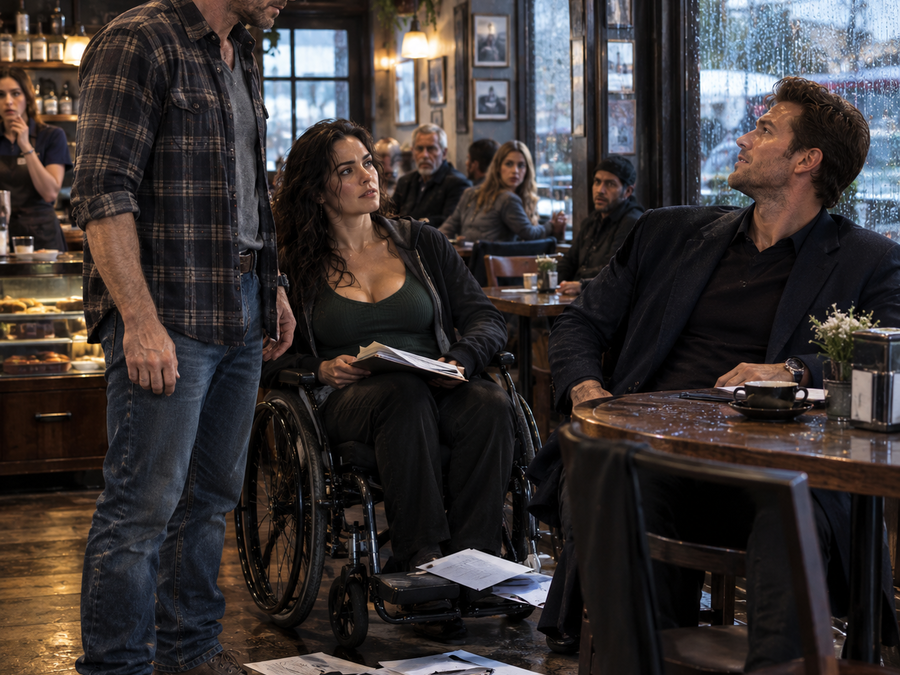
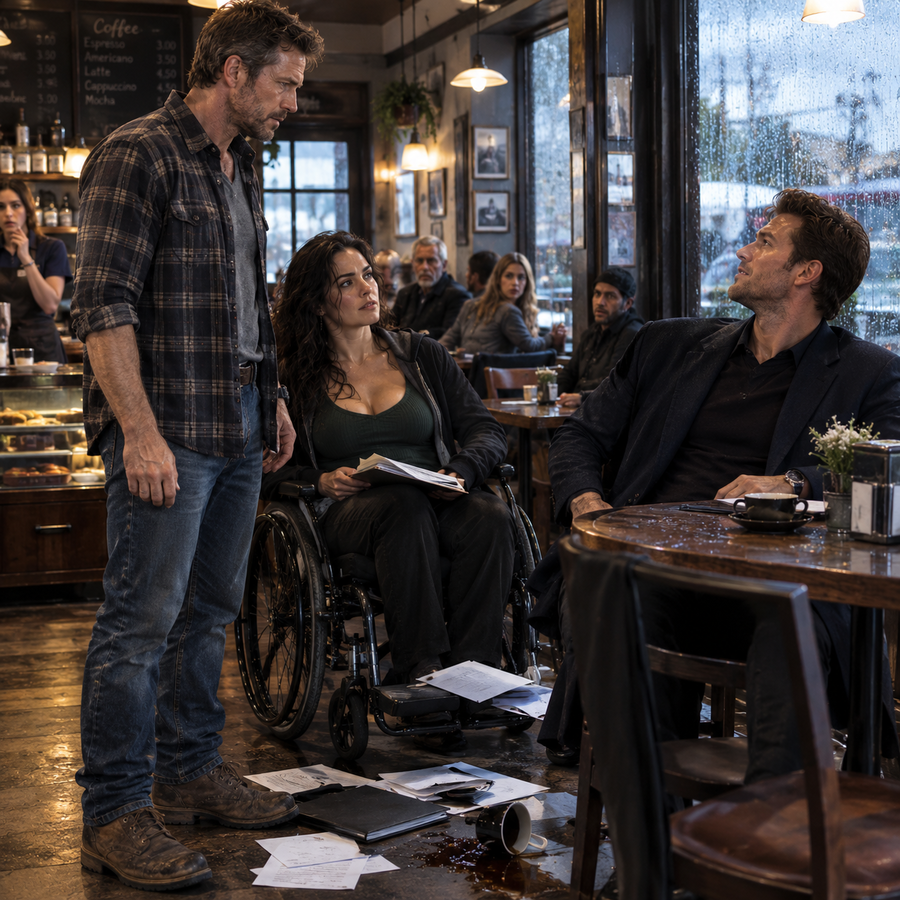
Ryan read the text. He showed it to Clare. She read it. She handed the phone back. “He’s pulling in his people,” she said. “Yes,” Ryan said. She looked at him with an expression that was somehow completely calm. “Good,” she said. “Let him.” Ryan looked at her. He thought about the cafe. About the stillness in her face when Derek Hail shoved her chair. About seven years of building something without knowing what she was building toward. He thought, “Victor Hail has no idea what’s coming.”
He texted Marcus back. Understood. Monday morning. Keep the AG contact warm. He pocketed his phone. “I’m going to stay until Jake gets home from his friend’s place,” Ryan said. “Then I need to go. But—” He paused. “Clare. Don’t be alone tonight.” She started to say something. He shook his head once. “I know you don’t need a rescue. I know that. That’s not what I’m saying.” He paused. “I’m saying that tonight, Victor Hail knows we’re moving. And I would like someone I trust to know where you are.”
She looked at him. “Deborah Mays,” she said. “Next door. She’s been checking on me since the ramp.” “Call her,” he said. “Tonight.” She nodded.
Ryan sat at her kitchen table for another hour. They talked. Not about Victor Hail. Not about the documents. Not about Monday morning. They talked about Jake’s history test, which Ryan had learned he’d gotten a 67 on, which was both worse and better than expected. They talked about the wall of books and what system she used to organize them. They talked about the boat Ryan was currently repairing and the fisherman who owned it, an 80-year-old man named George Tully, who had been fishing the same waters for 60 years and referred to GPS navigation as cheating.
It was the most ordinary hour Ryan had spent in several days. When he left, Clare walked him to the door. Or rather, she rolled and he walked, and they stopped at the threshold of her front door, the repaired ramp solid and correctly bolted beneath them. And he looked at her and she looked at him and there was something in the air that was not quite what it had been a week ago. “Monday,” he said. “Monday,” she said.
He went down the ramp. He got in his truck. He sat for a moment before he turned the key, and he thought about Marcus’s text. About Victor Hail making three phone calls. About a private security firm in Boston being activated. He thought, “The ground is moving now. There’s no putting it back.” He turned the key. He drove home to his son. The weekend was not going to be quiet. He was already sure of that.
He was right about the weekend.
Saturday morning started quietly enough. Ryan made breakfast for Jake. Scrambled eggs. Toast. The orange juice that Jake insisted had to be pulp-free, even though Ryan had told him twice that the pulp was actually good for him. They sat at the table and Jake talked about a video game he and his friend Marcus had been playing. Something involving building cities and managing disasters. And Ryan listened with half his attention while the other half ran quiet calculations about what Victor Hail was doing with a private security firm in Boston and 60 hours until Monday morning.
At 9:14, his phone buzzed. He checked it under the table so Jake wouldn’t see his face change. It was Clare. One sentence. Carl Dupri called me this morning. He wants to talk. Ryan set his fork down. He looked at Jake, eating his pulp-free orange juice and talking about virtual city disasters. He thought about what Marcus had said. Don’t approach witnesses without legal framework. He texted back. “How did he get your number?”
Her response came in 40 seconds. He says he’s had it for three years. He says he’s been waiting for someone to ask. Ryan read that twice. Three years. Carl Dupri, the 72-year-old retired electrician who had witnessed the accident on Route 9 and whose statement had been removed from the official record, had been sitting in Clearwater Ridge for seven years with Clare Bennett’s phone number, waiting for the moment someone started asking questions.
He texted Marcus immediately. Witness reached out on his own. Carl Dupri. Do we talk to him before Monday? Marcus replied in three minutes. Legally cleaner to wait for Frasier. Practically, if Hail’s people know someone is touching the archive, they may reach Dupri first. Your call.
Ryan looked at Jake. “Hey,” he said. “Change of plans today. I need to make a couple of stops this morning. You okay at Marcus’ place for a few hours?” Jake looked up from his eggs. He had his mother’s eyes. The particular sharpness behind them that noticed things. “Is this about that woman? The one whose chair you fixed?” Ryan kept his face neutral. “What makes you ask that?” “You’ve been on your phone more than usual,” Jake said. “And you get that look.” “What look?” “The one you had when you were deciding whether to move us back here,” Jake said matter-of-factly. “When you had to figure out something hard.”
Ryan looked at his son for a moment. Thirteen years old and reading him like a manual. “Yeah,” Ryan said. “It’s connected to that. You okay with Marcus’s place?” “I’m fine,” Jake said. “Is she—” “She’s working on it,” Ryan said. Jake nodded like that was a satisfactory answer. It was, Ryan thought. Probably the most honest one he had.
He dropped Jake off at 9:40. He called Clare from the car. “Tell me exactly what Dupri said.” Ryan said when she picked up. “He said he saw the accident. He said he gave a statement to the first officer on scene. Holt. And then two weeks later, someone came to his house. Not a police officer. A man in a suit who said he was with the county’s legal office and that the investigation was closed and his statement was no longer needed and he should consider the matter resolved.” She paused. “He said the man left him a card with a number on it and told him to call if he had any concerns. He never called. But he kept the card.”
“He has the card,” Ryan said. “He has the card,” she confirmed. Ryan pulled out of Marcus’ neighborhood and pointed the truck toward County Road 7. “Tell him we’re coming. Don’t tell him why we’re moving fast. Just tell him we’d like to come today if that’s okay,” he said. “Anytime,” Clare said. “He sounded relieved.” “That’s not a small thing,” Ryan said. “Seven years of sitting on something like that, it costs people. Even when they’re not saying anything, it costs them.”
He picked Clare up in 11 minutes. She was at her front door when he pulled up, already in her chair, already ready. No fuss, no wasted motion. He was beginning to expect that from her. And he recognized—in the way you recognize things you need to pay attention to—that he had started calibrating to her pace. Trusting her timing.
Carl Dupri’s house was a small, neat property on County Road 7 with a gravel driveway and a mailbox that had been repainted recently. The man who answered the door was 72, but moved like someone younger. A compact, deliberate man with white hair and hands that showed decades of electrical work. Thick and scarred at the knuckles. He looked at Ryan and Clare on his doorstep, and something in his face did what faces do when relief and guilt arrive at the same time. “Come in,” he said. “Please.”
They sat in his living room. Dupri had coffee ready. Real coffee. The kind that meant he’d been preparing for this visit since he made the call this morning. He poured three cups and sat across from them and folded his hands on his knees and looked at them both. “I’ve been thinking about what to say for about three hours,” he said. “And I decided the cleanest thing is to just say it.” “That’s the right call,” Ryan said. Dupri nodded.
“I was at that intersection that night. November, seven years ago. I was coming home from my daughter’s place. It was about 8:30 in the evening and I stopped at the light on Route 9 at Miller Road.” He looked at Clare directly. “I saw the car come through the red light. I saw it hit your vehicle first. The blue sedan. Driver’s side rear quarter panel. Enough force to spin you into the path of oncoming. And then the same car continued through and hit the second vehicle head-on.” He stopped. “I got out of my car. I called 911. I gave my statement to the officer. To Holt. And I told him exactly what I just told you. The sequence, the speed, the fact that I had seen the driver inside the cafe at Miller Road for a significant period before he got in that car.”
He stopped again. His hands were still folded on his knees, but they were not relaxed. “Two weeks later,” he said, “a man came to my house. Said his name was Philip Warren. Said he was with the county legal office. Said the investigation was complete and my statement had been incorporated and there was nothing further I needed to do.” A pause. “He was very pleasant. He offered me his card. He said—and I’m going to remember this exact sentence until I die—he said, ‘We find it’s generally better for everyone when witnesses understand that their civic duty has been fully discharged and they can return to their lives without further involvement.'”
Ryan said, “Return to their lives without further involvement.” “Yes,” Dupri said. “I knew what he meant. I’m not a stupid man. I knew what he meant, and I knew I was being told to disappear. And I knew—because it was obvious—that someone important had arranged for that to happen.” His voice tightened. Not with anger, exactly. With something older and more complex. “And I did it. I went back to my life because I had a daughter with two kids and a business that depended on contracts with county properties and because I was scared.” He looked at them both. “I have not been proud of that for seven years. I have not been proud of that.”
The room was very quiet. Clare said, “You kept the card.” “I kept the card,” he said. He reached into the breast pocket of his shirt and produced it. A plain white business card, slightly worn at the edges from seven years in a box somewhere. He set it on the coffee table between them. Philip Warren, County Legal Affairs Office. A phone number.
Ryan picked it up without touching the surface area too much. “I’m going to need to have this analyzed.” “Take it,” Dupri said. “Carl,” Clare said gently. “Why did you call me today?” Dupri looked at her. “Because I heard what happened at the cafe last week. The whole town heard. And I heard you didn’t back down from those men.” A pause. “And I’ve been carrying this for seven years and I am 72 years old and I would like to stop carrying it.” He looked at Ryan. “I’ll testify. Formally. Officially. In whatever proceeding requires it. I’ll testify to everything I just told you.”
Ryan looked at this man. Seventy-two years old. Retired electrician. Who had been sitting in Clearwater Ridge for seven years with guilt and a business card in a box, waiting for the moment he could put it down. “Okay,” Ryan said. “We’re going to do this correctly. There’s an attorney coming Monday morning. Her name is Donna Frasier and she does this kind of work and she’s not connected to anything local. When she arrives, we’re going to need you to tell her everything you just told us.” “I’ll be there,” Dupri said. No hesitation.
“There’s a risk,” Ryan said. He said it because he had to. Not because he wanted to discourage this man. “If Victor Hail finds out you’ve come forward before we have the state AG engaged, he may try to apply pressure.” Dupri looked at him steadily. “He already applied pressure once. I let him.” He shook his head once. “I’m not doing that again.”
They left Dupri’s house at 11:27. In the truck, Clare was quiet for a moment. Then she said, “Greta Hollands. The waitress in Portland.” “I know,” Ryan said. “We need her too.” “Can Marcus reach her?” Clare said. “Before Monday.” “Marcus can reach her,” Ryan said. “Don’t send Marcus,” she said. “Send someone she can trust. Someone who isn’t—” She stopped. “Greta was 24 years old when she gave that statement. Someone scared her enough that she moved cities eight months later. If a stranger calls her, she’ll run.”
Ryan said, “He understood immediately. You’re right.” “I want to call her,” Clare said. He looked at her. He thought about what she’d said about not being a woman who handed her problems to strangers. He thought about the notebook with the precise handwriting. He thought about seven years of building something. “Okay,” he said. “Tommy has her number. I’ll get it.”
He called Tommy from the car. Tommy had the number. Ryan relayed it to Clare, and Clare called from her own phone while they drove, and Ryan listened to one side of a conversation that he knew, even from one side, was going to matter. He heard Clare say, “Greta, my name is Clare Bennett. I was in the accident on Route 9 seven years ago. I was the other driver. The one they didn’t tell you about.” A pause. “I know. I know it’s been a long time. I know this is coming out of nowhere.” Another pause, longer. “I know someone came to see you. I know what he said. And I want you to know that his name wasn’t Philip Warren and he wasn’t from the county legal office and the investigation was never actually closed.”
Silence then. “Yes, I know. Me, too.” Her voice just briefly went somewhere it hadn’t been before. The place under the steadiness where something still hurt. “I know what it cost you to leave. I’m sorry.” Ryan kept his eyes on the road and said nothing.
When Clare hung up, she was very still for a moment. “She’ll come,” Clare said. “She’s driving down Sunday. She’ll be here for Monday.” Ryan exhaled slowly. “Good.” “She’s been waiting, too,” Clare said quietly. “She felt guilty for leaving. She thought no one was going to fight this.” A pause. “She cried when I told her we had Dupri’s card.” Ryan nodded.
He pulled into a gas station on the edge of town and stopped the truck but didn’t get out. He was thinking. “Moving pieces, Ryan,” Clare said. He looked at her. “We’re going to win this,” she said. Not as a question. Not as hope. As assessment. The way she said things that she had finished calculating and arrived at an answer she was prepared to be accountable for. He looked at her for a long moment. “Yeah,” he said. “We are.” He started the truck.
He was wrong about one thing, though. He’d thought the weekend would be difficult. He hadn’t thought it would move as fast as it did.
At 2:47 on Saturday afternoon, Marcus called. “He moved,” Marcus said, and his voice had the particular quality of someone delivering information they’d been hoping not to have to deliver this quickly. “Victor Hail filed an emergency injunction in county court this afternoon. His attorneys are claiming your public records request constitutes harassment and interference with an ongoing business negotiation. They’re asking for a restraining order that would prevent you or Clare from accessing any county records related to the Hail Development Project pending a hearing.”
Ryan was parked outside a grocery store. He’d been about to go in and buy something reasonable for dinner. He didn’t move. “He’s trying to freeze us out before Monday,” Ryan said. “He’s trying to make it procedurally impossible for Frasier to file anything on Monday,” Marcus said. “If the injunction is granted, any documents you’ve already obtained could be challenged as part of the harassment claim. He’s trying to contaminate the evidence.” “Can he get it granted?” “In county court, with the judge he’s going to file with—” Marcus paused. “Judge Ellsworth has received campaign contributions from Coastal Development Partners for the last three election cycles. So yes. In county court, with Ellsworth, he can get it granted.”
Ryan was very still. “How long do we have?” he said. “The filing was submitted at 2:30,” Marcus said. “Emergency injunctions can be processed in 24 hours. If Ellsworth fast-tracks it, which I believe he will, you could have a court order on your doorstep by Sunday afternoon.” Sunday afternoon. Less than 24 hours. “Marcus,” Ryan said. “Your contact at the state AG. How fast can we move?” “I’ve had the package ready since last night,” Marcus said. “If you tell me to send it, it goes in the next 10 minutes. But Ryan, going to the state AG before Monday. Before you have Frasier in the room. Before Dupri and Hollands are formally on the record—”
“If we wait for Monday, we might not have anything left to file with,” Ryan said. “Send it.” A pause. “Sending,” Marcus said.
Ryan hung up. He called Clare immediately. She picked up before the first ring finished. She’d been waiting. She always seemed to be waiting. “Hail filed an emergency injunction,” Ryan said. “He’s trying to freeze our evidence before Monday. We have maybe 24 hours before a county judge grants it.” Silence. Then, “Marcus’ contact at the state AG. Already sent,” Ryan said. “Package went out 10 minutes ago.”
She said, “Her voice was steady, but he could hear something underneath it. Not fear, but the heightened awareness of someone who understands that the timeline just compressed dramatically. What do we need to do right now?” “I need you to send me every original document you have. Every piece of paper from your public records request, your original letters from Hail’s company, everything in that folder you were carrying at the cafe. Scan them, photograph them, email them to me and to Tommy in the next two hours. Original documents can’t be injuncted once they’re out of county jurisdiction.”
“I’m doing it right now,” she said. “And Clare,” he stopped. “What?” “Call Dupri. Tell him what’s happening. Tell him not to discuss this with anyone until Monday and to photograph both sides of that business card and text the images to you before tonight.” “Done,” she said. She hung up.

