“His name was Nathan Hale. That was me, Gerry. Not you.
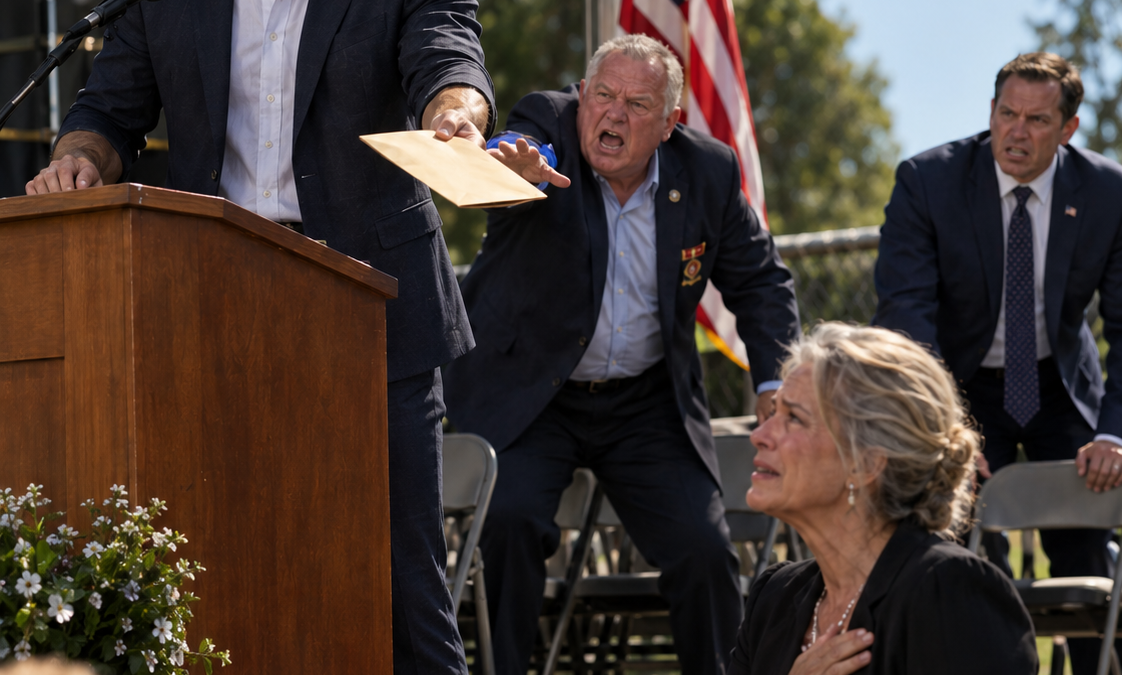
“The envelope was cream-colored and heavy, the kind of paper that cost more than my first car. I knew what it was before I opened it. The return address said ‘Town of Millbrook — Office of the Mayor.'”
They thought silencing me would keep their secret safe → they never expected the quiet construction worker to stand at the podium and expose it all.
I knew what it was before I opened it.
The return address said “Town of Millbrook — Office of the Mayor.” A gold seal held the flap shut. I turned it over twice in my hands, standing in my kitchen with the morning coffee going cold on the counter.
My wife Sarah came up behind me. She put her hand on my shoulder.
“You going to open it?”
“Eventually.”
“Daniel.”
I opened it.
The letter invited me to be the keynote speaker at Millbrook’s annual Memorial Day ceremony. It praised my “distinguished military service” and my “continued contributions to the community.” It asked me to share “reflections on sacrifice and duty” with my neighbors.
I read it twice.
“They want you to speak,” Sarah said. “That’s an honor.”
“Mm.”
“You don’t seem happy.”
I set the letter down on the counter. “I’m not a public speaker.”
“You commanded men in combat. You can handle a podium.”
I didn’t answer. I was thinking about something else.
My brother Michael had been chairing the Memorial Day committee for three years. He’d never once asked me to be involved. Not to speak. Not to march. Not to hand out water bottles.
Now, suddenly, an invitation.
What they didn’t know was that I’d already seen the draft program. A friend on the town council had sent it to me a week earlier, asking if I was okay with the wording.
I wasn’t.
My name appeared in the program. But I wasn’t the keynote speaker.
I was listed as a “special guest.”
The keynote speaker was a man named Gerald “Gerry” Fontaine.
My name is Daniel Kowalski. I was forty-six years old when my brother’s Memorial Day committee invited me to watch a stranger pretend to be me.
I’m a former U.S. Army Ranger. 2nd Battalion, 75th Ranger Regiment. I did four deployments — two to Iraq, two to Afghanistan. I was a staff sergeant when I got out. I earned a Silver Star and two Bronze Stars with Valor device.
I don’t talk about any of that.
Not because I’m modest. Because the people in my family made it clear a long time ago that they didn’t want to hear it.
My father was a dentist. My mother taught piano. They had three children: Michael, Daniel, and Rebecca. Michael was the oldest. Michael was the success story. Michael went to Wharton. Michael married into the Hargrove family — yes, those Hargroves, the ones with the car dealerships and the strip malls and the summer house on Cape Cod.
Michael was the one who mattered.
I was the one who enlisted.
You would have thought I’d spit on the family Bible. My mother cried for a week. My father didn’t speak to me for a month. Michael, who was twenty-two at the time and already planning his first million, told me I was “throwing my life away.”
“I’m serving my country,” I said.
“You’re serving someone else’s country,” he said. “You could be serving yourself. Building something. Making something of yourself.”
I shipped out three weeks later.
That was twenty-four years ago.
The thing about being a Ranger is that it changes how you see everything.
You learn to read a room in seconds. You learn to notice what’s out of place. You learn to stay calm when everyone around you is panicking, because panic gets people killed.
You also learn that most people are full of shit.
I don’t mean that cynically. I mean it practically. In combat, you find out fast who’s reliable and who isn’t. Who talks and who does. Who shows up and who disappears when things get hard.
I’d been back in Millbrook for twelve years. I ran a small construction company — decks, additions, kitchen remodels. Nothing fancy. I employed six guys, paid them fair, treated them right. My hands were scarred and calloused and I liked them that way.
I’d married Sarah eight years ago. She was a nurse at the county hospital. She’d been married before — to a man who hit her. She left him in the middle of the night with nothing but a suitcase and her daughter, Emma.
Emma was fifteen now. She called me Dad. I’d never asked her to.
We had a good life. Quiet. Small. Real.
And then Michael’s committee invited me to Memorial Day.
I called my friend on the town council, a retired teacher named Patricia Okonkwo.
“What’s going on with the program?” I asked.
She hesitated. “You saw the draft.”
“I saw it.”
“Daniel, I tried to tell Michael. I said, your brother should be the keynote. He’s the one who actually served. He’s the one who —”
“He said no.”
“He said you wouldn’t want to. He said you’re private. He said you’d be uncomfortable with the attention.”
I let that sit.
“And Gerry Fontaine?”
Patricia sighed. “Michael brought him in. Said he was a family friend. Said he’d served with distinction. Said he’d be a ‘draw’ for the ceremony.”
“What unit?”
“I don’t know. He’s been very vague about it. Says he doesn’t like to talk about his service. Says it brings back memories.”
“Mm.”
“Daniel, I’m sorry. I tried.”
“It’s not your fault.”
I hung up and sat in my truck for a long time.
I knew what was happening. I’d seen it before. Men who never served, or who served in some support role stateside, inflating their records. Claiming combat they never saw. Claiming units they never joined. Claiming wounds they never received.
It happened more than people thought.
Most of the time, it went unnoticed. Nobody checks. Nobody wants to call a veteran a liar.
But this was Memorial Day. This was a ceremony for the actual dead. For the families who’d lost sons and daughters, husbands and wives, fathers and mothers.
And Michael had put a fake in the spotlight.
I did what any Ranger would do.
I gathered intelligence.
It wasn’t hard. Gerry Fontaine was a loud man. He posted on Facebook every day. Photos of himself at the VFW. Photos of himself at charity events. Photos of himself shaking hands with politicians.
His bio on the town website said he was a “decorated combat veteran” who’d served in “elite special operations units” before retiring to Millbrook to “give back to the community.”
He never named a specific unit.
He never named a specific deployment.
He never named a specific battle.
That wasn’t modesty. That was cover.
I made some calls.
I had friends from the Regiment. Men I’d served with. Men who’d gone on to careers in intelligence, law enforcement, defense contracting. Men who owed me favors, and men who I owed favors to.
Within three days, I had a name.
Gerald Raymond Fontaine. Born 1968, Trenton, New Jersey. Enlisted in the Army Reserve in 1986. Served eight years. Honorable discharge. Rank: Specialist. MOS: 92A — Automated Logistical Specialist.
He’d never deployed. He’d never seen combat. He’d spent his entire military career in a supply warehouse in New Jersey.
There was no record of him ever attending Ranger School, Airborne School, or any special operations training.
There was no record of him ever serving in the 75th Ranger Regiment.
There was no record of him serving in any combat arms unit at all.
He was a warehouse clerk who’d spent thirty years pretending to be a war hero.
And my brother — my own brother — had made him the keynote speaker at Memorial Day.
I didn’t confront Michael right away.
That’s not how Rangers operate. You don’t go in loud and half-cocked. You gather your intelligence. You plan your approach. You wait for the right moment.
Instead, I did something else.
I drove to the VFW.
The Millbrook VFW was a small building on the edge of town. Brick. American flag out front. A sign that said “All Welcome” but meant “Veterans Only.”
I’d been a member for ten years. I didn’t go often — I wasn’t a joiner — but I paid my dues and I showed up on the important days.
That afternoon, there were five men at the bar. Men I knew.
Al Benson, former Marine, Vietnam. Wheelchair. Still drank his beer like he was proving something.
Tommy Rourke, former Army, Desert Storm. Talked too much. Kind heart.
Eddie Kaminski, former Navy, peacetime. Quiet. Read the paper every day.
Jimmy Tran, former Air Force, logistics. Loved to fish.
And a man I didn’t recognize. Sixties. Gray hair. Sitting alone at the end of the bar.
I took a stool next to Al.
“Daniel,” he said. “Haven’t seen you in a while.”
“Been busy.”
“Building decks for rich people.”
“Something like that.”
He laughed. Then he coughed. Then he drank his beer.
I nodded toward the stranger. “Who’s that?”
Al glanced over. “New guy. Says his name’s Gerry. Says he’s a vet. Says he’s speaking at Memorial Day.”
“Mm.”
“You know him?”
“No.”
“He’s been coming in here every day for a week. Buying rounds. Telling stories.”
“What kind of stories?”
Al’s face changed. “The kind that don’t add up.”
I waited.
“First day, he said he was in the 82nd. Second day, he said he was in Special Forces. Third day, he said he was a Ranger. Fourth day, he said he was a SEAL.”
“He’s covering a lot of ground.”
“He’s covering a lot of bullshit.” Al spat into his empty glass. “I was in Vietnam. I know what a combat vet looks like. That man ain’t one.”
“Did you say anything?”
“I asked him one question. Just one. I asked him what his MOS was. He said he couldn’t remember. Said the years had blurred together.”
Al shook his head.
“I told him I remembered mine. 0311. Rifleman. First Marine Division. I remember the smell of the jungle. I remember the men I lost. I don’t remember my MOS? That’s not a memory problem. That’s a lie.”
I nodded.
“You gonna do something about it?” Al asked.
“I’m working on it.”
“You know he’s speaking at the ceremony. Michael’s committee put him up there.”
“I know.”
“Your brother know he’s a fake?”
“I don’t know yet.”
Al looked at me. His eyes were old and sharp.
“You’re a Ranger,” he said. “I know you don’t talk about it. But I know. I’ve seen the way you carry yourself. I’ve seen the way you handle yourself. You’re not just a construction guy from Millbrook. You’re something else.”
I didn’t answer.
“Whatever you’re planning,” he said, “do it right.”
“I will.”
I left the VFW and drove home.
Sarah was making dinner. Emma was doing homework at the kitchen table.
“You look like you swallowed a rock,” Sarah said.
“Something like that.”
“Want to talk about it?”
I sat down. Emma looked up from her textbook.
“There’s a man speaking at Memorial Day,” I said. “He’s claiming to be a combat veteran. He’s not.”
“How do you know?”
“I checked.”
Emma’s eyes widened. “You can do that?”
“I have friends.”
“What are you going to do?”
I looked at her. She was fifteen. She’d seen her mother get hit. She’d seen her stepfather put in jail. She’d learned early that some people lie about who they are.
“I’m going to do it right,” I said.
“That’s not an answer.”
“No,” I said. “It’s not.”
The next day, I called Michael.
He answered on the second ring. “Daniel! Long time.”
“Hey, Mike.”
“What’s up?”
“I got the invitation.”
“Great, great. The committee’s thrilled. We’re going to have a big crowd this year. Gerry’s speech is going to be the highlight.”
“That’s what I wanted to talk to you about.”
“About Gerry?”
“About Gerry.”
There was a pause.
“What about him?”
“I did some checking.”
“Checking?”
“On his military record.”
Another pause. Longer this time.
“Daniel, what are you talking about?”
“I’m talking about the fact that Gerald Fontaine never served in combat. He was a supply clerk in the Army Reserve. He never deployed. He never saw a firefight. He never earned a single medal.”
“That’s — that’s not possible. Gerry’s told me stories. He’s shown me photos.”
“Photos can be faked. Stories can be invented.”
“Why would he do that?”
“Why would anyone do that? Because it gets him attention. Because it makes him important. Because it lets him stand on a stage on Memorial Day and pretend to be something he’s not.”
Michael was quiet.
“Look,” he said finally, “I don’t know where you got your information, but I trust Gerry. He’s been part of this community for years. He’s done a lot of good.”
“He’s a fraud, Mike.”
“He’s my friend.”
“He’s a fraud, and if you put him on that stage, you’re going to humiliate every real veteran in this town. You’re going to humiliate the families of the men and women who actually died.”
“You don’t know that.”
“I do know that.”
“You don’t even live in that world anymore. You’ve been out for years. You don’t know what’s going on.”
“I know enough.”
“You know enough to embarrass me in front of the whole town?”
The words landed like a slap.
“That’s what you’re worried about? Your reputation?”
“Daniel —”
“Your reputation. Not the truth. Not the veterans. Not the families. Your reputation.”
“I’m not going to have this conversation with you.”
“Then don’t.”
“Gerry speaks on Memorial Day. End of discussion.”
He hung up.
I sat in my truck for a long time after that call.
I thought about my father. He’d died five years ago. Heart attack. At the funeral, Michael gave the eulogy. He talked about Dad’s success, his practice, his investments, his standing in the community.
He didn’t mention me. Not once.
I thought about my mother. She was still alive, living in a retirement home in Florida. She called me twice a year. Christmas and my birthday. She never asked about my service. She never asked about my life. She asked about the weather and my health and whether I was “still doing that construction thing.”
I thought about the men I’d served with. The ones who’d died. The ones who’d come home broken. The ones who’d never come home at all.
And I thought about Gerry Fontaine.
Standing on a stage.
Pretending to be one of us.
I made a decision that night.
I wasn’t going to confront Michael. I wasn’t going to argue. I wasn’t going to plead.
I was going to do what Rangers do.
I was going to complete the mission.
I called a friend from the Regiment. A man named Victor Reyes. He’d been my team leader in Afghanistan. He’d saved my life twice. I’d saved his once. We didn’t talk often, but when we did, it mattered.
“Daniel,” he said. “What’s going on?”
“I need a favor.”
“Name it.”
“I need a copy of a service record. And I need it authenticated.”
“Whose?”
“A man named Gerald Fontaine. He’s claiming to be a Ranger. He’s not.”
Victor was quiet for a moment.
“You want to take him down?”
“I want to tell the truth.”
“That’s not the same thing.”
“It is for me.”
He sighed. “Send me what you have. I’ll get you what you need.”
“Thanks, Victor.”
“Daniel.”
“Yeah?”
“You’re doing the right thing.”
“I know.”
“You always did.”
He hung up.
The letter arrived three days later.
A plain manila envelope. No return address.
Inside was a certified copy of Gerald Raymond Fontaine’s military service record, obtained through official channels and authenticated by the National Personnel Records Center.
It told the truth.
It told the whole truth.
And it was going to change everything.
I put the envelope in my safe.
I didn’t open it again for a week.
I didn’t need to. I knew what it said.
Instead, I went to work. I built a deck for a family in the next town over. I helped Emma with her algebra homework. I had dinner with Sarah and watched a movie on the couch.
I lived my life.
And I waited.
Memorial Day was three weeks away.
The town was preparing. Banners on the streetlights. Flags on the storefronts. A stage being built in the town square.
Michael was everywhere. Shaking hands. Giving interviews. Talking about “the importance of remembrance.”
Gerry Fontaine was everywhere too. Standing next to Michael. Smiling for cameras. Practicing his speech.
I saw him at the grocery store one day. He was buying flowers for his wife.
He saw me. He smiled.
“Daniel! Your brother’s told me so much about you.”
“Has he.”
“He says you’re a veteran too. Army, right?”
“Something like that.”
“Wonderful, wonderful. We’ll have to swap stories sometime.”
“Maybe.”
He clapped me on the shoulder. “Looking forward to Memorial Day. It’s going to be a special one.”
“Yes,” I said. “It is.”
He walked away.
I watched him go.
What he didn’t know was that I had a copy of his service record in my safe. And I was going to put it on the head table at the ceremony.
The night before Memorial Day, I sat on my porch and watched the sun go down.
Sarah came out with two glasses of iced tea. She sat next to me.
“You’re quiet,” she said.
“I’m always quiet.”
“Quieter than usual.”
I took a glass. “Tomorrow’s going to be hard.”
“Why?”
“Because I’m going to do something that my family won’t forgive.”
She looked at me.
“What are you going to do?”
“I’m going to tell the truth.”
“About Gerry?”
“About Gerry.”
“And Michael?”
“About Michael too.”
She was quiet for a moment.
“You know they’ll blame you.”
“I know.”
“You know they’ll say you ruined the ceremony.”
“I know.”
“You know your mother will hear about it.”
“I know.”
She took my hand.
“Then why are you doing it?”
I looked at her.
“Because there are men who died wearing that uniform. Men who never came home. Men whose families are going to be sitting in the front row tomorrow, holding photographs, trying not to cry.”
I paused.
“And I’m not going to let a liar stand on a stage and pretend to be one of them.”
She squeezed my hand.
“Okay,” she said.
“Okay?”
“Okay. I’m with you.”
I kissed her.
“Thank you.”
“You don’t have to thank me. I’m your wife.”
“I know. That’s why I’m thanking you.”
Emma came out a few minutes later. She sat on the steps.
“Mom says you’re going to do something big tomorrow.”
“Something like that.”
“Can I come?”
I looked at Sarah. She nodded.
“Yeah,” I said. “You can come.”
“Good.”
She didn’t say anything else. She just sat there, looking at the stars.
I thought about the first time I’d met her. She was seven years old. She’d hidden behind Sarah’s legs. She wouldn’t look at me. She wouldn’t speak.
It had taken months for her to trust me. Months of showing up. Months of being patient. Months of proving that I wasn’t going to leave.
Now she was fifteen. She called me Dad. She asked me for advice. She sat on my porch and looked at the stars.
That was worth more than any medal.
The phone rang at nine o’clock.
I looked at the screen. It was Michael.
I let it ring.
He called again at nine-fifteen.
I let it ring.
He called again at nine-thirty.
I answered.
“Daniel, what the hell?”
“Hello, Michael.”
“I just got a call from Patricia Okonkwo. She said you’ve been asking questions about Gerry. She said you’ve been —”
“I’ve been doing research.”
“Research? What kind of research?”
“The kind that tells the truth.”
“Daniel, I don’t know what you think you’re doing, but you need to stop. Gerry is my friend. He’s a good man. He’s —”
“He’s a fraud, Michael.”
“You keep saying that, but you haven’t shown me any proof.”
“I have proof.”
“Then show me.”
“Tomorrow.”
“Tomorrow?”
“At the ceremony.”
There was a long silence.
“What are you planning?”
“I’m planning to tell the truth.”
“Daniel —”
“Goodnight, Michael.”
I hung up.
Sarah was standing in the doorway.
“That was your brother?”
“Yeah.”
“What did he say?”
“He wanted me to stop.”
“Are you going to?”
I looked at her.
“No.”
She nodded.
“Good.”
She went inside.
I stayed on the porch.
The stars were bright. The air was cool. Somewhere in the distance, a dog barked.
I thought about the men I’d served with. The ones who’d died. The ones who’d lived.
I thought about the families who would be at the ceremony tomorrow. The mothers. The fathers. The wives. The children.
I thought about what I was going to do.
And I felt calm.
That’s the thing about being a Ranger. You learn to be calm when everything around you is chaos. You learn to focus. You learn to execute.
Tomorrow, I was going to execute.
PART 2 — THE THIRD ROW
Memorial Day dawned clear and warm.
I was up before the sun. Old habit. I made coffee, checked the weather, laid out my clothes.
A dark suit. White shirt. No tie. Simple.
Sarah came downstairs at seven. She looked at me and nodded.
“You ready?”
“Yeah.”
“Emma’s still asleep.”
“Let her sleep. We don’t need to be there until nine.”
She poured herself a cup of coffee. We stood in the kitchen, not talking. The way you do when you’ve said everything that needs saying.
At eight-thirty, I went to the safe.
I opened it. I took out the manila envelope. I held it for a moment.
Then I put it in my jacket pocket.
Emma came down at eight-forty-five. She was wearing a dark dress. Her hair was pulled back. She looked older than fifteen.
“You look nice,” I said.
“Thanks.”
“You ready?”
She nodded.
“Good.”
We got in the truck and drove to the town square.
Millbrook was a small town. Twelve thousand people. A main street with a few restaurants, a hardware store, a bank, two churches. The kind of place where everyone knew everyone. Where people waved when they passed you on the road.
The square was already crowded when we arrived.
Folding chairs had been set up on the grass. A stage stood at the north end, draped in red, white, and blue bunting. A podium. A microphone. A large screen behind it, showing a slideshow of local veterans.
I saw faces I knew. Neighbors. Customers. Men I’d worked for.
I saw Michael, standing near the stage, talking to the mayor. He was wearing a navy suit and a flag pin. He looked important.
He saw me. His face tightened. He looked away.
Sarah took my arm.
“Steady,” she said.
“I’m steady.”
We found seats in the third row.
I’d chosen the third row deliberately.
Close enough to see everything. Far enough back to be overlooked.
The program said the ceremony would begin at ten. There would be an invocation. The national anthem. A reading of names. A wreath-laying.
And then the keynote speaker.
Gerry Fontaine.
I watched him work the crowd. He moved from group to group, shaking hands, clapping shoulders. He had a big laugh and a firm grip. He wore a navy blazer with a VFW pin on the lapel.
He stopped at a group of older men. Veterans, I could tell. They stood a little straighter. They shook his hand.
He was telling them something. They were nodding.
I wondered what story he was telling today. The 82nd Airborne? Special Forces? The SEALs?
He was covering all of them.
At ten o’clock, the ceremony began.
The mayor spoke first. He talked about “the sacred duty of remembrance” and “the debt we owe to those who gave all.”
A minister gave the invocation. He asked God to bless the fallen and comfort their families.
Then a young woman — maybe nineteen — sang the national anthem. She had a good voice. People stood and put their hands over their hearts.
I stood. I put my hand over my heart. I thought about the men I’d served with. The ones who’d died. The ones who’d come home in flag-draped coffins.
Then a Boy Scout troop read the names of Millbrook’s fallen. Eleven names. Eleven men who’d died in wars from World War II to Afghanistan.
When they read the last name — a man named Specialist Robert Ellison, killed in Afghanistan in 2011 — I saw a woman in the front row cover her face with her hands.
She was maybe sixty. Gray hair. A black dress.
Robert Ellison’s mother.
I’d known her husband. He’d died five years ago. Cancer. She was alone now.
I looked at her. I looked at the stage. I looked at Gerry Fontaine, sitting in the front row, waiting for his moment.
I felt the envelope in my pocket.
Not yet.
The mayor introduced Gerry.
“Ladies and gentlemen,” he said, “it is my great honor to introduce our keynote speaker. He is a veteran, a patriot, and a friend to this community. He has served our nation with distinction in some of the most elite units in our military. Please welcome Gerald Fontaine.”
Applause.
Gerry stood. He adjusted his blazer. He walked to the podium.
He looked out at the crowd. He smiled.
“Thank you,” he said. “Thank you very much.”
He paused. He let the applause die down.
“I’m not much of a public speaker,” he said. “I’d rather be in the field, doing the work. But when Michael Kowalski asked me to speak today, I couldn’t say no. Because this day — this day matters.”
He paused again.
“I served in the Army. Special operations. I won’t go into the details. The men I served with know who they are. And the men I lost — they’re the ones I think about on days like this.”
People nodded. The woman next to me dabbed her eyes.
“I want to tell you a story,” Gerry said. “About a mission I was part of in Afghanistan. In 2007. It was a mission that changed my life.”
I sat up straighter.
“Some of you might have heard of it. Operation Anvil. It was a joint operation with the Rangers. We were going after a high-value target in the mountains. The intel was bad. We got ambushed. We lost three men that day.”
The crowd was silent.
“I was one of the survivors. I carried one of my teammates down the mountain. He’d been shot in the leg. I didn’t think he’d make it. But I got him out. I got him home.”
He paused. He wiped his eyes.
“That’s what Memorial Day is about. Not the medals. Not the parades. The men we couldn’t save. And the men we did.”
He stepped back from the podium.
The crowd applauded.
I didn’t.
I knew Operation Anvil.
I knew it because I’d been there.
I’d been a staff sergeant in the 75th Ranger Regiment. 2nd Battalion. In 2007, I was in Afghanistan on my third deployment. I’d been part of Operation Anvil.
I’d planned the mission. I’d led the assault element. I’d been the one who called in the medevac.
I’d been the one who carried my teammate down the mountain.
Gerry Fontaine had just told my story.
And he’d told it wrong.
There was no “joint operation with the Rangers” in Operation Anvil. The Rangers were the only unit in Operation Anvil. There were no special forces attached. No other units.
He’d said we lost three men. We lost two. Sergeant Marcus Cole. Corporal James Ortiz. Both killed in the initial ambush.
He’d said he carried a teammate down the mountain. The man who’d been shot in the leg was Private First Class Nathan Hale. I’d carried him. Not Gerry. Me.
And there was no such thing as “high-value target” in Operation Anvil. The mission was to clear a village of Taliban fighters. There was no HVT.
Gerry Fontaine had taken my story and made it his.
And the whole town was clapping.
I sat in my seat, very still.
I felt Sarah’s hand on my arm.
“Daniel.”
“I’m okay.”
“Is that —”
“It’s my story.”
She went pale.
“Are you sure?”
“I’m sure.”
“What are you going to do?”
I looked at the stage. Gerry was shaking hands with the mayor. Michael was beaming.
“Not yet.”
“Daniel —”
“Not yet.”
I stood up. I walked toward the stage.
The ceremony was ending. People were standing, gathering their things. The folding chairs were being folded. The Boy Scouts were collecting programs.
I walked up to the stage. A man I didn’t know tried to stop me.
“Sir, the ceremony is over.”
“I need to speak to the committee.”
“The committee is —”
“Now.”
He looked at my face. He stepped aside.
I walked to where Michael was standing. He was talking to the mayor. He saw me coming.
“Daniel. What are you doing?”
“I need to speak to you.”
“Not now.”
“Now.”
He looked at the mayor. He forced a smile.
“Excuse me for a moment.”
He walked over to me. His face was red.
“What the hell are you doing?”
“I need to speak to you. Privately.”
“About what?”
“About your keynote speaker.”
“Daniel —”
“Now, Michael.”
He looked around. People were watching.
“Fine. Five minutes.”
We went behind the stage. There was a small tent where the speakers had gathered. Michael pulled me inside.
“What?”
I took out the envelope. I held it up.
“This is Gerald Fontaine’s military service record. Certified. Authenticated.”
Michael stared at it.
“You’ve got to be kidding me.”
“I’m not.”
“Where did you get that?”
“That doesn’t matter.”
“It matters to me.”
“It’s real, Michael. That’s what matters.”
He reached for it. I pulled it back.
“You can read it later. Right now, I need you to listen.”
“I don’t have to listen to anything. You’re trying to ruin the ceremony.”
“The ceremony is already ruined. You just don’t know it yet.”
“What’s that supposed to mean?”
I took a breath.
“Gerry Fontaine told a story about Operation Anvil. About carrying a wounded teammate down a mountain. About losing three men.”
“So?”
“That’s my story, Michael.”
He stared at me.
“What?”
“I was in Operation Anvil. I led the assault. I carried Private First Class Nathan Hale down the mountain. We lost two men, not three. There was no high-value target. There was no joint operation.”
Michael’s face went white.
“You’re lying.”
“I’m not.”
“You never told me —”
“Because you never asked. Because you never wanted to know. Because every time I tried to talk about my service, you changed the subject. Because you made it clear a long time ago that my military career was a disappointment, not an achievement.”
“That’s not —”
“It is.”
He was silent.
“I don’t want to humiliate you, Michael. I don’t want to embarrass the town. I don’t want to make a scene.”
“Then what do you want?”
“I want you to stop Gerry Fontaine from speaking again. I want you to tell the committee that he’s a fraud. I want you to issue a statement correcting the record.”
“And if I don’t?”
I held up the envelope.
“Then I’ll do it myself.”
Michael stared at me. His hands were shaking.
“You’d really do that? To your own brother?”
“I’d do it for the men who died. For their families. For the woman in the front row whose son is never coming home.”
“That woman —”
“Her son was Robert Ellison. He was killed in Afghanistan. I didn’t know him. But I know men like him. And I know what it costs to lose them.”
Michael was quiet.
“Gerry’s my friend,” he said.
“I know.”
“He’s done a lot of good for this town.”
“He’s a liar.”
“He’s —”
“Michael.” I stepped closer. “I’m not asking you to arrest him. I’m not asking you to ruin his life. I’m asking you to tell the truth.”
He looked at the ground.
“I can’t.”
“You can.”
“I can’t. The committee. The mayor. Everyone’s watching.”
“I know.”
“You don’t understand. This is my town. This is my reputation. If I admit I was wrong —”
“Then you’ll be a man who admitted he was wrong. That’s not a weakness, Michael. That’s a strength.”
He shook his head.
“I can’t do it.”
“Then I will.”
I turned to leave.
“Daniel.”
I stopped.
“Please don’t do this.”
I looked at him.
“I’m not doing this to hurt you. I’m doing this because it’s right.”
I walked out of the tent.
The crowd was still there. People were milling around, talking, laughing. The ceremony had been a success. Everyone was happy.
I walked to the stage. I climbed the steps. I walked to the podium.
The microphone was still on.
I tapped it.
“Excuse me.”
People looked up. Conversations stopped.
“My name is Daniel Kowalski. I’m a veteran. I served in the 75th Ranger Regiment.”
The crowd was silent.
“I’m here to correct the record.”
 [Tap here for the Next Part ]