My daughter told me she was leaving. She said it standing in the kitchen doorway, backpack already on her shoulders, shoes tied tight like she’d been planning the exit for weeks. Maybe she had.
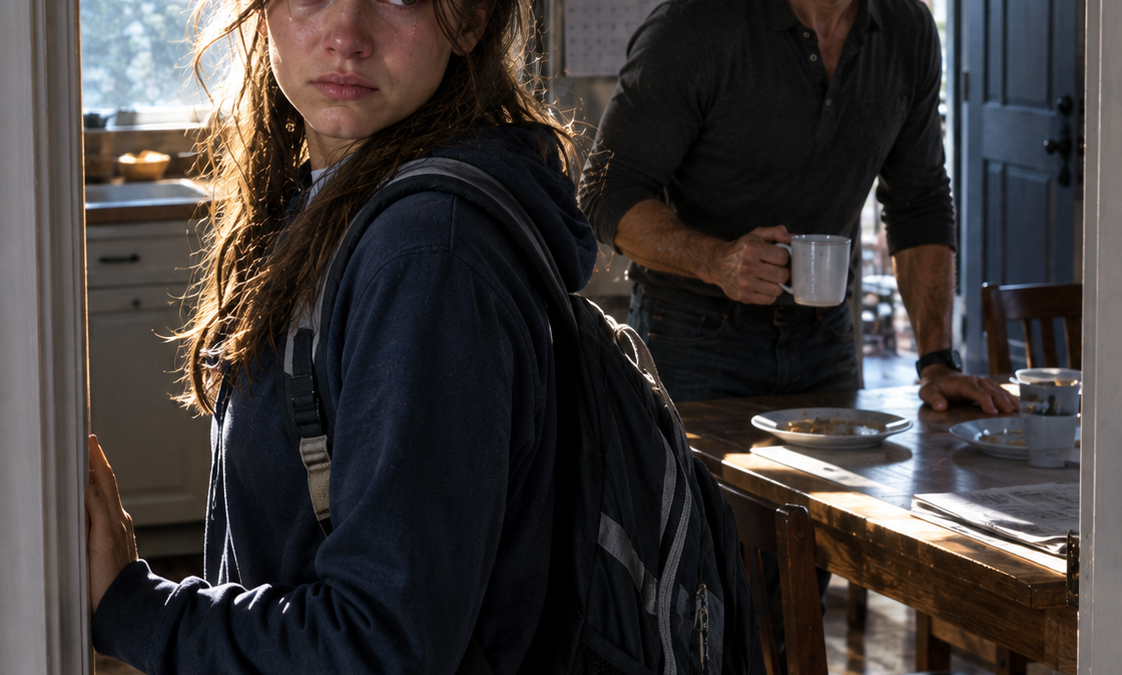
“My daughter told me she was leaving. She said it standing in the kitchen doorway, backpack already on her shoulders, shoes tied tight like she’d been planning the exit for weeks. Maybe she had.”
She thought she didn’t belong → she found the box that proved she’d been chosen from the very beginning.
She said it standing in the kitchen doorway, backpack already on her shoulders, shoes tied tight like she’d been planning the exit for weeks. Maybe she had.
“I can’t stay here anymore,” she said. “I don’t belong here.”
I was forty-seven years old, a former Navy SEAL, and I had survived things that would break most men. But I couldn’t find a single word to say to a thirteen-year-old girl.
She turned and walked toward the front door. I heard it open. I heard it close.
I stood there in the kitchen for a long time. The coffee maker gurgled. The refrigerator hummed. Normal sounds. Normal house. Normal life.
Except my daughter had just walked out.
What she didn’t know was that I had spent the last eight years trying to be the father she deserved. And I had failed so completely that she couldn’t even stand to live in the same house as me.
My name is Michael Hayes. I was born in Butte, Montana, in 1978. I enlisted in the Navy at eighteen because I didn’t know what else to do with a body that wouldn’t stop growing and a temper that wouldn’t stop burning. Four years later, I passed BUD/S. Two years after that, I was assigned to SEAL Team Three.
I served twenty years. Six deployments. More operations than I can count. I retired at forty with a body that ached in places I didn’t know I had and a mind that had learned to stay quiet when it mattered.
What I never learned was how to talk about any of it.
I met Emma when she was five years old. She was in a county facility in San Diego, a small girl with big brown eyes and a stubborn jaw who had already been through three foster homes. The social worker told me she didn’t trust men. I told her I understood.
I didn’t adopt her out of pity. I adopted her because the moment I saw her, something in my chest cracked open. I can’t explain it better than that.
The first year was hard. She didn’t speak much. She flinched when I moved too fast. She hoarded food in her room. She slept with the light on.
I learned to move slow. I learned to leave the light on. I learned to put extra snacks in the pantry where she could see them.
Eventually, she started to trust me. Not all at once. In pieces. A smile here. A question there. The first time she called me “Dad,” I had to leave the room so she wouldn’t see me cry.
That was eight years ago.
Now she was gone.
I found her two blocks away, sitting on a bus bench, staring at the ground.
She didn’t look up when I sat down next to her.
“I’m not going back,” she said.
“I know.”
She looked at me then. Surprised.
“I’m not going to make you,” I said. “But I want to understand.”
She was quiet for a long time. The bus came and went. She didn’t move.
“You never wanted me,” she said finally.
“That’s not true.”
“Then why don’t you ever say anything? Why don’t you ever tell me anything? You’re like a wall. I don’t know anything about you. I don’t know who you are.”
I opened my mouth. Closed it.
“I found the box,” she said.
My blood went cold.
The box was in the attic. I had put it there six years ago, when Emma was seven, because I didn’t know what else to do with it. It was a wooden footlocker, scarred and dented from twenty years of deployments. Inside were things I had never shown anyone.
My medals. My citations. Photographs from operations I couldn’t talk about. And a small envelope, yellowed with age, that I had carried with me through three combat deployments.
I never told Emma about the box. I never told her about any of it.
“How did you find it?” I asked.
“I was looking for the Christmas decorations. It was behind the old tree stand.”
She pulled something from her pocket. A photograph. Worn at the edges. A small girl with big brown eyes and a stubborn jaw, standing in front of a county building.
Me.
She was holding a photograph of herself.
“Where did you get this?” she asked. Her voice was shaking.
I looked at the photo. At the girl I had never met, but had known was mine the moment I saw her face.
“That’s from the day I first saw you,” I said.
She stared at me.
“That’s from the day I decided to adopt you.”
We sat in silence for a long time. Cars passed. A dog barked somewhere.
“I don’t understand,” she said finally.
I didn’t know how to explain it. I had spent twenty years learning to keep things inside. To not talk about the things I had seen, the things I had done, the things I had lost. It was a survival mechanism. It had kept me alive.
But it was killing my daughter.
“I was a Navy SEAL,” I said.
She blinked.
“I served for twenty years. I did things I can’t talk about. I saw things I can’t unsee. And when I came home, I didn’t know how to be a normal person. I didn’t know how to be a father.”
“You never told me.”
“No.”
“Why?”
I looked at her. At the brown eyes that had trusted me once. At the jaw that was set hard against me now.
“Because I was afraid,” I said. “Afraid that if you knew who I really was, you wouldn’t want me either.”
She didn’t say anything for a long time.
Then she handed me the photograph.
“There’s more in the box,” she said. “There’s a letter. I didn’t read it. I wanted to wait.”
I looked at the photograph in my hand. The girl with the big brown eyes.
“I wrote that letter the night before I met you,” I said. “I was in a hotel room in San Diego. I couldn’t sleep. I kept thinking about what I was about to do. About whether I was good enough to be someone’s father.”
“What did it say?”
“I don’t remember exactly. Something about how I would try. How I would do my best. How I would never let you down.”
She looked at me. Her eyes were wet.
“You did let me down,” she said. “You let me down by never letting me in.”
I nodded.
“I know.”
We walked home together. Neither of us spoke. The sun was setting behind the hills, painting the sky orange and pink. It was beautiful. I didn’t notice.
When we got to the house, Emma went to her room. I went to the attic.
The footlocker was still there, open, the contents scattered. I knelt down and started to put things back.
The medals. The citations. The photographs.
And the letter.
I picked it up. The envelope was yellow and fragile. My handwriting was cramped and uneven, the handwriting of a man who had spent more time holding a rifle than a pen.
I opened it.
Dear Emma,
You don’t know me yet. I don’t know you either. But tomorrow, I’m going to meet you, and if everything goes right, I’m going to become your father.
I’m scared. I’ve been in combat. I’ve jumped out of planes. I’ve done things that would make most people run the other way. But none of that scares me as much as this.
I don’t know how to be a father. I never had a good one. Mine left when I was six. I never learned how to be soft. I never learned how to say the things that matter.
But I want to try. For you.
I’m going to make mistakes. I’m going to mess up. I’m going to be quiet when I should be loud, and loud when I should be quiet. But I promise you this: I will never leave you. I will never give up on you. And I will spend the rest of my life trying to be the father you deserve.
I hope that’s enough.
Michael Hayes
San Diego, California
March 14, 2010
I read it three times. Then I folded it carefully and put it back in the envelope.
Emma was standing in the doorway.
“I read it,” she said.
I looked up.
“I know I said I wouldn’t. But I couldn’t help it. I’m sorry.”
I shook my head.
“It’s okay.”
She came and sat down next to me. The attic was dusty and dim. Boxes everywhere. Old memories.
“You really wrote that?” she asked.
“I did.”
“You really meant it?”
“Every word.”
She was quiet for a moment.
“Then why didn’t you ever tell me any of this? Why did you keep it all locked up in a box in the attic?”
I looked at the letter in my hand. At the words I had written sixteen years ago. At the promise I had made to a little girl I hadn’t even met yet.
“Because I didn’t think I was worth knowing,” I said.
She didn’t say anything. She just leaned against me. Her head on my shoulder. Her breathing slow and steady.
We sat like that for a long time. The attic was quiet. The house was quiet. The world was quiet.
“I’m sorry,” I said.
“For what?”
“For being a wall. For not letting you in. For making you feel like you didn’t belong.”
She was quiet.
“I do belong,” she said finally. “I just didn’t know it.”
That night, I made dinner. Nothing special. Spaghetti and meatballs. Emma’s favorite.
We ate in silence. But it was a different kind of silence. Not the cold, distant silence of the past eight years. Something warmer. Something that felt like the beginning of something.
After dinner, Emma went to her room. I sat in the living room, staring at the wall.
Twenty years in the SEALs. Six deployments. More operations than I could count. I had faced down enemies, survived ambushes, pulled my teammates out of firefights. I had been trained to handle anything.
But nothing had prepared me for this.
For being a father. For letting someone in. For being vulnerable.
I had spent my whole life learning to be strong. To be silent. To keep everything inside.
And it had almost cost me my daughter.
The next morning, Emma came downstairs with the letter in her hand.
“I want to know,” she said. “Everything.”
I looked at her.
“Everything?”
“Everything you can tell me. About the SEALs. About your deployments. About why you are the way you are.”
I took a deep breath.
“It’s not a pretty story.”
“I don’t care.”
I nodded.
“Okay.”
We sat at the kitchen table. I made coffee. She made toast. And for the first time in eight years, I started to talk.
I told her about BUD/S. About the cold water and the sand and the instructors screaming in my face. About how I almost quit three times, and how I didn’t.
I told her about my first deployment. About the night operations and the firefights and the friends I lost.
I told her about the things I couldn’t talk about. The missions that never happened. The places I was never at. The things I did that I would carry with me forever.
She listened. She didn’t interrupt. She didn’t look away.
When I was done, she was quiet for a long time.
“That’s why you’re so quiet,” she said finally.
“What?”
“You learned to be quiet. To not talk about things. To keep everything inside. Because if you talked about it, you’d have to feel it.”
I looked at her.
“Yeah,” I said. “Something like that.”
She reached across the table and took my hand.
“You don’t have to be quiet with me,” she said. “You don’t have to keep everything inside. I’m your daughter. I’m not going anywhere.”
I felt something crack open in my chest. The same thing that had cracked open sixteen years ago, when I first saw her face in that county building.
“Okay,” I said.
PART 2 — THE LETTER
Emma read the letter every night for a week.
I knew because I found it on her nightstand when I went in to say goodnight. The envelope was getting worn at the edges. The paper was starting to tear along the folds.
“You’re going to wear it out,” I said.
She looked up from her bed. She was in pajamas, her hair wet from the shower.
“I know. I just… I like having it close.”
I sat down on the edge of her bed.
“I can write you another one,” I said. “If you want.”
She shook her head.
“No. This one is special. This one is from the day before you met me.”
I didn’t say anything. I just looked at her. At the girl I had adopted when she was five. At the teenager she was becoming. At the person she was turning into.
“You never told me about my name,” she said.
“What about it?”
“How you picked it. Emma. Was that your mom’s name or something?”
I shook my head.
“No. I picked it because it means ‘whole.’ Or ‘universal.’ Something like that. I read it in a baby name book at the bookstore.”
She looked at me.
“You read a baby name book?”
“I read a lot of things. I wanted to be prepared.”
She smiled. It was a small smile, but it was there.
“You were prepared for a lot of things,” she said. “Just not for a kid who wouldn’t stop asking questions.”
I laughed. It felt strange. I hadn’t laughed in a while.
“Yeah,” I said. “I wasn’t prepared for that.”
The next day, I took Emma to the garage.
The garage was where I kept my workshop. My tools. My projects. It was also where I kept the other things. The things I had brought home from twenty years of service.
The footlocker was in the attic. But there was more.
I opened the cabinet in the back corner. Inside were three cardboard boxes. I pulled them out one by one.
“What are these?” Emma asked.
“Things I never showed you.”
I opened the first box. Inside were photographs. Dozens of them. SEAL teams in desert camouflage. Ships in the Persian Gulf. Mountains in Afghanistan.
I opened the second box. Inside were letters. Letters from my teammates. Letters from their families. Letters from people I had saved.
I opened the third box. Inside was a single item. A small, silver star. The Silver Star.
Emma stared at it.
“What is that?”
“It’s a medal.”
“For what?”
“For a mission in Afghanistan. 2006. We were ambushed. I carried three men out of a firefight. One of them was already dead. The other two made it.”
She looked at me.
“You carried three men?”
“It’s what we do.”
She picked up the medal. Turned it over in her hands.
“Why didn’t you ever tell me about this?”
“Because I didn’t want you to think of me as a hero. I’m not a hero. I just did what I was trained to do.”
She looked at me.
“You saved three lives.”
“I tried to save three lives. I only saved two.”
She was quiet for a moment.
“That’s still two more than most people ever save.”
I didn’t say anything.
We spent the rest of the day going through the boxes. I told her about my teammates. About the ones who made it and the ones who didn’t. About the missions that went right and the ones that went wrong.
She asked questions. A lot of them. Questions I had never answered for anyone.
“Did you ever kill anyone?”
“Yes.”
“Does it bother you?”
“Every day.”
“How do you live with it?”
“I don’t know. I just do. I get up. I go to work. I take care of you. I keep moving.”
She was quiet for a long time.
“That’s why you’re so quiet,” she said again. “It’s not because you don’t care. It’s because you care too much.”
I looked at her.
“Yeah,” I said. “Something like that.”
That night, I couldn’t sleep.
I lay in bed, staring at the ceiling, thinking about the past. About the things I had done. About the things I had seen. About the friends I had lost.
I thought about Emma. About the little girl I had adopted when she was five. About the teenager she was now. About the woman she would become.
I thought about the letter. The promise I had made.
I will never leave you. I will never give up on you. And I will spend the rest of my life trying to be the father you deserve.
I had kept that promise. But I had kept it in silence. In distance. In a footlocker in the attic.
That wasn’t enough. That was never enough.
I got up. Went downstairs. Made coffee.
The house was quiet. The world was quiet.
I sat at the kitchen table and thought about what I had learned in twenty years of service. About the importance of communication. About the need to talk about things. About the danger of keeping everything inside.
I had learned those lessons in combat. But I had never applied them to my own life.
Until now.
The next morning, Emma came downstairs and found me at the kitchen table. I had a notebook open in front of me.
“What’s that?” she asked.
“I’m writing things down.”
“What things?”
“Things I want to tell you. Things I should have told you years ago.”
She sat down across from me.
“Like what?”
I looked at the notebook. At the words I had written.
“Like how I felt the first time I saw you. Like how scared I was. Like how I knew, the moment I looked at you, that I couldn’t walk away.”
She was quiet.
“Like how proud I am of you,” I said.
She looked at me.
“You’ve never said that before.”
“I know. I should have. I should have said it every day.”
She was quiet for a long time. Then she reached across the table and took my hand.
“Say it now,” she said.
I looked at her.
“I’m proud of you, Emma. I’ve always been proud of you. I’ve been proud of you since the day I met you.”
She smiled. Her eyes were wet.
“I’m proud of you too,” she said. “I’m proud of you for being a SEAL. I’m proud of you for saving those men. I’m proud of you for being my dad.”
I felt something in my chest loosen. Something I had been carrying for a long time.
“Thank you,” I said.
Over the next few weeks, things changed.
Not all at once. In pieces. Emma started talking more. About school. About her friends. About the things she was worried about.
I started talking more too. About my past. About my fears. About the things I had never told anyone.
We went for walks together. We watched movies together. We cooked dinner together.
It wasn’t perfect. We still argued. We still had awkward silences. We still had moments when I didn’t know what to say.
But it was better. It was real. It was the beginning of something.
Then, one night, Emma came to me with a question.
“Dad?”
“Yeah?”
“Do you think you could take me to see where you used to work?”
I looked at her.
“What do you mean?”
“The SEAL base. In Coronado. Could you take me there?”
I was quiet for a moment.
“I haven’t been back there in years.”
“I know. But I want to see it. I want to understand.”
I looked at her. At the brown eyes that had trusted me once. At the jaw that was set with determination now.
“Okay,” I said. “I’ll take you.”
We drove down to Coronado the next weekend.
The drive was quiet. Emma watched the ocean out the window. I watched the road.
When we got to the base, I parked in the visitor lot. We got out. I stood there for a moment, looking at the buildings. The water. The boats.
“It looks different,” I said.
“Different how?”
“Smaller. Less intimidating. When I was here, it felt like the whole world.”
We walked around. I showed her the BUD/S training area. The obstacle course. The beach where we did surf torture.
“What’s surf torture?” she asked.
“You stand in the ocean, in cold water, for hours. You link arms with your teammates. You try not to quit.”
“Did you quit?”
“No.”
We walked to the chapel. The memorial wall. Names of SEALs who had died in service.
I stopped in front of one of the names. A friend. A teammate. A man I had served with for six years.
“Who’s that?” Emma asked.
“His name was Danny. He was my best friend.”
“What happened to him?”
“He died in Afghanistan. 2005. A mission went wrong. He didn’t make it out.”
She was quiet.
“I’m sorry,” she said.
“Me too.”
We stood there for a long time. The sun was setting. The sky was turning orange and pink.
“I’m glad you brought me here,” Emma said.
“Why?”
“Because I understand now. I understand why you’re the way you are. I understand why you’re quiet. I understand why you keep things inside.”
I looked at her.
“You do?”
“Yeah. You’re not quiet because you don’t care. You’re quiet because you care too much. You’re quiet because you’ve seen things that most people can’t imagine. You’re quiet because you’re still carrying it.”
I didn’t say anything.
“But you don’t have to carry it alone anymore,” she said. “I’m here. I’m your daughter. I’m not going anywhere.”
I felt something in my chest crack open again. The same thing that had cracked open when I first saw her face.
“Thank you,” I said.
She took my hand.
“Let’s go home,” she said.
PART 3 — THE CALL
Six months later, Emma came home from school with a black eye.
I was in the kitchen when she walked in. I saw her face and my blood went cold.
“What happened?”
“Nothing.”
“That’s not nothing.”
“I fell.”
“Emma.”
She looked at me. Her eyes were red. She had been crying.
“It’s nothing, Dad. I’m fine.”
I didn’t believe her. But I didn’t push. Not yet.
I waited until after dinner. We were doing dishes together. She was quiet. Quieter than usual.
“Emma,” I said. “Tell me what happened.”
She stopped washing. Her hands were still in the water.
“There’s this girl at school. Her name is Madison. She’s been giving me a hard time.”
“A hard time how?”
“Just… stuff. Calling me names. Making fun of my clothes. Telling everyone I’m adopted.”
I felt my jaw tighten.
“And today she hit you?”
“She pushed me into a locker. I hit my face on the handle.”
I set down the dish I was holding.
“Why didn’t you tell me?”
“Because I didn’t want you to worry. Because I didn’t want you to think I couldn’t handle it.”
I looked at her.
“Emma. You’re thirteen years old. You’re not supposed to handle it alone.”
She was quiet.
“I know,” she said. “I just… I didn’t want to be a burden.”
I felt something in my chest tighten.
“You’re not a burden. You’ve never been a burden.”
She looked at me.
“Then why did you keep me at arm’s length for so long?”
The question hit me like a punch.
“Because I was afraid,” I said. “Afraid of messing up. Afraid of being a bad father. Afraid that if you got too close, I would let you down.”
She was quiet for a long time.
“You didn’t let me down,” she said finally. “You just… you kept me out. You didn’t let me in.”
I nodded.
“I know. And I’m sorry.”
The next day, I went to the school.
I didn’t tell Emma. I just went. I walked into the principal’s office and asked to speak to someone about a bullying incident.
The principal was a man named Richard Coleman. He was in his fifties, with gray hair and a tired expression. He looked like a man who had seen too many problems and solved too few.
“Mr. Hayes,” he said. “I understand you have a concern about your daughter.”
“Yes. She’s been bullied by another student. Yesterday, she was pushed into a locker.”
He nodded.
“I’m aware of the incident. We’re handling it.”
“How?”
“We’ve spoken to the other student. She’s been given a warning.”
“A warning?”
“Yes.”
I looked at him.
“My daughter came home with a black eye. She’s been dealing with this for weeks. And all you’ve done is give the other student a warning?”
He shifted in his chair.
“Mr. Hayes, I understand your frustration. But these situations are complicated. We have to follow protocol.”
“Protocol.”
“Yes.”
I leaned forward.
“I spent twenty years in the Navy SEALs. I’ve been in firefights. I’ve lost friends. I’ve seen things that would make your worst day look like a vacation. And I’m telling you right now, if you don’t handle this, I will.”
He stared at me.
“Is that a threat?”
“No. It’s a promise.”
I didn’t threaten anyone. I didn’t raise my voice. I just made it clear that I wasn’t going to let my daughter be hurt.
The next day, Madison was suspended. The bullying stopped.
Emma came home from school and looked at me.
“What did you do?”
“Nothing.”
“Dad.”
I sighed.
“I talked to the principal. I made it clear that I wasn’t going to let this continue.”
She looked at me.
“You did that for me?”
“Of course I did.”
She was quiet for a moment. Then she hugged me.
“Thank you,” she said.
I hugged her back.
“Always,” I said. “I’ll always be here.”
That night, I couldn’t sleep again.
I lay in bed, thinking about Emma. About the black eye. About the bullying. About the fact that she hadn’t told me.
She hadn’t told me because she didn’t trust me. Because I had spent years keeping her at arm’s length. Because I had made her feel like she had to handle everything alone.
I had been so afraid of messing up that I had messed up in the worst possible way. I had made my daughter feel like she couldn’t come to me.
I got up. Went downstairs. Made coffee.
The house was quiet. The world was quiet.
I sat at the kitchen table and thought about what I needed to do. How I needed to change.
I had spent twenty years learning to be strong. To be silent. To handle everything on my own.
But being a father wasn’t about being strong. It was about being present. It was about being vulnerable. It was about letting someone in.
I had learned that lesson too late. But I was learning it now.
The next morning, I sat down with Emma at the kitchen table.
“I want to talk to you about something,” I said.
“Okay.”
“I want you to know that you can come to me. About anything. Anytime.”
She looked at me.
“I know.”
“Do you? Because you didn’t tell me about the bullying. You didn’t tell me because you didn’t think you could.”
She was quiet.
“I’m sorry,” she said.
“Don’t be sorry. I’m the one who should be sorry. I’m the one who made you feel like you couldn’t talk to me.”
She was quiet for a long time.
“I was afraid,” she said finally.
“Afraid of what?”
“Afraid that if I told you, you’d think I was weak. Afraid that you’d be disappointed in me.”
I felt something in my chest tighten.
“I would never be disappointed in you. Never.”
She looked at me.
“Promise?”
“Promise.”
That day, I took Emma to the beach.
We walked along the shore, the waves crashing beside us. The sun was warm. The sky was blue.
“I used to come here after deployments,” I said. “When I came home. I’d sit on the beach and just… breathe. It was the only place I felt calm.”
She looked at me.
“Why?”
“Because the ocean doesn’t judge. It doesn’t ask questions. It just… is.”
We walked in silence for a while.
“Do you still feel calm here?” she asked.
“Yeah. I do.”
She took my hand.
“Then let’s come here more often.”
I looked at her.
“Okay.”
We walked along the beach for hours. Talking. Laughing. Just being together.
It was the happiest I had been in years.
PART 4 — THE HEART ATTACK
The first sign was the pain in my chest.
I ignored it. I was forty-seven years old. I was in good shape. I was a former Navy SEAL. I didn’t have heart attacks.
But the pain didn’t go away. It got worse.
I was in the garage, working on a project, when it hit me. A crushing pressure in my chest. Pain radiating down my left arm. Sweat pouring down my face.
I knew what it was. I had been trained to recognize it. I had seen it happen to other men.
I tried to stand up. My legs wouldn’t cooperate.
I fell.
Emma found me.
She had come home from school and heard me groaning. She ran into the garage and saw me on the floor.
“Dad!”
I tried to speak. The words wouldn’t come out.
She pulled out her phone. Called 911. Stayed with me until the ambulance came.
“I’m here,” she kept saying. “I’m here. You’re going to be okay.”
I wanted to tell her that I was proud of her. That she was brave. That she was the best thing that had ever happened to me.
But I couldn’t speak.
The next thing I remember was waking up in a hospital bed.
Emma was sitting in a chair next to me. She looked exhausted. She had been crying.
“Dad?”
I turned my head.
“You’re awake,” she said.
“Yeah.”
“You had a heart attack. They had to do surgery. You’ve been out for two days.”
I looked at her. At the dark circles under her eyes. At the way her hands were shaking.
“I’m sorry,” I said.
She shook her head.
“Don’t be sorry. Just… don’t do that again.”
I tried to smile.
“I’ll try.”
I was in the hospital for a week.
Emma visited every day. She brought me books. She brought me food. She sat with me and talked.
She talked about school. About her friends. About the things she was worried about.
And I listened. I really listened.
I didn’t try to fix anything. I didn’t try to solve anything. I just… listened.
It was the most connected I had felt to her in years.
One night, she asked me a question.
“Dad?”
“Yeah?”
“When you were a SEAL… did you ever think you might die?”
I looked at her.
“Every day.”
“How did you handle it?”
“I didn’t think about it. I just… did my job. I focused on the mission. I focused on my team.”
She was quiet.
“I was scared,” she said. “When I found you. I was so scared.”
I reached out and took her hand.
“I’m sorry,” I said.
“Stop saying sorry.”
“Okay.”
She held my hand for a long time.
“I can’t lose you,” she said. “I just got you back.”
I felt something in my chest tighten. Not from the heart attack. From something else.
“You won’t lose me,” I said. “I’m not going anywhere.”
The heart attack changed things.
I couldn’t work for a while. I couldn’t do the things I used to do. I had to slow down.
But it also gave me time. Time to think. Time to reflect. Time to be with Emma.
We spent hours together. Talking. Watching movies. Just being.
I told her more about my past. About my childhood. About my father leaving. About why I had never learned to be soft.
She listened. She didn’t judge. She just… understood.
“You’re not like him,” she said one day.
“Like who?”
“Your dad. You didn’t leave. You stayed.”
I looked at her.
“I thought about it,” I said. “There were times when I thought about walking away. When I thought you’d be better off without me.”
She looked at me.
“But you didn’t.”
“No. I didn’t.”
She took my hand.
“That’s what matters,” she said. “You stayed.”
The hospital released me after a week.
Emma helped me get settled at home. She made me soup. She made sure I took my medication. She fussed over me like a mother hen.
“You don’t have to do all this,” I said.
“I know. I want to.”
I looked at her.
“Why?”
“Because you’re my dad. And I love you.”
I felt something in my chest crack open. The same thing that had cracked open so many times before.
“I love you too,” I said.
She smiled.
“I know,” she said. “You just never said it before.”
That night, I sat in the living room, staring at the wall.
Emma was in her room. The house was quiet.
I thought about my life. About the twenty years I had spent in the SEALs. About the things I had done. About the things I had seen.
I thought about Emma. About the little girl I had adopted. About the teenager she had become. About the woman she would be.
I thought about the letter. The promise I had made.
I will never leave you. I will never give up on you. And I will spend the rest of my life trying to be the father you deserve.
I had kept that promise. But I had kept it in silence. In distance. In a footlocker in the attic.
That was going to change.
The next day, I called a lawyer.
I wanted to make sure Emma was taken care of. If something happened to me. If the heart attack came back.
I wanted her to know that she was my daughter. That she was my family. That she would always be my family.
The lawyer asked me questions. About my assets. About my wishes. About Emma.
“She’s adopted,” he said. “Is she your legal daughter?”
“Yes.”
“Do you have the paperwork?”
I thought about it.
“I should,” I said. “I have everything.”
I went to the attic.
The footlocker was still there. The adoption papers were inside. Along with everything else.
I opened the box. Looked at the contents.
The medals. The citations. The photographs.
And the letter.
I picked it up. Read it again.
Dear Emma,
You don’t know me yet. I don’t know you either. But tomorrow, I’m going to meet you, and if everything goes right, I’m going to become your father.
I’m scared. I’ve been in combat. I’ve jumped out of planes. I’ve done things that would make most people run the other way. But none of that scares me as much as this.
I don’t know how to be a father. I never had a good one. Mine left when I was six. I never learned how to be soft. I never learned how to say the things that matter.
But I want to try. For you.
I’m going to make mistakes. I’m going to mess up. I’m going to be quiet when I should be loud, and loud when I should be quiet. But I promise you this: I will never leave you. I will never give up on you. And I will spend the rest of my life trying to be the father you deserve.
I hope that’s enough.
Michael Hayes
San Diego, California
March 14, 2010
I folded the letter and put it in my pocket.
Then I went downstairs.
Emma was in the kitchen, making dinner.
“Hey,” I said.
“Hey.”
I sat down at the table.
“I want to tell you something.”
She looked at me.
“Okay.”
“I wrote that letter the night before I met you. I was in a hotel room in San Diego. I couldn’t sleep. I kept thinking about what I was about to do. About whether I was good enough to be someone’s father.”
She was quiet.
“I meant every word,” I said. “I still mean every word.”
She came and sat down across from me.
“I know,” she said. “I read it every night.”
“I know. I’ve seen it on your nightstand.”
She smiled.
“I’m sorry I didn’t tell you before,” I said. “I’m sorry I kept it all locked up. I’m sorry I made you feel like you didn’t belong.”
She reached across the table and took my hand.
“You don’t have to be sorry anymore,” she said. “You’re here. You stayed. That’s what matters.”
I looked at her.
“I love you,” I said.
“I love you too.”
PART 5 — THE REUNION
Two years passed.
Emma turned fifteen. She grew taller. She grew more confident. She grew into herself.
I recovered from the heart attack. I started exercising again. I started working again. But I was different. Softer. More present.
We had a routine. Breakfast together. Dinner together. Walks on the beach. Movie nights.
It wasn’t perfect. We still argued. We still had moments when we didn’t understand each other.
But we were together. We were a family.
Then, one day, I got a call.
It was from an old teammate. A man named Jake Morrison. I hadn’t heard from him in years.
“Mike,” he said. “It’s Jake.”
“Jake. How are you?”
“I’m good. I’m good. Listen, I’m putting together a reunion. For the old team. I wanted to know if you’d come.”
I was quiet.
“A reunion?”
“Yeah. It’s been ten years since we all got together. I thought it was time.”
I thought about it. About the men I had served with. About the ones who were still alive. About the ones who weren’t.
“I don’t know,” I said.
“Come on, Mike. It’ll be good for you. It’ll be good to see everyone.”
I thought about Emma. About how she had been asking more questions about my past. About how she wanted to understand.
“Can I bring my daughter?” I asked.
Jake was quiet for a moment.
“Your daughter?”
“Yeah. I adopted her a few years ago. She’s fifteen.”
“That’s great, Mike. Of course you can bring her.”
I told Emma about the reunion that night.
“A reunion?” she said. “For your SEAL team?”
“Yeah.”
“Can I come?”
“I already asked. They said yes.”
She smiled.
“I want to meet them. I want to meet the people you served with.”
I looked at her.
“You do?”
“Yeah. I want to understand. I want to know who you were before you were my dad.”
I didn’t say anything.
“I know it’s hard for you to talk about,” she said. “But I want to know. I want to know everything.”
I nodded.
“Okay.”
The reunion was in San Diego. At a restaurant near the base.
We drove down on a Friday. The drive was quiet. Emma watched the ocean out the window. I watched the road.
When we got to the restaurant, I sat in the car for a moment.
“You okay?” Emma asked.
“Yeah. I just… I haven’t seen these guys in a long time.”
“Are you nervous?”
“A little.”
She took my hand.
“It’s okay. I’m here.”
I looked at her.
“Thanks.”
We got out of the car and walked into the restaurant.
The men were already there.
Jake Morrison. My old team leader. A big man with a bald head and a booming laugh.
Tommy Chen. Our sniper. Quiet. Precise. Always watching.
Marcus Williams. Our medic. The one who had patched me up more times than I could count.
And others. Men I had served with. Men I had bled with. Men I had lost touch with.
They all stood up when I walked in.
“Mike!”
Jake came over and hugged me. A bear hug. The kind that used to knock the wind out of me.
“You look good,” he said. “You look really good.”
“You too.”
He looked at Emma.
“And who’s this?”
“This is my daughter. Emma.”
Jake looked at her. Then at me. Then back at her.
“Your daughter?”
“Yeah.”
He smiled.
“It’s nice to meet you, Emma. Your dad was one of the best we ever had.”
Emma smiled.
“Thank you.”
We sat down. The men told stories. About missions. About training. About the things they had done.
Emma listened. She didn’t interrupt. She didn’t look away.
At one point, Jake leaned over to me.
“She’s a good kid,” he said.
“Yeah. She is.”
“You’re lucky.”
“I know.”
He was quiet for a moment.
“We all are,” he said. “We all made it out. We all got to go home. Not everyone did.”
I nodded.
“I know.”
After dinner, we went outside. The sun was setting. The sky was orange and pink.
Emma was talking to Tommy. Asking him questions about sniper training. He was answering. Patiently. Carefully.
Jake came and stood next to me.
“She’s something,” he said.
“Yeah.”
“She knows about you? About what you did?”
“Some of it. Not all of it.”
He looked at me.
“You should tell her. All of it. She deserves to know.”
I was quiet.
“I know.”
“You’re not the same man you were, Mike. You’re softer. More open. That’s a good thing.”
I looked at him.
“You think so?”
“Yeah. I do.”
He put his hand on my shoulder.
“You were always the quiet one. The one who kept everything inside. But you were also the one who never gave up. The one who always had our backs.”
I didn’t say anything.
“Your daughter is lucky to have you,” he said. “And you’re lucky to have her.”
That night, we stayed in a hotel.
Emma was in her room. I was in mine. I couldn’t sleep.
I thought about the reunion. About the men I had served with. About the stories they had told.
I thought about Emma. About how she had listened. About how she had asked questions. About how she wanted to understand.
I thought about the letter. The promise I had made.
I will never leave you. I will never give up on you. And I will spend the rest of my life trying to be the father you deserve.
I had kept that promise. But I had kept it in silence. In distance. In a footlocker in the attic.
That was going to change. I was going to tell her everything.
The next morning, we drove home.
The drive was quiet. Emma watched the ocean. I watched the road.
“Dad?” she said.
“Yeah?”
“Thank you for bringing me. To the reunion.”
“You’re welcome.”
“I understand now. I understand why you are the way you are.”
I looked at her.
“You do?”
“Yeah. You were trained to be quiet. To keep things inside. To not show weakness. It was how you survived.”
I didn’t say anything.
“But you don’t have to do that anymore. You’re not in combat. You’re home. You’re with me.”
I felt something in my chest tighten.
“I know,” I said. “I’m trying.”
She took my hand.
“I know you are. And I’m proud of you.”
 [Tap here for the Next Part ]