“Guns and things. Army things. That’s your world. This is accounting. This is law. This is Harold’s world.”
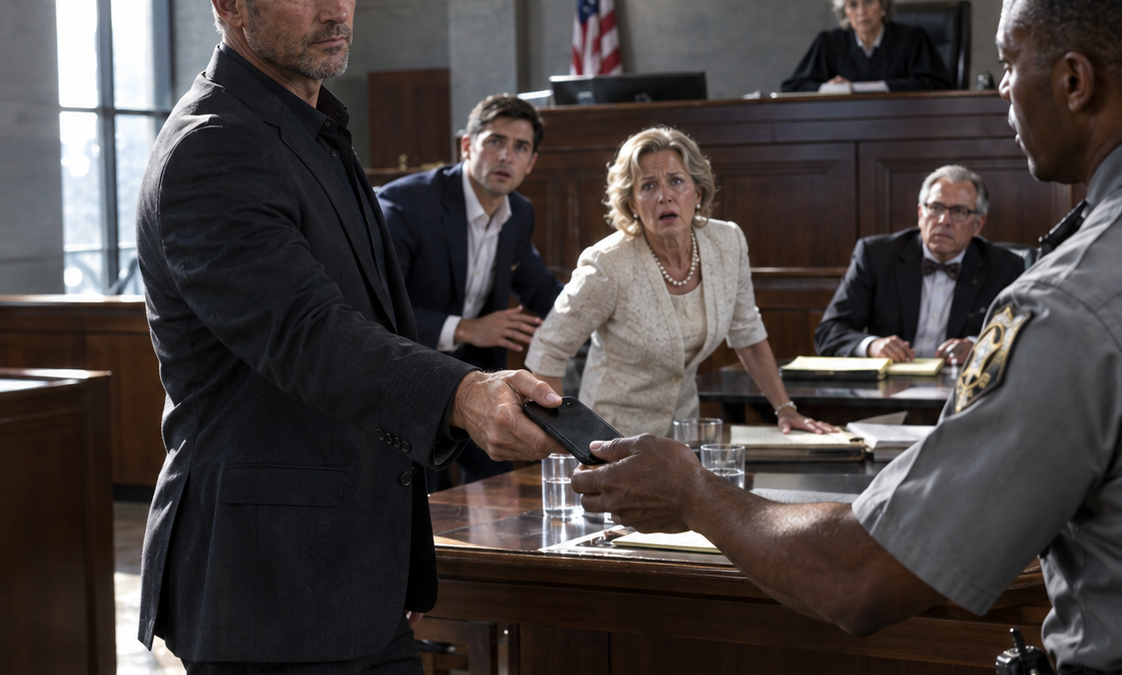
“My brother’s will named me executor. His wife didn’t like that. ‘Gary, honey, we don’t need to bother Danny with all this,’ Carol said, her hand resting on my forearm like a nurse checking for a pulse.”
The family thought the retired soldier would sign away the estate and go quietly back to North Carolina → he read the envelope, followed the paper trail to a Chicago shell network, and walked into the courtroom with the records that put them all in federal custody.
His wife didn’t like that.
“Gary, honey, we don’t need to bother Danny with all this,” Carol said, her hand resting on my forearm like a nurse checking for a pulse. “He’s been through so much. The family can handle the paperwork.”
She smiled when she said it. Carol always smiled.
What she didn’t know was that my brother had left me more than a legal title. He’d left me a manila envelope, eleven inches by fourteen, sealed with packing tape and marked in his own handwriting: For Danny — read alone.
My name is Daniel Mercer. I was fifty-six years old when my brother Michael died of a heart attack in his garage on a Tuesday afternoon, three weeks after he’d mailed that envelope to my address in Fayetteville, North Carolina. I’m a former U.S. Army Special Forces sergeant first class — a Green Beret, 7th Special Forces Group, retired after twenty-three years and change. I’ve been in rooms where people died. I’ve been in rooms where people lied about why others died.
I know the difference.
Carol’s smile was the first kind.
The funeral was at St. Bridget’s, a brick church in the suburbs of Columbus, Ohio, where Michael had lived for thirty-one years and where I’d visited exactly four times since I got back from my last deployment. That was my fault. I own that. The distance between us wasn’t his doing. It was mine.
I stood in the back of the church in a dark suit that fit a little loose in the shoulders, because I’d dropped twelve pounds since the surgery in March, and watched Carol receive condolences like a diplomat. She was good at it. She’d always been good at it.
My nephew Kyle stood beside her. Twenty-nine years old, a marketing manager at a healthcare company downtown, wearing a suit that cost more than my first car. He shook hands with the same three-hundred-watt smile he’d been using since he was a kid to get out of trouble.
“That’s your uncle Danny,” Michael used to tell him. “He’s a soldier.”
Was a soldier. Kyle always used the past tense when he mentioned it. As if the past were all I had.
“Uncle Danny,” Kyle said when he saw me. He shook my hand with both of his. “Thanks for coming. Dad would’ve wanted you here.”
Would’ve wanted. Past tense again.
“I’m sorry about your dad,” I said. “He was a good man.”
“He was.” Kyle’s smile flickered, then came back. “You should sit with us at the luncheon. Mom’s got it all arranged at the country club. It’s gonna be nice.”
“I’ll find a seat.”
“You do that.”
He patted my shoulder twice and moved on. The way you pat a man you’re not sure what to do with.
The luncheon was at the Wedgewood Country Club, a low-slung building of tan stone and brass fixtures that had been in the family — Carol’s family, not mine — for three generations. Carol’s father had been a member. Her grandfather had been a member. It was that kind of place.
White tablecloths. Arrangements of lilies. A table of framed photographs of Michael at various stages of his life — fishing trips, golf outings, a Caribbean cruise with Carol in 2018. Not a single photograph of the two of us together. Not one.
I noticed that. I notice things.
I sat at a table near the back with Carol’s cousins and an aunt who couldn’t remember my name and kept calling me “David.” I ate a chicken breast and green beans and listened to the speeches.
The lawyer spoke first. A man named Harold Finch, seventy-something, with a bow tie and thick glasses that magnified his eyes into something almost amphibian. He’d been the family attorney for forty years. He’d drawn up Michael’s will.
“The estate is in good order,” Harold said, reading from a single sheet of paper. “Michael was thorough, as always. He named his wife Carol and his son Kyle as primary beneficiaries. The house, the accounts, the business interests — all clearly designated.”
“Business interests” made my ears perk.
Michael ran a small commercial landscaping company. Fifteen employees. Twenty years of steady work. Not the kind of thing you’d call “interests,” plural.
“Michael also named his brother Daniel as executor of the will,” Harold continued, “which is a matter we’ll be addressing in probate.”
Carol’s hand found my forearm again. She’d materialized beside me without a sound. I hadn’t even seen her move.
“Danny,” she said, low and warm, “we should talk about that. After all this settles. Just the two of us.”
“Sure, Carol.”
“He loved you so much. You know that, right?”
“I know.”
“You were his hero. The Green Beret. The whole thing. He talked about you all the time.”
Past tense. The whole thing.
“I loved him too,” I said.
“He’d want this to be easy for us. You know how he was. He hated conflict.”
“He did.”
“So we’ll talk. You and me. Real soon.”
She squeezed my arm once, hard, and then she was gone, gliding back toward Kyle, who was holding court by the bar with a glass of something amber in his hand.
I finished my chicken. I drank my water. I watched the room.
And I thought about the envelope.
I drove back to Fayetteville three days later. Eight hours on I-70 and I-77, the rental car humming under me, the radio off. I don’t like the radio. I like the quiet.
I’d retired from the Army in 2019 and taken a job as a security consultant for a defense contractor in the Research Triangle. I’d bought a small house on a quiet street with a fenced backyard and a garage I kept clean. I lived alone. I’d never married. That was another thing Michael used to apologize for on my behalf — Danny never settled down, you know how it is — as if a life of service were something to be excused.
I’d killed men in three countries. I’d saved men in four more. I’d trained some of the best soldiers on earth, and I’d buried a few of them, and I’d stood at the back of their funerals in a suit that fit a little loose in the shoulders and listened to people say he was a good man without ever once knowing what that meant.
Michael was a good man too. He was a different kind of good.
And when I got home that Friday night, I opened the manila envelope.
It was thick. Almost an inch of paper. I sat at my kitchen table with a cup of coffee and a pocketknife and sliced the tape along the top edge, careful, the way you’d open a letter that mattered.
Inside were three things.
First, a handwritten letter. Four pages, front and back, in Michael’s neat, careful printing. He’d always printed, never cursive — he said his handwriting was too ugly for cursive. Even his signature looked typed.
Second, a spreadsheet. Six pages, printed, with columns and rows and dates and dollar amounts. Michael had been an accountant for eighteen years before he’d started the landscaping company. He knew his way around a spreadsheet.
Third, photographs. Four of them, printed on plain paper, taken from a security camera. Grainy but legible. Time-stamped.
I read the letter first.
Danny —
If you’re reading this, I’m gone. I’m sorry I didn’t have the guts to tell you any of this face to face. You were always the brave one. I was always the one who smiled and said everything was fine.
It’s not fine.
Carol has been taking money out of our joint accounts for two years. I don’t know how much. I stopped counting around $200,000. She thinks I don’t know. She’s been doing it a little at a time, so it doesn’t show up in the monthly statements. She’s got help from Kyle. He’s the one who set it up.
I found out last spring. I didn’t say anything because I was scared. I know how that sounds. You were in a war and I’m scared of my own wife. But she’s got her family’s money behind her, and she’s got lawyers, and she’s got everybody in this town, and I’ve got — I don’t know what I’ve got. I’ve got the business, and I’ve got the house, and I’ve got you, and I didn’t want to lose all three.
She’s got a boyfriend too. I don’t know who. Some guy she met at the club. I saw the texts. I didn’t say anything.
There’s a business loan I took out in 2020 to keep the landscaping company afloat during COVID. $180,000. Carol signed for it too. She’s been telling people I took it out alone. She’s been telling people I was the one who made bad decisions. She’s been telling people a lot of things.
The loan’s still there. She hasn’t touched it. It’s in both our names. If she doesn’t pay it, the bank comes after the estate, and the estate comes after the house, and everything she’s been trying to protect gets taken apart.
I put the details in the spreadsheet. I put the security photos in the envelope too — the ones of her and Kyle meeting with a guy at the club. I don’t know who he is. I’m sorry I can’t tell you more.
I love you, Danny. I’m sorry I wasn’t better at being your brother. I’m sorry I let them push you to the back of the family. You deserved better.
Please take care of this. You’re the only one I trust.
— Mike
I read it twice. Then I read it a third time.
Then I opened the spreadsheet.
The spreadsheet was meticulous. Michael had tracked every transaction he could find. He’d listed dates, amounts, account numbers, and the method Carol and Kyle had used to move the money — mostly through a series of small transfers to an account under Kyle’s name at a different bank, then onward to something called “Wexler & Associates LLC.”
Wexler & Associates. I didn’t know the name. But it sounded like the kind of thing a person sets up when they don’t want their name on the actual account.
The security photos showed Carol and Kyle at a table at the Wedgewood Club with a man in his fifties, bald, wearing a tan jacket. Three different dates. Three different meetings. The same man each time.
I studied the photos. The man had a specific watch on his left wrist — a chunky silver thing with a black dial. Michael had circled it in one of the photos, in pen, with a small arrow and the word NOTICE.
Notice what, Mike?
I stared at the pictures for a long time. Then I opened my laptop and started working.
I didn’t confront Carol. That’s not how I was trained.
In Afghanistan, when you’re trying to figure out who’s been stealing from the supply depot, you don’t walk in and accuse the quartermaster. You watch. You listen. You let people believe you’re not paying attention. You let them get comfortable.
That’s what I did.
I took two weeks of leave from my consulting job. I told my boss I had a family thing to handle. He said take all the time I needed.
I drove back to Ohio. I rented a room at a motel on the east side of Columbus — the kind of place where nobody asked questions and the parking lot was always half-full. I paid cash.
Then I started watching.
The first thing I noticed was the house.
Michael and Carol’s house was a four-bedroom colonial on a corner lot in a nice subdivision. Michael had bought it in 2001, before the market went crazy, and it was worth probably $600,000 now. Carol had never worked a full-time job in her life. Her family money had paid for the down payment. Her family money had paid for the kitchen remodel in 2015. Her family money had paid for Kyle’s private school, Kyle’s first car, Kyle’s college tuition.
But Michael had paid the mortgage every month for twenty-two years.
I sat in my car a block away, on the first evening, and watched the lights come on. Carol’s car in the driveway — a silver Mercedes SUV, three years old. Kyle’s car — a black Audi, leased. A third car I didn’t recognize — a dark sedan — pulled into the driveway at 8:15 and stayed until 11:40.
A man got out at 11:40. Mid-fifties. Not the man from the security photos. Someone else.
Carol kissed him at the door.
I didn’t react. I noted it. I noted the time, the make of the car, the man’s height and build and gait. I noted the fact that he was wearing a jacket that looked like the one from the photos — tan, but a different cut. Same style. Same club, maybe.
I noted it. Then I drove back to the motel.
The second thing I noticed was Kyle.
Kyle Mercer, twenty-nine years old, marketing manager, was living well above his means. His apartment in the Short North — the trendy part of Columbus — was a two-bedroom loft with exposed brick and a rooftop deck. Rent was probably $2,800 a month. His car was leased. His clothes were expensive. His watch was a Rolex, and I knew enough about watches to know it wasn’t a knockoff.
His salary at the healthcare company was $85,000 a year. I looked it up. It’s public information if you know where to look. $85,000 doesn’t buy a loft and a Rolex and an Audi.
I followed him for three days. He went to work. He went to the gym. He went to dinner at expensive restaurants with friends who looked exactly like him. He went to the Wedgewood Club twice.
On the second visit, he met with the same bald man from the security photos.
I took pictures with my phone. The zoom wasn’t great, but it was enough.
The bald man drove a gray Cadillac. I ran the plates. The car was registered to a company called “Wexler Holdings LLC,” incorporated in Delaware, with a registered agent at a law firm in Wilmington. I called a friend from my Army days who worked in financial crimes for the FBI. He owed me a favor — I’d pulled his son out of a bad situation in 2016, back when the kid was running with the wrong crowd — and he agreed to run the name through some databases he had access to.
“Wexler Holdings,” he said, calling me back two days later. “Shell company. No real operations. But it’s got a couple of interesting names attached to it. One of them is a guy named Richard Wexler. Sixty-one years old. Former investment advisor. Lost his license in 2009 after a client complaint. Never charged, but the SEC had him on their radar for a while.”
“What kind of complaint?”
“Client said he moved money out of their accounts without authorization. Small amounts over a long period. The kind of thing that doesn’t show up unless you’re looking.”
“What’s he doing now?”
“Nothing legitimate that I can find. He’s got a few LLCs. He’s got a country club membership. He’s got a boat. He’s got no reported income.”
“Where’s the money coming from?”
“That’s the question, isn’t it.”
I thanked him. He told me to be careful.
The third thing I noticed was the loan.
Michael’s letter had mentioned a $180,000 business loan from 2020, signed by both him and Carol. I found the paperwork in Michael’s filing cabinet — Carol hadn’t gotten around to clearing it out yet — when I stopped by the house on the pretext of picking up some papers Harold Finch needed for probate.
Carol was there. She was wearing a black dress and a pearl necklace, and she looked like she’d just come from a spa appointment. Her hair was perfect. Her makeup was perfect. Her smile was perfect.
“Danny,” she said, opening the door wide. “I was hoping you’d come by.”
“I need some documents. Harold said Michael kept everything in the study.”
“Of course. Of course. Come in. Can I get you anything? Coffee? Water?”
“I’m fine.”
“You always were the stoic one.” She laughed, light and airy. “Michael used to say you could sit through a hurricane without blinking.”
“That’s not true. I blink.”
She laughed again, longer this time, like I’d said something funny. I hadn’t.
The study was on the first floor, behind a set of French doors. Michael’s desk was still there, his chair, his bookshelves, his golf trophies. A photograph of him with Carol at a beach somewhere sat in a silver frame on the corner of the desk. He was smiling. She was smiling. They looked happy.
I found the loan paperwork in the third drawer I opened. Right where he’d said it would be.
I photographed every page with my phone. Then I put it back.
“Find what you needed?” Carol asked, appearing in the doorway.
“Yes.”
“Harold’s been so helpful with all this. I don’t know what we’d do without him.”
“He’s been the family lawyer for a long time.”
“He has. He’s practically family.” She paused. “Danny, I’ve been meaning to talk to you about the executor thing.”
“Okay.”
“It’s just — it’s a lot for you, isn’t it? All the way from North Carolina. And you’ve got your own life. Your own work.”
“I can manage.”
“I know you can.” Another smile. “You can manage anything. That’s what Michael always said. Danny can manage anything.”
“Did he?”
“He did. He admired you so much.” She stepped closer. “But this is different. This is family paperwork. Legal stuff. Probate stuff. It’s not — it’s not what you’re good at, honey. It’s not your world.”
I looked at her.
“What is my world, Carol?”
She blinked. Just once. Then the smile came back.
“Oh, you know. Guns and things. Army things. That’s your world. This is — this is accounting. This is law. This is Harold’s world. Let him handle it.”
“I’m the executor. I’ll handle it.”
“Danny—”
“I’ll handle it.”
Her smile held, but something behind her eyes shifted. A door closing.
“Of course,” she said. “Of course you will.”
I left with the paperwork I’d come for. I didn’t look back.
That night, I sat in my motel room and laid everything out on the bed.
The letter. The spreadsheet. The photographs. The loan documents. The notes I’d taken on Carol’s visitors and Kyle’s spending and Richard Wexler’s shell companies.
It was a puzzle. I’m good at puzzles.
In the Army, I’d been a team sergeant for most of my career — the guy who kept the team running, who tracked the supplies and the schedules and the little details nobody else wanted to bother with. I’d spent more time in a windowless room with a whiteboard than I’d spent in a firefight. That’s the truth nobody puts in the movies.
I laid out the pieces on the bedspread, and I started connecting them.
By midnight, I had a plan.
By 2 a.m., I had a problem.
Because the numbers didn’t add up the way I’d thought they would. Carol and Kyle had moved about $220,000 out of the joint accounts. That was the spreadsheet total. But the Wexler accounts had taken in much more than that — nearly $400,000 over the same period.
Where was the rest coming from?
I went back through the bank records. And I found it.
Michael’s landscaping company — Mercer Lawn & Landscape — had been paying invoices to a vendor called “Wexler Supply Co.” for two years. Small invoices. Monthly. Never more than $4,000 each. But they added up. $96,000 total.
The vendor address was a P.O. box in Delaware. The same registered agent as Wexler Holdings.
Carol wasn’t just stealing from the family accounts. She was laundering money through the business.
Michael had built that company from nothing. He’d started it with a used pickup truck and a push mower and a business card he’d printed at Kinko’s. He’d grown it into something real — fifteen employees, a fleet of trucks, a reputation. And Carol had been using it as a piggy bank.
I stared at the numbers for a long time.
Then I called my FBI friend back.
“I need one more thing,” I said.
“Name it.”
“I need to know if Richard Wexler has any connection to the Wedgewood Country Club.”
He was quiet for a moment. Then he said, “You know, that’s a weird question.”
“Why?”
“Because I was just about to ask you the same thing.”
PART 2 — THE CLUB
My FBI friend’s name was Marcus Webb.
We’d met in 2005, when he was a young agent assigned to a task force in Kabul and I was a team sergeant running village stability operations in the mountains north of the city. He’d been green then. Nervous. He’d wanted to prove something. I’d taught him how to read a room, how to listen, how to stay alive. He’d never forgotten.
“You’re not going to believe this,” Marcus said. “I ran Wexler through our financial crimes database. He’s been on our radar since 2017. We’ve never had enough to charge him, but we’ve got a file. He runs a small operation — maybe a dozen clients, all wealthy, all older, all with family money they don’t entirely understand.”
“What’s his angle?”
“He befriends them at country clubs. Gets close. Learns their finances. Then he offers to ‘help’ — investment advice, estate planning, that kind of thing. He moves small amounts out over years. Never enough to trigger an audit. Never enough for the victim to notice. By the time they figure it out, he’s gone.”
“How many clubs?”
“At least three in Ohio. Wedgewood’s one of them. He’s been a member there since 2012.”
I let that settle.
“He’s a member,” I said.
“He is. Under his own name. Pays his dues every year. Never causes trouble. The club loves him.”
“Does he know Carol Mercer?”
Marcus was quiet for a moment. I could hear him typing.
“He’s been photographed at club events with her. Three events in the last eighteen months. A charity gala in 2023. A member-guest golf tournament last spring. And a Christmas party last December.”
“The Christmas party. Was my brother there?”
“Doesn’t look like it. I’ve got the guest list. Carol Mercer plus one. Michael Mercer not listed.”
I stared at the wall of my motel room.
“She brought Wexler as her plus one.”
“That’s what the record says.”
“Did anyone notice?”
“Nobody’s going to notice at a club like that. Husband’s not feeling well, wife brings a friend. It’s not a scandal. It’s a Tuesday.”
“Except my brother wasn’t sick.”
“No. He wasn’t.”
I thought about Michael, sitting at home alone on a December night, while his wife was at the club with the man who was helping her steal his money.
“Marcus, I need one more thing.”
“Name it.”
“I need to know who else is on Wexler’s client list. Specifically, anyone connected to the Wedgewood Club.”
“That’s going to take a warrant.”
“I know.”
“You’re asking me to break the law.”
“I’m asking you to look at a file you already have access to. For a case you’ve already got open. I’m not asking you to do anything you wouldn’t do anyway.”
Marcus was quiet. Then he said, “You saved my life in Kabul.”
“I did my job.”
“You did more than your job. You pulled me out of a ditch while people were shooting at us. You carried me three miles.”
“You’d have done the same.”
“I would have tried. I don’t know if I would have made it.” He exhaled. “Give me a week.”
“Thank you.”
“Don’t thank me yet. Thank me when we’ve got something that sticks.”
I spent the next three days doing what I do best.
Nothing.
That’s not a joke. In my line of work — the real line of work, not the movies — the most important skill is patience. The ability to sit in a car for six hours and watch a door. The ability to listen to a conversation and not interrupt. The ability to wait for the other guy to make a mistake.
Carol was going to make a mistake. They always do.
I watched the house. I watched Kyle’s apartment. I watched the Wedgewood Club from a parking lot across the street, using a pair of compact binoculars I keep in my glove compartment for exactly this kind of thing.
On the third day, I saw something interesting.
Carol came out of the club at 2:15 in the afternoon, arm in arm with a man I didn’t recognize. He was tall, silver-haired, wearing a navy blazer and khakis. He opened her car door for her. She touched his arm when she got in.
Not Wexler. Someone else.
She was collecting them.
I took a picture. Then I called Harold Finch.
“Harold, this is Danny Mercer.”
“Danny. Good to hear from you. How’s North Carolina?”
“Fine. I need to ask you something about the probate process.”
“Of course. What do you need?”
“I need to know when the next hearing is.”
“Next Thursday. Ten a.m. At the county courthouse. It’s a formality, really — just a status update for the court. You don’t need to be there.”
“I’ll be there.”
“Oh. Well. That’s — that’s fine. Carol will be there too. With Kyle.”
“Good.”
“Danny, is everything all right? You sound — different.”
“I sound the same, Harold. I’m just paying attention.”
He paused. “Carol mentioned you might be having second thoughts about the executor role.”
“Did she.”
“She said you seemed overwhelmed. She said you might want to step aside and let her handle things.”
“Did she say that.”
“She did. She’s very concerned about you. She said you’ve been — I don’t know — distant. Preoccupied.”
“I’ve been working.”
“Of course. Of course. Well, we’ll see you Thursday, then.”
“See you Thursday.”
I hung up. Then I sat in my motel room and thought about what Carol was doing.
She was building a narrative. Danny’s overwhelmed. Danny’s not up to it. Danny should step aside. She was laying the groundwork for a legal argument — that the executor was unfit, that the family should take over, that the will should be administered by someone who understood “their world.”
She didn’t know I’d been in a windowless room with a whiteboard for the better part of twenty years. She didn’t know I’d tracked supply chains through hostile territory, managed budgets under fire, kept teams of twelve men alive in places where the wrong decision meant death.
She thought I was a soldier. Past tense. A man who couldn’t handle paperwork.
I let her think it.
Thursday came.
The county courthouse was a gray stone building downtown, four stories tall, with a metal detector at the entrance and a lobby that smelled like floor wax and old paper. I arrived at 9:30, wearing a dark suit and a plain tie, and I sat in the hallway outside the probate courtroom and waited.
Carol arrived at 9:50. Kyle was with her.
She was wearing a cream-colored dress and a string of pearls. Kyle was in a navy suit with no tie. They looked like they were going to a garden party. They looked like they belonged.
“Danny,” Carol said, her face lighting up. “You came.”
“I said I would.”
“I know, I just — I didn’t want you to feel obligated. This is all so tedious.”
“I don’t mind tedious.”
Kyle shook my hand. “Uncle Danny. Good to see you.”
“You too, Kyle.”
“Mom says you’ve been in town for a while. You should’ve called. We would’ve had you over for dinner.”
“I’ve been busy.”
“Busy with what?” Carol asked, light and curious.
“Just catching up on things.”
She smiled. “You were always so mysterious.”
Harold Finch arrived at 9:55, carrying a leather briefcase and looking nervous. He shook hands with Carol and Kyle, nodded at me, and led us into the courtroom.
The hearing was quick. The judge — a woman in her sixties with short gray hair and reading glasses — asked a few routine questions. Was the estate inventory complete? Were there any disputes among the beneficiaries? Did the executor have any conflicts of interest?
Harold answered for me. He was smooth. He’d done this a thousand times.
Then Carol spoke.
“Your Honor,” she said, her voice soft and careful, “I’d like to request that the court consider a change to the executor designation.”
The judge looked up. “On what grounds?”
“My brother-in-law, Daniel Mercer, is a wonderful man. He’s a decorated veteran. He’s served his country with honor. But this estate is complicated. There are business interests. There are debts. There are ongoing obligations. And Daniel — well, he’s been away from the family for a long time. He doesn’t know the details.”
I sat still.
“Mrs. Mercer,” the judge said, “the executor was designated by the deceased. That’s not something the court takes lightly.”
“I understand. I do. But I’m concerned about Daniel’s ability to handle the complexities of the estate. He’s been — with respect — he’s been dealing with some personal challenges.”
The judge looked at me. “Mr. Mercer, do you have anything to say?”
I stood up.
“Your Honor,” I said, “I’m prepared to execute my brother’s will exactly as he wrote it. I’ve reviewed the estate documents. I’ve reviewed the financial records. I’m aware of the debts and the obligations. And I’m prepared to fulfill my responsibilities.”
Carol’s smile flickered.
“Mrs. Mercer,” the judge said, “do you have any evidence that Mr. Mercer is incapable of serving as executor?”
“No, Your Honor. I just — I wanted the court to be aware of my concerns.”
“Concerns noted. The executor designation stands. This hearing is adjourned.”
Carol’s face didn’t change. But her hands, folded in her lap, tightened.
I saw it. I noticed.
We walked out of the courtroom together. Carol was quiet. Kyle was quiet. Harold was talking, filling the silence with legal pleasantries.
“Danny,” Carol said, stopping me in the hallway. “Can I speak with you for a moment?”
“Sure.”
Kyle and Harold moved ahead. Carol pulled me aside, near a window that looked out over the parking lot.
“I don’t understand,” she said. Her voice was still soft, but the warmth was gone. “Why are you doing this?”
“Doing what?”
“The executor thing. The estate. All of it. You don’t need this. You don’t want this. You’ve got your own life.”
“Michael asked me to.”
“Michael’s gone, Danny.”
“I know.”
“So why are you making this so hard? I’m trying to protect the family. I’m trying to protect Kyle. I’m trying to keep everything together. And you’re — you’re standing in the way.”
I looked at her.
“Am I?”
“You know you are.” Her eyes were bright. Angry. “You show up here after thirty years of being gone, and suddenly you’re the expert? You’re the one who knows what’s best? You didn’t even come to his birthday last year.”
“I was deployed.”
“You’re always deployed. You’re always somewhere else. You’re always too important for the rest of us.” She stepped closer. “Michael loved you. He worshipped you. But you weren’t here. You weren’t here when he was sick. You weren’t here when the business was struggling. You weren’t here when he needed someone.”
I let her talk.
“I was here,” she said. “Every day. For thirty-one years. I was the one who held this family together. And now you want to swoop in and take over? You want to be the hero?”
“I don’t want to be the hero.”
“Then what do you want?”
I looked at her for a long moment.
“I want the truth,” I said.
Her face changed. Just a flicker. Just a fraction of a second.
Then the smile came back.
“The truth about what?”
“Everything.”
She laughed. It sounded real. It probably was real, to her.
“You’re so dramatic,” she said. “Just like Michael said. Danny’s always looking for the conspiracy.”
“Was he?”
“He said you couldn’t help it. It was the training. You see enemies everywhere.”
“I don’t see enemies, Carol. I see patterns.”
She stared at me.
“What pattern?”
I didn’t answer.
“I’ll see you at the next hearing,” I said. “Take care of yourself.”
I walked away. I didn’t look back.
But I felt her eyes on me the whole way down the hall.
That night, Marcus called.
“I’ve got something,” he said. “You’re not going to like it.”
“Tell me.”
“Richard Wexler’s client list. I can’t give you names — that’s protected. But I can tell you this: he’s got at least four clients in the Columbus area, all connected to the Wedgewood Club. All of them are older. All of them have family money. And all of them have had ‘unexplained’ withdrawals from their accounts in the last three years.”
“How much total?”
“Close to two million dollars.”
I let that sink in.
“Two million.”
“Across four victims. One of them died last year. His estate is still in probate. His daughter’s been trying to figure out where the money went.”
“Does she know about Wexler?”
“She knows something’s wrong. She doesn’t know what.”
“Can you put me in touch with her?”
“I can’t give you her name. But — off the record — she’s been asking questions. She’s been calling the club. She’s been calling the bank. She’s been making noise.”
“Good. Noise is good.”
“Danny, be careful. Wexler’s not a lone operator. He’s got connections. He’s got lawyers. He’s got people who owe him favors.”
“I’ve dealt with worse.”
“I know you have. But this isn’t Kabul. This is Ohio. The rules are different.”
“I know the rules.”
“Do you?”
I thought about that.
“I know enough,” I said.
The next morning, I went to the Wedgewood Club.
Not as a guest. I didn’t have a membership. I went as a vendor — a guy in a work shirt and a clipboard, checking the irrigation system on the back nine. I’d called the club the day before and told them I was from a landscaping company, following up on a service request. The woman on the phone didn’t ask any questions.
I spent four hours on the property. I walked the course. I checked the sprinkler heads. I made notes on my clipboard.
And I watched.
I watched the members arrive. I watched them park their cars. I watched them walk through the front door and greet each other with handshakes and air kisses. I watched the staff — the waiters, the groundskeepers, the front desk girls — move around them like they were invisible.
I watched Carol arrive at 11:30, wearing a tennis skirt and a white top. She met a woman near the courts. They hugged. They laughed. They went inside.
I watched Richard Wexler arrive at 12:15. He was driving the gray Cadillac. He parked in a reserved spot near the front. He walked in like he owned the place.
He was inside for two hours.
When he came out, he was with Carol.
They walked to the parking lot together. They stood by her car for a few minutes, talking. Then he touched her shoulder. Then he got in his car and drove away.
I took pictures. I noted the time.
Then I finished my irrigation check and left.
I sat in my motel room that night and laid everything out again.
The letter. The spreadsheet. The photographs. The loan documents. The notes on Carol’s visitors. The notes on Kyle’s spending. The notes on Wexler’s shell companies. The notes from Marcus. The new pictures.
It was all there. Every piece.
But I needed one more thing. I needed something that would hold up in court. Something that would prove, beyond doubt, that Carol and Kyle and Wexler had been stealing from Michael and from the business — and from other people too.
I needed a document.
A document with signatures. A document with dates. A document that connected the money to the people.
I thought about where that document might be.
Then I thought about Kyle.
Kyle was the weak link. He always had been. He was smart enough to set up the scheme but not smart enough to hide it forever. He was arrogant. He was careless. He was the kind of man who kept receipts.
I’d followed him for three days and watched him throw away a receipt from a restaurant. He’d thrown it in a public trash can. I’d waited until he was gone and retrieved it. It was for a dinner at a steakhouse — $340, four people, paid with a company card.
The company was Mercer Lawn & Landscape.
Kyle was using his dead father’s business account to pay for dinners.
That was the kind of man he was.
I needed to get into his apartment.
It took me two more days.
Kyle worked from home on Fridays. I watched him leave at 8 a.m. on a Thursday, dressed for the office. I waited an hour. Then I walked up to his building and let myself in through the back entrance — a door that didn’t quite latch, which I’d noticed on my second day of surveillance.
His apartment was on the third floor. The lock was a standard deadbolt. It took me ninety seconds to pick it.
I’m not proud of that. But I’m not ashamed either. Michael had asked me to take care of this. I was taking care of it.
The apartment was exactly what I expected. Expensive furniture. A big TV. A kitchen that looked like it had never been used. A bedroom with clothes on the floor. A bathroom with more products than a pharmacy.
And a home office.
The office was a converted closet with a desk and a filing cabinet and a laptop. The laptop was password-protected. I didn’t touch it. I didn’t need to.
The filing cabinet was unlocked.
I opened the top drawer.
Inside were folders. Dozens of them. Labeled with names and dates. Wexler — 2022. Wexler — 2023. Club — Q1. Club — Q2. Mom — Expenses.
I pulled out the folder marked Mom — Expenses.
It was all there. Every transfer. Every deposit. Every conversation summarized in Kyle’s neat, tidy handwriting. Dates. Amounts. Account numbers. Notes like “Mom says keep under $5K” and “Wexler wants 15% cut” and “Dad doesn’t know — don’t tell him.”
I photographed every page.
Then I found the folder marked Dad — Loan.
It was the business loan. The $180,000. But there was more.
There was a second loan. $90,000. Taken out in 2022. Signed by Carol. Cosigned by Kyle. The money had gone into the business account and then out again, in a series of transfers to Wexler Supply Co.
Michael hadn’t known about the second loan. He’d never signed for it.
Carol had forged his signature.
I photographed that too.
Then I put everything back exactly where I’d found it, let myself out, and walked back to my motel.
I had what I needed.
 [Tap here for the Next Part ]