Gun to Her Head, the Quiet Nurse Saved Him—Then “Ghostline Six” Was Revealed – Part 1
Gun to Her Head, the Quiet Nurse Saved Him—Then “Ghostline Six” Was Revealed
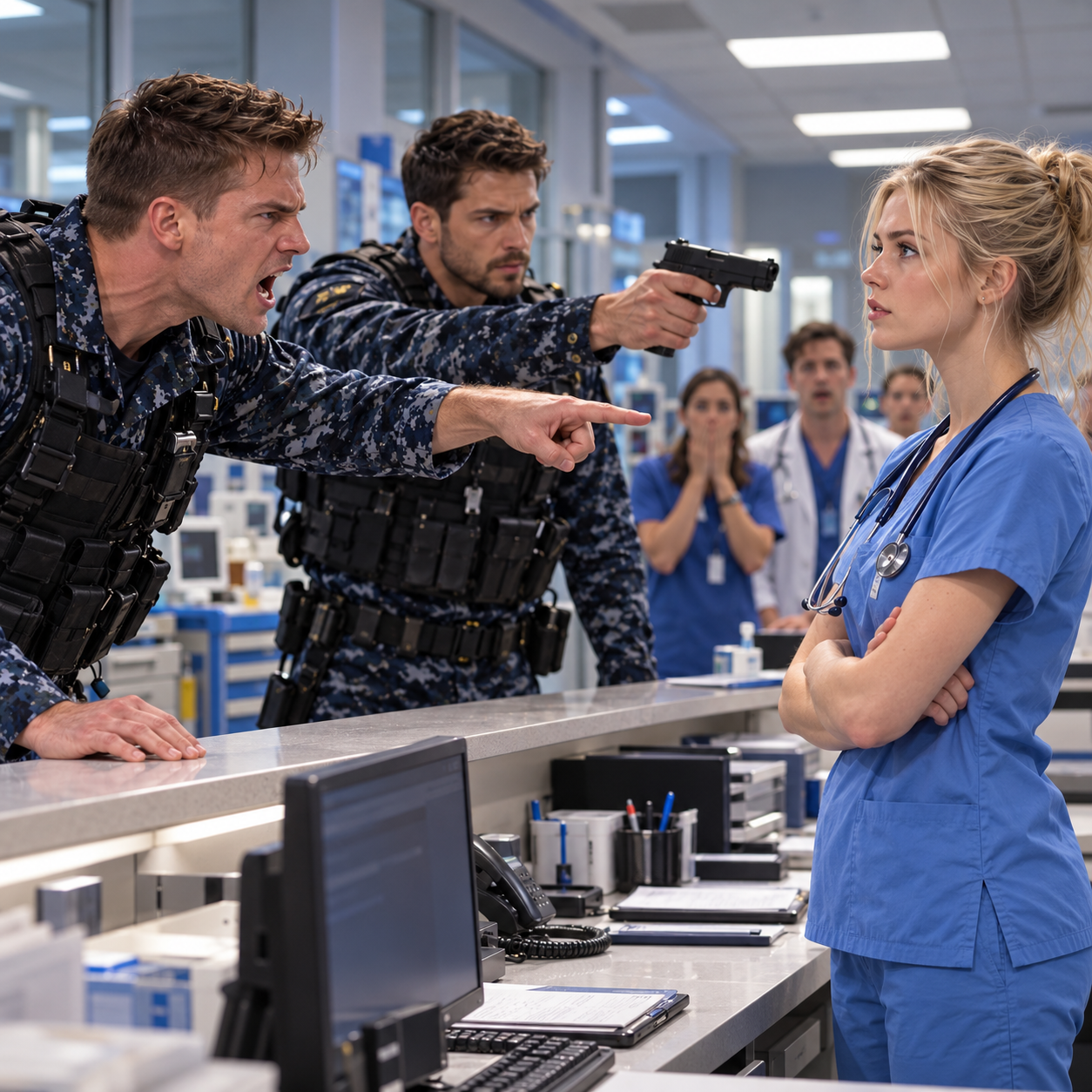
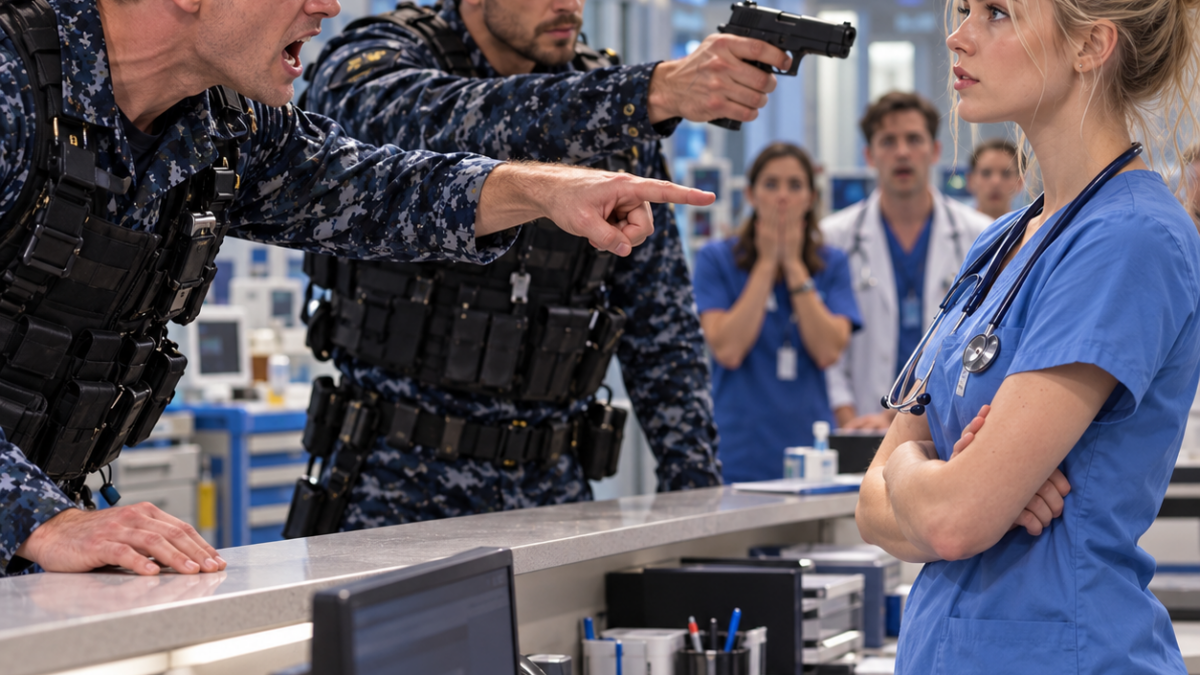
The gun was already touching her temple before she finished turning around.
Evan Ror, 24 years old, hands trembling. Sidearm stolen from the equipment locker.
Three floors upressed the muzzle against the side of Mara Vance’s head and told her to destroy the blood sample or he would put her on the floor next to his teammate.
Mara did not scream. She did not beg.
She looked at the unconscious man strapped to the trauma table.
Noah Bell, 23, cardiac monitor, shrieking and she quietly said, “Your trigger finger is outside the guard.”
Ror blinked. Fix it, she said.
Or you’ll shoot the wall when he codes.
47 minutes before Ror puts a stolen pistol against Mara Vance’s head, the trauma bay at Harrove Military Medical Center was having what passed on a Tuesday night for a quiet shift.
Quiet at Harrove meant something different than it meant at civilian hospitals. It meant no active combat casualties, no field evacuation handoffs, no surgeons sleeping upright in chairs waiting for the helicopter pad to light up. It meant the monitors beeped at their normal intervals.
The fluorescent panels overhead cast their usual greenish por over the lenolum and the nurses had time to drink coffee before it went cold. Mara Vance had been a night shift trauma nurse at Harrove for 5 years.
She was 39 years old. She had short dark hair she kept tied back with the kind of elastic band you could buy 20 for a dollar at any pharmacy.
Wore scrubs the color of faded ocean water and had a pair of battered silver traumata shears clipped to her badge that she never explained to anyone who asked about them. People occasionally asked.
She always said they’d belong to a colleague.
Left it there.
She was charting at the nurse’s station when the automatic doors at the far end of the corridor slammed open at 11:47P.
M and two men in military physical training gear came in half carrying a third. Mara was on her feet before the doors finished swinging. She had worked enough military er shifts to read entries fast.
The two men walking were young, early to mid20s. the wide-shouldered, neck thick build of advanced tactical candidates. The man between them was the same age, maybe younger, and he was not walking.
His feet dragged, his head listed left. His lips had a bluish tint that Mara clocked from 15 ft away and did not like at all.
“What happened?”
she said, already moving toward them. The taller of the two square jaw, closecropped dark hair, eyes that were working too hard to seem calm, answered before she finished the question. Training accident.
He collapsed during a conditioning run. He just needs to rest. He just sir.
Mara cut across him without raising her voice. I need you to step back and let me look at him. She took the patients weight from them, got her hands on his wrist.
The pulse was there, but wrong, fast, and thin, like a thread pulled too tight. His skin was clammy.
She pulled back his eyelid with one thumb and checked his pupils. Equal reactive but slow.
“Get me a bay,” she said over her shoulder to the desk.
Then to the two men names, his first Noah, the shorter one said.
He was 22, maybe 23, with a buzzcut starting to grow out and the look of someone who’d been holding a bad secret for longer than his face was designed for.
Noah Bell.
He’s 23.
We’re We were doing an endurance drill off schedule.
It wasn’t official.
I need his name and his medical history, not a legal brief. Mara guided Noah toward bay 3, where an aid was already pulling the curtain.
Is he on any medications? any supplements?
Did he hit his head? No medications, the tall one said. Supplements, the short one said at almost the same moment and then stopped.
Mara glanced at them both, filed it. She got Noah onto the gurnie, checked his airway, positioned him, and began the initial assessment with the brisk efficiency of someone who had done this 10,000 times and still treated each time like it counted, which she did. That was a thing about Mara that the people who worked with her had noticed early.
She moved fast, but she never looked rushed. There was a difference.
I’m putting in an IV line, she said.
Someone hold his arm still. What are your names? Ror, the tall one said.
Evan Ror. Luis Ortega said the other.
Okay. Ror Ortega, I need you both over there.
She nodded toward the wall.
I’ll come to you right now.
I need room. Ror took a half step back. Ortega went to the wall.
Mara had the line in within 40 seconds.
She’d done it in worse conditions than this.
In the dark, in moving vehicles, in temperatures cold enough to numb her fingers. A fluorescent lit trauma bay with a cooperative patient was practically a classroom exercise.
But Noah Bell was not cooperative.
He wasn’t conscious enough to be cooperative.
His body kept doing small involuntary things that she was watching very carefully. The slight arching of his back you the tension around his eyes that suggested pain somewhere deep and internal.
She put the first set of vitals on the monitor. His blood pressure was lower than it should be far lower for a physically fit man in his mid20s.
His heart rate was elevated, but the rhythm was irregular in a way that didn’t match a straightforward vasovagal collapse.
She ordered an EKG lead placement and turned to the respiratory tech. I want oxygen and an AG, and I need a full metabolic panel, CBC, CAG panel, and talk screen. How broad on the talks?
The tech asked. Broad, Mara said.
Then because her instincts were already prickling in a way she’d learned not to ignore and an expanded panel include anything you’d run for a performance drug screen.
She was aware of Ror’s posture changing.
She didn’t look at him directly.
She didn’t need to.
Is that standard? He said from the wall for a healthy 23-year-old presenting with unexplained cardiac irregularity and low blood pressure.
She was drawing the blood sample as she spoke. Yes, he just pushed himself too hard. Then the labs will confirm that.
She capped the specimen tubes and held them out to the aid. Pneumatic to the lab. Now the aid took them and went.
Mara straightened and finally looked at Ror directly for the first time since she’d gotten her hands on Noah.
What she saw was a young man who was frightened. That was normal. People in emergency rooms were usually frightened.
What was less normal was the specific flavor of his fear, which was not the ragged, helpless fear of someone watching a friend collapse. It was the contained, calculating fear of someone trying to manage what other people were about to find out.
She’d seen that particular expression before.
Different context, different uniform, different decade of her life. You said this was off schedule, she said.
Who was supervising the drill? Nobody formally.
We organized it ourselves. Is there a training log for the session? A beat too long.
It was unofficial, Mr. Ror.
She kept her voice neutral.
I’m not asking because I’m interested in your administrative record.
I’m asking because whatever your friends did in the hours before he arrived here is relevant to figuring out what’s wrong with him.
So, I’m going to ask again.
Was there a supervisor present?
Ror’s jaw tightened.
No, behind him very slightly.
Ortega’s head dropped.
Mara noted both things. She went back to Noah.
Doctor, Sadi Ren.
The trauma attending on tonight’s rotation came in at 12 minutes after Noah’s arrival.
Ren was 44, compact, with the kind of no- wasted motion energy that good emergency physicians developed after years of being outnumbered by sick people.
She took one look at the monitor, one look at Noah, and pulled Mara into a a 30-second verbal summary that they delivered in the shorthand of people who’d worked the same shifts for years.
Pulse Ox, Ren said, started at 88.
We’ve got him to 94 with supplemental.
That’s a significant gap for a respiratory healthy athlete.
I know.
What’s the story from the family?
Friends, not family. Training partners.
Mara tilted her head subtly toward Ror.
They’re inconsistent.
Ren glanced at the two men without making it obvious. Talks panel. Ordered broad.
Waiting.
Ren studied Noah’s rhythm on the monitor for a moment.
This is an exertion. Mara.
No, Mara said, “It isn’t.
” That was when Noah Bell opened his eyes.
It lasted maybe 12 seconds.
He surfaced through whatever was pulling him under with what looked like enormous effort, eyes tracking in a confused arc before they found Mara’s face.
His lips moved. She leaned down close. His hand came up and grabbed her wrist.
His grip was surprisingly strong, stronger than a man in his condition should have managed. Two words, fragmented, barely voiced.
Blue vial. Then his eyes closed and his cardiac rhythm stuttered and the monitor alarmed and Mara was already moving, calling the response because Noah Bell had just told her something that she did not yet fully understand, but that lodged in the back of her mind like a splinter. blue vial.
She got him stabilized. It took 6 minutes and a medication push and Ren calling out adjustments and calling out adjustments and the team moving with the practice coordination of people who drilled this scenario until it lived in their hands rather than their heads.
By the time Noah’s rhythms and settle back into something they could work with, Mara looked up and found Ror standing at the edge of the bay.
He’d heard she could see it in his face.
The calculation there had shifted, become harder, more urgent.
Whatever he’d been trying to manage before, it had just become more complicated.
Is he going to be okay? Ortega asked from behind him. Genuine no calculation in it.
Just the voice of someone who was actually scared about his friend.
We’re working on it, Mara said.
What did he say? Ror asked. She looked at him for a moment.
He’s not fully coherent.
We see that with severe hypoxic events. It was technically true. She turned back to the monitors.
3 minutes later, the aid came back from the pneumatic stations alone. Specimen, she said quietly to Mara. The tube system flagged an issue.
The sample didn’t go through.
Mara frowned. What kind of issue?
Physical obstruction in the secondary line. Maintenance is looking at it.
They want to know if you want to rescend by hand or wait.
She looked at the specimen tubes in the aid’s hands.
Then at Ror, who was watching this exchange with the focused attention of a man who just realized he still had a chance.
I’ll take them myself, Mara said.
She took the tubes, walked them to the corridor and through the door toward the lab transit desk, handed them to the overnight tech, watched them get logged and tagged and carried through the interior door. When she turned around, Ror was standing in the corridor behind her.
“Um, I just wanted to check if there was a family notification protocol,” he said.
“He was too close, 6 ft, maybe five.”
His voice had a careful quality like he was choosing each word one at a time. Dr.
Ren handles family notification.
Mara said, “Right, he didn’t move.
Mr.
Ror, you’re in a restricted corridor.
You need to go back to the waiting area.”
He held her gaze for a beat longer than was comfortable. Something moved across his face.
She couldn’t name it exactly, but it was in the same family as a decision.
I’ll need to know what tests you’re running.
He said for our training records standard protocol.
You’ll get a copy of the relevant portions through the base lison office once treatment is complete.
That could take days. Yes, she said it could. She walked past him and back into the bay.
Dr. Ren had stepped out briefly to call the senior duty officer about a possible military training incident. Protocol.
Mara charted the medication administration, updated Noah’s vitals record, checked the IV line, and was moving toward the nursing station when the lights in the corridor flickered.
Not a full outage, a flicker, and then the overhead panel at the end of the hall went amber instead of white. Emergency auxiliary mode. She stopped.
The electronic access panel beside the main trauma corridor door, the one that controlled passage between the treatment wing and the main hospital, made a short flat sound, and then the green light on it, turned red. Local lockdown. Mara had seen that mode once before during a drill.
It meant something had triggered the emergency isolation protocol, which could be activated from three places. the hospital security station, the main building control panel, or a secondary access terminal that existed specifically for scenarios where external emergency personnel needed to seal a contaminated or compromised ward.
She stood in the corridor for 2 seconds, then she turned. Ror was standing at the far end of the hallway.
Ortega was beside the bay door and Ror’s right hand was no longer empty.
She didn’t know where he’d gotten it.
Theft from the security equipment locker on the third.
Later learned he’d memorized the access code during a previous rotation through the facility.
The kind of incidental knowledge that ambitious trainees accumulated and that nobody thought to regulate but because nobody imagined what could be done with it. The pistol was standard military issue.
His hand wasn’t steady.
Mara looked at the weapon for approximately one full second. In that second, she rats friend.
She registered several things simultaneously. The distance, his stance, which was slightly wrong weight, too far forward, the specific grip, which told her something about his training level, and the trigger finger, which was outside the guard.
The last detail was the one she mentioned.
“Your trigger finger is outside the guard,” she said.
Ror stared at her.
Fix it, she said, or you’ll shoot the wall when he codes.
Behind him, Noah Bell’s cardiac monitor made a sound that none of them wanted to hear.
You need to let me work, she said, not moving, not backing up, meeting his eyes with an expression she had spent years cultivating. Not defiance, not fear, just the specific steady of someone who has decided what they are willing to accept.
Whatever you think is about to happen with those labs, I promise you it gets worse if Noah dies in there.
Ror’s hand tightened on the grip.
The blood sample, he said. I need to know where it went.
It went to the lab. Can you recall it? No.
Then you’re going to help me destroy the chart.
She looked at him for a moment. Truly looked not at the weapon.
at him, at the way his shoulders were set, at the perspiration on his forehead, at the specific mixture of determination and horror that was doing battle on his face. He was not a bad person, she thought.
That was the thing.
He was a person in a terrible situation, making decisions that were going to outlast this room in ways he hadn’t yet imagined.
Evan, she said, first name deliberate. Destroying this chart will not do what you think it will do.
The lab received those samples on an independent tracking system.
There are chain of custody logs that don’t exist inside this hospital’s records.
You cannot erase this.
I don’t need to erase it, he said.
And his voice had steadied in a way that was somehow more frightening than when it had been shaking. I just need to create enough uncertainty that any single result can be challenged.
You’re going to help me do that.
And Noah, a pause. Noah will be fine.
Noah, she said quietly, has a cardiac arhythmia that is not consistent with physical exertion, blood oxygen levels that recovered too slowly for simple exhaustion. And he used his last coherent moment to tell me something. When his labs come back, she paused.
And they will come back. Evan, there is nothing you can do about that. You You are going to want to be on the right side of what they show.
You don’t know what they’ll show.
Blue vial, she said. The silence in the corridor was complete.
Ortega, from his position by the bay door, made a sound that wasn’t quite a word.
Ror’s face had changed.
The calculation she’d seen there before had been replaced by something raarer, something that looked almost like grief.
And underneath the grief was the particular expression of someone who has just realized realized that the thing they feared this most has already happened. Who told you that?
He said Noah did.
Noah doesn’t know what he stopped himself.
Mara waited.
He doesn’t know the difference.
Ror finished. And the way he said it made very clear that Noah did know the difference and that Ror knew it too.
and that this entire situation was built on a foundation that someone else had constructed and that these three young men were now trapped inside.
“What was in the blue vial?”
Evan his jaw worked.
“Louise,” she said, shifting her eyes to Ortega.
“Do you know?”
Ortega looked at the floor. His hands were clasped in front of him, a posture that was almost like a man at prayer, except his knuckles were white. Commander Sloan, Ortega said very quietly.
Told us they were recovery compounds. Luis Ror said sharply. He told us they were recovery compounds.
Ortega said again louder this time as if saying it a second time was necessary to make it real. He said it was part of the performance protocol. He said the program had military approval.
He said Noah got a a different formulation because Noah was in the advanced cohort and it was a a targeted application. He called it Luis the monitors.
Ortega said and now he was looking at Mara and his eyes were the eyes of someone who has been carrying something heavy for long enough that being allowed to put it down was almost a relief if even the relief was going to cost him everything. We all had physiological monitors.
Sloan collected the data himself. I still have mine.
It’s in my gear bag.
Stop talking, Ror said. The cardiac monitor in bay 3 alarmed again different tone this time.
Not the apparent rhythm warning, but the more urgent lower pitched alarm that meant something in Noah Bell’s vital signs had crossed a line from concerning to critical.
Mara turned toward the bay door. I need to be in there, she said. Ror moved to block her.
I need to be in there, she said again. And her voice had not changed.
Same pitch, same pace, same absolute lack of performance in it. You can keep that weapon on me the entire time.
You can stand at my elbow. I cannot help you manage any outcome here. If Noah dies in that room, and I am telling you right now, Evan, that if you keep me out here for the next 4 minutes, that is exactly what is going to happen.
The alarm continued. Somewhere outside the sealed corridor, muffled by the emergency doors, Mark could hear her voices of special staff discovering the lockdown, trying to reach someone inside. Ror looked at the door, at Mara, at the weapon in his hand.
At the door again, and somewhere in the locked trauma unit, Noabel’s heart was doing something that could not wait.
Ror stepped aside. It was not a surrender.
His shoulders stayed rigid. The weapon stayed in his hand and his jaw was set with the particular stubbornness of someone who had committed to a direction even as the ground beneath it was shifting.
But he moved away from the door and Mara did not waste time analyzing it. She pushed through into bay 3.
Noah’s monitor was showing ventricular ectopy premature beats firing from the wrong part of the heart.
The rhythm stuttering every third or fourth beat in a pattern that made the machine alarmed and made Mara’s hands move faster than her face showed.
She checked the IV line, the oxygen delivery, the medication dosages already running. Ren had started him on a cardiac stabilization protocol before stepping out before stepping out and the baseline was solid, but something had progressed in the 14 minutes Mara had been in the corridor. She pulled up his blood pressure readout lower.
The downward trend was slow, but it was there.
The kind of gradual decline that didn’t look catastrophic on any single number, but that told a story when you put the numbers in sequence.
She adjusted the IV rate, checked his pupils again, listened to his chest with the stethoscope she’d had around her neck the entire time.
His breath sounds were clear, which ruled out pulmonary edema. The oxygen was getting into his lungs.
The problem was somewhere in what his blood was doing with it. Ror came in behind her. He stood at the far end of the gurnie, weapon still in hand, but pointed at the floor now, which was something.
Ortega remained near the door.
“What’s wrong with him?”
Ror asked.
“I don’t know yet.”
She was honest when honesty cost her nothing. His lungs are working. His blood pressure is dropping slowly.
His heart is firing irregularly. Those three things together are pointing somewhere.
But I need the labs to tell me where. The labs that you just sent out of this room.
Yes, she said. Those labs? He exhaled through his nose.
A short, frustrated sound.
If I could have predicted this situation when I sent them, Mara said, not looking at him, adjusting the lead placement on Noah’s chest to get a cleaner EKG trace, I would have done the same thing.
That’s not helpful.
It’s true, though.
She got the trace she needed and studied it for a moment. The ectopic beats were irregular, but not yet, in a pattern that demanded immediate aggressive intervention. She had time, but the margin of it was not as comfortable.
Ortega, she said. He looked up. Come hold this lead in place.
Put two fingers here. Light pressure, she showed him. He came forward and did it.
And his hands were steadier than she expected. Good.
Don’t let it drift.
I don’t know what I’m doing, he said.
You’re holding something still, she said.
That’s all you need to know right now.
She moved to the secondary supply cart, opened the second drawer, and pulled out what she needed. Behind her, she could hear Ror pacing two steps.
Stop. Two steps.
The sound of a person whose mind was running faster than any useful outlet for it. The chart, he said, you can still pull it back from the system.
Flag it as a data entry error.
I can’t.
You have system access. I have nursing level documentation access. I can amend a chart entry with a timestamped correction note that creates an automatic audit flag.
What I cannot do is reach into a chart and remove something as though it was never there.
She brought the medication kit to Noah’s bedside.
That’s not how hospital records work.
That is not how any records work.
Whoever told you it was possible didn’t know what they were talking about.
A silence. Sloan told you that.
She said it wasn’t a question.
She said it the same way. She would say a clinical observation. Matter of fact, no judgment in the delivery.
Neither of them answered, which was answer enough. She administered the medication.
Noah’s body didn’t react immediately.
It never did with this type, but his rhythm on the monitor settled fractionally. The ectopic beats spacing out a little.
He said it would seem simple. Ortega said from his position holding the lead.
His voice was quiet and had the specific emptiness of someone reciting something they’ve repeated to themselves so many times it has stopped sounding like their own words.
He said if anything went wrong, the hospital system could be corrected before it got to an official report.
He said he’d handled it before.
Luis work said he’s going to let us burn.
Ortega said, and now his voice had an edge in it. Not anger exactly, but something adjacent.
The clarifying recognition of a person who has just seen the architecture of a situation they’d been standing inside without being able to see the walls.
Sp. You know that.
You’ve known that since he called.
He called?
Mara said, Ror’s jaw tightened.
She looked at him. Commander Sloan called you since you brought Noah in?
doesn’t matter.
It matters quite a lot actually. She kept her tone clinical.
Someone outside inside this room is actively directing what happens inside it.
That changes the legal character of what’s happening here significantly for everyone.
Ror moved toward her.
She didn’t step back.
She measured the distance between them. Measured the position of his weapon hand.
Measured the position body hand.
measured the trajectory of his body language and held her ground with exactly enough stillness to communicate that she’d noticed all three.
He stopped short of her, maybe five feet.
The chart, he said again, “I’m telling you to pull it, and I’m telling you I cannot.
Her voice was even not defiant, matter of fact.
But here’s what I can tell you, Evan.
If Noah’s Labs uh come back showing what I think they’re going to show and your chart has been tampered with, the first and most prominent fact in every report that follows will be the tampering.
Whatever the underlying substance issue is, it becomes secondary. You become the story. You specifically, not Sloan, you.
He stared at her.
That’s not theater.
She said that’s how these investigations work.
I’ve seen it.
The cover up becomes the crime and the person closest to it, she nodded slightly toward him, is the person who owns it. So your advice is to just surrender this.
My advice, she said, is that there are degrees of what happens next, and some of them are significantly better for you than others, and the window for choosing is not infinite.
Another alarm from Noah’s monitor.
Not critical, a blood pressure threshold warning, automated, but it pulled both their eyes to the screen. The number was lower than it had been 6 minutes ago. Ror watched the number.
Something passed through his expression that she couldn’t entirely read.
Not quite fear, not quite grief.
Somewhere between them, the particular look of a person confronting the difference between what they’d agreed to do in the abstract and what they were watching happen in a real room to a real person.
What is that? He asked, not aggressive, just asking.
His blood pressure is continuing to drop. Is that dangerous?
It’s heading in a dangerous direction.
She was already at the cart again. I can manage it, but I need to work and I need to not be managing a conversation at the same time.
He didn’t stop her.
She worked.
3 minutes of focused, uninterrupted work adjusting fluid rate, adding a secondary monitoring parameter, repositioning Noah’s legs to encourage Venus return, charting every intervention in real time.
because whatever happened tonight, the record was going to be complete. Not because she was making a point.
Because that was what you did.
When she straightened up, Noah’s pressure was still low, but the downward trend had paused.
Mara looked at the clock on the wall. It was 12:31a.
M. 37 minutes since Noah had come through the doors. Outside the sealed corridor, she could hear the muffled sound of activity voices, movement, the kind of organized urgency that told her doctor.
Ren had gotten to the duty officer, and the hospital was responding to the lockdown, even if they didn’t yet know what was inside it.
She needed time. Not much, but some.
Tell me about the monitoring devices, she said, turning to look at Ortega. You said you still have yours. He glanced at Ror involuntarily.
The reflex of someone who’d learned to check before speaking.
Ror said nothing.
It’s a standard physiological monitor, Ortega said.
Chest strap records heart rate, oxygen saturation, body temperature, respiratory rate. SL Sloan used them for all the performance sessions, and he collected the data.
At the end of each session, he had a reader device.
He’d download the memory card and Ortega paused.
He told us the data was stored at the program level.
That it didn’t go into our official medical records.
It probably doesn’t, Mara said.
Which means you have the only copy of what your body was doing tonight. Ortega looked down at his own chest. He was still wearing the monitor under his shirt, the outline of it visible at the collar.
Yes, he said slowly.
Where’s your gear bag?
outside in the car and Noah’s monitor a pause.
Ror and Ortega looked at each other and Mara watched the look and what she saw in it told her several things at once about what had happened in the period between the injection and Noah collapsing. Sloan took it.
Ror said finally after Noah went down. He said he needed to archive the session data.
He took the reader and all three data cards. He took all three.
she said. Yes, including the cards from you and Ortega. Yes.
She let the silence sit for a moment and watched them both understand what she just pointed out. Sloan had taken everything that documented what had happened to all three of them.
Not just Noah’s, all of theirs, which meant he had not merely been managing the evidence of one man’s adverse reaction.
He had been managing the record of his own experiment.
Ortega’s hand came up slowly to his chest to the edge of the monitor strap.
He didn’t take the actual devices, Ortega said.
No. Mara agreed. He took the data cards.
The devices have internal buffer memory. Depending on the model, 4 hours, Ortega said very quietly.
I read the manual when Sloan issued them. The internal buffer holds 4 hours before it starts overwriting.
The three of them were quiet for a moment.
Noah’s monitor beeped steadily.
His pressure was holding. Ror had gone very still, the weapon hanging at his side in a grip that had loosened without him seeming to notice.
“That’s our data,” Ortega said.
He was looking at Ror, not at Mara.
It’s our data from our bodies from tonight.
Sloan took the cards.
He didn’t take what’s still in the device.
“Louise,” Ror said, but it was a different tone than before.
Less command, more warning.
The tone of someone asking another person not to say out loud the thing they’re both thinking because saying it would make it impossible to walk back from.
He ran an experiment on us. Ortega said he ran an experiment and something went wrong and he sent us here to clean it up. Evan, he sent us here not to get Noah help to clean it up.
We don’t know.
Noah’s been unconscious for 40 minutes.
Ortega’s voice was still quiet, but it had changed, become harder, more insistent with the particular quality of someone who has decided they’re done managing what they’re afraid to say.
He coded twice. He told the nurse something before he went under. We came in here with a gun because Sloan told you the chart needed to go away.
That’s what we know.
The silence after that was long enough for the ventilation system to cycle through a full rotation.
Ror’s head dropped just fractionally, just for a second.
The posture of a man absorbing something he’d been refusing to absorb.
Mara didn’t press it.
She turned back to Noah and checked his line, checked his breathing, noted his color. The bluish tint at his lips had improved with the oxygen.
His skin was still clammy, but slightly less so. Whatever was poisoning his bloodstream was progressing slowly. That was the only good news she had.
She was building a clinical picture in the the back of her mind, assembling what she knew into something that pointed toward a hypothesis. The pattern of symptoms, hypoxia, without clear respiratory cause, cardiac arhythmia, dropping blood pressure, the slow progression. It reminded her of something.
Not from nursing school, not from her 5 years at Harrove, from somewhere earlier.
She didn’t pursue it yet.
The memory was there, but she held it at arms length because right now the room needed her attention and the room was about to shift again. She could feel it.
Ror’s radio a standard tactical communications unit clipped to the waistband of his PT shorts emitted.
A short burst of static. Then a voice came through clear enough that the words were unmistakable. The voice was measured, authoritative, and recognizably not the voice of someone who was worried.
It was the voice of someone who had decided what was going to happen and was issuing the logistics. Ror, listen carefully.
The sample you’re concerned about cannot be individually identified in the lab queue without a confirming physician order attached to it.
Pull the IV access point documentation from the room record and the chain becomes ambiguous. You have approximately 20 minutes before the night lab tech runs the batch.
Do it now and come out of there.
I’ll handle the rest.
The voice stopped. The radio clicked off.
Mara turned. Ror was looking at the radio, then at her, then at Noah. His face had done something complicated in the last 30 seconds.
She watched it happen. Watched the sequence of it.
the brief moment of relief at hearing Sloan’s voice followed by the slightly longer moment of something else.
Something that she thought might be the specific recognition of what it meant that Sloan’s first sentence had been about the sample, not about Noah.
He didn’t ask how Noah was, Ortega said.
Nobody answered him. Ror raised the weapon again. Not at Mara specifically.
It came up in the general direction of the room. The gesture of someone who had made a choice and was trying to commit to it through physical assertion.
The IV documentation, he said, “Where is it?”
entered into the chart electronically. Yes.
Can you remove it? No. She was very tired of saying no to the same question.
Evan, I have explained this twice. Electronic medical records create an audit log every time a field is modified.
Removing something creates a record of the removal. This is not a gap in the system.
It’s intentional.
Then amend it. An amendment creates a timestamped note that says amended and the original value is preserved in the audit log. She looked at him steadily.
Your instructor is telling you to do something that will not work.
Either he doesn’t understand how hospital documentation systems function or he understands perfectly well and he’s sending you into an action that will become evidence of your intent to obstruct sect.
The weapon was still up. His hand was steadier than it had been, which was not entirely reassuring.
A steadier grip meant a more committed one.
He said he’d handle the rest, Ror said, but it came out uncertain, like he was testing the words.
And when investigators asked him what his role was in advising an armed trainee on how to destroy medical records, she kept her voice flat. No heat in it, just the question.
What does he say then?
Ror didn’t answer.

