Old Man Covered in Cigarette Burns Met 350 Hells Angels — What They Discovered Shocked Everyone – Part 1

Old Man Covered in Cigarette Burns Met 350 Hells Angels — What They Discovered Shocked Everyone
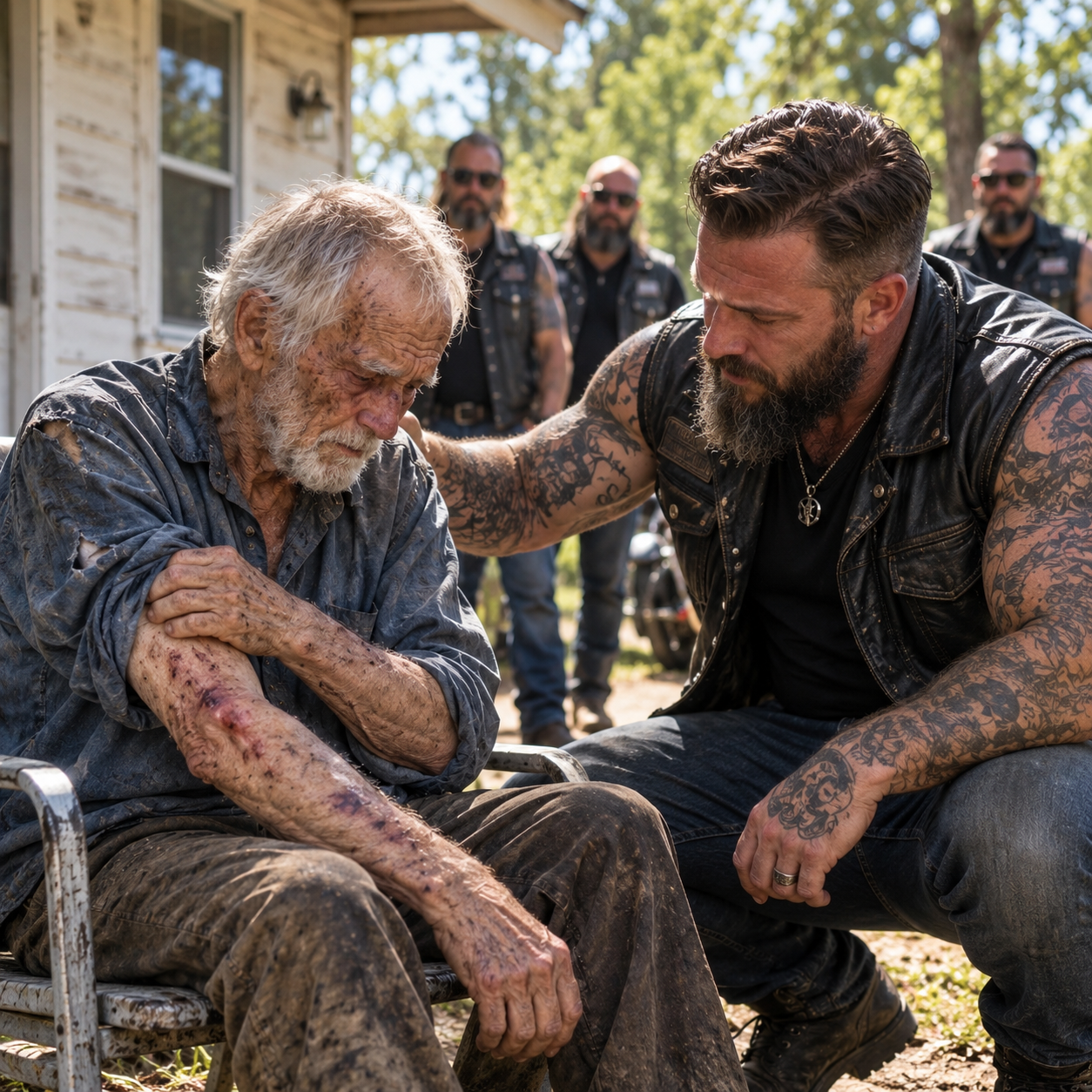
Marcus pulled Walter’s sleeve up and went completely still.
Burn marks perfectly round, evenly spaced. Some had scarred over months ago. Some were still red at the edges.
Walter jerked his arm back and dropped his voice to a whisper.
Please don’t tell anybody.
350 Hell’s Angels would park outside a courthouse because of what Marcus found that morning behind a quiet Arizona farmhouse.
But the part that shook the entire town of Red Valley wasn’t what had been done to this old man.
It was who had done it.
Walter Brooks didn’t ask much from this world, and the world had mostly taken him at his word.
At 87 years old, he had already outlived every version of himself he’d ever expected to become.
41 years laying track for the Arizona Railroad.
Two knee surgeries, one hip replacement, and a marriage that had lasted 43 years until the morning Ruth didn’t wake up next to him.
He had a porch he kept swept, a garden that needed more water than Arizona was willing to give it, and a wave he reserved for the kids who walked past his property on the way to the bus stop every morning. He was the kind of man people described as simple in the best possible sense.
Not complicated, not loud.
He fixed what he could reach, left alone what he couldn’t.
And never once in 87 years had he asked a neighbor for a favor he couldn’t return.
So when the motorcycles first came rumbling down his street on a Friday afternoon in late summer, Walter answered the door with dish towel in his hand and the expression of a man trying to make sense of something he’d never planned to see standing on his porch.
Marcus Walker was 6’2 and built like the desert had assembled him from whatever was hardest.
Leather vest, forearms that looked like they’d been carved rather than grown.
a face with enough years in it that you could see exactly what kind of life had made it.
He went by Stone had since his Marine Corps days, and he stood on Walter’s front porch with two other men behind him, and spoke in the direct unhurried way of someone who had long since stopped worrying about how he came across to people.
Mr. Brooks, my name is Marcus Walker. My chapter runs a program called The Last Ride Home.
We visit folks who maybe aren’t getting a lot of company these days.
We help with things around the house. Bring groceries. Sometimes just sit and talk.
He paused.
If you’d have us.
Walter stared at him for about 10 full seconds. Then he pulled the door open wider.
I made too much cornbread this morning.
He said, “You hungry?”
That was 14 months ago. Since then, Marcus and two or three riders showed up every Friday without exception.
They had rebuilt the back fence, fixed a gutter that had been dripping into the crawl space since the previous spring, hauled two pickup loads of accumulated years out of the storage shed, and mostly they had sat on Walter’s porch in the afternoon heat, and listened to a man who had more stories than he had people to tell them to.
stories about stringing rail across the Sonoran Desert in 1996, about a foreman named Gerald who could curse in four languages and somehow made every word of it sound like a compliment.
About the summer, Ruth talked Walter into buying a secondhand piano off a neighbor’s porch, even though neither of them could play a single note and how they had kept it for 11 years anyway because she liked the way it looked in the front room.
Marcus listened to every word like it was the last conversation he’d ever get to have because for Walter it might as well have been.
The change started small the way those things always do. Marcus noticed it before he could put a name to it.
Felt it first in the way you feel a shift in weather before the sky has done anything visible. Walter stopped being on the porch when they arrived. He stopped waving at the gate and when Marxness knocked and Walter finally answered.
The smile he used to have ready wasn’t there anymore.
“You doing okay?”
Marcus asked one Friday, standing just inside the door.
“Fine, fine.”
Walter waved his hand in that dismissive way.
Old men develop after decades of people asking questions they don’t actually want honest answers to.
“Just tired old bones,” Marcus said.
I hear you.
But the word that kept circling back to him wasn’t tired.
It was careful. Walter had become careful. Like a man measuring every word before he let it out, making sure nothing was in it that could be used against him.
Later, the following Friday, the temperature pushed 94°, the kind of dry Arizona heat that makes the air feel like something personal. Walter came to the door wearing a long-sleeved flannel shirt buttoned all the way to the collar.
Marcus looked at the shirt, looked at the old man’s face.
Walter, you’re not hot.
AC’s running good inside.
Walter didn’t meet his eyes.
I just came out for a second. He was back inside.
Before Marcus could get another word out that night, Marcus sat in the parking lot of a diner two towns over and told his vice president what he’d seen.
Decker was 54. Quiet in the way that people who have spent a lot of time in serious situations become quiet and he listened without interrupting. Long sleeves in 94°, Deker said when Marcus was done.
Yeah. Decker looked out the window at the parking lot.
You think someone’s hurting him?
I don’t know yet.
His son lives there. Daniel Brooks.
Marcus said the name slowly. Tasting it.
Half this town would tell you he hung the moon. Charitable man shows up to community.
Everybody calls him a devoted son. Everybody said that about a lot of people who turned out to be something completely different.
Marcus turned his coffee cup in both hands. I need to be sure before I do anything.
If I go in wrong on this and I’m off base, I make everything worse for Walter and I am not willing to do that to him.
So, what do you need?
time,” Marcus said.
And eyes on that house.
The following Friday, Walter didn’t answer the door at all.
Marcus knocked twice, waited, knocked again. He heard slow footsteps somewhere inside, then silence, then more silence. It stone, a long pause.
Then the door opened about 4 in.
Walter’s face appeared in the gap, one eye, part of his nose, a sliver of cheek.
His voice was barely above a whisper. Not feeling well today.
Maybe next week. Marcus kept his voice easy.
Unhurried.
That’s fine.
You need anything?
Decker’s wife made soup.
He takes no credit for it.
Something almost like a smile moved across the part of Walter’s face Marcus could see.
Then it was gone.
“No, thank you,” Walter said.
The door closed. Marcus stood on the porch for a moment.
He looked at the door. He looked at the house.
He looked at Daniel’s truck parked in the driveway.
Then he walked back to the curb, got on his bike, and didn’t leave.
He sat at the end of the block for 45 minutes. He was good at sitting still.
The Marines had taught him that before anything else, that patience wasn’t a personality trait.
It was a skill, and you practiced it the same way. You practiced everything else that mattered.
When Daniel’s truck finally pulled out of the driveway and turned toward town, Marcus gave it 2 minutes.
Then he walked back to the house and knocked again. This time, Walter opened the door all the way. He looked different without Daniel in the house.
His shoulders had come down.
The careful thing behind his eyes hadn’t gone away entirely, but some layer of it had peeled back.
He looked at Marcus on the porch and then passed him at the empty driveway and something in his expression shifted in a way that made Marcus’s chest tighten.
He went to the hardware store, Walter said quietly. Hour, maybe a little more. Can I come in?
Walter stepped aside without answering. They sat at the kitchen table. Marcus poured them both water from the tap.
He didn’t push.
He set the glasses down and folded his hands and waited. Because Walter Brooks had spent 87 years as a man who carried his own weight, and the idea of being rushed into laying it down was not going to work on him.
Walter looked at the table for close to two full minutes.
Then he said, “You were in the service, Marines.
4 years.
Railroad men were the same way.”
Walter turned his glass slowly.
“You had a problem.
You worked through it yourself.
going to somebody else with it wasn’t something you did.
It wasn’t weakness exactly.
It was just not how things got handled. I was raised the same way, Marcus said.
Served me pretty well my whole life until it didn’t.
Walter looked up at him. Is someone hurting you?
Marcus asked. He said it plainly. No cushioning around it.
Walter’s jaw tightened.
His eyes moved to the window. Then back to the table.
I’m not going to push you past what you’re ready to say, Marcus said.
But I want you to know that I’m not leaving you in a bad situation.
Whatever’s happening in this house, that’s not something I’m willing to walk away from.
You understand me?
Walter didn’t answer immediately.
He looked at his hands, then at Marcus. When he finally spoke, his voice was very low.
You don’t know my son.
Daniel’s a good man.
Always has been. He said it like he was reading from something written inside his own chest.
Something he’d read so many times the pages were soft.
He went through a hard patch. Lost his job last year.
That kind of thing changes a person. It does, Marcus said carefully.
You can’t blame a man for what hard times do to him.
Sometimes you can. Marcus kept his voice level.
But that’s a separate question from what’s being done to you.
The kitchen was very quiet. Walter set his glass down.
He looked at the table. Then he pulled back his left sleeve and laid his arm on the table between them.
Marcus looked at it. He had over the course of his life trained himself not to react to things. In the moments when reaction was not useful, he did that now.
He kept his face still and his breathing even, and he looked at what was on the old man’s arm without looking away.
burn marks, round, uniform, evenly spaced.
14 of them visible before Walter’s sleeve ran out.
Some of them had been there long enough that the skin had changed color and texture. Others were recent enough that the edges were still inflamed. He counted.
He did not allow himself to feel in that moment. Everything he was feeling.
How long? Marcus said March. That was 8 months ago.
8 months. Cigarettes?
Walter nodded small tight. Has he hit you? A longer pause.
Then another nod. Does he threaten to put you in a nursing home if you say anything? Walter looked up sharply.
The surprise on his face was the clearest thing Marcus had seen from him all afternoon.
He says he’ll sign the papers.
Walter saids I’m not capable of managing my own affairs.
Says he’ll have it arranged.
He looked at the table. I believe him.
Is that why you’ve stayed quiet?
Walter covered his arm again. He looked at the window for a moment at the empty driveway beyond it.
He’s my son, he said finally.
He’s all I have left in this world.
You understand what that means. Not just a person who visits. All I have, Marcus understood.
He understood it in a way that made the understanding hurt. I hear you, Marcus said.
and I’m not asking you to do anything today, but what’s being done to you is a crime and it will keep happening until something changes.
If I say something and it goes wrong, if he finds out before anything’s been done about it, I’ll be in a facility somewhere and I’ll never see this house again.
Walter’s voice was measured.
Deliberate.
I’ll die surrounded by strangers because my son told them I was confused.
That’s not going to happen.
You can’t promise that.
You’re right, Marcus said.
I can’t promise the process will be fast or clean, but I can promise you won’t go through it alone.
Not while I’m standing.
Walter stared at him across the table.
Marcus held the look and didn’t move from it.
I have known a lot of men, Marcus said. Good ones and bad ones and every variation in between.
And I have never once, not once in my life, walked away from a man who needed someone to stand behind him.
That’s not who I am.
Something moved through the old man’s face.
It wasn’t collapse.
Walter Brooks was not going to collapse in front of anyone.
Not after 87 years of being the kind of man who didn’t.
But his mouth pressed tight and his eyes went bright and he gave one single slow nod.
I need you to think about whether you’re ready to talk to someone, Marcus said.
Not today, not tomorrow necessarily.
When you’re ready.
There’s a county elder services unit most people don’t know about.
There’s a division within the sheriff’s office and I have people.
Walter looked at him steadily. Bikers.
Marcus didn’t apologize for it.
And if Daniel finds out you’re asking questions, he’ll find out eventually.
That’s just the nature of it.
But by the time he does, it won’t matter what he knows.
The sound of a vehicle came from outside. Walter went rigid. every muscle in his body locked.
Marcus looked at him. Is that his truck? Walter listened.
His whole body was an instrument turned toward the road outside. After 3 or 4 seconds, the tension released slightly.
No, that’s the Hendersons from across the street.
Different engine.
Marcus looked at the old man’s face.
At the way every sound from outside registered, at the way his body had organized itself. without his permission around the threat of an incoming engine. You listen for his car all the time, Marcus said.
It wasn’t a question.
Walter didn’t treat it like one.
Marcus stood and picked up his jacket.
I’m going to go before he gets back.
But I want you to hear what I’m about to say.
Walter looked up at him. You showed me your arm today.
That was not a small thing.
Whether it felt that way or not, I shouldn’t have.
Yes, you should have. Marcus said it with no hesitation.
I’m going to start learning things.
Quietly, carefully. Nothing that lands back on you.
And when the time is right.
We’re going to talk again.
This time you’re going to tell me everything.
He was nearly to the door when Walter spoke. Marcus. He turned.
The old man was looking at his own hands on the table.
I’m not a weak man.
I want you to know that’s important to me.
Marcus looked at him for a long moment.
“I know exactly what kind of man you are, Walter,” he said.
“I figured that out the first day you fed me cornbread.”
He walked out and pulled the door shut gently behind him. Standing on the porch, he took a long, slow breath of the afternoon heat. He let himself feel for just one moment the full weight of what was sitting on his chest.
Not the anger that was there, banked and controlled.
Where he’d learned to keep it years ago, what sat heavier was simpler, a man’s trust, and 8 months, and a whole town that had walked past this house without asking a single right question.
He called Decker before he reached his bike. I need you to pull everything on Daniel Brooks, he said.
employment, financials, anything connected to Walter’s accounts.
And I want eyes on that house. Rotating drivebys.
Nothing visible. Nothing Daniel can trace.
How bad? Decker said. Cigarette burns.
14 visible on one arm alone. 8 months. The silence on the line lasted several seconds.
I’ll start tonight.
Decker said. 3 days later.
Decker called back.
Marcus was in the chapter’s garage at the workbench with the cup of coffee when the call came in.
Walter’s pension and social security run about 2,000 a month combined.
Decker said he had his own separate bank account for 32 years in his name only. 14 months ago that account gets closed.
Funds moved to a new joint account. Daniel is co-signer. Marcus set down his cup.
When did Daniel lose his job? about 6 weeks before the account change.
So within six weeks of losing his income, he got himself onto Walter’s money.
That’s right.
And the spending pattern on the joint account, utilities paid, groceries paid, everything that’s supposed to look normal is there.
But there’s also $800 to $1,000 a month going out in cash withdrawals, ATM different locations each time.
That’s been happening for 10 months.
Marcus stared at the workbench.
10 months of Walter’s money disappearing in cash.
That started about two months before the burns.
There’s more.
Decker said, “I reached a contact at the county off record.
Walter had a primary care visit 6 months back. The doctor locomotion filed a notation.
Not a formal report because Walter refused to confirm anything, but it’s in the record.
Unexplained bruising on the left arm. Walter told him he fell and the doctor let it go.
He documented it and asked once. Walter denied it.
The locom didn’t push.
Decker paused. And a neighbor across the street, Rosemary Greer, told me she heard yelling from that house on at least three separate occasions. Late at night, she almost called it in once.
Almost.
She didn’t want to make trouble for a family she didn’t know.
Well, Marcus thought about that for a moment, about how many times human decency and conflict avoidance had stood side by side and looked exactly alike right up until the moment they weren’t.
“We need more,” Marcus said.
“Financial records and a neighbor’s account are a start.
But we need Walter to be willing to speak for himself, and if he’s not ready, then we keep building until he is.”
The following Friday, Marcus went back and Daniel was home. That was fine. Marcus had planned for it.
He wanted to look the man in the face. He wanted to take the measure of what Daniel Brooks put on for the outside world.
Daniel answered the door before the second knock. He was younger than Marcus had pictured early 50s.
Clean-cut, the kind of man who maintained himself like his appearance was part of his job. He had a broad handshake and a smile that came out easily.
the practiced kind that reached his eyes just enough to pass for genuine if you weren’t specifically looking.
Stone, he said warmly.
I’ve heard a lot about you from my dad.
Good things. I hope nothing but.
He opened the door wider. Come on in.
Pops in the living room. Good day today. A good day.
Marcus filed that phrase away. Walter was in the armchair by the window.
He was wearing a short-sleeved polo shirt which told Marcus something immediately Daniel was present. The visual performance was in effect and everything had to match.
Walter’s face when he saw Marcus was complicated in ways a careful observer could read and no one else would notice.
Relief, woriness, something behind it that sat very still. Hey, Walter. Hey yourself.
The old man smiled. But it was a shallow smile. No depth to it.
You brought reinforcements. Decker thinks your porch railing needs attention. The porch railing is fine.
Decker disagrees. From the hallway.
Daniel laughed. It was a good laugh. Easy warm timed perfectly.
Can I get you guys anything? Daniel said, settling onto the couch nearby. Coffee?
Water?
We’re fine, Marcus said.
He looked at Walter.
How’s the hip been?
Same as always. The old man shifted slightly in the chair.
Can’t complain.
Can and won’t are two different things.
Something softened briefly in Walter’s eyes.
Just a flicker. For the next 20 minutes, Marcus talked to Walter about nothing in particular.
The railroad, a game that had been on the previous weekend. The neighbor down the road who had planted a new hedge and was now in an ongoing disagreement with the county about the property line.
Easy conversation. Comfortable on the surface. Underneath the surface, Marcus was watching Daniel.
Daniel never once left the room. He refilled water glasses that nobody had asked to be refilled. He laughed at exactly the right places.
He touched Walter’s shoulder once, easy and practiced, the gesture of an attentive son, and every time Marcus directed a question specifically at Walter, Daniel was there first with the answer.
Not aggressively, not obviously, just occupying the space between Walter’s mouth and the words it might have formed independently.
Marcus had seen that behavior before. It had a name.
It was called control, and its most effective version looked like attentiveness from the outside.
Looked like love, almost looked like a man who just couldn’t help being involved in every corner of his father’s life.
When Marcus stood to leave, he shook Daniel’s hand at the door.
“Your father talks about you,” Marcus said.
Daniel smiled.
“He’s always been my biggest supporter.
You take good care of him.”
Something crossed Denial’s face for just a fraction of a second there, and gone before most people would have caught it.
Not guilt exactly, something more like a calculation. Then the smile was back, smooth and warm.
“He took care of me for a long time,” Daniel said.
It’s my turn.
Marcus said his goodbye to Walter.
And in the moment before the door closed, Walter’s hand found Marcus’s forearm and held it.
Not grabbing, just holding. One second. Two.
Marcus looked down at the hand and then up at the old man’s face.
Walter didn’t say a word.
He didn’t need to.
Marcus gave one small deliberate nod. Walter released his arm.
The door closed. In the driveway, Decker was leaning against his bike and spoke without looking up. He never left the room.
Not for two consecutive seconds. I know. Not once.
I know. Marcus put on his helmet.
Pull the full financials.
Every transfer, every withdrawal, and I want to know if there’s a power of attorney document anywhere with Daniel’s name on it.
3 days later, a parallegal named Sonia called Marcus at 7 in the evening. Power of attorney for Walter Alfred Brooks was filed with the county clerk eight months ago.
She said signed March 14th. March 14th, the same month the burns had started.
Who’s the agent?
Daniel Raymond Brooks. Full authority financial. Medical and residential decisions.
She paused.
That means he can sell Walter’s house.
Move him to any care facility he chooses.
Make medical decisions on Walter’s behalf.
control every dollar. Can it be contested?
If it can be shown Walter signed under duress or lacked capacity at the time, that’s a high bar, especially if Daniel can produce documentation of voluntary compliance.
She let a beat pass. One more thing, the document was notorized out of Flagstaff.
Not locally. Why Flag Staff?
You wouldn’t go that far for a notary unless you didn’t want anyone in Red Valley knowing what you were filing.
Marcus sat with that for a moment.
He thought about Daniel making that drive, making sure no one local saw the paperwork, making sure everything appeared voluntary, proper, and well-intentioned while the burns on Walter’s arm were still fresh.
“Be careful with this one,” Sonia said.
“Whatever he is behind closed doors.
He built this carefully.
I know careful is harder to fight than sloppy.”
He called Decker after he hung up. Decker listened to all of it without speaking.
When Marcus finished, Decker said, “So on paper, Daniel has legal control of Walter’s entire life, which means Walter’s not staying quiet because he’s confused or stubborn.
He’s staying quiet because he correctly understands that speaking up the wrong way at the wrong time gets him committed somewhere without recourse.”
“That’s exactly right.
So, it’s not a failure of courage.”
Deker said, “It’s a trap.”
Marcus looked at the ceiling of the garage, which means we build something airtight enough that the legal document doesn’t matter anymore.
Financial records, witness statements, medical documentation, and Walter’s own testimony when he’s ready.
And if Daniel figures out what we’re doing before Walter gets there, then we accelerate and we make sure that house is never unwatched.
The call from Rosemary Greer came on a Wednesday afternoon.
She had asked Deker for Marcus’ number during their conversation, and Decker had given it to her.
When Marcus picked up, her voice was steady but thin, the voice of someone holding something fragile together with both hands.
“I don’t know if I should be calling,” she said.
“I keep telling myself it’s not my business.”
“Tell me,” Marcus said.
About an hour ago, I was by my front window.
I wasn’t watching on purpose.
Walter came outside. He was moving very slow.
He got to the porch steps and he just he sat down like he didn’t have the energy to go further.
She took a breath. His shirt had written up on his side.
I could see Mark’s Mr.
Walker not just on his arm on his side. Marcus kept his voice level.
Where is Daniel now?
His truck’s been gone since before Walter came out.
You did the right thing calling. Marcus said he was already reaching for his jacket.
The exact right thing.
He drove to Walter’s house in 11 minutes and knocked.
When the door opened, Marcus looked at Walter and knew immediately that Rosemary had not exaggerated. The old man looked diminished in a way that had nothing to do with age.
His eyes were red at the rims.
He held one hand carefully against his side, low and close, the way a person does when they’re trying not to let the weight of an arm rest against something that hurts.
“Daniel’s not here,” Walter said.
I know. Marcus met his eyes.
I’m not here for Daniel.
They sat at the kitchen table again.
Marcus didn’t speak for a while.
He had learned over many years that sometimes the most important thing a person could do was simply occupy space beside someone who felt completely alone. Take up air.
Be present. Let the quiet run until the other person was ready to fill it.
After about 3 minutes, Walter said, “He’s been worse lately.”
Marcus waited.
He found out somebody’s been asking questions around town.
I don’t know who said something.
I didn’t say anything, but he knows.
Walter looked at the table. He was very calm about it.
That was the part that scared me. Not angry, just very calm. He sat at this table and he told me what would happen if I talked to anyone.
What did he say? Walter looked up.
His eyes were steady, but there was something behind them.
Marcus hadn’t seen there before.
or something older and darker than fear.
The way a feeling can turn into a fact inces a person when they’ve lived with it long enough.
He said by the time anyone finished listening to a confused old man’s stories, he’d have me placed in a memory care unit upstate.
He said nobody would visit.
He said he’d make sure of that.
Walter’s voice was quiet and precise.
He said the last years of my life would be four walls and a ceiling fan. The kitchen held that silence. Marcus looked at the old man across the table.
He looked at the way Walter held himself, not broken, not defeated, just utterly and quietly exhausted in the way of a man who has been fighting something alone for far too long. And then Walter did something Marcus had not expected. He pulled up both sleeves, both of them.
The left arm Marcus had already seen. The right arm he had not. Marcus looked at what was on both arms and did not look away.
I want to tell you something, Walter said. Go ahead.
I spent my whole life believing that asking for help meant you weren’t strong enough to carry it yourself.
He looked at his own arms. Then back up. I think I was wrong about that.
I think I spent a long time being wrong about that.
Marcus held the old man’s gaze.
I’m ready, Walter said.
Four words. But Marcus understood what they held. Not just a willingness to talk a decision.
the kind a man makes when he’s stopped trying to manage something alone and has decided finally that he’s going to let someone stand beside him.
“You’re sure?”
Marcus said, “I’m 87 years old,” Walter said.
“If I wait until I’m more sure, I’ll run out of time.”
Marcus nodded.
“Then we do this right.
We do it carefully and we do it together.”
Walter looked at him across the table.
“Why?”
he said quietly. Not a challenge, a genuine question. Why are you doing this for someone you barely know?
Marcus was quiet for a moment. He looked at his own hands.
Then he looked back at the old man. Because someone should have done it a long time ago, he said. Walter said nothing for a while.
Outside the afternoon lay flat and still across the Arizona earth. The sound of a distant road.
Nothing else.
Then Walter said, “You know what?
The worst part is not the pain, not even the fear. He looked at the table.
It’s the not knowing whether you’re worth saving.
After long enough, you start to wonder. Marcus leaned forward slightly.
You are, he said. Stop wondering. Walter looked at him for a long time.
And in the silence that followed, something shifted between them. Something that had nothing to do with court cases or financial records or power of attorney documents. something that was simply the weight of one man deciding to trust another and the other deciding to deserve it.
That was where everything really began.
The night Walter said he was ready, Marcus didn’t sleep.
He sat at his kitchen table until past 2 in the morning with a legal pad and went through every piece of information they had, everything they still needed, and every gap between those two things. Financial records showing the joint account and the cash withdrawals. The power of attorney filed in Flagstaff.
The doctor’s notation that had gone nowhere.
Rosemary Greer’s account of the shouting.
Two weeks of rolling surveillance.
Carol Medina’s name on a list.
Sonia was still working through.
It was a lot and it wasn’t enough.
Not yet. He called Decker at 7 the next morning.
I need Sonia to go deeper on the financials.
Marcus said, “Not just the account movement, transaction level detail, every withdrawal, every signature, every form that went through that bank in Walter’s name in the last 14 months.
What are you looking for?
I don’t know yet, but Daniel’s smart enough to file paperwork in Flagstaff, so nobody local saw it.
” That kind of careful leaves tracks.
I want to find them. By that afternoon, Marcus was in the chapter garage with Decker Briggs and a writer named Harlon, who had a talent for listening to the right people say the wrong things in public places. Sonia called while they were all in the same room.
Three things, she said.
First, there’s a signature on a wire transfer authorization from 4 months ago.
$11,000 signed in Walter’s name.
But when I pulled his authentic bank signatures from 5 years back and compared them, the handwriting doesn’t match.
Pen pressure, letter formation, baseline angle all different. Marcus straightened. Decker looked at him.
You’re saying someone signed Walter’s name?
Marcus said, “I’m saying the signatures don’t match.
I’m not the expert, but a professional would see it in 30 seconds.”
Second thing, a memory care facility in Tucson.
About 6 weeks ago, an online intake inquiry was submitted under Walter’s name.
The email address used belongs to Daniel. The garage went quiet.
He’s already started the process, Marcus said.
Not completed it, but the inquiry was made. I found the email exchange with their admissions coordinator. They were told Walter was showing signs of cognitive decline and had become a danger to himself.
Decker turned away and pressed both hands flat on the workbench. Nobody said anything for a moment.
Third, Marcus asked. The home health aid, Carol Medina. She worked in that house for about 14 weeks beats before Daniel terminated the arrangement.
When she left, she filed one line on the AY’s internal contractor system.
I almost missed it. Sonia paused.
She wrote, “Client’s condition of isolation was not consistent with good care.
Left at client’s family’s request.
Would not return to this household.”
Marcus set the phone down on the workbench and put it on speaker. Briggs said under his breath, she saw it.
“She might be willing to say it.”
Sonia said, “I have a number for her.
Your call.”
Marcus called Carol Medina that evening. She picked up on the third ring.
And when he introduced himself and explained why he was calling, the pause that followed was not the pause of someone caught off guard.
It was the pause of someone who had spent waiting for a call they didn’t know would ever come.
I knew something was wrong from the second week, she said. Her voice was steady, but there was weight in it.
The way Walter flinched when Daniel walked through a doorway. The way he tracked the front door.
I’ve worked home care for 16 years.
I know the difference between an old man having a rough day and an old man who’s living in fear.
Did you see anything directly? Not while I was there. He was too careful for that.
She said, “Careful the way you say a word that’s been sitting in your mouth a long time.
But once I came back for something I’d forgotten, and I could hear Daniel through the door talking quietly, almost whispering, and Walter not responding at all, just silence.
She stopped.
It didn’t sound like conversation.
It sounded like a man being spoken at while he sat there and absorbed it. Would you give a written statement?
Marcus asked. A long pause.
He’s a convincing man.
Daniel Brooks. I told one person what I suspected and they looked at me like I was the one with the problem.
Who did you tell? My agency supervisor. She said I was probably misreading a family dynamic.
Suggested I request a different placement.
Carol’s voice went flat.
I did because I wasn’t sure enough to fight it alone.
But I’ve thought about that man every week since I walked out of that house.
He’s ready to come forward, Marcus said.
He needs people behind him when he does.
She didn’t answer right away.
If Walter Brooks is ready to tell his story, she said finally.
Then I’m ready to back him up.
Send me the statement and I’ll sign it.
Marcus drove to the Red Valley Sheriff’s Office the following morning.
He had dressed deliberately for it no chapter vest, no colors, just clean jeans and a plain jacket. He understood how first impressions became conclusions, and he was not interested in handing anyone an easy excuse to dismiss what he was bringing in.
The receptionist’s posture shifted slightly when he walked in.
He noticed and said nothing.
Sheriff Galen Puit shook Marcus’ hand with the practiced warmth of a man who had been running a county for 11 years and knew how to make a person feel heard while deciding nothing.
He was good at it. Marcus had met versions of him before in different offices in different towns and recognized the performance immediately.
Puit listened. He asked a few questions.
He wrote something on a notepad that Marcus suspected was not related to the conversation. Daniel Brooks Puit said when Marcus had laid out the overview.
I know Daniel Community Foundation runs the fall fundraiser for the Children’s Hospital every year.
I understand that, Marcus said.
You’re telling me he’s been burning his own father with cigarettes?
I’m telling you I’ve seen those burns with my own eyes.
I’m telling you there’s financial documentation showing money being redirected out of a joint account.
I’m telling you there’s a power of attorney filed in Flagstaff signed the same month those burns started appearing and I’m telling you Walter has said directly to me that his son is responsible and Walter would be twe do tell me that himself when the right protections are in place.
Yes tapped his pen on the desk once.
Walker what you’re describing if it were happening would be a serious matter but serious matters require solid evidence.
A statement from a third party and a neighbor who heard some noise isn’t enough to go into a man’s home.
I have financial records showing joint accounts and power of attorney are common estate planning arrangements.
That’s not automatically criminal.
Puit set his pen down. I want to be helpful here.
I do.
But you’re asking me to act on secondhand information against the character of someone this community knows well.
Marcus looked at him across the desk. They both understood exactly what was happening in that room.
Then I’m going to keep building, Marcus said.
He kept his voice level.
When I have something that can’t be set aside, I’ll be back.
Puit gave a measured nod. That sounds like a reasonable approach.
Marcus drove out of that parking lot and called Decker before he’d cleared the county building’s parking lot.
The sheriff’s not moving reason.
He gave polite ones.
Marcus’ jaw was tight.

