The CEO’s Bodyguards Ran From Intruders—Until a Single Dad Ex-SEAL Saved Her Life – Part 1

The CEO’s Bodyguards Ran From Intruders—Until a Single Dad Ex-SEAL Saved Her Life
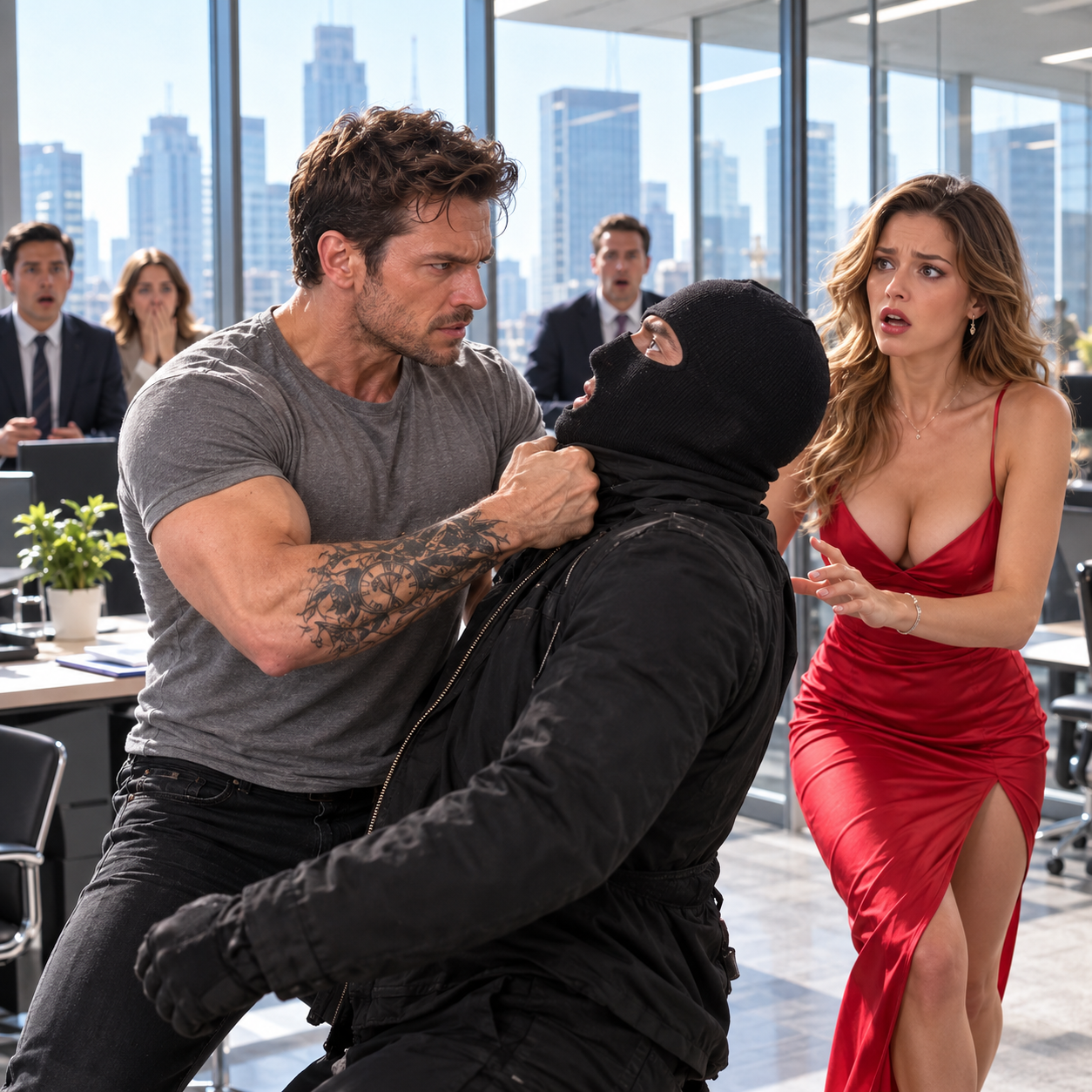
Gavin Ror had been chief security officer of Egyp Meridian for 11 years. He had shaken hands with senators. He had briefed intelligence contractors on building defense protocols.
He had stood at the podium during three consecutive company safety awards and told the assembled employees that their security was second to none in the private sector.
So when the first smoke canister rolled through the executive corridor and the glass wall behind Clare Bennett’s office shattered from a precision breach charge, the employees who saw what happened next could not immediately process what their eyes were telling them.
Gavin Ror pulled an emergency access badge from his jacket pocket, pressed it into a gloved hand belonging to a man in a mask, and Walk did not run. Walked toward the private stairwell marked authorized security only. He did not look back, not once.
Clare stood 6 feet away, watching the man she had trusted with her life disappear through a door that locked automatically behind him.
The badge he’d given her that morning was still in her hand.
The one she thought was for evacuation. She would not understand for another 40 minutes what had actually opened. The men who stepped through the shattered glass were not screaming, were not chaotic, were not the kind of threat you see in movies where the villains make noise.
They moved like people who had rehearsed the building in their sleep. That was when Luke Mercer stopped walking away from the sound and turned around.
The morning started the way most mornings started for Luke Mercer. Badly, then okay, then fine.
The alarm went off at 5:40, and he was already awake, which he hated, because being awake before the alarm meant he’d been lying there thinking, and thinking before sunrise was rarely productive.
He’d been thinking about the acquisition, not because he had any stake in it.
He was a facilities electrician. He had no stake in anything above the fourth floor, but because the building felt different lately, tighter, like something was wound two turns past where it should be.
He got up and made Sophie’s lunch before she woke up.
Turkey, not ham, because she’d gone through a ham phase for 3 months in second grade, and then one afternoon declared that she was finished with ham forever and had not touched it since.
Luke had stopped questioning her food logic. He had started simply remembering it. Sophie came downstairs at 6:15 wearing her backpack already, which meant she was anxious about the presentation.
You’re wearing your backpack, Luke said.
I know.
School doesn’t start for 50 minutes.
I know, Dad. He slid the lunch bag across the counter toward her. She picked it up without looking, turned it over twice like she was checking something, and then put it in the front pocket of her bag.
That was her routine. He had never asked her why.
“You’re going to do great today,” he said.
Sophie opened the refrigerator and stared into it the way she always did when she was trying to figure out what she actually wanted.
You don’t know that.
I know you’ve been practicing the presentation for 2 weeks.
Practicing doesn’t mean great.
It means practiced. She closed the refrigerator without taking anything.
There’s a difference.
Luke thought about that. She was nine.
He had no idea where she’d gotten that particular piece of logic, but she wasn’t wrong.
They drove to school mostly in silence, which was normal. Sophie was not a morning talker.
She processed the day ahead privately and came out the other side of it ready to speak. Luke understood this about her because he was the same way. His wife used to say they were the only two people she knew who treated mornings like a competitive event in which the winner was whoever could go longest without being interesting.
He missed that. He missed being known that well by someone without having to explain himself. He pulled up to the drop off line at 6:50.
Sophie grabbed her bag and got out, then leaned back through the window.
You’re coming tonight.
6:30. She said it like she was confirming a fact rather than asking.
6:30, he said, “Because last year, Mr.
Patterson’s dad said he was coming and he didn’t come.
And Mr.
Patterson cried in the bathroom for like 20 minutes and everyone knew.”
She paused.
“I’m I’m not saying I would cry.
I’m coming,” Luke said.
She studied him for a moment with a particular expression she’d inherited entirely from her mother.
Not suspicious exactly, just carefully measuring whether the statement matched the person. Then she reached into the side pocket of her bag and pulled out a small plastic star on a keychain. The star was yellow and slightly scuffed on one point where she dropped it once on the driveway.
She leaned through the window and clipped it to the strap of his tool bag on the passenger seat.
“So you remember,” she said.
Sophie, it’s not that I don’t trust you.
She stood back up straight.
It’s that I want you to have a physical reminder.
It’s called a pneummonic device.
We learned about it. She was already walking toward the building before he could answer.
Luke looked at the plastic star for a moment. Then he put the truck in drive.
Eeas Meridian’s head headquarters occupied 37 floors of a building in the financial district that the company had designed from the ground up 12 years earlier, specifically to serve as both a corporate headquarters and a physical
demonstration of what Aegis sold.
security architecture. The lobby alone had more cameras per square foot than most federal facilities.
The access control system had been cited in three industry journals. There was a full security operations center on the fourth floor, staffed around the clock. Luke had worked there for 6 years.
He knew every camera blind spot in the building, not because he was looking for them. Because when you spend 6 years maintaining an electrical infrastructure across 37 floors, you accumulate a very specific kind of knowledge about the gap between what a system claims to do and what it physically does. He knew which emergency exit cycled on a timing variance that made them show closed when they were actually staying open for an extra half second.
He knew which backup generator had a fuel sensor reading 3% higher than actual. He knew which service elevator responded to credentials.
It wasn’t technically supposed to accept because someone had overridden it during a renovation three years ago and never properly reset the permissions.
He knew things about the building that the building’s own security reports didn’t know.
That morning, he clocked in at 7:20 and started on the maintenance schedule for floors 12 through 16. Routine work, panel inspections, load balancing checks, a lighting fault on 14 that had been logged twice before and never fully traced to source.
He was on floor 12 when he noticed the emergency door. It was a fire egress store in a secondary corridor, the kind that should only cycle open and return to closed when someone physically pushed through it.
The push event was logged electronically. He was checking an adjacent conduit box and happened to glance at the local control panel which showed a door cycle had registered at 6:58 a.
m. Then another at 7 a. m.
Two cycles 6 minutes apart. The panel log showed one.
He stared at that for about 15 seconds. Then he opened the panel, ran a quick manual diagnostic on the door sensor, and found nothing wrong with the sensor itself.
The hardware was reading correctly. The discrepancy was in the log. Either the log had an error or someone had cleared one of the entries.
He flagged it in his maintenance log and moved on. The second thing was on floor 15.
A security camera in the east utility corridor had been replaced within the last week. He could tell because the mounting bracket was a newer model than the ones installed during the original construction, and the paint touch-up around the anchor points was slightly off color. New equipment replacing old equipment was ordinary.
What wasn’t ordinary was the circuit it was drawing power from.
Someone had wired the replacement camera into an older secondary circuit that ran parallel to the main security power trunk, but was not part of the managed security network. The camera was on.
The camera was recording. The camera was not sending its feed to the security operations center.
It was sending it somewhere else. Luke took a photograph of the wiring with his phone and logged it as an anomaly requiring security review.
He found the third thing at 7:55 on the service elevator that ran from the loading dock up to floors 20 through 26.
The elevator’s access log showed a credential override at 6:41 a.
m.
Credential overrides weren’t impossible.
They happen during move-in operations, heavy equipment deliveries, situations where the standard access protocol needed to be bypassed with authorization from the security department. The credential used belonged to the security department.
That wasn’t unusual.
What was unusual was that Luke had been in the loading dock at 6:45 a. m.
and the elevator doors had been closed.
If someone had used the elevator at 6:41, they’d been in and out in 4 minutes and nothing had come through the loading dock.
he would have noticed. He flagged that one, too. By 8:15, he had three separate anomalies documented in his maintenance log.
He wrote a summary note and routed it through the standard facilities to security communication channel. He did not expect a fast response.
The standard channel processed non-urgent technical anomalies on a 12 to 48 hour review cycle. He knew that.
He’d flagged things before.
Most of them came back with explanations. A few came back with nothing at all.
He went back to the lighting fault on 14. Clareire Bennett had been in her office since 7:00 a.
m.
The acquisition had been in negotiation for 14 months, and today was the day it closed, or it didn’t.
She had read the final terms three times before 8:00.
She had spoken with two board members who supported the deal and had not returned a call from one who didn’t.
She had her general counsel on standby, her CFO two floors down, and a communications team prepared to issue the announcement within an hour of the final signature. She was not nervous.
She had spent enough years in rooms where she was the only woman at the table, who was also the one with the most authority to understand that showing nerves was a form of information transfer she couldn’t afford.
So, she had developed a very efficient internal mechanism for converting anxiety into focus. It was not healthy probably, but it worked. What she had not fully worked through was the audit provision.
The acquisition of Sentinel Arc automatically triggered an independent audit of several legacy Eegis systems within 90 days of closing. The provision was standard for acquisitions in the defense technology sector. Anytime you brought external intellectual property into the ecosystem of a company holding government contracts, the regulatory framework required a backward-looking review.
Clare knew this. She had read the provision.
She had discussed it with councel. She had concluded it was routine.
Three board members had disagreed. Their objections had been framed in financial terms, cost of disruption, timing relative to existing contracts, resource allocation during integration. Clare had weighed those objections and concluded they were overstated.
She had proceeded. She thought about those objections now briefly and then set the thought aside. At 8:40, the executive elevator on the 31st floor developed a control fault.
It wasn’t stopping at the right floor consistently.
The alignment sensor had a lag that made the doors open 6 in above the floor level before self-correcting. Mildly dangerous, genuinely annoying, and the kind of fault that required a physical inspection of the control board rather than a remote fix. Luke was the closest technician.
He arrived at the elevator bank at 8:52. Clare was standing at the doors waiting for a car that had failed to arrive for the third time. She was holding a tablet in one hand and a coffee cup in the other.
She did not look at Luke when he opened the control panel on the wall beside the elevator.
It’s the alignment sensor on the down position, he said.
I can fix it in about 8 minutes.
You’ll want to use the south elevator until I do.
Clare looked up from her tablet.
She looked at him the way you look at someone you recognize from somewhere but can’t immediately place.
Thank you, she said.
Then what’s your name?
Luke Mercer. She nodded slowly. How long have you been on the facilities team?
6 years. Something in her expression shifted very slightly. Not guilt exactly.
More like a person who has just become aware of a gap between how they think they move through the world and how they actually do.
I don’t think I’ve ever asked, she said.
You’ve been busy.
He said, and he meant it without any edge to it, which she seems to understand. Her phone rang. She answered it before she reached the south elevator.
She was gone before he finished the repair.
He didn’t think about the conversation again until later when he was trying to understand why her name had stuck in his head during the worst 8 hours his professional life.
He eventually decided it was because the question had been genuine.
She hadn’t asked his name as a performance.
She’d asked because she’d actually wanted to know.
That turned out to matter more than he expected. At 9:40, Maya Chen found him. Luke was running a load test on the panel connections for floor 18 when she came through the utility access door.
Maya was compliance director. They had exchanged maybe 40 words in 6 years.
She always seemed to be in motion carrying documents on a call, moving between meetings with the specific urgencies of someone who had too many responsibilities and not quite enough time for any of them. Today she came in and looked at both ends of the corridor before she closed the door. That was the first sign.
Luke, she said, “Quick question.”
Sure.
The building has isolated systems, things that aren’t on the corporate network.
Some Yeah. Emergency backup systems, physical control infrastructure, things with air gaps. Right.
He watched her. Why?
I’m reviewing an audit process for a compliance item.
She said it the way people say things when the sentence is technically true and also not the full answer. Is there any infrastructure in this building that functions as a secure archive?
storage that’s completely off the main network with access controls that aren’t managed through the corporate system.
Luke put down his meter.
That’s a specific question for an audit review.
I know she met his eyes. Is there?
He thought about the authorization vault on sublevel 2.
The one he’d been told when he first started was part of the original construction spec for a defense related client requirement.
The one with the biometric readers and the dual authorization protocol.
the one he’d wired emergency backup power to 18 months ago and hadn’t touch touched since.
There’s a secure archive system on suble 2.
He said it runs on a completely isolated electrical circuit. Independent HVAC. The network connection was airgapped during the original construction.
I’ve worked on the power infrastructure for it, but I don’t have access inside.
Maya was very still. What kind of records does it store?
She asked.
I don’t know.
I just keep the lights on. He paused.
Are you going to tell me what this is about?
I’m looking into something, she said.
It might be nothing. It might not be, though.
She looked at him for a long moment.
If I needed to leave something somewhere in this building that wouldn’t be found unless someone knew specifically where to look somewhere off the main network.
Is there anywhere you’d suggest?
Luke stared at her. Maya, I know how that sounds.
It sounds like you’re scared.
She didn’t answer that directly.
I’ll find somewhere.
Thank you. She left.
He stood in the utility corridor for a full minute after she was gone, running the conversation back.
The way she’d checked both ends of the hall before closing the door.
The way she’d said it might be nothing like she was practicing the sentence rather than believing it.
At 10:15, he tried to send a follow-up note to Maya through the internal communication system about the anomalies he’d logged that morning.
He thought they might be connected to whatever she was looking into. Her communications profile showed offline, not in a meeting, not on a call.
Offline, he checked it again at 10:30. Still offline.
He told himself it was nothing.
People’s systems went offline.
It happened all the time. He did not fully believe himself. The attack began at 2:17 p.
m. Luke was on floor 11 running a trace on a dead outlet circuit near the conference center when the first power section failed. Not the whole building, just a section.
About a third of floor 11 went dark. Then the emergency lighting kicked in, which was normal, which was exactly what the system was designed to do.
He heard someone in the conference room say what happened to the lights and someone else say probably just a breaker.
He knew it wasn’t just a breaker.
A breaker failure was one location losing power cleanly. What he just felt in the electrical infrastructure and there was a feel to it after 6 years, a quality of how the current shifted when something upstream changed was a section being deliberately isolated, like a valve being closed rather than a pipe breaking.
He pulled out his radio and tried to reach the facility’s operations desk.
Static, not interference. Static, the kind you got when the channel was being blocked or the relay was down. He switched to the secondary channel.
Static. He switched to the emergency channel, also static, then the access door at the end of the corridor sealed.
He heard it, the heavy magnetic lock engaging with the kind of solid definitive sound it only made when it had been triggered centrally rather than by a card reader. Someone with master override authority had just locked that door from a remote location.
His phone had no signal. He stood very still for 3 seconds, which was long enough to take inventory of everything he knew. Three anomalies this morning.
Maya asking about isolated archive systems and then disappearing. Power section failure that felt deliberate, communications blocked, access doors sealing remotely.
None of those things together added up to a fire, a gas leak, a power grid failure, or any of the other emergency scenarios that the building’s protocols were designed around.
They added up to one thing.
Someone who understood this building’s system semon with deep specific insider knowledge of how its security architecture actually worked was using those systems right now not against the building against specific people inside it.
He started moving not toward the stairwell toward the maintenance access point in the east wall of panel that opened onto a utility riser that ran parallel to the main stairwell but was not controlled by the central access system.
He’d used it a hundred times for equipment transport.
It was not on any of the official building schematics that the security team would be referencing right now because it had been added during a facilities upgrade four years ago and the paperwork had gotten lost between three different contractors. He had it open in 45 seconds.
He was inside the riser when he heard the sound from above. Not an explosion, not gunfire, something harder to parse the specific acoustic signature of a room being rapidly reorganized under force.
Glass breaking in a controlled way. movement that was too coordinated to be panicked.
He went up. He was crossing the junction between floors 13 and 14 in the riser when he heard it through a ventilation gap.
Gavin Ror’s voice, not shouting, not commanding.
Gavin Ror, chief security officer of Aegis Meridian, speaking in a low measured tone that carried the specific calm of someone executing something planned. Confirm vault credentials transferred. Move to extraction timeline.
Floor is clear. Luke stopped moving.
He pressed his back against the riser wall and stayed completely still and breathed slowly. Floor is clear.
He thought about that phrase for what felt like a long time and was probably 4 seconds. A security chief announcing that a floor is clear during an active emergency did not mean the floor had been evacuated safely. It meant the floor had been vacated of security personnel.
It meant the floor had been deliberately abandoned. Luke had spent eight years in situations where the difference between a failed mission and an ambush was the ability to correctly identify the moment when the thing that looked like a collapse was actually a trap.
This was a trap and the woman Ror had just abandoned was Clare Bennett. He went up faster. He found Clare on the 31st floor inside a secondary corridor that connected the executive office cluster to the records archive.
She had her back against the wall holding an emergency radio that was producing the same static Luke’s had.
And she had the expression of someone who is very afraid and is working very hard to prevent that fear from making decisions on her behalf. She heard him coming.
The utility access panel didn’t open quietly, and she had backed into the corner with her arm raised in the only defensive posture available to someone who had never been in a situation where a defensive posture was necessary before today.
It’s me, Luke said, which was a stupid thing to say because she didn’t know who he was and he immediately revised it.
Luke Mercer, I fixed your elevator this morning.
I’m facilities.
I need you to come with me right now. She looked at him.
She looked at the maintenance access panel he’d come through.
She looked at his tool bag with the plastic star keychain hanging from the strap. Where is my security team? She said they left.
That’s not They wouldn’t.
Ror told them to. Luke kept his voice. Even I heard him.
I need you to come with me right now.
They’re going to seal this corridor in the next few minutes, and if we’re in it when that happens, we’re not getting out this way.
She stared at him. He understood the stare. Everything in her professional life had trained her to trust people with credentials, titles, authority.
She had paid for those people. She had built an entire system around them. And every single one of those people had just left.
And now a maintenance technician was standing in a utility access panel asking her to follow him into a wall. You know how this building works, she said. Yes.
Ror knows how this building works, too. He knows how the official systems work.
Luke met her eyes. I know the parts nobody put in the manual.
She took one second. Then she moved. They were 40 ft down the riser, moving fast when Clare noticed.
She’d spent 14 months of acquisition negotiations learning to read people under pressure board members who claimed confidence while hiding panic.
Lawyers who framed certainty and meant probability.
Executives who used the language of data to avoid the discomfort of admitting what they didn’t know.
Luke Mercer moved through this maintenance access like he’d done it in darkness blindfolded with people trying to stop him.
He checked intersections before entering them, not with a flashlight, with a specific careful pause of someone who was listening to a space before entering it, creating a mental image of what was on the other side before committing to crossing it. He turned corners at angles that gave maximum visibility with minimum exposure.
He’d paused at one junction, completely silent, for a full 8 seconds before waving her forward.
“How long were you in the military?”
she said.
She didn’t make it a question.
A while, he said. How long is a while? Long enough.
He stopped at a riser junction, checked it, waved her through.
It doesn’t matter.
You move like it matters. It matters for keeping you alive.
It doesn’t matter for who I am now.
She filed that away. They came out on the 28th floor in a mechanical transfer space behind the main elevator bank. It smelled like hydraulic fluid and processed air, which was exactly what it should smell like.
It was also completely empty, which was either reassuring or alarming, depending on how you interpreted the silence.
Ror gave me an emergency credential badge before he left,” Clare said.
Luke stopped. He turned to look at her. He gave you a badge.
He pressed it into my hand when the breach happened. He said it was for emergency evacuation protocols. She held it up.
It was a matte black card with a singlestripe and aegis authentication seal. I thought he was helping me. Luke took the badge carefully.
the way you handle something when you’re not sure what it is.
He turned it over. He looked at the authentication class on the edge of the stripe. He had seen that class before once 18 months ago when he had been running emergency power backup to the isolated archive system on sublevel 2.
The access readers on the vault had that class printed on their sensor panels. He had asked the security supervisor what it meant at the time.
Dual biometric authorization for tier 1 offline archive access.
The supervisor had said, “Don’t touch it.”
Luke looked at the badge. He looked at Clare.
“This isn’t for evacuation,” he said.
Clare’s expression was entirely still.
“This is vault authorization,” he said.
“Whoever gave you this badge wanted you to have it because they need you to open something, and they needed you to carry it willingly so they didn’t have to physically force you to bring it.
” Clare was quiet for a long moment.
When she spoke, her voice was steady and entirely controlled.
He wasn’t helping me escape.
She said, “No, he was making sure I stayed findable in a specific way with specific credentials.
Yes.
So, the attack isn’t about getting you out of the building.”
Luke watched her process it.
The people out there don’t want you dead, Miss Bennett.
Clare looked at the badge in his hand. Something moved across her face.
Not quite fear, not quite fury.
Closer to the expression of someone who has just realized that the ground they’ve been standing on was never solid.
“They need me alive,” she said.
They need you alive and they need you carrying that badge because there’s something in the vault that someone wants very badly.
She met his eyes and I’m the key.
The sound came from below them before Luke could answer. Not random, not panicked.
Coordinated movement through a building by people who understood that buildings had logical paths and were now cutting off the logical paths one by one. Systematic, professional, unhurried moving up.
Luke put the badge in his shirt pocket.
We’re going back into the wall,” he said.
Clare didn’t argue.
She moved first this time.
Somewhere at the bottom of his tool bag, underneath the voltage tester and the wire strippers and the laminated access map he’d made himself during his third month on the job.
The plastic star keychain bounced lightly against the zipper pull.
Sophie had given it to him so he’d remember.
He remembered.
He just didn’t yet know whether remembering would be enough to make the promise keepable.
The utility riser between floors 28 and 26 was narrow enough that they had to move in single file. Clare directly behind Luke, close enough that she could hear him breathing.
He breathed like someone who had learned to control it deliberately slow measured through the nose.
And she found herself unconsciously matching the rhythm, which was either a stress response or the most practical thing she’d done all afternoon.
She didn’t know which.
What she knew was that she was inside a wall in her own building, being guided through a space she hadn’t known existed by a man whose last name she hadn’t learned until 3 hours ago.
Luke stopped at a junction. He held up one hand without looking back.
She stopped. He listened.
She tried to do the same, but she couldn’t tell the difference between the ambient mechanical noise of the building’s ventilation system and the sound of someone moving two floors below.
Apparently Luke could because after about 12 seconds he lowered his hand and they moved again.
There’s a mechanical transfer space on 24.
He said his voice barely above a murmur. We can hold there and reassess.
The HVAC access gives us acoustic visibility on the stairwells. Acoustic visibility?
She repeated.
You can hear what’s happening in the stairwells without being in them.
Right. She adjusted her grip on the wall railing. How many access points to the riser system do the intruders know about?
The ones on the official schematics. Seven.
He paused at a junction, checked it, kept moving. We came through number eight. She let that settle.
How many unofficial access points are there in this section of the building? 14.
Claire thought about the last board meeting where she’d approved the security infrastructure budget.
She thought about the line item for schematic documentation review. She thought about how she had approved it without asking whether the documentation was comprehensive or merely current.
She did not say any of that out loud. There was no version of this moment where articulating her own institutional failures was useful. Tell me about the vault, she said instead.
What do you want to know? You said you ran emergency power back up to it 18 months ago.
What do you know about what’s in it?
Nothing. He said it without hesitation. I know where the power enters the room.
I know it has its own HVAC circuit. I know the biometric readers are dual authorization, two people minimum to open it.
I know the electrical infrastructure is completely isolated from the corporate network, which means it can’t be accessed or altered remotely, which means if someone wanted to destroy what’s inside, they’d need to physically access it with authorization.
Both authorization holders present. The riser opened into the mechanical transfer space on floor 24.
Luke checked the perimeter before they entered. All four corners, the overhead duct work, the access panels on the opposite wall.
Then he nodded and they stepped through. The space was about the size of a twocar garage, compressors, junction boxes, a tangle of conduit that followed the ceiling toward the east face of the building. Emergency lighting gave everything a flat white quality that made it look like the inside of something clinical.
Three heavy gauge HVAC ducts ran parallel to the floor, each about 2 ft in diameter. Put your hand on the middle duct, Luke said. Clare did.
She felt the vibration before she registered what it was telling her. A low rhythmic pattern. She looked at him.
The stairwell on the east side runs behind that duct assembly.
He said the vibration pattern changes when someone’s in it.
Right now, there are three people moving down from somewhere above us.
They’ve passed 26.
He watched the duct for a moment.
They’re not in a hurry.
Because they think they’ve contained the floor.
Because they think they’ve contained the floor, he agreed.
Clare pulled her hand back.
She looked at Luke properly in the flat emergency light for the first time since they’d entered the utility riser.
He was average height, lean in the way people got lean when they moved constantly rather than through deliberate fitness.
He had the kind of face that didn’t offer much when you first looked at it.
Not cold, just controlled. the sort of face that had learned to keep its own inventory.
She thought about what he’d said in the riser.
“It doesn’t matter for who I am now.
You left,” she said.
He glanced at her.
“The military.”
“You left deliberately.”
“He didn’t answer for a moment.
He was looking at the junction box on the east wall, reading something in it that she couldn’t parse.
” “Deliber is one word for it,” he said finally.
“What’s another word?”
“Nessary.”
He pulled a small tool from his bag and opened the junction box. My wife died while I was deployed. Sophie was five.
When I got back, she was living with my sister-in-law, and she’d learned to stop crying when she got scared because she didn’t want to upset the people taking care of her.
He said it with the specific flatness of someone who had worked very hard to carry a fact without letting it carry them.
She was 5 years old, and she’d already learned that her feelings were inconvenient to the adults around her.
Clare was quiet.
I decided she wasn’t going to grow up believing that.
He closed the junction box.
So I made changes and now you’re here.
I’m here.
She wanted to say something. She was good with words.
She had spent 20 years in rooms where precision of language was the difference between a deal closing and a deal dying.
But the thing she wanted to say to Luke Mercer didn’t fit inside the vocabulary she’d spent 20 years building.
What she eventually said was, “Sophie’s lucky.”
He looked at her like the sentence had landed slightly wrong.
That’s what everyone says.
He said, “Kids with good parents are called lucky, like it’s a lottery.”
He picked up his tool bag.
“She’s not lucky.
She’s owed.”
Clare thought she might remember that sentence for the rest of her life. She would later decide she was right.
They were in the mechanical transfer space for 11 minutes before Luke found Mia’s phone.
He almost missed it. It was tucked behind a conduit bracket on the back wall of the space, wrapped in a layer of electrical tape to keep it from sliding, pressed flat against the metal so that it would be invisible, unless you were running your hand along the wall for another reason entirely.
Luke had been checking the wall anchor for a junction box, and his fingers found it before his eyes did. He pulled it free.
The phone was powered off. Wrapped to the back of it, also under electrical tape, was a folded piece of paper with two words written on it in ballpoint. offline only.
That’s Maya’s phone, Clare said.
Luke looked at her. The screen protector, Clare said. She has a crack in the lower left corner.
She’s had it for months, and she always says she’s going to replace it and never does.
Something moved through Clare’s expression.
Complicated thing, part recognition and part something that was close to fear, but wasn’t quite fear.
She hid this here. She knew something was going to happen.
Luke said, “She came and asked me about isolated systems this morning.
He powered the phone on. She asked specifically about secure archive storage.
Clare’s eyes went very still.
The phone booted. No cell sign, no Wi-Fi completely dark network-wise, exactly as the note said.
But Maya had left it with internal storage intact. There was a single folder on the home screen, unlabeled, containing audio files and a series of document photographs.
Luke opened the first document photograph. It took both of them a moment to understand what they were looking at.
The photograph showed a contract, not a standard vendor agreement, nothing with Aegis letterhead, but a private arrangement between two entities identified only by alpha numeric codes. The text was dense and technical, but three phrases were clear enough without legal training, controlled vulnerability disclosure, third party access window, and a dollar amount in the low 8 figures.
Clare read it twice. Someone sold access, she said to what? To weaknesses.
Her voice was entirely level, which Luke was beginning to understand meant she was operating at the outer edge of what she could process without the processing showing. Eegis holds government contracts for defense system security.
We find vulnerabilities in the systems we’re paid to protect and we patch them.
But before patching them, there’s a window where the vulnerability is known internally and unpatched.
She pointed at the phrase on the screen, controlled vulnerability disclosure window. Someone was selling that window. selling the location and timing of unpatched vulnerabilities in defense systems to she stopped to whoever was paying Luke said and then those vulnerabilities were exploited attacks happened and then and then Eegis was hired to respond to attacks that Eegis had originally enabled.
Luke said it flatly without judgment because there was no version of this where judgment was the useful response. Who knew about this?
If this is real, Clare pulled back from the phone slightly. If this is real, very few people. This would have required someone with access to the security research pipeline and the authorization to negotiate private contracts without board visibility.
She paused and someone who understood the audit provision in the Sentinel Arc acquisition. What does the audit touch?
The legacy security research files, 3 years of vulnerability assessment records. She looked at him.
If the acquisition closes and the audit runs, those records get reviewed by an independent examiner who reports to the regulatory body, not to Aegis leadership. Anyone who had been selling from those records would be exposed, Luke said completely.
The second audio file was 11 minutes long. Luke played the first 40 seconds.
Maya’s voice recorded in what sounded like a small room, speaking quickly and precisely, “If you’re hearing this, something has already happened, and I wasn’t able to get to you first.
I want to walk through what I found and how I found it because the original records are fragmented and I need someone to understand the chain of evidence before anyone has a chance to explain it away.
This started 8 months ago when I was doing a routine compliance review of third-party contractor payments and I found a series of dispersements that didn’t route through any approved vendor account.
Luke paused the recording.
She documented everything, Clare said, and she hid it somewhere offline where it couldn’t be remotely deleted.
He looked around the mechanical transfer space. She came and asked me this morning where the isolated systems were. She needed to know if this was safe to leave here.
Was it safer than anywhere on the network? He pocketed the phone carefully.
The evidence she’s describing, it’s in the vault.
The complete records. The complete records. Which is why they need you alive and carrying that badge.
he met her eyes.
They don’t just need to destroy the evidence.
They need to do it in a way that looks like an authorized deletion during an emergency response. They need your biometric confirmation so the system log shows a legitimate access event rather than a forced breach.
If they breach the vault without authorization, every record of the breach survives on the isolated system log, and that log can’t be altered remotely.
Claire’s jaw tightened.
They need my fingerprint on it, she said. Literally. Yes.
She was quiet for a moment.
Then who’s the other biometric holder?
The authorization class on that badge says dual access.
You’re one.
Who’s the other?
Compliance director. Clare said. They looked at each other.
Maya. Luke said. They need both of us.
Clare said it with the particular stillness of someone who has just finished assembling a picture they were hoping would look different once complete.
and Maya disappeared from the internal communications network this morning, which means they either have her or they’re looking for her.
Either way, she’s in danger.
Either way, he agreed. He did not say what he was thinking, which was that either way covered a range of outcomes, some of which Maya had probably already stopped being able to affect. He did not say it because saying it served no operational purpose and would only cost Clare something she needed to keep right now.
What he said instead was, “We need to get to an analog communication line.
Not radio, not network, analog.
There’s one on sublevel one in the emergency operations relay station.
Original infrastructure from when the building was constructed.
It was part of the original spec, and it’s been maintained as a regulatory requirement, but it’s never connected to the corporate network.
Can we reach suble one?
If we go through the riser to floor 8 and then take the maintenance corridor to the secondary freight elevator?”
He paused.
The freight elevator’s been override accessed once this morning using security credentials.
I don’t know if they know about it, but you know about it.
I know it well enough that if the standard credential doesn’t work, I can manually release the mechanical hold from the shaft access panel.
Clare nodded once. How long to reach suble one?
40 minutes if we don’t encounter anyone.
Longer if we do.
She checked the time on Maya’s phone.
2:58 p. m.
Sophie’s science presentation was at 6:30.
Luke hadn’t looked at the time since they’d entered the riser system.
She noticed him not looking.
She didn’t say anything about it.
“Let’s go,” she said.
“The thing about moving through the maintenance infrastructure of a building you’ve spent 6 years in is that you know which shortcuts are real and which ones look like shortcuts on paper and are actually deadends that waste eight minutes and leave you further from where you need to be.
” Luke knew the difference.
He moved through the riser and the access corridors with the particular efficiency of someone who had stopped being in a hurry long ago because being in a hurry in tight spaces led to decisions that couldn’t be unmade and instead moved at the fastest pace that still allowed for observation.
Clare matched him without complaint.
She didn’t ask unnecessary questions.
When he stopped, she stopped. When he moved, she moved. She had understood within the first 20 minutes that the hierarchy between them had nothing to do with the organizational chart.
This was his floor. On floor 19, they passed a utility corridor that ran behind the internal communications hub.
Through the wall, they could hear voices, not clearly, but enough to parse tone. At least two men speaking in a cadence that was report style rather than tactical, which meant they were updating someone rather than coordinating movement.
Someone outside the building. Luke slowed, pressed his ear briefly to the wall.
They’re checking in, he said.
How often?
Can’t tell.
He moved them forward.
But they’re using uh a communications channel that’s separate from the building systems.
They came in with their own network, which means they planned for the possibility that we’d try to jam the building’s channels, Clare said, which means Ror gave them the information to plan for it.
Clare said nothing. She had been processing Ror in the background this entire time. Luke could see it in the way her expression periodically recalibrated, the way she occasionally went very still for a second before continuing.
11 years. She had known Gavin Ror for 11 years.
She had promoted him. She had trusted him with access to every system in the building. She had stood beside him at three consecutive security award ceremonies and listened to him talk about the people he was responsible for protecting.
At what point did you know something was wrong this morning? She asked.
They were moving down the riser toward floor 14 now. Single file 7:45. He said emergency door on 12 had cycled twice.
Log showed once. Someone cleared a record. You flagged it.
I flagged all three anomalies through the standard facilities to security channel which meant the flags had gone to the security operations center which meant Ror had received them assessed them and either discarded them or Luke’s jot tightened slightly at this used them to understand how much someone on the facilities team had noticed.
He knew you’d seen it.
Clare said maybe that’s why they didn’t announce your section of the building as a secured area until after the attack started.
They were watching to see if you’d moved.
Luke hadn’t thought about it in exactly those terms.
He thought about it now and found that it didn’t change anything material, but it did change the texture of things.
The idea that he had been watched while he was watching the building.
The idea that his three flagged anomalies had landed on a desk and been read by the person who’ created them.
He didn’t think I’d come back for you.
Luke said he thought I’d go down.
Everyone went down. I know.
She didn’t say thank you again.
She had said it once in the first corridor and had correctly understood that repeating it would make it smaller rather than larger.
Instead, she said, “Sophie must be extraordinary to make a man like you choose an ordinary life.”
Luke was quiet for a moment.
She’s nine.
She puts cereal in her juice glass sometimes, and then she can’t explain why she did it.
She’s regular.
He paused. But yeah, they came out of the riser into the maintenance corridor on floor 8 at 3:42 p. m.
The corridor was clear. The freight elevator was 40 ft ahead.
The elevator panel showed the car was currently on suble two. Suble two where the vault was.
Luke and Clare looked at the panel at the same moment.
They’re down there, she said.
Or they were. He opened the shaft access panel beside the elevator doors.
Inside was the mechanical release mechanism, a manual override for the elevator’s position lock designed so so that facilities technicians could move the car during power outages without requiring system access.
He checked it. The car has been down there for about 12 minutes based on the heat on the drive motor. Someone wrote it down and left it there.
Can we call it up without triggering the security system?
The security system that’s currently controlled by the people hunting us.
She acknowledged that with a look. The mechanical release lets me move the car manually, he said.
It’ll be slow and loud.
How loud? Like moving a freight elevator manually, he said.
Not subtle. Clare thought for exactly 3 seconds.
Are the stairs to suble one fire stairs? But they run through the main stairwell cluster.
And the main stairwell cluster is being used by people with guns. Yes. Alternate route.
He looked at the maintenance corridor. He looked at the junction where it split toward the east face of the building.
He ran the infrastructure map in his head, not the official one, the real one, the one assembled over 6 years of following conduit runs and cable trays and pipe chases through a building that had been modified and updated and partially renovated across multiple contractors who didn’t always know what the previous contractor had done.
There’s a pipe chase in the east mechanical core, he said.
It runs from 8 down to basement level.
It’s tight.
It was designed for an 18-in service run, and it’s got a vertical ladder in it.
It’s not rated for human traffic.
Is it physically passable?
For someone who doesn’t mind uncomfortable.
I’ve been inside a wall for the last hour and a half, Clare said.
Define comfortable. Luke almost smiled.
It was a small thing, barely a shift in his expression, but she saw it. This way, he said. The pipe chase was exactly as described.
A vertical shaft in the building’s east mechanical core.
30 ft of ladder rungs bolted to a concrete wall, the air thick with the smell of insulation and the faint metallic bite of old iron pipe. Clare descended at two rungs below Luke because he needed to be able to tell her where to put her feet in the sections where the rungs were worn or missing. One rung was missing entirely on the suble approach.
He bridged the gap with his arm and she stepped around it without comment. They came out in a sub-level mechanical space at 4:11 p. m.
The emergency operations relay station was three rooms away, past a decommissioned power transformer that Luke had tagged for replacement twice and had been told twice was still under budget review. In the relay station, behind a panel that had last been officially logged, as inspected 16 months ago, there was a phone line. It was connected to nothing digital.
No voiceover IP, no encrypted routing, no building network relay.
It was copper wire that ran from this room to a junction point outside the building’s footprint and connected to the city’s emergency services infrastructure in the old-fashioned way.
The way that predated every security architecture Eegis had ever built. Luke lifted the handset dial tone clerics hailed.
He passed her the phone and she dialed and the call connected to the emergency services coordination line on the six ring. She identified herself, gave the building address, gave a status summary in the clipped efficient language of someone who had spent years communicating across groups where clarity had dollar values attached to it. Armed intruders, multiple floors, internal security compromised at the command level.
Chief security officer Gavin Ror identified as a conspirator. Building lockdown was generated from the inside.
The response coordinator on the other end asked her to confirm authorization to initiate emergency response protocols.
Yes, Clare said, “This is CEO Clare Bennett confirming.
Personal authorization code is.”

