“Their Mistake, My Luck,” the Mafia Boss Said After She Was Kidnapped by Error (Part 1)
“Their Mistake, My Luck,” the Mafia Boss Said After She Was Kidnapped by Error (Part 1)
PART 1
The rain hammered against the windows of Lincoln Park High School as I gathered the last of my art supplies, carefully wrapping the ceramic pieces my students had created that day. Teaching art to teenagers in Chicago was never what I imagined I would be doing at 25, but there was something profoundly satisfying about watching young minds discover their creative potential. My hands were still stained with clay and acrylic paint, evidence of another long Thursday spent nurturing artistic souls who would rather be anywhere else.
I smiled to myself as I thought about Marcus, a quiet kid in my afternoon class who had finally opened up through his sculpture work. These small victories made everything worthwhile. I locked my classroom door and headed down the empty hallway, my footsteps echoing against the lockers.
The school had that peculiar silence that only comes after the last bell, when the chaos of adolescent energy dissipates and leaves behind a peaceful stillness. I loved these moments of transition, when the day shifted from professional obligations to personal freedom. Tonight, I had plans to meet my best friend, Rachel, at our favorite coffee shop in Wicker Park, where we would spend hours discussing everything from her latest dating disasters to my ongoing struggle to afford a better apartment on a teacher’s salary.
The parking lot was nearly deserted when I stepped outside, the rain having intensified to a proper Chicago downpour. I fumbled with my umbrella while balancing my tote bag full of student portfolios that needed grading over the weekend. The October wind whipped through the lot, carrying with it the smell of wet asphalt and fallen leaves. I was so focused on not dropping everything that I barely noticed the black SUV parked near my old Honda Civic until it was too late.
Everything happened so fast that my mind struggled to process the sequence of events. Two men in dark suits emerged from the vehicle with practiced efficiency, their movements coordinated like a well-rehearsed dance. Before I could scream or run, a hand clamped over my mouth while another pair of arms lifted me off my feet. My umbrella clattered to the ground, followed by my bag, student artwork scattering across the wet pavement like fallen dreams.
I kicked and struggled, but these men were professionals, their grip firm but not brutal as they shoved me into the back of the SUV. A cloth pressed against my face, and I smelled something sweet and chemical. My vision blurred and despite my determination to fight, my body betrayed me, growing heavy and unresponsive.
The last thing I remembered was the interior of the expensive vehicle, all leather and tinted windows, before darkness swallowed me whole. My final conscious thought was confusion, wondering why this was happening, what they wanted from a simple art teacher who barely had enough money for rent.
I woke up in stages, my consciousness returning in fragmented pieces like a puzzle assembling itself in slow motion. My head throbbed with a dull, persistent ache, and my mouth felt like it was stuffed with cotton. I tried to move and realized my hands were bound behind my back, secured to what felt like a chair. Panic surged through me, sharp and immediate, burning away the lingering fog of whatever drug they had used.
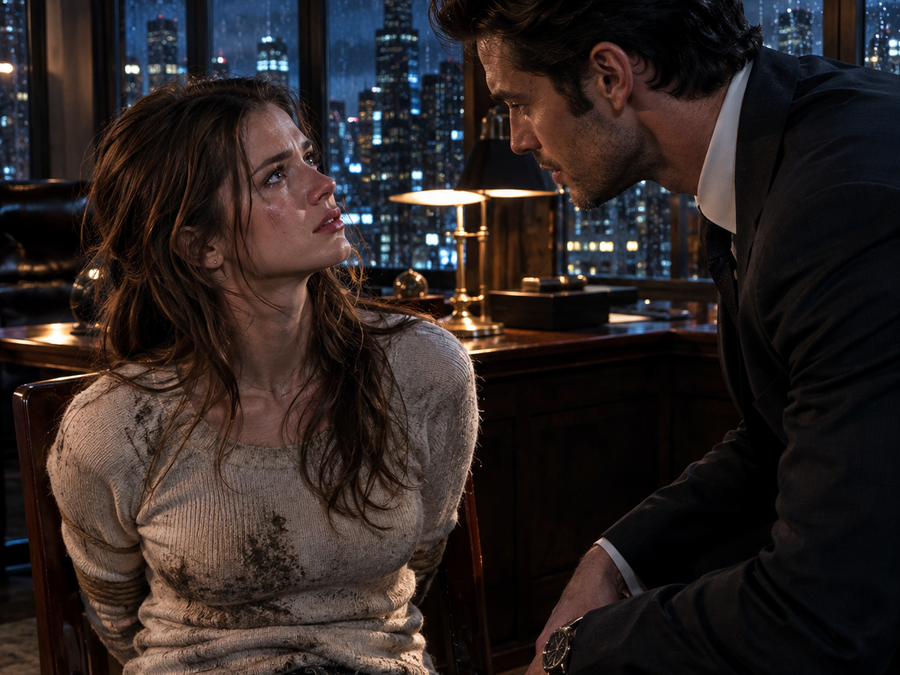
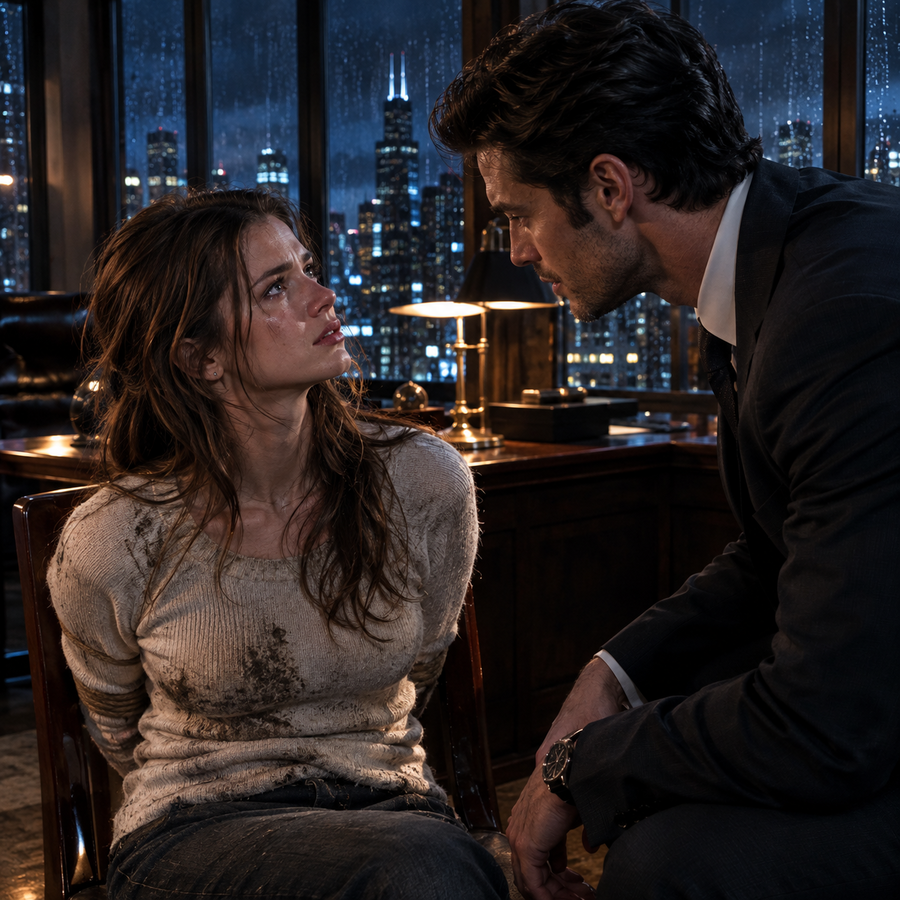
My eyes flew open and I found myself in what appeared to be an upscale office, all dark wood and expensive furnishings that spoke of wealth and power. The room was dimly lit by a single desk lamp, casting long shadows across walls lined with bookshelves filled with leather-bound volumes. A massive desk dominated the space, and behind it sat a man who radiated danger the way some people radiated warmth. He was studying a file folder, his attention focused on whatever information it contained, seemingly unconcerned with my presence.
I took the opportunity to examine him, my artist’s eye cataloging details even through my fear. He was probably in his early 30s, with dark hair styled perfectly, a strong jaw, and features that would be handsome if not for the cold calculation visible in his expression. He wore an expensive suit, the kind that cost more than I made in three months, and a watch that probably cost more than my car. Everything about him screamed wealth and danger in equal measures.
When he finally looked up from the folder, his eyes locked onto mine with an intensity that made my breath catch. They were dark, almost black in the dim lighting, and completely unreadable. I had never felt so thoroughly examined, as if he could see straight through to my soul and was categorizing everything he found there.
“Sophie Turner,” he said, his voice smooth and cultured with just a hint of something harder underneath. It was not a question, but a statement, though something in his tone suggested uncertainty. “Art teacher at Lincoln Park High School, 25 years old, lives alone in a studio apartment in Logan Square. No immediate family in Chicago, parents retired in Arizona.”
He recited these facts about my life with clinical precision, and the violation of my privacy added another layer to my terror. “Who are you?” I managed to ask, my voice coming out shaky. “Why am I here? What do you want from me?” The questions tumbled out in a rush, desperate and confused. I could not imagine any reason why someone like him would want anything to do with someone like me.
I was nobody, a struggling teacher trying to make a difference in kids’ lives, completely removed from whatever world this man inhabited. He stood up, moving around the desk with the fluid grace of a predator, and I instinctively tried to push my chair backward, achieving nothing except making the legs scrape against the hardwood floor.
He noticed my attempt to retreat, and something flickered across his face, an emotion too quick to identify. When he spoke again, his voice carried a note of genuine confusion that seemed out of place given the circumstances. “That is an excellent question,” he said, leaning against his desk and crossing his arms. “One I am currently trying to answer myself. You see, Miss Turner, you were not supposed to be here. My men were supposed to retrieve someone else entirely, and instead they brought me an art teacher.”
He said the last two words with a mixture of disbelief and frustration, as if my profession was somehow an insult to his operation. “Tell me, do you have any connection to the Romano family? Any dealings with organized crime? Any debts, gambling problems, anything that might explain why you would be of interest to my organization?”
I stared at him, completely bewildered by the questions. Romano family, organized crime—these were things I knew only from movies and news reports, completely alien to my world of lesson plans and student evaluations. “I do not know what you are talking about,” I said, my voice gaining strength as confusion overtook fear. “I teach art to teenagers. I spend my weekends grading assignments and visiting museums. The most exciting thing in my life is when the school board approves my budget for new supplies. I do not know any Romanos. I do not gamble, and I certainly have no connection to any criminals.”
Something in my vehement denial must have convinced him because his expression shifted, the cold calculation giving way to irritation. He pulled out his phone, tapped the screen a few times, then held it up to show me a photograph. It was a woman who looked vaguely similar to me. Same general height and build, similar hair color, but her face was harder, her eyes carrying an edge that mine lacked.
“This is Isabella Romano,” he said. “Daughter of my rival, Marco Romano. She has information I need, and my men were supposed to bring her to me. Instead, they brought you.” The implications of his words slowly sank in, and a new kind of fear bloomed in my chest. If I was not the person they wanted, then I was a witness to a kidnapping, someone who could identify his men and possibly him. In the movies, witnesses in situations like this rarely survived to tell their stories.
My hands trembled against the rope binding them, and I felt tears threatening to spill over. “Please,” I whispered, hating how weak I sounded, but unable to stop the plea from escaping. “I will not tell anyone. Just let me go, and I will forget this ever happened.”
He studied me for a long moment, his dark eyes searching my face for something I could not name. Then he straightened up and walked to the window, looking out over what I could now see was a spectacular view of the Chicago skyline, glittering in the night. The rain had stopped, leaving the city washed clean and sparkling.
“It is not that simple,” he said quietly, his back still to me. “You have seen my face. You have been in my home, and by now the Romanos will know that someone was taken from that school parking lot. They will be searching for their daughter. And when they discover my men took the wrong woman, they will realize their mistake might become my liability.”
“What does that mean?” I asked, though part of me did not want to know the answer. My mind raced through possibilities, each one worse than the last. Would he kill me to tie up loose ends? Would he hand me over to these Romanos as some kind of apology? Would I simply disappear? Another tragic statistic in a city that saw too much violence?
He turned back to face me, and this time I saw something different in his expression, a hint of frustration mixed with what might have been reluctant admiration. “It means, Sophie Turner, that you have become a problem I did not anticipate and do not particularly want.” He moved closer, stopping just a few feet away. Close enough that I could smell his cologne, expensive and subtle. “But you are also now in danger. The Romanos will want to know what you know, whether you are working for me, what information you might have, and my enemies are not known for their gentle interrogation techniques.”
The full horror of my situation crystallized in that moment. I was trapped between forces I did not understand, caught in a world that operated by rules completely foreign to everything I knew. “So what happens to me?” I asked, my voice barely above a whisper. The question hung in the air between us, heavy with implications.
He crouched down so we were at eye level, and I found myself looking into those dark eyes, searching for any hint of mercy. What I saw there was complex, a mixture of calculation and something else. Something almost human that gave me a sliver of hope. “That depends,” he said slowly, as if working through a problem in real time. “On whether you can follow instructions and keep your mouth shut. On whether I can trust that you are actually who you appear to be, not some elaborate plant by the Romanos, and on whether my instincts about you are correct.”
“Your instincts?” I asked, clinging to that word like a lifeline. If he had instincts about me, that meant he saw me as a person, not just a problem to be eliminated. It was a small thing, but in that moment it felt enormous.
“That you are exactly what you appear to be,” he said, standing up and moving back to his desk. He pressed a button on his phone and I heard a door open behind me. “An innocent woman who was in the wrong place at the wrong time, who now finds herself in a situation she never asked for and does not deserve.” He looked past me at whoever had entered, and I felt someone begin to untie my hands.
“Their mistake,” he said, his eyes returning to mine with an intensity that made my pulse quicken for reasons I did not want to examine. “My luck. Now you are mine.” The ropes fell away from my wrists, and I rubbed the sore skin, trying to process what he had just said. “Now you are mine.” The words echoed in my mind, equal parts terrifying and strangely compelling.
A woman appeared beside me, middle-aged with kind eyes that seemed out of place in this environment. She helped me to my feet, steadying me when my legs wobbled from sitting bound for so long. My body ached in ways I had never experienced, tension and fear having knotted every muscle. “This is Maria,” the man said, still not having offered his own name. “She will show you to your room and get you whatever you need. You will stay here in my penthouse where I can ensure your safety. You will not leave without my permission. You will not contact anyone outside, and you will not cause problems. In return, I will keep you alive and protected from the people who would hurt you to get to me. Do we understand each other?”
I wanted to argue, to demand he let me go, to insist that I had rights and could not just be held prisoner, but looking at him, at the absolute certainty in his posture and the power radiating from every line of his body, I knew that arguing would be pointless. Whatever world I had woken up in, it operated by different rules than the one I had left behind in that school parking lot. “Do I have a choice?” I asked, already knowing the answer.
“Everyone has choices,” he replied, his tone suggesting I would not like the alternatives. “You can stay here, protected and comfortable, until I determine what to do with you, or I can have my men drop you off at your apartment and wish you luck dealing with the Romano family when they come calling. Which would you prefer?” It was not really a choice at all, and we both knew it.
I looked at Maria, who gave me a gentle, encouraging nod, then back at the man who held my fate in his hands. “I will stay,” I said quietly, hating the defeat in my voice. “But I need to know your name. If I am going to be your prisoner, I at least deserve to know who is imprisoning me.” A ghost of a smile touched his lips, the first break in his cold demeanor.
“Dominic Salvatore,” he said, and the name sent a chill down my spine. Even I, removed as I was from the criminal underworld, had heard that name. The Salvatores were one of Chicago’s most powerful crime families, their influence reaching into every corner of the city. And this man, this dangerous, complicated man, was their leader. “And you are not my prisoner, Sophie. You are my guest. A guest who cannot leave, granted, but the distinction is important.”
Maria touched my arm gently, breaking the intense stare between Dominic and me. “Come, dear,” she said softly, her accent carrying hints of Italian heritage. “Let me show you to your room. You must be exhausted and confused. I will bring you some food and something comfortable to wear.” She guided me toward the door, and I went willingly, desperate to escape Dominic’s penetrating gaze and the confusing emotions it stirred within me.
The penthouse was even more impressive than the office, a sprawling space of modern luxury that occupied the entire top floor of what was clearly one of Chicago’s most exclusive buildings. Floor-to-ceiling windows offered breathtaking views of the city, and the interior was decorated with a combination of contemporary art and classic elegance that even my critical artist’s eye had to admire. Maria led me down a hallway past several closed doors to a guest room that was larger than my entire apartment.
The bedroom was beautiful, decorated in soft neutrals with touches of deep blue, dominated by a king-sized bed that looked impossibly inviting. An attached bathroom featured a soaking tub and a shower that could fit several people. A walk-in closet stood empty, waiting to be filled. It was a gilded cage, I realized. Luxurious, but still a cage. Maria bustled about, turning on lights and checking that everything was in order, her movements practiced and efficient.
“There are clothes in the dresser that should fit you,” she said, opening drawers to show me soft pajamas, comfortable casual wear, even exercise clothing. “Mr. Salvatore called ahead while you were unconscious and had things brought in. He is very thorough.” There was something in her tone, a hint of affection mixed with exasperation, that made me wonder about her relationship with Dominic. She was clearly not afraid of him, treating him with a familiarity that suggested long association.
“How long have you worked for him?” I asked, sitting on the edge of the bed because my legs would not support me anymore. The adrenaline that had kept me functioning was draining away, leaving exhaustion in its wake. My hands shook as I clasped them in my lap, trying to maintain some composure in front of this stranger who had shown me more kindness in ten minutes than my captor had. Maria smiled, her weathered face creasing with genuine warmth.
“Twenty years, since Mr. Salvatore was just a boy of twelve. I was his mother’s housekeeper, and when she passed, I stayed to look after him and his sister. He can be hard, demanding, sometimes frightening to those who do not know him. But he is not cruel, not like his father was. He has his own code, his own sense of honor, even if it is not one the rest of the world would recognize.” She patted my hand, a motherly gesture that brought unexpected tears to my eyes. “You will be safe here, Cara. He will not let anyone hurt you.”
“But he is keeping me prisoner,” I said, the tears finally spilling over. All the fear and confusion and anger I had been suppressing came flooding out, and I could not stop the sobs that shook my body. Maria sat beside me and pulled me into her arms, letting me cry against her shoulder like a child. She murmured soothing words in Italian, stroking my hair while I fell apart, the weight of everything that had happened finally breaking through my shock.
When the storm of emotion finally passed, leaving me drained and hollow, Maria helped me to my feet and guided me to the bathroom. “Take a hot shower,” she instructed gently. “It will help. I will bring you some food and tea, and then you need to sleep. Tomorrow things will seem less overwhelming. I promise. Everything is more frightening in the dark.” She left me alone, closing the door softly behind her, and I stood in that beautiful bathroom, wondering how my normal, boring life had transformed into this nightmare in the span of a few hours.
The hot water did help, washing away the physical traces of my ordeal, even if it could not touch the emotional trauma. I stood under the spray until the water ran cold, trying to scrub away the feeling of hands grabbing me, the smell of that chemical-soaked cloth, the terror of waking up bound and helpless. When I finally emerged, I found soft pajamas laid out on the bed along with a tray of food that actually made my stomach growl despite everything.
Maria had brought soup, fresh bread, fruit, and a pot of herbal tea that smelled of chamomile and something else, something soothing. I ate mechanically, barely tasting the food, but recognizing my body’s need for fuel. The tea did calm me, its warmth spreading through my chest and easing some of the tightness that had gripped me since waking in Dominic’s office. As I sipped from the delicate china cup, I looked around the room that was to be my prison, taking in details I had missed before. Fresh flowers in a vase on the dresser. Books on the nightstand, a mix of bestsellers and classics. A television hidden in an armoire. Small touches that suggested thought and care, which only confused me more.
Exhaustion finally claimed me, dragging me down into the bed’s embrace. I thought I would lie awake for hours, my mind racing with fear and questions. But instead, I fell into a deep, dreamless sleep almost immediately. My last conscious thought was of Dominic’s dark eyes and his words: “Their mistake, my luck, now you are mine.” I could not decide if that was a promise or a threat, or somehow both at once.
I woke to sunlight streaming through the windows and the smell of fresh coffee. For a blissful moment, I thought the previous day had been a nightmare, some strange stress-induced dream brought on by too many late nights grading papers. Then I opened my eyes and saw the unfamiliar room, and reality crashed back down on me. I was really here, really a captive in a crime boss’s penthouse, really in danger from people I did not know for reasons I did not understand.
Maria appeared with breakfast, as cheerful as if this were a normal morning and I were a normal guest. “Good morning, Cara,” she said, setting a tray on the bedside table. “I brought coffee, toast, eggs, and fruit. Mr. Salvatore asks that you join him in his office when you are ready. No rush, but sometime this morning.” She said it casually, but I heard the underlying message. It was not really a request.
“What if I refuse?” I asked, testing the boundaries of my captivity. I needed to understand what I was dealing with, what my actual options were in this surreal situation. Maria gave me a look that was equal parts sympathetic and pragmatic.
“Then he will come here,” she replied simply. “And he will be less patient than if you go to him willingly. Mr. Salvatore is accustomed to being obeyed, Sophie. Fighting him on small things will only make your situation more difficult. Save your battles for things that truly matter.” It was good advice, I realized, from someone who understood how to navigate Dominic’s world.
I nodded slowly, accepting the wisdom in her words, even as I hated the necessity of them. After Maria left, I ate the breakfast and drank the excellent coffee, trying to prepare myself mentally for whatever came next. I dressed in the clothes that had been provided, simple jeans and a soft sweater that fit perfectly, which somehow made everything more unsettling. How had he known my size? How much planning had gone into my captivity? The attention to detail suggested this was not his first time holding someone against their will, a thought that sent ice through my veins.
I made my way back through the penthouse, trying to memorize the layout in case I ever needed to navigate it in an emergency. The living room was vast and open with those stunning windows and furniture that managed to be both comfortable and clearly expensive. The kitchen was a chef’s dream, all professional-grade appliances and marble countertops. I passed a dining room that could seat twelve, a library filled with books that actually looked read rather than just decorative, and what appeared to be a gym through one partially open door.
Dominic’s office door was ajar, and I knocked softly before entering, some remnant of my normal life’s manners asserting itself despite the abnormal circumstances. “Come in,” his voice called, and I pushed the door open to find him standing by the windows, dressed more casually than last night in dark slacks and a white shirt with the sleeves rolled up. He looked less intimidating in the morning light, though no less dangerous. If anything, the casual attire made him seem more real, more human, which was somehow more unsettling than the cold mob boss of the previous night.
“How did you sleep?” he asked, turning to face me. The question was surprisingly normal, almost domestic, and it threw me off balance. I had expected threats or demands, not polite inquiries about my rest. “Fine,” I lied, not wanting to give him the satisfaction of knowing I had slept better than I should have given the circumstances. “What happens now? Are you going to tell me what you are planning to do with me?” I tried to keep my voice steady, to sound braver than I felt.
His lips quirked in what might have been amusement at my attempt at defiance. Dominic gestured to the chair across from his desk, the same one I had been bound to the previous night, though now it was simply a seat rather than a restraint. I sat carefully, keeping my spine straight and my hands folded in my lap, trying to project a calm I absolutely did not feel. He moved to sit behind his desk, creating a physical barrier between us that somehow made me feel both safer and more vulnerable at the same time.
The morning light caught his features, and I could see details I had missed in last night’s shadows: the small scar above his left eyebrow, the slight asymmetry of his face that kept him from being too perfect, the intelligence burning in those dark eyes. “I spent most of last night researching you,” he said without preamble, opening a laptop and turning it so I could see the screen. It displayed what appeared to be a comprehensive dossier on my life, more detailed than anything I could have imagined.
Social media profiles I had forgotten I had, college transcripts, employment history, even photographs from my childhood that must have been pulled from my parents’ online albums. The violation was complete and absolute. “Sophie Anne Turner, born in Phoenix, Arizona to Michael and Diane Turner, both retired accountants. Only child, graduated from the School of the Art Institute of Chicago with honors, no criminal record, not even a parking ticket, no significant debts beyond student loans. Current relationship status is single. Has been for eight months since breaking up with Jason Martinez, a software engineer who now lives in San Francisco.”
The recitation of my life in such clinical terms made me feel exposed in a way that went beyond physical vulnerability. He knew everything about me while I knew almost nothing about him beyond his reputation and what little I could glean from his environment. “Why?” I asked, my voice tight with anger and humiliation. “What does any of that matter? You already know I am not the person you wanted. Why dig into my life like this?”
“Because I needed to verify that you are exactly what you appear to be,” Dominic replied, closing the laptop and leaning back in his chair. His gaze never left my face, reading my reactions with the intensity of someone trained to detect lies and deception. “In my world, Sophie, nothing is ever as simple as it seems. People use innocence as covers, plant them in positions where they can gather intelligence, create elaborate backstories that can withstand surface scrutiny. I needed to know if you were genuinely a school teacher caught in the wrong place at the wrong time, or if you were something more dangerous wearing an innocent disguise.”
“And what did you conclude?” I asked, though his tone had already told me the answer. There was a subtle relaxation in his posture that suggested I had passed whatever test he had administered, at least provisionally. The thought that I had been under such scrutiny without my knowledge sent a fresh wave of anxiety through me.
“That you are either exactly who you claim to be, or you are the best-trained operative I have ever encountered,” he said, a hint of dry humor coloring his words. “And given that the latter would require resources and planning far beyond what any of my known enemies possess, I am inclined to believe the former. Which brings us to our current predicament.” He stood and moved to the window again, a habit I was beginning to recognize as something he did when thinking through complex problems.
“The Romano family knows someone was taken near that school. They have people in the police department who would have filed a report about your disappearance by now. They will be searching for their daughter. And when they realize she was never taken, they will wonder who was.” The implications of his words sank in slowly, each one adding weight to my already heavy dread.
“So I am in danger,” I said quietly. It was not a question, just an acknowledgement of the reality he was laying out for me. “Even though I have nothing to do with any of this, even though I am just a teacher who was in the wrong parking lot at the wrong time, I am now a target.”
“Yes,” he confirmed, his honesty somehow more frightening than a comfortable lie would have been. “If the Romanos think you might have information about my operations, or if they think taking you might hurt me, you become valuable to them. And their methods of extracting information or leverage are not pleasant.” He turned back to face me, his expression serious but not unkind. “That is why you cannot leave. Not yet. Not until I can guarantee your safety or until the situation with the Romano family is resolved one way or another.”
“How long will that take?” I asked, trying to keep the desperation out of my voice. The thought of being trapped here indefinitely, away from my students, my life, my freedom, was almost more than I could bear. I had worked so hard to build my independent life in Chicago, to create something meaningful through my teaching. Now all of that was suspended, frozen in time while I existed in this strange limbo.
Dominic’s expression shifted, something that might have been regret or sympathy crossing his features before he locked it down behind his usual mask of controlled power. “I do not know,” he admitted. “These things can take days, weeks, sometimes longer. The Romano family and mine have been at odds for three generations. This particular conflict centers around territory and business interests that have been disputed for months. Your accidental involvement is just one more complication in a very complicated situation.”
I felt tears threatening again and blinked them back furiously, refusing to cry in front of him a second time. I would not give him the satisfaction of seeing me break down, even though every cell in my body wanted to curl up and sob at the unfairness of everything that had happened. “What about my job?” I asked, focusing on practical concerns to keep the panic at bay. “My students, my life—I cannot just disappear without explanation. People will worry, will look for me.”
“Already handled,” Dominic said, pulling his phone from his pocket and tapping the screen a few times before showing it to me. It was an email from my own account, sent to my principal and copied to the main office, explaining that I had a family emergency in Arizona and would be taking an indefinite leave of absence. “You had the vacation days and personal time accumulated. The school was not happy, but they accepted it. Your parents received a call from you explaining the same thing, from your own phone, in your own voice.”
He must have seen the confusion on my face because he continued, “Voice cloning technology. We recorded you while you were unconscious. Got enough samples to create a convincing replication. Your neighbors think you are visiting family. Your friends received texts saying you would be out of touch for a while dealing with personal issues.” The thoroughness of it was both impressive and terrifying. He had essentially erased me from my normal life with surgical precision, creating a narrative that would prevent people from looking too closely at my disappearance.
“You thought of everything,” I said bitterly, anger finally breaking through my fear. “You just reached into my life and rearranged it to suit your needs. Never mind what I want or what I have worked for. Do you have any idea what it has taken me to build my career, to earn my students’ trust? And you have just swept all of that aside like it does not matter.”
For the first time, I saw genuine emotion flicker across Dominic’s face, something that looked almost like shame before he shuddered it away. “I did what was necessary to protect you,” he said, his voice harder now. “Would you prefer I had left things as they were? Let the Romanos track you down at your apartment? Let them question your principal, your friends, your neighbors until they found someone who could tell them where you were? Every person who knows about your disappearance is a potential leak. A vulnerability that could get you killed. I eliminated those vulnerabilities.”
“By taking over my life without my consent,” I shot back, standing up because I could not sit still anymore. The anger felt good, clean, and empowering after hours of helplessness. “You do not get to make these decisions for me, Dominic. I understand you are trying to protect me from the consequences of your men’s mistake, but I am not a child or a possession. I am a person with rights and choices, and you have taken all of those away from me.”
He moved toward me with that same predatory grace, closing the distance between us until we were standing too close, close enough that I had to tilt my head back to maintain eye contact. His height and presence were overwhelming, but I refused to back down, refused to let him intimidate me into submission. “In my world, Sophie, rights and choices are luxuries that get people killed,” he said, his voice low and intense. “You may not like my methods. You may hate being here, but you are alive. That is what matters. That is all that matters. And until I can guarantee that you will stay alive outside these walls, you will follow my rules and accept my protection, whether you want it or not.”
We stood there, locked in a silent battle of wills, neither of us willing to concede the point. I could feel the heat radiating from his body, smell that expensive cologne again, see the slight dilation of his pupils that suggested he was not as unaffected by our proximity as he pretended to be. The moment stretched between us, charged with tension that was not entirely about anger or fear, and that realization sent a spike of something complicated through my chest.
A knock at the door broke the spell, and we both stepped back as if burned. “Come in,” Dominic called, his voice only slightly rough. A man entered, tall and broad-shouldered with the look of someone who had seen combat, carrying a tablet that he handed to Dominic without speaking. Dominic scanned whatever information was displayed there, his expression growing darker with each passing second.
“When?” he asked, his tone clipped and controlled. “Two hours ago,” the man replied, his voice gravelly and his accent suggesting Eastern European origins. “Romano’s crew hit the shipment coming through the port. Took everything. Killed three of our guys. It was planned, boss. They knew exactly when and where it would be.” He glanced at me, his ice-blue eyes assessing me with professional detachment, clearly wondering what a civilian was doing in Dominic’s inner sanctum.
Dominic’s jaw tightened, and I could see him processing this new information, calculating responses and consequences with visible speed. “Double security on all operations. I want to know how they got that information, who the leak is, and I want them found yesterday. And arrange a meeting with the other families. If the Romanos are getting bold enough to hit us in broad daylight, we need to show them there are consequences.” The man nodded and left as silently as he had entered, leaving Dominic and me alone again with this new tension hanging in the air.
“I should go,” I said quietly, recognizing that whatever had just happened was serious and that my presence was probably not helping. Dominic looked at me as if he had forgotten I was there, his mind clearly already moving through strategy and response. Then his expression softened slightly, the calculating crime boss giving way to something more human beneath. “Maria will bring you lunch,” he said, already turning back to his desk and the laptop that was lighting up with incoming messages. “Stay in the penthouse. Do not go near the windows where you might be visible from outside. If you need anything, ask Maria.”
He looked up, catching my eyes with that intense gaze that seemed to see too much. “Sophie… I am sorry for all of this. You do not deserve to be caught in this world. But you are here now, and I will do everything in my power to keep you safe until I can return you to your life. That is a promise.” I nodded, not trusting myself to speak, and left him to his crisis management.
As I walked back through the penthouse, I could hear him making calls, his voice taking on the hard edge of someone giving orders that would not be questioned. This was his reality, I realized. A constant battle for power and survival in a world where violence was just another business tool. And I was now trapped in that world. A prisoner of circumstances I had not created and could not control.
Maria found me in the library, curled up in a leather chair with a book I was not really reading. She brought tea and small sandwiches, setting them on the table beside me with her usual gentle efficiency. “Hard morning?” she asked, her knowing eyes suggesting she understood more than I had said. I wondered how much she had heard of my argument with Dominic, how much she knew about what was happening in his world.
“You could say that,” I replied, setting the book aside. The words on the page had been meaningless anyway, my mind too full of everything else to focus on fiction. “Maria, can I ask you something? How do you do this? How do you live in this world, knowing what he does, seeing the violence and the danger? How do you reconcile working for someone who operates outside the law?”
She settled into the chair across from me, taking time to arrange her thoughts before speaking. “Mr. Salvatore is not his father,” she said finally. “The old man, he was cruel, violent for the sake of violence, cared nothing for the people who worked for him or the communities his business affected. Dominic, he is different. He did not want this life, you know. He wanted to be legitimate, to leave all of this behind. But when his father was killed and his sister needed protection, he had no choice but to take over. It was become the head of the family or watch everything collapse into chaos that would have gotten innocent people killed.”
I absorbed this information, trying to reconcile the image of a reluctant mob boss with the controlled, dangerous man I had been dealing with. “But he still does illegal things,” I protested weakly. “He still hurts people, runs criminal operations. That does not change just because he did not originally want this life.”
“No,” Maria agreed. “It does not. But he has rules, ethics that his father never had. He does not deal in drugs, does not allow his people to hurt innocents, does not traffic in anything that would harm children or the vulnerable. His businesses, while illegal, are things that would exist anyway. Prostitution and gambling and smuggling. He just makes sure they are done with as little collateral damage as possible. Is it right? No. But is it better than what would exist without him? Yes.” She reached out and patted my hand. “You do not have to forgive him for what has happened to you, Cara. But perhaps you can try to understand that the world is not so simple as good and evil, legal and illegal. Sometimes there are only choices between bad and worse, and we do the best we can.”
The days began to blur together in a strange routine that felt both surreal and oddly normal. I woke each morning to sunlight and Maria’s cheerful delivery of breakfast, spent my days reading in the library or exploring the confines of my gilded cage, ate carefully prepared meals that were far better than anything I usually cooked for myself, and fell asleep in that impossibly comfortable bed, wondering when this bizarre chapter of my life would end. It would have been easy to lose myself in the luxury, to forget that I was a prisoner rather than a guest. But the reality of my situation remained constant, even as the routine made it feel less immediate.
Dominic and I maintained a careful distance after that first confrontation. We would see each other at dinner, which Maria insisted we take together in the formal dining room despite my protests. Those meals were exercises in careful civility, polite conversation about neutral topics that skirted around the elephant in the room. He asked about my teaching and I found myself telling him about my students, the challenges of engaging teenagers with art, the small triumphs when a resistant student finally connected with their creative side. He listened with what seemed like genuine interest, asking thoughtful questions that suggested he was actually paying attention.
In turn, he told me sanitized versions of his day, talking about business deals and negotiations without ever explicitly mentioning what those businesses actually were. I learned he had a younger sister named Isabella—ironically, the same name as the woman I had been mistaken for—who was studying medicine in Europe, far away from the family business. He mentioned his mother, who had died when he was young, and the complicated relationship he had had with his father. These glimpses of humanity made it harder to maintain my anger, which frustrated me because I wanted to stay angry. Needed that anger to keep from becoming too comfortable in my captivity.
About a week into my confinement, I woke to raised voices coming from Dominic’s office. It was early, the sun barely up, and I pulled on a robe before carefully making my way toward the sound. The door was partially open, and I could see Dominic pacing like a caged animal while the man I had seen that first day, whose name I had learned was Victor, stood at military attention, delivering what was clearly bad news.
“Three more of our people are dead, boss,” Victor said, his voice controlled but with frustration underneath. “The Romanos hit another operation last night, this time at the warehouse in Cicero. They knew exactly where to strike, exactly when security would be lightest. Someone is feeding them information, and we still have not found the leak.” These were his people, too. Colleagues and maybe friends, dying because of a traitor they could not identify.
Dominic’s fist slammed down on his desk hard enough that I jumped despite being several feet away. “Then dig deeper. Question everyone who had access to that information. I do not care if they have been with us for twenty years. I want them investigated, and get me a meeting with Marco Romano. This ends now, one way or another.” His voice was harder than I had ever heard it, the urbane businessman completely gone, replaced by something far more dangerous.
“He will not meet with you,” Victor said carefully. “Not after what happened with his daughter. He thinks you tried to take her, that you are making a move against his family. Any message we send will be seen as weakness or a trap.” I realized with a start that they were talking about me, about the kidnapping that had gone wrong and started this whole mess. I was not just a victim in this situation. I was also a cause, a catalyst that had helped escalate a conflict that was now getting people killed.
“Then we make him meet,” Dominic growled, running his hands through his hair in a gesture of frustration that made him look younger and more vulnerable. “We have leverage. We have resources he needs. Find the angle and exploit it. I am tired of losing people to this pointless war. My father might have thrived on this kind of conflict, but I did not take over this family to watch it bleed out in territory disputes with the Romanos.” He paused, then added in a quieter voice, “And we need to resolve this before she gets hurt. She has been here too long already, trapped because of our mistakes.”
I should have retreated then, gone back to my room before they realized I was listening. But I was frozen in place by the realization that Dominic was worried about me. Not just in an abstract sense of protecting a liability, but genuinely concerned about what my continued captivity was doing to me. Victor must have noticed my presence because his eyes flicked to the doorway and Dominic turned, catching me standing there in my robe with my hair undone, clearly having just woken up.
For a moment, we just looked at each other, and I saw exhaustion in his face that I had not noticed before. Lines of stress and worry that went beyond just business concerns. “How much did you hear?” he asked quietly, dismissing Victor with a gesture. The other man left, closing the door behind him with a soft click that seemed too loud in the sudden silence.
“Enough,” I admitted, moving into the office since there was no point in pretending I had not been eavesdropping. “People are dying because of what happened to me. Because your men took the wrong woman, and now there is some kind of war happening.” My voice was steady, but I felt sick. The weight of that knowledge settling into my chest like a stone. “Is that right? Are people dying because I was in the wrong parking lot?”
Dominic moved toward me and I saw him struggle with how much truth to tell me. Finally, he sighed and gestured to the chairs by the window. We sat, the morning light harsh and unforgiving, showing every shadow under his eyes and every tension line around his mouth. “People are dying because the Romano family and mine have been on a collision course for years,” he said carefully. “Your kidnapping was the spark, but the fuel for this fire was already laid. If it had not been this, it would have been something else. Marco Romano has been looking for an excuse to move against my operations for months. You are not to blame for any of this, Sophie. The blame lies with me, for running an operation sloppy enough that my men could make such a catastrophic mistake.”
“But if I had not been there, if they had gotten the right woman, would this be happening?” I pressed, needing to understand my role in this nightmare. The guilt was irrational, I knew that, but it sat in my stomach anyway, heavy and undeniable.
“Probably,” Dominic said honestly. “Taking Isabella Romano would have provoked an even stronger response. At least with you, Marco does not know what happened. Does not know that we have someone he should care about. If we had his daughter, this would be all-out war instead of just escalating skirmishes. In a twisted way, my men’s mistake might have actually prevented something worse.” He leaned back in his chair, studying me with those dark, penetrating eyes. “You should not be bearing this guilt, Sophie. None of this is your fault. You are a victim in this situation, not a cause.”
“Then let me help,” I said impulsively, the words out before I had fully formed the thought. Dominic’s eyebrows rose in surprise, and I hurried to continue before I lost my nerve. “You said yourself that Marco Romano does not know what happened. Does not know you did not really take his daughter. What if we use that? What if I could somehow help you resolve this without more people dying?”
Even as I said it, I knew it was crazy. Knew I was volunteering to become even more entangled in a world I wanted nothing to do with. But the thought of people dying because I had been in the wrong place at the wrong time was unbearable. “Absolutely not,” Dominic said flatly, his expression hardening into the cold mask I had seen that first night. “You are a civilian, Sophie. You stay out of this. The last thing I need is for you to be put in more danger than you are already in. Whatever resolution comes, it will not involve you taking any risks.”
His tone made it clear the subject was closed, but I was not ready to let it go. “I am already involved,” I argued, leaning forward in my chair. “I am already in danger. At least let me do something useful instead of just sitting here waiting for you to decide when I can go home. You said yourself you need leverage with Marco Romano. Need some way to make him meet with you. Maybe I could be that leverage.”
I did not actually have a plan, had no idea what I was really suggesting, but the need to be active rather than passive in my own crisis was overwhelming. Dominic stood abruptly, pacing to the window and staring out at the city below. I watched his reflection in the glass, saw the conflict playing across his features as he weighed options and consequences.
“Do you have any idea what you are suggesting?” he asked, his voice tight with controlled anger. “Marco Romano is not a reasonable man you can negotiate with. He is a crime boss who built his empire on violence and intimidation. If he got his hands on you, if he thought you had information or value to me, what he would do to extract that information or leverage would be beyond anything you can imagine. I have seen what he does to people, Sophie. I will not expose you to that.”
“But I might be able to help,” I persisted, standing and moving closer to him. I did not understand why I was pushing this, why the idea of contributing to my own rescue felt so important, but I could not let it go. “I am good at reading people, at connecting with them. It is part of what makes me a good teacher. Maybe there is something I could do, some way I could help facilitate communication between you and him without putting myself directly in his hands.”
He turned to look at me and I saw something complicated in his expression. Frustration and admiration and something else I could not quite identify. “You have no idea how dangerous what you are suggesting is,” he said softly. “But I also see that you need to feel like you have some control over this situation, some agency in what happens to you. I understand that, Sophie. I do. But I cannot risk you that way. I will not.”
The words were firm, but there was a gentleness underneath that took the edge off the refusal. We stood there, close enough to touch, the air between us charged with something that went beyond the circumstances that had brought us together. I found myself noticing details about him that had nothing to do with his role as my captor: the way morning light caught gold flecks in his dark eyes, the slight stubble on his jaw that suggested he had been up most of the night, the way his shirt pulled across his shoulders when he crossed his arms.
The realization that I was attracted to him hit me like a physical blow, unwanted and completely inappropriate given everything that had happened. “I need air,” I said abruptly, stepping back from the suddenly claustrophobic proximity. “I have been inside for a week. Can I at least go out on the terrace, please?” It came out more pleading than I intended, but the walls of the penthouse were starting to feel like they were closing in, beautiful as they were.

