Former Navy SEAL Fixed an Old Man’s Truck for Free—“Stay Away from My Father,” His Daughter Said – Part 1
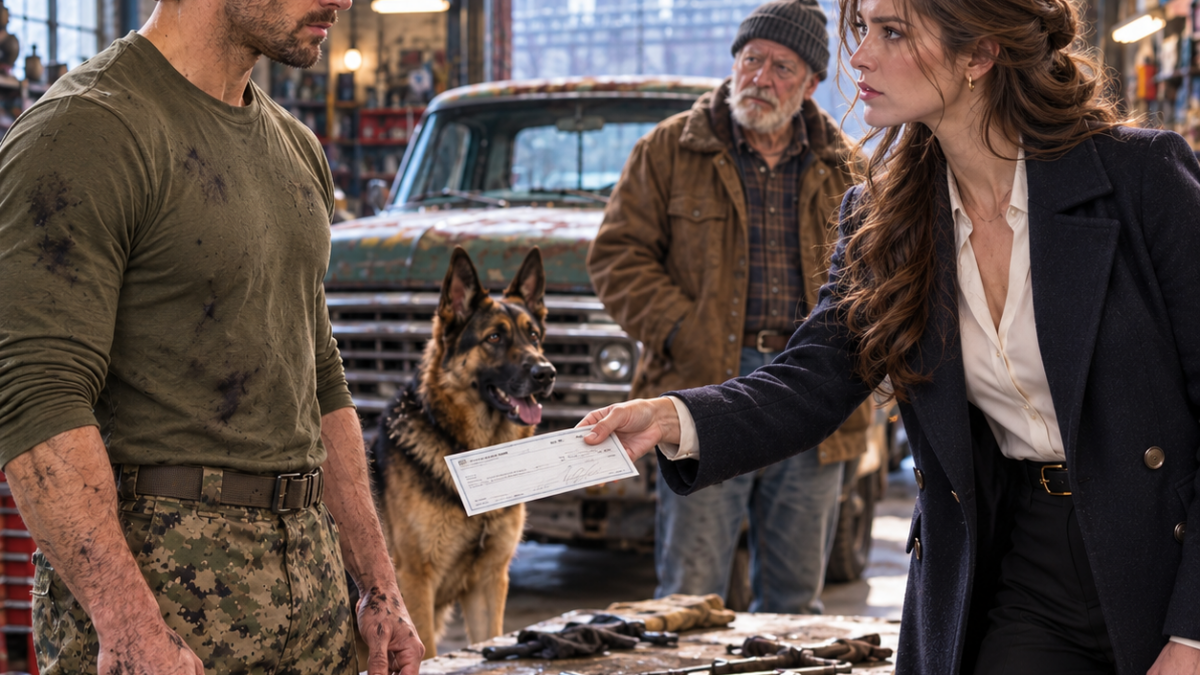
Former Navy SEAL Fixed an Old Man’s Truck for Free—“Stay Away from My Father,” His Daughter Said
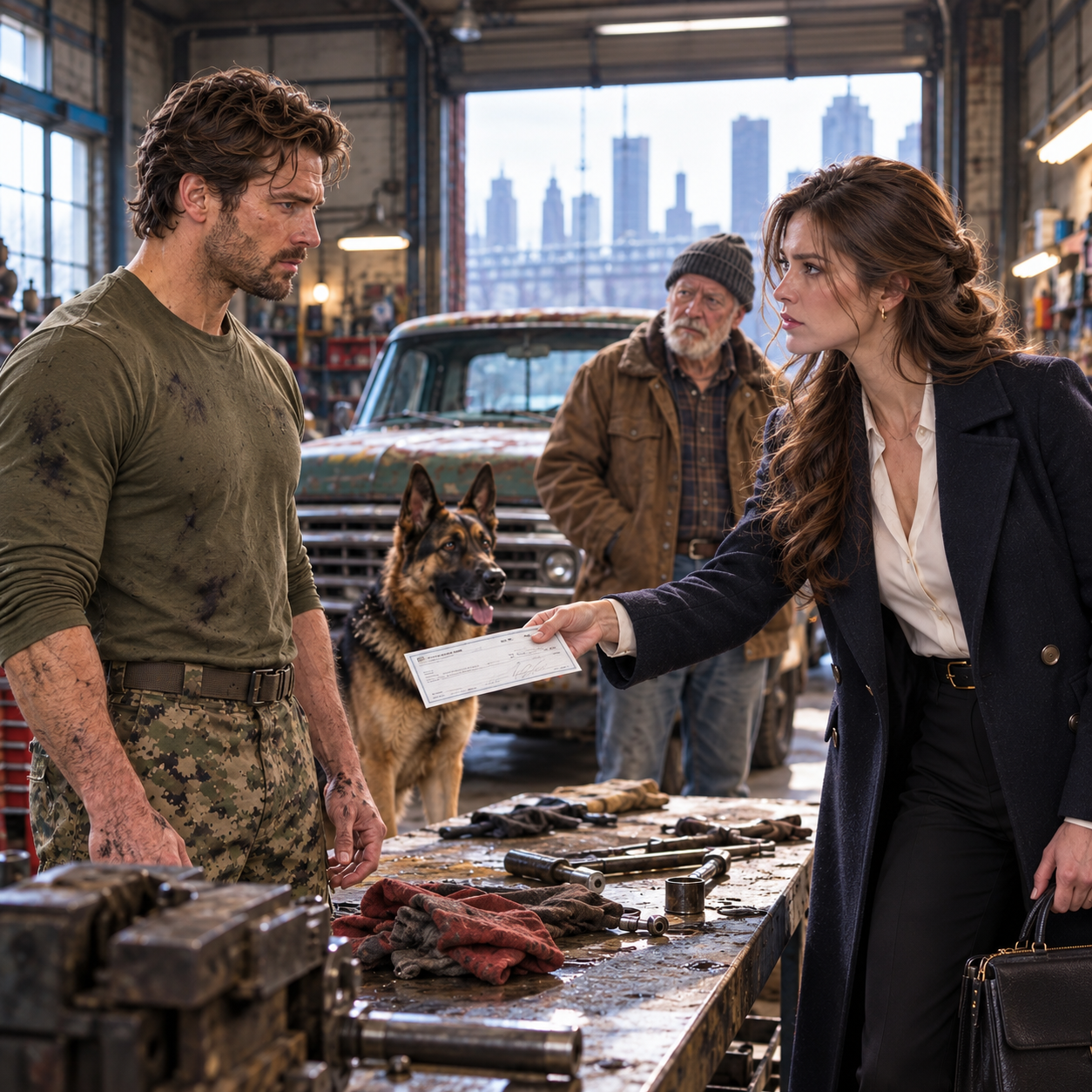
The $36,000 check sat on Mason Reed’s workbench beside his father’s worn ratchet and a stack of bills he could barely pay.
Julia Witcom stood across from him, telling him to take the money and stay away from her father. 4 days earlier, Mason had only stopped to help an old man whose truck had broken down.
He didn’t know who the man was, and he hadn’t charged him a dime.
Now, his garage was 45 days from serious trouble. and that check could solve almost every problem he had.
Atlas, his German Shepherd, lay quietly beside his father’s empty stool while Julia waited for an answer.
By the time Julia walked out, the certainty she had arrived with was gone. Their argument was only the beginning of a relationship neither of them could have imagined.
By the last week of November, winter had settled over Spokane Valley without ceremony. Mornings came hard and dry, laying a thin skin of frost across warehouse roofs along East Trent Avenue.
Wind moved through the industrial blocks in long, cold pushes, rattling loose signs and making the garage door at Reed Motorworks shiver in its tracks whenever someone opened it. The sign above the building had once been red. Jack Reed had painted it by hand more than 20 years earlier.
Now the paint had faded toward brick brown, and the final letters in motor works had nearly disappeared. Mason Reed noticed it every morning and did nothing.
There were always more urgent things, customer repairs, supplier invoices, the lift in bay 1, and a furnace that occasionally seemed to reconsider its commitment to the profession. Atlas watched the furnace with the same expression he gave overly friendly strangers.
The German Shepherd was eight now, darker around the muzzle than in Mason’s last years in uniform.
Atlas had worked beside him during the final part of Mason’s Navy career, and certain habits remained.
He preferred doorways and corners where he could see most of her room.
At the garage, that usually meant the space beneath Jack’s old workbench.
Mason had been out of the Navy for 5 years. the first three. He worked beside his father.
A former Navy Seal did not become a mechanic overnight. The teams had taught Mason how to keep equipment moving when conditions were bad and options were worse.
Jack had taught him why machines failed in the first place.
Long before Mason had a driver’s license, Jack made him learn socket sizes by feel.
After Mason came home, his father spent three years correcting him and slowly trusting him with the difficult jobs. Then Jack died, leaving him the garage, a battered toolbox, loyal customers, and a way of doing business that had never cared much for margins. For 2 years, Mason had kept the garage alive, but not healthy.
The newer service centers around Spokane Valley had bright websites, online appointments, shuttle service, clean waiting rooms, and financing options. Reed Motorworks had a coffee pot old enough to vote, handwritten notes, and mason. It also had a habit of telling customers things they did not always want to hear.
That Tuesday morning, a woman brought in a 7-year-old SUV after another shop had recommended a repair costing several thousand. Mason traced the problem to a damaged connector and a smaller failed part, then charged a fraction of what she had expected. She left relieved.
Mason watched the SUV disappear and knew honesty had just cost him the kind of invoice his monthly numbers badly needed.
Later, one of Jack’s oldest friends arrived with a grinding front wheel.
Mason knew the man lived mostly on retirement income, so he split the bill into two payments. Atlas accepted a biscuit and received more gratitude than Mason did.
Near closing, another customer wanted to spend almost $4,000 keeping an aging sedan alive. Mason looked at the rust underneath and told her to save the money for a down payment on something more reliable.
She thanked him and left. Another repair gone. Jack would have approved.
Jack was also dead, which meant he no longer had to balance the books. Several commercial customers were late paying invoices.
Mason’s parts supplier had shortened his credit terms.
The heating system needed work. One lift was leaking. Insurance renewal was coming.
And the bank had requested a meeting about the commercial loan tied to the building.
The letter sat open on Jack’s desk.
Before leaving that evening, Mason looked through the office glass. Atlas lay beneath the workbench, chin on his paws.
Jack’s toolbox still stood against Bay 2.
Each drawer labeled in his block handwriting. A promise Mason had made to himself several nights earlier came back with uncomfortable precision. No more free rescues.
No more unpaid favors disguised as quick jobs. No more telling himself he would save the garage tomorrow. He had spent years helping whoever stood in front of him.
Reed Motorworks had become the one thing he kept asking to wait. Mason shut off the lights and left early. The first snow looked harmless.
By the time he reached the main road, it was not. Wet flakes thickened against the windshield while wind pushed them sideways through the headlights. Lane markings blurred.
Traffic slowed. Atlas sat behind the passenger seat while Mason checked the clock more often than he liked.
He could still make the bank meeting barely. Then he saw the hazard lights.
An old pickup sat angled near the shoulder with its hood raised. An elderly man in a faded canvas coat stood beside it. One hand braced against the fender while the other held a flashlight into the engine bay.
Mason eased off the gas. The man looked stubborn rather than frightened.
Jack had possessed the same posture. The particular refusal to admit weather, age, or common sense had any authority over him. Mason drove past.
Relief came first. The man had a phone. Roadside assistance existed.
Someone else would stop.
Mason had a meeting that might decide whether his father’s garage still belonged to him in a few months.
All of those reasons were sensible. In the rear view mirror, the amber lights grew smaller.
Atlas turned his head and kept watching them.
Mason remembered the ledger and his promise to stop treating every stranger’s emergency like a personal assignment.
For once, he needed to choose the garage. The next intersection appeared through the snow. Mason exhaled, muttered something Atlas politely ignored, and turned around.
“One more,” he said quietly.
“Then we’re done saving strangers.”
Atlas gave no sign that he believed him. By the time Mason pulled in behind the pickup, snow had begun collecting along the road edge. He switched on his hazards, grabbed a roadside bag, and stepped into the cold.
The old man looked up.
“I’m fine,” he said.
Mason glanced at the dead truck, then at the weather.
That’s encouraging.
One corner of the man’s mouth moved.
His name was Harold Witcom. The truck had lost power gradually, lights dimming before the engine quit. Harold described the symptoms with unusual precision, and Mason noticed.
He checked the obvious things first, then traced the trouble to a deteriorating electrical connection near the engine block. Cold and wet had finally pushed the weak connection past its limit.
Harold held the flashlight exactly where Mason needed it without being told.
You’ve done this before.
Once or twice. Mason cleaned and secured the connection, protected the damaged section as well as he could, then warned Harold that the repair was temporary.
Harold nodded before he finished.
Atlas stood near Mason’s open vehicle door, watching both men.
Harold glanced toward him.
That dog always look at people like he’s reviewing their paperwork, only the suspicious ones.
Harold laughed and the truck started on the second try. Its headlights steadied.
The engine settled into a rough but dependable idle. Harold reached for his wallet.
Mason checked his phone. The bank meeting had already begun and several missed calls filled the screen. He put the phone away.
Keep it. Harold frowned, but Mason only told him the meeting was already missed, so at least one of them should get home before the roads froze.
Harold put the wallet away and reached behind the seat for an old steel thermos. He poured coffee into the lid and handed it over. It was strong enough to remove paint, but it was hot.
While Snow hissed softly against the hood, Harold asked where Mason worked. Reed Motorworks Family Place.
My father’s.
Harold nodded as though that explained more than Mason had said.
Before leaving, he wrote Mason’s name and number in a small notebook.
“I’ve got a few old vehicles,” he said.
“Might need somebody who still fixes things instead of replacing them.”
Then he drove away. Mason returned to his vehicle and listened to the bank voicemail twice before calling back. The loan officer agreed to meet him the following morning.
By then, the snow had eased. The consequences had not. The next day, the bank gave Mason 45 days to bring the loan into a range they could restructure.
Once normal operating expenses were counted, he needed roughly $17,800 more than the garage was likely to produce on its own. The deadline said enough.
Mason drove back to Reed Motorworks beneath a hard, pale sky. The old sign looked even more faded in daylight.
Inside, Atlas lifted his head from a folded blanket. The furnace clicked on, rattled for 12 seconds and shut itself off again.
Mason stood beneath the vent, and looked up at it. Helpful, he said.
Very helpful. Atlas put his head back down.
45 days had begun. 3 days after the snowstorm, Mason was replacing a front wheel bearing on a delivery van when he heard an engine outside that sounded familiar for all the wrong reasons. Not broken, just old enough to have a voice.
The uneven idle reached the garage before the truck did, followed by the soft chirp of a belt that had probably been promising to fail for several winters without finding the nerve. Mason rolled out from beneath the van and wiped his hands on a shop towel.
Harold Witcom’s green pickup stopped just outside bay 2.
Atlas lifted his head from beneath Jack’s workbench.
Harold climbed out carrying the same battered thermos. Though this time he looked less like a stranded driver and more like a man who had arrived exactly where he intended to be.
“You break down again?”
Mason asked. Harold looked offended.
“The truck’s fine.”
Mason glanced toward the hood.
“Then I assume you came to apologize for the coffee.”
Harold looked down at the thermos.
“Don’t push your luck.”
He walked into the garage without asking permission, slowly enough that Mason had time to notice what he was looking at. Not the waiting area, not the faded walls, the work.
Harold studied the shelves where Mason kept filters and fittings labeled in black marker.
He paused beside the alignment rack, ran his eyes over the floor drains, then stood for several seconds in front of Jack’s old toolbox.
The name Reed was still painted on the top drawer in Jack’s blocky handwriting.
Harold did not touch it. That earned him more trust than Mason expected.
“Your father?”
Harold asked. Mason nodded.
For a moment, the garage filled with the ordinary sounds of heat pipes ticking and tires hissing on wet pavement outside. Jack Reed had been able to hear a failing bearing before most customers finished describing the noise. He had distrusted unnecessary parts, glossy sales language, and anyone who referred to a repair bay as a service experience.
Mason had once thought the Navy had made him good at fixing things. It had certainly taught him to keep equipment running under pressure, often with too little time and fewer options than anyone would have preferred. Then he had come home.
Jack had spent the next 3 years showing him the difference between making something survive and making it right. Harold seemed to understand without Mason saying much. You worked with him long?
3 years after I got out. Not long enough. No.
Harold nodded as if that answer belonged to both of them. Then he turned back toward the bays. He said he had a few vehicles stored across town and wanted someone to inspect them properly.
Old pickups, service trucks, a couple of utility vehicles, maybe more depending on what Mason found. How many is a few?
Seven to start. Mason lowered the towel.
Seven inspections were not a favor. Seven vehicles meant labor, parts, scheduling, and possibly enough money to matter. He reached for a service pad and started explaining his rates.
Harold did not interrupt to ask for a discount.
That alone separated him from most people who began a sentence with, “I’ve got several vehicles.
” As Mason wrote, Harold’s questions changed.
He wanted to know how Mason handled vehicles that spent more time idling than driving. what usually failed first after repeated winter exposure.
Whether Mason preferred replacing suspect components early or waiting for measurable wear, how often he had worked around fleet vehicles that could not afford long downtime. None of the questions sounded casual. Mason stopped writing.
You collect old trucks professionally? Harold took a drink from his thermos.
I spent a long time around logistics. That was all he offered.
Mason had known men in the teams who could answer a question with three words and somehow make it clear the conversation was over. Harold had the same talent. He moved toward the open bay door and looked out at the dull winter light.
My daughter runs the company now. There was pride in the sentence, but something else underneath it.
Fatigue perhaps or the resignation of a father who knew pride and peace were not always delivered together. Good at it.
Annoyingly, Mason smiled. Harold continued watching the road.
Smartest person I know. Remembers every number she reads. Finds problems before most people know there is one.
Sounds useful. It is.
The pause that followed said the subject was more complicated than that. Harold finally turned.
She won’t like you.
Mason leaned against the workbench.
You’ve known me 4 days.
That should be enough for her. Mason assumed it was another joke.
Harold did not explain.
Before leaving, he tore a sheet from Mason’s service pad and wrote an address on the back.
A private storage facility near the industrial corridor. Monday, 9:00.
Mason looked at the paper for the seven vehicles for a start. And after that, Harold pulled on his gloves.
Maybe we talk about something larger. He started toward the truck, then stopped beside Atlas.
The German Shepherd remained stretched beneath the bench, watching him. Harold looked down.
He’s still reviewing me.
Results aren’t final.
Harold gave the dog a faint nod. Fair.
Then he left. For the rest of the weekend, Mason tried not to think too much about the phrase something larger. He had learned not to build hope from vague promises.
Seven paid inspections were enough. Monday morning arrived under freezing fog.
Moisture clung to the windows and turned the parking lot into a gray sheet of slush bordered by ice.
Mason reached the garage before 7, swept both bays, cleared the workbench, and checked Harold’s handwritten address twice.
At 8:15, tires rolled slowly over the gravel outside. Mason looked through the office window, expecting the green pickup. A black SUV stopped beneath the faded Reed Motorworks sign instead.
It was clean in the deliberate way expensive vehicles stayed clean, even when the rest of winter had given up. A woman stepped from the rear door wearing a dark wool coat and black boots almost untouched by roads salt.
She looked to be in her mid-30s. Her posture was straight without seeming stiff and her eyes moved across the garage once before settling on Mason.
She did not look lost. Atlas rose but stayed beside the workbench.
Mason put down the rag in his hand. Can I help you? The woman said his full name.
Mason Daniel Reed. Hearing the middle name changed the temperature of the room more effectively than the failing furnace ever had. Mason studied her.
That depends. Julia Witcom.
The connection took a second.
Harold’s daughter.
Mason glanced toward the SUV. No, Harold. He said he was meeting me this morning.
He won’t be.
Mason’s first thought was that something had happened.
Julia noticed.
He’s fine.
Only then did Mason relax slightly. Julia stepped farther inside. Her attention moved over the shop without touching anything.
The old lift, the shelves, the worn stool beside Jack’s bench.
Atlas standing quietly a few feet away. I wanted to speak with you before you had another conversation with my father.
The phrasing carried more weight than the words themselves. Mason folded the shop towel once and set it aside. About the vehicles, about him.
Julia opened a slim leather folder. The first thing she gave Mason was not an explanation.
It was a name. Northline Emergency Logistics.
Mason knew it. Most people in Eastern Washington knew it, even if they did not know much about the family behind it.
Northline trucks moved generators, utility equipment, replacement parts, mobile support units, and emergency supplies throughout the Pacific Northwest whenever storms, outages, or damaged infrastructure made ordinary shipping less ordinary. Harold Witcom had founded it decades earlier. Mason looked toward the empty parking space where he had expected the old green pickup.
Suddenly, the questions about idling vehicles, winter corrosion, downtime, and maintenance made sense. Harold had not spent a long time around logistics. He had built an empire around it.
Your father left out a few details. He does that. Julia placed several pages on the workbench.
Mason’s business name appeared at the top, then the numbers.
Loan balance, late payments, supplier terms, estimated monthly revenue, the bank deadline, 45 days, $17,800. Mason stared at the pages, then at her.
You looked into my garage. And you? Her tone remained measured.
No fraud complaints, no criminal history, strong customer reviews, good technical reputation, serious financial pressure. She spoke as though she were reading weather data. That calmness bothered Mason more than anger would have.
Julia tapped the bank figure.
You’re under significant pressure, Mr.
Reed. Then you happen to meet my father on the side of the road.
Help him for free. And 3 days later, he wants to bring you into private vehicle work. Mason let out a short breath.
You think I planned the snow? Julia did not smile.
She said, “Wealthy men were noticed in ways they rarely understood themselves.
” Mason looked toward the bay door.
Your father was standing beside a 20-some yearear-old pickup wearing a coat with a zipper that barely worked. My father prefers looking ordinary. He succeeded.
That almost moved something in her expression. Almost.
Mason pushed the papers back.
I didn’t know who he was.
Julia left them where they were. People in financial trouble, she said, sometimes became very good at recognizing opportunity.
Mason felt the first real edge of anger. He pointed toward the snowstained service van outside.
If I were hunting billionaires, I’d probably pick somewhere warmer than the side of a highway.
Julia’s face remained composed.
The argument moved in circles after that. Every answer Mason offered seemed to become evidence of another possibility.
If he had accepted money on the roadside, he might have been taking advantage. because he refused it.
Julia suggested he could have been creating a larger obligation. There was no version of the story Mason could tell that her suspicion could not absorb. He recognized the structure before she did.

