Former Navy SEAL Fixed an Old Man’s Truck for Free—“Stay Away from My Father,” His Daughter Said – Part 2
So that’s convenient.
Julia’s eyes narrowed slightly.
If I take his money, I’m using him.
If I don’t, I’m playing a longer game.
I didn’t say that.
You didn’t have to.
For the first time, her control tightened visibly. Mason had dealt with pressure from people who shouted, threatened, negotiated, and tried to intimidate.
Julia did none of those things. She simply kept placing facts between them until they began to feel like accusations.
Then she mentioned the garage, the supplier, the bank, the building. That changed something.
Mason’s voice dropped rather than rose.
You don’t get to use my father’s garage as proof that I’m dishonest.
Julia glanced toward the faded sign through the front window. When she spoke again, her tone softened by less than an inch. Then you understand why someone might become protective of what their father built.
The sentence landed. For a second, Mason saw something behind the polished certainty. Not warmth exactly, something closer to fear that had learned how to wear a good coat.
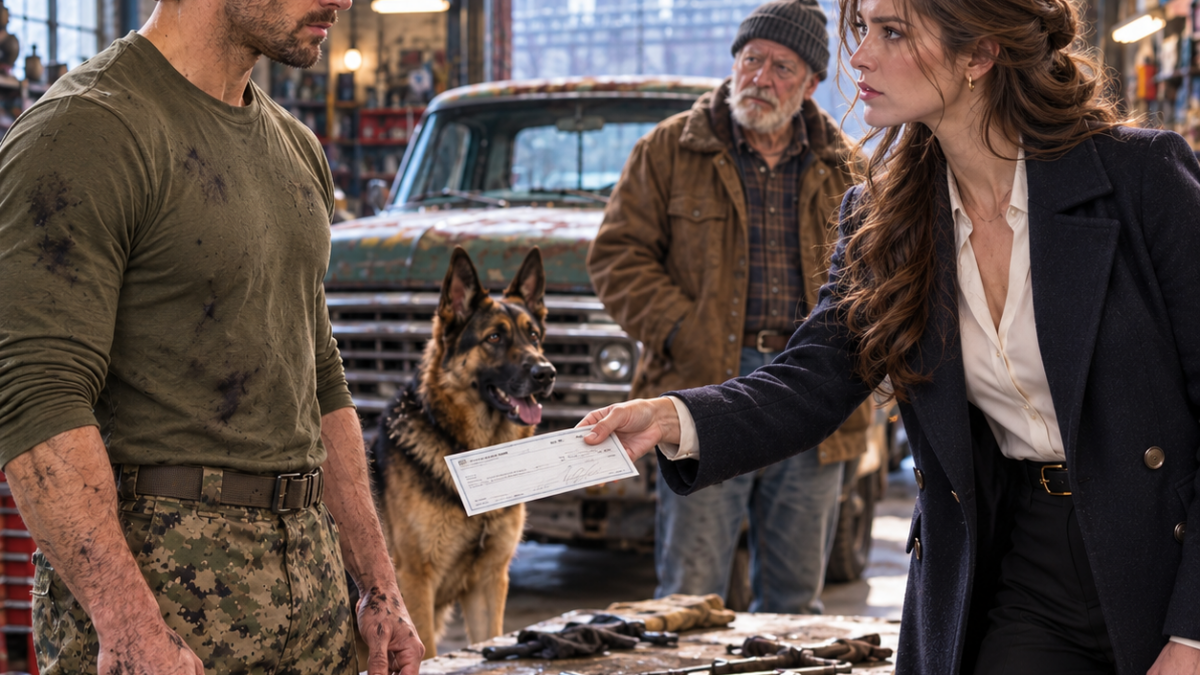
It vanished almost immediately. Julia reached into the folder again and removed a checkbook. Mason looked at it.
“You’re serious?”
she wrote carefully, tore the check free, and slid it across Jack’s old workbench.
$36,000. Mason did not touch it at first. That number was not abstract.
It was the bank, the supplier, the furnace, the lift, insurance, breathing room. He finally picked it up.
Atlas lay down beside Jack’s empty stool.
Julia waited.
that compensates you for your time, your roadside assistance, and any inconvenience involving my father.”
Mason looked at the amount again. Then she gave him the condition. No private work for Harold.
No meetings, no business proposals, no calls initiated by Mason. Nothing that allowed what had begun beside the road to become something larger.
Mason held the check long enough to feel every practical argument for keeping it. He could call the bank before lunch. he could bring the supplier account down.
The furnace might stop sounding like it was dying in installments.
Jack’s garage might survive because a woman who distrusted him had decided his absence was worth $36,000.
His gaze moved to the toolbox, then to the stool, then to Atlas. Finally, Mason placed the check on the workbench and slid it back across. Julia looked down at it.
“The amount isn’t the problem,” Mason said.
Her eyes returned to him. The condition is for the first time since she entered the garage, Julia Witam had nothing ready to say.
She collected the paperwork slowly. The check went back into the folder last. At the door, she paused as though she had expected one of them to add something.
Neither did. Then she walked into the freezing fog and the black SUV disappeared beyond the wet front windows.
5 minutes later, Mason stood in the office, staring at the board above Jack’s desk.
Bank notice, supplier invoice, insurance renewal, heating estimate. Every piece of paper carried a number. None cared about dignity.
Atlas came in and sat beside him. Mason looked at the dog.
That may have been the dumbest decent thing I’ve done all year.
Atlas offered no opinion, which at that moment felt suspiciously like agreement. The consequences of refusing $36,000 were less philosophical the next morning.
At 8:12, Mason’s parts supplier called.
The conversation lasted less than 4 minutes until Reed Motorworks brought its account down. Every new order would have to be prepaid. No more 30-day terms, no exceptions for longtime customers, no promise that a fleet invoice was coming soon.
Mason understood. That almost made it worse.
He spent the next hour calling people who owed the garage money. One small delivery company promised to send $2,500 by Friday.
Another commercial customer apologized three times before asking for 10 more days. The largest outstanding invoice belonged to a contractor whose accounting department had apparently developed the ability to lose paperwork whenever Mason called. By lunchtime, he had recovered $800.
It was better than nothing and nowhere close to enough. The old temptation to blame Julia surfaced occasionally.
But Mason knew better. She had not created his debt. She had simply walked into the middle of it, put a price on his disappearance, and left him staring at problems already there.
That evening, after the last customer drove away, Mason lowered the thermostat another two degrees and turned his attention to the leaking lift in bay 1, Atlas settled on a folded blanket nearby. The repair should have been hired out.
Mason knew that, but hiring someone required money, and money had recently become a subject with too many opinions attached to it. He worked beneath the lift until hydraulic fluid streaked one sleeve of his coveralls. The concrete pulled heat through his shoulders.
Somewhere above him, the garage radio played softly beneath the rattle of the furnace. Jack would have hated the situation.
Mason could almost hear his father asking whether Pride was paying interest. Now, the thought annoyed him because it sounded accurate.
He had defended something important when he refused Julia’s check.
He was still certain of that. What he was less certain about was whether dignity and stubbornness had become tangled together somewhere along the way. The lift finally held pressure shortly before 10.
Mason stood, rolled one shoulder, and looked toward Jack’s stool.
Good news, he told Atlas.
We’re still broke, but now we can lift things.
Atlas thumped his tail once. Harold called the next morning. Mason watched the name appear on his phone and let it ring.
There were already enough Whitcom complications inside Reed Motorworks. Harold called again that afternoon. Mason let that one go, too.
He was not angry with the old man exactly. Harold had not written the check, but Mason had no desire to become the disputed property in a family argument between a billionaire founder and the daughter who believed strangers needed financial screening before they were allowed within 10 ft of him. The following days returned to ordinary work.
Brake pads, a failing alternator, a heater core Mason wished belonged to anybody else. Mason collected another partial payment from a fleet customer and prepaid for parts he would once have ordered on account. None of it solved the larger problem, but motion felt better than waiting.
Late Friday afternoon, light snow began drifting past the front windows. It was the quiet kind, falling almost vertically in the still air and whitening the edges of the parking lot without immediately covering the pavement. Mason was finishing a wheelbearing when headlights moved across the inside wall.
He knew the engine before he saw the truck.
Harold’s old green pickup stopped beneath the faded Reed Motorworks sign.
Mason closed his eyes for half a second. Atlas stood.
Harold climbed from the driver’s side wearing his familiar canvas coat.
The passenger door opened next. Julia stepped down.
No polished SUV waited behind them. No charcoal suit.
No leather folder. She wore jeans, winter boots, and a dark sweater beneath a plain coat. Her hair was tied back with less precision than Mason remembered.
Without the armor of her first visit, she seemed younger. Mostly, she seemed uncomfortable. Harold pointed toward the garage door.
Julia gave him a look that suggested the ride over had contained several conversations neither wanted repeated. Then they came inside.
Harold removed his cap and placed it carefully on the workbench. He did not apologize for Julia. He did not explain her.
He simply made it clear with the efficiency of a man who had managed difficult people for most of his life that she had something to say and he intended to stand far enough away to make sure she said it herself. Julia faced Mason. Her apology was shorter than he expected.
She admitted she had investigated him because suspicion had been easier than asking questions.
She had treated his financial problems as evidence of poor character and used the possibility of losing his father’s garage as leverage.
There was no explanation attached to the apology. No, but that mattered.
Mason had spent several evenings imagining what he would say if Julia returned. Most versions were sharper than anything useful. Standing across from her now, he discovered anger was easier when she was absent.
He accepted that she understood what she had done. He did not tell her it was fine. It had not been.
The more important question remained. Why did you assume the worst?
Julia’s expression changed slightly.
Harold moved toward the front window and looked outside at the falling snow. For once, he seemed uninterested in helping the conversation along.
Julia rested one hand against the edge of an empty workbench, but did not sit on Jack’s stool.
Her mother’s name had been Margaret.
She and Harold had been married for nearly four decades. Margaret had been the person who could make Harold leave a depot before midnight, take a vacation without bringing three phones, or admit that being tired was not a sign of weak leadership.
When she died several years earlier, Harold did not collapse in any dramatic way. He simply began disappearing from the life he had built. He stopped attending some meetings.
He drove old roots instead.
He visited depot’s north line no longer needed and bought trucks that reminded him of the company’s early years.
Sometimes he spent entire afternoons talking with mechanics and retired drivers. Harold remained at the window. Mason looked at the old green pickup outside and understood it differently now.
During that period, one of Northline’s longtime executives had taken advantage of Harold’s distance from the company.
The man had been trusted for years, close enough to the family that Julia had grown up seeing him at holiday dinners. He routed a series of contracts through companies connected to people he knew, hiding inflated costs behind legitimate work.
Northline eventually discovered it. Most of the financial damage was recovered. The other damage remained.
Harold had built a company by trusting people until they gave him a reason not to. After the betrayal, he began questioning the very instinct that had once made employees loyal to him. Julia had watched it happen.
She had also spent months in rooms where executives questioned whether she was ready to lead. She learned to arrive with every number memorized and every weakness already identified. Being prepared became being guarded.
Being guarded became assuming motives before anyone could hide them. Eventually, she began investigating people around Harold before she ever met them. Mason understood the progression, even if he did not approve of where it ended.
Julia had not been protecting a fortune. She had been trying badly to protect the part of her father that still wanted to believe people could be decent.
Mason glanced toward Harold. The old man kept watching the snow, understanding Julia changed the shape of her mistake.
It did not erase it. Mason made that clear.
If she had a question about him, she could ask him. If she did not believe the answer, she could walk away, but she would not use money, investigators, or her position to decide his value again.
Julia nodded. Agreed. Harold finally turned from the window.
Excellent. Are we done growing as people? Mason looked at him.
Harold rubbed his hands together.
because this garage is cold enough that I’m starting to remember the snowbank fondly.
Julia lowered her eyes, but Mason caught the beginning of a smile. The tension loosened. Harold picked up his cap, then reached inside his coat.
Mason immediately looked suspicious.
If that’s another checkbook, you can both leave.
It was not. Harold pulled out several photographs and spread them across the workbench. They showed an old warehouse near the northeast industrial area, not far from North Sullivan Road.
brick walls, tall windows, wide bays, years of dust and neglect. Harold had bought it the previous month.
He called the project Second Watch Veterans Technical Center. The name stayed with Mason. Harold did not want a polished charity built for photographs and donor plaques.
He wanted a practical place for veterans who had reached the stage of life when too many people began speaking about them as though experience had an expiration date. Many would be over 50. Some had left the military decades earlier and spent years in other trades.
Some had been laid off. Some were retired but restless. Others simply wanted to learn enough modern systems to remain useful in workplaces that had changed around them.
The center would offer practical training, part-time pathways, mentoring opportunities, and a place where older veterans could contribute without pretending they were 25. Mason studied the photographs longer than he intended.
The warehouse reminded him of Reed Motorworks before Jack had made it his own. Empty space, waiting for a reason to matter. Then suspicion returned.
“If this is payment for the roadside repair, I’m not interested.”
Harold looked irritated. It was Julia who answered quietly.
“It isn’t.
” Harold had watched Mason work.
He had seen how the garage was organized, how Mason spoke to customers, and how he chose repairs based on what people actually needed rather than what produced the largest invoice. He had also noticed something Mason himself rarely considered unusual.
Mason respected old equipment without romanticizing it. He knew the difference between something worn out and something worth saving. Harold needed someone to help shape the technical side of second watch with that same judgment.
Not because Mason had been kind to him, because Mason was good at his work. That landed harder than Mason expected.
Jack had been the last person to say it that plainly. Julia reached into her coat.
This time, Mason only raised an eyebrow. She produced a thin contract packet.
6 months salary, benefits, clearly defined authority over technical planning.
regular milestones, no ownership transfer, no hidden repayment, no condition involving Harold’s personal life.
At the end of the project, if Second Watch opened successfully, the arrangement could become permanent. Mason looked at Harold, then Julia, then the first page. A week earlier, $36,000 had been offered to make him disappear.
Now work was being offered because someone believed he belonged in the room. Those were not the same thing. He did not sign.
Not yet. Mason closed the packet and held it beneath one hand.
I’ll read it.
Harold nodded once. Julia did too.
For the first time, neither Witcom seemed interested in pushing him toward an answer. Outside, Snow continued settling quietly on the old pickup.
Inside Reed Motorworks, Atlas walked over, sniffed the edge of the contract, and lay down across Mason’s boots.
Harold looked at the dog.
I assume that means he’s reviewing the terms.
Mason looked down at Atlas. He charges more than I do.
And for the first time since the black SUV had appeared outside his garage, Julia laughed. By the first week of January, Spokane Valley had settled into a harder kind of winter.
The sky was clear enough to turn the snow on warehouse roofs almost white blue beneath the sun, but the temperature stayed well below freezing. Metal burned cold through gloves. Breath hung in the air inside unheated corners of the building.
Every truck door seemed reluctant to open before sunrise. Mason signed the six-month contract after having a lawyer review it. That part mattered to him.
No favors hidden in the language. No ownership changes, no clause giving Northline control over Reed Motorworks. The agreement paid him to help design, organize, and operate the technical side of Second Watch through opening and its first months of use.
For the first time in weeks, he had income he could count on. It did not solve the garage. It gave him room to breathe while he tried.
Mason began splitting his days between Reed Motorworks and the old warehouse near North Sullivan Road. Atlas went with him most mornings, riding quietly in the rear and learning the new building faster than some of the contractors did. Second watch was still mostly dust, exposed walls, old concrete, and the steady sound of work.
The building had good bones, high ceilings, wide bays, thick exterior walls, enough space to create work areas without making the place feel crowded. Years of neglect showed everywhere, but Mason preferred that to something overdesigned.
Empty buildings were honest about what they needed. Harold saw possibility in almost everything.
Julia saw the budget. Mason saw what would fail first if they chose badly. That difference became obvious during the second week.
Mason wanted heavier workts with adjustable heights, wider aisles between certain stations, and a set of rolling equipment stands that cost more than the basic versions. Julia had already priced. She studied the numbers without saying much.
Mason knew that look. It was the same one she had worn before writing the check.
Only now he no longer assumed it meant trouble. Julia asked why a training center needed commercialgrade equipment in spaces where many people would only be learning. Mason walked her through the room instead of answering from across a table.