“Get Your Hands Off Her!” Billionaire Explodes After Discovering His Fiancée Mistreating the Maid in Secret—But What He Uncovered Next Revealed a Shocking Truth That Changed Everything

“Get Your Hands Off Her!” Billionaire Explodes After Discovering His Fiancée Mistreating the Maid in Secret—But What He Uncovered Next Revealed a Shocking Truth That Changed Everything
What you’re about to hear isn’t just a story.
It happened in a ballroom full of 500 guests under crystal chandeliers at the most important night of a billionaire’s life.
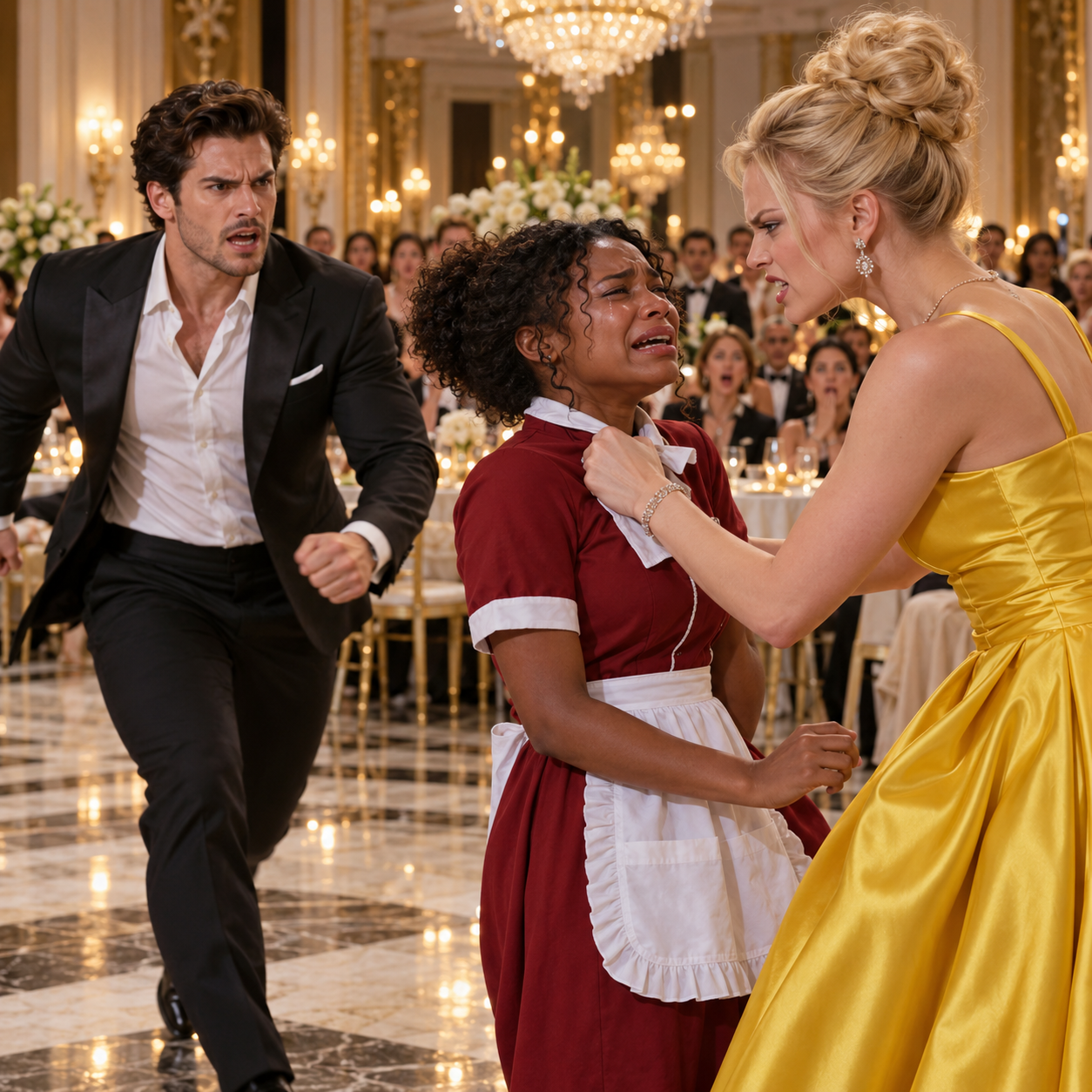
A woman in a yellow dress grabbed a maid by the collar in front of everyone. She thought no one important was watching.
She was wrong because the man who owned that house, the man about to marry her, was standing 10 ft away.
And what he did next didn’t just end an engagement.
It exposed a secret that had been hiding in that mansion for 6 years. Stay with me. This gets unbelievable.
All I’ll say is by the end of this, you might look at the people who serve you coffee, clean your office, or open your doors a little differently.
Let’s get into it.
Nobody notices the woman who refills the water glasses.
Rosa Delgado had learned that lesson a long time ago, and most days she didn’t mind it.
Invisibility, she’d found, was a kind of safety.
If people didn’t see you, they couldn’t judge you.
Couldn’t ask questions you didn’t want to answer.
Couldn’t look too closely at the woman in the black and white uniform, moving quietly between marble columns.
She was 34 years old and for the past 6 years she had worked in the household of Marcus Whitfield, one of the wealthiest men in Connecticut. His estate sat on 18 acres overlooking the Long Island Sound, a house so large that Rosa still, after all this time, sometimes lost track of which hallway led where.
She started as a part-time housekeeper when Marcus’s mother, Elellanor, was still alive.
Eleanor had been kind to her, more than kind. She used to sit in the kitchen some mornings drinking her tea and talk to Rosa like she was a person, not furniture. You have good hands, Rosa, Elanor told her once.
Good hands and a better heart.
Don’t let anyone in this house make you feel small.
Rosa held on to those words the way some people hold on to scripture. When Eleanor passed 3 years ago, something in the house changed. Marcus, grieving and lonely, threw himself into work even harder than before.
And within a year, he’d met Vanessa Cole.
Vanessa was beautiful in the way magazine covers were beautiful. Sharp cheekbones, a laugh that turned heads, a wardrobe that could have funded a small college. She came from old money that had quietly become not so old money, though nobody outside her family knew that yet.
To the world, she was a socialite. To the staff of the Witfield estate, she was something else entirely. From the very first week, Vanessa started staying over.
Rosa noticed the way she looked at the household staff, like they were part of the furniture, too, except furniture that occasionally needed correcting. A wrinkle in a tablecloth, a speck of dust on a picture frame, a tray carried a half second too slow. Vanessa noticed everything and she never let it go unmentioned.
You people are lucky to work somewhere like this. She told the young gardener once, loud enough for Rosa to hear from the kitchen.
Most of you would be doing this work for half the pay anywhere else. Rosa had learned to keep her head down. She had two reasons to.
The first was rent. Her apartment in Bridgeport, small but home, the only stability she and her son Mateo had ever really known. The second reason was bigger.
Rosa was raising Matteo alone. His father had left before Mateo turned two, and since then it had been just the two of them against the world. Rosa working days at the estate and some nights cleaning offices downtown just to make sure Matteo could stay in the good school, the one with the after-school science program he loved so much.
Matteo was eight now. Smart in the way that made teachers call home, not because he was in trouble, but because they wanted to tell Rosa how far ahead he was. He wanted to be an engineer.
He wanted to build bridges, he told her once. So people can get to the other side, mama.
Even when the water is scary. Rosa thought about that a lot. Getting people to the other side, even when the water was scary.
It felt like exactly what she was trying to do for her son, one long shift at a time. Tonight, the Whitfield estate was preparing for its biggest event of the year, the engagement gala.
Marcus and Vanessa’s engagement would be announced publicly for the first time in front of 500 of the wealthiest, most influential people on the East Coast.
Senators, Tios, old family names that went back generations.
The kind of night where a single mistake wouldn’t just be embarrassing, it would be remembered for years.
The house had been in motion since 5 that morning. Florists arranged 3,000 white roses through the ballroom. A 12-piece orchestra tuned instruments in the West Wing.
The head chef, a Frenchman named Etienne, who rarely spoke unless it was to complain, was overseeing 17 courses being prepared in a kitchen that felt more like a battlefield than a room. And Rosa, Rosa had one job tonight that mattered more to her than any other.
Marcus had personally asked her just two days before to be the one serving the head table.
You’ve been with this family the longest,” he told her, standing in the doorway of the kitchen with that same quiet kindness his mother used to have.
“I want people I trust near me tonight.
It should have felt like an honor, and it did for about 6 hours until Vanessa found out.”
“Absolutely not,” Rosa overheard her say to Marcus in the study that afternoon.
Her voice sharp as glass.
I don’t want the help anywhere near the headt.
Get someone who actually looks the part. Rosa stood frozen in the hallway outside.
A tray of champagne flutes trembling slightly in her hands.
She didn’t hear what Marcus said back.
His voice was too low, too calm.
But she heard Vanessa’s response clear as a bell.
Fine, but she stays out of my sight tonight. I mean it, Marcus. Rosa walked back to the kitchen with her chin up the way her mother taught her back in Guatemala decades and a lifetime ago.
Dignity is the one thing they can never take from you, Mija, unless you let them.
She didn’t know yet that in a few hours, dignity would be the exact thing tested in front of 500 people under the brightest chandeliers in Connecticut on the night that was supposed to be the happiest of Marcus Whitfield’s life.
She had no idea what was coming. Neither did anyone else in that ballroom.
But some things once they start cannot be stopped, and this was one of them. By 7:00, the ballroom had transformed into something out of a dream. Rosa moved through it in the final hour before guests arrived, checking place settings for the third time, making sure every fork was aligned, every glass polished without a single smudge.
The chandeliers overhead, six of them, each the size of a small car, threw golden light across white tablecloths and towers of roses. String lights wound through the columns outside on the terrace, where guests would gather before dinner for cocktails against the backdrop of the sound.
She thought about Matteo home tonight with Mrs.Alvarez from two floors down, probably already asleep with his math homework half finished on the kitchen table.
She’d promised him pancakes in the morning.
Small thing, but small things were what got her through nights like this. At 7:30, the first guests began arriving, and the house came alive with a different kind of energy.
Laughter, the clink of champagne glasses, the low hum of important people making important conversation about things Rosa would never be part of. She kept to her post near the head table, refilling water, adjusting chairs, invisible in the way she trained herself to be.
Marcus looked happy, genuinely happy, in a way Rosa hadn’t seen since his mother passed.
He moved through the crowd, shaking hands, laughing at jokes.
His arm resting easily around Vanessa’s waist whenever they stood together for photos.
Vanessa, for her part, glowed under the attention. This was, after all, her night as much as his, maybe more.
Rosa tried not to think about the conversation she’d overheard that afternoon.
She told herself it didn’t matter.
She was here to do a job and she was good at her job.
And in a few hours, it would be over and she’d go home to her son and none of this would matter anymore.
She should have known better. Nights like this always found a way to matter.
It happened around 9:15 during the second course when a young server named Priya accidentally brushed against Vanessa’s chair while reaching to clear a plate.
It was nothing, barely a touch, the kind of thing that happens a 100 times at events like this.
But Vanessa’s wine glass wobbled and a few drops splashed onto the white silk of her gown.
The room didn’t stop.
Most guests didn’t even notice, but Rosa saw Vanessa’s face change instantly, the polished smile dropping away like a mask sliding off.
“Are you serious right now?”
Vanessa hissed, standing so fast her chair nearly tipped. Priya, barely 22, went pale, stammering an apology, reaching for a napkin with shaking hands.
“Don’t touch me,” Vanessa snapped, jerking away.
God, do they train you people at all?
A few nearby guests glanced over uncomfortable, then looked away the way people do when they don’t want to get involved.
Marcus was across the room, deep in conversation with a senator, and hadn’t noticed yet.
Rosa moved quickly, the way she always did when something needed smoothing over.
I’m so sorry, ma’am.
Let me help.
I don’t want your help.
I want competent people who don’t ruin a $5,000 dress in the middle of my own engagement party.
Vanessa’s voice was rising now, carrying further than she probably realized or maybe not caring who heard.
This is exactly what I’m talking about.
This house is full of people who don’t know how to do their jobs.
Priya’s eyes filled with tears.
Rosa stepped slightly in front of her. Instinct more than plan. It was an accident.
Let us get you a new glass of wine and I can have the dress cleaned before the dessert course.
I’m not talking to you.
Vanessa’s eyes flicked to Rosa and something in them hardened further like she’d been waiting all night for a reason.
In fact, maybe you should go home. Both of you.
This isn’t the kind of night for mistakes.
The words landed heavier than they should have. Not because they were the worst thing Rosa had ever heard, but because of the venom behind them, the total absence of even performed politeness.
Around them, a few more heads turned. A photographer near the wall lowered his camera slightly. Sensing something, Rosa felt her pulse quicken, but kept her voice level.
I understand you’re upset.
Please, let’s take care of the dress, and everything else can wait until after the party.
Take care of the dress. Vanessa let out a short, sharp laugh.
You people always have an excuse ready, don’t you?
You people. Rosa had heard it before, more times than she could count in more polite and less polite forms.
It never stopped stinging, but she’d learned to let it pass through her like water off stone.
Tonight though, something about the setting, the chandeliers, the roses, the 500 watching eyes. The fact that Priya was crying quietly 3 feet away made it harder to simply let pass. With respect, Rosa said, quieter now, but not backing down.
Priya didn’t do anything wrong.
It was an accident.
We’re happy to fix it.
For a moment, Vanessa just stared at her as if genuinely shocked that Rosa had spoken at all.
Then her hand shot out and closed around the collar of Priya’s uniform, yanking the younger woman half a step forward.
Did I ask for your opinion?
Vanessa’s voice cracked through the air, no longer bothering to stay quiet.
This is exactly the problem with people like you. You think you get to talk back?
Priya gasped, stumbling, one hand flying up instinctively to protect herself. Tears now streaming freely down her face.
The music from the string quartet faltered. Conversations nearby died out one by one, like dominoes falling as more and more guests turned to see what was happening at the head table.
Rose’s heart was pounding now.
Every instinct in her screaming to step in, to physically pull Priya free. Consequences be damned. And that was the exact moment Marcus Whitfield turned around, searching for his fianceé after finishing his conversation.
a smile already forming on his face for the toast he was about to give and saw across his own ballroom in front of everyone who mattered to his family name.
Vanessa’s hand fisted in the color of a terrified young woman’s uniform.
The smile vanished from his face like it had never been there at all. Time seemed to slow down in a way Rosa would never quite forget.
Marcus crossed the ballroom in what felt like three strides, though it must have been more.
His face, usually so composed, so carefully controlled in the way powerful men learn to control themselves, had gone completely still, the kind of stillness that was more frightening than shouting, “Vanessa!”
His voice cut through the room, low but
carrying to every corner of it.
“Let go of her now.”
Vanessa’s hand snapped open like she’d been burned, and Priya stumbled back into Rose’s waiting arms, sobbing openly now.
The entire ballroom had gone silent, except for the faint, uncertain notes of the string quartet, who didn’t seem to know whether to keep playing or stop entirely.
Marcus, I can explain. Vanessa started, her voice shifting instantly into something softer, more practiced, the tone of a woman used to smoothing things over with charm. Explain what?
Marcus’s eyes hadn’t left her.
Explain why you put your hands on someone who works in my house in front of 500 people. She spilled wine on me.
Look at this dress.
I don’t care about the dress.
His voice rose slightly now, enough that even the string quartet finally stopped altogether.
“I care that you just grabbed a 22year-old girl by the collar like she was nothing, like she wasn’t a human being standing in my home.”
Vanessa’s face flushed red.
Embarrassment curdling fast into anger.
Don’t you dare embarrass me like this.
Not tonight. Not in front of everyone.
You embarrassed yourself.
Marcus’s voice was quiet again, but somehow it carried further than his shouting had.
I’ve heard the way you talk to my staff for months.
Vanessa, I told myself it was stress.
I told myself you’d change once we settled down.
I was wrong. And I think some part of me has known I was wrong for a long time. A murmur rippled through the crowd.
the kind of collective intake of breath that happens when everyone realizes they’re witnessing something that will be talked about for years.
Rosa stood frozen, one arm still around Priya’s shaking shoulders, painfully aware that she was now the center of attention in a room she’d spent 6 years learning to disappear inside of.
She wanted to shrink into the floor. She also, for the first time in a long time, felt something else stirring beneath the fear. Something that felt almost like vindication.
“Marcus, please,” Vanessa said, her voice cracking now, tears welling.
“Real or performed?”
Rosa genuinely couldn’t tell.
“Can we talk about this privately?
You’re humiliating me.
You humiliated yourself,” Marcus said again.
And this time, his voice was almost gentle, almost sad, like a man watching something he’d built for years crumble in real time.
And honestly, I think I needed to see it. I think some part of me has been avoiding seeing it for a long time.
He turned then, not to Vanessa, but to Rosa, and to Priya, still trembling in her arms. His expression softened completely, the anger replaced by something that looked almost like shame.
“I am so sorry,” he said, and Rosa realized with a jolt that he was speaking directly to them in front of everyone without a trace of performance.
“Both of you.
This should never have happened in my house. Not tonight.
Not ever.”
Priya managed a small nod, still crying too hard to speak. Rosa found her voice first.
“Thank you, Mr.Whitfield.
We’re okay.
You’re not okay,” he said quietly.
“But you will be.
I promise you that.”
He turned back to face the room. 500 guests, senators, and CEOs, and old money and new money, all staring, all waiting to see what happened next.
Marcus took a breath, the kind of breath a man takes before doing something he knows will change the course of his life.
I want to apologize to everyone here,” he said, his voice steady now, carrying clearly through the silent ballroom.
“This isn’t the announcement I planned to make tonight.
But I think it’s the one that actually matters.
” Vanessa’s face had gone from red to pale.
Marcus, don’t.
I think, he continued, ignoring her that how a person treats the people who can do nothing for them tells you everything you need to know about their character. I built this company on that principle.
I thought I understood it.
Tonight, I realized I’d let myself ignore it in my own house, in my own relationship, because I was lonely, and because I didn’t want to admit what I already suspected.
He looked at Vanessa one last time, and whatever had once lived between them seemed to visibly leave the room. The engagement is off.
I’m sorry it has to happen this way in front of everyone, but I think everyone deserved to see the truth tonight, including me.
Gasps rippled through the crowd. Somewhere near the back, a phone camera flashed.
The first of what would become within hours dozens of photos and videos spreading across social media, turning a private humiliation into a very public reckoning. Vanessa stood frozen for a moment, mouth open before turning and storming toward the terrace doors, her heels clicking sharply against Marble, the whispers following her the entire way.
Marcus stood alone at the center of his own ballroom, 500 eyes on him, his engagement over, his carefully planned night in ruins, and then he did something nobody expected. He turned to Rosa and Priya and to the rest of the staff who had frozen near the kitchen doors, watching everything unfold.
“Dinner is still being served,” he announced, his voice carrying warmth now instead of anger.
“And I’d like to propose a toast, not to an engagement, but to the people in this house who show up every single day and do their jobs with more grace and dignity than most of us manage in a lifetime.”
He raised his glass toward Rosa specifically, and something in his eyes told her this wasn’t performance either.
To Rosa, Priya, to every person in this house I’ve failed to properly see until tonight.
I’m sorry it took this long.
The room stunned into silence moments before, slowly began to raise glasses, too. uncertain at first, then with growing conviction, until 500 of the wealthiest people on the East Coast were toasting a housekeeper and a young server, standing in the middle of a ballroom that had just witnessed the end of an engagement, and though nobody knew it yet, the beginning of something Rosa never could have imagined.
She had come to this house 6 years ago, invisible, trying to hold her family together one shift at a time. She had no idea that tonight was only the beginning of everything changing. The days after the gala moved fast, faster than Rosa could have prepared for.
By Monday morning, the video of Marcus ending his engagement had been viewed over 4 million times. News outlets picked up the story within hours.
Billionaire N’s engagement after fiance’s cruel treatment of staff goes viral ran across half a dozen headlines.
Reporters camped outside the estate gates.
Vanessa’s own social media accounts, once filled with curated photos of gallas and vacations, went dark within a day, then reappeared with a carefully worded statement about personal growth that fooled almost no one.
Rosa tried to keep her head down the way she always had. But the world, it seemed, had decided she was no longer invisible.
A local news crew found out her name somehow.
She suspected one of the caterers, though she’d never know for sure.
And within a week, reporters were showing up outside her apartment building in Bridgeport, asking Matteo’s teacher for comment, even trying to reach Mrs.Alvarez two floors down.
Rosa felt her carefully built, quiet life beginning to crack open at the seams, and it terrified her more than anything Vanessa had ever said to her.
“Mama, why are there cameras outside?”
Matteo asked one morning, peering through the blinds with a kind of unfiltered curiosity only an 8-year-old could manage.
It’s nothing, Mo.
Joe, eat your breakfast.
But it wasn’t nothing, and both of them knew it.
Marcus called her personally 3 days after the gala.
A call she almost didn’t answer, assuming it was another reporter who’d somehow gotten her number.
Rosa,” he said when she finally picked up.
His voice careful, almost hesitant, so different from the composed businessman the world knew.
“I owe you an apology, and I owe you more than that.
I should have handled things privately, or found a way to protect you from the attention this has brought.
I didn’t think it through.”
Rosa gripped the phone tighter.
“You don’t owe me anything, Mr.Whitfield.
What you did, what you said, it mattered.
Priya and I were grateful, but the attention it’s it’s a lot.
I know, and I’m sorry.
He paused, and she could hear him choosing his next words carefully.
I’d like to help if you’ll let me.
Not charity.
I know that’s not what you want, and I respect that, but I’ve been thinking about something for a while now.
Something my mother used to talk about before she passed. She always said this house had more resources than purpose.
I think it’s time that changed.
Rosa didn’t understand what he meant.
Not fully, not yet. But 2 weeks later, she found out. Marcus called a meeting with the household staff.
All 23 of them, from the groundskeepers to the kitchen staff to Rosa herself, in the same ballroom where everything had happened. It felt strange standing there again, empty now of roses and chandelier light. Just plain daylight streaming through tall windows onto bare marble floors.
“I’ve spent the last 2 weeks thinking about what happened here,” Marcus told them, standing at the front of the room the way he might address a boardroom, except his voice carried none of the usual corporate distance.
“And I’ve realized something.
This house employs some of the hardest working people I know, and most of you have been here for years without a single conversation from me about your futures, your families, your goals beyond this job.”
He explained then what he decided to do.
A portion of his family’s foundation, previously focused entirely on large-scale philanthropic causes, hospital wings, and university buildings with the Whitfield name attached, would be redirected towards something smaller, more personal.
Full scholarship funding,
healthc care coverage, and career development support for every member of his household staff and their immediate families, starting immediately.
“This isn’t about guilt,” he said, looking directly at Rosa as he spoke.
though his words were meant for everyone in the room. This is about finally seeing people I should have been seeing all along. Rosa stood in stunned silence along with the others, unsure how to process what she was hearing.
It wasn’t until later that afternoon, sitting alone in the kitchen with a cup of coffee going cold in her hands, that the weight of it fully hit her.
Matteo’s education fully funded all the way through college if he wanted it.
health care that didn’t require her to choose between a doctor’s visit and rent.
A path forward that had until three weeks ago felt impossibly far away. She cried for the first time in longer than she could remember.
Not from sadness, but from something she didn’t quite have words for.
Relief maybe, or the strange, disorienting feeling of finally being seen after years of trying not to be.
But even as good news settled over the household, Rosa couldn’t shake a nagging unease.
Vanessa hadn’t simply disappeared quietly.
Word had begun circulating through the same informal network that connected household staff across Connecticut’s wealthiest estates that Vanessa was telling a very different version of events.
In her retelling, Rosa was the villain. manipulative, opportunistic, someone who had engineered the entire scene to get close to Marcus and his fortune. It was a lie.
It was an obvious, almost laughably transparent lie. But Rosa had learned over 34 years of life that lies told with enough confidence by people with enough money and connections had a way of becoming believed, regardless of the truth underneath them.
And 3 weeks after the gala, that lie found its way to something far more dangerous than gossip. It found its way to a lawyer.
The letter arrived on a Tuesday, delivered by certified mail to Rosa’s small apartment in Bridgeport, and it changed the shape of everything that had felt for a brief and fragile moment like it was finally going right.
It was from a law firm representing Vanessa Cole.
The letter accused Rosa of intentional interference in Vanessa and Marcus’ relationship, alleging absurdly painfully that Rosa had orchestrated the entire incident at the gala to manipulate Marcus into ending the engagement, positioning herself for financial gain.
It threatened a defamation lawsuit unless Rosa issued a public retraction and apology, admitting she had instigated the confrontation with Priya. Rosa read the letter three times, standing in her kitchen with her hands shaking before she fully understood what was happening.
Vanessa wasn’t just trying to save face.
She was trying to rewrite history. And she was using the machinery of wealth and legal threat to do it. The same machinery that had protected people like her for generations, while people like Rosa simply absorbed whatever came their way.
This can’t be real, Rosa whispered to herself, sitting down hard at her kitchen table, the letter trembling in her grip.
She thought immediately of Matteo, asleep in the next room, of the scholarship fund Marcus had promised, still working its way through legal paperwork, not yet finalized, of her small savings, barely enough to cover a lawyer’s retainer, let alone a prolonged legal battle against a family with more resources than Rosa could imagine.
Fear settled into her chest like a stone.
She didn’t sleep that night.
She sat at her kitchen table until sunrise, turning the letter over and over, trying to figure out what to do, who to call, whether this was a bluff or a real serious threat that could unravel everything. At 7 the next morning, she called Marcus, her voice barely steady. He listened without interrupting as she read him the letter.
And when she finished, there was a long silence on the line, long enough that Rosa wondered if the call had dropped.
“Rosa,” he finally said, his voice tight with something that sounded like fury held carefully in check.
“I need you to send me a copy of that letter right now.
And I need you to know this ends today. I promise you that, Marcus.
I don’t have the money for lawyers.
I don’t.
You won’t need to spend a single dollar.”
he said firmly. This is not your burden to carry.
It never should have reached you at all.
What Rosa didn’t know, what she would only learn over the following days, was that Marcus had spent the 3 weeks since the gala quietly doing something Vanessa never expected.
unsettled by the whispers reaching him about her version of events and frankly suspicious of a woman whose cruelty that night had felt less like a single bad moment and more like a pattern finally surfacing.
Marcus had hired a private investigator to look into Vanessa’s background more thoroughly than he ever had during their relationship.
What the investigator found took even Marcus by surprise. Vanessa Cole was not, as she had always presented herself, the heir to old, quiet money.
Her family’s wealth, the wealth that had funded her lifestyle, her wardrobe, her carefully curated social standing, had evaporated nearly four years earlier when her father’s investment firm collapsed under the weight of a fraud investigation that had never quite made national headlines, buried through legal maneuvering and a very expensive PR team.
Since then, Vanessa had been living on borrowed appearances, cycling through relationships with wealthy men, each one funding the lifestyle the last one could no longer sustain.
Marcus, it turned out, wasn’t her first fiance.
He was her third in 5 years. The first two engagements had ended abruptly and quietly.
Both times under circumstances the men involved had chosen never to discuss publicly until Marcus’s investigator with some careful respectful outreach convinced both of them to finally speak.
Both men described eerily familiar patterns. A woman capable of extraordinary charm in public and startling cruelty in private, particularly toward anyone she perceived as beneath her. household staff, service workers, anyone without power to push back.
Both men had ended things quietly, choosing to avoid public embarrassment rather than expose the truth.
Marcus, standing in his study with the investigator’s full report spread across his desk, felt something shift inside him.
Not just anger at Vanessa, but a deeper, more uncomfortable recognition of how close he had come to marrying someone capable of real sustained harm. hidden behind a beautiful practiced smile.
He called Vanessa’s lawyer directly, calmly laying out exactly what he now knew along with a clear message.
pursue the defamation claim against Rosa and every detail of Vanessa’s financial history, her pattern of behavior toward service workers documented through two other former fiances, and full video footage of the Gala incident, footage that showed unambiguously who had done what to whom, would become part of the public record, likely finding its way to the same news outlets that had already
covered the broken engagement extensively.
The threat, quiet but absolute, worked exactly as Marcus intended. Two days later, Rosa received a formal letter withdrawing all claims against her along with a written retraction acknowledging that her account of the Gala incident was accurate. Vanessa, according to the household grapevine that still somehow reached Rosa, had left the state entirely within the week, moving to stay with relatives out west.
her carefully built public image quietly, permanently dismantled. Rosa held the retraction letter in her hands, standing in her small kitchen, and felt something loosen in her chest that had been tight for weeks. But even as the immediate danger passed, she found herself sitting with a strange unexpected realization, one that would come to define the next chapter of her life.
far more than the crisis itself. She had spent 6 years being invisible, trusting that staying small and quiet would keep her and Matteo safe.
And in the space of a single month, being seen, truly seen for the first time, had brought both the worst threat she’d ever faced and the greatest support she’d ever received.
She was beginning to understand something her mother had tried to tell her years ago. Something about the cost and the necessity of being visible in a world that preferred people like her to stay quiet.
She didn’t know yet how much that understanding would matter in the months ahead.
But she was about to find out. Spring arrived slowly that year, the way it always did in Connecticut.
The estate’s grounds shifting from brown to green in patches.
Cherry trees along the drive. finally beginning to bud.
With Vanessa gone and the legal threat resolved, life at the Whitfield estate settled into something that felt for the first time in Rose’s memory genuinely peaceful.
The scholarship program Marcus had promised became official in March, formalized into something called the Eleanor Whitfield Foundation for Household Families, named Marcus told the staff during another gathering in the ballroom after his mother, the one person who had always seen the people working in that house as fully human.
Matteo’s college fund was fully established.
Healthc care coverage kicked in for every staff member and their families. But more than the financial support, Rosa noticed something shifting in the day-to-day rhythm of the house itself.
Marcus began eating breakfast in the kitchen some mornings instead of the formal dining room, asking staff about their weekends, their kids, their lives outside these walls in a way that felt genuine rather than performative. You know, he told Rosa one morning in April, both of them standing in the kitchen while coffee brewed.
My mother used to do this. sit right here. Talk to whoever was around.
I used to think it was strange.
Honestly, I was young and stupid and thought successful people didn’t have time for that kind of thing.
What changed your mind? Rosa asked genuinely curious, Marcus considered the question seriously.
I think I always knew she was right. I just got comfortable not living it.
It took almost marrying someone who proved the opposite point to remind me. Rosa smiled, small but real.
Your mother was a good woman.
She’d have liked you, I think.
She always said the measure of a house wasn’t the size of it, but the way people were treated inside it.
He paused, then added almost shily.
She’d have been glad I finally started listening.
Over the following months, Rose’s relationship with the Whitfield household continued evolving in ways she never could have anticipated.
Marcus, working with the foundation’s newly hired director, asked Rosa to help design the scholarship and career development programs.
Not as a formality, but because, as he put it, you understand what these families actually need better than any consultant I could hire. It was strange at first sitting in meetings with financial adviserss and program directors offering opinions that people actually wrote down and took seriously. Rosa had spent so many years being talked over or talked around that being genuinely listened to took some getting used to.
But she found gradually that she had a lot to say about flexible scheduling for parents working multiple jobs.
about mentorship programs that paired staff kids with professionals in fields they were interested in, about mental health resources that didn’t carry stigma.
By early summer, the foundation had expanded its scope, eventually reaching out to several other prominent Connecticut estates, encouraging similar programs for their household staff. It became almost accidentally a small movement, quiet, unglamorous, but real, changing the daily lives of dozens of families who had spent years working in beautiful houses that had never quite seen them as more than staff.
Priya, the young server who had been at the center of that terrible night in the ballroom, used part of her new scholarship funding to enroll in nursing school that fall, something she’d wanted to do since high school, but never believed she could afford.
She stopped by Ros’s kitchen station one afternoon in August, practically glowing with excitement over her acceptance letter.
“I wanted to thank you,” Pria said a little shy.
“For standing up for me that night.
I don’t think I ever really said it properly.”
Rosa pulled her into a hug, the kind that didn’t need words.
“You don’t have to thank me, Mija.
You deserved better than what happened that night.”
All of us did. Matteo, meanwhile, had taken to visiting the estate on weekends sometimes, wideeyed at the grounds, the greenhouse, the small workshop Marcus had built years ago and rarely used anymore. Marcus, it turned out, had studied mechanical engineering before going into business, and he began spending Saturday afternoons with Matteo in that workshop, teaching him basic principles of physics through half-finish projects.
small bridges built from popsicle sticks, tiny catapults, the beginnings of what would become over the following years a genuine mentorship neither of them had expected.
“He’s got a real gift for this,” Marcus told Rosa one Saturday evening, watching Matteo carefully sand the edge of a small wooden bridge model, tongue poking out in concentration.
“You should be proud.”
I am, Rosa said softly, watching her son’s face light up under Marcus’ attention.
Attention from a man who months earlier she’d only ever seen as her employer, distant and unreachable, and who had somehow become something more like family.
It wasn’t a fairy tale, not exactly.
There was no dramatic romance blooming between Rosa and Marcus. No sudden reversal of the vast gulf between their worlds. Rosa remained cleareyed about that and grateful for it.
Some stories didn’t need that kind of twist to be meaningful.
What had changed instead was something quieter, sturdier, a genuine relationship built on mutual respect, on a shared understanding that had emerged from the wreckage of that terrible night in the ballroom.
But not everyone in Rose’s life was ready to let that peace remain undisturbed.
In September, just as Matteo started third grade with a scholarship funded tutor helping him prepare for an accelerated math program, Rosa received a phone call that would once again threatened to unravel everything she’d worked so hard to rebuild.
It was Vanessa, and she wasn’t calling to apologize.
The call came on a Wednesday evening.
Rose’s phone buzzing with an unknown number while she stood at her stove stirring a pot of rice for dinner.
Matteo doing homework at the kitchen table behind her. Rosa Delgado.
The voice was unmistakable even after months of silence. Smooth practiced, carrying an edge of barely restrained hostility beneath the polished surface.
Rose’s stomach dropped.
Vanessa, I’m sure you’re surprised to hear from me.
A short, humorless laugh.
I’ll keep this brief.
I know about the foundation. I know about the scholarships, the healthcare, all of it.
Quite the payout for one dramatic night, wouldn’t you say?
I don’t want any trouble, Rosa said carefully, gripping the phone tighter, aware of Matteo just a few feet away, oblivious to the tension suddenly filling the small kitchen.
I’m not calling to make trouble.
I’m calling with an opportunity.
Vanessa’s voice shifted, taking on a strange, almost conspiratorial tone.
There are people, journalists mostly, but also a few interested parties who’d pay very well for a different version of what happened that night.
One where I wasn’t the villain of the story.
One where maybe things weren’t quite as they appeared.
Rosa felt cold understanding settle over her. You want me to lie?
I want you to consider that the story people believe isn’t always the whole truth.
And I want you to consider that I know things about certain arrangements at that estate that could be complicated if they came to light. Things about how quickly Marcus moved to protect you after the incident.
How closely you two have grown since then. People might start to ask questions about motive, Rosa, about whether any of this was ever really about kindness at all. The implication was clear and cheap.
And Rosa felt anger rise in her chest, sharp and sudden.
You’re threatening to spread lies about me and Mr.Whitfield because you’re angry that the truth cost you everything.
I’m offering you a chance to make some real money for once in your life instead of scraping by on whatever scraps Marcus feels guilty enough to throw your way.
Vanessa snapped, the polished veneer finally cracking. You think this is charity?
You think he actually cares about you people? Wake up, Rosa.
You’re a good story to him right now.
Attacks right off with a sympathetic face. The moment the cameras stopped caring, so will he.
Rose’s hands were shaking, but her voice when she spoke came out steadier than she expected.
I’ve worked in that house for 6 years, Vanessa.
I watched Eleanor Whitfield with her own eyes, treating every person in that house like they mattered, long before any cameras existed to see it.
And I’ve watched her son slowly become the same kind of person in the months since you left.
Not because of guilt, because it’s who he actually is.
Underneath everything you tried to make him forget.
You’re naive.
Maybe, but I’d rather be naive and honest than clever and cruel.
Rose’s voice hardened.
You put your hands on a 22-year-old girl in front of 500 people because she spilled a few drops of wine on your dress.
That’s not something Marcus invented to embarrass you.
That’s who you are.
And no amount of money or lies is going to change what everyone in that ballroom saw with their own eyes. There was a long silence on the line. When Vanessa spoke again, her voice had gone cold.
All pretense of persuasion dropped.
You’ll regret this “Maybe,” Rosa said again quietly.
“But I won’t regret telling the truth.”
“Good night, Vanessa,” she hung up before Vanessa could respond, her hands trembling as she set the phone down on the counter.
Matteo looked up from his homework, sensing something in his mother’s expression.
“Mama, are you okay?”
Rosa took a breath, steadying herself, and managed a small smile for her son’s sake.
I’m okay, Mojo.
Just a difficult phone call. Nothing for you to worry about.
But that night, after Matteo was asleep, Rosa sat awake for a long time, turning the conversation over in her mind. She knew she needed to tell Marcus.
Not because she believed Vanessa’s threats had real power anymore.
not after everything that had already come to light about her, but because secrets, she’d learned, had a way of growing more dangerous the longer they stayed hidden.
She called him the next morning, and he listened once again without interrupting. His expression growing darker the longer she spoke.
“She’s grasping at anything at this point,” Marcus said when Rosa finished.
“There’s nothing left for her to threaten with.
The investigator’s report already covers everything.
her financial situation, the pattern with her previous engagements, all of it. Sitting quietly, waiting only to be released if she ever tries something like this publicly.
He paused.
I think it’s time I made sure she understands that clearly once and for all.
What followed was quiet and precise. No public confrontation this time. No dramatic scene in a ballroom.
Marcus’ legal team sent Vanessa’s attorneys a final unambiguous message.
Any further contact with Rosa, any attempt to sell a false narrative to media outlets would result in the full documented truth about Vanessa’s history becoming public record, complete with corroborating statements from her two previous fiances.
Vanessa didn’t call again, but the experience left Rosa with something important.
A clearer understanding of exactly how fragile the piece she’d found really was.
how easily it could be threatened by someone determined to protect their own version of events.
It also left her with a renewed sense of conviction about something she’d started considering quietly over the past few months, something she hadn’t yet worked up the courage to share with anyone, not even Marcus.
She wanted to do more than simply accept the help being offered to her family. She wanted to build something that could protect people like Priya, like herself, long after the cameras and headlines had moved on to the next story entirely.
She wanted to make sure that what happened in that ballroom actually meant something for good, far beyond her own life. It took Rosa until October to finally share the idea that had been growing in her mind since that difficult phone call with Vanessa. She approached Marcus on a Sunday afternoon, finding him in his study going over foundation paperwork, and asked if she could talk to him about something important.
He set his work aside immediately, giving her his full attention in a way that 6 months earlier would have felt impossible to imagine.
I’ve been thinking,” Rosa began, her hands twisting together nervously in her lap.
About what happened that night, about Priya, about all the women and men working in houses like this one who don’t have someone like you willing to stand up when things go wrong.
“I’m listening,” Marcus said quietly.
“The foundation you’ve built here, it’s wonderful.
It’s already changed so many lives, including mine.
But it only helps people already lucky enough to work somewhere like this. Somewhere with someone paying attention. What about everyone else?
The household workers with employers who’d never do what you did.
Who’d fire someone the moment they spoke up, who’d never even consider that the people cleaning their houses deserve to be treated with basic dignity.
Marcus was quiet for a moment, considering, “What are you proposing?”
Rosa took a breath, steadying her voice. A hotline, a legal support network, something specifically for domestic workers, housekeepers, nannies, home health aids, people who often work alone in private homes, without co-workers to witness mistreatment, without unions or HR departments to turn to, somewhere they could report abuse, get connected to legal help if they needed it, find resources if they wanted to leave a bad situation without losing everything in
the process.
That’s a much bigger undertaking than what we’ve built here, Marcus said, though there was no dismissal in his voice.
Only genuine consideration. I know, but I think it matters more honestly. What happened to me to Priya?
We were lucky. Genuinely lucky in a way most people in our position never are.
I keep thinking about all the women who don’t get that kind of luck, who go through worse quietly every single day with no one ever knowing.
Marcus leaned back in his chair, studying her with an expression Rosa couldn’t quite read.
You know, he finally said, “My mother used to say something similar near the end.
She said the money in this family had always gone toward buildings, hospital wings, university halls, things with our name carved into marble. She wanted before she died to put some of it towards something that actually reached people directly. I think this might be exactly what she meant.
Over the following months, what started as an idea in Rose’s mind began taking real shape.
Marcus committed significant funding from the family foundation, but insisted at Rose’s request that the organization remain independent, run by people who actually understood the realities of domestic work rather than simply another charitable initiative controlled entirely by wealthy donors.
Rosa found
herself somewhat to her own astonishment, stepping into a role she never could have imagined a year earlier.
Not merely a beneficiary of Marcus’ changed perspective, but an active architect of something designed to help thousands of workers she’d never meet.
She worked with labor lawyers, advocacy groups, and eventually a small, dedicated staff, building what would become known as the Rosa Delgado Domestic Workers Alliance, a name Rosa had initially resisted, embarrassed by the attention, until Marcus gently
insisted.
“Your name belongs on this,” he told her firmly.
Not because of what happened to you, but because of what you’re building now.
People need to know this exists, and they need to trust the people running it. Your story does that.
By the following spring, the alliance had launched a confidential hotline connected to a growing network of proono lawyers willing to take on cases of wage theft, abuse, and unsafe working conditions for domestic workers across Connecticut, with plans to expand regionally within the year. Within its
first three months, the hotline had already helped dozens of workers navigate difficult, sometimes dangerous situations.
Connecting a livein nanny facing unpaid wages to legal support, helping a home health aid document unsafe working conditions that led to real policy change at the agency employing her, providing emergency housing assistance to a housekeeper who’d finally found the courage to leave an abusive employer.
After learning she wouldn’t lose everything in the process, Rosa found herself more and more often speaking publicly about the alliance’s work.
Something that would have terrified her a year earlier, the same woman who’d spent 6 years perfecting the art of invisibility.
But something had shifted permanently in her since that night in the ballroom.
She’d learned that being seen, while frightening, could also be powerful.
that her voice, once she allowed herself to use it, could genuinely change things for people who needed it.
Matteo, now in fourth grade, sometimes came to her events, sitting quietly in the front row, watching his mother speak with an expression of quiet, fierce pride that Rosa found more meaningful than any award or headline the alliance’s growing success generated.
You’re like a superhero, mama, he told her one evening after watching her give a short speech at a community fundraiser.
You help people nobody else helps. Rosa laughed, pulling him close.
I’m not a superhero, Mojo.
I’m just someone who remembers what it felt like to need help and not have anyone to ask.
But privately, she recognized something true in what her son had said, even if she’d never claim it for herself.
She had transformed something painful, a night of public humiliation, fear, and threat into something that would outlast her, something that would keep helping people long after the headlines about a billionaire’s broken engagement had faded from memory entirely.
And yet, even as the alliance grew and thrived, one piece of unfinished business remained, quietly weighing on Rose’s mind.
She still hadn’t spoken to Priya about something the young woman had confided in her recently.
Something that suggested the story of that terrible night wasn’t quite as finished as everyone believed.
Priya found Rosa in the estate’s kitchen on a gray November afternoon, nearly 2 years after the night that had changed both their lives so completely.
Priya was 24 now, finishing her second year of nursing school, working occasional shifts at the estate during breaks to help cover expenses her scholarship didn’t fully address.
She’d grown more confident over the years, Rosa had noticed.
Steadier, more willing to speak her mind, though something in her eyes still carried the memory of that night whenever certain topics came up.
“Can I talk to you about something?”
Priya asked, settling into a kitchen chair across from Rosa.
Her hands wrapped around a mug of tea she wasn’t really drinking.
Of course, Mija, what’s on your mind?
Priya hesitated, clearly working up to something difficult. I saw Vanessa last week in the city.
Rose’s stomach tightened slightly.
Did she say anything to you?
No, she didn’t see me.
I was across the street and I almost didn’t recognize her at first.
She looked different, tired. She was with a man, older, wealthy looking obviously, and she was doing that thing.
Priya’s voice dropped slightly.
That thing where her whole face changes depending on who’s looking at her, sweet and charming when he glanced over.
Then this flat, cold expression the second he looked away.
Rosa sat with that information for a long moment, feeling a complicated mixture of emotions she hadn’t expected.
Not quite sympathy, but something adjacent to it. A recognition of a person seemingly incapable of genuine change, still moving through the world, causing quiet harm wherever she went.
I keep thinking about that night, Priya continued quietly about how close I came to just accepting what she said, apologizing for something that wasn’t my fault.
Staying quiet because that’s what I’d always been taught to do in situations like that.
If you hadn’t stepped in, you would have found your own strength eventually, Rosa said gently.
I just happened to be standing next to you when you needed someone that particular night. Maybe Priya wrapped her hands tighter around her mug.
I guess I wanted to ask you something.
Do you ever worry that she’s still out there doing the same thing to someone else?
Someone who doesn’t have anyone standing next to them.
It was a question Rosa had asked herself many times over the past 2 years, usually late at night, when the exhaustion of running the alliance alongside her regular work left her mind quiet enough to wander toward difficult thoughts. I think about it sometimes, Rosa admitted.
But I’ve also learned something important through the alliance’s work.
We can’t save everyone from every cruel person in the world.
We can’t force people like Vanessa to change.
And honestly, some people never will, no matter what consequences they face. She paused, considering her next words carefully. But we can build something that makes it a little easier for the next person to speak up.
A little less frightening to say this isn’t right when it happens.
That matters even if it can’t fix everything.
Priya nodded slowly, absorbing that. The alliance helped someone last month. A nanny up in Hartford.
Her employer was doing something similar to what Vanessa did. not physical, but constant humiliation, threats about her immigration status if she complained. She called the hotline and within a week she had a lawyer helping her file a complaint and resources to find new work if she needed it.
I heard about that case, Rosa said softly.
She’s doing well now from what I understand.
New job, better employer actually treats her like a person because of what happened to us, Priya said. because of what you built.
Afterward, Rosa reached across the table, covering Priya’s hand with her own.
Because of what we built, this isn’t just my work, Mija.
You’ve been part of this from the very beginning, whether you fully realized it or not.
That night didn’t just happen to me.
It happened to both of us. They sat together in comfortable silence for a while.
The kitchen around them quiet except for the distant sounds of the estate’s other staff going about their afternoon work.
Outside, gray November light filtered through the windows, casting long shadows across the counters, where two years ago, almost to the day, Rosa had stood frozen with fear over a letter threatening everything she’d worked to build.
Everything felt different now, not because the world had become perfectly fair or fully just.
Rosa knew better than to believe that particular fantasy, but because she’d learned something important about the space between powerlessness and power, about how ordinary people, given the right moment and enough courage, could sometimes reshape not just their own lives, but the lives of countless people they’d never even meet.
That evening, driving home to Bridgeport with Matteo chattering happily in the back seat about a science project he was excited to start, Rosa found herself thinking about her mother again, about those words that had carried her through so many difficult years. Dignity is the one thing they can never take from you unless you let them.
She understood now in a way she hadn’t fully grasped as a younger woman that dignity wasn’t just something to protect quietly, privately within yourself.
Sometimes dignity meant standing up loudly publicly, even when it terrified you. Not just for your own sake, but for everyone standing beside you who needed someone willing to go first. She had no way of knowing.
driving home that evening with the last light fading over the Connecticut hills that the alliance’s work was about to reach a milestone neither she nor Marcus had ever anticipated.
One that would take the quiet local organization she’d built from scratch and transform it into something with the power to change domestic worker protections far beyond the borders of a single state.
The invitation arrived in January, nearly 3 years after the night that had started everything. an official request for Rosa to testify before a state legislative committee considering a new bill, comprehensive protections for domestic workers, including mandatory reporting systems, stronger legal recourse for workplace abuse, and funding for exactly the kind of support network Rosa had built almost entirely from instinct and necessity. She sat in her small apartment the night before the hearing.
Matteo, now 11 and taller than her shoulder, helping her rehearse what she planned to say, offering surprisingly thoughtful suggestions between bites of the dinner they’d made together.
“You should tell them about Mrs.Okafor,” he suggested, referring to a recent alliance case that had helped an elderly home health aid recover months of stolen wages.
“That one always makes people quiet when you tell it.”
Rosa smiled at her son, marveling not for the first time at how much he’d grown, not just in height, but in understanding in the particular kind of wisdom that came from watching his mother transform pain into purpose over the course of his entire childhood.
I think you’re right, Mij, she said.
That’s exactly the story that needs telling tomorrow.
The hearing room the next morning was smaller than Rosa expected, though no less intimidating. Rows of legislators seated behind a long table.
Staff members bustling with papers. A scattering of press in the back rows. Cameras positioned to capture testimony that would, whether the outcome favored her or not, become part of the public record.
Marcus sat in the audience along with Priya.
Both of them having insisted on being there, though Rosa had told them it wasn’t necessary.
We wouldn’t miss this, Marcus had said simply.
And Rosa understood in that moment. exactly how far their strange, unlikely friendship had traveled since that terrible, transformative night 3 years earlier.
When it came time for Rosa to speak, she felt her hands trembling slightly against the podium, old fear resurfacing briefly, the instinct toward invisibility that had protected her for so many years, whispering that she should keep her testimony brief, unremarkable, easy to forget.
She thought of her mother instead, of Eleanor Whitfield’s quiet kindness, of Pria’s tears in that ballroom, of Mrs.Okafor’s relief upon finally recovering months of stolen wages, of the nanny in Hartford building a new life free from constant fear.
My name is Rosa Delgado, she began, her voice steadying with each word. Three years ago, I was a housekeeper who believed the safest way to survive in this world was to remain invisible.
I’ve since learned that invisibility, while it can feel like safety, often comes at a terrible cost.
Not just to ourselves, but to everyone around us who might have been helped had we found the courage to speak sooner. She told them about that night in the ballroom briefly without dwelling on details that had already been extensively covered in the media years earlier.
She spoke instead about what came after the alliance, the hotline, the dozens of workers who’d found their way to safety.
dignity and justice through resources that simply hadn’t existed before.
Resources built not by policy experts or wealthy philanthropists alone, but by people who understood firsthand exactly what was at stake. Domestic workers are often invisible by design, she told the committee, her voice growing stronger with every sentence.
We work alone in private homes without co-workers to witness what happens to us, without the protections most workers take for granted.
This bill wouldn’t fix everything.
No single piece of legislation could, but it would ensure that the next person facing what I faced, what Priya faced, what Mrs.Okapor faced, has somewhere real to turn, backed by actual legal power rather than simply the goodwill of an employer who happens to be paying attention. When she finished, the room was quiet for a moment before scattered applause broke out, quickly quieted by the committee chair.
Though Rosa caught Marcus’ proud smile from the audience, Priya wiping tears from her eyes beside him.
The bill passed 3 months later, becoming the first comprehensive domestic worker protection law in the state’s history, with provisions directly modeled on the alliance’s existing support systems.
Within the year, two neighboring states began drafting similar legislation, citing Ros’s testimony and the alliance’s proven track record as a model worth replicating.
Rosa never fully got used to the recognition that followed.
The interviews, the awards, the strange sensation of being recognized by strangers in grocery stores who’d seen her testify or read about her work.
But she found over time a version of peace within it. Understanding that visibility, once embraced, could become a tool for protecting exactly the kind of quiet dignity her mother had taught her to value above almost everything else.
Matteo, now 12, started keeping a scrapbook of newspaper clippings about the alliance’s work.
Not out of vanity for his mother, but because, as he explained earnestly one evening, “Someday I want to remember exactly how this all started.
From one bad night to all of this, Rosa often thought back to that terrible evening in the ballroom.
The fear she’d felt standing frozen while Vanessa’s hand closed around Priya’s collar.
The humiliation of being called you people in front of 500 watching strangers. It remained in many ways one of the worst nights of her life.
But she’d come to understand something important in the years since, that the worst nights sometimes carried within them the seeds of something far greater than the pain itself, if a person found the courage to plant them properly, to nurture whatever small, unexpected good managed to survive the wreckage.
She thought about all the roses out there still. Women and men working quietly in houses across the country, absorbing cruelty because speaking up felt too dangerous, too costly, too unlikely to change anything.
She thought about how many of them might never get a Marcus Whitfield willing to stand up in a crowded ballroom, might never have their moment of indication captured by chance on someone’s phone camera.
But she also believed with a conviction that had only grown stronger over the years that dignity didn’t require a viral moment to matter.
It didn’t require wealth or fame or a billionaire’s public reckoning.
It simply required people willing to see each other clearly to recognize in the person serving their dinner or cleaning their home or caring for their children someone every bit as deserving of respect as anyone seated at the headt. That in the end was the lesson Rosa carried forward from that terrible transformative night.
Not that cruelty always gets publicly punished or that kindness always gets properly rewarded because life rarely offered such tidy resolutions. But that even in a world built on such deep and lasting inequalities, ordinary people standing up for each other in small, unglamorous moments could still change the course of things for themselves, for the people beside them. And sometimes if they were fortunate enough and brave enough, for thousands of people they would never even meet.
So here’s what I hope you take from this story.
The people who serve your coffee, clean your office, care for your children, or open your doors, they carry entire worlds inside them. Hopes and struggles and dreams just as real and just as important as anyone standing at the headt.
Dignity isn’t something that belongs only to the powerful.
It belongs to every single one of us and it’s worth defending loudly, even when it’s frightening, especially when it’s frightening.
THE END.

