“SHE’S JUST A NURSE” — Then She Calmed the K9 That 6 HANDLERS Couldn’t Move – Part 1
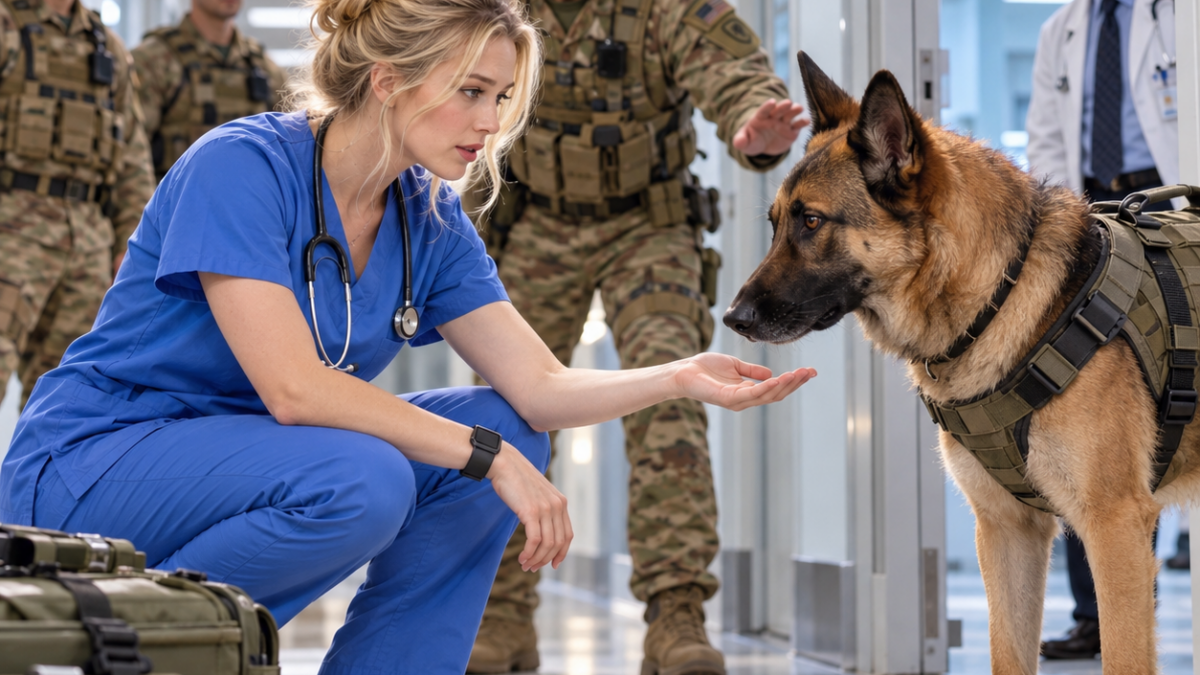
“SHE’S JUST A NURSE” — Then She Calmed the K9 That 6 HANDLERS Couldn’t Move
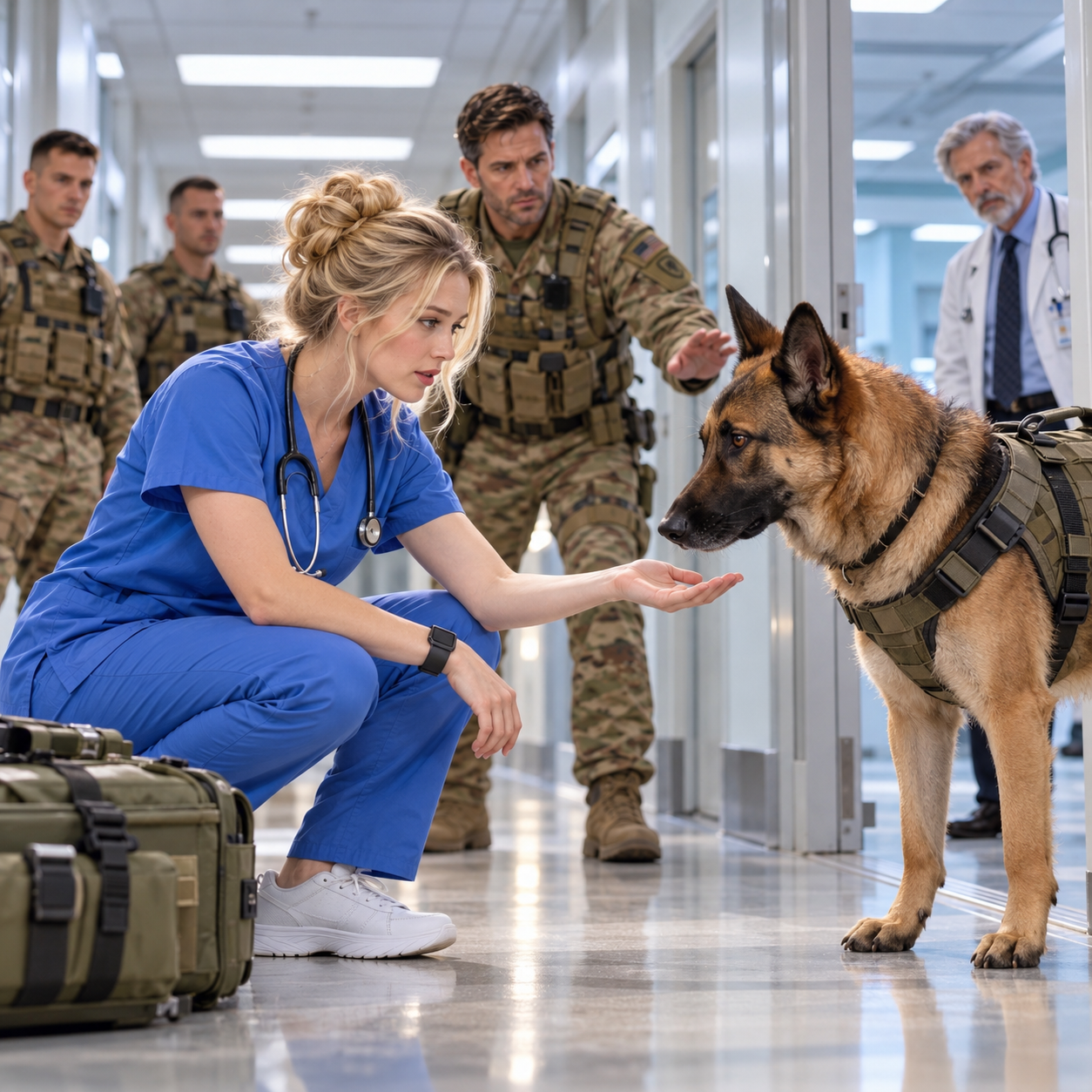
She was just a nurse.
That’s what they said.
Just a nurse.
Six military K-9 handlers trained, armed, decorated, couldn’t move a single dog.
Not one inch. The Belgian Malininoa sat in that doorway like something carved from stone.
And every man in that corridor with a badge and a title and 20 years of experience stood there sweating out of options. Then she walked in.
No weapon, no rank, no fear.
and the dog, the dog that hadn’t let a single person touch him in 11 weeks, stepped aside for her like she was the only person in the building worth trusting.
That’s when the real trouble started.
The first thing Diana Reeves noticed about the dog was that he wasn’t moving.
That probably sounds obvious. He was a military working dog in a rehabilitation wing, not exactly a golden retriever at a birthday party. But the stillness was different.
It wasn’t the stillness of an animal resting or an animal waiting for a command.
It was the kind of stillness that had weight to it. The kind that made the hair on your arms lift without knowing why. Diana had been told before her shift even started that the K9 unit situation on the third floor was contained.
Those were the exact words charge nurse Patty used when she handed over the assignment sheet. Contained like it was a spill.
Diana didn’t ask follow-up questions.
She’d learned in her first month at Eastfield Veterans Medical Center in Tucson, Arizona, that asking too many questions you’d actually seen a problem was was a good way to spend your morging about theory instead of work.
She clipped her badge to her scrubs, the plain white one she’d had for 3 years.
The left pocket slightly faded from where she always kept her pen, picked up her supply cart, and took the elevator to three. She heard the dog before she saw him. Not barking, not growling, just breathing this low, controlled sound that carried down the corridor ahead of everything else.
The kind of breath that said, “I am still here.
I have not left and I am not going to.”
There were seven people clustered near the end of the hall when Diana rounded the corner. mom. Six of them were men in military utility uniforms and the seventh was Sergeant Firstclass Derek Hol, the K9 supervisor assigned to oversee the program at Eastfield.
Hol was a broad shouldered man in his late 40s who carried himself like every room was a briefing he was already running late for. Between those men and the door to the rehabilitation suite stood the dog.
His name, according to the records Diana had been handed, was Rook, Belgian Malininoa, 7 years old, former MWD military working dog deployed three times to combat zones in the past four years. His tactical harness was still strapped to his body.
It looked old, worn in the specific way gear gets worn when it’s been through things that nobody in the chain of paperwork ever fully describes.
Rook wasn’t snarling.
His ears weren’t pinned back.
He wasn’t in what most people would recognize as an aggressive posture.
He was just standing in the doorway with his eyes moving slowly across every person in that hall. And not one of them had managed to get past him.
Diana stopped her cart about 20 ft back and stood there for a moment. Hol noticed her immediately.
Nurse, he didn’t look at her badge.
This area is restricted.
We’ve got a handler situation in progress.
I have a patient in room 312.
Diana said, “Mr.
Callaway, wound care.
He’s already 40 minutes past his dressing change.”
Then he’s going to be 50 minutes past it.
Holt turned back to the dog.
We’re working.
Diana didn’t move.
She watched Rook shift his weight slightly as one of the handlers took a half step toward him. Just a half step.
The dog’s head dropped maybe an inch, and every man in that hallway took a corresponding step back without being told to.
“What’s he guarding?”
Diana asked.
Holt’s jaw tightened.
“Excuse me?”
“He’s not blocking the hallway.
He’s specifically in that doorway.”
Diana tilted her head.
“What’s in room 312?”
One of the younger handlers, 20some, closecropped hair, looking like he’d rather be literally anywhere else, glanced at Halt before answering.
That’s where they’re storing his transfer equipment.
Harness’s leads, his deployment kit, so he knows it’s in there.
Obviously, he knows. Holt stopped himself, breathed through his nose. Nurse, I need you to go wait at the elevator.
I have a patient. Your patient can wait. Diana looked at him steadily.
Mr. Callaway lost his left leg at the knee in Kandahar in 2009.
He’s been at this facility for 6 weeks.
That dressing change is 40 minutes late, and I’m not explaining to him that we pushed it because we couldn’t figure out a dog.
Silence. One of the handlers coughed.
Holt’s expression went through several things in about 2 seconds, and what landed on the other side of all of them was not respect.
It was the particular condescension of a man who has decided he is being patient. Stay in your lane, he said.
Flat, final. This animal is trained for combat operations. He has been assessed as unpredictable.
You are not certified in military working dog protocols, and you will wait at the elevator until we have the situation under control. Diana looked past him at the dog.
Rook’s size had moved to her.
She’d noticed it the moment Holt started talking.
The dog had stopped tracking the handlers and started watching her. Not in the threat assessment way he watched the men.
Something else.
Something she didn’t quite have a word for yet, but recognized the outline of the way you recognize a song you haven’t heard in years.
She took the cart handle in both hands.
I’ll wait, she said.
She moved the cart to the side of the hall out of the way, parked it against the wall near the water fountain, and stood there. Hol went back to his problem.
Diana went back to watching. She stood there for 22 minutes. In that time, the handlers tried three different approaches.
The first was a fresh food offer, a treat from a sealed training pouch, presented at arms length, no eye contact.
Rook didn’t even look at it.
The second was a long lead thrown loosely toward him, which the handler tried to loop without grabbing. Rook stepped sideways, let it land, and resumed his position.
The third was the calm, practiced voice commands that clearly worked on every other dog any of these men had ever worked with. Down, stay, heel, come, release.
Rook didn’t move for any of them.
Diana watched the whole thing and said nothing.
What she was watching wasn’t really the handlers.
She was watching Rook between the attempts. How he breathed, where his weight settled, his pit settled, what he did with his eyes.
The dog wasn’t escalating.
He wasn’t getting more agitated with each failure.
He was simply waiting, methodical. Patient in the way that something is patient when it believes it is doing the right thing and has no doubt about that.
That was when the administrator walked in. Garrett Slade was the kind of hospital administrator who had never worked a shift in a care unit in his life, which meant he had the confidence of someone who had never personally dealt with the aftermath of a bad decision. He wore a gray blazer over a pressed shirt, carried a tablet, and walked into the hallway with the energy of a man who believed problems were primarily administrative in nature.
He looked at the dog.
He looked at the seven people who hadn’t solved the dog.
Then he looked at Diana. What are you doing here?
He said to her specifically as if the answer were already going to be wrong. Waiting. She said waiting.
He turned to Hol. Is this one of your people?
No, she’s nursing staff.
Third floor.
She’s been told to go wait at the elevator.
Slade looked back at Diana. So why are you still here?
I have a patient in room 312.
I’m waiting for access.
Your patient will be reassigned. Slade swiped something on his tablet.
What’s your name?
Diana Reeves. Nurse Reeves.
This corridor is closed for a K9’s safety assessment.
You have no business being in this section of the building, and your presence here is not helping. He lowered the tablet and looked at her over it.
The way men look at things they’ve already decided are beneath addressing further.
Please go to your station. Diana did not move immediately. She was looking at Rook.
The dog was looking back at her.
And in the 3 seconds of stillness that followed, something happened that she couldn’t fully explain later.
Not in any official report, not in the conversation she’d have about this for years.
It wasn’t that the dog communicated something specific.
It was that she understood something she’d been circling for the past 20 minutes.
The gear in that room was Rook’s last link to someone who wasn’t coming back.
Every lead, every harness, every piece of tactical equipment in room 312 had been handled by the same pair of hands Rook had worked beside for 4 years.
The dog wasn’t guarding equipment.
He was guarding what the equipment meant, and nobody in this hallway had stopped long enough to understand that. Diana picked up a roll of clean gauze from her cart.
I’d like to try something, she said.
Every head turned.
Slade’s expression went from cold to genuinely affronted.
Excuse me. Just the dressing change.
His harness has a pressure wound developing under the left shoulder strap. I can see it from here. It needs to be addressed regardless of of the transfer situation.
Let me approach him for the dressing change and I’ll have him comfortable in under 10 minutes.
Hol let out a short humorless sound.
You’ll have him comfortable.
Yes. Nurse Reeves. Slade stepped forward.
You are not a K9 specialist. You are not trained in military animal handling. This is a dangerous animal in an unstable state.
And you are suggesting we allow you to what? walk up to him.
Yes, that is the most irresponsible thing I’ve heard this week, and I’ve had a full week.
Slade turned away from her like the conversation was over. Halt, get your people organized.
I want this resolved in the next 30 minutes or I’m calling for sedation and transport.
If you sedate him in this state, Diana said, you may not get him back. The words landed quietly, not dramatically, just clearly. the way medical information sounds when someone says it from knowledge rather than opinion.
Slade turned back slowly.
I’m sorry.
Dogs in acute grief response, and that’s what this is, can enter a shutdown state under chemical sedation that’s very difficult to reverse.
His cortisol is already elevated. You can see it in the base of his tail. If you add ketamine or mitozolam to that without addressing the underlying trigger, you risk permanent behavioral damage.
She paused.
I’m not saying so don’t sedate him.
I’m saying know what you’re trading if you do.
Silence. Hol was looking at her differently now. Not warmly, but differently.
Slade was not looking at her differently. He was looking at her the way men look at junior staff who have made the mistake of knowing things out loud.
I’m going to have to ask you to leave this floor, nurse Reeves.
Sir, now or I will have security escort you. Diana left.
She walked to the elevator, pressed the button, stepped inside, and rode it down to the second floor break room where she sat at the small table by the window with a cup of bad bad coffee and let herself be angry for exactly 4 minutes.
She’d spent 8 years in the army, 8 years as a trauma nurse attached to special operations units in places that didn’t show up on most maps.
She had worked on operators who came in with injuries that the standard medical textbooks didn’t cover because the the standard medical textbooks were written for people who got hurt in ways that had names.
She had treated working dogs in the field. Three of them two after blast injuries, one after a gunshot wound to the left flank.
She knew more about military working dog physiology and psychological trauma response than anyone on that floor, possibly anyone in the building. And she had been told to wait at the elevator.
Stay in your lane. She looked out the window at the parking lot.
In the army, she had never once been told to stay in her lane when the alternative was that someone got hurt. Rank mattered in theater.
Protocol mattered. But when a body was failing in front of you, what mattered was the person who knew what to do. She finished her coffee.
Then her pager went off, not a standard page.
The code on the small screen was one she hadn’t seen in 14 months.
Since last time, something on the third floor had gone genuinely wrong. Medical emergency. Third floor rehabilitation wing.
She was up before the thought completed. She came through the stairwell door at a run and heard it before she saw it.
Not barking, not screaming, but a kind of controlled chaos that had its own sound, a tight, pressurized noise of people trying to manage something that had gotten past them. Two of the handlers were against the wall.
One was on the floor, not injured, just down, having tripped backward over his own feet when Rook had moved. Because Rook had moved.
He’d moved away from the door.
He was standing in the center of the hallway now, and he was not in an aggressive posture, but he was not in a calm one either.
He was in the posture of a dog who has been pushed to the edge of something, and is now standing precisely at that edge, deciding the reason he’d moved.
In the 20some minutes since Diana had left, Slade had sent a facilities worker to retrieve the equipment from room 312.
The man hadn’t known about the dog.
He’d opened the door, started loading gear onto a dolly, and Rook had come off that doorway like a compressed spring releasing.
Nobody was hurt. The facilities worker was in the supply closet at the end of the hall, door closed, technically fine. But Rook was now between the dolly, partially loaded old tactical harness visible at the top and the exit, and he had not moved from that position, and the look in his eyes was the specific look of an animal that has run out of options except the final one.
Diana didn’t hesitate.
She walked straight toward him.
Reeves, Holt’s voice, sharp.
Do not. She held up one hand without turning around.
Not at Holt. just wait.
The universal signal of someone who needs a single moment of silence to do something that requires total quiet. She had the gauze in her left hand. She held it low out to the side, visible but not threatening.
She didn’t look directly at Rook, not full-on eye contact, just peripheral, just enough to track without challenging.
She stopped 6 ft away from him.
“Hey,” she said.
Not loud, almost conversational.
“I see you.”
Brook’s ears rotated toward her.
“I know what you’re doing,” she said.
“I know what that is.
” She glanced briefly at the harness on the dolly, then back to the middle distance between her and the dog.
“You don’t have to let me touch it.
That’s not what I’m here for.”
She took one step forward and crouched slowly, bringing herself to his level without reducing the distance between them.
“I’m just going to take a look at that shoulder,” she said.
That’s all I’m doing here.
Everything else stays where it is. Rook watched her.
His breathing was still elevated, but it wasn’t spiking further.
Diana held out the back of her hand, not pushing it toward him, just presenting it, letting him make the choice. She waited 7 seconds. 8.
The dog’s nose dropped 2 in and touched the back of her hand.
She heard one of the handlers exhale somewhere behind her.
She didn’t touch the harness.
She didn’t reach for the gear.
She moved her hand slowly to his shoulder, announced it with a quiet word before touching, and when her fingers found the raw skin beneath the left strap, she felt him tense once and then release. Like something that had been held for a long time, deciding it was allowed to rest.
She worked quickly and quietly. Clean the area. Dress it.
No muzzle, no restraint, no commands. She just finished the second piece of tape when the doors at the end of the hall opened.
They came in quietly, which was somehow more alarming than if they’d come in loud.
Four of them in Navy working uniforms, moving with the particular economy of people who know exactly where they’re going and have not come here to explain themselves.
Two had folders, one had a radio. The fourth, who walked slightly ahead of the others, had the kind of face that had learned a long time ago not to show you what it was thinking.
His rank insignia said, “Commander.”
His name tape said veil.
Commander James Veil Veil had Rook’s full attention before he was halfway down the hall.
The dog something had moved toward him, but something in his posture changed a recognition that went beneath trained response. something older and more complicated than command hierarchy.
Vale stopped walking when he saw Diana. He looked at her for a long second. Diana, still crouched beside Rook with medical tape on her fingers, looked back.
Something moved across Vale’s face that she couldn’t quite categorize.
Then he came to attention sharply, formally, the way military people come to attention when the person in front of them has a specific kind of rank. Captain Whitmore.
The name landed in the hallway like something dropped from a height. Not Reeves.
Not nurse. Not her. Captain Whitmore.
Diana stayed where she was for one more second.
Her hand rested lightly on Rook’s side, and she felt the dog’s breathing against her palm, steady now, slower than it had been 10 minutes ago.
She finished pressing the last piece piece of tap flat. Then she stood.
Garrett Slade, who had been standing near the nurses stationed with with his his tablet in his certainty, had gone completely still.
Holt’s expression was unreadable.
The handlers along the wall looked at each other and then looked away.
“Commander Veil,” Diana said.
Her voice was even.
“I wasn’t expecting you today.”
“No, ma’am.”
His eyes were doing a rapid professional assessment of everything in the hallway. the handlers, the dog, the dolly with the gear, slayed the handlers on the floor.
Apparently, neither was anyone else.
He didn’t say it like an accusation.
He said it like a man doing the math of a situation and not liking the sum. He looked at Slade.
You’re the administrator.
Garrett Slade. Yes. Slade stepped forward with the automatic authority of his title.
Commander, I don’t know what brings naval personnel to a VA facility today, but if you could give us a moment to I need to know, Vale said.
Who who authorized the early movement of the equipment from room 312? Slade blinked. That was the transfer was scheduled.
We were clearing the room for the transfer. Veil said was not scheduled for today.
It was scheduled for Thursday under a specific handling protocol that included notification of this facility’s K9 supervisor at least 6 hours in advance.
He looked at Holt. Did you receive that notification, Sergeant?
Holt’s jaw tightened.
No, sir. Vale turned back to Slade.
Slade’s tablet suddenly seemed to require his attention.
I want every piece of equipment back in that room, Vale said quietly. Exactly as it was.
and I want a meeting with this facility’s leadership team in the next 20 minutes.
He looked at Diana.
I’d like you in that meeting, Captain.
I’m suspended, Diana said.
Vale looked at her. Slade suspended me about 45 minutes ago for approaching the dog without authorization.
There was a long pause. Vale turned to look at Slade again.
Slade was no longer looking at his tablet.
Nurse Reeves, Captain Whitmore, and I will both need a full account of this morning’s events, Bale said, starting from when she arrived on this floor.
He looked down the hallway at Rook, who had settled into a loose sit beside the dolly, one shoulder just barely touching Diana’s leg.
And I’d like someone, Bale said quietly, to explain to me why a decorated army trauma nurse was told to wait at the elevator while a military working dog in acute distress went without medical attention for the better part of an hour.
Nobody answered because there wasn’t a good answer.
There was only the particular spreading silence of people who had made a very large of people who had made a very large mistake and were only now beginning to understand the size of it. Diana looked at Rook.
The dog looked back at her, calm now, his breathing slow and even, the old harness on the dolly, still within his sighteline, but no longer worth throwing himself against a wall for.
She understood in the way she sometimes understood things about patients that she couldn’t put in a chart that she had only solved the surface of this.
That the real problem, what Rook was protecting, why he’d been transferred, what was actually in those files, veils people were carrying, was something she hadn’t been told yet, and she had a feeling she was about to be told things that would make this morning look simple.
behind her. She heard Slade begin to say something.
Then she heard Veil say very quietly, “I’d stop there if I were you.”
And for the first time all morning, the right person in the room was the one doing the talking.
What Commander Vale brought with him that morning wasn’t just a transfer order.
It was a file. And buried inside that file was the reason Rook had never once in 11 weeks of rehabilitation been able to walk away from that door.
The file was classified, not in the bureaucratic. Someone stamped it without thinking way that half the paperwork at a federal medical facility got marked restricted.
This was the other kind. The kind that had a specific color coding on the cover tab and a handling notation that meant you needed a particular clearance just to be in the same room while it was open.
Vale set it on the small conference table in the third floor administrative office without opening it. He sat down across from Diana and placed his hands flat on either side of it and looked at her.
The way people look at someone, they’re still calibrating how much to tell.
Diana sat down too.
She’d washed her hands in the hall sink on the way in.
There was still a faint smell of antiseptic on her fingers, and she was aware of it in the specific way you become aware of small sensory details when everything else in the room is pressurized. Slade had been told to wait outside. The expression on his face when Vale said it had been since something Diana filed away without comment.
Hol was in the room.
One of Vale’s people, the one with the folders, sat sat at the corner of the table with a pen and a legal pad and the particular stillness of someone whose entire job was to write things down and not have opinions about them.
How long have you been at Eastfield? Vale asked.
14 months under your married name.
It wasn’t a question.
Diana looked at him. Reeves is my name.
Has been for 11 years.
Vale’s voice was careful, not unkind, just careful.
The voice of a man who understood that the next several minutes were going to require precision. Your discharge record is under Whitmore. Your nursing license transferred under Reeves.
Nothing flagged it here.
I didn’t try to hide anything.
I’m not suggesting you did.
He paused.
I’m explaining why nobody in this building knew who you were until about 20 minutes ago.
Holt shifted in his chair.
Diana didn’t look at him.
“What’s in the file, Commander?”
she said. Vale looked at the folder for a moment. Then he opened it.
He didn’t push it across to her.
He turned it so she could read it from where she sat and pointed to a section near the top of the first page, a block of text with a name, a unit designation, and a date. The name was Lieutenant Caleb Morrow.
Diana read it once, then she read it again.
He was Rook’s handler, she said.
For four years, deployed together three times.
Vale’s finger moved down the page.
Lieutenant Marorrow was killed during a classified extraction operation 11 weeks ago. Hostile contact two vehicle convoy eastern sector.
Rook was recovered beside Marorrow’s kit approximately 90 minutes after the incident.
Diana looked at the date. 11 weeks ago was exactly when Rook had arrived at Eastfield.
He came here directly from the recovery site.
He was flown out with the rest of the team’s equipment.
Standard procedure.
When there’s a working dog involved in a fatality, they come back with the unit’s gear for inventory and documentation before reassignment.
Vale turned to the next page. Except the intake notes here say Rook was flagged as unstable on arrival and placed in the rehabilitation wing.
pending behavioral evaluation because he wouldn’t leave the equipment.
Because he wouldn’t leave the equipment.
Veil confirmed. Diana thought about this.
In the army, she’d seen it twice.
Working dogs that came back from theater after losing their handlers and simply stopped being dogs operationally speaking. They still ate. They still slept.
But something in them went into a holding pattern that no amount of retraining could break because the retraining was working on the wrong problem. Everyone kept treating it as a behavior issue, a compliance failure, something to be corrected. None of them had ever tried to understand what the dog was actually doing.
He was never released from his last assignment, she said. Vale looked at her.
That’s what the intake team missed.
He wasn’t refusing to comply.
He was still on watch.
Marorrow’s last order, whatever it was, however it was given, Rook is still carrying it.
She pushed back slightly in her chair.
What was Maro’s assignment the day he was killed?
Vale closed the file partway.
That’s where it gets complicated.
How complicated? He looked at her for a moment. Classified.
Commander Captain. His voice was still even, but there was something underneath it now. Something that had edges.
I know your clearance level.
It’s current technically, but what I’m looking at in this file is an active operations matter that I cannot fully brief you on in an unsecured room in a VA facility in Tucson.
He held her gaze.
What I can tell you is that the reason I’m here today personally is because someone in this building was about to move Rook’s equipment without following the specific protocol that was put in place to prevent exactly the kind of incident that happened in that hallway this morning.
Slade, we’ll get to that.
The door opened.
One of Vale’s other people leaned in and said something quietly that Diana couldn’t hear.
Vale’s expression tightened by a fraction.
He nodded and the door closed again.
“What was that?”
Diana asked.
“Mr.
Slade has made a phone call,” Bale said.
“To the facility’s legal department.”
Diana breathed in slowly through her nose.
“Of course he had.
” The next 40 minutes were among the more unpleasant of Diana’s career, which was saying something because her career had included a field surgery in a vehicle with no running water and a gunshot wound of her own that she had treated herself for 2 hours before anyone else got to her.
Slade had not been idle in the waiting area.
By the time Vale emerged from the conference room to handle the legal department inquiry, Slade had drafted an incident report, emailed it to three separate administrative addresses, and filed a formal complaint with the
facility’s HR division, citing Diana for endangering staff by approaching an unstable military animal without authorization, interfering with a supervised K9’s assessment, refusing a direct instruction from facility admin.
administration. And this was the one that actually made her stomach clench, misrepresenting her professional qualifications to medical facility leadership. That last one, misrepresenting her qualifications.
She read it twice when Patty, the charge nurse, forwarded it to her with a text that just said, “I’m sorry, Diana.”
And a second message 30 seconds later that said, “HR is saying your access badge has been flagged.”
Diana looked at her badge. It was still clipped to her scrubs. It still had her photo and her name and her nursing license number printed on the back.
She was still Diana Reeves, RN, third floor, 14 months of unblenmished record, and her badge had been flagged while she was sitting in a conference room helping a naval commander understand why a military dog was in psychological crisis.
She sat in the hall for a moment with the phone in her hand and felt the specific quality of anger that doesn’t come from surprise, the kind that comes from recognizing a pattern you’ve already lived through.
She’d been told
in the army that she was overstepping.
She’d been told that her job had a specific boundary and that the area beyond that boundary belonged to people with different titles.
She had overstepped anyway because the alternative was that someone died.
And in when someone didn’t die because she’d overstepped, the people who told her to stay back sometimes said thank you and sometimes just found different ways us to remind her that she was still technically out of line.
She was very, very tired of that pattern.
She stood up, walked to the nurse’s station, and asked Patty for a copy of her full employee file.
Patty blinked.
Diana, I’m not doing anything dramatic.
Diana said, “I just want to know what they have and what they don’t.”
HR already, Patty. Diana kept her voice level. I spent 8 years as a trauma nurse with Army Special Operations.
I treated wounded operators and working dogs in active combat zones.
I have a commenation from the Joint Chief’s Office that I never once mentioned in this building because it wasn’t relevant to the job I came here to do.
She looked at the desk between them. Whatever Slade put in that report, the facts are the facts.
I just need to know what I’m working with.
Patty held her gaze for a long moment. Then she reached for the file cabinet.
You’re going to get me in trouble, she said.
But she was already pulling the drawer open.
I’m going to get a lot of people in trouble today, Diana said.
Unfortunately for them, it’s not going to be the kind they planned for.
Holt found her in the break room 20 minutes later.
She was sitting at the same table by the window where she’d been an hour ago, the same bad coffee in a different cup.
Her employee file open in front of her.
She heard him come in and didn’t look up.
He poured himself coffee, stood at the counter for a moment. Then he sat down across from her without being invited, which she noted.
“I owe you an apology,” he said.
Diana turned to Paige.
Yes, that’s it.
Just yes. What would you like me to say, Sergeant Holt?
He wrapped both hands around his cup.
He was quiet for a moment, and in the quiet, he looked like what he probably actually was under all the authority, a man in his late 40s who was good at his who was good at his job and had spent that morning being very publicly wrong about something in front of several people he’d need to work with again.
I’ve been working K9 for 19 years, he said.
I have never seen a dog do what Rook did when you walked up to him. You have.
You just didn’t recognize it.
He frowned. What does that mean?
It means that what Rook was showing you was compliance. She closed the file.
Not to you, to something else. And when you stopped trying to override it and just stood still, he had room to choose.
She looked at him.
You’ve seen dogs choose before.
You’ve just been trained to see it as a failure of command when they choose something you didn’t order.
Holt stared at her.
That’s not an insult, Diana said.
That’s just the limitation of the system.
He was quiet again. Outside the window, a facilities truck was pulling into the parking lot. a maintenance crew getting out, moving slow in the afternoon heat, completely unaware that that the building they were about to enter had spent its morning in a state of quiet implosion.
Slade’s not going to back down, Holt said.
Whatever Vale does with the transfer protocol violation, and that is a real violation, by the way, the equipment was moved early without authorization. Slate is going to push the complaint against you.
I know the misrepresentation thing is thin, but it’s going to sit in your file.
I know. Does that bother you?
Diana looked at him. Does it matter? It might.
If you’re planning to keep working here.
I’m planning to go check on Mr.
Callaway, she said, whose dressing change is now 2 hours late and who has been sitting in room 312 wondering what on earth is happening in the hallway outside his door. She stood up and gathered her file.
After that, I’m going to cooperate fully with whatever process Vale and the HR department need from me because I have nothing to hide and I have very good documentation of everything that happened this morning.
She tucked the file under her arm.
And after that, Sergeant, I’m going to find out what’s actually in that classified file that Vale isn’t telling me because whatever Lieutenant Marorrow’s last assignment was, it’s the key to everything Rook is doing.
And nobody in this building is going to help that dog properly until someone understands it. Hol looked up at her. How do you plan to do that?
I’m going to ask him, Diana said.
She walked out of the breakroom. Room 312 had two patients.
One was Thomas Callaway, 63, below knee amputation, three weeks from his expected discharge date.
A man who had a photograph of a brown dog taped to the wall beside his bed and who had without asking anyone’s permission developed a habit of staying up past midnight watching old baseball games on his phone with the volume because he couldn’t sleep and he didn’t want to bother anyone.
The other patient was Sergeant Firstclass Denise Adler, 44, spinal injury, 6 months into what was going to be a very long recovery, who spent most of her days doing crossword puzzles from a book her sister had sent, and who had the specific patient energy of someone
who knew better than to complain, because she’d seen worse, and she’d been the one administering care in that worse.
Neither of them said anything when Diana came in 2 hours late with her supply cart in her face doing the professional calm thing that every nurse learned in the first year. The expression that says everything is under control and you should not worry regardless of whether either of those things is true. Callaway looked at her over his glasses.
Rough morning little bit. Diana said heard some noise in the hall earlier. K9 situation.
It’s handled.
That dog okay? She looked at him.
He’s better.
Callaway nodded satisfied and went back to his book. Diana started on the dressing and worked in silence for a few minutes. Adler was asleep or pretending to be.
It was sometimes hard to tell with her. You know, Callaway said after a while I had a dog in country. Different unit, different lifetime.
He got hit same time I did. They flew him out before they flew me out. He paused.
Never found out what happened to him. Diana kept her hands moving.
What was his name? Diesel.
He said it the way people say the names of things they haven’t said out loud in a long time carefully, like a test to see if it still works.
Dumbest name for a dog. It was very small. She finished the dressing and started on the tape.
She didn’t say anything because sometimes the most useful thing you can do for someone is not immediately respond to what they’ve said.
Is it true they’re going to put the dog down?
Callaway asked. Diana stopped. Where did you hear that?
Someone in the hall earlier. One of the handlers. No, she said firmly.
That is not happening. How do you know? She pressed the last piece of tape flat.
because I’m not going to let it.”
Callaway looked at her for a moment over his glasses. Then he went back to his book.
“Good,” he said quietly.
The call from HR came at 2:47 in the afternoon. Diana was in the documentation room completing her morning notes when her personal phone buzzed.
Not the facility line, her personal cell, and the number was one she didn’t recognize, which meant it was someone who had gotten her number from the file.
Slade had put together, which meant it was someone who wanted her to understand that they had her file. She let it go to voicemail.
The voicemail said that her badge access had been temporarily suspended pending the completion of an administrative review, that she was to consider herself on unpaid administrative leave effective immediately, and that she should not report to the facility tomorrow morning
until she had received written confirmation. that the review was complete. It was read from a script.
She could hear the faint rustle of paper in the background. She listened to it twice.
Then she called Vale’s number which he’d written on the back of a card when they’d parted in the hallway.
And when he picked up on the second ring, she said they suspended my badge. There was a short silence.
When? Just now.
Effective immediately. Unpaid administrative leave pending review.
She looked at the window. Slade moved fast.
Yes, Vale said. He did, commander.
I need to know what’s in that file.
Another silence. Different quality from the first one.
The kind that meant he was deciding something. Not on this line, he said.
Then where? Can you be at the 8th Street VA annex at 4:00? She checked the time.
Yes. Come to the second floor. Ask for warrant officer Puit.
She’ll bring you to me.
He hung up. Diana sat for a moment in the documentation room with her suspended badge in her hand, looking at her own photograph.
On the front of it, the picture they’d taken her first week here when everything was new and she was still adjusting to the particular rhythms of a facility.
The particular way the light came through the third floor windows in the morning. She thought about Rook standing in that doorway waiting.
She thought about Callaway’s question.
Is it true they’re going to put the dog down?
She clipped the badge back to her scrubs even though it didn’t work anymore.
Picked up her bag and walked out. The VA annex on 8th Street was a smaller building than the main facility.
Two floors, administrative offices on both. a parking lot that needed resurfacing and had needed it for at least three years by the look of it. Diana found a spot in the back and sat in her car for a moment with the engine off.
The heat in Tucson in October was deceptive.
It wasn’t summer heat anymore.
It had that quality of afternoon afternoon warmth that felt manageable until you stepped out of the air conditioning and realized the air still had teeth. She went inside. Warrant officer Sandra Puit was waiting near the elevator.
On the senpet floor, a compact woman in her mid30s with the economical body language of someone who’d spent a long time in rooms where every movement was noted.
She shook Diana’s hand once, firmly said this way, and led her down a corridor to a conference room at the back of the building that had no windows and a whiteboard covered in handwriting that someone had half erased.
Veil was there.
So was someone Diana hadn’t seen before.
A woman in civilian clothes, late 40s, with the kind of face that was very deliberately neutral. She was introduced only as coordinator Mills, which told Diana exactly what she needed to know about what kind of coordinator she was. Thank you for coming, Vale said.
He didn’t sit down.
Neither did Mills.
Diana sat anyway because her feet hurt and she’d been on them since 6:00 in the morning except for the time she’d spent being escorted places and suspended from things.
The classified of Marorrow’s file veil began relates to the specifics of the extraction operation he was killed during that remains classified and I can’t give you that.
He paused.
What I can tell you is the element that’s directly relevant to Rook.
Please, Diana said. Vale looked at Mills briefly. Mills gave no visible signal, but something in the room shifted.
Marorrow’s final assignment before the convoy was a to secure a specific piece of operational equipment, a case, and ensure it was transferred to the recovery vehicle before the convoy moved.
The convoy was hit before the transfer was complete. Veil stopped.
Rook was found with the case. Diana went very still. The case is in the equipment inventory from room 312.
Vale continued.
It’s been there since Rook arrived.
It was checked in, sealed, and listed as classified contents to be reviewed by authorized personnel during the formal inventory. He looked at her.
Nobody reviewed it because nobody had clearance because the inventory request was submitted to an administrator who didn’t escalate it through the correct channel.
It sat in a queue for 11 weeks. Diana closed her eyes for one second.
11 weeks.
Rook had been standing guard over his handler’s final assignment for 11 weeks in a rehabilitation wing because the piece of bureaucratic machinery that was supposed to come collect what he was guarding had failed to function.
And nobody in the building had understood that the dog was not broken. He was loyal. He was doing exactly what he had been trained to do.
and exactly what Marorrow had in some way through a command, through habit, through the simple wordless communication between a handler and a dog who had worked together long enough to understand each other without language asked him to do. Secure it.
Wait, don’t let anyone take it.
The case, she said, is it still in the room?
It’s been secured by my people, Vale said.
He paused. We need to complete the inventory and close the assignment so Rook can be formally released from it.
You can’t just formally release him, Diana said.
It doesn’t work like that.
He’s not a file you can close.
She looked up. He needs to be present when you process that equipment.
He needs to see it handled correctly by someone he recognizes as as authorized.
Otherwise, the watch doesn’t end for him.
It just gets interrupted. Vale looked at her for a long moment.
You’re saying he needs to see the mission completed?
Veil said.
I’m saying he needs to understand that the right people came.
Diana paused. That what Marorrow asked him to protect got where it was supposed to go.
Mills spoke for the first time. Her voice was flat and precise like a legal document reading itself.
What you’re describing is not a standard K-9 decommission protocol.
No, Diana said it’s not.
The facility’s K9 coordinator would need to be present.
The assigned VA mental health liaison for working dogs would need to sign off on.
The assigned VA mental health liaison for working dogs, Diana said carefully, has never seen a dog in Rook’s specific situation because what happened to Rook has not been documented as a protocol before.
And the reason isn’t Ben’s been documented is because the people who usually make these calls don’t stay with the animal long enough to understand what they’re looking at.
She stopped herself, breathed.
I’m not trying to circumvent anything.
I’m telling you that if you want Rook to actually recover, not just stop the immediate behavior, but actually recover, then you need to give him a chance to to let go.
And that means completing the thing he’s been holding.
Another silence.
Vale’s hands were flat on the table again.
That thing he did.
If I bring you back into that building tonight, he said, “Your badge is suspended.”
Then get it unsuspended.
That’s not how administrative processes.
I know exactly how they work, commander. She held his eyes. Get it unsuspended.
Vale looked at Mills. Mills looked at Diana.
There’s another problem, Mills said.
Diana waited. Slate has filed an expedited request with the federal contractor oversight office, citing the incident this morning as evidence that the VA facilities K9 rehabilitation program has inadequate safety protocols.
Mills paused. If that request is approved, the entire program gets placed under external review, which means no movement on any of the animal, including Rook, until the review is complete. Diana stared at her.
How long would that take? Minimum 60 days.
Possibly 90. In 90 days. In 90 days, Vale said quietly.
We lose the window. He looked down at the table.
Dogs and extended acute grief states the behavioral literature gives a specific window for intervention. After that point, the patterns calcify.
Rook’s 11 weeks in already.
He looked up. We have maybe 3 weeks before the the intervention window closes. Diana sat with that 3 weeks or 60 days of external review that would eat all three of them and leave Rook in a cage at the end of it with a file that said unsuitable for reassignments and options that did not include anything good.
And behind all of this, behind the classified file, the suspended badge, the expedited oversight request, the bureaucratic machinery that Slade had clearly been working for much longer than just this morning was a question that Diana hadn’t asked yet, but that had been sitting in the back of
everything since she’d read the name Caleb Morrow in that file.
Why was the equipment transfer moved up?
She said, “You said it was scheduled for Thursday.
Someone moved it to today. Who authorized that change?
Vale looked at her. That, he said, is the question.
And he was quiet for a long moment.
The authorization came from this facility’s administrative office, he said.
Digitally signed and timestamped. He paused.
At 6:14 this morning, before your shift started, Slade, the signature is Slates. Diana looked at the half erased whiteboard across the room.
Someone had been mapping something on it before she arrived. Boxes, arrows, connecting lines. Whoever had done it had scrubbed it before she came in.
He moved the equipment up deliberately, she said.
It wasn’t a question.
It appears so. To trigger the incident.
Vale didn’t answer.
Why?
Diana said, “What does he gain from an incident with the K9 program?”
Mills shifted almost imperceptibly in her chair. Diana looked at her. Then back at Vale.
What does Eastfield gain? Diana said slowly. From the K9 program going under external review.
The room was very quiet. Vale put both hands in his pockets and looked at the ceiling for a moment.