“SHE’S JUST A NURSE” — Then She Calmed the K9 That 6 HANDLERS Couldn’t Move – Part 5
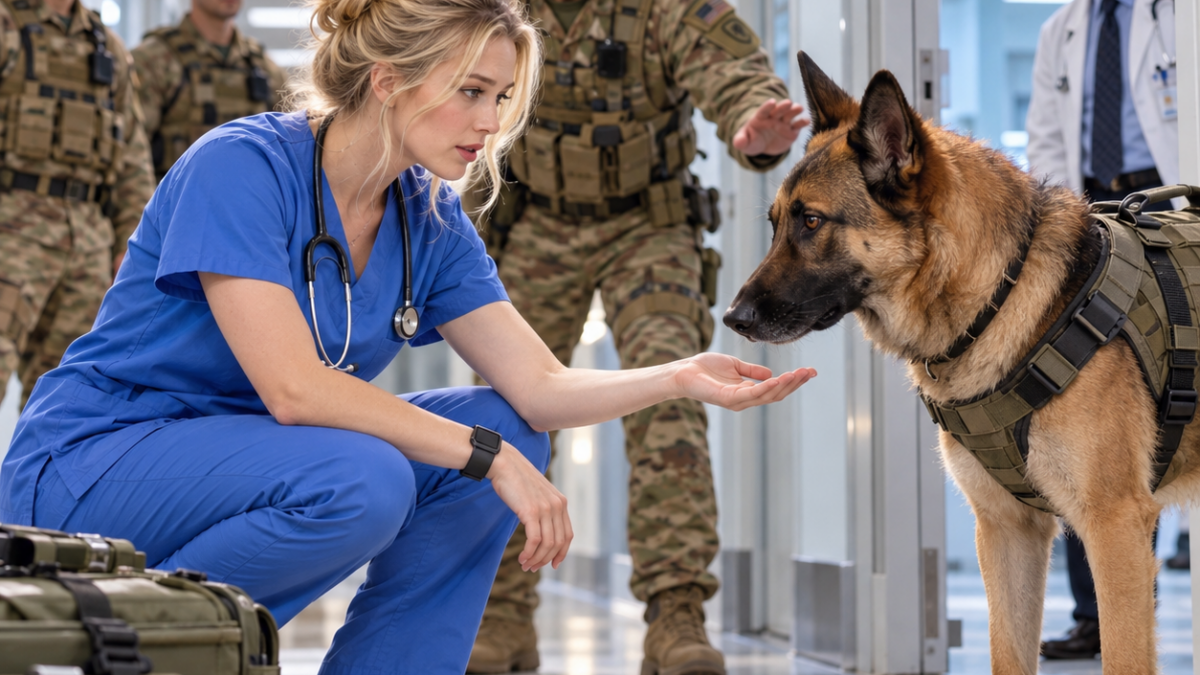
The previous night had been driven by adrenaline and urgency, the kind of wakefulness that keeps you at a kitchen table with a legal pad because your body understands that the next 12hour hours and won’t let you rest until they’re accounted for.
This night was quieter. She lay in the dark with her eyes open and let the day move through her in pieces.
Not trying to organize it or resolve it.
Just letting it pass the way events pass when you’ve been inside them so completely that your nervous system needs time to understand they’re over.
Rook sitting in the corridor in the afternoon light.
Slade’s voice going flat and stripped.
Veil’s face in the conference room doorway carrying something she still didn’t have a full name for.
You should probably ask Driscoll when he calls.
She had driven home through Tucson’s early evening.
traffic, ordinary traffic, people going ordinary places, the kind of normaly that always felt slightly surreals after a day like the one she’d had and eaten an actual meal for the first time and showered and sat on the edge of her bed with her phone in her hand for a while before setting it on the nightstand and lying down.
She thought about the Northern Virginia area code. She thought about 14 months. At some point, somewhere past midnight, she stopped thinking and slept.
Driscoll called at 8:17 the next morning. Not his assistant. Him directly, which told her something about the nature of the call before he said a word.
Nurse Reeves, are you available to meet today? Yes, she said.
Not at Eastfield. He gave her an address, a federal building downtown. the kind of address that hit a security desk in the lobby and required showing ID before the elevator.
10:00 if that works. It works. She got there at 9:52 and there at 9:52 and sat in the lobby for 8 minutes watching the security desk and the people coming through and the specific quality of institutional stillness that federal buildings had regardless of city or climate.
And then Driscoll’s assistant came down and brought her upstairs to a conference room that looked almost identical to the one at the annex down to the half erased whiteboard.
Driscoll was there. So was someone else.
The woman was in her late 50s, civilian clothes, hair cut short and practical.
She had the kind of stillness that wasn’t cultivated.
It was residual. the way people become still when they m spent years in environments where movement draws attention. She was introduced as director Anita Voss and the office she was from was one that Diana had heard of but had never had reason to interact with directly a federal inspector general division that handled contract fraud within the department of defense healthcare network.
Diana sat down. Thank you for coming.
Driscoll said, “I’ll be direct because I think you’d prefer that.”
Yes.
Diana said, “What happened at Eastfield was not a standalone incident.”
He opened the folder in front of him. Meridian Health Resource Partners has vendor relationships with four federally contracted VA facilities across the Southwest. In each case, the relationship was established within 6 to 18 months of Raymond Hatch serving on the relevant contract review committee.
He looked up the K9 program was the first time a budget reallocation had been actively pursued. The other facilities show the infrastructure, the vendor registration, the preliminary preliminary documentation, but no active scheme.
Our read is that Eastfield was the pilot. Diana looked at him steadily. And if it had worked, it would have been replicated, Voss said.
Her voice was flat and precise. Four facilities. Potentially 8 to10 million million dollars in reallocated federal funds channeled through a privately held entity with a documented conflict of interest on the review side.
She paused.
We’ve been building the case on the financial structure for 14 months.
What we needed was an incident at one of the facilities that was clean enough and well documented enough to open the formal review. Diana sat with that. You needed an incident, she said carefully.
We needed evidence of active implementation, boss said. Hatch and Slade were careful.
The infrastructure existed, but they hadn’t moved until the K9 program.
Why did they move when they did? The contract renewal deadline. Driscoll said 42 days.
If they were going to execute at Eastfield, it had to be this cycle.
They’d been waiting for the right trigger.
Something that looked like a genuine safety concern happened fast enough that the review timeline would fall inside the renewal window. He paused.
Rook’s arrival gave them that trigger.
Diana thought about this. 11 weeks.
Rook had been in that facility for 11 weeks. visible, documented, the focus of escalating handler concerns, and Hatch and Slade had watched that situation develop and recognized in it the shape of what they needed. A military working dog behaving in ways that could be characterized as dangerous, a K9 program that could be characterized as inadequately supervised, a line item that could be characterized as a liability.
They had looked at a grieving dog and seen an instrument. The people who called me, Diana said.
The Fort Bliss number. The Northern Virginia number.
Voss looked at her. That was your office. Diana said, a pause.
The Fort Bliss contact was a source within the operational documentation chain.
Voss said, “Not our office directly.
Someone who understood what Kowalsski’s statement meant and why it was being blocked.”
She looked at Diana evenly. The second call was from our office.
Yes, you had my personal cell number. We had your file, Voss said simply.
We’ve had it since you were hired.
Diana kept her face neutral. It was an effort. You were hired at Eastfield 14 months ago.
Driscoll said 4 weeks after Hatch filed the vendor registration for Meridian. The timing was not entirely coincidental. Diana looked at him.
The facility needed a new nurse for the third floor rehabilitation wing. Driscoll said the position was posted through standard channels. You applied and were hired through standard channels.
He paused, but the posting was flagged by our office when Eastfield came onto our radar. We reviewed the applicant pool.
Your application stood out for reasons that given what we were building on the financial side seemed potentially relevant. You let me get hired, Diana said, knowing what was coming.
We didn’t manufacture your hiring.
Voss said you were qualified. You were the best applicant. The facility chose you on their own merits.
We we simply She paused, choosing the word carefully.
Didn’t intervene.
Diana looked at the half erased whiteboard. She wanted to be angry about this.
She turned the anger over, examined it, looked for the place where it was justified, and she found it the specific cold feeling of having been a variable in someone else’s equation without knowing it, of having walked into a building and a life and a situation that had been on some level anticipated by people sitting in a room like this one.
But she also found the
edges of the anger where it stopped because she had not been placed. She had not been controlled.
She had not been told what to do or when to do it or how.
Every choice she had made in that building, getting off the elevator, watching Rook, refusing to go to the nurse’s station, walking toward the dog when everyone told her not to.
Every single one of those choices had been hers. Made from her own knowledge, her own training, her own stubborn unwillingness to walk away from something that needed to be understood. Nobody in this room had made those choices for her.
“Um,” she said.
“Why are you telling me this now?”
she said.
Voss looked at her directly, and for the first time, something moved in the flat professional surface of her expression, something that wasn’t quite warmth, but was adjacent to it.
The look of a person who respects something enough to tell it the truth.
“Because you deserve to know,” Boss said.
And because what comes next, the formal proceedings, the public record is going to include your name, your actions, your documentation, the suspension Slade filed, the complaint he withdrew, the evidence you gathered and brought to Driscoll. She paused.
You’re going to be visible in this in a way that you didn’t sign up for.
We thought you should understand the full context before that happened. Diana looked at her hands on the table.
What does visible mean? She said it means Driscoll said that the federal complaint against Garrett Slade and Raymond Hatch will site specific incidents and individuals.
It means that a nurse at Eastfield Veterans Medical Center documented and identified evidence that accelerated a federal fraud investigation and prevented the exploitation of a military working dog rehabilitation program. He paused.
That’s going to be in the public record.
Diana thought about this. She thought about what it meant to be visible in the specific way Driscoll was was describing.
Not the private satisfaction of having done something right, but the public version of it. The version that got written into documents and cited in proceedings and became eventually a thing that other people read out about and formed opinions on.
She had never wanted that, had specifically actively not wanted it, which was part of why she’d been at Eastfield for 14 months under her married name, doing her job well and quietly without ever once mentioning the Joint Chief’s Commenation or the 8 years of special operations nursing or any of the specific weight of
her background that would have changed how people in that building looked at her.
She thoughts about Slade saying, “Stay in your lane.”
She thought about how she had never, not once in her life, been able to make herself do that when the alternative was that someone got hurt.
“All right,” she said.
The formal charges against Garrett Slade and Raymond Hatch were filed 17 days later. Diana was at work when it happened third floor, morning shift, dressing change on a new patient in room 309, who had questions she answered patiently and completely.
the way she answered all patient questions, which was as though the answer mattered because it did.
She found out from Mel, who came in at 10:30 with the specific energy of someone who had been watching a news alert and couldn’t decide how to present it.
It’s public, Mel said.
Slade and some board member federal fraud charges. Diana pressed the last piece of tape flat and stripped off her gloves.
I know. Mel looked at her. It mentions you.
I know that, too. A pause. Are you okay?
Mel said. Diana looked at her patient, an army veteran named Rosa Tilman, 61, who had been listening to this exchange with the quiet, assessing attention of someone who had spent a career in situations where you gathered information and kept your anaction kept your reaction private.
I’m good, Diana said.
I’m going to go check on the K-9 wing.
Tilman looked at her as she gathered her cart.
You’re the nurse who handled the dog situation.
Diana paused. Yes. Tilman studied her for a moment with the specific evaluation of a person deciding whether someone is the real thing or just performing at it.
Then she nodded once in the way people nod when they’ve made a judgment and it’s come out positive.
Diana took that with her into the hallway. The formal charges read in the specific bloodless language of federal documents as follows. Garrett Slade, facility administrator, Eastfield Veterans Medical Center, on charges including falsification of federal personnel records, fraudulent submission of a federal contract modification request, unauthorized movement of classified military equipment, and conspiracy to defraud the United States
government in connection with federal rehabilitation contract funds.
Raymond Hatch, board member and contract review signatory on charges including federal conflict of interest, conspiracy, and wire fraud in connection with the operation of Meridian Health Resource Partners as a vehicle for the receipt of improperly directed federal funds. The document was 43 pages. Diana read all of it that evening at her kitchen table because she believed in reading things completely rather than letting other people summarize them for her.
The section on pages 12 through 14 described the events of the day Rook had blocked the hallway. It described the unauthorized equipment transfer, the handler failures, the subsequent suspension of a nursing staff member whose military credentials had been deliberately omitted from the complaint filed against her.
It described with the
dry specificity of federal pros how that nursing staff member had identified the board conflict of interest through public records and provided the documentation to the investigating officer at a critical point in the review session. Diana Reeves RN formerly Captain Diana Whitmore you s Army Medical Corps her name in a federal document. She sat with that for a moment.
Then she turned the page and kept reading. Slade entered a cooperation agreement 10 days after the charges were filed.
He provided full financial records, communication logs between himself and Hatch spanning 16 months, and documentation of Hatch’s direction at every stage of the Meridian scheme.
He also provided without being specifically asked a written the March incident report confirming that it had been filed at Hatch’s instruction as a preliminary record rather than from genuine safety concern.
His attorney negotiated a reduced charge structure in exchange.
Diana didn’t have strong feelings about this one way or the other.
reduced charges in exchange for complete cooperation was how these things worked when they worked. And what mattered was that the record was complete and accurate, not that every person who had done something wrong suffered maximally for it. Hatch did not cooperate.
Hatch’s attorney filed a series of motions challenging the scope of the review authority, the admissibility of the public records Diana had pulled, and the legitimacy of Kowaltski’s statement as evidence in a contract fraud proceeding.
All three were denied. The trial date was set for the following spring.
Raymond Hatch was removed from Eastfield’s board of directors 6 days after the charges by a unanimous were filed by unanimous board vote that took approximately 11 minutes.
His vendor registration for Meridian Health Resource Partners was suspended pending the federal proceedings. The company had no other active contracts.
The K9 program review was completed in 3 weeks.
Driscoll’s office submitted a formal clearance notation to the federal rehabilitation contract.
The K9 program line item was confirmed valid.
The safety concerns cited in Slade’s oversight request were formally designated as without merit and the program was restored to full operational status.
The contract was renewed.
Eastfield Veterans Medical C Center’s federal rehabilitation funding remained intact, including the $2.
3 million that Hatchen Slade had intended to redirect. Hol got a new handler assigned to the program in the second week.
A woman named Specialist Tara Okafor, 26, recently returned from deployment, whose first act upon meeting Rook was to sit on the floor of the kennel corridor and wait to see what he’d do.
He’d come to her in about 4 minutes, which Hol told Diana later with something in his voice that sounded like it might have been relief that the methods she’d introduced weren’t a one-time thing, that they could be learned and applied by someone other than her.
Diana took that as meaningful.
Rook’s tactical harness came off on a Tuesday morning, 17 days after the session in the kennel corridor.
Diana wasn’t there for it.
She was in room 312 with Thomas Callaway redoing his dressing, but Hol sent her a photograph afterward.
Rooks sitting in the training yard without the harness, coat catching the morning light, looking at something off camera with the alert, interested expression of an animal that has remembered it’s allowed to be curious.
The questions see she looked at the photograph for a long time. Then she put her phone back in her pocket and went back to work.
3 weeks after that, was called into the office of Eastfield’s interim administrator, a woman named Doctor Patricia Brewer, brought in from the regional VA office to manage the facility while the board restructured and offered the position of K9 program clinical liaison.
A new role created specifically to formalize the connection between the rehabilitation nursing staff and the military working dog program. Oversight of medical care for the dogs, training interface with handlers, coordination with VA mental health resources for veterans working through the program.
Diana sat across from Brewer and looked at the offer letter on the desk.
You’d keep your nursing duties.
Brewer said this would be an addition, not a replacement. 20% of your hours.
She paused.
We’re also formally adding your military service record to your personnel file with a notation that the suspension filed by the previous administrator was rescended as filed in error and without factual basis.
It’s already been withdrawn.
Diana said withdrawn isn’t the same as formally corrected.
Brewer said withdrawn means it went away. Corrected means the record shows it never should have existed. She looked at Diana steadily.
There’s a difference.
Diana looked at the offer letter. She thought about all the ways this could go. The new role, the visibility, the specific exposure of being the person that the federal document had named.
Working in a program that had been the center of a fraud scheme that was now in the public record.
She thought about how she had come to Eastfield specifically not to be visible, how she had spent 14 months doing good work quietly in the lane she’d been assigned because she had been tired.
And she thought about the fact that the tired had not apparently prevented her from getting off the elevator. I have a condition, she said.
Brewer waited. Specialist Okaphor stays as lead handler.
Whatever the liaison role looks like, it doesn’t override handler authority.
The medical side and the training side coordinate, but nobody’s going around the handlers.
She paused.
That’s how it goes wrong.
People with credentials bypassing the people with relationship.
I won’t be that.
Brewer looked at her for a moment. Agreed, she said.
Diana looked at the offer letter one more time. Then she picked up the pen. She went to see Rook that afternoon, not for a scheduled dressing change, the pressure wound had healed cleanly two weeks ago.
The the skin healthy and intact under where the harness had been just to see him. He was in the training yard with Okafor working through a loose attention exercise. Nothing high stakes, just the rebuilding of basic engagement that had been the first casualty of 11 weeks in a grief loop.
Okaphor was patient with him in the specific way Diana had described and which the young specialist had apparently taken to heart, not as a technique, but as an orientation. She gave him space to choose. She noticed when he chose.
Diana stood at the chainlink fence at the edge of the yard. Rook noticed her almost immediately see that precise sensory inventory that working dogs conducted constantly cataloging their environment with an efficiency that made human awareness look approximate. He oriented toward her, assessed, and then made a decision.
He trotted across the yard in a loose, easy gate that Diana had not seen from him before unhurried. No urgency underneath it, just a dog moving through space because it wanted to go somewhere.
He stopped at the fence. She put her fingers through the links.
He pressed his nose against them briefly. The way he had pressed his nose to the back of her hand that first day in the corridor when six handlers and two administrators and one very expensive tactical plan had all failed and she had simply crouched down and been present. Then he turned and trotted back to Okafor.
No lingering, no backward glance, just the clean pivot of an animal that had somewhere to be and someone to be there with. Diana watched him go.
She thought about what Marorrow had understood that a release wasn’t dismissal.
That ending one watch didn’t erase the value of having kept it.
That the right closing was a recognition, not an eraser. I see what you did. It counted.
She thought about what it had cost Rook to carry that watch for 11 weeks in a rehabilitation kennel while the people around him tried to override what he was doing instead of understanding it. She thought about what it cost in general to know something true and be unable to make the people with authority heed hear it. How that particular kind of cost accumulated.
how it shaped you over time in ways you didn’t always notice until you were standing at a chainlink fence in a training yard jaunching watching a dog recover and feeling something in yourself ease that you hadn’t known was still taught looked up and saw Diana at the fence she raised a hand not a wave more an acknowledgement particular nod of one person to another
across a space recognizing each other as people doing related work in the same direction.
Diana raised a hand back.
The hearing in Hatch’s case was scheduled for April.
Kowalsski gave a formal deposition in late November from his room at the Fort Bliss annex 2 weeks before he was cleared to begin outpatient therapy.
His statement went into the federal record as submitted, including the specific account of Marorrow’s final moments.
Rook positioned over the case the command given the dog’s response.
The evaluating attorney’s notation described it as one of the clearest and most consistent witness accounts he had reviewed in 11 years of federal proceedings.
Callaway was discharged from Eastfield the second week of November. On his last morning, Diana came in early to do his final dressing check and found him sitting in the chair by the window with his coat already on, packed bag beside him, looking at the parking lot where his daughter is due to pick him up in 40 minutes. The photograph of the dog named Diesel was still on the wall.
He hadn’t taken it down yet.
You leaving that? Diana said. He looked at the photograph for a moment.
I was thinking about it. He paused.
thought maybe the next person who comes in here and here might need it if they’re having a bad time.
He shrugged, slightly self-conscious about the sentiment. Dogs help.
It’s a fact.
Diana looked at the photograph. A brown dog of indeterminate breed, clearly old, squinting into what looked like desert sunlight.
I’ll make sure it stays up, she said.
Callaway looked at her. You hear anything about what happened with the dog, Rook?
He’s doing well, Diana said.
He’s in the training yard most mornings now.
Working with a new handler. Good.
Callaway looked at the window.
That’s the thing people don’t understand about dogs.
They don’t want to be in pain.
They want to move forward.
They just need someone to show them it’s okay.
He was quiet for a moment. Same as most people when you think about it. Diana finished the dressing check.
She said goodbye to him when his daughter arrived. stood in the lobby and watched him get into the car and then walked back to the elevator and wrote it up to three. The formal clearance letter arrived on a Thursday.
It came from the VA regional office. Three paragraphs formal language, dry as all official letters were dry. It stated that the administrative suspension filed against Diana Reeves, RN, on the date in question had been reviewed and found to have been filed without factual basis, that the personnel complaint associated with that suspension had been formally withdrawn and expuned from her record, and that her file had been updated to reflect both the expungement and her military service record in full, three paragraphs.
She read them standing at her mailbox in the building lobby.
Three paragraphs for something that had been over her head for 6 weeks that had sat in her sat in her file as evidence of wrongdoing she hadn’t committed that had been used as a tool by a man who had looked at her competence and decided it was a threat to be neutralized.
She folded the letter and put it in her coat pocket and went upstairs.
She didn’t frame it.
She didn’t keep it anywhere prominent.
She put it in the file where she kept her other important documents, her nursing’s licenses, her discharge papers, the commenation she’d never mentioned to anyone at Eastfield, and closed the drawer.
What the letter said was true.
What she’d known all along was true.
The difference between having the truth and having the paper that confirmed it was the difference between knowing you’d done the right thing and being allowed publicly to stop defending it.
She was glad for the paper, but she had always known about the truth.
In December, 4 months after the morning, Rook had stood in that doorway and refused to move for anyone who didn’t understand what he was doing.
Diana stood in the training yard in the early morning and watched Okaphor run a full confidence exercise with him. The exercise used a series of gates, a handler technique for dogs rebuilding trust in transitions, in movement, the act of crossing a threshold without something to guard on the other side.
Okafor opened each gate in sequence, paused, let Rook make the choice, not commanded through, given the option, Rook moved through all five without hesitation. At the sixth gate, the last one, at the far edge of the yard, Okaphor opened it and stepped back. Beyond the gate was the open space outside the training area.
Unfenced, no handler waiting on the other side, just open ground in the winter morning light, the low desert sun finding the edges of things. Rook stood at the threshold. Diana watched him from across the yard.
He stood there for several seconds, long enough that Okaphor glanced briefly at Diana with an expression that asked without words whether this was still okay.
Diana didn’t move, didn’t signal, just watched.
Rook looked at the open ground. Then he crossed the threshold. He walked into the open space slowly, not running, not performing just walking.
the way a dog walks when it’s not going anywhere specific and doesn’t need to be.
He sniffed at something in the dry grass, moved a few feet, stopped, looked back at Okaphor. Okapor called him back through the gate.
He came, no hesitation, no urgency. The clean return of an animal that had gone somewhere and come back because it it wanted to, not because it was still guarding everything it had left behind.
Diana stood in the morning cold with her hands in her coat pockets and felt something she didn’t immediately have a word for.
Not triumph, not relief exactly, though there was relief in it. Something older and quieter than both of those.
the specific feeling of having done a thing that needed doing correctly with full understanding of why it mattered and of now being in the moment after where the doing was complete and the proof of it was visible in front of you. She thought about Marorrow, the voice on the training footage, the 2-cond pause, the two fingers on the shoulder. I see what you did.
It counted. She thought about Callaway and Diesel and the photograph on the wall in room 312.
She thought about Kowalsski in Fort Bliss, trying for 8 weeks to tell someone what he’d seen because he’d understood what Marorrow asked for and believed it deserved an answer.
She thought about every person who had told her to stay in her lane, every administrator, every s supervisor, every person who had looked at her badge and seen a category instead of a person, who had measured her by her title and found her insufficient, who had treated her knowledge as as a liability, and her presence as an inconvenience. She thought about how none of them had been right.
Not because she was exceptional. She was competent and experienced.
And on the specific morning in question, she had been paying attention when other people weren’t.
That was all. That was the whole thing.
You showed up. You looked at what was actually in front of you instead of the version of it that was easiest to manage.
You didn’t leave when they told you to leave if leaving meant someone got hurt.
Those weren’t extraordinary qualities.
They were just qualities that the people with the titles and the authority and the administrative discretion over $2. 3 million in federal funding had chosen not to use.
Rook trotted back across the yard toward Okafor, and Okaphor crouched down and spoke to him.
And Rook’s ears were up, and his tail was moving, and his whole body carried the specific ease of an animal that had set something down, and discovered that it could stand without the weight of it.
Diana turned and walked back toward the building. She had a patient at 8, a new admit, Army veteran, lower extremity injury, first week in the facility.
She had read the intake notes and she had some questions about the pain management protocol that she was going to raise with the attending physician. Probably not for the last time because that was how it went. You you looked at the chart and you saw the thing and you said the thing even if it meant the conversation was uncomfortable.
Even if it meant someone looked at you with the particular expression that said, “Whose lane are you even in right now?”
You said it anyway because the alternative was someone in unnecessary pain and she had never once been able to make herself choose the easier thing when the alternative was that the door to the building closed behind her. The training yard was empty except for Oak Kafur and Rook and the December light and the gate at the far edge of the yard that stood open because there was nothing anymore that needed to be guarded.

