“They Let Everyone In… Except Me!” The Little Girl Trembled Outside the Exclusive Event—Then a Quiet CEO Knelt Down Beside Her, Heard Her Story, and Made One Unexpected Decision That Left Everyone Speechless
“They Let Everyone In… Except Me!” The Little Girl Trembled Outside the Exclusive Event—Then a Quiet CEO Knelt Down Beside Her, Heard Her Story, and Made One Unexpected Decision That Left Everyone Speechless
They let everyone in except me. The tit girl trembled. Then a quiet CEO knelt down and did this.
By a/4 to 8, the Charlotte Heat had already settled over Meyers Park like a heavy quilt. Parents stepped out of polished SUVs at Lynwood Hall Day School with iced coffees in hand and waved goodbye with the easy confidence of people who had never wondered whether they belonged.
It was the first day of school. The black iron gate had a keypad now and a gray box that buzzed each time a card was scanned. Buzz, open.
Click. Closed. It sounded less like a welcome than a machine deciding.
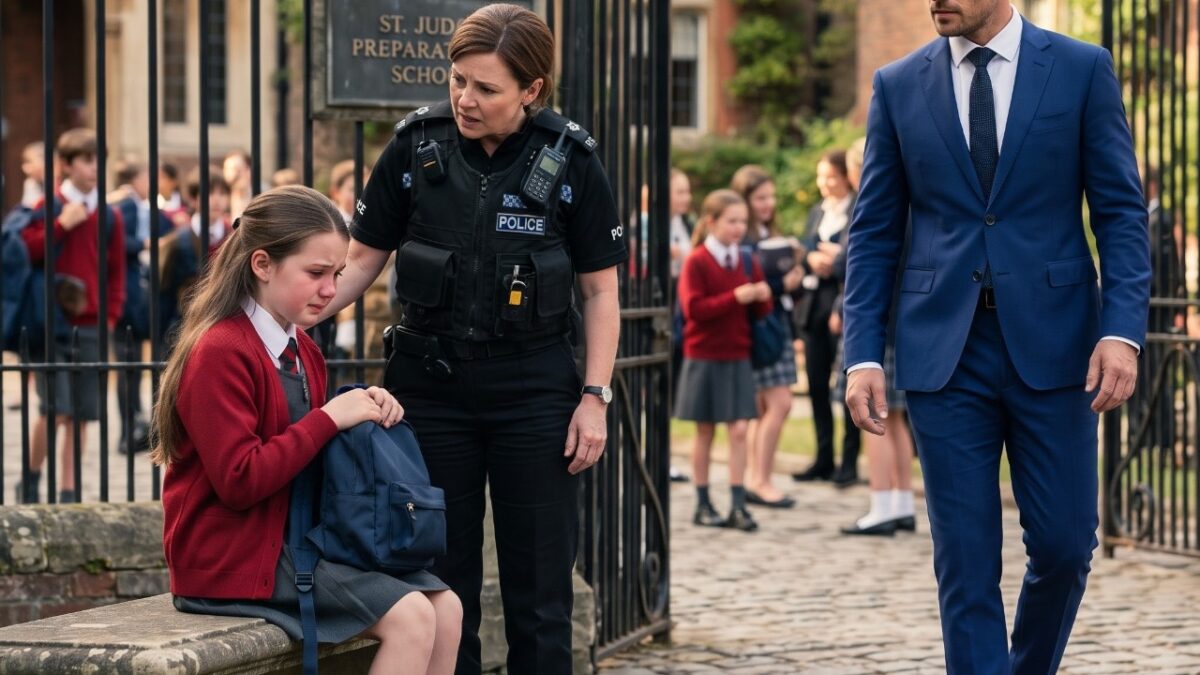
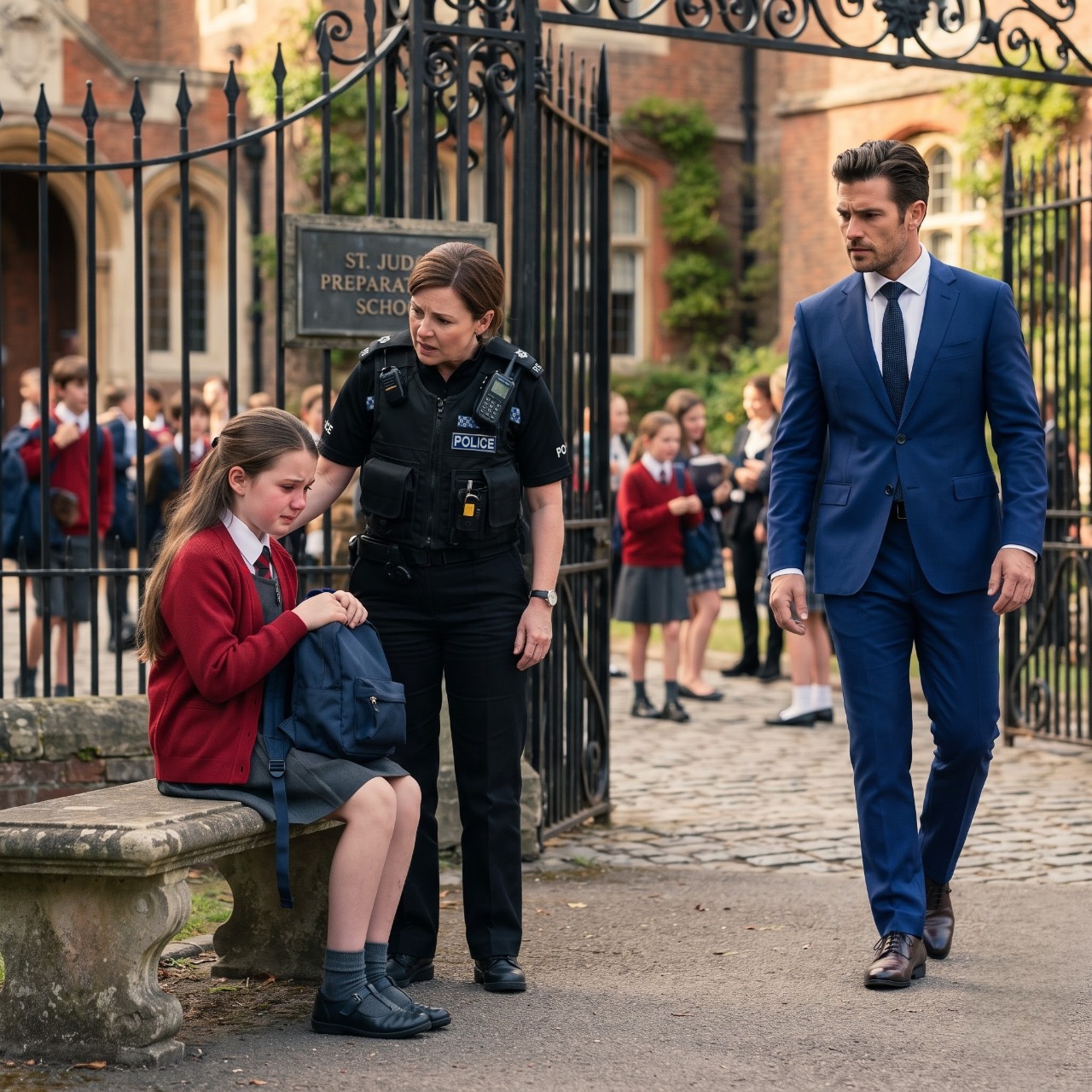
Just outside it, on a stone bench, sat a little girl in a navy jumper washed so many times it had gone pale at the seams. Her sneakers were scuffed gray at the toes.
She held her backpack against her chest with both arms. the way you hold something someone might take.
Her name was Nora Bishop. She was 7 years old. Beside her stood a security guard, 50 or so, reading glasses pushed into graying hair.
Her tag said, “Lhannes.”
Twice she had been told to return to her post by the keypad.
Twice she had said, “I’m at my post.”
And hadn’t moved.
The rule was new this year. Only students with cleared enrollment could pass the gate.
The office had left Norah’s mother a voicemail at 7:20, brought Norah a paper cup of water, and gone back inside.
Children streamed past.
Two mothers glanced over and looked away at the same moment as if they’d agreed on it.
At 8:05, a young woman from the office came out with a zip bag and set it on the bench without meeting anyone’s eyes.
Her things from last spring.
They’re reassigning cubbies.
Inside were crayons, a spare pair of socks, and a laminated card with Nora printed in cheerful purple letters. Old tape still stuck to the back.
She had been so proud of that card.
On the last day of first grade, she’d shown it to her mother.
That’s my spot.
It says me.
Loretta Haynes’s jaw tightened.
There was nothing to say that a 7-year-old should hear. At 8:12, a black sedan eased to the curb. A tall man in a charcoal suit stepped out.
50 silver at the temples with the kind of stillness that made people lower their voices. Jacob Merritt had built one of the largest furniture companies in North Carolina. For 20 years, Lynwood Hall had asked him back to speak on the first day of school.
For 20 years, he had said no.
This year, for reasons he couldn’t fully explain even to himself, he had said yes.
A staff member hurried down the walk and pressed a lanyard into his hand.
Distinguished guest, Mr.Merritt, we’ll take you through the side, sir.
He had taken three steps when he heard a small voice behind him. Miss Loretta.
Norah’s chin was trembling.
They let everyone in except me. Jacob stopped. 43 years earlier, at this same gate, a 7-year-old boy in a borrowed blazer had walked past a little girl crying on a bench.
He had not stopped. He had never turned around.
Now he did.
Loretta stepped between them before he’d taken a step.
Not rudely, just firmly the way a good fence stands. Mister, she said quietly. with respect.
Rich men interfering usually makes it worse for the kid. Jacob met her eyes.
He didn’t argue.
He nodded once like a man who’d been told something true.
Then he knelt.
He went down slowly on the brick, a good arms length from the bench until his eyes were level with Nora’s.
He looked at the pass in his hand a long moment. Then he held it out to Loretta.
Then I won’t be needing this.
The staff member blinked.
“Sir, the assembly starts at 8:30.
Tell them I’m sorry,” he said.
“I’m going to sit out here a while.”
And he did. He lowered himself onto the curb beside the bench on concrete hot enough to feel through the fabric.
He did not reach for Nora. He did not make a speech. He simply sat so that whatever this was, she would not be sitting in it alone.
Loretta studied him. Then she took the pass. The gate buzzed, opened, closed.
After a while, Jacob spoke low and careful.
Who told you you can’t go in?
Nora didn’t answer.
She unzipped the front pocket of her backpack, took out a folded half sheet of pink paper, and handed it to Loretta. Loretta read it.
Her mouth went thin. Then she turned it so he could see.
Across the top in smeared red ink was a stamp. Tuition hold.
Do not admit. Before sunrise that morning, Jacob Merritt had stood alone in his kitchen 31 floors above Uptown. The condo was beautiful.
Pale oak floors, a wall of glass, furniture from his own company, every piece chosen and placed and never moved again.
No clutter, no sound but the refrigerator’s hum.
The dining room held a walnut table built for eight. Seven of the chairs looked brand new.
The one at the end had a faint shine worn into its arm, where one man had rested his hand through years of dinners eaten alone. On his desk lay a letter from Lynwood Hall addressed to the Gate House Fund anonymous donor.
Because of your quiet generosity, children who could never have walked through our gate are thriving inside it. He read it again.
Then, as he did every year, he turned it face down. His mother had cleaned houses in Meyers Park for 30 years.
She’d polished other people’s dining tables until she could see her own tired face in them.
She had raised him on church clothes from the thrift store and one simple rule.
Keep your head down, say thank you, and don’t make trouble.
He had kept that rule all the way up. Somewhere along the climb, silence had stopped being a survival skill and become the whole shape of his life.
At 8:40, on the curb outside the gate, his phone buzzed.
“Tell me you’re about to walk on stage,” said Martin Shaw, his CFO.
“I’m not going to speak.”
“A pause.”
“Jacob, Conrad Prior chairs that school’s board.
You said yes to this for a reason. His team is at our office at 10:00 and it took 8 months to get them there.
Whatever you’re doing, don’t get distracted.
Jacob watched Nora turned the paper cup slowly in her hands.
She hadn’t taken a sip.
Move the meeting, Martin. And if they walk, then they walk. He ended the call.
Loretta didn’t look at him, but she’d heard every word.
I’d like to talk to someone in the office, he said.
Would you stay with her?
Loretta gave him a look that said she hadn’t planned on going anywhere.
The front office was cool and smelled like new carpet. A woman in a cardigan rose from behind the counter with the smile reserved for important visitors.
Mr.Merritt, we were so sorry to hear you won’t be speaking this morning.
There’s a little girl sitting outside your gate, he said.
I’d like to understand why.
The smile held, but it thinned.
“I’m sorry, sir.
Enrollment matters are confidential. We can only discuss a student with a parent or guardian.
That’s the right rule,” Jacob said.
And he meant it.
“So, don’t tell me about her.
Tell me about the policy.”
“This year, only students with cleared enrollment may be on campus.
It’s for the security of all our children.
When an account status is pending resolution, the student is temporarily unable to be accommodated until a parent can.
She’s seven, he said.
It’s 90°.
We’ve contacted the family.
It’s an administrative matter.
Account status pending resolution temporarily unable to be accommodated. Every phrase was smooth and polished like the tables his mother used to clean.
Not one of them had a child in it. Jacob knew what was being offered.
The oldest bargain there is. Nod politely.
Go back to the car. Let the grown-ups handle it and never ask how.
It was his mother’s rule.
Dressed up in a lanyard. For 43 years, he had taken that bargain.
I’d like a meeting with Dr.Bell, he said.
Today.
Dr.Bell’s calendar is very full on the first day, sir.
I understand.
I’ll wait.
He paused.
I’ve had some practice this morning.
She looked at him a long moment, then she typed something. 3:30.
He walked back out into the heat. The gate still buzzed. Parents still hurried past the bench or saw it and decided not to.
He sat on the curb again. He knew something the people in that cool office had never had to learn. The worst part of being poor is not the empty cupboard.
It is standing in plain sight while everyone decides you are not there. Norah glanced at him then quickly away, but she moved her backpack an inch so it no longer covered her face.
Above her, Loretta Haynes slid her reading glasses off.
She studied the side of Jacob’s face for a long moment.
The way a person looks at a photograph turned up in an old box, trying to place it. Something in her expression changed.
She didn’t say a word.
Across the street, a coffee cart had been doing steady business all morning with parents who had somewhere to be. Jacob crossed over and ordered carefully.
Two egg and cheese biscuits, same bread, same wrapping, nothing fancy. Two small orange juices. He did not want to walk back holding something that looked like charity.
He wanted it to look like breakfast.
At the bench, he didn’t hand anything to Nora.
He held the paper bag out to Loretta instead.
In case anybody’s hungry, he said.
Loretta opened the bag, looked inside, then bent a little toward Nora.
“Baby,” the gentleman brought biscuits.
Norah shook her head at once.
She didn’t look at the bag.
She looked at the brick between her sneakers.
“No, sir,” she said, small but firm.
“That’s for kids who earned it.
” The words hung in the heat.
Jacob understood them better than he wanted to. Somewhere, somehow, a seven-year-old had learned that help comes with a price.
That the free lunch has a line of its own, and everyone can see who’s standing in it.
That a child can go hungry and still keep her head up.
But once she’s the poor kid, she’s the poor kid all year.
She had decided at seven that her pride was worth more than a biscuit.
He didn’t argue.
He didn’t say any of the kind things grown-ups say that make a child feel smaller.
He sat back down on the curb, took one biscuit out of the bag, unwrapped it, and ate it slowly.
The way anybody eats breakfast when they’re waiting on something.
When he was done, he set the second biscuit and one orange juice on the bench beside Loretta, not beside Nora. Loretta glanced at the food, then at Nora.
Your choice, baby, she said.
Norah didn’t touch it, but she didn’t push it away either.
At 9:40, a dented silver Corolla swung into the drop off lane and stopped crooked. A woman climbed out before the engine had fully settled.
Thin, dark hair twisted into a clip, pale blue scrubs with a dental clinic’s logo over the pocket.
Nora. Nora was off the bench before her name was finished.
Tessa Bishop didn’t grab her daughter.
She crouched and looked face first. Then her eyes, her cheeks, the set of her shoulders.
Then Norah’s hands turned over gently, palms up, as if checking for something that wouldn’t show on the outside.
Jacob watched that and felt a quiet respect settle in him. This was not a careless mother.
This was a mother who knew exactly where damage hides. My phone was in my locker, Tessa said to Loretta, her voice tight.
We’re not allowed to have them on the floor.
I got the voicemail on my break. She pressed her lips together.
I’m so sorry, Loretta.
You don’t owe me sorry, Loretta said.
Somebody owes you one. Only then did Tessa notice the man on the curb in the ruined suit pants, her face closed like a door.
Who’s this?
He sat with her. Loretta said simply.
Tessa looked at Jacob for a long second. There was no gratitude in it yet. Only the caution of a woman who had learned that strangers who help usually want something.
Thank you, she said.
We’re fine from here.
Jacob stood and stepped back.
Yes, ma’am.
It was more than manners. It was how you answer someone who has earned the right to decide.
Norah tugged her mother’s scrub top and nodded toward the bench.
He brought biscuits.
I didn’t take one.
Tessa looked at the biscuit, then at Jacob, then at her daughter’s face.
Something passed between mother and child that no one else was meant to read. Tessa nodded once.
Norah picked up the biscuit and ate it in quick, careful bites, like a child who hadn’t had breakfast.
Tessa turned to Loretta and lowered her voice. I called them twice. They said it was under review.
They told me to bring her today and we’d sort it out.
She dug into her bag and pulled out a folded envelope worn soft at the corners. Then this.
She unfolded the letter. Jacob was two steps away.
He didn’t have to try to read it.
It’s dated August 1st.
Tessa said.
It says we failed to pay our share, but our share wasn’t due until the 15th.
Her voice cracked for the first time.
How can I be late on a payment that wasn’t even due yet?
At the top of the page, above a signature was a small printed crest, a gate drawn in simple lines, and beneath it, three words, the Gate House Fund. Jacob went very still. He knew that name.
He had written it himself. Jacob could have ended it with one phone call. By lunch, Norah would be inside and everyone would be very sorry, and it would be the same sickness wearing a nicer suit.
A powerful man deciding which child gets through the gate because of who he knows.
So, he didn’t make the call.
He turned to Tessa instead.
Ma’am, I have a meeting with Dr.Bell at 3:30.
That letter shouldn’t exist.
If you’re going in to ask why, I’d like to be in the room.
Only if you want me there. Tessa studied him.
Why?
Because I’ve stood outside that gate before, he said a long time ago.
It wasn’t the whole truth, but it was true.
Loretta spoke without looking up. He gave up the stage for her.
Tess. Tessa called the clinic. Family emergency.
They would dock her the afternoon.
She said, “Yes, I understand.”
and and hung up without complaint.
“You don’t speak for us,” she told Jacob.
“You sit, you listen.”
“Yes, ma’am.
” Inside, a parent could go where a stranger couldn’t.
Tessa asked for the school counselor. Ms.Elena Vasquez, in her 40s, came down the hall and looked at Nora before she looked at anyone else. In the small glass conference room, Ms.Vasquez slid a form across the table.
“Mishop, if you want me to speak openly with Mr.merit present.
I need your written permission, otherwise I can’t say a word.”
Tessa read every line before she signed.”
Jacob noticed that, too. Norah sat just outside the glass where her mother could see her coloring on the back of a flyer with crayons from her zip bag.
Ms.Vasquez didn’t soften it.
Norah’s lunch account had gone negative last spring.
$11.
The school’s policy was an alternate meal for students with a balance, a cheese sandwich on a different colored tray served from a different line.
Norah stopped going to the cafeteria. For the last 6 weeks of first grade, she ate lunch alone in the library behind the tall shelf with the atlases.
Tessa closed her eyes. She never told me.
She didn’t want to worry you, Ms.Vasquez said gently.
She told me that there was more. Stomach aches most mornings.
A way of going very still when an adult raised their voice even across the room.
Twice she had asked her teacher if she was in trouble when she wasn’t.
Kids don’t have words for pressure.
Ms.Vasquez said they have bellies and shoulders.
Tessa’s hand trembled on the table.
Jacob kept his eyes on the paperwork.
Some moments aren’t yours to watch.
The door opened a crack. Norah stood there with the flyer.
“Mommy, is my cubby going to have a new name on it, like Theo’s?”
The room went quiet.
“Who’s Theo, baby?”
Tessa asked.
“He was in my class.
” “On the first day of school last year, his cubby had somebody else’s name.
Nobody said where he went.”
She looked at the three adults.
“Is that what happens?”
Tessa knelt and held her daughter’s face in both hands.
Nobody’s taking your name off anything.
Go finish your picture.
I’m right here.
When the door closed, Ms.Vasquez chose her words carefully.
I can’t discuss other students.
That’s the law, and it’s a good law.
She paused.
But I can tell you I’ve kept notes for 4 years, and I’ve written down three first days that looked a lot like this one.
Three children, three scholarship families, three empty cubbies. Jacob leaned forward for the first time.
Would you put what you’ve seen about Nora in writing?
Dates, times, the lunch account, the gate this morning. Facts only. I was going to anyway, Miss Vasquez said.
And a formal request for a meeting, Tessa added from me in writing. Paper, not drama.
Jacob had built a company that way.
He’d never imagined using it for this.
At noon, mothers drifted out of the welcome back coffee. Someone recognized him.
Isn’t that Jacob Merritt?
He skipped the convocation.
For her, he’s buying special treatment.
That’s what that is.
Tessa heard it. Her shoulders rose an inch.
Jacob didn’t turn toward the voices.
He stayed in his chair beside the glass where a seven-year-old could see him still there when she looked up from her picture. Being liked had never been the point. Being right was.
At 3:25, the receptionist came to the doorway. Dr.Bell is ready for you.
He’s asked Mrs.Kingsley to join as chair of the scholarship committee.
Tessa unfolded her letter and looked at the signature. V. Kingsley.
Before they went in, Tessa crouched by the bench. Sit with Miss Loretta a few minutes. Okay.
Norah nodded. Loretta was already making room.
Dr.Gordon Bell’s office had a wall of framed groundbreings.
He was 64, two years from retirement with kind eyes that didn’t quite stay on anyone.
On an easel by his desk stood an architect’s rendering, a glass and brick wing, and above the doors in elegant letters, the prior center.
Mrs.Vivien Kingsley was already seated. white linen, pearls, a tablet on her knee. She offered Jacob a warm smile and Tessa a nod.
Mr.Merritt, what an unexpected pleasure. Tessa laid the letter on the desk.
This is dated August 1st. Our share was due the 15th.
I’d like to know how we were late.
Dr.Bell cleared his throat. Ms.Bishop, the policy.
The committee has discretion, Viven said smoothly. Scholarship seats are limited.
Commitment isn’t only a payment date.
It’s reliability.
Your daughter missed 11 days last year. She had stomach aches, Tessa said. Every morning.
I’m sure she did.
Jacob said nothing. He had promised. But he watched.
He watched Dr.Bell’s eyes drift again and again to the rendering on the easel, and slowly the shape of it came clear.
Dr.Bell wasn’t a cruel man.
He was a frightened one. That wing needed money, and money came from people who expected things in return.
Policy was the wall he stood behind so he’d never have to say what he knew.
Viven was something else. She chaired the scholarship committee and the building campaign, and she understood exactly what one seat was worth.
A family stood ready to pledge $2 million toward the new wing, provided their son had a place this fall. Conrad Prior, chairman of the board, wanted his name above those doors badly enough not to ask questions.
The seat they needed was Norah’s, and Tessa, in her clinic scrubs, was exactly the kind of parent Vivien believed a place like Lynwood Hall could lose without anyone noticing.
At 3:45, Viven stood. Let me walk you out. She led them through the front doors and onto the wide brick steps.
Pickup had begun. Parents stood in clusters under the magnolia, heads turned. Viven stopped where everyone could see, and when she spoke, her voice was pleasant and pitched to carry.
Ms.Bishop, I’ll be frank because I care about children.
This morning, a seven-year-old sat at our gate for over two hours with no parent in sight. She let that settle. Some people would call that a safety concern.
Some people might feel obligated to report it. Tessa went pale. Across the lawn, a mother lowered her phone.
It was masterful. No shouting, no insults, just shame. Placed carefully in public.
Left to do the work.
Tessa’s hands were shaking.
She looked at Jacob just once.
It wasn’t a plea.
It was permission. He stepped forward.
When he spoke, his voice was quieter than Viven’s.
Somehow it carried farther. Your office left her there, Mrs.Kingsley. Your gate.
Your rule. Her mother was at work where she was supposed to be.
Viven’s smile didn’t move.
Rules exist for a reason, Mr.Merritt.
We can’t make exceptions every time someone’s feelings are hurt.
It would set a precedent. Jacob held her gaze.
“A 7-year-old is not a precedent,” he said.
“She’s a person.
The steps went silent.”
Vivien tilted her head almost fondly.
“Then prove it,” she said.
“The official way.”
She went back inside. The door hissed shut behind her.
20 minutes later, Tessa’s Corolla idled at a red light on Providence Road.
Jacob had sent his driver back hours ago.
She’d offered him a ride up town without quite looking at him.
In the back seat, Norah had fallen asleep against the window, the zip bag in her lap, one hand still resting on her name tag. For a long time, neither adult spoke.
“Why do you care?”
Tessa asked finally.
“Really?”
Jacob watched the heat shimmer off the road. When I was seven, I walked through that same gate on my first day.
He said there was a girl on that bench crying. I walked right past her.
He paused. I never turned around. Tessa glanced at him.
He didn’t explain further.
She didn’t ask.
The light turned green.
She said, “Prove it the official way.”
Tessa said quietly, “Then that’s what we’ll do.
” Neither of them knew that Vivien Kingsley had already picked up her phone.
That night, Jacob sat at the end of his walnut table with a checkbook open in front of him. $1,200.
That was all Tessa was behind. Her clinic had switched payroll systems in July, and two paychecks had come late. He could cover it before breakfast.
He closed the checkbook. Tessa would never accept it. And even if she did, Viven would have exactly what she wanted, proof that a rich man had bought a child her seat.
He needed a different kind of help, the kind that left a person standing on her own feet.
On Tuesday, they met in a converted bungalow off Bey’s Ford Road, where a handpainted sign read, “Legal aid, Walkkins, welcome.
” Nora colored in the waiting room with the receptionist visible through the open door.
Renee Whitfield was 60 with reading glasses on a beaded chain and 30 years of tenant cases and school appeals behind her. She read the letter twice, then opened the Lynwood Hall family handbook to page 14.
Scholarship families get 60 days grace after a payment is due, she said in writing.
Your own school’s rules, she tapped the page.
Your payment wasn’t due until August 15th.
that gave you until the middle of October and they sent you a letter saying you’d failed to pay on August 1st.
Tessa stared at the paragraph as if it might vanish.
And there’s more, Renee continued.
Under this same policy, a student must be allowed to attend classes while an appeal is pending. Norah should never have been kept outside that gate.
We’re filing the appeal today and she’ll be back in class tomorrow.
Tessa worked out a payment plan of her own, $200 every payday until the balance was cleared. Renee agreed to submit it with the appeal.
Tessa wrote down every figure herself, then folded the page and placed it beside the school’s handbook.
In the parking lot afterward, under a live oak thick with cicas, Jacob said it anyway. Let me cover the 1200. Nobody would ever know.
I would. Tessa unlocked her car and someday so would she. She turned to face him and her voice was steady.
I don’t need saving Mr.Merritt.
I need a fair shot. Jacob nodded slowly.
That’s exactly what I’m trying to give you.
For the first time, she almost smiled. On Wednesday morning, Loretta buzzed Nora through the gate. Nora walked in with her backpack straight on both shoulders.
Her cubby had a temporary sticky note with her name and marker.
She didn’t put the laminated card back up.
Not till it’s for real, she told her mother.
Ms.Vasquez delivered her written statement that afternoon. four pages, dates, times, the lunch account, the library shelf with the atlases, and a final paragraph noting three prior first day removals of scholarship students, circumstances consistent with this case. Then, Loretta did something no one had asked her to do.
She brought a copy of a page from her guard’s log book, the one she’d kept in her own neat handwriting for 20 years.
7:14 a.m.Bishop, age 7, held at gate per office. 7:20 a.m.Office states parent contacted by voicemail only.
9:40 a.m.Mother arrives on Thursday. The other side answered.
A letter from the school’s outside council reached Tessa at the clinic.
polite, carefully worded.
It noted the minor child’s extended unsupervised presence at the gate and warned that the school may be obligated to refer the matter to the appropriate authorities.
Tessa read it in her car on her lunch break, her hands cold despite the heat.
Jacob didn’t panic when she called.
He drove to Rene’s office, took a yellow legal pad, and started writing a timeline down the left margin.
Every call, every minute, every document. Who had the child and when and why?
Systems don’t fear anger, Renee said, watching him work.
They fear paper. On Friday evening, the timeline was finished.
Tessa sat across from him.
Norah asleep on the waiting room couch under Rene’s cardigan.
“That girl at the gate,” Tessa said.
“Do you know what happened to her?”
Jacob kept his eyes on the legal pad. No, Tessa watched him a long moment.
You’re good at helping people, she said quietly.
But you don’t let anyone see you.
He didn’t answer.
She was right, and they both knew it. At dusk, Jacob drove to Lynwood Hall to thank Loretta in person.
The campus was empty. Cicas droned in the Magnolia.
Loretta was pulling the iron gate shut for the night. The latch clanked into place.
She turned the key, then she didn’t move.
When she finally faced him, her eyes were steady, and something 43 years old was sitting in them.
“You were the merit boy,” she said.
“I was the girl outside.
For a long moment, the only sound was the cicas.”
“I knew you the first morning,” Loretta said.
“Grown man in a good suit.
But you still walk like you’re apologizing for taking up room.
You did that at 7, too?
Jacob’s voice came out rough.
You were on the bench. I was on the bench. She leaned against the iron bars.
I’d been accepted.
Letter and all. My daddy drove a bread truck and he wore his church tie to bring me.
We got to the gate and a lady from the office said there had been a change. My seat had gone to another scholarship child. Somebody important had made a phone call for him.
Jacob closed his eyes.
His mother had cleaned for a family on Queen’s Road.
She’d told him years later that the lady of the house had put in a word.
He had never let himself ask what that word had cost.
I didn’t know, he said.
Not then. I should have found out.
I should have turned around. You were seven.
Loretta’s voice was even.
Grown-ups closed that gate, not you. She let that stand, then more quietly.
But you’re not seven anymore.
He had carried it for 43 years, and she had just set it down in front of him like a bag he’d been holding for someone else.
Why work here? He asked. Of all places.
So nobody sits on that bench alone, she said. Not on my watch.
She picked up her lunch cooler and walked to her car.
She didn’t wait for thanks.
The cost came Monday.
Martin Shaw stood in Jacob’s office doorway with his tablet held like evidence.
Prior walked. 8 months of work.
He says he can’t do business with a man who’s waging war on his school.
He shook his head. You just lost the deal of the decade for a kid you met last week. Jacob looked out at the skyline.
I know what I lost, Martin. By Wednesday, Vivien had found her words.
They moved through the parent group chats, soft and poisonous.
Why is a rich stranger this invested in a family he doesn’t know?
Nobody accused him of anything. They only wondered out loud often.
She couldn’t fight the facts, so she went after his motives.
On Thursday, the school made Tessa an offer. It came through their council, typed on heavy paper.
Nora would be fully reinstated, scholarship restored. In exchange, Tessa would withdraw her complaint and sign a confidentiality agreement.
It was everything she’d asked for, for one child.
Nothing in those pages would bring Theo back, and nothing would make the school answer for the two children who had lost their places before him. Tessa read it standing at her kitchen counter, then set it face down.
“No,” she told Renee on the phone.
If I sign this, I’m teaching my daughter that dignity comes with a gag order.
I won’t do it.
Jacob across the table didn’t say anything, but he looked at her in a way he hadn’t looked at anyone in a very long time.
Not with pity, with admiration. That same afternoon, the board of trustees called a special session for the last Tuesday in September.
Late that night, the paperwork covered Tessa’s small kitchen table like weather.
The window unit rattled. Norah had been asleep for 2 hours down the short hall.
Jacob told her about the bread truck, the church tie, the phone call, all of it.
He didn’t dress it up.
Tessa listened without interrupting.
When he finished, she didn’t say, “It’s okay.”
She simply refilled his coffee, and he understood she had seen him now all the way through and hadn’t looked away.
Renee sent our timeline to their lawyers today, she said before they could send anything anywhere. Her log book, the voicemail, all of it and and nothing. Their letter was all they had.
She let out a long breath.
Nobody’s calling anybody.
She squared the stack of papers with both hands.
If this gets ugly, she said, I won’t let my daughter think it’s her fault.
Jacob met her eyes.
“Then we tell the truth,” he said quietly.
“It has nowhere left to hide.”
“A floorboard creaked.
Norah stood in the kitchen doorway in pajamas printed with little yellow stars.
She’d been awake longer than either of them knew.
Tessa was out of her chair at once and kneeling beside her, but Nora wasn’t looking at her mother.
She was looking at the papers on the table, at the words she was just old enough to read. report. Authorities removal.
Her voice was very small.
Are they going to take me away from mommy because she couldn’t pay?
She swallowed and looked at the papers again. Is that why Theo disappeared from school? Tessa answered first.
She knelled, took Norah’s hands, and said, “No, baby.
Never.”
Then she looked up at Jacob and nodded. He crouched at a respectful distance. Nobody takes a child away over money, he said.
Not you. Not ever. Norah studied his face the way her mother always studied hers.
Then she let her mother carry her back to bed. Over the following weeks, Tessa and Renee gathered every document they could find. Norah continued attending classes while her appeal remained open.
Jacob stayed close enough to help when he was needed, but the decisions remained Tessa’s.
By the last Tuesday in September, the school could no longer dismiss what had happened as a simple misunderstanding. The trustees met on the last Tuesday in September in the library conference room. Fluorescent lights, wooden chairs, a water picture nobody touched, no music swelled.
There were only lives on paper and people holding their breath. Nora was not there.
She was in her second grade classroom down the hall where she belonged. Ms.Vasquez went first. Four years of notes, three first days, three empty cubbies.
Renee walked the board through page 14 of their own handbook, then the gate log, then the risk of holding a seven-year-old outside for 2 hours. She never raised her voice.
She didn’t need to.
Then Loretta stood in her uniform and told them about a bread truck, a church tie, and a bench. The room was very quiet when she sat down. Tessa went last.
She unfolded a sheet of lined paper written in careful pencil.
“My daughter asked me to read this,” she said.
She wrote it herself.
“I told mommy not to miss work because when grown-ups get mad about money, kids disappear.”
“Nobody spoke.”
A light buzzed overhead. Then Dr.Gordon Bell rose. His hands were not steady.
He set a thick folder on the table. The unedited committee file, he said, including the correspondence that was never shared with the bishop family. He opened the folder and read an email aloud.
It was from Viven Kingsley, dated July 29th, released the bishop’s slot before the first day.
He turned to the next page. Attached to the email was a revised enrollment list.
Norah’s name had been removed.
In her place was the son of a family that had pledged $2 million toward the new wing on the condition that he receive a seat that fall. Dr.Bell laid both pages on the table.
The decision was made before Mrs.Bishop’s payment was even due.
He said, “We used the tuition policy to justify something we’d already decided to do.
” Viven’s face went still.
I told myself it was policy, Dr.Bell continued.
It wasn’t.
I feared our donors more than I protected our children. He looked at Tessa.
I’m sorry.
Conrad Prior cleared his throat.
Whatever the committee’s missteps, this board has obligations to the donors who fund these scholarships.
Jacob stood. Then let me speak as one, he said.
15 years ago, I started the Gate House Fund. I never put my name on it. He took a single page from his jacket.
I’m not taking the gift back.
I’m asking you to keep the promise it was made with.
He read the first clause, the one he had written for a girl on a bench. No scholar shall ever be turned away at the gate.
Across the table, Loretta lowered her eyes. She was smiling.
The board voted that afternoon. Vivien Kingsley was suspended from both committees pending an internal investigation. The trustees ordered a full review of the scholarship program and voted to end the practice of keeping children outside the gate over unpaid balances.
Within the week, Conrad Prior resigned as chairman. The review uncovered the names of three children who had lost their places under similar circumstances.
Letters went out to their families, Theo among them, acknowledging what had happened and offering their children a way back. For the first time in years, the gate would no longer be used to settle a question of money.
Before he retired, Dr.Bell asked to see Tessa and Nora. He apologized to them in person.
Norah shook his hand like a grown-up. Months passed. Tessa paid off her balance $200 at a time and took on more hours at the clinic.
Nobody handed her anything she didn’t earn.
Jacob kept showing up. School pickups, spelling words at the kitchen table. Saturday mornings at the park.
No grand gifts. Just there on time again and again.
Tessa didn’t fall for his money.
She fell for his reliability.
And Jacob didn’t fall for her need.
He fell for her spine, for the way she had refused to trade her daughter’s dignity for comfort.
They were married the next spring in a small chapel off Providence Road. Loretta sat in the front row in a lavender dress.
Norah carried the rings in both hands. That summer, the walnut table built for eight finally had people at it. On the first morning of the new school year, the heat settled over Meyers Park like an old quilt.
Loretta stood at the keypad. When she saw the three of them coming up the brick walk, she pressed the button before they reached it. The gate buzzed open.
Just past it, Jacob stopped. For more than 40 years, he had never looked back.
Now he turned around and looked at the stone bench. It was empty.
Inside, Nora walked straight to her new cubby. She took the laminated card from her backpack. Nora in cheerful purple letters and pressed it into place with fresh tape.
“Now it’s for real,” she said.
This time he had turned around and there was no one left outside.
And that’s where this inspiring story gently ends.
Even though all characters and events are fictional, this story was created for entertainment to inspire hope, compassion, and the kind of quiet strength that restores faith in humanity. Thank you for spending this moment with me.
I’m Flint, wishing you warmth, clarity, and the courage to look back and forward with an open heart.
THE END.

