“What Rank Are You, Asshole?” a SEAL Mocked Single Dad—Then 4 Generals Saluted Him (Part 2)
“What Rank Are You, Asshole?” a SEAL Mocked Single Dad—Then 4 Generals Saluted Him (Part 2)
PART 2
By 11:00, the records hold was fully in place, and Vance’s administrative officer had called the commission’s Washington office three times. The calls were logged. The commission did not return them. That was by design. At 11:47 a.m., Daniel received a text from Margaret Chen. “Convoy departs Andrews. Tomorrow night. Arrives your location 0700 Friday. Confirmed. Four principles. Records team follows separately.” Four principles. He put his phone away.
At 12:30 p.m., Captain Vance appeared in the doorway of the planning bay with his XO behind him and the expression of a man who has decided that aggressive forward motion is still his best option. “Mr. Cross,” Vance said. “I think we should have a conversation.” “Of course,” Daniel said. He closed the folder in front of him and folded his hands on the table. Vance came in and sat across from him without invitation, which told Daniel something. The XO hovered near the door, which told him something else.
“I want to understand the scope of what’s being reviewed,” Vance said. “As commanding officer of this installation, I believe I’m entitled to—” “Captain,” Daniel said. His voice was not unkind, but it was precisely clear. “The commission’s authority under the Joint Oversight Charter supersedes local command review. You’ve received the relevant documentation. What specifically would you like to clarify?”
Vance’s composure held. But it held the way ice holds in late March. By habit rather than structural integrity. “I want to know what allegations are being investigated.” “The commission doesn’t characterize its inquiry as allegation-based at this stage,” Daniel said. “We’re conducting a readiness and safety review. The scope is defined in the charter documents you received.” “The helicopter crash,” Vance said flatly. “Is one element,” Daniel said. “The report on that crash was completed by qualified investigators and signed off through the appropriate chain.” “Yes,” Daniel said. “It was.”
The flatness of that confirmation sat between them for a moment. Vance understood it. His jaw moved. “I have an excellent readiness record,” he said. “This command has consistently exceeded performance benchmarks across every—” “Captain.” Daniel leaned forward slightly. Not threateningly. Just closing the distance enough to make the conversation real. “I’ve read your readiness reports. They’re impressive. I’m sure they looked excellent from Washington.” He paused. “I’ve also read Senior Chief Murdoch’s personal log and Chief Hartman’s formal statement, which he gave this morning. And I’ve reviewed seven months of maintenance documentation that suggests the relationship between your readiness numbers and actual equipment condition has been… creative.”
The word landed exactly as he’d intended it to. Vance’s face did something complicated. “I’d recommend,” Daniel said, still level, still without cruelty, “that you speak with your legal representative before Friday. That’s not a threat. It’s practical advice.” “Are you telling me to lawyer up?” Vance said. “I’m telling you that the review convenes Friday morning at 0800, that four commission principles will be present, and that your cooperation at that stage will be noted in the findings.” He held Vance’s gaze. “As will its absence.”
Vance stood. He straightened his jacket. He looked at Daniel with the expression of a man who had been very powerful in a very specific world for a very long time and who was beginning to understand that the walls of that world did not extend as far as he had believed. “We’ll see what Friday looks like,” Vance said. “Yes,” Daniel agreed. “We will.” Vance left. The XO followed without making eye contact.
Daniel sat alone in the bay again. He looked at the folder in front of him. He thought about the two servicemen who had gone down in that helicopter three months ago. He thought about one of them in particular. A man named Specialist Carlos Reyes, whose wife had been told by an official representative that the accident had been caused by unexpected component fatigue. A finding consistent with the operational age of the aircraft. And that the command deeply regretted the incident. Reyes had two kids. His wife’s name was Angela. She had called the investigators twice, asking follow-up questions, and been told both times that the case was closed.
Daniel thought about Angela Reyes reading a form letter that had been designed to be technically true and emotionally sufficient and systematically false. And he felt something move through him that was not anger and was not grief, but was close to both. The particular feeling of a man who understands what accountability is actually for. Not punishment. Not institutional self-protection. Not the satisfaction of seeing the guilty face consequences. Those things mattered. But they weren’t the point. The point was that Angela Reyes deserved the truth. The point was that the two men who had been injured deserved the truth. The point was that the next group of sailors who strapped into equipment at this base deserved the truth. The real truth. Not the version that fit the readiness report.
That was why he was here. That was what the flash drive was for. That was what Murdoch’s log and Hartman’s statement and Bennett’s seven months of copied documents were for. Not to destroy Vance. Not to humiliate Ror. Not to collect scalps. To make it so that the next thing that broke broke in a room where someone was required to say so out loud. He went back to his notes.
At 3:15 p.m., his phone rang. Not Mia. Not Chen. A number he recognized as belonging to a man named General Arthur Whitfield, one of the four commission principles. Calling from a number that was not his official line, which meant this was a personal call and not a formal one. Daniel answered. “General.” “You’re on schedule,” Whitfield said. “Vance’s people have been making some calls. There’s some pressure coming from his Hill contacts.” “I expected that.” “It won’t affect the review,” Whitfield said. “I want you to hear that from me directly.” “I know.”
A pause. “How’s it look?” Daniel thought about Murdoch’s folded paper. Hartman’s statement. Bennett’s flash drive. The inspection board with forty-three green tags. The conversation he’d had with Ror that morning. The way Ror had said, “My team respects you.” The way Mia had said he decides what matters most and then shows up for it. “It looks like a system that forgot what it was for,” Daniel said. “And some people who remembered.”
Whitfield was quiet for a moment. “See you Friday,” he said. “Yes, sir,” Daniel said. He ended the call. He sat with the silence for a beat. Then he looked at his watch. 3:22 p.m. Forty hours and thirty-eight minutes until 0800 Friday. He picked up his pen, opened his notebook, and kept working. Because the story he had spent three days building out of maintenance logs and personal courage and quiet conversations in maintenance bays and documentation rooms had to be told correctly. Completely. Irrefutably. Not as an accusation, but as a record. Not as a weapon, but as a mirror. And because two families in North Carolina were waiting for someone to tell them the truth, he was going to give it to them. Every word of it.
Outside, the base went on with its afternoon exercises. Running aircraft. Moving personnel. Rotating through their cycles. Most of them had no idea what was coming on Friday morning. Most of them were doing their jobs well, in the way that most people in any institution do their jobs. With competence and commitment and the reasonable expectation that the system they were part of was fundamentally sound. Some of them, though, were moving differently today than they had on Monday. A little more carefully. A little more honestly. As if something had shifted underneath the normal weight of things, and they could feel it, even if they couldn’t name it.
In training area four, the damaged harness had been pulled from service. A yellow tag had replaced the green one on the inspection board. And Noah Bennett, signing off on an equipment log at the end of his shift, wrote down exactly what he saw. Exactly as it was. And signed his name under it without hesitation. That was new. That was what the next forty hours were about.
Thursday night came in cold off the coast, and Daniel Cross sat at the kitchen table in the house outside Wilmington and did not sleep. It wasn’t anxiety. That was the thing people misunderstood about men who had operated in these environments. The stillness they carried wasn’t the absence of feeling. It was the presence of discipline. The ability to acknowledge every variable, every risk, every possible failure point—and then set all of it aside and focus on the one thing that needed doing next. He had learned that quality over years in places he would never describe to anyone at this table. In circumstances that had required him to be the calmest person in a room where other people were dying. He had never lost that quality. He suspected he never would.
What he was sitting at that kitchen table at 11:47 p.m. with his notebook open and his second cup of coffee cooling beside it was ready. The commission opened in eight hours and thirteen minutes. He reviewed his materials one final time. Not because he needed to. The shape of the investigation was clear in his mind, sequenced and sourced and documented at every critical juncture. He reviewed them because thoroughness was respect. Because the two men who had gone down in that helicopter, and the families who had been handed a careful lie, deserved someone who had checked his work twice.
He closed the notebook at 12:20 a.m. He washed his cup. He went to check on Mia. She was asleep on her side with one arm over the edge of the mattress, her hand curled loosely in the way she’d slept since she was a baby. Her nightlight threw a soft amber light across the room. Daniel stood in the doorway for a moment. Long enough to let the image settle somewhere permanent in him. The way certain things do when you know that tomorrow will require everything you have. He said good night quietly, even though she couldn’t hear it. Then he went to bed.
He was up at 5:30 a.m. He made breakfast. Eggs and toast. Nothing remarkable. The same breakfast he made every Thursday, because Mia had decided at some point in the last year that eggs on Thursdays were tradition, and he had not argued with her. She came down at 6:15 in her school clothes with her hair not quite done and a question already forming on her face. “Are you nervous?” she asked. He slid eggs onto her plate. “No.” She considered this with the same evaluating expression her mother had used. “You made the eggs first instead of the toast first,” she said. “You always do the toast first.” He looked at the plate. She was correct. “A little,” he admitted.
She picked up her fork. “It’ll be okay,” she said, with the absolute, unqualified certainty of someone who has never had a reason to doubt her father. “You always do the right thing.” The simplicity of it hit him somewhere behind the sternum. He sat across from her and ate his breakfast. He drove her to school at 7:40 a.m. She got out, took her backpack, turned back to the window. “Tell me tonight,” she said. He said he would. She walked into the building without looking back, which was new, which meant she was growing up, which was the best and hardest thing he knew.
He drove to the base. It was 7:12 when he cleared the gate. The guard processed him faster than Monday. Not because protocol had loosened, but because the record that had come back confusing and full of restricted fields on Monday had now been annotated by the commission’s Washington office, and whatever annotation it carried changed the tempo of the transaction entirely. The young petty officer at the desk handled it with practiced professionalism and said, “Good morning,” with the specific quality of someone who has been briefed that this morning is not a standard morning.
The base knew something was happening. Not the details, but the texture of a place changes when something significant is approaching, and everyone who worked there daily could feel the change, even if they couldn’t name it. Conversations were shorter. People were at their stations earlier. The administrative wing had lights on that were normally dark until 0800. Daniel walked through it all and noted everything with his peripheral attention while his primary focus stayed on what came next. He had forty-eight minutes before the commission convened. He used them carefully.
At 7:18, he stopped at the operations bay and confirmed that Bennett and Murdoch had both received formal notification of their interview times. Bennett at 0930. Murdoch at 1100. Both had acknowledged. Daniel had arranged for a commission counsel to be present for both—partly for legal completeness, and partly because both men deserved someone in that room whose job was explicitly to protect them. At 7:31, he confirmed with Margaret Chen by text that the four principles had arrived at the regional airfield at 0643 and were twenty minutes out by convoy. She added, without his asking: “Vance’s Hill contact called the under secretary’s office last night. Was told to stand down. Vance knows. He’s going to be difficult this morning.”
Daniel texted back: “Noted.” At 7:44, Blake Ror found him in the corridor outside the main operations center. Ror was in full uniform, which was standard for a Friday on base, but the uniform sat differently on him this morning. The same clothes. The same rank insignia. But worn with less performance in them than Daniel had seen all week. He looked like a man who had decided to stop using the uniform as armor and was now just wearing it as a uniform.
“I pulled the full rope system,” Ror said without preamble. “Not just the harness. The whole rig. Had it sent to independent maintenance for assessment.” Daniel looked at him. “When?” “Yesterday afternoon. After we talked.” He paused. “They found two additional stress points on the primary attachment system that weren’t in any inspection log. Neither of them would have survived a week of active training load.” The weight of that sat in the air between them. “You documented it?” Daniel asked. “Filed the full stand-down report at 1700. Sent copies to the maintenance chief, the training coordinator, and the commission’s records hold address that was in the briefing.” He met Daniel’s eyes. “I figured if I was going to start doing this right, I should start before anyone told me to.”
Daniel was quiet for a moment. Not from lack of response, but from the decision about which response to offer. “That took integrity,” he said finally. Ror’s jaw shifted. “It took being ashamed of myself,” he said. “Which is apparently what I needed.” Before Daniel could answer, the sound of engines came from the front of the building. Multiple vehicles. The particular weight of a convoy arriving with the specific, unhurried authority of people who don’t need to announce themselves. Both men turned toward the sound without thinking. The four principles had arrived.
At 8:01, Daniel was standing in the main operations hangar—a large, high-ceilinged space that was used for briefings and equipment staging, and on this morning, the formal convening of the Joint Special Operations Readiness Commission review. Tables had been arranged in a U-shape. Commission personnel were setting up documentation stations. The two junior analysts who had been seconded to the review were organizing the physical evidence packages. Murdoch’s log. Hartman’s statement. The printed summary of Bennett’s flash drive contents. The maintenance inspection photographs. The chain-of-decision documentation that traced every flagged safety report from its origin to its disappearance.
Captain Richard Vance entered the hangar at 8:03. He was in his best uniform. Every decoration properly placed. Every crease exact. The command bearing of twenty-two years of service worn like a second skin. He walked to the position that had been designated for command personnel and stood there with the composure of a man who had decided that his best option was to project absolute confidence and dare the room to contradict it. Daniel watched him from across the hangar. Vance was not a coward. That was important to understand. He was a man who had made a series of decisions that prioritized institutional metrics over human safety, and had convinced himself that those decisions were reasonable, pragmatic, even necessary. And had then compounded them by burying the evidence rather than facing the consequences. That was a different thing from cowardice. It was a kind of moral arithmetic that produced monstrous results from individually defensible-seeming calculations. And it was far more common, and far more dangerous, than simple cowardice, because it wore the face of competence.
Other personnel filed in. Senior officers. Training coordinators. Several of Ror’s fellow instructors. Enlisted personnel who had been notified of required attendance. The hangar filled with the low sound of people arranging themselves into positions appropriate to their rank, which was what military personnel did by reflex, even when the nature of the event was unclear. Ror came in and stood with his fellow instructors. Murdoch came in and stood in the enlisted section, and he and Hartman exchanged a brief look, and something passed between them that looked like two men who had made their peace with a hard decision and were no longer second-guessing it.
Bennett came in last, nearly late, and took a position near the back. He looked young this morning. He looked exactly as young as he was. Twenty-four years old, with a flash drive’s worth of institutional courage riding on what happened next. Vance watched all of this from his position and held his face steady. Then the doors at the far end of the hangar opened. And four United States generals walked in.
They came in without announcement. Without ceremony. Without the kind of entrance that was designed to impress. They simply walked in with the unhurried confidence of people who understood exactly where they were and what they were there to do. They wore their uniforms the way men wear things they have worn for decades without thinking about them, which is the only way you know something fits completely. The hangar went quiet. Not silently—there was still the ambient sound of the building, the distant equipment, the coastal wind. But the particular quality of conversation and movement that fills a room with people in it simply stopped. Because everyone present understood instinctively that the room had changed.
Vance stepped forward. He was three steps into his movement toward the generals when it became clear that they were not moving toward him. He took a fourth step and stopped. Because the four generals, in formation, walking with the quiet certainty of people who knew precisely where they were going, were walking directly past him. Not around him. Past him. Not hostile. Not theatrical. Simply directed. As if his position in the room was not the position they had come to find.
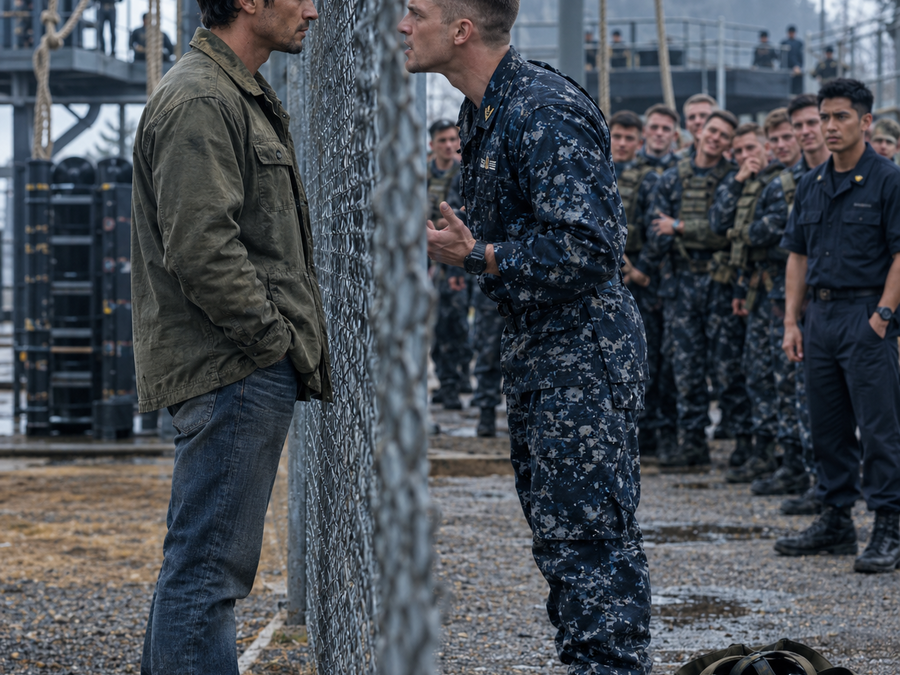
Every eye in the hangar followed them. Ror watched. Bennett watched. Murdoch watched. Vance stood absolutely still and watched. The four generals crossed the hangar floor and stopped directly in front of Daniel Cross, who was standing with his notebook in his hand and his visitor credential still clipped to his jacket, in the same faded jeans he’d been wearing all week, next to the same worn jacket, looking for all the world like a man who had wandered into the wrong building. And then, in the silence of the hangar, with every uniformed person present watching, all four of them saluted him.
It was precise. Clean. The full, formal military salute, held, directed at the man in the civilian clothes with the old truck in the parking lot. One of them, General Whitfield, whom Daniel had spoken to Thursday afternoon, said in a voice that carried clearly in the silence: “Mr. Cross. The commission is assembled and ready for your findings, sir.” Daniel returned the acknowledgement. He did it without drama. Without the satisfaction of looking across the room at Ror or at Vance or at any of the faces that were doing the math right now, recalculating every interaction, every assumption, every judgment made in the past four days about the man with the visitor badge and the juice box in the cup holder. He simply said, “Thank you, General. Let’s get to work.”
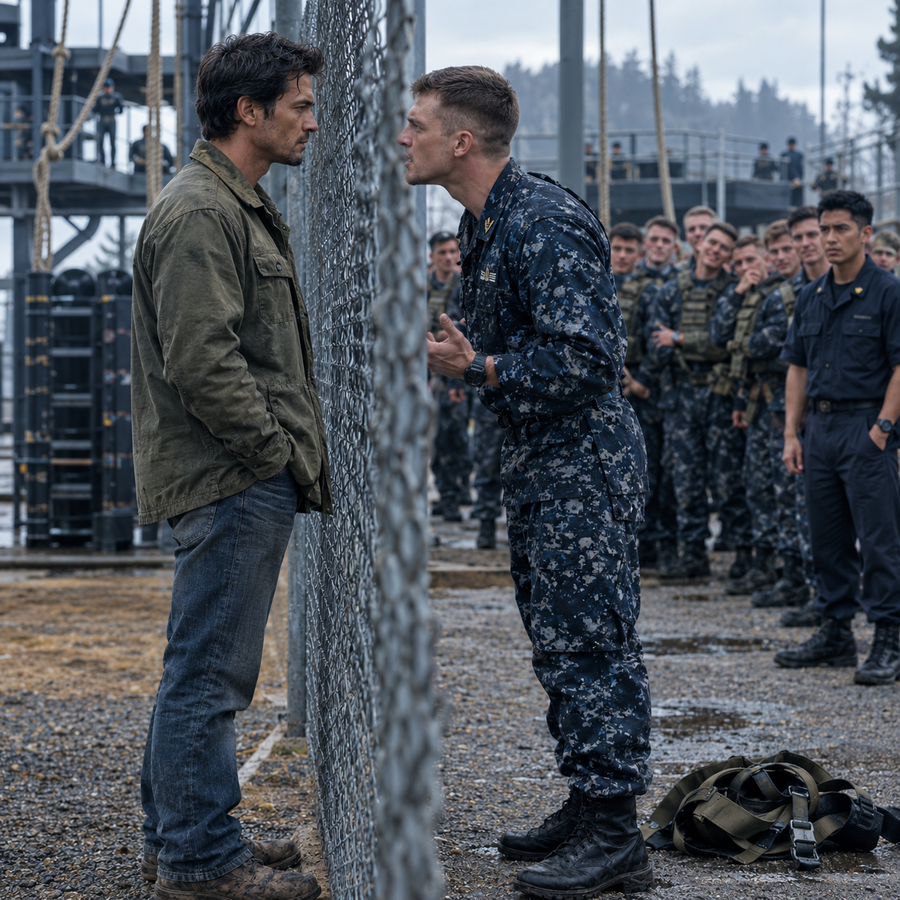
But Ror was looking. And Ror was looking with the expression of a man who has been handed a mirror and cannot look away from it. Not because of the power the gesture revealed—though the power was real, and the revelation was complete. But because of the contrast between what he was seeing now and what he had said in the training yard on Monday morning. The gap between those two moments was not navigable by rationalization. It sat there in the middle of the hangar, clear and exact and permanent. He had looked at this man and made a decision about him in three seconds. He had been wrong about every element of that decision. And the worst version of that wrongness—the version that kept surfacing when Ror tried to think about it clearly—was not that he had underestimated a powerful man. It was that he had treated a person as less than he deserved to be treated because of how that person looked. Because of what he wore and what he drove and where he sat in the hierarchy of visible rank. And he had done it in front of his team. Which meant his team had learned something from watching him do it. He had taught them, without intending to, that visible power was the condition of respect. He stood there in the hangar and understood, for the first time without any qualification, that he had been wrong. Not just strategically. Not just practically. Wrong in a way that went deeper than consequences.
Vance’s composure held for approximately ninety seconds after the salute. Then it didn’t. He moved toward the commission table with the urgent, controlled energy of a man who has decided that forward motion is his only remaining option. He addressed Whitfield directly, bypassing the protocol that would have required him to address the civilian chairman first. “General, I want to register my concern about the process by which this review was initiated and the—” “Captain Vance.” It was Daniel’s voice. Quiet. From eight feet away. “The commission convenes in four minutes. If you have procedural objections, they go through commission counsel. She’s at the table to your left.”
Vance turned to look at him. Something happened in Vance’s face in that moment. Something that was the last rearrangement of a man who has run out of moves. Not surrender—men like Vance didn’t surrender cleanly. But the specific expression of a man who has understood, fully and finally, that the room he is standing in does not belong to him. He went to commission counsel at 8:08.
Daniel Cross opened the formal review. He stood at the head of the table and spoke without notes, which was the first thing that set the tone for what followed. He didn’t perform. He didn’t prosecute. He laid out findings the way a skilled surgeon describes what an examination revealed. Clearly. Sequentially. Without drama. With the understanding that the facts themselves were serious enough not to require embellishment. He began with the helicopter. He walked through the timeline of the tail rotor assembly. The original maintenance flag. The chain of reports and responses. The documented decision to classify the wear reading as within operational tolerance. The replacement of Murdoch’s maintenance entry. The flight clearance. The crash.
He laid each piece next to the one before it with the care of a man building something that needed to hold weight. When he reached the moment where he cited Murdoch’s log directly, he saw Vance’s counsel lean close to Vance’s ear. He saw Vance give a single, small shake of his head. That was the tell. The moment where Vance understood that the log existed, that it had been preserved outside the system he’d been cleaning for forty-eight hours, and that it contained exactly what it contained.
He moved to the rope system documentation. The two write-ups that had been returned to Murdoch and Hartman with notes clearing the equipment to operational standard. The harness that had been kept in service. The additional stress points that Ror’s independent maintenance assessment had found the previous afternoon. He presented Ror’s voluntary stand-down report without comment, because the document spoke for itself, and because he had said to Ror what needed saying and had no interest in adding to it publicly. He presented Bennett’s documentation last. Seven months of maintenance logs. Emails with attachments. Training incident reports that didn’t match the official summaries. The pattern they revealed—the systematic relationship between the quarterly readiness reporting cycle and the timing of safety concern dismissals—was, in the aggregate, impossible to read as coincidence.
The hangar was completely still. When he finished presenting, he closed the folder in front of him and looked at the commission principles. “The injury to Specialist Reyes and Corporal Thies,” he said, “was not the result of unexpected component fatigue. It was the result of a documented maintenance concern that was administratively suppressed to protect a readiness reporting metric. The responsibility for that suppression, and the decision-making that led to it, is traceable and documented.” He paused. “The commission has what it needs to make its determinations.”
“Thank you, Mr. Cross,” Whitfield said. That was when Vance stood up. His counsel put a hand on his arm. He shook it off. “I have twenty-two years of service at installations across four commands,” he said. His voice was controlled. But it was the control of a structural element under more load than it was designed for. “I have consistently produced the highest readiness metrics in this region. The decisions made at this command were made within the framework of operational necessity and the guidance I received from the reporting chain above me. I reject the characterization that—” “Captain.” General Whitfield’s voice was not loud. It didn’t need to be. It had the quality of a door closing. “You’ll have the opportunity to present your response through the formal process. Please sit down.”
A long, terrible moment. Vance sat. The hangar breathed again. It was 9:47 when the formal session recessed. Daniel stepped away from the table and walked toward the far side of the hangar. He needed sixty seconds with no one in front of him. Not for drama. Just to let the morning recalibrate in his body the way you need to after something that requires everything. He heard footsteps behind him. He turned. It was Ror. They were far enough from the main group that they had a version of privacy. Ror stopped four feet away, and for a moment, neither of them spoke.
“I need to ask you something,” Ror said. “Go ahead.” “When you walked into the yard Monday morning. When I said what I said to you.” He stopped. Worked through it. “Did you know then that it was going to end up here? Did—did you know what the week was going to look like?” Daniel thought about it honestly. “I knew what I was here to find out. I knew the general shape of what the investigation would show if the reports were accurate.” He paused. “I didn’t know what you were going to be.” “What do you mean?” “I mean I didn’t know whether you were the cause of the problem or a product of it.” Daniel held his gaze. “That mattered to me. It makes a difference.”
Ror absorbed that. “Which was I?” “Product,” Daniel said. “With enough self-awareness to become something else.” A long silence. “What happens to me?” Ror asked. The question was quiet. Not begging. Just a man asking a real question because he needed to know. “You’ll face a formal review of the training incidents documented in the record. The voluntary stand-down you filed yesterday will be noted. Your cooperation will be noted.” Daniel looked at him steadily. “You’re a good officer who has been operating inside a broken system and absorbing its values as if they were his own. That’s not a death sentence. It’s a diagnosis.”
Ror was quiet for a moment. “The thing I said to you on Monday morning,” he said. “Yeah.” “I’ve been a SEAL for seven years. I’ve said some version of that to a lot of people.” He looked at his hands. “I said it to people who couldn’t say anything back. Who had no rank to invoke. No authority to protect themselves.” He looked up. “I was more careful about who I said it to than I thought. I was saying it to the people I knew wouldn’t cost me anything.”
Daniel let him sit with that. “That’s the thing Holloway was trying to tell you,” Daniel said. “I know,” Ror said. “I just needed to hear it from you.” Before Daniel could respond, Bennett appeared at the edge of the space, approaching with the careful, permission-seeking energy of someone who wasn’t sure if he belonged in the conversation. Daniel gestured him forward. Bennett looked between the two men, clearly uncertain of the geometry. Then he looked at Daniel.
“The commission counsel needs your signature on the evidence chain documentation,” he said. And he stopped. And Daniel said, “And?” “Specialist Reyes’s wife is on the phone,” Bennett said. “She heard about the review. From—I don’t know how she heard, but she heard. She wants to know if someone can talk to her today.” He swallowed. “She just wants to know what actually happened to her husband.”
Daniel was already moving. He crossed the hangar in twenty seconds, took the phone from the commission’s communications officer, and walked out through the side door into the cold morning air. The call lasted thirty-one minutes. He did not record it. He did not take notes. He just talked to Angela Reyes, who was thirty-one years old and had two children, ages four and six, and who had spent three months being told in official language that what had happened to her husband was nobody’s fault and the case was closed.
He told her the truth. All of it. He told her that the investigation had been reopened. That the crash was not the result of random component failure. That her husband and Corporal Thies had been put in an aircraft that the maintenance record showed should not have been cleared for flight. He told her that the commission’s findings would be formal and documented, and that the command responsible for those decisions would face appropriate consequences. She was silent for a long time after. Then she said, “I knew. I knew that what they told me wasn’t right. I just—I didn’t have anything to point to.” “You do now,” Daniel said.
She cried for a few minutes, which he allowed, because it was real and it was appropriate, and the only thing to do with real grief is let it be there. When she was done, she said, “Thank you for telling me the truth.” He said, “I’m sorry it took this long.” He ended the call and stood in the cold air for a moment. The base was running its regular Friday schedule around the edges of what was happening in the hangar. Vehicles moving. Personnel rotating. The machinery of the installation going on, because it always did, because that was the nature of institutions. They continued regardless of what was happening in any individual room.
But in training area four, the rope system was tagged out for full maintenance assessment. And in the administrative wing, an officer was logging a formal safety concern under the new anonymous reporting protocol that hadn’t existed forty-eight hours ago. And in the main hangar, a commission was preparing its findings. And somewhere across the country, Angela Reyes was sitting with a truth she had waited three months for. Daniel walked back inside. He had more work to do.
At 1:15 p.m., the commission formally presented its preliminary findings to the command, and Richard Vance was informed that he was being relieved of command pending a full investigation. He received the notification standing with his counsel beside him and his hands at his sides, and he said nothing, which was the most dignified thing he had done all week. Three senior officers were notified of pending reviews. The maintenance documentation case was referred to a separate investigative body. The helicopter crash investigation was formally reopened.
At 2:30 p.m., Daniel sat at the commission table and signed the findings package, which was eighty-three pages long and had four years of institutional consequences embedded in its language. He signed it the way he’d written everything this week. Steadily. Without ceremony. Because the work was the thing, not the performance of the work. He handed it to Whitfield. Whitfield looked at it. Looked at Daniel. “Good work,” he said. “Thank the people who talked,” Daniel said. “I just carried it.”
At 3:17 p.m., he walked out of the hangar. The convoy was preparing to move. Commission personnel were packing documentation. The base was digesting what had happened the way large institutions always digest accountability. Slowly. Imperfectly. With significant amounts of institutional inertia pushing back against every inch of change. But change was in the record now. It was signed. It was documented. It was real in the way that only things committed to formal record are real, which was the only kind of real that protected the people who needed protecting.
He reached his truck. He sat behind the wheel. He thought about Monday morning. The same truck. The same lot. The visitor badge. The visitor he’d been pretending to be. He thought about 8:43 a.m. and a damaged harness and a voice that had said, “What rank are you, asshole?” He thought about the answer he’d given. “No rank you need to worry about.” He almost smiled. His phone buzzed. Mia. “Is it over?” she asked. “Yeah, sweetheart. It’s over.” “Did you do the right thing?”
He looked through the windshield, at the base, at the gate, at the institutional machinery of it all, continuing to run in the complicated, imperfect way it ran. “I think we got a little closer to it,” he said. She was quiet for a second. Then: “Are you coming home?” He started the engine. “Already on my way,” he said.
The drive home took forty-seven minutes. Daniel didn’t listen to the radio. He didn’t make calls. He just drove with both hands on the wheel and the late afternoon light coming through the windshield. And he let the week decompress the way it needed to. Not all at once. Not dramatically. But the way pressure releases when you finally allow it to. The steady bleeding off of accumulated weight. The return from the place where everything mattered at maximum intensity back to the ordinary world where a man drove a truck home to make dinner for his daughter. The juice box was still in the cup holder. He noticed that and felt something so simple and so complete that he couldn’t have named it if anyone had asked.
Mia had leftover pasta ready when he walked in, which meant she had heated it herself using the instructions he had taped to the inside of the cabinet door when she was eight, which meant she was proud of herself and wanted him to notice. He noticed. He told her the pasta was perfect, which it wasn’t quite, but the effort behind it was, and that was the thing worth acknowledging. She talked through dinner about a disagreement at school, about a book she was reading, about whether the youth baseball season would start before or after spring break. He listened to all of it. He asked questions. He refilled her glass without being asked. He was completely present.
That was the discipline nobody talked about. Not the classified missions. Not the operational training. Not the decade of high-stakes decisions in environments that had no margin for error. The discipline of coming home and being home. Of leaving the weight of the day in the truck where it belonged and walking through the door as a father, not as whatever he had been for the past five days. He had learned that discipline the hard way. Through the years when he hadn’t quite managed it. When he had come home still carrying everything and given Mia the leftover version of himself, and had watched her small face absorb his distraction with the uncomplaining adaptability of children who understand instinctively that their parents are fallible and love them anyway. He didn’t do that anymore. Tonight, he was completely there, at that table, with the slightly overdone pasta and his daughter’s voice filling the kitchen. And it was enough. It was more than enough. It was the thing.
Later, after dishes and homework and the nightly negotiation over screen time that he always lost by exactly fifteen minutes, he sat on the edge of Mia’s bed while she settled in, and she asked him the question he’d been waiting for all evening. “So, what actually happened today?” He thought about how to answer that in the terms available to a ten-year-old without being condescending about it, which was always the calibration challenge with her. “Some people got hurt,” he said, “about three months ago. Because some other people made bad decisions and then tried to cover up that they’d made them.” “Did the bad people get in trouble?” “They will,” he said. “Yes.” She absorbed this. “Did you get in trouble?” “No.” “Good.” She pulled her blanket up. “Were you scared?”
He thought about it honestly. “There were moments,” he said. “Not of the physical kind. More the kind where you’re not sure if what you’re doing is going to work. Or if the people who need to be brave are going to be brave.” “Were they?” He thought about Murdoch with the folded paper he’d been carrying for three months. Hartman walking out of Vance’s office with his jaw set. Bennett setting a flash drive on a table with steady hands. “Yeah,” he said. “They were.”
She looked at him with the particular evaluating expression that always reminded him of her mother. “Were you the most important person there?” He smiled. “No.” “Then who was?” “The people who were afraid,” he said, “and showed up anyway.” She thought about that. Then she nodded, the way she nodded when something made sense on a level she wasn’t going to argue with. “Good night, Dad.” “Good night, sweetheart.” He turned off the light. He sat at the kitchen table for another hour. Not working. Just sitting with the quiet of the house. Then he went to bed, and for the first time all week, he slept without the notebook.
The commission’s preliminary findings went public in the specific, controlled way that classified joint investigations go public. Eleven days later. The announcement was institutional and precise. “Joint Maritime Warfare Center command structure under review following safety compliance investigation. Independent assessment of training protocols and maintenance certification procedures ordered across three regional commands. New anonymous reporting framework established effective immediately.” It was not front-page news. It never was, with things like this.
The machinery of accountability in these institutions moved in the language of internal memos and formal reviews and reassignment notices, not in press conferences. But within the world where it mattered—within the network of people who wore the uniform or had worn it, who knew what the words meant and could read between them—the announcement landed with significant weight. Richard Vance was formally relieved of command on a Tuesday. The ceremony involved no ceremony at all, which was its own statement. He was escorted from the installation by his XO, which was the same man who had hovered near the door during Vance’s confrontation with Daniel on Thursday, and who had looked away when Vance tried to make eye contact at the moment of departure.
Vance’s formal investigation would take months. The outcome of it was not something Daniel permitted himself to predict, because he had been in this work long enough to know that institutional accountability was real but imperfect, and that the gap between what should happen and what did happen was where careers and oversight were made or broken. He had done what he could do. He filed his final report two weeks after the review. Eighty-nine pages this time, with four appendices and a separate recommendation section that outlined specific structural changes to the readiness reporting framework. Changes designed not to punish commanders for having problems, but to make it impossible to hide them. He submitted it, received formal acknowledgement from the commission, and returned to the ordinary life that existed on the other side of Joint Maritime Warfare Center. Youth baseball. School pickup. Bad pancakes on Saturday mornings. The F-150 that knocked once when it started and then settled. The purple hair tie on the gear shift.
He didn’t talk about what had happened. There was nobody to tell who didn’t already know. The professional version and the personal version—the particular texture of the week, Mia’s presentation, the gymnasium, the good night he’d said through a closed door at midnight—was not something he needed to process out loud. He carried it in the way that people carry the weeks that clarify something important about who they are.
Six months passed. He was coaching third base during a Saturday morning youth baseball game, wearing a hat that said “Coaches” on the front in letters that had faded to barely legible, when his phone buzzed with a number he recognized as the Joint Maritime Warfare Center administrative line. He let it go to voicemail. The runner on second needed his full attention. He called back during the water break between innings. The voice on the other end was a young administrative specialist he didn’t recognize, who said that the base had organized a small recognition event in conjunction with the implementation of the new safety reporting framework, and that certain individuals had been specifically requested by name by personnel currently assigned to the installation, and that Mr. Cross’s attendance would be appreciated if his schedule allowed.
He asked who had made the request. The specialist said, “Petty Officer First Class Bennett, sir. He’s been selected to speak at the event. He specifically asked if you could be there.” Daniel looked at the field. The water break was ending. Kids were picking up their gloves. “I’ll be there,” he said.
He arrived at Joint Maritime Warfare Center on a Thursday morning, six months after the week that had started with a knock in his truck engine and ended with four generals in a hangar. He drove the same truck. He wore the same kind of clothes. He had his visitor credential updated, reissued, clipped to his jacket in the same position. The gate was staffed by a different petty officer than the young man from that first Monday. This one processed his entry without any of the subtle recalibrations that had characterized his arrivals during the investigation week. But the record that came back was what it was. Restricted fields. Blank pages. Clearance levels that didn’t match a visitor badge. And the young man simply processed it with professional efficiency and said, “Good morning.”
The base felt different. Daniel had been in enough institutions at different points in their life cycles to read the texture of a place accurately, and the texture of Joint Maritime Warfare Center on this Thursday morning was different from what it had been six months ago. Not transformed—institutions don’t transform. They evolve slowly and imperfectly, with significant friction and backsliding and the constant competing pressure of the things that made them comfortable in the first place. But different. Measurably. He noticed it in the small things. An equipment stand-down notice posted in the operations corridor that wasn’t apologetic about the impact on readiness numbers. It was factual. Signed. Dated. With a clear resolution timeline. A group of junior sailors in conversation with a chief who was listening more than talking. A maintenance log on the wall near the secondary bay that had two yellow tags and one red, which meant things that were actually yellow and red were being logged as yellow and red rather than as green. Small things. The ones that mattered.
Noah Bennett found him before the event started, in the corridor outside the main briefing room. And for a moment, they just stood there, in the way that people stand when too much has passed between them for a normal greeting to contain it. Bennett looked different. Not older, exactly—six months wasn’t enough for that. But more settled in himself. The quality of suppressed alertness that had characterized him in that first maintenance bay conversation had become something else. Not the absence of alertness. The absence of the suppression. “You came,” Bennett said. “Of course,” Daniel said. “I wasn’t sure you would.” He paused. “I mean, I asked, but I wasn’t—” “Bennett,” Daniel said. “I told you I’d carry it after you handed it to me. I meant that in both directions.” Something in Bennett’s face relaxed. “How are you?” Daniel asked. “Good,” Bennett said. And it had the ring of something true rather than something performed. “I’m in the advanced leadership program. Started in January.” He paused. “Senior Chief Murdoch wrote my recommendation.”
Daniel felt something warm move through him at that. “The new reporting framework,” Bennett continued. “It’s—I mean, it’s not perfect. People are still figuring out how to use it. Some of the senior NCOs are still adjusting to a world where junior personnel can file concerns without it automatically getting read as insubordination.” He tilted his head. “But three things have been filed in the past six weeks that would never have been filed before. One of them was a maintenance issue that the assessment team said could have caused a serious injury within thirty days.” “Three things caught,” Daniel said. “Three things caught,” Bennett agreed.
The weight of that was not small. Three reports that would have been buried six months ago. Three potential injuries that hadn’t happened. Three moments where the system had worked the way it was supposed to work. Where someone had said out loud what they saw, and the institution had responded to it rather than suppressing it. That was what eighty-nine pages of commission findings were actually for.
“Are you nervous about speaking?” Daniel asked. Bennett made a sound that was almost a laugh. “Yes. Completely.” He straightened slightly. “But Senior Chief Murdoch told me something when I was prepping. He said the most important thing about speaking in front of people who need to hear something is that you say it clearly. Not impressively. Clearly.” “Murdoch’s right,” Daniel said. “He usually is,” Bennett said. “Which is annoying, because he’s also not great at admitting when he’s wrong about the small stuff.” Daniel actually laughed at that.
Then the door opened, and the administrative specialist from the phone call appeared and said the event was starting in seven minutes, and Bennett straightened, and they walked in together. The briefing room held about sixty people. A mix of ranks. A mix of assignments. The specific cross-section of an installation that you got when an event was genuinely installation-wide rather than rank-specific. Junior enlisted near the front. NCOs in the middle section. Officers toward the back. The natural gravitational arrangement of military rank that happened without direction. And sitting in the third row, not far from the middle, was Blake Ror.
Daniel saw him immediately. Ror was not in his SEAL instructor role today. He was dressed in the working uniform of his current assignment—the training command position he’d been moved to during his formal disciplinary review, which was still ongoing. He was sitting straight, looking forward, with the particular quality of a man who is attending something he didn’t have to attend and chose to anyway. Daniel took a seat near the back, off to the side, the way he always did in rooms like this. Positioned to see the whole room without occupying a prominent position in it.
Murdoch was on the small stage, serving as the event’s organizing senior NCO. He saw Daniel come in and gave him the nod. Brief. Precise. The acknowledgement of a man who communicated efficiently. Hartman was in the second row. He caught Daniel’s eye and gave a small lift of his chin. The new base commander, a captain named Elise Torres, who had been assigned in the wake of Vance’s relief and whose reputation Daniel had checked thoroughly before the appointment was finalized, opened the event with remarks that were direct and without the particular brand of self-congratulation that these institutional reform events often produced.
She talked about the framework. She talked about what it was designed to do. She talked about what it would require from everyone in the room. Not just junior personnel filing reports, but senior leaders creating the conditions where filing a report was genuinely safe. She said the word accountability without flinching, which was notable. She said, “Our readiness numbers should reflect reality. If they don’t, the numbers are wrong, not the reality. And a wrong number that looks right is the most dangerous number there is.” It was the right thing to say, in exactly the right way.
Then Bennett stood up. He walked to the front with the same careful dignity that Mia had carried into her school gymnasium six months ago, and Daniel recognized it for what it was. The composure of someone who is afraid and has decided that what they’re about to do matters more than the fear. Bennett spoke for eleven minutes. He didn’t talk about the flash drive. He didn’t talk about Daniel by name. He didn’t frame it as a story of whistleblowing or institutional failure or personal courage, though it was all of those things. He talked about the morning he had almost let it stay quiet. About the decision. The specific, concrete, first-person decision to say something rather than nothing. About what it had cost him in the short term and what it had meant in the longer one. About the two men who had been injured in the helicopter and what it felt like to know that their injuries were preventable. And what it felt like to know that now, going forward, there was a mechanism in place that hadn’t existed before.
He said the hardest thing wasn’t being afraid. “I was going to be afraid no matter what. The hardest thing was deciding whether being afraid was a good enough reason to stay quiet when people were getting hurt.” The room was completely still. He said, “It isn’t.” He stepped back.
The room applauded, and in the applause, Daniel heard something genuine. Not the obligatory, reflexive applause of military events, but the sound of people responding to something they recognized as real. He was still processing that when Ror stood up. Not to speak—there was no program slot for Ror. He simply stood, and when people turned to look at him, he started clapping. Specifically. Deliberately. Facing the direction where Bennett was standing. It lasted for maybe five seconds before it was absorbed into the general applause, but it was particular. It was aimed. And in a room where rank and its implications were visible to everyone present, a SEAL lieutenant making that specific gesture toward a petty officer first class carried weight that everyone in the room understood.
The event ended at 10:40 a.m. People dispersed the way they do after institutional events. Some quickly. Some with the small clusters of follow-up conversation that meant the content had landed and people wanted to keep talking about it. Murdoch was approached by a group of junior sailors that he handled with the particular efficiency of a man who had spent twenty-two years figuring out how to transfer understanding from his head to other people’s heads in the least possible time. Daniel was heading for the door when Ror stepped into his path. Not blocking. Just arriving.
They stood in the thinning crowd of the briefing room, and for a moment, neither of them said anything. And it was not an uncomfortable silence. It was the silence of two people who had said the important things and were deciding what, if anything, came next. “I’ve been thinking,” Ror said, “about what I said to you the first morning.” “You’ve said that before,” Daniel said. “I keep thinking about it,” Ror said. “I think I’m going to keep thinking about it for a while.” He paused. “I want to apologize properly. Not because of who you turned out to be. Because of who you were when I said it.”
Daniel looked at him. “You were a person,” Ror said, “standing at a fence, telling me something true. And I used my rank as a reason not to hear you.” He met Daniel’s eyes. “That’s what I’m apologizing for.” There it was. Not the apology that said, “I’m sorry I didn’t know you were important.” The apology that said, “I’m sorry I treated you as though importance was the condition of respect.” That was a different apology. A harder one. The kind that required a person to understand what they’d actually done, rather than just the consequences of it.
Daniel extended his hand. Ror took it. They shook hands in the emptying briefing room, and it wasn’t a ceremony, and it wasn’t a resolution of everything between them, because some things don’t resolve cleanly. They just reach a point where two people understand each other well enough to move forward. That was enough. That was, in fact, exactly enough.
“What happens with your review?” Daniel asked. “Formal board meets next month,” Ror said. “My counsel thinks I’ll retain my commission. Modified duties for another six months minimum. Probably operational command review after that.” “And if you get it back?” Daniel asked. Ror was quiet for a moment. “Then I run my team the way I should have been running it,” he said. “Where the mission is the thing. Not the metrics.” He paused. “Where Bennett gets to speak.”
Daniel nodded. “Can I ask you something?” Ror said. “Go ahead.” “Your record. The blank pages. The restricted fields.” He stopped. “I’m not asking what’s in them. I know I don’t have that clearance and I probably never will.” He looked at Daniel steadily. “I’m asking—was it worth it? All of it. Whatever it was.”
Daniel thought about the question in the way he thought about questions that deserved real answers. He thought about the places he had been. The things he had done in them. The years when the mission had been the whole world and everything else had been peripheral to it. He thought about the hospital corridor and the drive home and the five-year-old who had asked him where Mommy was. He thought about the morning he had looked at what his life had become and understood, clearly and finally, what it was actually for. He thought about Sunday mornings at the kitchen table. Math worksheets and laughing. A photograph on a poster board at a school gymnasium. The highest rank he had ever held. “Different parts of it were worth different things,” he said. “The part I’m living now is the best part.”
Ror absorbed that. Then Daniel said, “Take care of your people, Lieutenant. Not their metrics. Them.” “Yes, sir,” Ror said. It was the first time Ror had used that address. He hadn’t used it during the investigation. He hadn’t used it after the salute. He hadn’t used it in any of the conversations that had moved between hostility and reckoning and something closer to mutual understanding over the course of a complicated week. He used it now, quietly, in an emptying briefing room, as one man to another, with all the performance stripped away. Daniel accepted it with a nod and walked out.
He found Bennett in the corridor, talking to two junior sailors who were asking him questions with the energy of people who had heard something they wanted to understand better. He was answering them with the particular patience of someone who has recently figured out that patience in this direction—toward people with less experience, less rank, less context—is not weakness but craft. Daniel caught his eye and gave a small nod toward the door. Bennett nodded back. He finished the conversation, shook both of their hands—which made them visibly surprised and then pleased—and fell into step beside Daniel as they walked toward the building exit.
“How’d it feel?” Daniel asked. “Terrifying,” Bennett said. “Good.” He thought about it. “Mostly good.” “That ratio improves,” Daniel said. “Does the terrifying part go away?” “No,” Daniel said. “But you stop needing it to.” Bennett considered that for a few steps. “I got my first evaluation under the new commander last week,” he said. “Torres.” He paused. “She wrote, ‘Demonstrates integrity under institutional pressure.’ I’ve never seen that phrase in an evaluation before.” “How’d it feel?” “Like something I actually earned,” Bennett said.
They pushed through the main door into the late morning air. Murdoch was outside, standing with Hartman and a coffee cup, and the two of them made a picture that six months ago would have been impossible to imagine. Not because they hadn’t known each other, but because six months ago they had each been carrying something alone that they were now carrying together. The weight was the same. The carrying was different. Murdoch looked at Daniel. “You don’t have to be back for a while,” he asked. “Got some time,” Daniel said. “Coffee’s inside,” Murdoch said. “It’s bad, but it’s hot.”
Daniel got coffee. They stood outside for twenty minutes. Murdoch, Hartman, Bennett, Daniel. And talked about baseball, of all things, because Hartman had a son in Little League and wanted advice about what to do when the kid was having trouble with his swing. And Daniel gave him three specific things to try at practice. And Hartman wrote them down in his phone. And the conversation was entirely ordinary and entirely human, and contained within it, in some form that couldn’t be directly stated, everything that the past six months had been about.
At 11:47 a.m., Daniel said goodbye. Murdoch shook his hand without anything extra in it, which was the right amount. Hartman said, “Thanks. Genuinely. For the baseball advice and for the other thing. In that order.” Bennett walked him to the parking lot. At the truck, he stopped. “What’s next for you?” Daniel asked. “Leadership program through March,” Bennett said. “Then I’ve requested a transfer to the oversight support team. The one that works with the new reporting framework at the regional level.” He paused. “I want to help other people do what I did. Make it easier for them than it was for me.”
Daniel looked at him for a long moment. “That’s the right call,” he said. “I thought you’d say that.” “Don’t let it get to your head,” Daniel said. Bennett grinned. “Too late.” Daniel got in the truck. The engine knocked once and settled. The purple hair tie was still on the gear shift. A different one. Mia’s current favorite, which she had left there last week. And he had not returned it, because there was something about its presence that he found grounding in a way he had never tried to explain to anyone.
He pulled out of the lot. He didn’t look in the rearview mirror. He drove toward the gate, and the gate guard processed his exit with the same professional efficiency as his entry, and he pulled onto the highway and headed toward Wilmington. Toward the school where Mia was in the middle of her Thursday. And did not know yet that her father had been at the base, or what had happened there, or what any of it meant. She would ask tonight. She always asked.
He was thinking about how to answer when his phone rang through the truck’s speaker. The name on the screen was Margaret Chen. He answered. “Heard the event went well,” she said. “It did,” he said. “Commission is moving to implement three of the five framework recommendations at the other regional installations. The fourth is under review. The fifth is complicated politically, but we think it gets there by end of year.” “Good,” he said. “There’s another assignment,” she said. “When you’re ready. Different installation. Some of the same patterns. Metrics pressure. Documentation irregularities. Nothing confirmed yet, but the early reports are concerning.”
He drove for a moment without answering. “Daniel,” she said. “You don’t have to take it.” “I know,” he said. “There are other people who can—” “Margaret.” His voice was quiet. “Send me what you have.” A pause. “You sure?” He thought about Murdoch’s folded paper and three months of carrying something alone. He thought about Angela Reyes and a phone call that had lasted thirty-one minutes. He thought about three safety reports filed in six weeks at an installation that had filed zero the year before. He thought about the gap between the thing an institution claims to be and what it actually is, and the people inside it who know the difference and are waiting for someone with the authority and the will to do something about it. He thought about what it cost to stay quiet when it mattered. “Send me what you have,” he said again. “Okay,” she said. “I’ll have it to you by Monday.” She hung up.
He drove the rest of the way home in silence. He picked Mia up from school at 3:15. She came out the door with her backpack bouncing and a story already forming in her expression. Something that had happened in science class. Something about a lab experiment that had gone differently than expected, which she described in such detail and with such animation for the first ten minutes of the drive that he barely needed to say anything. He listened. He was completely there.
At a red light, she paused her story and looked at him. “Dad.” “Yeah.” “What rank were you? Like, actually?” “I know you say you don’t like to talk about it, but—” She tilted her head. “I’m curious.” He looked at her. He thought about blank pages and restricted fields. He thought about four generals in a hangar. He thought about commands and citations and classifications and all the invisible architecture of a career that had taken him to places and decisions that most people would never be cleared to know about. He thought about Sunday mornings at a kitchen table. The light turned green.
“These days,” he said. He reached over and squeezed her hand once. “Dad,” he said. “That’s my rank.” She looked at him for a second. Then she rolled her eyes in the way that ten-year-olds roll their eyes when something is both completely sentimental and entirely true. “That’s so cheesy,” she said. “Highest rank I’ve ever held,” he said. She laughed. The full, unguarded laugh that had been cutting through him since she was three years old. And turned back to her window and went on with her story about the science experiment.
He drove. The road stretched out ahead of them, ordinary and clear. Toward the house and the knock in the engine and the bad pancakes on Saturday morning and all the small, unglamorous, irreplaceable work of being the person someone needs you to be, every single day. Not because the mission is over. Because this is the mission. The one that doesn’t end. The one that never appears in any classified record, on any restricted page, under any clearance level, in any file anywhere in Washington. The one that mattered most.
He drove his daughter home.

