She Whispered, “Men Leave When They Learn I Have Four Kids”—I Said, “Then You’ve Met the Wrong Men.”
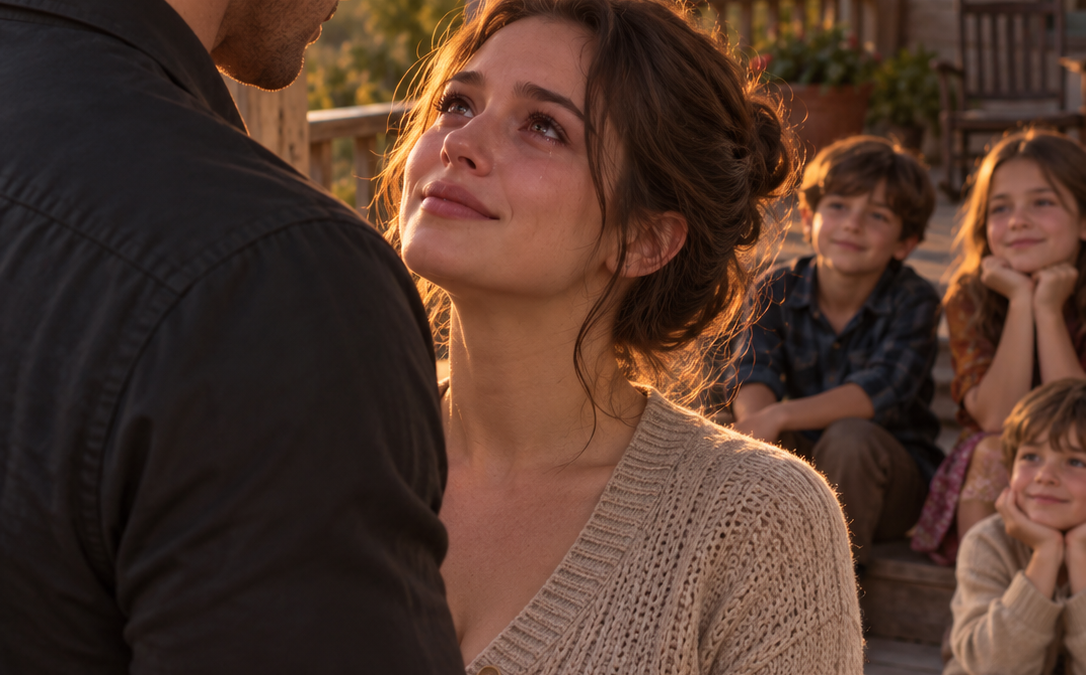
She Whispered, “Men Leave When They Learn I Have Four Kids”—I Said, “Then You’ve Met the Wrong Men.”
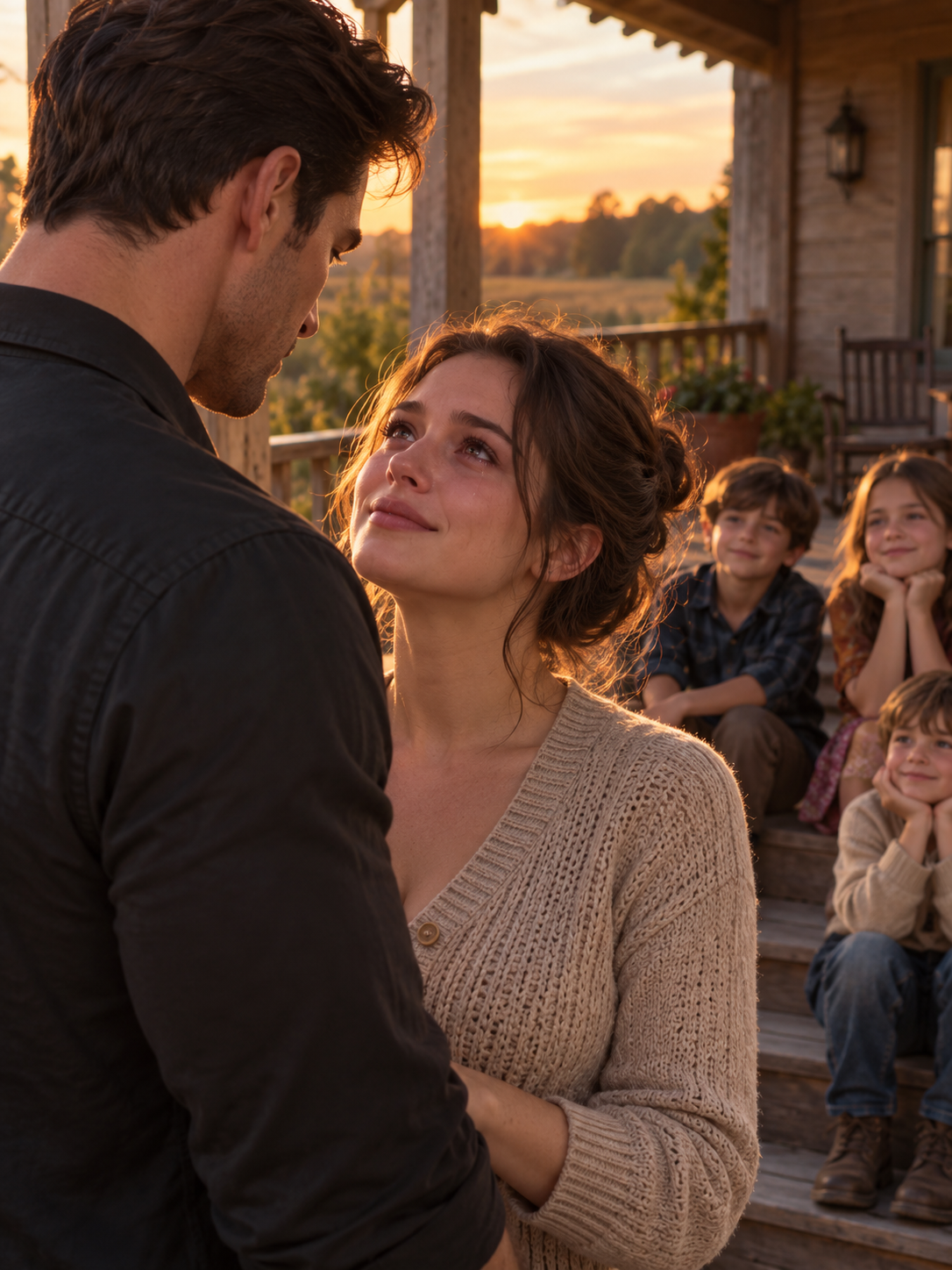
There is a table in my kitchen that seats six.
I built it myself three winters ago out of white oak from a barn they tore down over in Hartselle County. Mortise and tenon joints. No screws.
The kind of table you build when you want something to outlast you. Six chairs around it, sanded smooth. Each one a little different because I made them by hand.
And my hands are honest about their mistakes. For 3 years one man ate at that table. Me.
Same chair, same spot, same quiet. People who came by the shop would sometimes see it through the kitchen window and ask why a single man needed a table that big.
I never had a good answer.
I’d shrug and say something about resale value and they’d laugh and we’d move on.
But the truth is I built it for people I hadn’t met yet.
I just didn’t know how to say that out loud without sounding like a fool.
Then one night in the rain a woman stood in my doorway and told me in a voice so small I nearly missed it exactly why she believed no man would ever sit at a table like mine with her. She had proof. Years of it.
Names and dates. She was wrong.
Not about the men she’d known.
About the ones she hadn’t.
My name is Owen Callahan.
I’m 34 and I live in Millbrook, Tennessee in the same white house with the crooked porch that I grew up in.
I run a repair shop out of the converted garage. Washers, dryers, mowers, the occasional stubborn tractor part and furniture when folks ask nice.
If it’s broken and it matters to somebody I’ll take a look at it.
That’s been the whole business plan for 8 years.
And somehow the lights have stayed on.
I should tell you about my father because he’s the reason for most of what happened.
I was 9 years old the night he left. I remember it in pieces. The truck door slamming.
My mother standing on the porch in her nightgown with her arms crossed. Not crying. Just still.
The tail lights going red down Cooper Road. And then gone.
He didn’t say goodbye to me.
He left a note that my mother never let me read. And a socket set in the garage that I still use. Which feels like some kind of joke God is telling slowly.
My mother worked the front desk at the medical clinic in the morning and cleaned offices at night. And she raised me on casseroles and stubbornness.
She never spoke badly about him. She only said one thing. Once when I was 17 and angry about it.
She said, “Owen, a man’s word is the only tool that never wears out.
Your father just never learned to use his.”
I carried that. Maybe too far. I became the kind of man who shows up when he says he will.
Down to the minute. Because being late feels like the first small version of leaving. I fix things for a living because fixing felt like the opposite of what he did.
Mom passed 3 years back. Her heart. Quick and quiet.
The way she did everything. She left me the house.
The porch.
And a silence I didn’t know what to do with.
That was the winter I built the table. I told myself it was just a project to get through the cold months.
You already know better. So that was my life. Work.
The diner. Church some Sundays. The table for six with one plate on it.
I wasn’t unhappy.
Exactly. I was paused.
Like a job left on the bench.
Waiting on a part that hadn’t come in.
The part came in on a Tuesday in April. Wearing a yellow apron.
The Bluebird Diner sits on Main Street between the barbershop and the bank.
And I’ve eaten breakfast there most mornings since I was old enough to pay for it.
Darlene owns it.
She’s 61, calls everybody sugar, and knows more about this town than the newspaper ever did.
That Tuesday, there was a new waitress. She was maybe early 30s, brown hair pulled back in a knot that was losing the fight, tired eyes that were doing their best not to look tired.
She moved fast, but careful, like someone who had carried a lot of full plates through a lot of narrow spaces. The name tag said Natalie.
“Coffee?”
she asked, already pouring.
“You read minds?”
“No, sugar.”
She caught herself and winced.
“Sorry, Darlene’s rubbing off on me.
Day three.”
“It’s a good word,” I said.
“Suits the place.”
She smiled.
“Just a corner of one.”
“You want the special?”
“Or are you a menu reader?”
“What’s the special?”
“Biscuits and gravy and Darlene watching to see if you finish it.”
“Special, then.
I don’t want trouble.”
“Smart man,” she said, and moved on to the next booth.
That was all. Two minutes, maybe.
But I noticed things, because noticing is most of my job. I noticed she wore a thin gold ring on a chain around her neck, tucked inside her collar. And when she caught me seeing it, she pushed it out of sight with one finger, quick, like closing a drawer.
I noticed her sneakers were worn through at the same spot on both heels.
And I noticed that at exactly 5:40 that evening, I’d come back in for pie, which was not something I usually did, and we don’t need to examine why.
She untied her apron mid-sentence, said something to Darlene, and was out the door like the building was on fire. Through the window, I watched her climb into an old gray minivan with a sun-faded sticker on the back glass, one of those stick-figure family stickers.
Except it had been scraped at, half-peeled, so you couldn’t tell anymore who was supposed to be standing in it.
I sat there with my pie and thought about that sticker longer than a normal man should. The next week I learned her laugh.
It came out once by accident when old Ray Tillman tried to pay his bill with a coupon from 2019, and it was a real laugh, loud and surprised, and she covered her mouth right after like it had escaped without permission. I learned she read paperbacks on her break, westerns mostly, with cracked spines from the library sale. I learned she hummed when she wiped down counters, low, some song I never could place.
I learned she was polite to everyone and close to no one, and I learned one more thing, overheard, not meant for me.
Charlie the cook was ribbing her about a trucker who’d left his phone number on a napkin.
Natalie scraped the grill and didn’t smile.
“You should call him,” Charlie said.
“He had a nice truck.”
“No point,” she said, quiet, almost to herself.
“Give it one dinner and he’d run like all the rest of them.”
“All the rest of who?”
She didn’t answer.
She just tucked that chain back into her collar and called out an order that wasn’t ready yet.
I sat at the counter pretending my coffee needed attention.
“All the rest of them.”
I turned those five words over for days like a part I couldn’t find the number for.
Now, I want to be honest about the pace of things, because this wasn’t some lightning strike.
It was slower than that, and better. The first real conversation happened in the rain, in May, in the diner parking lot at closing.
I was leaving late.
Darlene’s walk-in cooler had been rattling, and I’d stayed after to look at the compressor, and Natalie’s van was sitting in the dark with its hood up and its hazards blinking.
And she was standing there getting soaked, staring at the engine like it owed her money.
“Battery or alternator,” I said, walking over.
“Those are your suspects.
She jumped then recognized me.
It’s fine.
I called someone. Who? A pause.
I’m deciding.
Pop the hood latch all the way.
I’ve got tools in the truck.
I can’t pay you tonight, she said fast like she’d said it before to other people about other things.
I get paid Friday. Good.
Friday I’ll want pie.
Save me the corner piece. She stood in the rain deciding whether to trust me. And I let her take her time.
Because a thing like that shouldn’t be rushed.
Then she nodded once and held the flashlight while I worked. It was the alternator belt, shredded like wet paper. I put on the spare I keep in the truck.
Small town, you learn to carry the common failures. And while I worked, she held that light steady and asked me questions.
Not small talk. Real ones.
How long I’d had the shop.
Whether I liked the work or just knew it. What happens to a town like this when the young people leave?
You ask questions like a person who doesn’t like answering them, I said tightening the last bolt.
You fix things like a person who doesn’t like leaving them broken.
That’s fair.
I know it is, she said. And there in the dark, in the rain was the laugh again.
Small this time. But mine.
I’d earned it.
I felt like I’d won something at the county fair.
When she climbed into the van, the visor flopped down and a piece of paper fell out onto the wet floor mat.
A child’s drawing.
Crayon. A house.
A sun. Some tall stick figures and some small ones. She snatched it up so fast I barely saw it.
Pressed it flat against her leg and looked at me with a face that had gone carefully blank. Goodnight, Owen, she said.
Thank you. She pulled out of the lot and I stood in the rain and I thought there it is.
That’s the drawer she keeps closing.
I didn’t push.
I want that on the record. I never asked around town, never fished, never once put Darlene in a corner about it. Though Lord knows Darlene was dying to be put in a corner.
Whatever Natalie was carrying, she’d set it down when she wanted to.
Or she wouldn’t.
And either way it was hers. But we became something after that night.
Friends is the word, I guess. Though it always fit us wrong, like a borrowed coat. June.
The diner’s coffee machine gave up during the morning rush.
I came in with my bag and fixed it while she handed me tools and insulted my organizational system. You have three of the same screwdriver. Those are three different screwdrivers.
They are identical. Only to the untrained eye. Oh, forgive me.
I forgot I was assisting a surgeon. Darlene watched us from the register with her eyebrows saying things her mouth was too smart to.
When the machine gurgled back to life, the whole counter cheered. And Natalie poured the first cup and set it in front of me like a trophy. And for a second, over the steam, she let me see her without the tiredness stacked in front of her.
It only lasted a second. Then her phone buzzed on the counter.
Face up.
I didn’t mean to look.
The screen said home and her face did something complicated. And she was gone to the back before the second ring.
Every 300 words of my life that summer, I swear, ended the same way. A door easing open.
Then a phone, or a clock, or that gold chain easing it shut. The Saturday that mattered, she came to my shop.
First time. She stood in the doorway of the garage holding a toaster like it was a sick bird.
“It burns one side,” she said.
“Only one side.”
Which feels personal.
That’s the element.
Five-minute fix.
“You drove out here for a toaster?
I was in the neighborhood. Natalie. This road ends at my house and then a soybean field.
Then I was in the soybean field, she said. Are you going to fix it or interrogate me? I fixed it.
It took 4 minutes.
And she watched and then since it was hot and neither of us moved toward goodbye, we ended up on the porch with lemonade and she rocked in my mother’s old chair with her feet tucked up under her like she’d been sitting there for years.
We talked about nothing which is the best conversation there is.
The heat, Darlene’s feud with the food supplier, whether the hardware store’s cat was fat or just dignified.
Her whole body was different out here, looser and I remember thinking that whatever she was resting from, it was heavy because look how far she had to drive to set it down. Then she went quiet. She was looking through the kitchen window at the table.
You live alone, she said.
It wasn’t a question.
I do. Six chairs.
I like to be prepared. For what? Whoever shows up hungry.
She looked at that table a while.
Something moved behind her eyes, some arithmetic I couldn’t see.
Then she stood brisk and thanked me for the toaster and drove off at 5:15 leaving early even from leaving and the dust from the van hung in the road light long after she was gone.
July was a hundred small scenes and I’ll give you three because they matter.
One slow Tuesday, 2:00 dead diner I came in for a part I’d left and found her building a fort out of sugar packets.
A real one, walls, a tower a moat of creamer cups.
Don’t she said without looking up.
I didn’t say anything.
You were about to.
I was going to say your east wall’s going to fail.
You’ve got no cross bracing.
She sat back and studied it.
You’re serious.
Structurally? Dead serious.
First kid that sneezes, that whole kingdom’s done.
Then fix it, surgeon, she said, and slid the sugar caddy across the counter. And I sat down and braced her east wall, and we defended that fort for 45 minutes against an enemy that never came.
And Darlene took a picture of us with her phone that I didn’t find out about until it showed up framed at my wedding.
Another day, the radio behind the counter caught some old song, and her humming slipped into actual quiet singing. Eight seconds, I counted, before she caught herself and shut it off mid-note. You have a nice voice, I said.
I have a coffee pot, she answered, and I’m not afraid to use it.
And there was the morning I came in with a splinter the size of a fence post in my thumb, and she came around the counter with tweezers from the first aid kit before I could argue. Hold still. Big tough repairman.
It’s fine.
I was going to handle it. With what?
Pliers? Give me the hand, Owen.
And she took it, and held it steady on the counter, and worked the splinter out slow, her head bent over my palm, and we were both very casual about all of it, and neither of us succeeded. Twice that month I got as far as the top of the hill. You know the hill I mean.
The one where you stand with the words in your mouth. Come to dinner.
Just dinner.
I’ll cook.
I want to hear you laugh with nobody working. And twice, right at the top, 5:40 came, and the apron came off mid-sentence, and the gray van was gone, and I was standing there with my words getting cold.
You know, Darlene said to me one of those evenings, wiping the counter in slow circles, for a man who fixes things, you sure can stare at a broken situation a long time.
It’s not broken.
It’s just locked.
She said. Mhm. Well, locks have reasons, sugar.
Good ones. Usually.
And she moved off down the counter and left me with that. Then came the second Saturday in September and the Millbrook Elementary Fall Festival and everything I thought I was slowly walking toward turned out to be standing right in front of me all along holding a corn dog. I was there because of the popcorn machine.
The PTA rents this ancient thing every year and every year it jams and every year somebody calls me and I stand in the gym smelling like butter for an hour. Tradition.
I had the side panel off in my hands full of popcorn machine when I heard a voice I knew better than my own phone number. Eli. Sam.
Walk. I looked up.
Natalie stood 20 ft away in the gymnasium crowd. Not waitress Natalie. Another one.
She had a little girl on her hip, maybe four, with pigtails and a face painted like a butterfly. Twin boys, seven or so, were orbiting her at high speed with a shared corn dog.
And beside her, arms crossed, wearing the expression of a girl who considers fall festivals beneath her, stood a daughter of maybe 11 who had Natalie’s exact eyes.
Four kids. The little one on her hip.
The twins. The girl.
Four. The stick figures on the van.
The drawing in the visor. 540.
The phone that said home. Every locked drawer in that woman slid open at once, right there next to the cake walk. She turned.
She saw me. I watched the color leave her face like water finding a drain.
Her arm tightened around the little one.
The oldest girl followed her mother’s stare, found me, and narrowed her eyes at me with a precision that should be studied by the military.
I raised my hand. Just a small wave. Easy.
Nothing.
Natalie didn’t wave back.
She turned the whole group of them like a captain turning a ship. And they were gone into the crowd by the pumpkin table.
And I stood there holding a popcorn machine panel like a fool. At a dance with no partner. Monday, the diner.
She poured my coffee without being asked. Same as always.
Nothing else was the same. Morning, I said.
Special’s French toast.
Her voice was level. Flat as a parking lot.
Natalie.
I’ve got a six-top.
Owen, they’re beautiful kids.
Her hand stopped. One second.
The coffee pot hovered.
Don’t she said.
Quiet, don’t what?
Whatever you’re winding up to say.
The nice thing.
Don’t.
She set down my plate without looking at me.
It’s better this way.
Trust me.
I’ve run this experiment before.
What experiment? Your toast is getting cold, she said.
And she was gone down the counter. And she stayed gone.
All week. Present, professional, and a thousand miles away. The chain stayed inside her collar.
The laugh stayed wherever laughs go when they’ve been recalled by the factory.
Friday, I stayed till close.
I’m not proud of the pretending I did with that one cup of coffee.
But a man does what he must. When the chairs went up on the tables, Darlene sat down across from me. Uninvited.
And folded her hands. You want to know. She said.
And she’s not going to tell you.
And it’s not my story.
So I’m going to tell you the county record version, which is public.
And you can do with it what a grown man does. I waited.
Her husband was Matt Brooks, lineman for the power co-op over in Carver County. Two years ago June, that big storm, you remember? A tree came down on Route 9 and took the lines with it.
And Matt went up to get the county’s lights back on.
And the good Lord took him home instead. 33 years old.
Darlene’s thumb rubbed a scratch in the tabletop.
She had four babies and a mortgage and a casserole brigade that lasted exactly six weeks.
Because that’s how long casseroles last.
Then everybody’s sorry wore off and she was just a woman alone doing the arithmetic.
She moved here in March to be near Matt’s mama, Carol, who keeps the kids after school.
Darlene looked up at me.
That’s the record.
Now here’s the footnote.
And then I’m done.
Somewhere in that first year, some people convinced her that her and those babies were a package nobody orders.
I’ve watched that belief walk around my diner in an apron for six months.
And Owen Callahan, it is the only thing I have ever known that girl to be wrong about. I sat there a long while after Darlene locked up.
The gold ring on the chain.
Of course, she wasn’t hiding a secret.
She was carrying a whole family alone and covering the sound. The toaster came back to my shop that next week.
Not with her, with a note left on the workbench while I was out on a call. It burns both sides now, which is worse. Do not charge me for this.
And the little one apparently had put a plastic fork in it.
The note didn’t say that.
Darlene said that.
It also, conveniently, had an address on the repair tag from where I’d filled out the paperwork in the spring.
I want to be straight with you. I told myself I was returning a toaster.
I put it on the passenger seat and drove across town to a small blue house on Linden Street with a tire swing and a flower bed that somebody was keeping alive out of pure discipline.
And I told myself the whole way, “Toaster.”
A woman answered the door who was not Natalie.
60-something, silver hair pinned neat, a dish towel over her shoulder, and eyes that took my measure on the doorstep the way a carpenter takes a wall looking for what’s not level.
“You’d be the repairman,” she said.
Owen Callahan, ma’am.
I’ve got Natalie’s toaster.
I know who you are. Sam talks about the popcorn machine man. Sam talks about everything.
She didn’t move from the doorway.
Behind her, deeper in the house, I could hear a television and the specific thunder of children who have been told twice to settle down.
She’s not home.
Works till close on Thursdays. I can just leave it.
Rosie put a fork in it, the woman said. The little one.
She was trying to get the toast out herself so her mama wouldn’t have to get up.
That’s the kind of children they are.
She said it like a fact she was laying down on a table between us.
I’m Carol Brooks.
Matt was my son.
I’m sorry for your loss, ma’am.
Truly, everyone is. She looked at the toaster in my hands, then at me, and her chin came up a little.
I’m going to say this once, Mr.Callahan, because I’m too old to circle a thing.
I know why a man drives a toaster across town, and I want you to understand what’s inside this house before you knock on it again.
There’s a girl in there who still writes letters to her daddy.
There’s twin boys who ask their mama every August if this is the year the storm comes back.
There’s a baby who calls Matt’s picture the man.
Her voice didn’t break.
It bent right at the end the way oak bends. They are just now just barely standing back up.
Ma’am, I would never.
I’m not afraid you’re a bad man, Carol said.
Darlene vouches for you and Darlene doesn’t vouch.
I’m afraid you’re a good one.
Because a bad man leaves and they cry for a week. A good man leaves and they stop believing the whole category. She pulled the dish towel off her shoulder, folded it small, and her eyes were shining now and angry about it.
Every man who has come around and gone has taken a piece of my son’s children with him out the door.
And my boy gets smaller every time.
So you’ll forgive me if I stand in this doorway.
From inside the house, a crash. A beat of silence.
Then a small voice, it’s okay.
It was already broken. Carol closed her eyes for 1 second the way tired generals do.
Give me the toaster, Mr.Callahan, she said gentler, and go on home. You seem like a decent person. Be decent from a distance.
I gave her the toaster. I went home.
And that night I sat at my table for six in my one chair and I did the thing I do worst in this world. I doubted. Because maybe they were right, all of them.
Natalie had run the experiment. She had the data. Carol had counted the cost in pieces of grandchildren.
Who was I? A man who fixed appliances and built furniture for ghosts.
I’d never raised a child.
I’d never even kept a dog alive past No.
That’s not true.
Biscuit lived to 14. But you take my point. The evidence for me was thin.
The evidence against men in general was in that house overwhelming. I looked at those five empty chairs for a long time.
Then I got up and I went to the garage and I did what Callahans do when their heads are too loud. I worked.
I took down the winter’s worth of white oak I’d been saving and I started building and I didn’t fully know what I was building yet but my hands did the way they always know before I do.
10 days went by. Cold ones. Early for October.
I kept my distance like Carol asked. I switched to take out coffee which tasted like punishment.
Natalie and I passed each other twice on Main Street and performed two small nods that should win awards for how much they didn’t say.
Then on a Thursday night in the rain it’s always the rain with us.
Some couples get a song. Headlights swept my shop windows at 9:00.
The gray van. The engine cut. For a full minute nobody got out.
Then she came through the garage door with her hood up and her arms crossed and she stood there dripping on my clean floor and she said “Carol told me she turned you away.
She told me tonight.
She’s been feeling bad about it for 10 days which for Carol is a record.
She wasn’t wrong to do it.
No. Natalie said.
She wasn’t.
She pushed her hood back. She looked tired in the old way the deep way the way from before the sugar packet fort.
That’s actually why I’m here Owen.
Because she wasn’t wrong.
And you should hear it from me instead of a doorway. I came to say what I should have said in September and save us both the long version. I like long versions.
Don’t.
Her voice caught on the word.
Don’t be easy to talk to right now.
I’m begging you.
She took a breath and squared up like a woman lifting something heavy with correct form. There was a man in Carver about a year after.
An accountant. Nice enough.
Third date, Ava mentioned her brothers. Just mentioned them. Just existing.
And I watched his face do the math, and he was gone before the check came.
He texted me that it wasn’t a good fit.
A fit. Like we were pants. The rain hammered the roof.
There was another one this spring before I took the diner job. Lasted a month.
One month, and then Rosie called him. She called him something sweet.
It doesn’t matter.
And 2 days later he sat me down and said, and I quote, that he wasn’t looking to raise another man’s kids.
Another man. Matt has a name.
She wasn’t crying.
She was past it. In that dry country on the other side.
So I don’t do it anymore.
I don’t introduce anyone.
I don’t hope.
I leave at 5:40, and my kids stay whole.
That’s the system.
It works. Natalie. And then you, she said, and her voice dropped, and it shook.
You with your porch and your lemonade and your six chairs. Owen.
You think I didn’t do that math the second I saw that table?
You think I haven’t been doing it all summer?
She pressed the heel of her hand against her eyes. Quick, furious at them.
I came here to end it before it starts.
Because it’s the only part I’m still in charge of.
Whatever this was going to be.
I’m saying no.
On behalf of four kids who didn’t get a vote last time the world changed on them.
She turned for the door. She got one hand on it.
And I said, why? She stopped. And here is the choice, the whole hinge of my life, and it fit in one breath.
I could let her protect everyone from a thing that hadn’t happened.
Or I could stand in that garage and mean something out loud. My father left with a note.
My mother said a man’s word is the only tool that never wears out.
I picked up the tool. Say the actual reason I said, not the system.
The reason under it. You owe the long version to somebody, Natalie.
And I’m volunteering.
She stood with her back to me and her hand on that door for so long that the rain filled up all the space in the world.
When she finally turned around, she wasn’t the diner Natalie or the porch Natalie.
She was down to the last wall, and her voice came out barely above the rain, and I had to lean in to catch it. And I will hear it every day for the rest of my life.
“Men don’t stay when they find out I have four kids,” she whispered.
The words just hung there in the sawdust and the rain noise between us.
She wasn’t accusing me.
That was the worst part.
She said it the way you’d read a weather report.
The way you’d state a law of nature to a man about to fall off a roof and hurt himself.
Gravity exists. Winter comes.
Men don’t stay.
She had four kids and a dead husband’s ring on a chain and an entire body of evidence, and she was sparing me.
And she believed it all the way down in the place where a person keeps the things they’re done arguing about.
I looked at her for a breath. Then I said it.
Not loud.
You don’t have to be loud when you’re sure.
“Then you’ve been meeting the wrong men.”
Her chin came up like I’d struck her, and her mouth opened around some ready answer, some fifth or sixth defense, and nothing came out.
I watched the sentence land somewhere it wasn’t supposed to reach.
“I’m not done,” I said.
You came here with your speech, that’s fine.
Here’s mine.
I’m 34 years old.
I have watched one man leave in my life, up close, from the porch, when I was nine. And I have spent 25 years becoming everything that man was not.
I do not raise my voice. I do not miss a Friday.
And I have never in my life left a job unfinished. You can ask this whole town.
They’ll bore you with it.
I’m not asking you to hope, Natalie.
Hope’s expensive and you’re stretched thin.
I’m asking you to let me show up.
That’s all.
Friday dinners. Flat tires.
Homework I’m probably too dumb to help with.
Let me show up. On time, over and over, until the evidence changes. I took one step closer and lowered my voice, because the next part was the true center of it.
And hear me on this last thing. I know about Matt.
I know he has a name.
And I know it’s load-bearing in that house of yours.
I’m not applying for his job.
Nobody can have it.
I’ve got my own name and my own two hands.
And there’s no clock on any of this.
And the first kid who doesn’t like me sets the pace.
That’s the whole offer.
No fit. No math. Just a man who stays, standing here, telling you the category still exists.
The rain filled the silence again.
Natalie Brooks stood in my garage with 20 defenses and couldn’t find one.
Because I hadn’t argued with her evidence.
I just volunteered to be new evidence.
“You’ll get tired.”
She whispered. Last wall.
There’s four of them.
Owen.
Ava doesn’t trust anyone.
The twins are a hurricane with two heads.
Rosie doesn’t sleep.
Then I’ll learn to make pancakes tired.
A sound came out of her that was half laugh and half sob. The two of them tangled together after a long time apart. She put her hand over her mouth.
Her eyes went once past my shoulder through the shop door toward the kitchen window where the table sat under the one light I always leave on.
“Six chairs,” she said, muffled behind her hand.
“I like to be prepared,” I said.
“Whoever shows up hungry.
” And that was the night the drawer stopped closing.
I’d like to tell you the rest went easy after that.
It didn’t.
It went slow, which is different and better, and exactly what I’d signed up for.
The first Friday dinner, I met them on neutral ground, Darlene’s back corner booth, because Natalie was smart about it.
Rosie inspected me for 2 minutes and then handed me a crayon, which I’m told is a knighthood.
The twins interviewed me the way 7-year-olds do, rapid fire, no follow-ups. Did I have a truck? Did I have a dog?
Had I ever seen a snake? Could I fix a bike chain? Yes, no, yes, obviously.
Ava said four words the entire meal.
“You’re the toaster guy.”
And she watched me all night, 11 years old and running background checks with her eyes.
I didn’t push.
I showed up. That was the whole strategy, and I ran it like a man laying brick.
Friday dinners became Friday and Tuesday dinners.
I fixed the van’s heater before the cold came, and the bathroom sink, and the tire swing rope, which I replaced with proper braid because the old one kept me up at night.
When the twins’ bikes both needed chains the same week, a hurricane with two heads, she wasn’t lying.
I taught them to fix it themselves in my garage, and Sam got grease up to his elbows and told his mother it was the best day of his life, which cost me nothing and bought me a country. Rosie fell asleep on my shoulder in November during a movie about talking dogs, and I sat there without moving my arm for 2 hours, and Natalie watched me not move it, and something in her face quietly retired. Carol was the long campaign and she should have been.
She watched me from doorways for 2 months, arms crossed, taking her measurements. I never once tried to charm her. I just kept turning up on time until the pattern got boring.
The day it turned, it turned all at once.
A Sunday in December, I was under the kitchen sink at the blue house fixing a leak, and I heard her set down two cups of coffee on the floor beside me, and she sat herself down on a kitchen chair, and she said to my boots, “Matt used to get the fittings
wrong, too.
Righty tighty, I’d tell him.
Grown man.
An actual lineman.”
A pause.
“He would have liked you, I think.
He liked people who show up.”
That was all, but when I slid out from under that sink, one of the coffees was fixed the way I take it, which meant she’d been paying attention for weeks, which meant everything.
And Ava. Ava took 5 months, and she was right, too.
In March, she appeared in my garage doorway one Saturday, arms crossed, her mother’s exact eyes, and said, “If you’re going to keep coming around, you should know Dad’s birthday is June 9th, and we make his pancakes, and you don’t get to be weird about it.
Understood, I said. What kind of pancakes?
Blueberry. He put too many in.
That’s the rule.
Too many. Too many blueberries, got it.
She stood there a second longer. Then, the twins go easy on people.
I don’t.
I know, I said.
It’s my favorite thing about you.
She left without answering, but I saw the smile she took with her, because I see things.
It’s most of my job.
Natalie and I got married the following September on a Saturday in my backyard, our backyard, under the oak that’s older than the county.
Small Darlene did the food and cried through all of it.
Carol sat in the front row with Rosie on her lap, and when the pastor asked who gives this woman, four kids stood up at the same time, like they’d rehearsed it.
Because they had. Because Ava organized it. Because, of course, she did.
And here’s the part I built with my own hands, so you’ll forgive me for telling it slow.
That morning, before anybody arrived, the twins and I carried the table out of the kitchen and set it under the oak. The table for six.
Three winters old, white oak, no screws.
And then I brought out the thing I’d started building the week Carol turned me away at her door.
The thing my hands knew before I did, and set it along the open side. A bench. Long enough for three kids and a grandmother.
Long enough for whoever shows up hungry. We ate the wedding dinner at that table as the sun went down. Natalie sat at my right with her hand in mine, and the gold chain gone from her neck.
The ring lives in Ava’s jewelry box now, by Ava’s own request, until the day it’s hers.
Rosie fell asleep in Carol’s lap before the cake.
The twins fought over a chicken leg with perfect joy.
And somewhere in the middle of all that noise, my wife leaned her head on my shoulder and looked down the length of that crowded, loud, sticky, beautiful table, and she whispered, because the biggest things in her life always arrive at a whisper,
“Not one empty chair.”
She was right.
There wasn’t.
There hasn’t been since.
I think about my mother sometimes, on quiet nights, when the house finally settles.
A man’s word is the only tool that never wears out.
I use it every morning now.
I tell four kids I’ll be there at 3:00, and I’m there at 10:00 till.
I tell a woman I’m staying, and then I wake up and stay, and I wake up and stay.
And I wake up and stay.
It turns out that’s the whole secret.
It isn’t lightning, and it isn’t luck, and it isn’t some grand rescue.
It’s a table you build before you can explain why.
It’s a word you keep until the evidence changes.
It’s showing up at 10:00 till 3:00 every day forever.
Some men run. I know.
I watched one go down Cooper Road when I was 9 years old.
But she asked me once, months into it, half asleep against my shoulder, why I never got tired the way she’d been promised I would, and I told her the truth.
The same truth I’d tell any man standing where I stood in that rainy garage, scared of the size of somebody else’s whole world.
You don’t get tired of the table being full.
You only ever got tired of it being empty.
THE END.

