“$20K If You Can Beat Me!” — The Gym Went Silent When a Single Dad Ex-Marine Walked In (Part 1)
“$20K If You Can Beat Me!” — The Gym Went Silent When a Single Dad Ex-Marine Walked In (Part 1)
PART 1
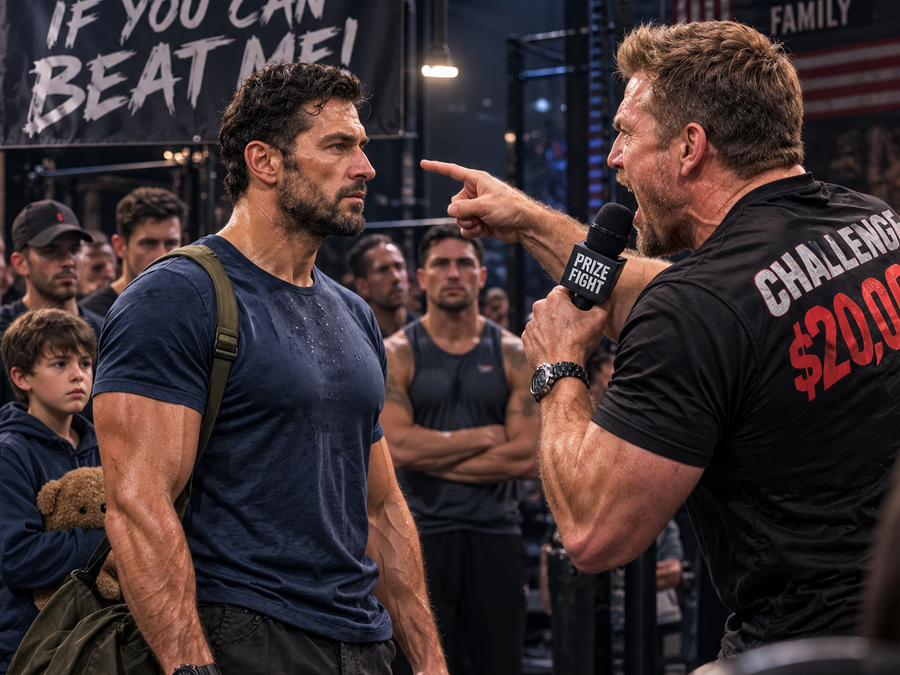
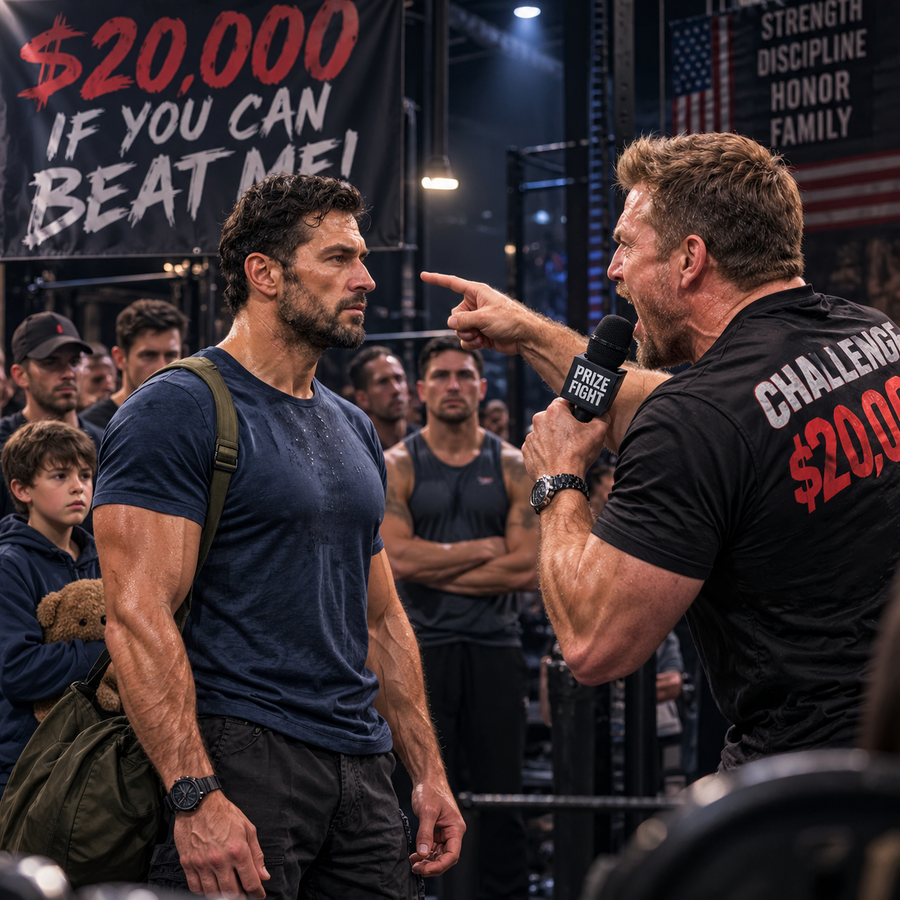
Logan Pierce snatched the microphone, pointed straight at the quiet man near the back wall, and laughed.
“Hey, you. Yeah, you with a backpack. Twenty thousand dollars if you can last one minute with me.”
The crowd exploded.
Ryan Mitchell didn’t laugh back.
He didn’t flinch.
He didn’t look away.
He set his daughter’s backpack down on the floor slowly, carefully, like it was the most important thing in the room, and walked straight toward the mat.
Nobody in that gym knew who he was. Nobody knew what was coming. And what happened next in the next forty-seven seconds would end up on every sports channel in the country by morning.
The champion’s voice cut through the noise like a gunshot.
“Twenty thousand dollars.”
Logan Pierce stood in the center of the training floor at Ironside Athletic Center in downtown Columbus, Ohio, and let those three words land like a challenge nobody in that room was ready for. He was thirty-one years old, six-two, 220 pounds of pure competitive aggression, and he had not lost a professional fight in four years. His record was clean.
His reputation was surgical. His management team had arranged this event—specifically a public open challenge at a respected community sports center, filmed for his growing social media brand—designed to generate content, generate buzz, and remind the public exactly who Logan Pierce was.
He turned slowly, letting the cameras follow him.
“Twenty thousand dollars,” he repeated, louder this time.
“To the first person in this building who can take me down and keep me there.”
The crowd reacted exactly the way his team had calculated. Laughter from some. Nervous energy from others.
A handful of younger fighters near the front exchanged looks—half excitement, half the honest recognition that they were not walking away with that money today. There were about two hundred people in the building that afternoon.
It was a Thursday, just past four, and the community center had opened its main floor for a ticketed exhibition event that Logan’s team had been promoting for three weeks on social media.
Most of the people in the stands were fans—Logan Pierce fans, specifically, the kind who followed his training videos online and wore his merchandise and genuinely believed he was untouchable. A smaller section near the side doors held community members who had wandered in out of curiosity or were waiting to pick up children from the after-school programs running in the back rooms. Ryan Mitchell was standing near those side doors.
He was not there for the exhibition. He was not there for Logan Pierce.
He didn’t follow combat sports, didn’t have a social media account, and hadn’t had a free Thursday afternoon in longer than he could honestly remember.
He was there for one reason only.
His daughter, Lily Mitchell, was seven years old and enrolled in the after-school reading program that ran in the community center’s back room every Thursday from two to four-thirty.
Ryan picked her up every week. Rain or shine.
Whether he’d slept or not.
Whether he’d eaten or not.
Whether the truck needed gas or not. He had not missed a single pickup in two years.
That record mattered more to him than anything else on Earth.
He came in through the side entrance because the main parking lot was full—overflowing, actually, with vehicles belonging to Logan Pierce’s audience.
Ryan had parked three blocks away, walked the distance in a jacket that had seen better years, and pushed through the side door expecting the usual quiet hallway that led toward the children’s wing.
Instead, he walked into a wall of noise. He stopped inside the doorway, getting his bearings, trying to understand what he was looking at. The main floor was packed.
Camera rigs were set up at two corners of the central mat. A small ring had been assembled in the middle of the space, regulation-sized, and the man standing in its center was the kind of person who visibly commanded attention—big, confident, wearing professional shorts and a fitted training shirt, with a microphone in one hand and the posture of someone who had never once in his adult life doubted that everyone in any room was looking at him.
Ryan checked the clock on the far wall. 4:17. He had thirteen minutes.
He started moving toward the hallway on the right side of the room, staying close to the wall, not making eye contact with anyone.
He just needed to get through the crowd, reach the children’s wing, and get Lily before the program wrapped up.
He’d been on his feet since five that morning.
His lower back was telling him about it in clear and direct language. He had a delivery job starting at nine that evening and needed to grab something to eat and rest for a couple of hours before then.
He wasn’t thinking about Logan Pierce.
He wasn’t thinking about money.
He was thinking about whether Lily had finished the book she’d started last week and whether she’d eaten the sandwich he’d packed and whether he remembered to sign the permission slip for the science field trip that was sitting on the kitchen table.
He was about six feet from the hallway entrance when Logan Pierce’s voice found him again.
“Come on, somebody step up.
Don’t be shy.”
Ryan kept walking. He heard laughter. Heard the crowd shifting.
Heard one of Logan’s cornermen making a comment that drew more laughs.
He kept walking.
Then Logan’s voice changed—pitch higher, theatrical, performing now.
“Hey, backpack.”
Ryan didn’t stop.
“I’m talking to you.
Old jacket near the wall.”
Someone close to Ryan elbowed a friend. A few people nearby turned to look at him. Ryan felt the attention shift in his direction, the way you feel a change in temperature.
Not dramatic. Just suddenly present.
He stopped walking. Not because he wanted to engage. Not because he felt challenged.
He stopped because the hallway door was now partially blocked by a group of people who had turned to see who Logan was pointing at.
And pushing through them while the room’s attention was aimed his way felt like it would make the situation bigger, not smaller.
So he stood still. Logan Pierce was pointing—actually pointing, with one finger extended, like he was identifying Ryan to the room.
“Backpack guy,” Logan said into the microphone.
“You came in right from work, didn’t you?
You look like you’ve been moving boxes all day.”
He paused for the laugh. And it came, scattering across the crowd.
“I’ll tell you what.
I’m feeling generous.
You want that twenty thousand.
You look like you could use it.”
More laughter.
Someone near the front shouted, “He’s going to get killed.”
Ryan looked at Logan Pierce the way he had once looked at certain situations overseas—with the quiet, comprehensive attention of a man cataloging information. Not sizing him up emotionally. Not reacting to the mockery.
Just looking. Logan Pierce was athletic, well-trained, clearly experienced.
His stance, even while standing, still carried the unconscious weight distribution of a serious fighter. He was not performing for the sake of it.
The confidence was real. The ability behind it was real. Ryan knew what he was looking at.
He also knew what Logan Pierce did not know he was looking at.
Ryan didn’t take the bait.
He turned back toward the hallway, intending to push through quietly and let the crowd refocus on something more interesting. He almost made it.
Then a voice from somewhere in the middle of the room—male, probably early twenties, the kind of voice that belongs to a person who feels protected by a crowd—called out, “Coward.”
Ryan’s feet stopped.
Not because the word hurt him. Because of what that word cost him the last time he walked quietly from something he should have walked toward.
He had been standing outside a hospital room fourteen months ago, holding a paper coffee cup that had gone cold an hour earlier, when the social worker told him that Lily’s school had flagged a concern.
“Nothing serious,” she said.
“Nothing that couldn’t be addressed.”
But a teacher had noted that Lily had come to class three times in one week without lunch and twice without completing homework that Ryan had definitely seen her working on at the kitchen table. Ryan stood there and listened to the social worker speak in the careful, professional tone of someone trying not to make a tired man feel like a failure while also communicating that certain things needed to change.
He didn’t argue.
He didn’t explain.
He didn’t tell her about the water heater that had died that month, or the transmission repair that had wiped out two weeks of savings, or the fact that he had been working a combined seventy hours a week for the previous six weeks trying to keep the electricity on and still come home before Lily’s bedtime.
He just nodded and said he understood. The social worker meant well. He knew that.
But what he heard underneath everything she was saying, with professional kindness, was a simple truth he had already been telling himself every night when the apartment went quiet. He was not enough. Not alone.
Not at the pace the world was demanding. Not without something giving somewhere.
He’d sat in the truck that evening and stared at the parking lot of his apartment building for twenty minutes before going inside.
Lily was with the neighbor, Mrs. Chen, an older woman who watched her sometimes on short notice and refused to take more than a symbolic amount of money for it. Ryan sat in the truck and calculated for maybe the hundredth time whether the numbers worked.
Whether there was a version of the situation where he wasn’t constantly behind.
Constantly trading one shortage for another. Constantly winning small and losing something else.
He always came to the same conclusion.
There wasn’t.
Not without a significant change.
Not without something that wasn’t a slow accumulation of forty-dollar shifts.
He had walked away from that calculation the same way he always had, because there was a little girl upstairs who needed dinner, and he was the only person available to make it.
The word “coward” had come out of a stranger’s mouth in the middle of a crowded gym, aimed at a man they didn’t know a single thing about.
But Ryan Mitchell stood still because he knew something about himself that the crowd did not. He was not a coward. He had never been a coward.
What he had been for the better part of three years was someone who had made the deliberate, daily choice to hold himself back because the cost of engaging with the world the way he was built to engage with it was too high. Not for him.
For Lily. A man who got into fights—even the right kind, even the kind he won—was not the stable, predictable presence she needed.
A man who showed up on television doing something impressive but chaotic was not the man who helped with reading homework and made lunches and sat through school plays in folding chairs without complaint. So he had stayed quiet.
He had stayed invisible. He had traded who he used to be for who his daughter needed him to be. And he had done it without resentment, without grief, without asking anyone to recognize the cost.
He was proud of that. But twenty thousand dollars was sitting in the middle of a gym thirty feet away from him.
And someone had just called him a coward. And the back rent was forty-three days past due.
And Lily’s winter coat had a broken zipper that he’d been meaning to fix for three weeks.
And the truck needed two new front tires before snow hit.
And he couldn’t afford to wait another month.
And the school field trip required $112 in fees that he hadn’t figured out yet.
Ryan slowly turned around. The crowd shifted.
Logan Pierce’s grin widened—the kind of grin that meant he already knew the outcome of what was about to happen and found the process entertaining rather than genuine.
“All right,” Logan said into the microphone, drawing the word out.
“Look at that.
Backpack’s got some spirit after all.”
Ryan set his backpack down on the floor near the side wall, next to a water fountain that wasn’t running.
He placed it carefully.
Not the way you drop something you don’t care about, but the way you set down something that matters.
He crouched for a second, made sure the top pouch was zipped, checked once. A few people nearby glanced at the bag. Curious.
Nothing impressive was visible.
Just the worn fabric of an old daypack, a corner of a child’s pink jacket tucked near the top, and the edge of what might have been a granola bar wrapper.
Ryan straightened up.
He didn’t stretch.
Didn’t roll his neck.
Didn’t perform any of the physical rituals that fighters use to signal readiness to an audience.
He simply stood there. And then he started walking toward the mat.
The crowd was making noise now. Not the encouraging kind.
Mostly the kind that anticipated impact. The kind that gathers when people are about to watch something they expect to be quick and uncomfortable for the smaller person involved. Logan Pierce stepped back into his corner of the mat, rotating his shoulders, still smiling.
His trainer, a compact man named Desmond who’d been with Logan for six years, leaned forward from outside the mat’s edge and said quietly, “You don’t need to actually hurt this guy, Logan.”
Logan didn’t respond.
The referee for the exhibition, a local club official named Marcus who had been doing this for sixteen years, stepped to the center and looked at Ryan.
“You understand this is a controlled exhibition?
Tap means stop.
You tap at any time, fight ends immediately.”
Ryan nodded once. Marcus looked at him for a moment.
Longer than he usually looked at challengers.
Something in Ryan’s stillness registered as unusual.
Marcus had spent sixteen years watching people walk onto mats. The nervous ones.
The overconfident ones. The ones doing it for the crowd. The ones doing it because they were angry.
He had a reliable instinct for reading what a person was made of before the first contact.
He wasn’t sure what Ryan Mitchell was made of.
But he was sure it was something he hadn’t seen in this setting before.
“All right,” Marcus said, and stepped to the side.
Logan Pierce rolled his head once and settled into his stance. The room went quiet.
And in that quiet, standing twelve feet away from one of the fighters in the current regional circuit, Ryan Mitchell experienced something he hadn’t felt in a long time.
Clarity. Not calm. Calm was what you performed.
Clarity was what happened when everything unnecessary fell away and the only things left were facts. He knew this feeling from overseas. He knew it from the kind of moments where the difference between a good decision and a catastrophic one was measured in fractions of a second.
He had lived in that clarity before. He had built himself around it.
He felt it now, standing on a mat in a community sports center in Columbus, Ohio, in an old work jacket, with his daughter’s snack in his backpack ten feet away, about to do something he had not done in three years.
He breathed out slowly. Logan came forward. 👉👈
Part 2
The fight lasted forty-seven seconds.
Days later, when the footage had been reviewed and replayed and slowed down and analyzed by people who understood what they were watching, the consensus among those who knew the sport was that what happened in those forty-seven seconds was one of the most precise pieces of physical problem-solving any of them had witnessed in an informal setting. Logan Pierce was not a sloppy fighter. That needed to be understood clearly before anything else.
He was fast. Technically sound.
Genuinely experienced. And he led with a combination that had ended dozens of fights before this one—a feint to the body followed by a high attack that most opponents never picked up on until it had already landed. Ryan picked it up before the feint was even complete.
He didn’t counter it.
He didn’t meet it with force.
He simply wasn’t where Logan was aiming when the commitment came through.
Shifted three inches to the outside, weight already transitioning, and Logan’s follow-through carried him slightly past the point of balance he’d planned on.
That was the moment. Three inches. One beat of timing.
A body that knew exactly what it was doing, even after three years of doing nothing like this. What followed was not a brawl. It was not dramatic in the way the crowd had expected dramatic to look.
There were no big exchanges. No back-and-forth.
No moment where either man absorbed punishment and kept going. It was quiet and geometrically precise. And it was over before most people in the audience fully registered that something was happening.
Ryan redirected Logan’s weight, stepped into the resulting space, and took him down with a technique so clean and efficient that the crowd’s first collective response was confusion.
A tiny second of silence while two hundred people tried to understand why Logan Pierce was on the mat. Logan was not a small man.
He was not easy to move. He had been attempting takedown defense for four years against professionals.
What Ryan did shouldn’t have worked on someone like Logan.
It worked because Ryan hadn’t tried to overpower him.
He had simply understood, in the moment, where Logan’s weight was committed to going and given it a more direct path to the floor.
Logan was on his back. Ryan was not on top of him in the way of someone dominating from strength. He was positioned—controlled, economical, balanced—in a way that gave Logan no efficient exit while requiring Ryan to expend almost nothing to maintain.
Logan felt it immediately. He was experienced enough to understand what the position meant.
He tested two escapes in rapid succession—the kind any trained fighter would attempt first, and the kind that work against a wide range of opponents. Neither worked. Not because Ryan overpowered them.
Because he anticipated them both and was already in a different position than the one Logan was escaping from. Logan tried a third approach.
Ryan’s weight shifted three inches again.
Same result.
Forty-one seconds in, Logan Pierce had used a significant portion of his available energy on attempts that produced no progress, and he was beginning to breathe harder than he’d breathed in a real fight in over a year.
Six seconds later, his hand found the mat. Three quick taps.
Marcus called it immediately.
The room didn’t explode the way rooms usually do after an upset.
It went completely, utterly, stunned quiet. And in that quiet, Ryan Mitchell stood up, walked back toward his backpack, and picked it up. He checked the time.
4:29. One minute. He shouldered the backpack and started toward the hallway.
He was almost there when Logan Pierce said, from somewhere behind him, in a voice that was stripped of performance and genuinely confused.
“Hey.”
Ryan stopped. Turned. Logan was on his feet.
Desmond was beside him, doing the job of any good trainer after an unexpected result—quiet, steady, making sure the fighter was physically fine before anything else. Logan waved him off slightly and looked across the mat at Ryan. The cameras were still rolling.
The crowd was very still. Nobody seemed to know what the appropriate response was.
“Who are you?”
Logan asked.
He wasn’t being theatrical.
He was genuinely asking. Ryan glanced at the hallway door. Glanced back at Logan.
“Ryan Mitchell,” he said.
“Where did you train?”
Ryan adjusted the strap of his backpack.
“Marine Corps.”
“That’s not—” Logan stopped.
Reorganized.
“When did you last compete or train?”
“Three years ago,” Ryan said.
Silence. Logan looked at him.
Looked at the jacket, the jeans, the old backpack, the clear absence of any investment in what had just happened beyond the moment itself. He looked at the clock on the wall, where Ryan had looked twice.
“You have somewhere to be,” Logan said.
It wasn’t a question.
“Yes.”
“Your daughter,” Desmond said quietly from beside Logan.
He had been the one standing nearest to where Ryan had set down his backpack. He had seen the pink jacket inside. Had seen the small photograph tucked in the outer pocket.
A small girl with Ryan’s eyes, holding a stuffed bear.
Logan looked at Desmond, then back at Ryan. His expression changed.
Not dramatically. Logan Pierce was not the kind of man whose face made large movements. But something shifted in his eyes that was genuine and visible to anyone paying attention.
“The money,” Logan said.
He turned to his management coordinator, a woman named Sandra, who was already white-faced with the logistical implications of what had just happened.
“The twenty thousand.
It was a real offer.”
Sandra opened her mouth. Logan looked at her directly.
“It was a real offer,” he repeated.
Sandra closed her mouth. Logan turned back to Ryan.
“You’ll have a check within forty-eight hours.
I’ll have Sandra get your information.”
Ryan looked at him for a moment.
“I appreciate that.
Can I—” Logan stopped again.
Ran a hand over his head.
“I want to ask you something and I don’t know how to ask it without it sounding wrong.
So I’m just going to say it.”
Ryan waited.
“Why are you working a job?”
Logan asked.
“Whatever job you’re working, why—with what you just showed me?
You could be—” “Mr.Pierce,” Ryan said.
Logan stopped.
Ryan’s voice wasn’t hard.
It wasn’t cold.
It was the voice of a man who had made a decision a long time ago and was completely at peace with it.
“My daughter’s program ends in thirty seconds.
I’ve never been late picking her up.
I’m not going to be late today.”
He held Logan’s gaze for one more moment.
Then he turned, pushed through the hallway door, and was gone. The hallway was quieter.
The noise from the main floor muffled behind the heavy door. Ryan moved through the familiar corridor—past the bulletin board covered in flyers for local programs, past the water fountain that worked, past the mural some community kids had painted three summers ago of the Columbus skyline in bright reds and blues—toward the reading room at the end of the hall. The door was already opening.
Lily came out first, the way she always did, because she had inherited something from her father: a preference for being in motion rather than waiting. She was carrying a library book under one arm and had her jacket half on, one sleeve dragging, and she was already looking for him before she was fully through the door. She found him.
“Dad.”
She said it the way she always said it. Not like a greeting, exactly. More like a confirmation.
Like her day wasn’t fully real until he was standing there, making it real.
Ryan crouched down to her level. She walked into his arms, and he held her, and over her shoulder he looked at nothing in particular and breathed.
“You’re on time,” she said into his shoulder.
Slightly accusatory, which meant she’d been worried.
“I’m always on time,” he said.
“You almost weren’t.”
He pulled back to look at her face.
She had a smear of something purple on her left cheek—marker, probably, from some art project—and her hair was escaping from both sides of the braid he’d done that morning.
“Almost doesn’t count,” he said.
She considered this.
“Mrs.Patterson says ‘almost’ is the most important word in the English language.”
“Mrs.Patterson is a very smart teacher.”
“She says that if you’re almost on time for something important, you’re actually late.”
Ryan stood up, took the library book from under her arm so she could finish getting her jacket on, and held it while she wrestled with the sleeve.
“Then I’ll make sure ‘almost’ never applies to picking you up,” he said.
“Good.”
She got the sleeve on, looked up at him.
“What happened to your hands?”
Ryan glanced down. The knuckles of his right hand had a faint redness to them. Nothing broken.
Nothing serious. The kind of contact that leaves a mark you notice later rather than in the moment.
“Nothing,” he said.
“Bumped them on something.”
Lily studied his hands with the particular attention of a seven-year-old who has decided she is not being given the full story.
“They look like you hit something.”
“I told you.”
“Did you fight someone, Lily?”
She crossed her arms.
“Dad.
Did you fight someone?”
He looked at her. She looked at him.
Somewhere in the exchange, the same face looked back at itself from two different heights.
“We’ll talk about it in the truck,” he said.
Her eyes went wide.
“The truck?
Was it bad?
Lily, are you in trouble?”
“I’m not in trouble.
Everything’s fine.
Truck.
Now.”
She uncrossed her arms, clearly filing this conversation away for continued excavation later, and fell into step beside him. Her hand found his automatically, the way it always did in hallways and parking lots and anywhere with people moving around them.
And he held it the way he always held it. Firmly. Without making a production of it.
They walked back down the corridor, past the mural, past the bulletin board, toward the side exit.
“I finished the book,” she said, shifting topics with a rapid lateral movement that characterized every conversation he’d had with her since she was five.
“The one about the lighthouse keeper.”
“Yes.”
“It was sad but also happy at the end.”
“That’s the best kind.”
“The lighthouse keeper had a daughter,” she said.
“And she had to learn to keep the light going when he was too sick to do it.
And she was scared, but she did it anyway.”
Ryan pushed the side door open. The late afternoon air was cool.
“Why was she scared?”
he asked. Lily thought about it as they walked toward the street.
“Because,” she said finally, “the light was important.
And if she messed it up, ships could crash. So being scared was the right thing to feel.
But you do it anyway because the ships need the light.”
Ryan walked.
“Dad.”
“Yeah.”
“Is that what you do when you’re scared about stuff?
You do it anyway because we need the light?”
He looked down at her.
She was looking straight ahead, working on something in her mind, the way she did when she’d arrived at a thought that was bigger than she was entirely sure how to carry.
“Where did that come from?”
he asked. She shrugged.
A seven-year-old’s shrug.
Economical and deeply serious.
“I was just thinking.”
Ryan put his arm around her shoulders as they walked.
“Yeah, Lily Bug,” he said quietly.
“That’s pretty much exactly what it is.”
She nodded, satisfied. Like a question that had been sitting with her for a while had finally been given a proper answer. They walked the three blocks to the truck in the cooling Thursday afternoon.
Her hand in his. The library book under his arm.
The twenty-thousand-dollar check—not yet written, but already real somewhere in the world. The back rent and the tires and the field trip fees and the broken zipper.
All still exactly where they’d been three hours ago.
But something was different. Not fixed.
Not resolved. Not anything so clean and immediate as that.
Different in the way the air feels different before a change in weather.
When you can’t see it yet, but your body knows it’s coming, because the pressure has shifted in some way that can’t be unfelt.
Ryan Mitchell had not planned to walk into that gym. He had not planned to step onto that mat.
He had not planned to prove anything to anyone. Least of all himself. He already knew exactly who he was and exactly what he was capable of, and had made his peace with keeping it quiet.
But sometimes the world reaches into the place where you’ve carefully stored the most important parts of yourself and pulls one of them back out.
Not to humiliate you. Not to make a spectacle.
But because somewhere in the distance, a ship needs the light, and you’re the only one who knows how to keep it burning.
👉👈
Part 3
The hallway door swung shut behind Ryan, and the noise from the main floor dropped away like a curtain falling.
But the quiet out here wasn’t the kind that settled.
It was the kind that pressed. The kind that followed a man home and sat across from him at the kitchen table while he counted what was left of the week. Lily was talking.
She was always talking after the reading program. Words stacked on top of words. Ideas bumping into each other.
The way a child’s mind works when it’s been given good material and hasn’t had anyone to share it with for two hours.
Ryan heard her. He answered her.
He kept his hand on her shoulder as they walked the three blocks back to the truck, and he opened her door and made sure her seat belt clicked before he walked around to the driver’s side.
But the moment he sat down and closed his door, she stopped talking. She was looking at his hands again.
“Dad.”
“I already told you.”
“I know what you told me.”
She said it exactly the way his mother used to say things. That particular combination of patience and certainty that communicated clearly that the person speaking already knew the full truth and was simply waiting for you to stop wasting both of your time.
“Tell me the real thing.”
Ryan put both hands on the steering wheel and looked straight through the windshield at the parking structure across the street.
“There was a man in there offering money to anyone who could beat him in a fight,” he said.
Silence.
“How much money?”
Lily asked.
“Twenty thousand dollars.”
Another silence. Longer this time.
“And you beat him?”
she said.
He didn’t answer.
“Dad.
You beat him.”
“I stepped onto the mat and the fight ended quickly,” he said.
“That’s what happened.”
Lily was quiet for four full seconds, which was, for her, an extraordinary amount of restraint.
Then she said, very carefully, “Does that mean we have twenty thousand dollars?”
Ryan finally looked at her. She was watching him with an expression that was doing its very best to be neutral and was failing completely.
Behind the neutrality was something she was trying not to show him.
Something that looked a great deal like the particular hope that children learn to be careful with after they’ve had it disappointed enough times.
He recognized it because he had put it there. Not intentionally. Not through cruelty or carelessness.
But through three years of her watching him do the math out loud at the kitchen table. Watching his face when bills arrived. Watching him put things back on shelves at the grocery store without explaining why.
Children learn the shape of a family’s struggles the way they learn the layout of their home.
Without anyone teaching them. Just by living inside it long enough.
“He said he’d have a check sent,” Ryan said.
“I gave his coordinator my information.”
Lily nodded slowly.
“Okay.”
“Okay,” he repeated.
She turned and looked out her window. Ryan started the engine.
Then she said, very quietly, almost to herself.
“I knew you were strong, Dad.”
He kept his eyes on the road. His jaw tightened once.
That was all.
“Buckled?”
he asked.
“I’ve been buckled,” she said.
“I buckled before you even got in.”
They drove.
The route home took them down Whitmore Avenue, past the auto parts store where Ryan had worked briefly two winters ago, past the laundromat where he took their clothes every Sunday because the building’s machines had been broken for eight months and the management company kept sending notices about repairs that never happened, past the corner where a taco truck parked on Thursday evenings that Lily had declared, at age five, to be her favorite restaurant in the world.
She pressed her face against the glass as they passed it.
“Dad.”
“Not tonight, Lily Bug.”
“I didn’t say anything.”
“You were about to.”
She pulled her face back from the glass.
“I was just looking.”
“I know.”
She was quiet.
Then: “When the check comes—” “When the check comes, we’re going to take care of some things that need taking care of.
Then we’ll see.”
“The taco truck is a thing that needs taking care of,” she said.
Despite everything, Ryan almost smiled. Almost. He turned onto their street.
The apartment building came into view at the end of the block—a six-floor brick structure that had been built in the 1960s and maintained with the casual indifference of a landlord who understood that people with limited options don’t leave easily.
The front steps needed work.
The intercom panel in the lobby had three buttons that didn’t correspond to any actual unit.
The elevator ran, mostly, except on very cold mornings.
Ryan had lived here for two years and nine months, and he had made his peace with the building the way you make peace with anything you can’t change.
By focusing on what’s actually inside it rather than what surrounds it.
What was inside his apartment on the third floor was Lily’s drawings covering the refrigerator, a bookshelf they’d built together from a flat-pack kit that had taken an entire Saturday and produced two leftover bolts neither of them could account for, and a lamp with a yellow shade that Lily had chosen because she said yellow was the color of staying awake.
He parked. They went inside, and the evening moved forward the way evenings did.
Dinner, which was scrambled eggs and toast because it was Thursday and Thursday was the day before Ryan’s delivery route ran, and the refrigerator reflected that accurately.
Homework at the kitchen table.
Lily’s bath.
Thirty minutes of reading before bed. Lights out at 8:30.
Ryan sat on the edge of her bed while she settled.
“Dad,” she said.
“That man who offered the money.
Was he mean?”
Ryan considered the question with the seriousness it deserved, coming from her.
“He was performing,” he said finally.
“He was in front of cameras and an audience, and he was doing what he does in front of cameras and audiences.
Whether that’s the same as mean, I don’t know.”
“He pointed at you,” she said.
“I bet that felt mean.”
He looked at her.
“How do you know he pointed at me?”
She met his eyes steadily.
“Because you walked away from a mean thing and then you went back.
You only go back to something if someone pushes it.”
Ryan sat with that for a moment.
“Go to sleep, Lily.”
“Okay.”
She pulled her blanket up.
“Dad.”
“Yeah.”
“I’m glad you went back.”
He turned off the lamp.
“Go to sleep,” he said again.
She did. Ryan sat in the kitchen alone for a long time after that. At the table.
With a glass of water he wasn’t drinking.
Looking at nothing in particular and thinking about everything. The delivery job started at nine.
He had an hour and forty minutes. He thought about the twenty thousand dollars with the same careful, controlled attention he gave to every resource that had the potential to change something real. Not excitement.
Excitement was for people who hadn’t learned yet how quickly a large number could become a smaller number when reality started subtracting from it.
He thought about it practically. The back rent first.
The tires. The field trip fees.
Lily’s winter coat.
A buffer—whatever remained, put somewhere he wouldn’t touch unless it was necessary, because a buffer against the next emergency was worth more than any single comfort.
He did the math. The large number became a smaller number fairly quickly.
But what remained after the subtracting was something he hadn’t had in a very long time.
Room. Not wealth.
Not security in any permanent sense. Just a small, real measure of breathing space between where they were and the next crisis.
He sat with that and let himself feel it. Quietly.
The way he let himself feel most things. Without drama. Without performance.
With the simple acknowledgement that it was real. Then he changed his shirt, filled a thermos with coffee, and went to work.
The delivery route ran from nine in the evening until somewhere between three and four in the morning, depending on volume. He drove a panel van for a regional distribution company. Package sorting first, then route delivery to commercial addresses that received overnight freight.
The work was physical and solitary and required concentration without being complex, which suited him. He could think while he worked.
He usually did. That night, somewhere around the second hour of the route, his phone buzzed. He pulled over in a loading zone, engine running, and looked at the screen.
Unknown number. Columbus area code.
He answered.
“Mr.Mitchell.”
A woman’s voice.
Professional. Slightly brittle.
The voice of someone managing more than they had anticipated managing that evening.
“This is Sandra Reyes.
I work with Logan Pierce’s management.”
“I know who you are,” Ryan said.
“Right.
Of course.”
A pause. Brief.
Controlled.
“I’m calling to confirm your banking information for the wire transfer.
Mr. Pierce has authorized the full twenty thousand.
As stated, we’d like to process it by end of business tomorrow.”
Ryan gave her the information.
“Thank you,” she said.
Another pause. Slightly longer than the first.
Then: “Mr.Mitchell, I have to ask. And this is completely off the record. Not anything official from the organization.
I just have to ask.”
“Ask.”
He said, “How long ago did you leave the military?”
“Three years.”
“And you haven’t trained since?”
“Not formally.”
She was quiet for a moment.
“I’ve been with Logan’s team for four years,” she said.
“I’ve watched a lot of fights.
I’ve seen a lot of people step onto that mat thinking they could do what you did today.
None of them could.”
Another pause.
“You should know that.”
Ryan didn’t respond.
“I’m not saying that for any particular reason,” Sandra said.
“I just—I think sometimes people don’t know what they have.
And it seems like a waste, is all.”
“Thank you for calling about the transfer,” Ryan said.
She let the deflection stand.
“You’ll see it in your account by five tomorrow afternoon.”
He thanked her and ended the call. He sat in the loading zone for a moment. Longer than necessary.
Engine running. The city quiet around the van. Then he pulled back out into the street and finished the route.
He got home at 3:47. Checked on Lily.
She was sleeping on her side with her arm around the stuffed bear she’d had since she was three—a bear named Gerald, for reasons she had never fully explained.
Ryan stood in the doorway of her room for approximately twenty seconds, which was his version of allowing himself something that felt close to gratitude, before closing the door carefully and going to bed. His alarm was set for 6:15.
He was asleep before his head finished settling. He dreamed about sand. Which happened sometimes.
Not with drama. Not as a nightmare in the cinematic sense.
But with the particular texture of the subconscious working through things it hadn’t finished processing.
The heat. The weight of gear.
The particular quality of attention required when every decision exists inside a margin that permits no revision. He dreamed about a man named Torres, who had been his closest friend in the Corps for two years. A compact and irreverent person from Albuquerque who had an opinion about everything and was right about most of them.
And who had told Ryan once, at three in the morning on a base in a country Ryan no longer permitted himself to think about too directly, that the scariest thing about highly capable people was that they were usually the last ones to understand what they were worth. Ryan had told him he was full of it.
Torres had laughed and said, “Sure, Mitch.
Keep telling yourself that.”
In the dream, Torres said it again. Ryan woke up at 6:30. Two minutes before the alarm.
He lay still for a moment, looking at the ceiling, letting his mind settle into the day. 👉👈
Part 4
Friday.
Lily had school. He had a service call at eight—a compressor unit at a commercial kitchen two miles away—and another one at eleven that he estimated would take most of the afternoon. He needed to call the school about the field trip form.
He needed to get the truck to a tire place before the end of the month.
He got up, showered, dressed, started coffee, and was halfway through making Lily’s lunch when his phone buzzed again.
Different unknown number. He answered.
“Is this Ryan Mitchell?”
Male voice. Measured.
Deliberate. Not the voice of someone making a routine call.
“Who’s asking?”
Ryan said.
“My name is Carl Hendris.
I own Hrix Performance and Athletic Training.
It’s a fitness facility here in Columbus.
We do youth development programs, adult conditioning, some semi-professional training contracts.
A bit of everything.”
A pause.
“I was at Ironside yesterday.
I watched what you did.”
Ryan said nothing.
“I want to offer you a job,” Carl Hendris said.
Ryan set down the knife he’d been using to cut Lily’s apple into the specific eight equal slices she preferred and leaned against the counter.
“I’m employed,” he said.
“I know.
I did some asking around after yesterday.”
Another measured beat.
“I’m not talking about a better version of what you’re currently doing.
I’m talking about something different.
I run a legitimate operation with real youth programming. Kids twelve to eighteen, mostly from this side of the city. A lot of them without much structured activity in their lives.
I need a trainer.
Someone who can teach discipline and physical skill and do it in a way that actually lands with kids who have good reasons not to trust people who show up with plans.”
Ryan said nothing.
“I watched you walk off that mat,” Carl said.
“And I watched you pick up that backpack.
I don’t know what’s in it, but I saw how you picked it up.
And that told me more than the fight did.”
Ryan looked at the apple slices on the cutting board.
“What does the position pay?”
he asked. Carl told him.
It was more than Ryan made from the service calls and the delivery route combined. Not by a life-changing margin, but by a real one. More importantly, the hours Carl described were day hours.
Structured hours. The kind of hours that had a person home by six most evenings and off on weekends.
Ryan was quiet for long enough that Carl said, “Still there?”
“Still here,” Ryan said.
“I want to think about it.”
“That’s fair.
Can I call you back today?”
“Take until Monday,” Carl said.
“I’ve been looking for the right person for this position for eleven months.
I can wait a weekend.”
Ryan thanked him and ended the call. He stood in the kitchen looking at the apple slices.
From down the hall, the sound of Lily’s alarm going off.
The one she’d set herself on a secondhand digital clock she’d configured with great ceremony the previous year, declaring that she was old enough to get herself up in the mornings.
She almost always beat it by five minutes but considered the act of turning it off to be important to the ritual. The alarm stopped.
Her feet on the floor. Her door opening. She appeared in the kitchen doorway, hair in the particular state of geological disruption that seven hours of sleep reliably produced, wearing the oversized t-shirt she used as pajamas, still mostly asleep in the eyes but functional enough to locate the kitchen and her father inside it.
“Morning,” she said.
“Morning,” Ryan said.
“Pancakes or toast?”
She climbed onto her chair at the table. Considered the question with visible seriousness.
“Pancakes,” she said.
“Because yesterday was a big day.”
Ryan reached for the cabinet where the mix was.
“It was,” he said.
“Are we different now?”
she asked. He looked over his shoulder at her.
Her expression was entirely sincere. Not dramatic. Not performing.
Just genuinely curious, in the direct way she had of asking the questions that most adults had learned to approach sideways.
“Are we different from yesterday?”
she clarified. Ryan turned back to the cabinet.
“Some things changed,” he said.
“We’re still us.”
She seemed to find this answer acceptable.
She pulled her knees up to her chest on the chair, which she did when she was settling into a comfortable morning, and said, “Good.
I like us.”
Ryan started the pancakes. He was thinking about the phone call.
About Carl Hendris. About the job and the hours and what day hours would mean concretely, practically, in the actual texture of daily life.
He was thinking about Torres, telling him that capable people were always the last to understand what they were worth. He was thinking about a job that involved twelve-to-eighteen-year-olds from this side of the city who had good reasons not to trust people who showed up with plans.
He knew what that meant.
He’d been one of them.
Not in Columbus. A different city.
A different decade. But the same particular combination of circumstance and limited margin.
And the presence of exactly one adult who had managed to show up consistently enough that something in Ryan’s structure had held when it might otherwise have broken.
He knew what it cost to be that adult. He knew what it cost not to be one.
“Dad,” Lily said.
“Yeah.”
“If things change, does that mean I have to change schools?”
He looked at her. She was watching him with the particular focus she applied to things that mattered to her and that she was trying not to show mattered to her.
“No,” he said.
“Nobody’s changing schools.”
She relaxed. Not dramatically.
A small, specific release of tension across her shoulders that he’d learned to read the way you learn to read weather.
“Okay,” she said.
“Just checking.”
“Eat your breakfast,” he said.
“Bus in twenty-two minutes.”
She straightened up.
“Twenty-two is very specific.”
“I know exactly how long it takes you to eat pancakes and then spend ten minutes on your shoes.”
“I’ll spend ten minutes on my shoes.”
“Seven minutes.”
“Then it’s more like four.”
She paused.
“Sometimes five.”
He set the first pancake in front of her. She picked up her fork.
“Dad,” she said.
“What?”
“I told Mrs.Patterson about you this morning.”
He stopped.
“You didn’t have school this morning.
You just woke up.”
“In my head,” she said.
“I was thinking about what I’d tell her.”
She cut into the pancake with careful precision.
“I told her in my head that my dad walked into a gym yesterday and nobody knew who he was.
And he did something nobody expected.
And then he picked up his backpack and came and got me, because that was what mattered.”
Ryan stood at the stove.
“And what did Mrs.Patterson say?”
he asked.
“In your head?”
Lily chewed. Considered.
“That’s a story worth writing down,” she said.
Ryan turned back to the stove. His jaw was doing the thing again. The tightening.
The controlled stillness. That meant something real was moving underneath it. He made the second pancake.
The morning moved forward the way mornings do when a man is standing in his own kitchen making breakfast for his daughter, with a wire transfer coming in by five and a phone call he needs to return and a job offer sitting on the counter like something that arrived from a direction he hadn’t been watching.
He got Lily to the bus with four minutes to spare. He stood on the sidewalk and watched the bus pull away, the way he always did, until it turned the corner and was gone.
Then he stood there a moment longer. The city was running its morning routines around him.
Traffic on the main street two blocks over.
Someone’s radio from an upper window.
The smell of someone’s coffee from a ground-floor apartment.
Ryan Mitchell stood on the sidewalk in front of his building and thought about who he had been before Lily. Not with regret. Not with longing.
With the clear-eyed assessment of a man who has been carrying something heavy for a long time and is finally, if only briefly, putting it down and looking at it straight. He had been a Marine. Before that, he had been a kid from a neighborhood not entirely unlike this one.
With a mother who worked double shifts and a father who’d been gone since Ryan was nine and a particular talent for reading situations and responding to them faster and more accurately than most people around him.
The Corps had taken that talent and built an architecture around it. Had given it structure and language and discipline and purpose.
He had been good. Not adequate.
Genuinely, exceptionally good, in the way that some people are built for certain things—the way an instrument is built for certain sounds. And then he had left.
Not dishonorably. His service was complete. His exit was clean.
His record was the kind that nobody could argue with. He left because he had started to want a different life. Slower.
With different anchors.
He left because he had met a woman named Clare at a friend’s gathering in Cincinnati, and something happened that he hadn’t been prepared for, which was that he found himself wanting a specific future with a specific person for the first time in his adult life.
He had built toward that future with the same discipline he brought to everything. And then Clare got sick.
He was thirty-one when the diagnosis came. Lily was fourteen months old.
He didn’t let himself stop moving.
He didn’t have the luxury.
Clare’s treatment ran for nineteen months.
Hope to no more hope. And through all of it, Ryan managed Lily and the medical coordination and the insurance battles and his own employment, because none of those things had the decency to pause while life fell apart.
He did it the way he’d done difficult things in the Corps.
By breaking it into the next required action and executing that action. And then identifying the next one.
He didn’t break.
But something changed.
After Clare died, Ryan was thirty-three years old with a three-year-old daughter and a reduced version of the savings they’d accumulated and a set of skills that the civilian job market received with the particular combination of respect and confusion it reliably extended toward veterans.
Acknowledged in principle. Underutilized in practice. He tried several things.
A security consulting contract that went sideways when the company restructured. A business with a friend from the Corps—physical training and security services—that survived eleven months before the financial foundation proved too thin. A series of service jobs that paid adequately but never enough and never in the configuration that gave him the hours he needed to be where Lily needed him to be.
He had made his adjustments. He had made his peace.
He had gotten very good at the version of life available to him and had stopped, with considerable deliberateness, thinking about the version that wasn’t.
And then Logan Pierce had pointed a finger at him in a crowded gym and called him “backpack guy.”
And a stranger in the audience had said a word that cost seven letters and changed the next forty-seven seconds of Ryan’s life.
And now it was Friday morning and the money was coming. And a man named Carl Hendris had called and offered him something that looked, from a sufficient distance, like a door. Ryan took out his phone.
He found Carl Hendris’s number in his recent calls.
He stood on the sidewalk in front of his building and looked at the number for a moment. He thought about twelve-to-eighteen-year-olds from this side of the city.
He thought about Lily asking, in complete sincerity, “Are we different now?”
He thought about Torres, dead three years now from something that had nothing to do with combat, saying, “The scariest thing about capable people is they’re always the last ones to know what they’re worth.”
Ryan pressed call. It rang twice.
“Hrix,” the voice said.
“It’s Ryan Mitchell,” Ryan said.
“I’ve thought about it.
I’m interested.
Tell me more about the program.”
There was a pause on the other end. Brief.
Genuine. The pause of a man who had been doing this long enough to know that the right person saying yes felt different from anyone else saying yes.
“Monday morning,” Carl said.
“Come by the facility.
Nine o’clock.
I’ll show you what we’re building.”
“I’ll be there,” Ryan said.
He ended the call. He put the phone in his pocket.
He stood on the sidewalk in the morning air, in his work jacket, with a service call to get to and a truck that needed tires and a daughter who was currently on a school bus heading toward Mrs. Patterson and a story worth writing down.
Something was moving.
He couldn’t see the shape of it yet.
Not fully. But he could feel the direction. And for the first time in three years, the direction felt like forward.
Monday came the way Mondays always did in Ryan’s life.
Early. Without ceremony. With a list of things that needed doing before the day gave him permission to think about anything else.
He was up at 5:45. Coffee made.
Lily’s lunch packed.
Her uniform laid out on the chair by her door. He moved through the apartment in the particular quiet of a man who had done this exact sequence so many times that his body knew it without instruction, which left his mind free to run through what was coming.
Nine o’clock at Hendris Performance and Athletic Training.
He had looked the facility up over the weekend. It was a real, established operation on the east side of Columbus.
Twelve years in business, with a legitimate youth development program that had placed a number of kids into college athletic programs, and—from what he could piece together from the facility’s basic web presence—a reputation in the community that had been built slowly and held carefully.
Carl Hendris was not a promoter. He was not a networker looking for a name to attach to his brand.
He was someone who had spent a decade building something modest and functional and was now trying to make it better. Ryan respected that. He got Lily to the bus at 7:22.
She was wearing her backpack and carrying a permission slip she’d remembered at the last possible second, and she kissed him on the cheek in that brisk, business-like way she had when she was focused on something else and said, “Be good at your new thing,” and climbed onto the bus before he could respond.
He stood on the sidewalk and watched the bus go. Then he went back upstairs, changed into clean clothes, and drove across town. Carl Hendris met him at the front door of the facility at 8:57—which told Ryan something about the man immediately.
He’d been there early enough to be at the door when Ryan arrived, which meant he’d been there earlier than that.
A man who opens his own door before the appointment is a man who takes the appointment seriously. Carl was in his mid-fifties, compact and direct in his movements, with the physical ease of someone who had stayed active without making it a performance.
He shook Ryan’s hand with a grip that was firm and brief and led him inside without preamble.
“I’ll show you the floor first,” Carl said.
“Then we’ll sit down and talk specifics.
I find it’s easier to have a conversation when a person knows what they’re actually looking at.”
Ryan followed him through the facility. It was clean, well-maintained, with the particular character of a place that had been built up piece by piece rather than designed all at once. Equipment that was high-quality but not new.
Wall space that had been repurposed multiple times. A training floor that showed real use.
There were photographs on one wall. Teams.
Kids in competition gear.
A timeline of the program’s history that started with a single photograph of an empty room and moved forward in increments of visible growth.
Ryan stopped at the photographs without planning to. Carl stopped with him.
“Started with six kids,” Carl said.
“Twelve to fourteen.
All from within two miles of this building. None of them had anywhere structured to go after school.
Three of them had already been picked up once by the juvenile system. Nothing serious. But nothing harmless either.
Just kids with time and nowhere good to put it.”
Ryan looked at a photograph of a group of teenagers in matching shirts. Some of them grinning at the camera with the specific energy of young people who have recently been told they belong somewhere.
“Where are they now?”
Ryan asked.
“Two in college.
One in the military—Navy. One managing a gym in Cleveland.
One I lost track of.”
Carl paused.
“One I lost.”
He said it plainly, without drama, and moved past it in the way of someone who had made his peace with a fact without dismissing its weight.
“That was eight years ago.
It made me build the program differently.”
Ryan looked at him.
“Different how?”
Carl turned and started walking again.
“Come on.
I’ll explain over coffee.”
They sat in Carl’s office, which was a small room adjacent to the main floor, with a desk covered in organized paperwork and two chairs that had been there long enough to have opinions about it.
Carl poured coffee from a machine on the credenza and handed Ryan a mug and sat down and looked at him directly.
“I’m not going to waste your time with a sales pitch,” Carl said.
“You watched me watch you on Thursday.
You know I’m interested.
I want to explain why specifically, because I think the reason matters.”
“Go ahead,” Ryan said.
“I’ve had trainers before.
Good ones.
Technically, people who could teach form and conditioning and put a kid through a legitimate program.”
Carl leaned forward slightly.
“What I’ve never been able to find is someone who has the specific combination of things I saw in you on Thursday.”
“You saw forty-seven seconds of a fight,” Ryan said.
“I saw forty-seven seconds of a fight.
And then I saw the twenty seconds after it.”
Carl held his gaze.
“You know what told me more about you than anything you did on that mat?”
Ryan waited.
“The way you picked up that backpack,” Carl said.
“You came off the mat after doing something extraordinary, and your first instinct—your automatic, unrehearsed first instinct—was to go back to that bag.
Not to the crowd. Not to the cameras.
Not to Logan Pierce.
To a worn-out backpack with your kid’s stuff in it.”
Carl sat back.
“I’ve been trying to find that in a person for eleven months.
The kind of person who has genuine capability and isn’t looking to make it about themselves.”
Ryan drank his coffee.
“Tell me about the kids,” he said.
Carl talked for forty minutes.
Ryan listened the way he’d been trained to listen.
Completely. Without interrupting.
Without performing engagement. Just actually receiving information and sorting it in real time. The program currently ran three days a week with two groups—twelve to fifteen and fifteen to eighteen—totaling about thirty-four kids across both groups.
The physical training component was structured, but the retention problem was real.
Kids would commit for a few weeks and then drift when life pulled them in other directions, which in this neighborhood meant any number of directions that Carl didn’t need to describe in detail.
“The technical side of what I need you to do, I can explain in an afternoon,” Carl said.
“The other side—the part where a kid who doesn’t trust anybody decides whether you’re worth trusting—that I can’t train.
Either you have it or you don’t.”
“How do you know I have it?”
Ryan asked. Carl looked at him steadily.
“Because a seven-year-old is riding a school bus right now who believes, completely, that her father is worth trusting.
Kids don’t give that away.
They watch first. They test.
They pull back and wait and see what happens when things get hard.”
He paused.
“Somebody did the work with your daughter to earn that.
I’m betting it was you.”
Ryan set his mug down.
“The hours you described on the phone,” he said.
“Eight to five, Monday through Friday, with Saturdays as needed for competition events.”
“Correct.”
“I have a service business.
I’d need to wind down responsibly.
Three regular clients.
I’d want two weeks to handle that without leaving anyone in a bad spot.”
Carl nodded.
“Two weeks is fine.”
“And I’ll need to understand the program structure completely before I lead a session.
I won’t walk in front of kids without knowing exactly what I’m delivering.”
“That’s exactly what I want to hear,” Carl said.
Ryan looked at the photographs on the office wall—a smaller version of the timeline from the hallway, distilled to the most significant moments. His eyes moved across them without haste.
“The kid you lost,” he said.
“What happened?”
Carl was quiet for a moment.
“He was seventeen.
He was in the program for four months, and it was working. Genuinely working.
You could see it in him. And then he had a situation at home that pulled him out.
And by the time I tracked him back down six months later, he’d made a different set of choices.”
Another pause.
“He’s doing eight years.
He’ll be twenty-six when he comes out.”
Ryan nodded slowly.
“I think about him,” Carl said.
“I don’t think there was a different version of the story where I did everything right and he was fine.
But I think about what those four months did for him and what it cost to interrupt them.”
The room was quiet. Ryan looked at Carl.
“I’ll take the position,” he said.
Carl let out a breath that was not quite a sigh but carried the weight of one.
“Good,” he said.
“Good.
I’ll have the paperwork ready this week.”
He extended his hand across the desk. Ryan shook it.
They were standing up, the meeting wrapping, when Carl’s phone buzzed on the desk.
He glanced at it and something in his expression shifted. Not alarm.
But a sharpened attention.
“Interesting,” he said.
“What?”
Ryan asked. Carl turned the phone around. It was a news alert.
Local sports.
The headline read: “Logan Pierce Issues Public Statement Following Surprise Defeat at Ironside Invitational.”
Ryan looked at it. Carl set the phone down.
“I saw his team filming everything Thursday.
Didn’t expect him to address it publicly this fast.”
Ryan picked up his jacket from the back of the chair.
“I’m not interested in his statement,” he said.
“You might want to be,” Carl said carefully.
“Because he named you.”
Ryan stopped. He looked at Carl.
Carl picked the phone back up and read aloud, his voice neutral and measured.
“Quote: ‘Thursday’s event introduced me to someone I wasn’t expecting.
Ryan Mitchell is a former Marine and a single father.
What he demonstrated wasn’t just physical skill.
It was a kind of discipline I haven’t seen outside professional training at the highest level.
I offered the challenge as a marketing event. He answered it for a reason that had nothing to do with marketing.
I think people should know his name.’
End quote.”
The room held the silence for a moment.
Ryan’s jaw was doing the controlled stillness thing.
“I didn’t ask for that,” he said.
“I know,” Carl said.
“I don’t want it.”
“I know,” Carl said again.
“But it’s out there now.
And by this afternoon, it’s going to be moving.”
He paused.
“The question isn’t whether people are going to find out who you are.
That’s already happening.
The question is how you handle what comes next.”
Ryan looked at him.
“My daughter gets off the school bus at 3:40,” he said.
“I understand,” Carl said.
“Whatever comes next doesn’t change that.”
“It shouldn’t,” Carl said.
“And it won’t, if you decide it won’t.”
Ryan buttoned his jacket. He was already thinking about how fast a story could travel. He knew something about that from the Corps.
How quickly information moved when it found a channel. How little control any individual had once a thing was in motion. He had spent three years cultivating invisibility.
And in forty-seven seconds on a Thursday afternoon, he had burned it down.
He wasn’t angry about it.
But he was realistic about what it meant. His phone buzzed as he walked to his truck. Unknown number.
He let it go to voicemail. By the time he reached the vehicle, it had buzzed twice more.
He sat in the driver’s seat and checked the voicemails.
First one: a local news station. Someone named Derek, assignment desk, requesting a comment or interview opportunity. Second one: a sports podcast he had never heard of.
Enthusiastic. Very enthusiastic.
Third one: Logan Pierce himself.
Ryan listened to Logan’s voicemail twice.
Logan’s voice was different from the performance voice he’d used at Ironside.
Quieter. More careful. In the way of a man choosing words instead of projecting them.
“Mitchell, it’s Pierce.
I know you didn’t ask for any of this, and I’m not calling to apologize for the statement, because I meant every word of it.
But I want to talk to you. Not for content. Not for my brand.
Privately.
Because there’s something I want to offer you that I didn’t put in the statement.”
A pause.
“Call me back if you’re willing.
If not, I understand.”
Ryan sat in the truck for a moment. Then he started the engine and drove to his first service call.
He did not call anyone back. His morning ran the way it was scheduled to run.
The compressor unit took two hours. The second call stretched into the early afternoon.
And by two o’clock, he was sitting in his truck in a commercial lot, eating the sandwich he’d packed at 5:30 that morning, and thinking with the methodical patience of someone who had learned not to rush conclusions.
His phone had buzzed fourteen more times. He had not answered. By 2:30, his neighbor, Mrs.Chen, called. He answered that one.
“Ryan,” she said, and he could hear from her voice that something had happened.
“Not bad,” she used a different voice for bad.
This was the voice she used when something surprised her.
“What is it?”
he said.
“There are two people outside your building,” she said.
“With a camera.
They’ve been there since noon.”
Ryan closed his eyes briefly.
“Are they bothering anyone?”
“No, they’re just standing there.
But I thought you should know before you come home.”
A pause.
“Ryan, I saw the video.”
He said nothing.
“You didn’t tell Lily.”
“I told her the basic facts.”
“The video has three hundred thousand views,” Mrs.Chen said.
“It was filmed by someone in the crowd.
The audio isn’t perfect, but you can see everything clearly.”
Three hundred thousand. By noon on a Monday.
Ryan opened his eyes.
“Thank you for calling,” he said.
“What do you want me to do if they knock?”
she asked.
“Tell them I’m not available,” he said.
“And thank you, Mrs.Chen.”
He ended the call and sat with the number for a moment. Three hundred thousand people had watched him pick up a backpack and walk onto a mat.
Three hundred thousand people had watched forty-seven seconds of something he had done for a single, simple reason that had nothing to do with any of them. He thought about Lily getting off the bus at 3:40. He thought about camera people outside his building.
He made a decision. He called Logan Pierce back.
Logan picked up on the second ring.
“Mitchell.”
“Tell me what you want to offer,” Ryan said.
No preamble. Logan was quiet for a beat, like he was recalibrating.
“I want to set something up,” he said.
“A real event.
Legitimate. Organized.
Under a proper sanctioning body. You and I.
Rematch. Professionally run. Significant purse.
Nothing I’m pulling from a marketing budget.
Real prize money. Real contract.
Everything clean.”
Ryan said, “Nothing.”
“Before you answer,” Logan said, “I want you to hear the rest.
I’ve already talked to my promoter.
He’s interested.
Not because of the upset. Because of the story.
A single father, Marine veteran, steps off the floor of daily life and does what you did.
That’s something people want to see more of.”
Another pause.
“The purse I’m offering you for one event is more than your current annual income.
I’ve done the asking around.”
Ryan let that land.
“And if I say no,” he said, “then the twenty thousand was a real offer with no strings and you keep it and we never talk again.”
Logan said, “I mean that.
I’m not trying to leverage you.
You’ve already beaten me once in front of two hundred people.
I don’t have any leverage.”
Ryan sat in his truck in the commercial lot, the sandwich half-finished on the passenger seat, the phone at his ear, the city moving around him the way it always moved. Indifferent and constant and full of its own motion.
“I’m not a fighter,” Ryan said.
“Not anymore.”
“You were forty-seven seconds ago,” Logan said.
“I don’t mean that as pressure.
I mean it factually.
What you did on Thursday, that doesn’t disappear.
That’s in you.
It’ll be in you whether you compete again or not.”
“I know that,” Ryan said.
“Then you know that the only question is what you do with it.”
Ryan looked at the clock on his dashboard. 2:48. Fifty-two minutes until the bus.
“I’ll think about it,” he said.
“That’s all I’m asking,” Logan said.
Ryan ended the call. He finished his sandwich.
He drove home the long way, down Whitmore Avenue, past the auto parts store, past the laundromat, past the corner where the taco truck would be setting up in about two hours. He drove the way he always drove this route.
With attention. Without rushing. Letting the familiar sequence of it settle him.
He pulled up to his building at 3:17. There were two people outside with a camera, exactly where Mrs.Chen had said. They saw his truck and one of them moved toward him as he got out.
“Mister Mitchell, I’m with Channel 4 News.
We’re—” “I’m not available,” Ryan said.
“Not stopping, sir.
If we could just—” “I’m not available,” he repeated, and pushed through the building’s front door.
He went upstairs. Checked his apartment. Checked his messages.
Deleted the ones from unknown numbers without listening to them. Kept two.
One from Sandra Reyes confirming the wire transfer had processed. One from Carl Hendris saying the employment paperwork would be ready Thursday.
He sat at the kitchen table. The apartment was quiet.
He thought about Logan’s offer.
He thought about the number 300,000 and what it would look like by tomorrow morning.
He thought about Lily asking, “Are we different now?”
He had told her, “Some things changed.
We’re still us.”
He had meant it when he said it. He still meant it. But he was sitting in a kitchen that was about to become something harder to describe as invisible.

