They Mocked Scarred Nurse—Then Her Secret Battlefield Protocol Left Every Federal Agent Speechle
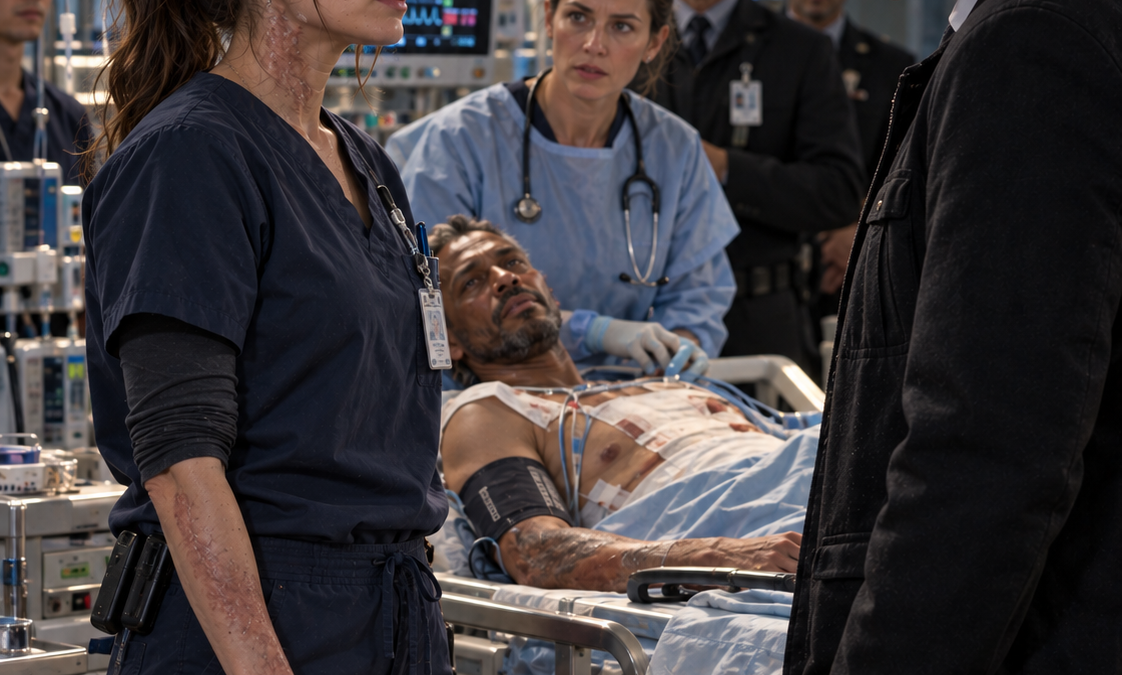
They Mocked Scarred Nurse—Then Her Secret Battlefield Protocol Left Every Federal Agent Speechle
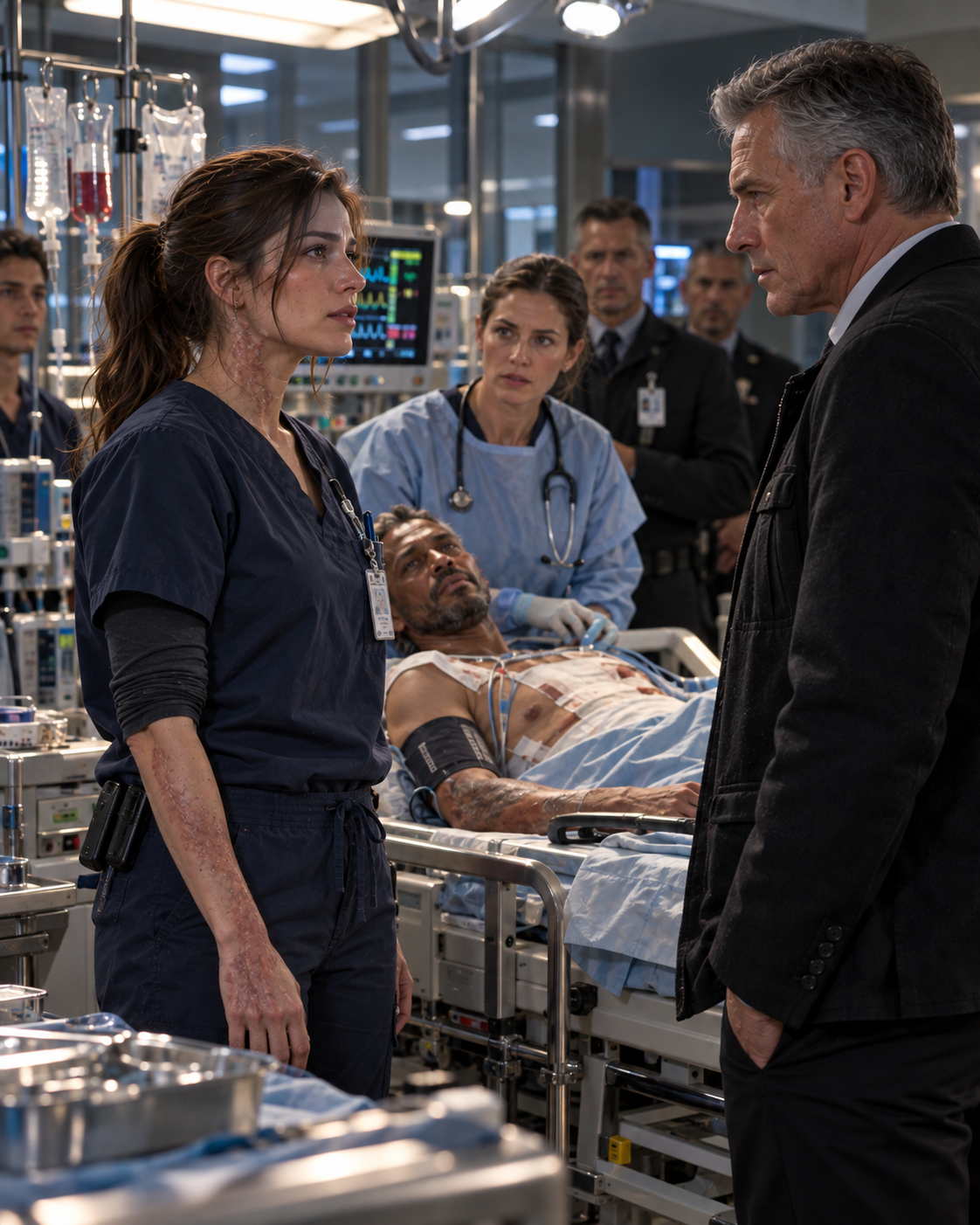
The mother’s scream cut through the entire trauma bay like a blade.
Don’t let her touch my son.
Look at her face. Look at her arms.
She’s going to traumatize him.
Every head in the room turned. The monitors kept beeping. The six-year-old boy on the gurnie was bleeding from a head laceration, his small fingers clutching the sheet, and the nurse reaching for his IV line had burn scars running from her jaw down the left side of her neck, disappearing beneath the collar of her scrubs.
Scars that didn’t fade.
scars that pulled the skin tight and made strangers flinch without meaning to.
The nurse didn’t move.
She didn’t pull her hand back.
She kept her eyes on the child’s vitals and said nothing.
Her name was Laura Voss. And in 3 weeks, Harrove Memorial Hospital in Delwood, Montana, was going to try to destroy her.
The mother kept screaming. A charge nurse named Deborah Wills arrived at the doorway in under 20 seconds, which told Laura everything she needed to know. Deborah had been waiting for exactly this kind of moment.
The older woman placed a hand on the mother’s shoulder and said gently and loudly enough for the entire bay to hear.
Let me get you another nurse, sweetheart.
One who won’t upset your little boy.
Laura stepped back from the gurnie. She handed the IV prep kit to a newer nurse named Peta without making eye contact, without a word, and walked back to the supply al cove at the far end of the bay. She pulled a pair of gloves from the dispenser.
She snapped them on. Her hands were steady.
They were always steady. It was the one thing nobody at Hard Grove Memorial could take away from her, no matter how many meetings they scheduled or how many incident reports they filed with her name on them.
The boy got his IV. The other nurse did it in two attempts.
Lara would have done it in one, but that wasn’t a point anyone in that room was interested in acknowledging.
She went back to her other patients. By the end of the shift, Deborah had filed a formal complaint.
The document said Lara had been aggressive and confrontational during a pediatric trauma intake, that she had refused to step aside when the patients guardian expressed distress. There were three signatures on it.
Lara had seen none of the signitories speak to each other for more than 30 seconds during the actual incident, which meant the report had been assembled quickly, efficiently, and with a degree of prior coordination that nobody was going to acknowledge out loud.
She read it standing in the hallway outside the nursing director’s office, leaning against the wall with her arms crossed, her jaw working slowly the way it did when she was processing something she didn’t intend to show on her face.
The nursing director was a man named Gerald Fitch. He had a framed degree from a school in Connecticut and a handshake that lasted slightly too long and felt like a negotiation. He told Laura to sit.
She sat. He told her this was the fourth complaint in 6 weeks.
She said she was aware. He told her the hospital had an image to maintain, that patient comfort was paramount, and that certain staff members, through no fault of their own, could create an environment of unease simply by their presence. He did not look at her scars when he said this.
He didn’t have to.
I’m recommending a formal performance review, he said.
Given the pattern, I want you to understand that continued employment here is contingent on that review’s outcome.
Lara looked at him for a moment. What pattern are we talking about, Gerald? He shifted in his chair.
The complaints, four complaints in 6 weeks, all originated by Deborah Wills or submitted within 2 hours of a shift she supervised. Three of those involve patients who had no documented complaint and whose family members were approached by Deborah before any paperwork was filed. She kept her voice even.
I’ve treated 47 patients in those 6 weeks.
46 were discharged without incident. The 47th was a septic shock case that the attendant wanted to manage with oral antibiotics. I escalated.
The patient lived. She let that sit for a second.
That’s the pattern I’m aware of.
Fitch looked uncomfortable in the way administrators looked uncomfortable when they had already decided on an outcome and were simply completing the formality of the conversation that preceded it.
“Lara, do what you need to do,” she said.
She stood up, set the complaint document on his desk, and left the office without waiting for a response. She walked back to the trauma bay because there were still 4 hours left in her shift and three patients who needed her more than Gerald Fitch needed to feel comfortable with the decision he had already made. What most people at Harrove Memorial knew about Lauravos was this.
She had transferred from a hospital in Wyoming 2 years earlier. She kept to herself.
She was technically proficient in ways that sometimes made attending physicians visibly irritated. And she had burn scars that covered the left side of her neck, her jaw, most of her left forearm and hand, and a section of her upper chest visible above her scrubs when she moved a certain way. The scars were old, layered, and settled, the kind that had finished the long process of healing years ago.
She never explained them. Nobody asked directly because the scars created enough ambient discomfort that looking at them felt like an imposition and asking about them felt like something considerably worse. Outside work, Lauravos occupied the smallest possible footprint.
A studio apartment 12 minutes from the hospital, a used truck with a cracked passenger side mirror she kept telling herself she would replace. a collection of medical and pharmacological journals she read on days off organized by subject on a shelf above a desk that had nothing personal on it.
No photographs, no decorative objects, nothing that would require explanation if someone happened to see it. She had a habit of doing inventory in her head before she fell asleep.
What she’d treated that day, what she’d missed, what she could have approached faster, what a different call in a critical moment might have changed.
It was a methodical, systematic habit, a soldier’s habit.
She’d stopped noticing she did it years ago, the same way you stop noticing the sound of traffic outside a window you’ve slept beside long enough.
The performance review was scheduled for a Thursday. On the Tuesday before it, something arrived that changed the shape of everything. It started the way genuine emergencies always started in a trauma bay with a radio call that used the wrong codes followed immediately by a second call correcting the first and the correction somehow contained information that made the initial wrong call seem almost
preferable.
A chemical processing plant 30 mi outside Delwood, a facility called Veric Industrial, had experienced a catastrophic pressure system failure in one of its production units. 13 workers had been evacuated.
Four were in critical condition with confirmed inhalation injuries.
Two of those four were presenting with symptoms the paramedics on scene couldn’t confidently identify, which meant the attending physicians at Harrove Memorial were going to be working without a complete clinical picture from the moment the
ambulances arrived.
Laura was halfway through a suture job on a construction worker’s forearm when the alert came through the overhead system.
She tied off the suture cleanly, covered the wound, told the man to keep firm pressure on it and do not move that arm, and was moving toward the trauma bay doors before the intercom finished its announcement. The first two workers arrived by ambulance 4 minutes later. Lara read their intake vitals off the paramedics board before the first stretcher fully cleared the bay entrance.
Both patients had oxygen saturation readings that were declining faster than standard inhalation injury progression could explain.
One of them, a broad-shouldered man in his mid-50s, still wearing a hard hat someone on the scene had forgotten to remove, was presenting with a fine rhythmic tremor in both hands, and along his jaw that wasn’t consistent with shock, hypoxia,
or straightforward carbon monoxide exposure at this stage of presentation.
The attendant on call was a surgeon named Dr.Marcus Hol. He was 42, well regarded in the region, and had the specific kind of confidence that comes from being right often enough to begin treating certainty as a reasonable default.
He took one look at the intake sheet, did a brief visual assessment of both patients, and said, “Smoke inhalation, probable mild CO exposure, standard protocol, high flow O2, get labs, get a CO level.”
“That tremor isn’t CO,” Lara said.
Holt turned and looked at her with the expression doctors used when a nurse said something outside the expected range of input. Excuse me.
The patient on the left, the tremor in his jaw and both hands.
Carbon monoxide poisoning at this stage of exposure and this saturation level doesn’t produce that motor pattern.
That presentation is consistent with neurotoxic exposure. Something in that plant was offging something besides CO. Holt looked at this man on the stretcher.
He looked at Lara. Then he looked back at the patient.
You want me to deviate from protocol based on a tremor?
I want you to find out what was actually processed in the unit that failed before we commit to a treatment path that could accelerate neurological damage if the exposure source isn’t what we’re assuming.
Standard labs first, Holt said and turned back to his patient with the finality of a door closing.
Lara didn’t argue with him in front of the bay.
She moved to the intake terminal at the supply station and pulled up the paramedic’s run sheet.
The facility name was there, Veric Industrial Processing, Unit 7, pressure failure with heat exposure. She ran the facility name through the intake systems linked industrial database. It took 40 seconds.
What came back was a chemical inventory for registered processing units at the site filed with the state’s industrial safety board.
Unit 7 processed specialty polymer precursors. Several compounds in that production chain required isocyanate derivatives as intermediate reagents under pressure failure conditions with the heat signature. The paramedics had reported certain isoccyanate compounds could decompose and off gas in ways that produced a toxic vapor profile very different from simple combustion products.
She knew that profile. She had known it for over a decade. Though the last time she had encountered it, she had been in a very different building in a very different country, and the people around her had been wearing body armor instead of hard hats.
She found the attending resident, a sharp, composed young woman named Petra Nano, who was in her second year and had the useful quality of listening before she reacted, and said quietly and quickly, “Pull the material safety data for isocyanate thermal decomposition products.
Look specifically at fosgene and fosgene adjacent compounds. symptom progression, respiratory and neurological effects.
Don’t bring it to halt with my name attached.
Petra looked at her steadily.
You think it’s F gene?
I think the symptom pattern is consistent with it and I think we have maybe 30 minutes before we find out the hard way. Pull the data.
Petra pulled the data. The second pair of workers arrived 8 minutes after the first. One of them was conscious, breathing shallowly but able to speak, which was more than the first pair had managed.
He told Lara between labored coughs that produced a wet, unhealthy sound at the base of each breath, that when the pressure valve in unit 7 had let go, the room had smelled wrong immediately, not like burning plastic, not like engine exhaust, but sharp and faintly sweet underneath the chemical bite. sharp and sweet and wrong in a way that had made everyone in the room instinctively move toward the exit before they had consciously registered they were doing it.
Sharp, faintly sweet, delayed, and progressive respiratory failure combined with early neurotoxic motor signs. Lara knew that profile the way she knew her own hands.
She had studied it from a field manual in a situation where getting the identification wrong meant people died before help arrived. She had then on one specific occasion applied that knowledge in real time under conditions that had produced the scars she now wore under her scrubs everyday.
She crossed the bay to where Hol was managing the first patients oxygen setup and spoke without preamble. The offging is consistent with a fosgene compound.
The standard CO protocol is contraindicated in fosgene exposure.
High flow O2 alone doesn’t address the inflammatory cascade in the pulmonary tissue and in some presentations it can accelerate the edema.
These patients need highdose systemic corticosteroids to slow the pulmonary damage broncoilators and the man with the tremor needs an urgent neurological assessment because delayed neurotoxic progression in this compound class can accelerate significantly within 60 to 90 minutes of initial exposure. Hol stopped what he was doing.
He was looking at her with a different expression now. Not the dismissive look from earlier, but something more guarded.
Where exactly are you getting a Fosgene diagnosis?
The plant’s chemical inventory and their symptom presentation.
It fits.
You pulled the plant’s chemical inventory.
Yes. During an active intake.
It took 40 seconds.
Holt’s jaw tightened.
The bay had gone quiet in the specific attentive way that spaces went quiet when a conflict became interesting enough to override the professional habit of pretending not to listen. Deborah Wills had come down from the floor when the mass casualty alert went out, which was standard procedure, and she was standing near the supply station with her arms folded in a posture that was technically appropriate for her position and communicated something else entirely.
You are a trauma nurse, Holt said with deliberate spacing between the words. I am the attending physician. I will run this bay according to established protocol.
Your protocol is going to put that man on a ventilator within the hour. Get back to your assigned patients. Laura looked at Roy Gallagher.
She’d seen his name on the intake band when they’d brought him in.
Roy Gallagher, 19 years at Veric Industrial, his hard hat still on his head when the paramedics rolled him in.
His oxygen saturation had dropped four more points in the time she’d been standing at Holt’s side.
The tremor in his hands was more pronounced. His eyes were tracking the ceiling with the slightly unfocused quality of someone whose neurological function was starting to lose the precision contest with whatever was happening inside him.
She went back to her station. She picked up her chart tablet and she began to document precisely chronologically in the careful clinical language she had learned to use because it left no room for later reinterpretation. She documented the symptom pattern she had observed.
She documented the chemical inventory findings. She documented the specific treatment recommendation she had made, the time she had made them, the attending physicians response, and the current status of each patient. She included the timestamp on every entry.
She did it quickly and without visible agitation because agitation was information you gave to people who were already looking for reasons to dismiss you. And she had stopped handing that out for free a long time ago.
Holt standard protocol went in at 6:14 p.m.By 6:29 p.m.Roy Gallagher’s oxygen saturation had dropped to a level that triggered an automatic monitor alarm.
His respiratory rate was climbing. The pulmonary edema was advancing faster than the ventilation setup was compensating for, and the tremor that had been limited to his hands and jaw had migrated to his shoulders and upper arms. Holt was at the bedside, and his voice had taken on the clipped, precise quality that experienced clinicians used when they were managing a situation that was moving faster than anticipated.
Petra caught Laura’s eye from across the bay.
She didn’t say anything.
She didn’t need to.
Laura walked to the medication cabinet. She drew methyl prednney salone at a dosage calibrated for acute inflammatory pulmonary injury and combined it with a broncoilator pairing she had used once before in a context she had never documented in any civilian medical record.
She labeled both syringes.
She crossed the bay to where Hol stood at Roy Gallagher’s bedside and held them up.
Methyl predinisolone and broncoilator combination. She said highdose systemic corticosteroid to interrupt the inflammatory cascade in the pulmonary tissue.
His edema is going to olude the airway before the ventilator compensates if we don’t slow it now.
This is the window. She kept her voice flat and factual.
You can continue what you’re doing or you can let me push this.
I need your answer in the next 30 seconds. The monitor alarmed again, louder.
Holt looked at the monitor. He looked at Lara.
He looked at Roy Gallagher’s face, which was the color of old concrete, and at the waveform on the screen that was doing something it should not have been doing.
He stepped back from the IV line. One step, that was all.
But it was the step that mattered. Laura administered the medications with the unhurried, deliberate efficiency of someone who had made critical pharmacological decisions in environments where the consequences of an error were not measured in complaints or performance reviews.
She adjusted the drip rate, repositioned the patient’s left arm to optimize the line, verified the second IV’s patency, and stepped back.
45 seconds.
Roy Gallagher’s saturation stopped falling.
70 seconds. It moved a single percentage point upward, which in this context was the difference between a trajectory that ended one way and a trajectory that ended another. The room held itself very still.
Then the stillness broke in the small involuntary ways.
A breath released, a shoulder that had been raised dropping fractionally, Petra’s pen clicking once in her hand without her noticing.
Holt stood at the foot of the bed. His arms were at his sides. His face was doing something complicated and inward that Lara looked away from because she had not done this to win something over him, and she had no interest in the moment where he understood that.
She went back to her documentation and added the 6:29 p.m.intervention with full clinical specificity.
Quote, “Gerald Fitch arrived at the trauma bay at 7:06 p.m.Lara heard him before she saw him.
His footsteps had the particular rhythm of someone walking with purpose toward a situation they had been briefed on by phone and had already begun framing before they arrived. Deborah was in the corridor outside the bay door.
They exchanged 11 words.
Laura couldn’t hear them, but she could read the body language from 30 ft away, and she knew what the conversation contained.
Fitch came to find her in the staff documentation area off the main corridor. He did the face, the careful, managed neutrality of someone who had decided on a position and was now performing the procedural obligation of the conversation that preceded announcing it. Dr.Holt has reported a protocol violation, he said.
Medication administered without a standing physician order. medication administered in response to acute patient deterioration in the presence of the attending physician who did not object.
He says he didn’t authorize.
He stepped aside from the IV line. There were seven people in that bay with a direct line of sight to that moment. She set her tablet on the counter.
Roy Gallagher’s saturation is currently at 91 and climbing.
3 hours ago, the paramedics weren’t sure he was going to make the drive.
That’s not the issue here, Laura.
Then explain the issue to me clearly, Gerald, because from where I’m standing, the issue appears to be that a patient is alive who might not have been, and the problem is that I’m the one who made that happen.
Fitch pressed his lips together. He was not a cruel man.
She had never thought he was a cruel man. He was a cautious one, which in some circumstances amounted to the same thing.
I’m suspending your trauma bay access effective immediately pending the outcome of Thursday’s review.
You can continue administrative and floor duties, but I cannot have you in that bay until this is formally resolved.
” Laura looked at him for a moment.
She looked past him at the small reinforced window in the trauma bay door, at the room beyond it, where Roy Gallagher’s ventilator was now cycling in the steady, reliable rhythm of a machine doing its job effectively.
“Fine,” she said.
She picked up her tablet. She walked to the staff lounge at the end of the corridor, sat down at the table, and continued her documentation. She added the 7:06 p.m.conversation in full.
Exact words, exact time, names, context.
She added Deborah’s presence in the corridor and the 11-word exchange she had observed but not heard, noted as observed rather than recorded because accuracy was the entire point of documentation and accuracy included the limits of what you could verify.
She was still writing at 8:47 p.m.when the sound of the emergency bay outside changed. She heard it before she identified it.
A shift in the ambient noise of the building. the way the air in a hospital moved differently when something significant was happening near the entrance.
She heard the receptionist’s voice change register.
She heard the exterior doors open and not close at the normal speed. She heard footsteps in the main corridor, more than two people moving in a specific formation with the controlled deliberate cadence of people who had already assessed the space they were entering and were now moving through it according to a plan.
She heard an unfamiliar voice clipped and directional ask, “Who’s the senior medical officer on duty right now?”
And underneath that, quieter from what sounded like a satellite phone rather than a hospital radio, she heard four words that landed somewhere in her chest and did not move. Confirm.
Package is mobile. Lara sat her tablet down on the table.
She sat completely still for three full seconds. Not because she was uncertain, but because she was processing, running the information through the part of her that still operated on old instincts and old training and had never fully stood down, regardless of how many years of civilian routine had accumulated on top of it.
Then she stood up. She straightened her scrubs.
She walked out of the staff lounge and into the corridor, moving toward the sound of those footsteps because whoever had just come through Hard Grove Memorial’s front entrance was not here for a standard medical emergency.
And she had spent enough years in enough rooms with people who use that kind of language to understand with complete and absolute clarity that whatever was about to come through this hospital was going to arrive at a speed that Gerald Fitch’s performance review
process was entirely catastrophically unprepared for.
She walked out of the staff lounge and into the corridor. And the first thing she saw was the suits, not hospital administration suits.
Those were soft campus casual things that men like Gerald Fitch wore to communicate approachability while still signaling rank. These were different, dark, structured, worn by people whose jackets fit in ways that accommodated things underneath them. Three of them in the main corridor moving with the lateral awareness of people trained to know where everyone in a room was at all times without appearing to look.
A fourth at the reception desk speaking to the overnight administrator in a low efficient voice that wasn’t asking for information so much as extracting it.
Lara slowed her pace without stopping. The fourth man, the one at the desk, was holding a badge while it open.
The overnight administrator, a woman named Sandra Teal, who had worked the desk at Harrove Memorial for 11 years and had seen most things, was reading whatever was on the credentials with an expression that said she had not in 11 years seen this particular thing before. Two of the suited figures moved toward the trauma bay without waiting for anyone to direct them.
A fifth man came through the exterior doors behind them, and this one was different from the others, older, with the kind of posture that came from decades of physical discipline rather than gym attendance. And he was speaking into a phone with one hand while the other held open the door for two people in tactical gear, carrying a hard-sided medical case between them.
Then the gurnie came through. Lara saw the patient for exactly 4 seconds before the cluster of bodies around him closed the visual angle. 4 seconds was enough.
The man on the gurnie was somewhere between 50 and 60, broad-framed and unconscious in the specific total way of someone who hadn’t chosen unconsciousness.
It had been imposed on them. His shirt had been cut open. There was a field dressing on his left side, high up near the axilla, and a second one at his right thigh.
And both dressings were the kind of professional field application that didn’t happen in a standard ambulance.
Someone with specific training had done that work before this man arrived at a hospital. She stepped back against the corridor wall as the gurnie moved past her toward the trauma bay.
One of the suited figures broke from the group and walked directly toward her, which told her she had already been identified before she understood how. He was maybe 35 with a square jaw and pale eyes that were doing a rapid assessment of her as he covered the distance between them.
He stopped 2 ft away, close enough for a private conversation, far enough that it wasn’t threatening, which was itself a trained behavior.
“Hargrove Memorial Staff,” he said.
“Trama nurse.”
He looked at the ID badge clipped to her scrub’s pocket.
“We’re going to need your trauma bay cleared to essential personnel, federal jurisdiction, medical emergency protocol.
Anyone not directly assigned to the incoming patient needs to step back.”
“Who’s covering the incoming patient?”
Lara said, “Your senior attending, Dr.Holt, whoever’s on call.”
Lara looked past him at the trauma bay doors, which had swung open to receive the gurnie. Through the gap, she could see Hol at the bedside, his posture carrying the particular stiffness of someone who had been pulled into a situation significantly outside his normal operating parameters.
She could also see the field dressings on the patient more clearly now. And what she could see was confirming something she had begun calculating from the moment she heard those four words on the satellite phone. The dressings on his left side, she said.
Is that entry or exit? The suited man looked at her differently.
Entry angle. He paused.
Downward 40° approximately. She was already doing the math. Trajectory probable internal damage path.
what that meant for the structures underneath.
What’s his pressure?
60 over 40 when we loaded him. We lost it in transit.
How long in transit? 41 minutes. She nodded once and started moving toward the trauma bay.
I said essential personnel, he began. Then clear me in, Laura said without breaking stride.
He didn’t stop her.
The trauma bay was crowded in a way that made it immediately less functional. Holt had two residents with him, neither of whom looked entirely certain what was expected of them.
Two of the suited figures had positioned themselves at the room’s perimeter, far enough to be technically out of the way, close enough to observe everything.
The man in the tactical gear had set the hard medical case against the wall and opened it, revealing a supply inventory that was not standard hospital issue.
field hemostatic agents, a portable blood warmer, IV access hardware, and medications that Laura recognized but wouldn’t have found in Harrove Memorial’s formulary.
Deborah was there. Of course, Deborah was there. She had positioned herself at the supply station, her default authority location, and was watching the incoming patient with the alert proprietary expression of someone who intended to be the nursing point of contact for whatever this situation became.
Laura crossed to the assessment side of the gurnie. Holt was calling for blood type in a surgical consult. One of the residents was setting up an IV line.
The patients face was slack, pale beneath a few days worth of stubble, and his breathing was audible, shallow, and slightly wet, which in combination with the axillary wound told her something she needed to say out loud immediately. Left side entry, downward trajectory, shallow breathing with fluid sound. You need to listen for attention numo before you push fluids, she said directly to Hol.
If that wound track passed through the plural space, you’ll drive him into arrest with aggressive volume resuscitation.
Hol was reaching for the IV setup. He stopped.
He looked at her. His expression had the complicated layering of a man who was simultaneously irritated by the source of information and aware that the information itself deserved attention. He picked up the stethoscope and listened.
The room waited. left side is diminished, he said. Needle decompression first, then fluids.
He set the stethoscope down.
He didn’t say anything to Lara.
He said to the resident, “Get me a 14 gauge left second intercostal mid-clavicular line.”
The resident moved. Deborah was watching Lara from across the gurnie with an expression that had traveled some distance from her usual administrative displeasure into something colder and less defined. The needle decompression worked.
The rush of air confirmed what Laura had said, and the patients breathing shifted within 90 seconds. Still labored, still precarious, but no longer the sound of a man drowning from the inside. Holt called for blood products.
The resident got the IV running. The room settled into the functional chaos of acute trauma management rather than the paralyzed chaos that preceded it.
One of the suited figures, not the one who had stopped Lara in the corridor, but an older one, shorter, with gray at his temples and a stillness that suggested he was the most senior person in the room who wasn’t holding a medical instrument.
Moved to Hol’s side.
What’s his outlook?
He said he needs a surgeon, Hol said. This is stabilization.
We need an O. How long to stabilize?
I don’t know yet.
Estimate.
That’s not how medicine works.
The great-tempered man looked at Holt with the specific patience of someone who was accustomed to being told things couldn’t be done and who had on multiple occasions watched people do them anyway.
Give me your best assessment. 30 minutes minimum to stabilize for transport.
An hour to get him to surgical prep.
If there’s internal bleeding beyond the plural injury we don’t know about yet.
Those numbers change.
There’s a surgical team being diverted.
They’ll be here in 90 minutes.
Then let us work. The gray-tempered man stepped back. He had not looked at Lara during this exchange, but when he stepped back, he positioned himself at an angle from which he could see her clearly, and he did not look away.
The next 25 minutes were the kind of sustained high-pressure clinical work that Lara had trained for in a context she didn’t discuss and had been doing in various forms for the 11 years since.
She assisted without being asked to assist in most cases, anticipating the next instrument or medication or adjustment before Hol called for it, filling gaps before they became problems, doing it all without commentary or visibility. This was the discipline she had developed before she ever set foot in a civilian hospital.
The ability to function at maximum effectiveness in a situation with incomplete information under observation while simultaneously being the least important person in the room to anyone who wasn’t paying attention.
The patients pressure came up, not to a safe level, to a less catastrophic one. Holt called the number and looked relieved in the small controlled way of a man who was trying not to show how worried he had been.
“Good,” said the gray-temped suited man from his position near the wall.
We’re not there yet, Hol said.
No, but that’s better than 4 minutes ago.
He was looking at Lara when he said it. She was recapping a syringe.
She didn’t look up.
Then the patients left hand moved. It was a small movement, fingers contracting slightly, an involuntary motor response as consciousness made its first uncertain attempt to surface.
The patient’s eyes didn’t open, but his face changed.
The total slack of full unconsciousness, shifting to something with slightly more architecture in it. the suggestion of a person rather than a body. And then with no warning, the patient spoke.
Two words, horsearo and indistinct, but audible in the brief quiet between Holing one instruction and the resident responding to it. Sparrow unit.
The gay-tempered man was across the room in four steps. Sir, stay still.
You’re in a hospital.
The patients eyes opened to slits. He was looking at the ceiling. His lips moved again without producing clear words.
The gray-tempered man leaned close and whatever the patient said at that volume stayed between the two of them. The gray-tempered man straightened. He was on his phone in seconds, moving to the corner of the room, his back to most of the space.
Lara heard three words before he lowered his voice further. Get Reyes here.
She didn’t know who Reyes was.
The name didn’t connect to anything in the filing system of her memory.
But the urgency in those three words, controlled, precise urgency, the kind that came from someone who understood exactly how bad a situation was and had moved past fear into pure operational response, told her that whoever was lying on that gurnie was not the only
variable in whatever equation these people were managing tonight. Deborah chose that moment to assert herself.
It was Laura thought later almost impressively poorly timed though she suspected Deborah didn’t see it that way.
The charged nurse crossed to the medication station where Laura was preparing the next round of supportive drugs and said at a volume calibrated to be heard by Holt but presented as a private remark.
You’re not supposed to be in this bay.
Dr.Fitch suspended your access. Lara kept work working.
I’m aware.
I’m going to have to call him.
Call him. Lara. The use of her first name.
Not a greeting, a grip.
I’m serious.
You’ve already created enough problems tonight.
Don’t make this worse for yourself.
Laura set down the medication she was preparing and looked at Deborah directly for the first time in the conversation. The man on that table had attention pneumothorax when he came in.
I identified it before the attending did. His pressure is currently 60 points higher than when he arrived.
You can call Gerald Fitch right now and explain to him why you’re trying to remove the nurse who kept this patient alive long enough for a surgical team to get here.
Go ahead.
Deborah’s jaw tightened or Lara said, “You can let me do my job.”
She picked up the medication and crossed back to the gurnie.
Deborah didn’t call Fitch.
She also didn’t leave the bay, which meant she spent the next 40 minutes standing at the supply station documenting everything she observed in a way that Lara understood was being assembled into a record that would be used the moment this immediate crisis concluded.
It was a particular kind of hostility, patient, systematic, institutional, and Lara had been on the receiving end of it for 6 weeks, and understood its mechanics well enough to know that the outcome it was building toward hadn’t changed just because the stakes in this room had temporarily elevated the cost of acting on it.
At 9:34 p.m., the trauma bay doors opened again. The man who walked through them was somewhere in his early 60s with closecropped gray hair and the deliberate unhurried gate of someone who had walked into rooms like this before and had long since stopped being rattled by what he found in them.
He was in civilian clothes, a dark jacket over a collared shirt, no tie, but he moved through the cluster of federal agents at the room’s perimeter as though they were furniture, pausing only to exchange four words with the gray templed man before crossing the floor toward the gurnie.
He
stopped at the foot of the bed and looked at the patient for a long moment. Then he looked at Holt.
Status, he said. Stable but critical. Penetrating trauma, left thoracic entry, pneumothorax addressed.
We’ve got him on blood products and pressers.
The surgical team. I know where the surgical team is. He looked at the patient again.
Then slowly he looked around the room at the residence, at the suited figures, at Deborah still posted at the supply station, and his gaze traveled until it reached Laura standing on the patients right side adjusting the IV drip rate. He looked at her for 4 seconds.
Then he said quietly to no one in particular, “Who did the needle decompression call?”
The resident who had performed the procedure started to answer. Holt spoke over him.
It was a team assessment. The gray-tempered man from his corner of the room said it was her.
The newcomer looked at the gray-tempered man, then back at Lara. Name?
He said, Lara Voss, trauma nurse. He studied her with the particular attention of someone cross-reerencing what they were seeing against something they already knew. It was a look she had been on the receiving end of before in a different life in situations where being recognized carried consequences that varied significantly depending on who was doing the recognizing.
Voss, he said it wasn’t a question.
It was something else. The specific intonation of a name being checked against a mental file.
Yes, she said.
He didn’t say anything else.
He turned back to the patient and began asking Hol a series of precise questions about wound depth, blood loss volume, and the timeline of interventions. And Hol answered each one with the slightly diminished confidence of a man who had been the primary authority in the room 30 seconds ago and was recalibrating that status in real time.
Laura went back to the IV line. Her hands were steady. They were always steady.
The surgical team arrived at 10:52 p.m.Not the 90 minutes the gay-tempered man had estimated 78. Four people traveling light with equipment that over overlapped with but was not identical to what the hard-sided case against the wall contained. They took over the patients management with the frictionless synchronized efficiency of a team that had worked together in settings where friction cost lives.
And within 6 minutes, the bay had reorganized itself around them without anyone explicitly directing the reorganization. Holt stepped back.
It was a different kind of stepping back from what he’d done earlier in the evening when he’d moved away from the IV line and let Laura administer the medication that kept Roy Gallagher’s saturation from bottoming out.
This was institutional, a
senior physician making way for a higher level team.
and Hol handled it with a professional composure that Lara gave him credit for because it wasn’t a comfortable position for someone with his particular relationship to his own competence.
The man with the closecropped gray hair, she still didn’t have a name for him, positioned himself at the edge of the surgical team’s working space and observed without interfering.
The gay-tempered man was on his phone again near the door. Two of the suited figures had stepped out into the corridor. Lara was, by any reasonable assessment, peripheral at this point.
The surgical team didn’t need her.
The patient was in hands more specialized than hers. She could have left the bay. Gerald Fitch had, in fact, officially required her to leave the bay 2 hours ago.
She stayed.
She stayed because she was watching the surgical team’s assessment of the wound site, and something she was seeing didn’t align with what she’d been told in the corridor.
Entry wound, downward trajectory, 40°.
The surgical team’s lead was probing the wound’s margins with an expression that said the geometry wasn’t matching the expected internal damage path.
And Lara had enough experience with ballistic wound assessment to understand why.
She moved to a position where she could see the lead surgeon’s hands without blocking anyone’s access to the patient.
The wound entry was consistent with what she’d been told, but the tissue disruption pattern at the wound margins was wrong for a standard projectile at that angle.
The damage radius was too wide with a particular kind of peripheral hemorrhage that she had seen before. Not in a civilian trauma bay.
In a field briefing, in a manual she’d studied at a facility whose name she was not going to say out loud in this room, she said to no one directly in the tone of someone noting a clinical observation rather than making an accusation, “That’s not standard ballistic trauma.
” The lead surgeon looked up.
The room reconfigured its attention. the wound margins, Laura said, the peripheral hemorrhage pattern.
That’s not a clean projectile wound.
There’s a secondary dispersal pattern.
She paused because she was about to say something that she had never said in a civilian context in 11 years. And once she said it, there was no way to unsay it.
That’s consistent with a frangible round carrying a secondary payload, possible chemical or biological component.
The lead surgeon stared at her. The man with the close-cropped gray hair had turned away from the wall.
“Where?”
he said very quietly.
“Did you learn to identify that?”
Lara looked at him. The room was completely still, the kind of stillness that had weight and texture, the kind that preceded moments that divided time into before and after.
She had two choices. She could deflect, the way she had been deflecting for 2 years, the way she had become so proficient at deflecting that it felt like a second skin. She could cite a textbook, a training course, a colleague who had mentioned it once.
She could give him a civilian answer to a question that deserved something else. Or she could give him the real one. From the same place the man on that table got those scars on his right forearm, she said.
The silence stretched. The man with the closecropped gray hair looked at the patients right forearm, which was exposed beneath the surgical draping. And on it, visible even now, were the particular marks that Laura had noticed.
the moment the gurnie came through the trauma bay doors. Not burn scars, not surgical scars, the specific identifiable marking pattern of someone who had been through a chemical exposure event in a classified operational context.
A pattern she recognized because she had seen it on her own reflection in a mirror 11 years ago in the early weeks before her scars had fully declared what they intended to become. The man with the close-cropped gray hair looked at her forearm, at the scars beneath her rolled back scrub sleeve, then at her face.
“Your name,” he said.
“Not her current name.
” He said it with the inflection of someone asking for a different answer than the one she’d already given.
“Your actual name.”
Before she could respond, the lead surgeon said sharply, “I need everyone who is not surgical support out of this bay right now.
If there is a secondary payload in this wound, we are in a potential containment situation, and this room needs to be controlled. The Graytempled man was already on his radio, his voice dropping into the clipped staccato cadence of someone issuing instructions that would be executed before he finished the sentence.
Two of the suited figures came back through the doors. Holt was asking a question nobody was answering.
Lara didn’t move.
The lead surgeon looked at her. Out?
If it’s a chemical payload, Laura said, and it’s what I think it is based on that dispersal pattern, you need a different antidote profile than what’s in your case.
What you have will address the systemic symptoms, but not the secondary neurological mechanism.
I’ve seen this before.
The lead surgeon stared at her for a long moment.
The man with closecropped gray hair said very quietly, “Let her stay, sir.
Let her stay.”
His voice had not gotten louder. It had gotten quieter, which was more effective. He crossed the room in six steps and stood directly in front of Lara.
Up close, his eyes were dark and still and doing the same cross referencing calculation they’d been doing since he arrived.
What antidote profile? Lara looked at the hard-sided case against the wall.
She looked at the surgical team’s field inventory.
She ran the calculation, compound class, dispersal pattern, body weight, time elapse since wounding, and she gave him the answer. Specific drug names, specific doses, specific sequence and timing.
He listened to every word without interrupting. When she finished, he was quiet for 3 seconds.
Then he said, “You were at Kesler Basin.”
It was not a question. It was not the name of a place she had heard spoken out loud in two years. It was the name of a classified operational site in a country she was not going to name where 11 years ago a field medical unit had been caught in a chemical dispersal event during an extraction and where she had administered emergency treatment to six wounded operatives under conditions that had lasted 4 hours and 40 minutes and
had left her with scars that ran from her jaw to her forearm.
She had never told anyone at Harrove Memorial what those scars were from. She had never told anyone in Delwood, Montana.
She had never told anyone in Wyoming, where she’d worked before.
She had for 2 years answered questions about the scars with a kitchen fire, a story clean enough to discourage follow-up, practiced enough that she delivered it without hesitation. The man with the close-cropped gray hair knew it was a kitchen fire only in the same sense that he knew the sky was green.
“Yes,” Lara said.
He looked at her for a moment that felt longer than it was.
Then he turned to the lead surgeon and said with absolute finality, “Use her protocol.”
The next hour was the most focused work Lara had done in two years.
Not because it was more technically complex than what she’d done in the early part of the evening.
It wasn’t.
But because it required her to operate from a knowledge base she had spent two years deliberately not accessing, pulling forward skills and protocols and muscle memory from a context she had locked away with the same methodical care she applied to everything she wanted to remain contained. The antidote sequence worked. It worked in the specific unremarkable way that correct medical interventions worked.
Not dramatically, not cinematically, but in the gradual stabilization of numbers on a monitor and the slow return of color to a face that had been the color of old concrete since the gurnie came through the door. At 11:47 p.m., the patients pressure reached a level that the lead surgeon described as defensible.
At 11:53 p.m., his eyes opened, not slitted this time, but fully tracking the ceiling with the confused, searching focus of someone trying to reconstruct where they were and what had happened to them. He turned his head. He looked at Lara.
His lips moved. She leaned in because the sound he was producing was too low to make out from standing height. And when she was close enough to hear him, what he said was three words.
You’re still here.
She wasn’t sure if he meant here in this room or here in this life.
She wasn’t sure which version was more surprising to him.
Still here, she said. He closed his eyes.
The lead surgeon called the next stage of treatment and the room reorganized around it and Lara straightened and stepped back and looked up and found the man with the closecropped gray hair watching her from across the room with an expression she couldn’t fully categorize.
Something between recognition and calculation and something older than either of those things. He had his phone out again.
He was looking at her as he spoke into it. And even from 15 ft away, even with the noise of the trauma bay and the surgical team and the two suited figures who had come back in from the corridor, she was close enough to read three words on his lips before he turned away. Found her.
Confirmed. The door to the trauma bay opened from the outside. Gerald Fitch came through it.
Pale, disheveled, clearly pulled from somewhere else in the building in a hurry.
his administrator’s composure not fully assembled around him yet, he took in the room, the suited figures, the surgical team, the hard medical case, the patient, and his eyes moved until they found Lara, and the expression that crossed his face was the specific expression of a man who had sent a carefully constructed letter and returned to find that the address no longer existed.
He opened his mouth. The man with the close-cropped gray hair turned from his phone and looked at Fitch with the patient terminal attention of someone who had already determined everything they needed to know about the next 30 seconds. Are you the facility administrator?
He said Fitch straightened reflexively.
I’m the nursing director, Gerald Fitch.
Who are your nurse kept that man alive tonight?
He didn’t point at Lara.
He didn’t need to.
I need to know the specific authority by which she was removed from this bay earlier this evening, and I need that information in writing, available for federal review by 900 a.m.tomorrow. Fitch opened his mouth again.
Nothing came
out. 9:00 a.m., the man said.
He turned back to the surgical team. Fitch stood in the doorway of the trauma bay with his authority draining out of him like water from a broken vessel.
and Deborah Wills, still at the supply station, looked at the floor. And Lara looked at neither of them because she was watching the patients monitor and the patients numbers and doing the one thing she had always done in every setting, in every context, in every version of herself she had ever been required to become.
She was keeping someone alive.
And somewhere outside the building, in the parking lot that served Hardrove Memorial’s emergency entrance, three more black vehicles had arrived that had not been there an hour ago.
And the man with the closecropped gray hair had just sent a message to a number that had no name attached to it. And the message contained two words and a location. The location was Delwood, Montana.
The two words sat in the air of the parking lot like a detonator waiting for someone to close the circuit. And inside the trauma bay, Lara had no way of knowing they had been sent because she was watching the patients chest rise and fall with the careful attention of someone who understood that a number on a monitor was only a proxy for the real thing. And the real thing required eyes on it.
The surgical team’s lead, a compact, efficient woman named Dr.Sable Orin, whose hands moved with the particular economy of someone trained to operate in spaces smaller than an O, was managing the wound site with two of her team members, while the third handled fluid balance on the opposite side of the gurnie.
The antidote sequence Laura had provided was running on a secondary IV line, and the patients color had shifted incrementally in the last 40 minutes from the gray of acute crisis to something closer to the pale, exhausted look of a body fighting its way back from significant damage. It was not recovery.
It was the preliminary phase of the long, ugly process that preceded recovery. But the numbers were moving in the right direction. And in trauma medicine, direction was often the best information you had.
Gerald Fitch had not moved from the doorway. He was standing there with the expression of a man who had walked into a building he recognized and found the interior completely rearranged and who was processing the realization that the rearrangement was not temporary.
The man with the close-cropped gray hair, Lara still had no name for him, had not asked because asking would have required a conversational exchange.
She didn’t have the bandwidth for right now, had returned to his position near the wall, and was engaged in a quiet, rapid phone conversation that had been ongoing for 7 minutes.
The gay-tempered man was outside in the corridor.
The suited figures at the room’s perimeter had been joined by a fifth, a woman in her 30s with a tablet, and the manner of someone processing information faster than she was producing visible reactions to it.
Deborah had not left either. Laura was aware of her the way she was aware of a sound at a frequency just outside comfortable hearing.
Not because she was looking at her, but because two years of working in the same building had calibrated her to Deborah’s presence as a variable that required monitoring.
At 12:09 a.m., the patients blood pressure reached 90 over 60. Dr.Orin said there quietly to no one in particular and made a notation.
The resident who had come in with Holt’s original team, the one who had performed the needle decompression at Holt’s direction, was still in the room, positioned at the periphery with the stillness of someone who understood they were witnessing something that exceeded their current category of experience and had decided that staying quiet and present was more valuable than anything they might say.
Holt himself had left 20 minutes ago.
Lara didn’t know if he’d been directed to leave or if he’d made that assessment himself.
She suspected the latter.
Holt had faults, significant ones, but he wasn’t someone who required explicit removal.
He had enough self-awareness to read a room that had shifted outside his jurisdiction and extract himself before it became formally uncomfortable. She gave him credit for that, too.
The patient opened his eyes again at 12:14 a.m.This time, they stayed open. He turned his head with the slow deliberation of someone managing pain that was significant but below the threshold that canceled conscious function.
and he looked at the ceiling for a moment, then at the IV lines running into his arm, then at Dr.Orin’s hands, then following some internal logic, across the room to where Lara stood.
He said at a volume that required the room to be quiet to catch. Tell me what you gave me. Doctor Orin answered before Lara could.
She gave him the antidote sequence in clinical terms, dosages, and timeline, the language of a physician, briefing a patient who had enough medical literacy to receive the full version. The patient listened. He looked at the IV line.
He looked back at Dr.Orin.
That’s not in your standard field kit.
No, Dr.Orin said, “Where did it come from?”
Dr.Orin didn’t answer that one.
She looked briefly and involuntarily at Lara, which was information the patient received and processed in the half second he was conscious of it. He turned his head toward Lara.
You the protocol? Yes, Laura said.
He looked at her for a moment. The particular look of someone reorganizing what they thought they knew about a situation. You recognize the compound, the dispersal pattern?
Yes. From you already know the answer to that. she said.
He did. She could see it in the way his expression settled.
Not surprise, but the specific neutrality of someone whose existing information had just been confirmed by a source they hadn’t anticipated.
He looked at the ceiling again, he said more quietly.
“What’s your name now?”
“Lara Voss.”
He made a sound that might have been acknowledgment or might have been something else.
“Vos,” he said.
“Okay.
” His eyes closed again.
not unconsciousness, she could tell the difference, but the deliberate retreat of someone who needed to manage their energy budget carefully.
The man with the closecropped gray hair ended his phone call and walked toward Lara with the directional purpose he’d had since he walked through the trauma bay doors.
He stopped beside her and looked at the patients monitor for a moment, not at her, the way people looked at a neutral object when they were about to say something, they were still calibrating. His name is Warren Aapor, he said.
I’m going to ask you to keep that inside this room.
All right.
He’s been embedded in a foreign logistics network for 22 months.
The shooting tonight was not random. He paused.
The people who did it know he’s here.
Laura looked at him.
Know he’s at Harrove Memorial specifically.
We’re operating on that assumption.
She looked at the trauma bay doors. The corridor beyond was visible through the reinforced window. Two suited figures visible.
the glass giving her a narrow angle on the hallway and the waiting area beyond. Then this building is a problem.
Yes, you need to move him. We need him stable enough to move.
Dr.Orin’s assessment is another 3 hours minimum.
3 hours. Laura ran the arithmetic on that facility vulnerability single entrance point for the emergency bay.
The parking lot configuration she’d memorized in the habit of memorizing spaces.
how many people were in the building at this hour and how many of them represented a liability in a security situation versus a resource. It was a kind of thinking she had not applied to Hard Grove Memorial in 2 years of working here.
The building looked different when you ran it through that filter. Most buildings did.
What’s your name?
She said he looked at her then. Garrett Soon, deputy director.
She didn’t ask of what.
The suited figures, the satellite phones, the federal jurisdiction declaration at the front desk, the surgical team that arrived in 78 minutes from whatever facility kept a team like that on standby. The institutional framework was legible enough without the title. Soon, she said, I need to know something.
Go ahead. The round that hit him, you said frangible possible secondary payload.
Your team’s initial assessment, did you characterize it as assassination specific, purpose-built for a particular target?
Soon looked at her steadily. Why?
Because if it was purpose-built, the people who made it know his body chemistry. They know his blood type, probably his medical history, definitely his weight and physical conditioning, which means the secondary payload was calibrated to him specifically, which means the antidote sequence I gave you.
She stopped. May not be complete, Sunni said.
May not be the full picture.
I identified the compound class from the dispersal pattern, but if it was a custom formulation, there may be a secondary agent I didn’t account for.
Soon was quiet for 3 seconds. Then he turned to Dr.Orin. I need a full toxicological panel.
Everything.
Prioritize anything that wouldn’t appear in a standard trauma workup.
Dr.Orin nodded without expression. She was already moving.
Soon turned back to Laura. What would you look for?
Laura told him. She laid out three compound families.
not household names, not textbook entries, but the specific categories of agents that had been developed in the operational context she had been part of and that she knew existed because she had helped develop the antidote protocols for two of them. She gave him the information in the clipped sequenced way she had been trained to communicate under time pressure without hesitation, without the self-protective hedging she had spent 2 years cultivating in a civilian environment where what you said was frequently turned into a record used
against you. soon listened.
He asked two precise follow-up questions. She answered both. He nodded.
And then, in the space between one moment and the next, the corridor outside the trauma bay window went wrong. What? She saw it before she could have said what she saw.
A change in the quality of the light through the reinforced glass. A shift in the way the two suited figures in the corridor were holding themselves. the specific transition from routine monitoring posture to something that had a different center of gravity.
One of them had his hand at his jacket. The other was on his radio.
“Something’s happening in the corridor,” Lara said.
Sunni turned.
He had his phone out in the same motion, his thumb moving before he’d finished turning.
He said two words into the phone and then moved toward the trauma bay doors, and Lara followed him because the patient on the gurnie was not in a state to be moved quickly. And if whatever was developing in the corridor came through those doors, the people in this room needed to know about it in time to respond rather than in time to react.
The corridor was not what she’d expected.
It was not a threat, not directly. It was a crowd of the wrong kind for this hour of the night, assembled in the waiting area at the near end of the hallway. Six people, civilian clothed, two of them with cameras on shoulder rigs, one holding a directional microphone on a boom pole.
press, local press by the equipment quality, but press nonetheless. And one of the suited figures was already engaged with a man in a blazer who was talking fast and holding up a phone in the manner of someone who had received information and intended to act on it before anyone could officially prevent him.
Behind the camera crew, half visible in the waiting area entrance, was Gerald Fitch. He had his phone in his hand and the expression of a man who had either called these people or had called someone who had.
Lara stopped soon beside her said something very quiet that was not intended for her. The man in the blazer was saying loudly enough to be heard clearly from the corridor.
We have a source confirming a federal patient intake at this facility tonight and we have a right to this is a restricted area.
The suited figure said, “It’s a hospital.
Under federal medical emergency protocol, which supersedes standard public access rights, you need to leave this area now.”
The man in the blazer looked past the suited figure and saw soon standing in the corridor. His eyes moved, calculating.
“Is that you need to leave?”
The suited figure said. Sunna had already turned away from the media cluster and was speaking into his phone again.
Lara looked at Fitch, who was standing at the edge of the waiting area with the expression of someone who had set a thing in motion and was now watching it go somewhere further and faster than he’d intended.
He met her eyes. He looked away first. They contained the press situation in 11 minutes.
The suited figures moved the camera crew out with the professional low drama efficiency of people who had handled exactly this kind of problem before. and the man in the blazer left with the phone number of a federal communications office and the clear understanding that anything broadcast before a clearance call would generate consequences he would prefer to avoid.
Fitch disappeared before anyone formally addressed him, which was perhaps the most competent thing he’d done all evening, but the 11 minutes had cost something.
Dr.Orin was at the doorway of the trauma bay when Lara came back in and her expression had the specific tightness of someone who had received bad news from a test and was managing it. The talks panel, she said to Sunoon. She was right about the secondary agent.
Sunna looked at Lara.
There’s a secondary compound in the wound site.
It’s sequenced differently from the primary.
It appears to be on a delayed release mechanism. probably a polymer coating on part of the frangible round that degrades on a specific timeline.
Dr.Orin’s voice was precise and controlled.
Based on the degradation rate we’re seeing, the secondary release began approximately 40 minutes ago.
What’s the timeline on full release?
Soon said, best estimate, another 90 minutes to 2 hours. And without treatment, Dr.Orin paused.
Acute neurotoxic cascade. The primary compound compromised enough of enough of the bloodb brain barrier integrity that the secondary agent will have a significantly amplified effect without targeted treatment.
Fatal neurological damage within 4 to 6 hours of full release. The room was quiet.
Laura was already thinking.
She was pulling from the same place she’d been pulling from all evening.
the deep file, the one she’d locked and kept locked for two years, opening it systematically and going through its contents with the dispassion of someone doing inventory rather than visiting a place they’d left behind.
The secondary compound’s mechanism, if it was what she was beginning to think it was, had a treatment pathway.
It was narrow and it required materials that Harrove Memorial’s formulary was not going to contain and it would need to be custom prepared.
and the window for preparation and administration before the secondary release reached critical threshold was not generous.
There’s a treatment pathway, she said.
Dr.Orin looked at her.
The secondary compound, if it’s what the dispersal behavior is suggesting, the mechanism is a sodium channel modulator.
The treatment is a targeted antagonist that blocks the modulation before the cascade initiates.
It’s not in your field kit.
It may not be in this hospital. She looked at soon.
What’s your nearest resupply with specialized pharmaceutical access?
Billings 80 m.
That’s She ran it 40 minutes minimum at speed assuming clear roads at this hour.
Assuming the resupply was immediately available, assuming no complications on either end. Tight. Very tight.
What do you need specifically? Soon said.
She gave him the compound name.
Then the alternative in case the primary wasn’t available.
Then the preparation parameters, concentration, volume, administration route, timing relative to the secondary release timeline. She gave him all of it without stopping.
The way you gave critical information to someone who was going to act on it immediately. Soon had the phone at his ear before she finished the last sentence.
Dr.Orin was looking at Lara with an expression that had passed through several phases in the last 30 seconds and had arrived somewhere that was neither professional assessment nor personal reaction but something in the space between them. How do you know the preparation parameters for that compound?
She said that protocol isn’t published anywhere.
No, Laura said it isn’t.
Dr.Orin held her gaze for a moment.
Then she turned back to her patient and said to her team, “Let’s get the secondary tox markers quantified.
I want a baseline number before the resupply arrives.”
Soon spent 4 minutes on the phone. When he came off it, he crossed to Lara without pausing for anyone else in the room.
The compound is available. Our Billings contact is prepping it now.
43 minutes door to door. He needs to be stable enough that the existing antidote is fully active before we introduce the second treatment.
If the first sequence isn’t complete, how long does it need?
She looked at the IV drip rate, at the monitor numbers, at the elapse time on the first antidote administration. It needs 22 more minutes minimum, which gives us a 21minut window between first sequence completion and the outer edge of safe administration for the second.
43US 22 Soon said, is 21 minutes. Yes.
He looked at her.
That’s workable if nothing else goes wrong.
Yes, he said if nothing else goes wrong. It was the kind of conditional that both of them understood was not a comfort. It was an operational reality.
In Lara’s experience, nothing else goes wrong was a condition that was honored approximately as often as weather forecasts, which was to say often enough to plan for it and not often enough to rely on it.
22 minutes. She watched the clock and the monitor simultaneously.
the way she had learned to divide attention across multiple critical variables without losing resolution on any individual one. Warren Aaphor she had a name now and names had a way of making a patient more specifically themselves and less an aggregation of clinical problems was in and out of consciousness at intervals.
Awake he was lucid and controlled managing his pain with the specific economy of someone trained to function through physical compromise. asleep. His face lost the control and showed something underneath it that looked like what it was.
A man who had spent 22 months maintaining a cover identity in a foreign operational environment and had gotten shot for it and was now lying in a small hospital in Montana being kept alive by a nurse. Everyone in the building had spent 6 weeks trying to remove.
At the 14-minute mark, soon received a confirmation on the resupply ETA on schedule.
At the 17-minute mark, the woman with the tablet, the one who had come in with the later contingent of suited figures, appeared at Soon’s side and said something in a voice too low for Lara to catch.
Soon’s expression didn’t change.
He said, “When?”
More low words.
He said, “How many?”
The woman showed him the tablet screen. He looked at it for two seconds.
He said, “Get Ror on the perimeter.
I want the bay entrance hardened.
Nobody in through the parking lot side.”
He looked up. He found Lara. We have a problem.
She had already read most of it from his face. How close?
Thermal imaging picked up two vehicles stationary on the service road that runs behind the facility.
They’ve been there for approximately 25 minutes, which means they arrived roughly.
When the press showed up, Laura said, “Yes, decoy.”
She said, “The press was a decoy.
Draw your people’s attention to the front.
Establish position at the rear.
That’s our read.”
She looked at the trauma bay’s secondary access point, a supply corridor entrance at the far end of the room, which connected through two locked doors to the building’s internal service route, which in turn connected to the loading dock at the facility’s rear.
She had walked that route once in her first month at the hospital during a fire evacuation drill. She had the layout in her head with the fidelity of someone who stored spatial information the way other people stored phone numbers automatically completely without deciding to. The loading dock was 30 yards from the service road.
Those doors, she said, indicating the supply corridor entrance.
What’s your status on them?
Sunni looked at the woman with the tablet. Locked, the woman said.
Standard electronic lock. Building security is on our frequency. But she paused.
The system shows a manual override used on the interior corridor door 40 minutes ago.
The room didn’t react loudly.
It reacted the way trained people reacted. Through a rapid, quiet reorganization of physical positioning and attention.
Two suited figures moved toward the supply corridor entrance. Soon had his phone up.
Dr.Orin, without being told anything, said to her team, “We may need to move fast.
Be ready.”
Lara looked at Warren Oafur. He was awake. He had heard the exchange, or enough of it, and he was looking at the supply corridor entrance with an expression of complete exhausted clarity.
How long until the second treatment, he said. 6 minutes on the first sequence, Lara said.
Resupply is 12 minutes out. How long can I stay in this room if that door comes open?
Nobody answered immediately, which was itself an answer. Get me a number, he said. That depends on what comes through it, Sunni said.
then give me the range.
Sunna looked at Lara for reasons she didn’t entirely understand but chose not to examine.
She said, “If the second treatment doesn’t go in within the critical window, you have 4 to 6 hours before the neurological damage is irreversible.
If we move you before the first sequence completes, there’s a risk the antidote doesn’t fully neutralize the primary compound, which compromises the second treatment’s effectiveness.
The variables interact. Moving you before both treatments are complete is a significant risk.
Okapor absorbed this. Define significant 40% chance of permanent neurological impact even with treatment rising to 70% if we miss the window entirely. He was quiet for a moment.
What does think? I think we hold position for the next 6 minutes and see what those doors do. Sunni said if they open then we adapt.
Okapor looked at Lara.
You’re the one whose plan this is.
It’s not a plan, she said.
It’s a set of constraints.
That’s what a plan looks like when the variables aren’t cooperating, he said.
Something that might have been the distant ancestor of a smile crossed his face and left quickly. He looked at the supply corridor entrance.
6 minutes. 6 minutes, Laura confirmed.
The suited figures at the corridor entrance had their hands at their jackets.
The woman with the tablet was watching the door panel’s electronic status readout.
Dr.Orin’s hands were on the gurnie rail, not gripping it, just resting there, ready.
The resident who had stayed was in the corner, his face white and still, doing the thing Lara had assessed him doing earlier, staying quiet and present, because that was the most useful thing available to him. 4 minutes. The electronic panel on this corridor door flickered.
Everyone in the room saw it. The flicker lasted less than a second. A brief irregular pulse in the display.
The kind of thing that could have been a power fluctuation or a system hiccup or something that was neither of those things.
The suited figure closest to the door said, “That was a bypass attempt.”
Soon said into his phone, “I need the loading dock status now.”
3 minutes. The answer came back and the answer was wrong because the suited figure who had gone to check the loading dock access had not checked in on schedule. and not checking in on schedule was its own kind of answer.
2 minutes. The corridor panel flickered again.
This time it didn’t stop.
1 minute.
Laura reached the resupply courier’s ETA in her head.
The compound was still 9 minutes out. The first antidote sequence had 45 seconds remaining.
The critical window between completion and administration of the second treatment was 21 minutes. And they were going to spend some of those minutes doing something other than medicine. And that fact was simply a variable she needed to incorporate.
She went to the hard-sided case against the wall. She opened it. She found the portable blood warmer, the field heatic agents, the IV hardware.
She found what she needed and moved it to the Gurnie’s immediate perimeter within reach.
She did it quickly and without explanation because explanation was time, and time was currently the most precisely managed resource in the room. The supply corridor door shuttered. Not a flicker, a physical impact from the other side.
Soon said very calmly, “Dr.Orin, prep for immediate transport.”
The door shuttered again. The electronic panel died completely, its display going dark, which meant the lock was no longer receiving power from the building system, which meant whatever was on the other side had done something to the power feed rather than the lock mechanism itself. The third impact was harder.
And in the waiting area at the far end of the hallway, visible through the reinforced window in the trauma bay’s main entrance door, Lara saw Gerald Fitch standing at the nurses station with his phone at his ear.
And she saw him look directly at the trauma bay window, and she saw his expression. And what she saw in his expression was not the alarm of a man watching a security situation unfold in his facility.
It was something that looked considerably more like anticipation. The door at the far end of the supply corridor gave way. The door came open with the particular sound of something that had been forced rather than unlocked.
A splintering of the frames edge where the bypass had failed to fully disengage the bolt. And the people on the other side had decided that waiting for a cleaner solution was not a luxury they had.
Two figures came through. Civilian clothes, which was the first thing Laura registered.
The second thing was their movement pattern.
tight, coordinated, the kind that didn’t come from civilian context.
The third thing was what the first one was carrying, held low against his thigh, which was a weapon that had no business being in a hospital supply corridor. Soon as people moved before Lara had completed that third registration, what happened in the next 40 seconds was controlled and fast and not clean.
It was never clean, no matter what the training simulation suggested, because real spaces had equipment in them and real people moved in directions that weren’t predicted.
And the fluorescent lighting in a hospital trauma bay did not create the same visual conditions as a training facility. The first figure went down in the doorway, controlled, not permanently.
Soon’s operative had taken him to the floor with the specific economy of someone whose objective was containment, not elimination.
and the sound it made was the sound of a body meeting lenolium with force. The second figure pulled left toward the supply station and made it two steps before the second operative had him against the wall with his arm at an angle that suggested cooperation was the path of least structural damage.
14 seconds total.
Dr.Orin had not moved from Warren Oafur’s side.
Her hands were on the gurnie rail. Okafor himself had pushed himself up onto one elbow during the breach.
an involuntary movement, the body’s instinct to rise regardless of whether rising was advisable.
And Lara was beside him in three steps with one hand on his shoulder, not forcing him down, but providing a counterpoint that his body could make a decision about.
“Stay,” she said.
He stayed. He lay back with the controlled descent of someone managing pain while making a tactical choice, and his eyes stayed on the doorway. The resident in the corner had not moved or made a sound.
He had his back against the wall and both hands flat against it and was breathing in the careful, deliberate way of someone who had decided that controlled breathing was the most useful thing available to him right now. Lara gave him half a second of attention, assessing for shock, assessing for injury, and he was neither.
He was scared and functional, which was the correct response to the situation and significantly better than several alternatives. Soon was on the phone, voice low and rapid, before the second figure was fully restrained.
He gave a position code and then a status code and then a third sequence Lara didn’t have the cipher for but understood from tone was an escalation flag.
The woman with the tablet was documenting standing in the corner with the device up recording the doorway, the two figures on the floor and against the wall the specific configuration of the space. Evidence protocol.
Whatever was going to happen in the hours and days following this moment was going to require a documented record of what had occurred in this room and when. Laura understood that instinct completely. She looked at her watch.
The first antidote sequence had completed 40 seconds ago. The resupply courier was 7 minutes out. The critical window was intact barely, and its integrity depended on the next 7 minutes going better than the last 40 seconds.
She looked at the supply corridor entrance where soon’s operative was zip tying the first figure’s wrists with the brisk professionalism of someone doing a routine task.
She looked at the main bay entrance through the reinforced window at the corridor beyond. Gerald Fitch was gone.
The nurse’s station where she had seen him standing with his phone was empty.
The phone number he’d been calling, the expression on his face when the corridor door gave way.
She was building a picture with those pieces, and the picture was not ambiguous. It had the specific, unmistakable shape of a man who had known something was coming through that door before it came. Soon, she said, he looked at her.
Fitch is gone. He was on his phone when the door came open.
He wasn’t surprised.
She gave him the exact description of what she’d seen through the window.
The position, the expression, the timing.
She gave it to him in the sequential factual way she’d learned to give field reports.
What she saw, when she saw it, what she assessed from it, nothing more. Soon absorbed it without visible reaction. He said three words into his phone.
Find the administrator. Then he looked at Lara.
You’re sure about his expression?
I’ve been watching his face for 6 weeks, she said.
I know what his surprised face looks like.
That wasn’t it.
up.
The resupply courier arrived at 1:34 a.m.Brought directly to the trauma bay by two of Soon’s operatives who had met the vehicle at the facility perimeter.
The compound came in a temperature-cont controlled container the size of a large thermos, handled with the care of something that was both precisely necessary and difficult to replace on short notice in a town of this size.
Dr.Orin prepared the administration while Laura verified the concentration against the parameters she’d specified.
The numbers matched. The preparation was correct.
This was not a moment Lara had any interest in rushing through because the margin for error in a targeted neurological antagonist at this dose was the kind of margin that required you to be right the first time. Ready? Dr.Orin said.
Laura checked the clock against Okafor’s secondary release timeline.
We’re inside the window.
4 minutes to spare.
That’s not much.
No. Okapor was awake.
He had been awake through the breach and the restraint and the arrival of the resupply, tracking everything with the alert, exhausted attention of a man who had been running on operational discipline for so long that shutting it off was not something his body knew how to do, even when his body was actively trying to kill him.
He looked at the syringe in Dr.Orin’s hand.
“Is this going to work?”
he said.
“It should,” Dr.Orin said.
“That’s not it’s the accurate answer,” Lara said.
Nothing in medicine is guaranteed. The mechanism is sound.
The timing is right. Those are the best conditions we can give it.
He looked at her for a moment. Then he looked at the ceiling.
Do it, he said. Dr.Orin administered the compound.
Lara watched the monitor.
Okapor’s jaw tightened once, a response to the IV burn, a common reaction with this class of compound.
And then he went still, 60 seconds, 90. The monitor numbers held.
They didn’t improve immediately.
This wasn’t that kind of treatment.
The antagonist worked by blocking the sodium channel modulation before it cascaded, which meant success looked like nothing happening rather than like something improving. You were watching for the absence of a bad event rather than the presence of a good one, which was a harder thing to watch for and required a different relationship with patients than most medical situations demanded.
3 minutes. No cascade initiation. Dr.Orin said quietly.
5 minutes. His neurological markers are stable.
Soon from across the room. Is it working?
It’s working, Lara said.
The room made that sound again, the sound of collective tension releasing in small, involuntary ways. The resident in the corner pressed his head back against the wall and closed his eyes briefly.
Dr.Orin set down the syringe she’d been holding without realizing she was still holding it.
Okapor said to the ceiling. Good.
Then he said without changing his tone. Someone in this building was communicating our position.
We know. Sunnu said the administrator.
We’re finding him.
Find him fast. Okapor said.
He’s not the end point.
He’s connective tissue.
Whoever he was calling has been running this operation for longer than tonight. They found Gerald Fitch at 2:07 a.m.Not in the building.
He had made it out through the administrative wing side exit, which had a key card lock he had authority to operate, and which the building’s security feed showed him using at 12:58 a.m., approximately 4 minutes after the corridor door gave way.
He had not run. The security footage showed him walking at a brisk, controlled pace, carrying his jacket rather than wearing it, his phone in his hand, the walk of a man executing a planned departure rather than a panicked one. He made it to his car in the staff
parking lot.
He made it out of the lot. He did not make it to the highway because soon had three vehicles on the perimeter that had been redeployed the moment Lara gave him the description.
And the third vehicle intercepted Fitch’s sedan on Dellwood’s main arterial at 2:1 a.m.Four blocks from the hospital.
Lara was not there for the intercept.
She was in the trauma bay monitoring Aaphor’s response to the second treatment.
She learned about it from the woman with the tablet who appeared in the bay doorway at 2:19 a.m.and gave soon a quiet summary that Lara was close enough to hear. Fitch had been carrying a second phone, not the hospitalisssued device, a personal prepaid that the Intercept team found in his jacket pocket.
It contained 12 outgoing calls over the previous 3 weeks, all to the same number, and the last of those calls had been made at 12:54 a.m., 6 minutes before he left the building.
Sunni brought this information to Lara’s side with the manner of someone closing a loop.
He was feeding them the patients status updates. He said he knew Okafor was coming before the ambulances arrived. Someone told him who told him, Lara said.
That’s what’s being established right now.
He paused.
He’s being cooperative.
The cooperative phase tends to happen quickly when people understand the jurisdictional weight of what they’re in.
Lara looked at Okafor’s monitor.
His numbers were stable, genuinely stable. Now, not the held breath stability of a treatment in progress, but the quieter, more durable numbers of a body that had been pulled back from the edge and was beginning incrementally to recognize solid ground.
“Did he know about me?”
she said.
“Was that part of what he was providing?”
Soon’s pause was a fraction of a second too long.
“Your presence in the facility was in the patient status updates.”
“Yes,” she absorbed that.
the performance review, the suspension from Bay Access, the six weeks of documented complaints, the systematic campaign to remove her from the trauma floor. She had understood that campaign as institutional in origin.
Deborah’s particular combination of aesthetic hostility and territorial preservation, amplified by Fitch’s administrative cowardice.
She had not until this moment considered that it might have had a different function entirely.
“How long has Fitch been in contact with them?”
she said, establishing that now. If it predates my hire, she stopped.
She ran it. Her transfer to Hard Grove Memorial had come through standard channels, standard references, a straightforward application process. But the timing of when she had applied, the facility she had come from, the 2-year gap in her employment record that she had papered over with the kitchen fire story and a Wyoming address, those were pieces of a picture that someone paying the right kind of attention could have assembled.
You’re wondering if you were specifically targeted.
Sunni said, “I’m wondering if the campaign to remove me from this hospital was about removing me from this hospital specifically before Okafur arrived.”
Soon looked at her. Why would they want you removed specifically?
Because someone knew what I could identify that your standard trauma team couldn’t.
The compound, the dispersal pattern, the treatment protocol. She kept her voice level, but the implications were assembling themselves in her head with the cold sequential logic of a field analysis.
If I’m not in this bay tonight, Okafor dies on a table in front of a surgeon who doesn’t know what he’s dealing with.
The secondary compound does its work and it looks like a tragic outcome of a severe trauma case. Clean, untraceable. The room had gone quiet.
Dr.Orin was listening without appearing to listen, which was its own confirmation that the logic was landing. You think they knew you were here? Sunni said.
I think someone did. Did Yes. Sunoon looked at the tablet woman.
She was already moving. At 3:15 a.m., Deborah Wills was asked to remain in the building for questioning. She was found in the third floor breakroom sitting at the table with a cup of coffee and her phone.
In the specific posture of someone who had decided that looking calm and available was the best available strategy. When the suited operative and the tablet woman came through the door, she set her coffee down with the careful steadiness of someone controlling their hands. The questioning happened in the break room with a federal investigator who had arrived in the second wave of vehicles an hour earlier.
Lara was not present for it.
She didn’t need to be.
What she learned afterward came in pieces from soon, from the tablet woman, from the investigator’s summary that was shared with her at 4:30 a.m.in the corridor outside the trauma bay.
Deborah had not known the full picture. That was the first thing the investigator established and it was probably true.
Deborah was not the kind of person who operated in the full picture. She was the kind of person who operated with selective information and a clear personal objective. And the selective information she had been given was enough to serve the purpose without making her a witting participant in the operational element.
What she had known that Gerald Fitch wanted Lara Voss removed from Harrove Memorial.
that there were people who considered Lara’s presence in the facility a problem and that facilitating that removal through the complaint mechanism she had available to her was something she could be compensated for.
The investigator used the word compensated with a specific flatness that made it mean something beyond performance bonuses.
Deborah’s personnel file when the investigator accessed it contained 3 years of financial records that Harrove Memorial’s HR department had never looked at.
The records contained deposits that didn’t correspond to her nursing director’s salary.
They were not large deposits. The amounts were calibrated to stay below the automated reporting thresholds, which was itself evidence of knowledge and intent.
Individually, they looked like transfers from family, from investment accounts, from the kind of financial movements that a person of her income level plausibly generated. In aggregate, over 34 months, they added up to something that had a different name.
Lara sat with this force a while. She sat with it in the corridor outside the trauma bay on one of the plastic chairs that hospital corridors contained for reasons that had always seemed insufficient to the actual physical needs of the people who ended up in them.
It was 4:30 in the morning. She had been on shift since 700 a.m.the previous day.
Her feet had the deep, dull ache of long hours on hard floors, and there was a tightness across her left shoulder blade that she recognized as the physical location where her body stored stress when she was not sleeping. She was not sleeping. She was thinking about 34 months.
The time span Deborah’s financial records covered.
She had been at Harrove Memorial for 24 months, which meant the operation, if it was an operation, and the geometry of it was pointing with increasing clarity toward that conclusion, had begun 10 months before she arrived. Someone had known she was coming before she got here. The investigator sat down in the chair beside her.
His name was Pharaoh. She had learned that in the last hour.
I was in his mid-50s with the careful, unhurried manner of someone who interviewed people for a living and had long since learned that patients extracted more than pressure. He had a paper cup of coffee that had probably been hot an hour ago.
I want to ask you something, he said. Go ahead.
Your transfer to Delwood, who initiated it? She looked at him.
I applied. I found the posting. I applied.
I was offered the position. Who knew you were applying? She went through the list.
It was short. She had been deliberate about that. A former colleague from Wyoming who had served as a reference, the administrator at the Wyoming facility, the standard HR channels.
Four people, maybe five, she said.
We’re going to need that list.
You’ll have it.
Pharaoh looked at his coffee. The posting you applied to.
Do you remember where you found it?
She remembered a healthcare employment database she’d used twice before.
standard listing, nothing unusual about it. She told him the name of the database, he wrote it down.
He didn’t react to the name, but she had spent enough time watching people control their reactions to recognize the specific neutrality of someone who had just received a piece of information that confirmed something they already suspected.
“Was the posting real?”
she said.
“The position is real.
You’ve been doing the job.”
He paused.
Whether the posting was placed where you would find it by people who wanted you in a specific location before a specific event is something we’re establishing.
Laura sat with that. She had applied for this job because she had found the listing and it had fit her criteria, distance from her previous location, facility size, department structure.
She had thought she was making a choice. She was now sitting in a hospital corridor at 4:30 in the morning, learning that the shape of that choice might have been constructed around her before she made it. The same way you built a frame around something you intended to catch.
The feeling this produced was not simple. It was not clean anger or clean violation.
It was more complicated than that because the framing, if it was real, had placed her in a position where she had kept a man alive who otherwise would not have been. Whatever the intent behind the manipulation, the outcome had landed somewhere specific.
She was not sure how to hold those two things simultaneously, so she set that aside for now and focused on what was immediately actionable. The people Fitch was calling, she said.
Do you have an ID? Working on it. Okapor said Fitch was connective tissue.
He’s right.
Pharaoh stood up. This goes somewhere larger than a nursing director and a hospital administrator in Montana.
We’ve been tracking a network that’s been targeting embedded operatives for 14 months.
Tonight is the first time we’ve had a live interdiction at the point of attack.
He looked at her with the direct assessing attention of someone who had made a decision about what information to share and was watching for her response to verify the decision was correct.
The person who coordinated tonight’s operation from the outside has been active for those 14 months.
They know our placement protocols. They know how we select facilities. They know or knew enough about your specific training background to understand that you were the single variable in this building capable of identifying the compound in the treatment pathway.
Laura looked at him, which means which means the campaign to remove you from this building wasn’t incidental to tonight’s operation.
It was prerequisite to it. She had already arrived at that conclusion 40 minutes ago.
Hearing it stated plainly by someone with access to the full operational picture was different from building it herself. It had a different weight, a different texture, the specific gravity of something confirmed rather than suspected.
The complaint records, she said, the four complaints, the performance review, those are documented. Fitch signed them. Deborah signed them.
Yes.
And the financial records behind Deborah’s involvement.
Yes. Those are a federal paper trail.
A very clear one.
Pharaoh’s expression was not quite a smile, but had some of the same qualities.
By the time our investigative team is finished with this facility’s records, every action taken against you in the last 6 weeks is going to be documented in a federal case file.
That has implications for the hospital’s institutional liability.
Those implications are going to be significant. Lara looked at the corridor, at the plastic chairs, at the overnight lighting that made everything look slightly worse than it was. What happens to Aaphor now?
He’ll be transferred to a secure medical facility when he’s stable for transport.
Dr.Orin will manage the transition. Pharaoh paused. He asked about you before the second treatment.
He wanted to know your full history. What did you tell him? I told him I was still assembling it.
He looked at her. but I think you know more of it than your file does.
She didn’t respond to that.
She sat in the plastic chair and looked at the corridor and the quiet that had settled into Harrove Memorial at 4:30 a.m.when the crisis had resolved into its aftermath. And the aftermath was doing the long, slow work of becoming whatever came next. At 5:10 a.m., Marcus Hol found her in the corridor.
He came around the corner from the main hall with a cup of coffee in each hand and the expression of a man who had rehearsed what he was going to say and was not confident in any of the available versions. He stopped in front of her. He held out one of the coffees.
She took it.
She didn’t say anything.
He sat down in the chair Pharaoh had vacated. He looked at the wall.
He said after a silence that lasted long enough to be genuine. Roy Gallagher is being discharged tomorrow.
His neurological function is intact. His pulmonary damage is recoverable.
He paused. His wife came in at midnight.
She wanted to know who had identified the compound. I told her it was a team assessment. Laura held the coffee.
Why?
Because I didn’t.
He stopped, started again. Because saying your name felt like it required more than I was ready to do in that moment. He looked at her.
That was wrong. She looked at him.
Holt. she had discovered over two years was not a bad physician. He was a proud one.
And Pride in a clinical context had a specific failure mode that tonight had walked him through at full resolution.
She she didn’t say any of that.
She said, “Tell her tomorrow before he’s discharged.
” He looked at her.
“His wife,” she said, “Tell her tomorrow with his name on it.”
He held her gaze for a moment.
“I will.”
He stood up. He took his coffee.
He walked back around the corner toward the main hall, and his footsteps were slower than they’d been when he came, which was its own kind of information.
At 6:45 a.m., soon came to find her.
He didn’t sit.
He stood in front of her with the containment of a man who had been awake all night managing a crisis and was now standing on the other side of it in the particular stillness of someone who has been running on adrenaline and protocol and is waiting for both to finish clearing.
He said, “Fitch has given us the upstream contact.”
Who is it? A logistics coordinator embedded in a domestic shipping company.
She’s been the routing node for the network Okafor was investigating 22 months of his embedded work and she’s the junction point where all of it connects.
He paused. Her name is Viven Core.
She’s been operating out of a facility in Colorado.
We have a team moving now. Laura looked at him. Does she know tonight went wrong?
She knows the operation failed.
She doesn’t know the full extent of what we have.
He paused.
She also doesn’t know that Okapor is alive.
You’re going to use that?
Yes. She nodded.
That was clean. That was the right call.
She didn’t say either of those things because Soon wasn’t asking for her assessment of his operational choices.
He said, “I need to talk to you about your status here.
My employment status, your status generally.”
He looked at her directly, the cross- referencing look again, but without the calculation this time. He had finished calculating, she could tell. Your file from before, the classified record.
I have access to it now. I read it on the drive here.
She waited. Kesler Basin, he said the extraction. Six operatives 4 hours and 40 minutes under active chemical exposure while you managed their treatment and kept all six alive until the extraction team arrived.
He said it flatly without decoration. The debrief report characterizes your actions as quote operationally decisive in circumstances that exceeded the parameters of available training protocols.
It was a field improvisation.
She said, “Yes, an exceptionally effective one that the reviewing board recommended for commenation.”
He paused.
A commendation that was never formally issued because your unit was subsequently classified at a level that made the commenation’s existence a security liability.
She had known that. She had been told that years ago by someone whose name she was not going to say in this corridor. She had filed it in the same place she filed most things from that period.
Closed, settled, not requiring ongoing attention.
The record also soon said includes a notation from your unit’s medical director recommending you for an advanced operational medicine role.
The notation was written 3 weeks before the incident that produced your injuries. It was buried in the classification.
She hadn’t known that.
She looked at her coffee. Your burn injuries ended your operational capacity.
Sunni said, “Your discharge was medical.
You were not removed for performance or conduct.
The record is unambiguous on that.”
He paused again.
“It’s also apparently not something anyone at Harrove Memorial was ever told, including you, when you transitioned to civilian employment.
” She looked up at him.
Your civilian employment record was processed through a standard transition pathway that didn’t include access to your classified service documentation.
The licensing boards, the HR systems, none of them had the full picture. He held her gaze. Two years ago, when this hospital hired you, they hired a trauma nurse with a gap in her employment history and a kitchen fire story.
They had no way to know what they were actually getting.
And now, she said, “Now we know what they were getting.”
The corridor was quiet. The 5:00 a.m.stillness of a hospital was its own particular sound.
Muted, held, the building breathing at its lowest metabolic rate before the morning shift began to pick it up. Lara thought about the last 2 years, the studio apartment and the cracked mirror on her truck and the medical journals on the shelf and the inventory she ran in her head before sleep.
the complaints filed against her in the meetings with Fitch and the pediatric mother’s scream across the trauma bay and Deborah’s arms crossed at the supply station and all the thousand small acts of institutional exclusion that she had absorbed and filed and continued working through because the patients on the other side of all of it had needed her to keep moving.
She thought about Roy Gallagher’s wife coming in at midnight to ask who had identified the compound.
She thought about the six-year-old boy on the gurnie whose mother had screamed at the sight of her.
She thought about Warren Ulapor saying, “You’re still here with the weight of someone who had expected otherwise.
” “What are you asking me?”
she said.
Sunni said, “I’m not asking you anything tonight.
I’m telling you what the record says, and I’m telling you that the people who need to know it now know it.”
He looked toward the trauma bay.
What comes after that is a conversation for when you’ve slept and when aor is stable enough to participate in it.
He wants to participate in it. He specifically requested it. Those were his words.
Sunna looked at her again.
He also said, and I’m quoting because I think you should hear it directly.
Make sure she understands what she actually did tonight. Not the clinical version, the other one.
She looked at the corridor floor, the other one. The version where a woman that an entire institution had spent six weeks systematically eliminating had stayed in the building anyway, had documented everything, had continued doing her job at the edges of increasing hostility,
and had been standing in exactly the right place at exactly the right moment with exactly the right knowledge to do something that nobody else in that building could have done.
the version that had nothing to do with the performance review or the complaint records or Gerald Fitch’s 2 a.m.drive toward a highway he didn’t reach.
She held her coffee in both hands and looked at the floor of the corridor and did not say anything for a long moment.
Then she said, “I have four more hours left on my shift.”
Soon looked at her. Something crossed his face.
Not quite surprised, but it’s more experienced relative.
Lara, the chemical plant workers from last night, the ones who came in before Okafor. Roy Gallagher is being discharged tomorrow, but the others are still on the floor. Someone needs to run their postexposure monitoring.
That’s a specific protocol.
She looked at him. Gerald Fitch suspended my bay access.
He’s currently in federal custody.
The suspension seems like it may not have been issued in good faith. Sunoon looked at her for a moment.
Then he said, “I think you can consider that suspension resolved.”
She stood up. She finished the last of the coffee.
She set the cup on the chair. She straightened her scrubs, which were the same scrubs she had put on 22 hours ago.
And she walked down the corridor toward the patient floor with the steady, unhurried gate of someone who knew where she was going and had work to do when she got there. Behind her, soon watched her go. He had his phone out.
He was composing a message that was going to travel a long distance in the next 30 seconds to a set of people who needed to know that the variable they had been watching tonight had resolved in a specific and decisive direction and that the resolution had consequences that extended considerably beyond a single hospital in a small Montana city. The message was three sentences.
The third one said, “She went back to work.”
He sent it down the hall in the room where Gerald Fitch’s office sat empty and dark.
The filing cabinet that contained 6 weeks of complaint records and disciplinary documentation and a performance review scheduled for Thursday sat in silence and in the electronic system that backed up Hardgrove Memorial’s personnel files.
A federal investigator’s access credentials had been active for the last two hours, and the copy of those records now existed in a federal case file where it was going to spend the foreseeable future doing something very different from what Gerald Fitch had built it to do.
At 7:02 a.m., the day shift began arriving.
The first nurse through the main doors was a woman named Paulie Reese, who had worked the day shift for 6 years and who had over the previous six weeks signed one of Deborah’s complaint documents without reading it carefully because Deborah had presented it as a routine administrative matter during a shift handoff and Polly had been running on 4 hours of sleep.
Polly would think about that document for a long time after this morning. She would think about it when she learned what the document had been part of. And she would think about it when she learned who had been in the trauma bay all night and what had happened there.
She came through the doors and went to her locker and found slipped under the locker door a folded piece of paper. She opened it. It was a single line of text printed, no signature.
It was a case number, a federal case number, and below it a four-digit access code. She looked at it for a long time.
Then she went to the nursing station’s computer terminal and she entered the case number and she entered the access code and what came up on the screen was the first page of a federal investigative file that contained 34 months of financial records in a timeline and a list of names.
Her name was on the list, not as a subject, as a witness. She read the first page twice.
Then she picked up her phone and called the number at the bottom of the document, which was a federal investigator’s direct line.
And when the investigator answered, she said, “My name is Paulie Ree.
I’m a nurse at Harrove Memorial.
I think I need to tell you something about a document I signed 6 weeks ago.”
The investigator said, “We know.
Thank you for calling.
We’re going to need a statement.”
Paulie sat down at the nursing station.
The morning light was coming through the east-facing windows at the end of the hall, the particular flat gold of very early sun that hadn’t fully committed to the day yet.
And in the trauma bay at the far end of the corridor, the monitoring equipment was running its quiet continuous work and Warren Aaphor’s numbers were stable and Laraveos was on the patient floor checking postexposure protocols on the Veric industrial workers.
And the complaint file that had been 6 weeks in the building was now in the hands of people who were going to do something very different with it than Gerald Fitch had intended. And Deborah Wills in a conference room on the second floor with a federal investigator and a lawyer. The investigator had informed her she was permitted to call, was looking at a printout of her own financial records, and beginning at last to understand the full weight of the thing she had agreed to do, and finding that the weight was considerably greater than she had been led to believe when she agreed to do it.
The investigator set a second document on the table in front of her. It was a photograph.
Deborah looked at it. The photograph showed a woman she did not recognize seated at a table in what appeared to be a restaurant across from a man Deborah did recognize very well. She had met him twice.
He had given her the first deposit instructions. She had never known his name.
She knew, looking at the photograph, that whatever the investigator was about to tell her about the man in the image was going to change the shape of every calculation she had been making since 1:00 a.m.and that the change was not going to be in her favor.
Tell me,” the investigator said, “About the first time you spoke with him.
” Deborah looked at the photograph.
She looked at the investigator. She looked at the lawyer she had called, who gave her the very small, very measured nod of someone whose job was to navigate toward the least bad available outcome. She began to talk and across the city in a secure federal communications facility that Delwood, Montana did not officially contain, a phone rang on the desk of a senior analyst who had been awake since the first report came in from Harrove Memorial.
And when she answered it, what she heard was four words from a field operative she had been waiting on for 14 months. Core is in custody.
The analyst closed her eyes for exactly 1 second. Then she opened them and began making the calls that needed to be made.
And the first call went to a number that had Warren Aaphor’s name attached to it.
And when the secure line connected, the analyst said, “It’s done.
Core is in custody.
You can stand down.”
On the other end of the line, in a hospital room in Delwood, Montana, Warren Aaphor said nothing for a moment.
Then he said, “Is Voss still in the building?”
The analyst checked. The check took 11 seconds during which Okaphor waited with the patient stillness of a man who had spent 22 months learning how to wait.
She’s on the floor, the analyst said, running postexposure protocols on the chemical plant workers.
Okafor was quiet again, then of course she is. He ended the call.
He lay back against the hospital pillow and looked at the ceiling, and the expression on his face was the specific expression of a man who had arrived at a conclusion he’d been building toward for a long time, and had found that the conclusion was exactly what he’d expected it to be, and that this was both a relief and the beginning of something that had not yet been
named.
The ceiling of the patient room had a water stain in the upper left corner shaped like nothing in particular, and Warren Oakafhor had been looking at it for 4 minutes when the door opened and Laura came in. She was still in the same scrubs.
She had a chart tablet in one hand and a cup of coffee in the other. That was probably her third of the morning, and she moved through the doorway with the matter-of-act efficiency of someone making a routine check rather than the entrance of a person who had kept him alive through two separate treatment sequences and a security breach in the same night.
She looked at his monitor. She looked at his IV line.
She looked at his face briefly with the clinical attention that processed what it needed and moved on.
“Your pressure’s better,” she said.
“I know.
They tell me every 30 minutes.”
That’s because it keeps being true.
She made a notation on the tablet.
How’s the pain?
Manageable scale. Four.
That’s better than 3 hours ago.
Yes. He watched her check the IV connection with the practiced automatic movements of someone whose hands knew the work independent of conscious direction.
Core is in custody, he said.
She didn’t look up.
I heard the network she was running has 14 months of interdiction data attached to it now enough to build a case that doesn’t require my testimony which means I don’t have to surface.
He paused which means 22 months of work actually produced something. It produced several things she said.
He looked at her. She was still looking at the tablet.
Soon told me what you figured out about the posting about Fitch knowing you were coming.
Pharaoh’s team is establishing the timeline.
It’s established.
They briefed me an hour ago. He shifted against the pillow, managing the movement with the controlled care of someone respecting the limits their body had set overnight.
You were placed here. The job posting was seated in the database you used specifically because someone who had access to your classified record knew your training background and knew that the compound they were going to use on me required someone with your specific knowledge to counter. He said it plainly, the way he said everything, without softening it, without framing it for easier reception.
Someone on our side set you up, placed you in this facility 14 months before I was brought in, arranged the operational environment around you. She looked up from the tablet. That someone, he said, is also in custody this morning.
He was the source inside the agency who gave Kors network the placement protocols. He knew your record. He knew mine.
He built the board and put the pieces on it. He held her gaze.
He didn’t account for Fitch moving against you early.
That wasn’t part of the plan.
The harassment, Deborah, the complaint campaign. That was Fitch running a separate agenda. Someone in his network wanting you out before the operation date, overriding the placement logic.
It nearly worked. Laura set the tablet on the bedside table.
She sat down in the chair beside the bed. Not the way visitors sat in hospital chairs, but the way someone sat when they were going to have a conversation that required stability.
The person who placed me here, she said they used me without consent. Yes. They made a decision about my life and my location based on classified information I had no access to, without telling me, without asking me, and then watched while I spent 6 weeks being systematically dismantled by an institution they had put me in.
Yes.
He didn’t qualify it.
He didn’t reach for the operational justification she could see available to him.
He just held the word there, clean and without cushioning.
That’s exactly what happened.
She looked at the window.
The morning had fully arrived outside, but genuine daylight now, the thin gold of early hours filling out into the broader, flatter light of a Montana morning that didn’t have the warmth the color suggested.
Did it work? She said the placement. Did having me here change the outcome?
The compound would have killed me within 6 hours if it had gone unidentified.
He said Holt’s protocol would have masked the secondary release until it was past the treatment window.
Every physician in this building would have called it complications from traumatic injury. He paused.
So yes, it worked. That makes it worse, she said. Not better.
I know. She looked at him.
You knew, she said. Not about me specifically, but you knew someone had been placed.
He didn’t answer immediately, which was itself an answer.
When you said you’re still here, she said that wasn’t about tonight.
No, he said it wasn’t.
She sat with that, the water stain in the upper corner of the ceiling, the monitor’s quiet rhythm, the particular silence of a room in which two people were in the same location of understanding, and neither of them had a clean thing to say about it.
I’m angry, she said.
Not at him. She said it the way you stated a clinical finding informational for the record. You should be.
I’m going to stay angry for a while.
That’s reasonable.
But she stopped. She looked at her hands, the left one with its scarred surface, the right one steady and unadorned. Roy Gallagher is going home tomorrow with his neurological function intact.
The four plant workers from Veric are going to recover without permanent damage because I caught the compound profile before Holt’s protocol locked in.
Warren Aapor is looking at a water stain instead of a coroner’s report.
She looked up. I can be angry about what was done to me and still know that the work mattered. Both of those are true.
He looked at her for a long moment. Yes, he said they are.
The formal consequences arrived in three separate waves, and none of them were clean because formal consequences rarely were. The first wave was institutional.
Hardrove Memorial’s board convened an emergency session at 10:00 a.m.that Lara was not present for and did not need to be.
The federal investigative file had preceded that meeting by 6 hours, distributed to every board member’s secure inbox by Pharaoh’s team in the specific preemptive way of people who wanted the institution’s leadership to arrive at the meeting already knowing what they knew so that the meeting could be about response rather than discovery.
What the file contained was a documented record of 34 months of coordinated harassment, financial inducement, falsified complaint reports, and a performance review process that had been engineered to produce a predetermined outcome.
It contained Fitch’s signature on 11 documents.
It contained Deborah’s financial records.
It contained the security footage of Fitch’s 12:58 a.m.departure through the administrative exit.
It contained the federal jurisdiction declaration that had been filed at 9:00 p.m.the previous evening, which meant that every action taken against Lara Voss subsequent to that filing was now part of a federal record, regardless of what the hospital’s internal processes had intended.
The board’s response took 40 minutes to produce.
It was a document of nine paragraphs. The first paragraph acknowledged the federal investigation and the institutional liability it represented.
The second paragraph formally rescended every disciplinary action, complaint record, and performance review notation in Laraveos’s personnel file, effective immediately.
The third paragraph announced the termination of Gerald Fitch’s employment, effective the previous evening.
The fourth paragraph announced the termination of Deborah Wills’s employment, also effective immediately pending the outcome of federal proceedings.
The remaining paragraphs addressed liability management, public statement coordination, and the specific steps the board intended to take to cooperate with the federal investigation in its ongoing phase.
There was no paragraph that said, “We are sorry.”
That would come later in a different format from a different set of people, and it would be imperfect and insufficient the way apologies for institutional failure always were.
too late, too measured, delivered by people who hadn’t been the ones wielding the daily instrument of it.
Lara read the document in the corridor outside Okaphor’s room and found that she had already used up most of what she had available for the board’s particular category of failure.
What remained was something quieter and more durable than anger, something that felt unexpectedly like patience.
Not the passive kind, but the kind that knew it had time because it wasn’t going anywhere.
The second wave was public and it was the one that Lara had the least control over and the most complicated relationship with. The story broke at noon on a local news outlet.
A carefully constructed summary source approved by Pharaoh’s team that contained the operational details that could be disclosed without compromising Okafor’s cover status ongoing work or the core prosecution.
What it contained was enough. a federal patient, a chemical compound, a trauma nurse who had identified both when no one else in the building had the knowledge to the harassment campaign that had nearly removed her from the building before she could do so.
The hospital administrator in federal custody, the charged nurse terminated and under investigation, the scope of the financial arrangement, broadstrokes, enough to establish the shape of it without the case file specifics. By 2 p.m., it had moved beyond local.
By 4 p.m.it had the particular online velocity of a story that carried the satisfactions people needed stories to carry. The underestimated person vindicated the institutional cruelty exposed. The competence that had been mocked turning out to be the thing that mattered most when mattering most was a life ordeath calculation.
Laura was aware of this from a distance through Petra, who appeared at her elbow during an afternoon patient check with her phone screen facing outward and an expression that suggested she was trying to calibrate between professional restraint and the more human impulse to say, I knew it. I always knew it.
You don’t have to show me, Laura said.
I know. Petra put the phone away.
She stood there for a moment.
For what it’s worth, the needle decompression that first night, I saw you figure it out before Hol moved.
I saw the whole thing. She paused. I should have said something then.
Formally, I didn’t.
You were a secondyear resident.
That’s not It is a reason, Lara said.
Not an excuse, but a reason.
There’s a difference.
She looked at Petra steadily.
Say something the next time, that’s all.
Petra looked at her for a moment. Yes, she said.
I will. Um, Deborah Wills was escorted from the building at 11:15 a.m.by a federal investigator and a hospital HR representative who had the specific expression of someone carrying out a task they found genuinely distressing. Deborah had a cardboard box with her personal items from her office, a photograph, a coffee mug, a small calendar.
She walked through the main corridor during shift change, which meant she walked past 12 nurses and four physicians, and an orderly named Marcus Teal, who had worked at Harrove Memorial for 23 years, and who watched her pass with an expression that wasn’t satisfaction exactly, but had some of Satisfaction’s structure.
No one said anything to her. Silence was complete and deliberate, and heavy in the way that silences were when everyone present understood what it signified.
At the nursing station, a woman named Yolanda Ferris, who had worked under Deborah for 3 years and had twice been pressured to add her name to complaint documents.
She hadn’t witnessed the events described in watched the escort reached the exterior doors.
She waited until the doors closed.
Then she turned to the nurse beside her, a young man named Drew, who was 6 months out of his nursing program, and said quietly, “That’s what it looks like when something finally catches up.
” Drew watched the empty doorway.
Does it happen much? Yolanda thought about that honestly. Not enough, she said, but sometimes.
Yes.
Fitch’s situation resolved through the federal process rather than the public one.
He was charged. The charges were substantial, and the cooperation he had offered in the first hours of his custody had reduced some of the variables in his future without removing the central one, which was that he had facilitated an operation that had resulted in a direct attack on a federal operative in a
civilian medical facility and had constructed a six-week institutional abuse campaign as part of the enabling conditions. He did not return to Harrove Memorial.
He did not return to hospital administration. Those were the facts of his immediate future, and what came after them was a matter for courts and time.
The third wave was the one Lara felt most directly because it was personal in the specific way that institutional vindication was not.
Roy Gallagher’s wife came to the nursing floor at 300 p.m.40 minutes before his discharge.
Her name was Carol, and she was a compact, gay-haired woman with the particular energy of someone who had spent a very hard night and a very long day running on the specific fuel of relief that hadn’t yet converted into rest.
She asked at the nursing station for Lara Voss. The nurse at the station, Yolanda, pointed down the hall without a word.
Carol found Lara in the supply room doing inventory. Laura looked up when the door opened.
Carol said, “You’re the one who knew what was wrong with my husband.”
“Yes,” Laura said.
Carol looked at her at the scars on her neck and arm, at the faded scrubs and the chart tablet and the supply room’s unremarkable fluorescent light.
She looked at all of it with the direct, unhesitating attention of a woman who had decided she was going to see what was in front of her clearly and completely and without flinching. Then she crossed the room and put both arms around Laura and held on.
Lara stood very still for a moment. She was not, by default, a person who received physical expressions of gratitude easily. She had spent too long in context where physical contact was either tactical or clinical, and the intermediate human version of it sometimes landed wrong, mistimed, in the gap between who she had been and who she was currently being.
But Carol Gallagher held on with the uncomplicated, total sincerity of someone who had something real to express and no interest in performing it correctly.
And after a moment, Laura put one hand on the woman’s back and let it be what it was.
Thank you, Carol said. She pulled back.
Her eyes were wet, which she didn’t apologize for or manage.
Marcus Holt told me this morning. He told me your name. She paused.
He looked like it cost him something to say it. It probably did, Lara said. Good, Carol said without particular heat, just as a statement of appropriate accounting.
She looked at Lara one more time. Then she nodded once, the nod of someone completing a thing they came to complete, and left the supply room. Lara stood in the supply room for a moment after the door closed.
She looked at the shelves. She looked at her hands.
She looked at the middle distance between the two and stayed there for a moment that was longer than a breath and shorter than anything that needed a name. Then she went back to the inventory.
Soon came to find her at 5:00 p.m.which was the end of a shift that had technically begun 22 hours earlier, though the official clock had been reset at some point in the administrative wave that morning when the board had processed the recision documents and restored her status without the suspension attached to it. He had two chairs with him, which he had apparently carried from the waiting area at the end of the hall, which was an oddly domestic gesture from a deputy director of a federal intelligence apparatus. He set them in the corridor outside the trauma bay.
He sat in one. He waited. She came out of the bay at 5:08 p.m.and looked at the chairs.
She sat in the second one. He had a folder.
He set it on his knee without opening it. Warren is being transferred tonight, he said. secure facility in Denver.
Dr.Orin will accompany him for the first 48 hours. After that, his recovery is a protected process. Will he be all right?
The neurological markers are clean. The wound is manageable.
His timeline for operational recovery is 6 to9 months. He paused.
He asked me to give you something before I left. He held out the folder.
She opened it.
Inside was a single sheet of paper, official letter head she didn’t immediately recognize with a security classification marker in the upper corner and a signature at the bottom that she also didn’t recognize.
Above the signature was a paragraph of dense official language that she read twice to make sure she was parsing it correctly.
It was a formal declassification notice specifically applied to her service record, her operational history, her classified commenation from the Kesler Basin Incident Review Board, and the medical director’s recommendation that had been buried in the classification 14 months after it was written.
All of it declassified, effective the previous evening, authorized under emergency executive provision. Below the official paragraph, in handwriting that was not printed, someone had written four words. for the record.
Wo. She looked at the handwriting for a long moment. Your nursing license board will receive the full service record by end of week.
Soon said, every institution that has a file on you will have the complete picture. The kitchen fire story retires.
He said this last part without any particular weight, just as a statement of changed logistics. What you do with the record after that is your decision.
What would you like me to do with it? She said.
He looked at her.
I’m not going to answer that the way you’re expecting.
Try me.
I’d like you to do whatever you were going to do anyway.
He said it plainly.
You’ve been making your own calls in bad conditions for 11 years.
I don’t think you need a deputy director to tell you what to do next.
She looked at the paper in her hands, at the four handwritten words at the bottom, at the signature above them and the classification marker above that, and the long official language of a system finally doing belatedly what it should have done years ago. She thought about what Warren Auror had said that morning.
Both of those things are true. And she thought about Kesler Basin, which she had not thought about directly in 2 years.
The 4 hours and 40 minutes in a space that smelled like burned polymer and blood, with six people whose survival had depended entirely on her ability to stay functional and precise in conditions designed to prevent exactly that. She thought about the scars she had earned in those 4 hours and carried into every room she had entered since.
She thought about the mother in the trauma bay screaming about her son.
She thought about Roy Gallagher’s wife holding on in the supply room.
She folded the paper carefully. She put it in her scrub pocket.
I have a question, she said. Go ahead.
The role Okafur mentioned whatever conversation he wants to have when he’s recovered.
What’s the shape of it?
Sunna looked at her. Advisory, he said, field medical protocol development. The compound you identified last night.
The treatment pathway you sourced from a training context that’s 15 years old.
That knowledge base doesn’t exist anywhere accessible.
We’ve been operating without it.
He paused.
The shape of it is you continue doing what you’re doing here and when we need what you have, we ask.
You decide each time. Not operational. Not operational.
Strictly medical advisory. Your terms. She looked at the trauma bay doors.
Through the window, she could see the evening shift settling in. The particular reorganization of a room changing hands, the new team orienting to the space, the monitors continuing their indifferent, reliable work regardless of who was watching them.
The room had held a federal patient and a security breach and a chemical compound no civilian physician would have identified. And now it held a woman in her 30s with a minor laceration on her palm from a cooking accident and a 12-year-old boy who had broken his collarbone falling off a fence.
And the work was the same work regardless of the stakes attached to it. That was the thing nobody had understood when they looked at her scars and saw a liability. The work was the same work.
The person doing it was the same person. The stakes varied, but the requirement, stay present, stay precise, stay in the room when the room got hard, that was constant.
That had always been constant. She had never left the room.
“Tell Okaphor I’ll be here when he’s ready to talk,” she said.
Soon nodded. He picked up the folder and stood.
He held out his hand. She shook it. His grip was firm and complete, the handshake of someone who meant it.
He walked down the corridor toward the exit, carrying the two chairs because he was apparently the kind of person who returned things he’d borrowed, even in the aftermath of a 20-hour federal operation.
And she watched him go with the particular attention of someone committing a detail to the part of their memory that kept things without being asked to. At 5:30 p.m., Lauravos walked back into the trauma bay. Yolanda was at the nursing station.
She looked up.
She didn’t say anything elaborate.
She said, “Room 3 needs a line check.
The monitor’s been reading funny since shift change.”
“I’ll take it,” Lara said.
She crossed the bay to room three. The patient was the 12-year-old with the collarbone, a boy named Eli, who had the particular combination of genuine pain and desperate effort to appear unbothered that 12-year-olds brought to injury situations. He was watching the monitor with the concentrated attention of someone who had decided that understanding the machine was the most dignified available response to not being in control of what it was measuring.
Laura checked the line. The connection had a small air bubble in the secondary port.
Easy fix. 30 seconds.
She cleared it. The monitor reading stabilized. There, she said.
Eli looked at the monitor. He looked at her arm, at the scars directly without the flinching redirect that adults used.
Children did that sometimes.
They looked at the thing and then they looked at the person and their assessment ran in that order and then they asked or they didn’t.
And either way it was more honest than the adult version. Does it hurt?
He said your arm. Not anymore, she said. It did for a long time, but it stopped.
He looked at the collar bone he was protecting with his other arm. How long?
Longer than you’re going to need for that, she said.
You’ll be back on the fence in 6 weeks.
My mom says I’m not allowed on that fence anymore.
She might mean it for about 3 months, Laura said. After that, probably less.
He almost smiled. It cost him something because smiling moved his shoulder, but he almost did it anyway, which was its own kind of information about who Eli was going to be in 20 years.
She picked up his chart. She made the notation.
She set it back on the hook at the foot of his bed.
“Get some sleep,” she said.
“Your collar bone needs it more than you do.”
She walked out of room 3 and back into the main bay. And the bay was doing what Baze did at 5:30 p.m., filling with the specific productive noise of a team that knew its work and was doing it. monitors and voices and the squeaking wheel on the supply cart that had needed replacing for four months and would probably need replacing for four more.
Ordinary noise. The sound of a department that was going to be here tomorrow and the day after and all the days that followed, doing the same work with the same imperfect necessary ongoing effort it had always done.
She picked up the next chart. She was still here. Not because someone had placed her here.
Not because a federal operation had required her presence. Not because an institution had finally belatedly produced a document acknowledging that what they had done to her was wrong.
She was here because this was the work and she knew how to do it. And the people on the other side of it needed someone who would stay in the room when the room got hard.
She had been that person in a classified facility on a different continent with a very different title. And she was that person here in faded scrubs under fluorescent light.
And the scars were the same scars and the hands were the same hands. And the decision, stay, stay, do not leave the room, was the same decision she had been making for 11 years.
Some people spent their whole lives waiting to be recognized for what they already were. Laura Voss had stopped waiting a long time ago.
She had gone back to work instead. And that, it turned out, had made all the

