They Called the Nurse a Liability—Then Her Secret Navy Past Exposed a Deadly Chemical Cover-Up – Part 1
They Called the Nurse a Liability—Then Her Secret Navy Past Exposed a Deadly Chemical Cover-Up
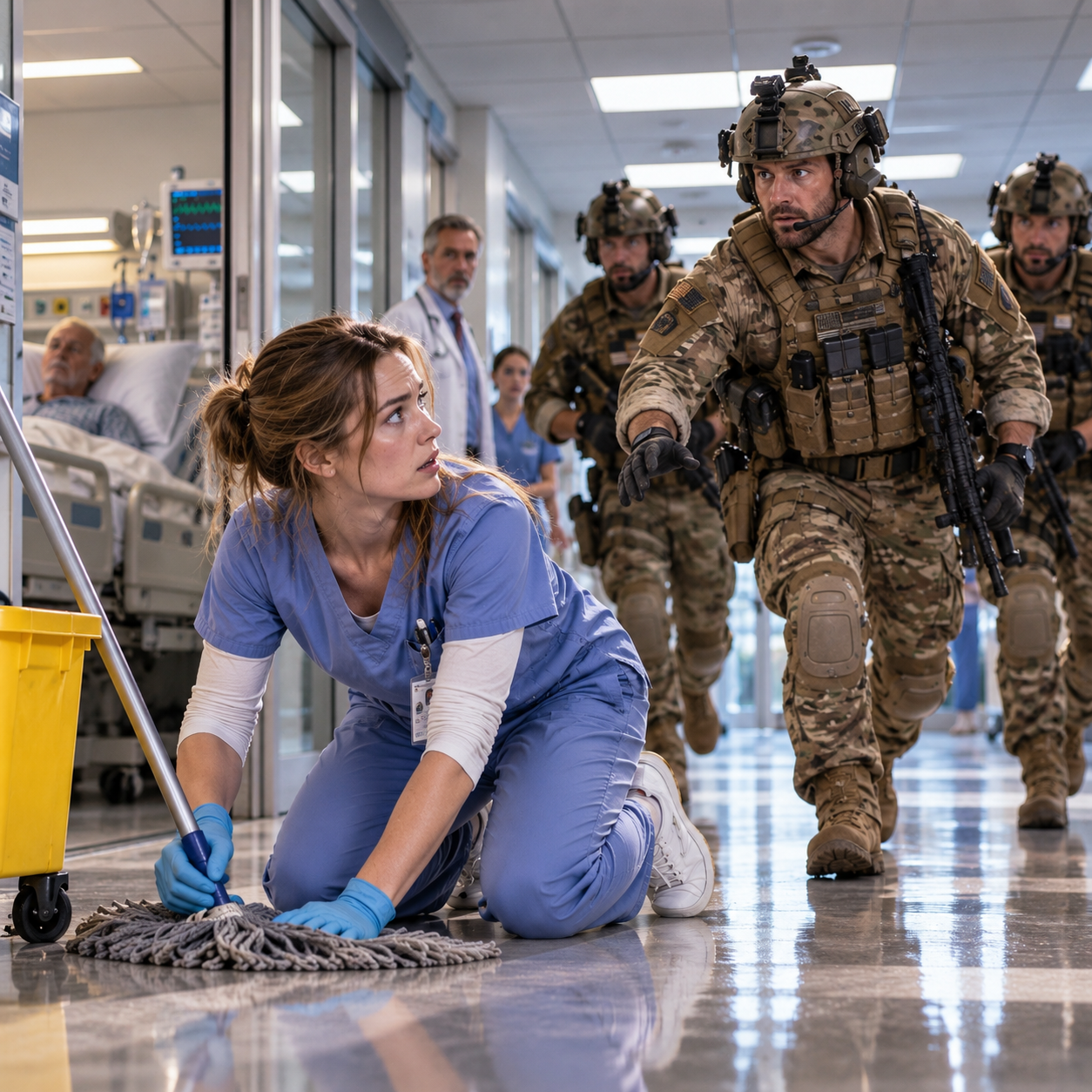
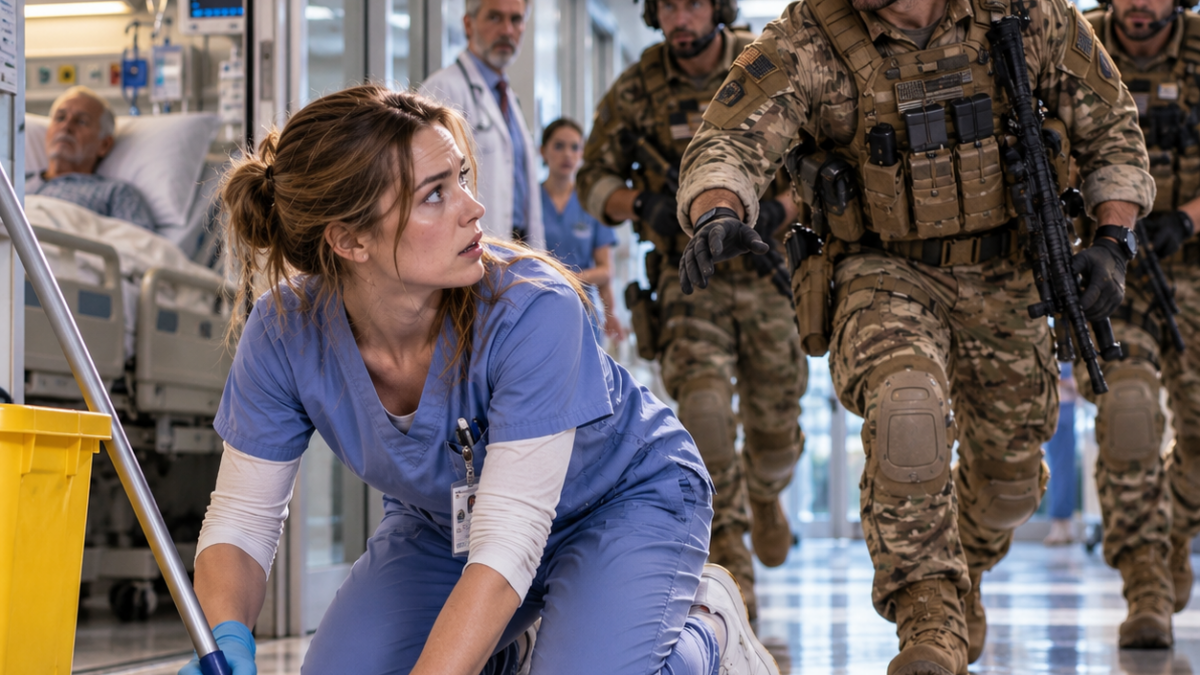
At 2:14 in the afternoon, Dr. Garrett Holt snatched the triage board from Lena Marsh’s hands in front of every nurse on the floor and told her she was a liability.
He used that exact word. Then he pointed toward the wall. I and told her to stand there and observe because observing was apparently the only task she was competent enough to handle.
11 minutes later, the first ambulances from the Caldwell industrial explosion came screaming into the bay with 43 contaminated casualties, and the number was still climbing.
One patient’s airway closed.
Two blood pressures fell off the monitors.
A boy was screaming somewhere behind curtain four, and Lena Marsha’s hands, the same hands Garrett Hol had just humiliated in public, stopped, shaking entirely.
Lena Marsh arrived at Harrove Valley Medical Center on a Tuesday in late October with a rumé that looked like it had been assembled by someone trying very hard to appear ordinary.
Short assignments, humanitarian placements with organizations that most people hadn’t heard of.
one gap of nearly two years explained only by the phrase personal circumstances, which told the HR department nothing useful and apparently satisfied them enough to hire her anyway. She was 36 years old, brown-haired, medium height, and unremarkable in every visible way.
Her clinical license was current, her certifications checked out, three references, all credible. She smiled during orientation, answered questions in complete sentences, and thanked people by name when they showed her where supplies were kept.
Dr. Garrett Hol made up his mind about her within the first 40 minutes.
He watched her hesitate twice during medication verification, not mistakes, just pauses, and he watched her spend 90 seconds examining a supply cart before signing off on it. He was 48 years old and had run the trauma department at Harrove Valley for 11 years. And in his experience, hesitation was a shape that meant the same thing no matter what form it took.
The catch and it meant someone didn’t trust themselves.
It meant delay.
In an emergency department, delay cost things he wasn’t willing to have it cost.
Nurse Marsh, he didn’t look up from the chart he was writing.
The medication verification process takes 6 minutes under standard protocol. You took 11.
Lena glanced at him. I found a labeling discrepancy on one of the midolum vials. I flagged it.
He did look up then briefly and you needed five extra minutes to determine that a label discrepancies required flagging. I needed five extra minutes to determine whether it was a documentation error or an actual dispensing error.
She said it was dispensing. The pharmacist confirmed it.
He studied her for a moment with a particular expression. Someone who has just been corrected and is deciding whether to acknowledge it.
He didn’t.
He capped his pen, tucked the chart under his arm, and walked away. That was day one. By the end of the first week, Lena had been corrected publicly four more times, three of which Garrett Holt delivered himself.
Once for asking whether the chemical disaster supply carts had been recently restocked. He called that catastrophizing.
Once for taking longer than expected to introduce herself to a non-urgent patient. He called that inefficiency.
Once for requesting that a paramedic repeat a handoff report she’d partially missed because another physician spoke over it.
He called that a failure to multitask in a basic clinical environment. Ruth Callaway watched all of this.
Ruth was 57, built like someone who had been on her feet for 30 years and had simply integrated it into her skeleton.
She had been charged nurse at Harrove Valley for 16 of those years and before that that she’d worked emergency departments in two other states and she had enough experience to know the difference between a new nurse who lacked skill and a new nurse skill.
A new nurse who lacked something else entirely. What she noticed about Lena Marsh was this.
The woman became anxious when praised, but flustered during ordinary small talk, visibly uncertain when a physician asked her opinion in a routine situation. Her hands trembled sometimes when the department was quiet, a subtle thing, just a faint unsteadiness when she was writing notes or holding a coffee cup in the breakroom. But when a patient deteriorated, the trembling stopped.
Ruth saw it happen the third day. when an elderly man in bay 6 went into respiratory distress faster than his presentation had predicted.
Three nurses were closer.
Lena was across the room and already moving before the monitor alarmed, already calling it out before anyone else had registered the change in the man’s color.
She didn’t look uncertain for one second of that intervention.
Ruth didn’t say anything about it.
She just filed it away in the part of her brain where she kept things she wasn’t ready to name yet.
Lena, for her part, was doing everything she could to be invisible. She wanted this job, not because Harrove Valley Medical Center was extraordinary.
It wasn’t particularly.
It was a regional trauma center in a mid-size city, underfunded in the way that most regional hospitals were underfunded, staffed by people who ranged from genuinely excellent to genuinely burned out with a physical plant that had been renovated in sections. So the newest wing to the oldest through a corridor that always smelled faintly of something institutional and unidentifiable. She wanted this job because it was ordinary.
Because the patients came in with ordinary injuries and ordinary illnesses and went home or were transferred or sometimes didn’t make it.
And all of it was hard and sometimes it was worse than hard. But none of it required her to think about the things she had spent 3 years working very hard not to think about.
She wanted a life that didn’t know her old name.
on the morning of the third Wednesday and the Holt stopped her in the hallway during pre pre-shift handoff and told her in front of the assembled nursing staff SAP and two physicians that he had reviewed trash assessments from the previous week and found them overly cautious to the point of operational delay. Lena stood still while he said it. You categorized four patients as potential secondary exposure risks during intake.
He said four. None of them presented with anything outside standard parameters.
You were consuming triage time and paramedic attention on assessments that were not clinically indicated. Two of them symptom combinations that nurse Marsh his voice was patient in the way that authority sounds patient when it is not interested in patients. In the last week, I have watched you add 15 minutes to intake procedures.
Question two, verify decontamination clearances and ask a fire department hazmat officer to explain his own protocols to you. You are new here.
This is not a battlefield. We do not treat this ER as a contamination zone. Every time someone arrives from an industrial accident, someone laughed.
A short sound quickly suppressed.
Lena looked at the wall behind Holtz left’s shoulder and said nothing.
She said nothing because saying the truth, saying, “Fyen, I’ve seen what a contaminated cake does to a hospital that didn’t believe it was happening would have required explaining where she’d seen it.
” And she couldn’t explain that.
She couldn’t explain any of it, and she had no intention of trying.
So, she nodded.
She said, “I understand.”
And she went to start her shift. Ruth caught her eye from across the corridor.
The look on the older woman’s face wasn’t sympathy exactly.
It was the specific expression of someone watching an equation she hasn’t finished solving yet.
The call came in at 1:51 p. m.
Caldwell Industrial Processing Facility, 12 mi east of of Clarkfield. An explosion in the secondary production wing.
Cause unknown. Casualties ongoing.
Fire and hazmat units responding. First ambulances ETA 14 minutes.
The ER went into surge protocol immediately. Holt moved to the ambulance bay to direct triage. Lena was assigned to bay 3 standard intake support about as far from any decision-making authority as he could place her without uh sending her to the break room.
At 158, while the department was still rearranging itself, Lena walked to the supply corridor and quietly checked the chemical disaster cart. It was under stocked. The activated charcoal supply was at 40%.
Four of the eight decontamination shower kits had been pulled for a training exercise 3 weeks ago and not replaced. She found this out in approximately 90 seconds by opening the cart and looking at it.
She went back to bay 3. At 23, a hazmat officer named Kowalsski came through the ambulance entrance ahead of the first wave and reported that all outgoing patients had received field decontamination and were cleared for standard intake. The fire department had flagged the explosion as a propellant fire with secondary inhalation, risk smoke, carbon monoxide, blast over pressure, the kind of thing an ER handles several times a year.
At 29, Lena was standing at the bay 3 supply station when the second paramedic unit radioed ahead. She heard the transmission through the overhead systems.
Three patients presenting with bilateral meiosis. One with excessive secretions.
Two with muscle cramping that field crews had attributed to blast wave effects. She stopped moving. Meiosis secretions cramping in the context of an industrial chemical facility.
She crossed the floor to where Hol was standing near the ambulance bay doors. OP reviewing the incoming manifest. Dr.
Holt. She kept her voice flat. The last radio report included three patients with constricted pupils, hyper salivation, and muscle cramping.
That’s not a smoke inhalation picture.
That’s a coneric pattern.
He didn’t turn around.
The field don was completed.
Nurse Marsh Fieldon doesn’t guarantee the exposure agent has been fully removed if we don’t know what the agent is.
If this is organo phosphate contamination, bringing those patients through the main ER minus the hazmat officer has cleared them. The hazmat officer cleared them for propellant fire exposure.
That’s what they were told they were looking at.
She kept her voice. Even her hands, she noticed distantly were completely still.
If there’s a secondary chemical release we haven’t identified, we could be introducing contaminated patients into to a space where 40 plus people, staff, and existing patients are breathing the same same recirculated air.
Holt turned
around then.
He looked at her with an expression she’d seen before on other faces in other situations.
The particular combination of irritation and dismissal that forms when someone with authority believes they are being hel challenged by someone without the standing to challenge them.
I’ve been running this department for 11 years.
He said what I will not do is turn this ER into a decontamination theater based on the instincts of a probationary nurse who has been here for 3 weeks. He reached across and took the triage clipboard from her hands.
The motion was deliberate, almost ceremonial. Go to bay three. Observe.
If you cannot observe without second-guessing protocol, I would suggest using the time to review our standard chemical exposure procedures because clearly there are gaps. He said it loudly enough that two residents and a paramedic heard it.
Lena’s jaw tightened.
She went to bay 3. 22 seconds later, the first ambulance backed into the bay.
What happened in the next 11 minutes was not chaos in the way that word gets used loosely. It was worse than that because it looked at first almost manageable.
Blast injuries came in first burns, lacerations, tempanic perforations, the kinds of trauma a competent ER handles badly only when overwhelmed by volume. The Hargrove Valley team was not overwhelmed by volume, not yet. And they were good at what they did.
And for the first 8 minutes, the intake felt heavy but controlled. Then it stopped feeling controlled.
The first sign was a paramedic. His name was Rodriguez, 24 years old, 4 years on the job.
He had been in and out of the ER three times already that afternoon, and he sat down suddenly on a supply cart in the hallway, and said he felt strange. His partner coming through the door behind him took one look and called for assistance. Rodriguez was not a casualty from the plant.
He was a responder who had transported one. At almost the same moment in bay 7, a male patient who had been assessed as stable post decon began seizing. In Bay 2, a woman in her 40s whose intake vitals had been acceptable was now showing rapid respiratory deterioration that did not fit simple smoke inhalation.
Her oxygen saturation was dropping and her pupils were pinpoint. The word moved through the department like a current.
Lena heard it from bay three. She was already moving.
She didn’t think about the clipboard.
She didn’t think a clip didn’t think about Holt’s expression when he’d taken it back or the sound someone had made when they laughed or the phrase operational delay.
She thought about the woman in bay 2 whose airway was closing and the man in bay 7 whose muscles were firing out of sequence and the paramedic in the hallway who had transported a contaminated patient without knowing it. and she thought about the ventilation system currently circulating air from the ambulance bay through the main ER at a rate of six cycles per hour.
She found Ruth Callaway near the nurse’s station.
Listen to me, Lena said. This is organo phosphate or something structurally similar, not smoke. The field decon was done for the wrong agent and some of these patients are still carrying surface contamination.
We need to stop bringing new intakes into the main department until we establish a decon corridor at the ambulance bay entrance. Ruth looked at her for exactly 2 seconds.
Then what do you need? Physical barrier between the bay entrance and the main floor.
Redirect any incoming personnel to change clothes and rinse before they pass the threshold. The charcoal supply in the disaster cart is low.
I I checked it this afternoon. It needs to be supplemented from the secondary pharmacy store, fourth floor.
And someone needs to call Hol and tell him we have secondary contamination moving through the ER right now.
He’s not going to then get someone who will validate it fast enough that he’ll have to listen.
Lena was already pulling on a fresh pair of gloves. Is there a toxicologist on call? Dr.
Voss. Paula Voss.
She’s off site.
I have her cell. Call her.
Tell her coneric toxidrome industrial exposure possible organo phosphate derivative symptoms presenting in patients who cleared field decon.
Ask her if the clinical picture I’m describing fits.
She glanced up. I need her to tell Hol, not me.
He’ll hear it from her.
Ruth already had her phone out. Lena turned back to bay 2. The woman in bay 2 was named Sandra Ooa, 41 years old, an administrative manager at Caldwell Industrial, who had been on a site visit when the explosion occurred.
She had been in the wrong part of the building at the wrong time, and she had inhaled something she couldn’t name.
And by the time Lena reached her side, Sandra’s oxygen saturation had dropped to 81% and her chest was working hard in the uncoordinated way that meant the muscles responsible for breathing were no longer doing it correctly.
Sandra Lena put her hand on the woman’s arm.
I’m here.
Look at me.
Sandra’s eyes found her dark and frightened and still present.
I need you to let me work.
Lena’s voice was calm in a way that had nothing performative about it.
“Your body is fighting the wrong thing right now, and I’m going to help redirect it.”
“Don’t fight me,” she began the intervention.
She was not supposed to be doing this. She was a probationary nurse assigned to bay 3 with her clipboard taken away. The attending on bay 2 was a second-year emergency physician named doctor Weston who appeared in the doorway 2 minutes later and stopped when he saw what she was doing.
What he started she needs atropene and pralidoxim and she needs them 4 minutes ago. Lena said without turning around the clinical picture is chonurgic not smoke inhalation. I called it on intake.
are you going to stand in the door or are you going to order it? Dr. Weston was 29 years old and had been practicing for 2 years and he looked at his patient and then at Lena and then at the monitor readings and he stepped forward and ordered it.
That was the moment the department cracked open because Weston ordering treatment protocol on bay 2 sent a signal that moved faster than any announcement. Nurses heard it. The other attending Dr.
Ferris heard it from across the floor and Garrett Hol standing 20 ft away directing the ongoing intake of blast casualties heard it and went still. He crossed the floor.
He he came through the Bay 2 curtain with the measured speed of someone who is angry but hasn’t um who is angry, hasn’t decided whether to show it.
And he looked at Sandra ooa. He looked at the medication being administered and he looked at Lena nurse Marsh.
She presented with bilateral meiosis, hypers salivation and muscle faciciculations on intake. Lena said she was still working. Her hands did not stop.
She had field decon clearance for smoke inhalation, but the symptom picture doesn’t match.
It matches organo phosphate or carbonate poisoning. There are three other patients in this department right now with the same cluster and at least one responder is showing early symptoms which means surface contamination came through on the clothing before we establish the barrier.
Hol said you do not have authority to halt Ruth’s voice from behind him.
Paula Voss is on the phone. She needs to talk to you right now. Something shifted in his face.
He took the phone. Lena listened to half of that conversation without turning around.
She heard Voss’s voice precise, unhurried, describing exactly the toxidrome presentation Lena had identified.
She heard Hol ask two questions in a row and not get the answers he wanted.
She heard him say, “Are you certain?”
and then say nothing for a long moment.
Then he said, “All right.”
He handed the phone back to Ruth. He did not look at Lena.
He turned to the floor and said, “Yellow zone protocol.
Now I need the ambulance bay sealed off from the main ER floor. All incoming patients strip and rinse before they pass the threshold.
I don’t care what field clearance they have.”
Ruth, I want the decon corridor set up in the next 10 minutes. He glanced at bay 2.
Follow what she’s doing in there.
He said she without specifying who she was. Then he walked away for 30 seconds. No one in the immediate area said anything.
Then the department moved.
What came after was the kind of hour that people who survive it never fully subscribed to anyone who wasn’t there.
Not because it was unescribable, but because any description comes out wrong either, too heroic or too clinical. And neither version is accurate.
The truth was messier and more exhausting and full of small failures alongside the things that worked. 10 patients in critical condition across the department.
Seven had been initially prost trauma and were now identified as having secondary chemical exposure of varying severity. Three had arrived with organo phosphate contamination.
The field team hadn’t recognized for what it was.
Lena moved between them. She was not the physician directing treatment. She was not the senior staff member running the floor.
She was a probationary nurse with no triage authority who had correctly identified the primary threat before anyone withstanding had done it. And in the absence of any formal instruction about what her role was now, she did the thing she knew how to do. She watched the monitors.
She caught the changes before they became crisis. And she told the people with prescribing authority what she saw in time for them to act on it. It was not seamless.
The atropene dosing on one patient was initially too low and Lena caught it late enough that they had an uncomfortable 3 minutes. A patient in Bay 9 kept refusing to keep his oxygen mask positioned correctly.
And she spent 11 minutes explaining why it mattered before he stopped fighting it. The decon corridor worked, but it slowed intake and there was a period around the 40minute mark when the department had more incoming casualties than it had properly staged treatment bays for.
Ruth ran the nursing floor during that period with the efficiency of someone who has managed understaffed emergencies enough times that she no longer wastes motion on anything except what is directly necessary. Holt directed the physicians. He had not acknowledged Lena again.
He moved through the department making decisions and when those decisions required information she’d already identified, someone relayed it to him without specifying the source.
And he sits he accepted it. It was an imperfect arrangement. It was the arrangement that existed and they were keeping people alive inside it and that was the only thing that mattered in the room.
At the 47 minute mark, Lena found Theo Barker. He was 12 years old, and he was sitting on the floor in the corridor outside Bay 6 with his knees pulled to his chest and his eyes fixed on the curtain through which his father had disappeared 20 minutes ago.
Someone someone had given him a blanket that he hadn’t unfolded.
His sneakers were slightly too large for him in the way that boys shoes sometimes are when they’ve been bought to grow into.
Lena crouched down to his level.
“Your dad is in basics,” she said.
It wasn’t a question.
He looked at her.
His eyes were red, but he wasn’t crying anymore, which sometimes meant a child had simply run out of immediate resources for crying.
Nobody will tell me anything.
What’s your name?
Theo. Theo.
She didn’t tell him everything was fine.
She didn’t tell him his father would definitely be okay.
She had seen psychologically she had seen too many times what happened to children who were given those sentences when the sentences turned out to be wrong. Your dad is very sick right now.
The doctors are with him.
Is he going to I don’t know yet?
She said, “What I know is that everyone in this building right now is doing something useful.
That includes you sitting right here where I can find you if I need to.
Can you do that?”
He stared at her.
I know that’s not a real job, she said.
But stay here and don’t disappear on me.
Deal. After a moment, he nodded. She stood up and went back to the floor.
At the 53 minute mark, a secondary sweep of contaminated equipment revealed something that made Lena stop walking midstride. Two of the gurnies used during initial intake prior to the decon corridor being established had tested positive for surface residue.
Those gurnies had been moved into the main treatment area. She found Holt near the physician station.
The contamination didn’t stop at intake, she told him.
We have two gurnies in the main area that tested positive. I need you to pull them and recheck every piece of equipment they contacted in the last hour.
He looked at her for a moment with an expression she couldn’t read.
Do it, he said. By the 59th minute, all 10 critical patients were in monitored, stable, or stabilizing condition. None of them had died.
Rodriguez, the paramedic, was being treated and already showing improvement. Sandra Ooa, was breathing without assistance.
Theo Barker’s father, J Mouse Barker, 38 years old, plant floor supervisor, who had been closest to the secondary release point, was still critical, still in bay six.
But the intervention was working and his blood pressure was climbing back into ranges the attending could work with. Lena was standing at the supply station reglathing after a procedure when she heard it.
The sound came from outside from the rear access that connected to the ambulance bay entrance. Multiple vehicles. The sound of doors, not ambulance doors, a different weight and rhythm.
and radio frequencies cutting in and out in the low frequency way they did when someone was deliberately managing their signal footprint.
She didn’t move.
She stood at the supply station and listened and felt a very specific kind of stillness spread through her chest that she had not felt in 3 years. Ruth appeared at her shoulder.
There are vehicles at the ambulance bay entrance. Military looks like three of them.
They’ve sealed off the minets.
I know, Lena, said. Ruth looked at her.
I know, Lena said again quietly. And this time it had nothing to do with the vehicles. She pulled on her gloves.
She turned back to the floor. She heard them before she saw them.
The shift in the department’s ambient noise, the particular hush that falls when authority enters a space, and people aren’t certain whose authority it is or what it wants.
She kept moving toward Bay 9, telling herself it was possible she was wrong, that there was another reason that three military vehicles at the back entrance of a regional ER during a chemical emergency could mean a dozen different things.
She told herself that she didn’t believe it.
When she finally looked up, she was standing in the corridor between Bay 9 and the nurses’ station and Rear Admiral Dennis Aldrich was crossing the ER floor in the direction of Garrett Hol.
He was 59 years old. He wore service dress with two command staff behind him.
And his posture was the kind of erect that doesn’t come from physical training alone, but from 25 years of occupying rooms in ways that made other people automatically rearrange themselves.
He had more gray in his hair than the last time she’d seen him, and she knew with the cold precision of someone who notices things um they shouldn’t be noticing that the gray had come in thicker on the left side.
She stopped that thought.
He hadn’t seen her yet.
Lena began moving toward bay 9, toward the wall, toward the supply corridor.
She wasn’t certain where she was going, only that she needed to be somewhere he wouldn’t see her face from across the room, where she might have another 30 seconds to nurse Marsh.
Ruth’s voice from directly to her left, Lena stopped.
And in the moment she stopped in the fraction of a second when she was standing still with her back to the main corridor. Rear Admiral Dennis Aldrich looked up from his conversation with Hol.
His eyes crossed the ER floor. They found her.
The expression that moved across his face was not surprise. It was something quieter and far more complicated than surprise. The expression of someone who has spent a long time looking for something and cannot quite trust themselves when they find it.
He said one word, just one, across 30 ft of emergency department floor in a voice that didn’t carry far, but carried clearly.
Nightclass. The sound went through Lena like cold water through a crack in stone.
She hadn’t heard that name in 3 years.
She hadn’t been that person in 3 years.
Garrett Holt, standing 3 ft from the admiral, looked up. He looked across the room.
He looked at Lena.
And the thing he found on her face, the thing he hadn’t once managed to find during three weeks of watching her hesitate over clipboards and tremble over medication verification and apologize for asking about chemical disaster.
Supply carts was something he didn’t have a name for.
It wasn’t fear.
It wasn’t guilt.
It wasn’t recognition in any ordinary sense.
It was the look of someone who has been dead on paper for 3 years and has just heard a stranger speak the name of the ghost she used to be out loud in a room full of people. The ER continued around her.
Monitors, voices, the mechanical breath of a ventilator in bay 4, the squeak of a supply cart rounding the corner. All of it kept moving and Lena Marsh stood very still in the center of it and did not run and did not answer. Not yet.
But in Bay Six, behind the curtain, where James Barker was still fighting his way back toward his son, something shifted. One of the patients recently transferred from intake, still sedated, chemical tagged, turned his head through the gap in the curtain, through the dim light and the oxygen tubing and the IVs lines.
He looked at the woman standing motionless in the middle of the ER floor. His voice was raw and damaged from the chemicals, rough from the intubation they had attempted and removed. But his eyes were clear.
Clear enough to recognize a face he had last seen at an industrial facility overseas 3 years ago at a facility where according to every official record that existed, this woman had not survived. The man in Bay 6 had eyes the color of dark water, and they were open.
Lena saws him the same moment he saw her through the gap in the curtain that the orderly hadn’t fully closed across 30 ft of ER floor and two layers of procedural noise.
His name was on the intake manifest somewhere.
She’d been too busy during the first hour to read every chart that came through.
He had arrived in the second wave transferred from triage after apparent blast injuries and someone had categorized him as stable critical and moved on. He was intubated and sedated, and his hands were bandaged to the elbows, and the monitor above his head was drawing a rhythm that was labored, but holding. He was also looking directly at her with the expression of a man who has just seen a thing he knows cannot be real.
His mouth moved. Nothing came out. The intubation tube made that impossible.
Lena looked away first. She made the decision inside of 1 second.
Not because she had thought it through, not because she had weighed any of the consequences, but because Admiral Aldrich was still uh alt that’s still 30 ft away and Holt was staring at her and the department was still running around them and she needed another minute, just one more minute to find her footing on ground that had just dropped out beneath her.
She turned toward Bay 9 and took three steps.
Senior Chief Marsh Aldrich’s voice behind her.
She stopped walking.
She didn’t turn around.
Not yet. Her hands were gloved and she pressed them together, feeling the latex against her palms and made herself breathe in and out exactly once before she faced him. He was closer than she expected.
He had moved fast for a man of his rank and age, crossing the ER floor with the practiced economy of someone who had spent decades not wasting motion. His two staff members had stayed back at the entrance, and Hol was watching from 12 ft away with with the expression of a man trying to read a document in a language he only partially speaks.
Up close, Aldrich looked older than she remembered him. Not in a diminished way, in a way that suggested the last three years had cost him something, too.
You’re looking at me like I’m going to run, Lena said.
Are you? A beat. Not with a patient still critical in bay 6.
Something moved across his face. Relief, she thought, or something adjacent to it.
I’ve been he stopped.
Started again.
We’ve been looking for a long time, senior chief.
My name is Marsh, she said. Lena Marsh.
It’s on my badge.
I know what’s on your badge.
Then use it. He studied her for a moment. The ER continued to function around them, nurses moving past, monitors beeping, the contained and disciplined noise of people working through an emergency that was not yet over.
Aldrich glanced once at Hol, who was close enough to hear every word and didn’t bother pretending otherwise.
“I need 5 minutes,” Aldrich said to Lena.
“Private.
I’m midhift.”
“I know.
5 minutes.”
She looked at him. She looked at Hol. She looked at the door to bay 6 where the curtain was still cracked and the man inside whoever he was had just seen a dead woman standing in the corridor of a regional emergency department.
Ruth,” she said without raising her voice.
Ruth materialized from the nurse’s station with the unhurrieded speed of someone who had been watching this entire exchange from the peripheral position she preferred.
“What do you need?
B six, please make sure they know the patient showing signs of emerging from sedation.”
Already flagged.
Ruth’s eyes move between Lena and Aldrich with careful neutrality.
You’ve got 5 minutes before the next lab results come back on the exposure cluster.
Thank you. Lena moved towards the family consultation room at the end of the south corridor. Aldrich followed.
Holt, after a visible moment of deciding whether he had the standing to follow, stayed where he was.
The consultation room was small and fluorescent and smelled like disinfectant with two chairs and a low table and a box of tissues that someone the hospital’s original design phase and nobody had ever removed because the had ever removing the job of it belonged to nobody in particular.
Lena didn’t sit.
She stood with her back to the wall and her arms at her sides and waited. Aldrich closed the door.
The Caldwell explosion wasn’t random.
He said she had already suspected this. She said nothing.
The precursor compound involved in the secondary release. We identified it 4 hours ago.
It’s the same formulation that was present at the Savar facility.
The overseas one. He paused. The one where you disappeared.
The word disappeared was doing a great deal of work in that sentence. She let it sit there without correcting it.
Caldwell Industrial has been manufacturing equipment components for an export company that sourced materials from Savar’s parent contractor.
Aldrich continued, “We’ve known about the connection for 8 months.
” That’s why I was in the region.
When the explosion was called in and the symptom pattern started coming through the dispatch channels, I He stopped again. This time the pause was longer. I knew you knew I was here.
I knew about the chemical signature. the rest. He looked at her.
No, that was not part of my planning. Lena considered this. She believed him.
She wasn’t sure that made it better.
What do you need from me?
She said, “Right now, nothing you’re not already doing.”
He held her gaze. Later, your testimony, the complete record.
Everything you documented during nightclass that didn’t make it into the official report.
Her hands tightened slightly at her sides. She felt it and made them stop.
Later she said, “Right now, I have 10 patients to the door opened.
Dr.
Weston, Bay 2 physician, leaning in with the specific expression of someone interrupting something he knows he shouldn’t be interrupting.
Nurse Marsh, I’m sorry.
Bay 7 is deteriorating.
Voss is on the line and she’s asking for you specifically.
” Lena was already moving past Aldrich before Weston finished the sentence.
Bay 7 held a man named Greg Foresight, 52 years old, facilities maintenance director at Caldwell, who had been among the first wave of patients brought into the ER before the decon corridor existed. He had been stabilizing for the last 40 minutes, blood pressure improving, respiratory rate normalizing, the conergic symptoms responding to treatment. When Lena pushed through the curtain, she found him in acute respiratory distress again.
His oxygen saturation back down to 83 and dropping his chest working in the shallow uh is poorly organized way she had last seen on Sandra ooa 50 minutes ago. Dr. Ferris was at the bedside.
He crashed 20 minutes into the recovery window. Same treatment protocol he was responding to before. Lena looked at the chart, looked at the monitor, looked at the IV access and the medications and the timeline of his presentation.
The decontaminated gurnies, she said. Ferris looked up.
We found surface residue on two gurnies from the initial intake period, she said. What other equipment was in contact with those gurnies before we pulled them? A beat while Ferris processed this phone.
Lena said Dr. Voss first.
Ruth handed her the phone.
Paula Voss’s voice came through crisp and slightly distorted by the connection.
She was clearly moving somewhere, heels on a hard floor, doors opening in the background. She had driven in from somewhere.
Lena realized she wasn’t calling from an office anymore.
Marsh Voss’s voice was direct.
The patient in Bay 7 described the relapse presentation. Lena described it. 30 seconds.
No wasted words. Secondary reexposure, Voss said immediately.
Something in his immediate environment is re-releasing.
It’s not metabolic.
The timing is wrong. What changed in that space? Equipment contact.
I’m investigating.
A door sound on Voss’s end.
I’m 8 minutes out.
Tell me what you know about the specific agent because the toxicology I’m pulling from the Caldwell incident report doesn’t account for this relapse pattern.
Organo phosphate derivatives can metabolize this way.
But the standard industrial compounds don’t.
Not at this concentration. Not with this timeline.
Lena didn’t answer immediately.
8 minutes. Voss was 8 minutes away.
She thought about the encrypted file she had been carrying on a drive smaller than her thumbnail for 3 years. She thought about what was in it. She thought about the fact that the information she needed to give Voss right now, the specific metabolic cascade pattern, the delayed secondary absorption mechanism, the modified treatment window that departed from standard organo phosphate protocol in two critical ways.
That information existed in exactly one clinical record in the world.
The one she hadn’t disclosed to anyone.
Dr.
Voss, she said, “When you get here, I need to show you something.”
A pause. Then is it relevant to my patients?
Yes.
Then I’ll be there in 7 minutes.
The call ended. Lena handed the phone back to Ruth and turned to find Hol standing 6 ft behind her.
She hadn’t heard him come in.
He stood in the Bay 7 doorway with his arms at his sides in the expression of a man who has spent the last 10 minutes revising everything he he thought he understood about the last 3 weeks.
He wasn’t angry.
She would have found anger easier to navigate. He looked like a man in the specific uncomfortable conditions of realizing that his certainty has been more expensive than he had known. the contaminated equipment, he said.
How do we find what else it touched back to the work? She appreciated that full equipment trace from the first intake period, she said.
Everything that entered this ER before we sealed the corridor. Gurnies, IV poles, any monitoring equipment that moved between intake and the main floor.
She glanced at Ruth. Can we pull the intake log?
I’m already on it, Ruth said.
I need it room by room. Give me 4 minutes.
Hol stepped aside to let a nurse through and Lena moved back to Foresight’s bedside and adjusted his oxygen delivery, tilting the mask and raising the flow rate.
His saturation climbed back to 87. Not enough, but buying them time.
She heard Theo Barker’s voice before she saw him.
He wasn’t crying.
He was asking a question somewhere in the corridor. the specific flat-voiced question of a child who has been holding himself together for long enough that the question comes out stripped of inflection.
She couldn’t make out the words.
She heard Ruth’s response low, steady, unhurried, and then she heard the silence that followed, which was the silence of a child absorbing something he had asked for and wasn’t sure he wanted.
James Barker’s monitor in bay 6 was showing a pattern she didn’t like.
She had been watching it peripherilally for the last 10 minutes. The rate was slightly elevated, the rhythm more variable than it had been during stabilization.
Not critical, not yet, but variable in the directional way toward instability, not away from it.
And when she stepped briefly into the corridor to cross reference the bay 6 readout with what Ruth had handed her from the equipment trace, she found what she’d been afraid of.
and the gurnie that had carried James Barker from intake to bay 6 was on the contaminated equipment list. She went back to Foresight first because Foresight was already in active distress and James Barker still had a margin.
She made the adjustment to Foresight’s protocol with Ferris, a calculation based on something she couldn’t fully explain yet, something that lived in the encrypted file she hadn’t opened.
a modification to the standard atropene timing that the nightclass incident had taught her in the particular brutal way that that field experience teaches things. Ferris looked at her for a moment.
She met his eyes. He made the order.
She didn’t wait to see whether she was right.
She moved to bay six. The man in the bed was still sedated, but less deeply than before.
His eyes were closed again, but his vitals had the slightly elevated quality of someone whose system was was working back toward consciousness. The monitoring nurse, a young woman named Priya, who had been on shift since 6:00 in the morning and showed it, was charting at the bedside.
Lena reviewed the chart, checked the IV site, adjusted the rate on one of the lines.
She looked at the patients hands where they rested on the blanket bandaged as she’d noticed earlier.
But she could see now from the shape of the injuries underneath that this wasn’t blast trauma.
These were chemical burns. The pattern was wrong for someone caught in an explosion at ground level.
These were hands that had been in contact with something for an extended period. Geck. She looked at the admission tag clipped to the bedside rail.
Marcus Talbot, 44 years old. Occupation safety compliance director, Caldwell Industrial Processing. She read it twice.
Safety compliance director.
The person at a chemical processing facility responsible for knowing what compounds were on site, what their risk profiles were, what the emergency’s response protocols should be if they were released.
the person who if there was a non-standard compound in the Caldwell facility would have known about it and signed off on its storage or would have refused to sign off and would have documented that refusal. She set the chart down very carefully.
At 3:24 p. m.
, Paula Voss walked through the ambulance bay entrance of Harrove Valley Medical Center. She was 38 years old, wore her hair in a short natural cut, and moved with the precision of someone who has spent a lot of time being the only toxicologist in a room, and has made peace with the fact that this requires a specific kind of speed. She introduced herself to Hol with four words and asked for Lena with three.
They met at the supply corridor outside Bay 7.
Lena looked at Voss for a moment, at the readiness in her face, the absence of political concern, the interest that was purely clinical, and made a decision she had not permitted herself to make since she had walked into Hargrove Valley’s HR office 3 weeks ago with a raum that told almost nothing true about her.
“What I’m about to show you,” Lena said, is from a classified Navy operational record.
I’m showing it to you because there are patients in this department who need the information inside it and I cannot find a version of this situation where I withhold it.
Voss’s expression didn’t change.
Is this you telling me it’s classified so I can tell you I don’t care?
It’s me telling you so you understand the weight of what you’re seeing.
Understood. Voss waited. Lena reached into the inner pocket of her scrub top.
She had sewn the pocket herself, a small, flat, precisely located space that didn’t show under normal clothing.
From it, she removed a drive so small that Voss, who had been expecting something larger, almost missed it.
The metabolic cascade you’re seeing in the relapse patients, Lena said, is documented in here.
The compound at Caldwell is a derivative modified stabilization formula. Whoever design and sand designed the storage conditions knew it needed a higher vapor pressure tolerance than standard organo phosphates.
That’s why the field decon appeared complete.
The compound was temporarily suppressed, not neutralized. At body temperature and humidity exposure inside the ER, it volatilized off the surface contamination on the equipment.
Voss was already pulling out her tablet. treatment modification. The standard atroponization window is too short.
You need to extend the paladoxy dossing period by 40% past symptom resolution.
There’s also a hpatic involvement pattern in the more severely exposed patients that appears late day 2 or three that the standard protocol doesn’t address.
Lena paused. I modified the foresight protocol 14 minutes ago based on this.
If I was right, his saturation should be stabilizing.
A nurse appeared at the Bay 7 curtain and caught Lena’s eye.
89% and climbing, the nurse said. Voss looked at Lena.
The look was not the look of someone impressed. It was the look of someone updating a large number of calculations simultaneously. How long have you known about this compound?
Voss asked. 3 years.
Another pause. Havos asked.
Lena didn’t answer that.
Not yet, but she held out the drive. Voss took it.
What followed was the kind of medicine that doesn’t look like anything heroic because it is too busy being necessary.
Voss and Lean. Voss and Lena moved through the Bay7 case together and then through the two patients who were showing early signs of lateage hypatic involvement.
And then Voss called two colleagues, one toxicologist and one emergency medicine specialist to begin reviewing the full data set with an eye toward the patients who would be admitted overnight and would need monitoring for the day 2 presentation. Holt was present for much of this.