K9 Refused Everyone Near the Wounded SEAL — Until the NURSE Used a SECRET MILITARY Skill – Part 1
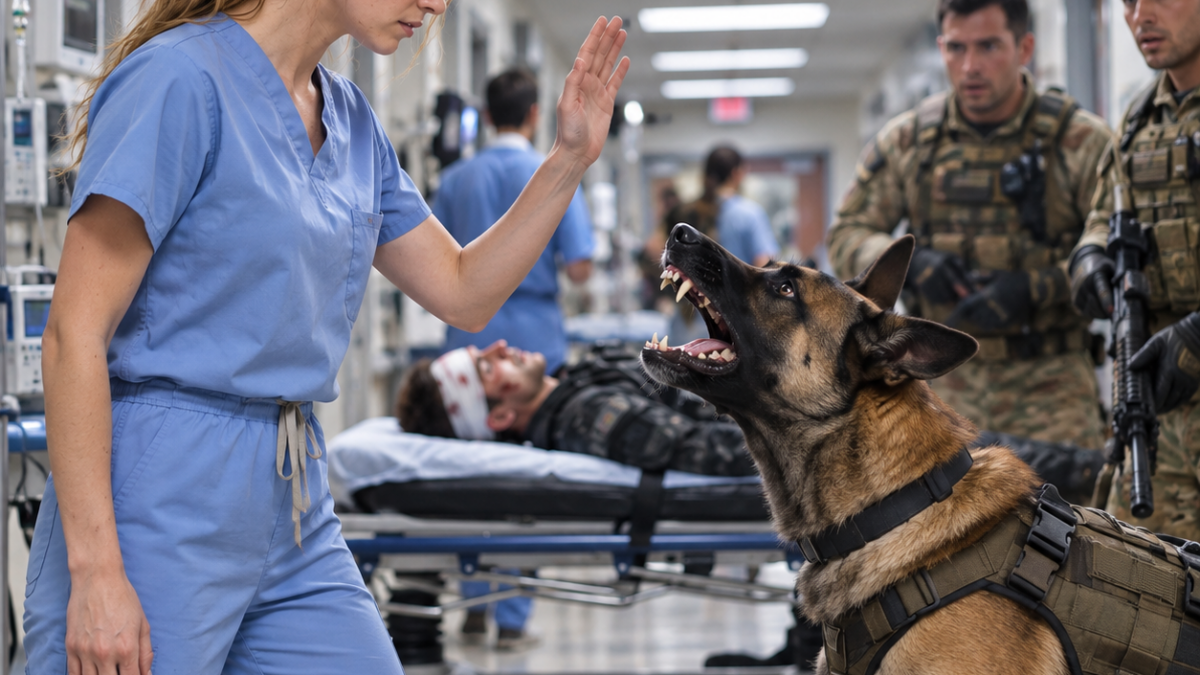
K9 Refused Everyone Near the Wounded SEAL — Until the NURSE Used a SECRET MILITARY Skill
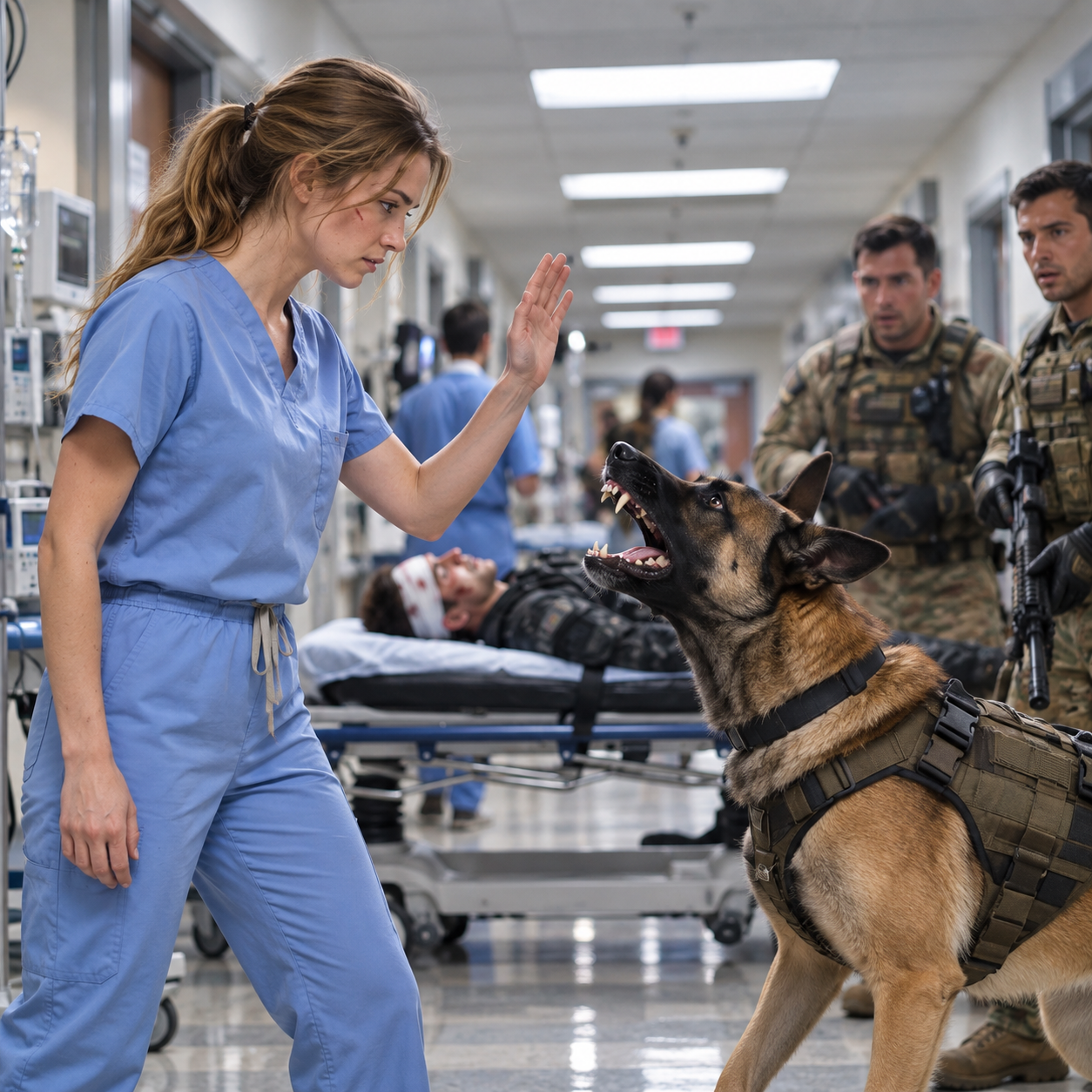
Two military helicopters touched down on a hospital roof and armed soldiers flooded every hallway before the morning shift could process what was happening. A combat K9 had three surgeons backed against a wall, teeth bared, body coiled like a loaded spring.
The hospital director grabbed the nearest security officer and said the words out loud, “Shoot the dog.” And nobody moved to stop him.
Nobody except the floor nurse everyone had spent months pretending didn’t exist.
She stepped forward from the back of the crowd, voice flat and certain, and said four words that silenced the entire corridor.
I’ve got him.
Stand down.
The thing about Maplerrest Valley Medical Center was that it had a reputation for two things. The best cardiac surgery department in the state of Montana and a culture that ate its own. Nobody said that out loud, of course.
The brochures talked about patient outcomes and research partnerships and a teaching affiliation with the university 60 mi east. The administration kept framed mission statements in every conference room.
got compassion, excellence, integrity printed in a font that probably cost more than a floor nurse’s monthly take-home.
But inside the building, especially inside the trauma wing on the second floor, the real rules were different. And everyone who worked there knew it.
Doctor Marcus Hol ran that trauma wing the way certain men run every room they’ve ever occupied, loudly, carelessly, with the unshakable certainty that whatever he wanted to happen was simply what was going to happen.
He was 53 years old, thick through the shoulders with silver at his temples and the kind of posture that came from decades of people stepping aside when he walked through doors. His surgical record was genuinely impressive.
Nobody disputed that. When a 30-year-old motorcycle accident came through the bay at 2:00 in the morning, bleeding from four different places, Holt was exactly who you wanted at the table. The problem was everything that happened between the emergencies.
He had a habit of narrating his contempt in real time. Not behind closed doors, not in private conversations, but out loud in the hallway, in the trauma bay, in front of patients and families and whoever happened to be standing close enough to hear. He aimed it at residents mostly, but residents eventually became attendings and moved on.
Floor nurses didn’t move on as easily, and Hol had identified one in particular who had become, for reasons he’d never articulated and probably couldn’t have if asked, his preferred target.
Her name was Lydia Mercer. She had worked the trauma floor at Maple Crest Valley for 3 years.
She was 36, quiet in the way that some people are quiet because they’ve made a deliberate choice about where they spend their energy.
She was good at her job, careful, fast, spatially aware in that particular way that trauma nurses develop after enough hours in controlled chaos. She kept her dark hair pulled back, wore plain scrubs without the novelty print some of her colleagues preferred, and had a neutral expression that some people read as blankness, and others, if they were paying attention, recognized as focus. Hol had decided to read it as blankness, maybe from the first week, maybe earlier.
Hard to say exactly when he’d settled on her, but he had settled and that was that.
He called her the shadow in front of residents.
He assigned her the supply restocking work that was technically an orderly’s job.
He redirected her during procedures with the particular brand of casual dismissal that was designed not to sound like dismissal.
I’ve got it, Mercer.
Step back so that anyone watching might think he was simply organizing the team. She stepped back every time and she did the supply work without complaint and she kept her neutral expression on her face and she did not give him anything he could use to escalate further.
3 years of that. The morning the helicopters came, she had been on shift for 4 hours.
It started like any other Tuesday at Maplerest Valley. The overnight census running down, the dayshift coming in still pulling their badge lanyards over their heads, the smell of the breakroom coffee mingling with antiseptic in that particular way that trauma floor workers stopped noticing after about 6 months. Lydia had already pushed the medication cart down two hallways, checked in with three patients recovering from surgeries performed the day before, and restocked the supply cabinet in bay 3.
Despite the fact that the orderly on shift was fully capable of doing it, she hadn’t complained about it.
It wasn’t worth what complaining cost.
She was at the nursing station reviewing discharge paperwork when the first sound reached them. Not a siren exactly, something lower than a siren. A mechanical thunder that was too close and too sustained to be a news helicopter passing over downtown Breenville.
The windows in the corridor rattled slightly.
“Two of the newer nurses looked up from their workstations.”
“That’s rooftop,” said Carllin Wen, a pediatric float who was covering trauma that morning.
She was looking at the ceiling as if she could see through it. Lydia set down the tablet she was holding.
The sound multiplied. Not one. Two separate engines, distinct rhythm patterns, the kind of overlapping percussion that meant coordination.
Two aircraft arriving together. Not coincidentally.
The building’s PA system crackled and the security desk downstairs came through with something that wasn’t quite a coherent announcement.
Two words were clear. Emergency protocol. What happened next moved faster than hospital events usually move.
The rooftop access stairwell, which opened at the far end of the trauma wing corridor, banged open before anyone at the nursing station had time to react. Two men in tactical gear came through first. Not security, not police.
Something harder edged than either. And they were followed by a stretcher moving at a pace stretchers did not usually move indoors.
Behind the stretcher came more soldiers, four of them. And beside the stretcher ran a Belgian Malininoa in a military working dog vest, leash clipped to the wrist of the nearest soldier, but pulling hard enough forward that the clip looked purely ceremonial.
The man on the stretcher was big, even horizontal. Broad through the chest, dark tactical clothing soaked through at the left side in the pattern that meant something arterial had been compromised.
His face was pale in the gray way that wasn’t palar from shock, but rather the white that came after significant blood loss.
He was unconscious. The dog was not calm.
The Malininoa brindle coat working harness with patches Lydia clocked from 20 ft away was scanning the corridor with the systematic intensity of an animal running a threat assessment. Not panicked, focused, which was in certain ways more alarming than panicked. The stretcher team hit the trauma bay entrance and the automatic doors opened and immediately the problem became clear.
The dog had gone rigid in the doorway. Shoulderto-sh shoulder with the frame. No amount of leash tension was moving him and the soldier holding the lead had clearly been managing this for a while because he looked tired in addition to everything else.
Somebody get animal control, said Dr.
Holt’s voice, arriving before Hol himself did.
He came around the corner from the attending station, tucking his badge into his chest pocket, and he assessed the scene with the brisk efficiency he applied to anything that had stopped operating the way he thought it should. Clear the dog and get that patient into bay 1.
The soldier with the leash looked at Holt once.
Sir, Kodiak doesn’t transfer without handler clearance.
He’s been protecting the patient since Xfill, and this is my trauma bay, not a kennel.
Holt moved toward the dog. The Malininoa turned its head and fixed halt with a look that every person in that corridor registered simultaneously.
It did not growl. It did not lunge.
It simply looked at him with an absolute directness that conveyed with complete efficiency that moving forward was not an option Kodiak was going to allow. Holt stopped, recovered quickly, the way he always did when something surprised him, reorganized his expression into authority.
I need security up here, he said to the nearest nurse without looking away from the dog. And get Dr. Fenton from administration now.
Uh the man on the stretcher was dying by degrees and the corridor was filling up.
Security arrived, two officers, both of whom understood in approximately 4 seconds that the standard options weren’t available.
The military personnel formed a loose perimeter that wasn’t aggressive, but was also unmistakably a perimeter.
Nurses clustered at the nursing station end of the corridor close enough to see far enough that the distance felt reasonable. The Malininoa had not moved from the doorway.
His head was up, ears forward, and he was conducting his ongoing assessment of every human in the space. The patients oxygen saturation was dropping.
Lydia could see it on the portable monitor the stretcher team had brought with them.
She could also see from her position slightly behind and to the left of the main group that the field bandaging on his left side was saturated and the team had stopped attempting to change it because every time someone reached toward the patient, Kodiak’s stance changed.
Dr.
Warren Fenton, Maple Crest Valley’s medical director, arrived at a pace he reserved for situations where his authority was about to be required in a visible way.
He was 60, thin with an administrator’s instinct for the optics of any given moment.
He looked at the stretcher, looked at the dog, looked at the soldiers, and pulled his own phone out.
“If this animal cannot be controlled,” he said, addressing the soldiers with the measured cadence of someone who had made decisions in conference rooms his entire career, then we have grounds to have it removed by any means necessary to preserve patient care.
The lead soldier captain from the insignia, though Lydia hadn’t been staring at the rank patches the way she’d been staring at the patient, said, “Sir, with respect, shooting that dog will likely cause the patient to go into cardiac arrest from the noise response alone.
He’s been trained to read handler distress at the physiological level.”
Fenton looked at Hol. Hol looked at the dog. Neither of them had a response to that.
The sat monitor on the stretcher read 84 and the number was moving in the wrong direction. Lydia pushed forward.
She wasn’t entirely sure later what the calculation was, whether it was calculation at all or something faster than thought.
The thing that happened after enough years of watching situations deteriorate past the point where anyone’s going to do the right thing unless somebody does.
She moved through the cluster of nurses, past the security officers, past the edge of the military perimeter, and she said clearly, not loud, the kind of voice that carries by quality rather than volume, “Move!
Let me through.
He’s going to arrest in under 3 minutes.”
Several things happened at once. Holt turned and saw who had spoken, and his face went through a rapid sequence.
Surprise! Irritation! The beginning of dismissal.
Mercer, get But the dog moved. Not toward Lydia. Not threateningly.
It shifted its weight and turned its head toward her with an attention that was fundamentally different from the threat scanning it had been running on every other person in the corridor.
Kodiak’s ears moved, back, then forward.
His body, which had been a coiled, ready thing since the stretcher had come through the rooftop door, dropped half a degree out of that operational tension. He looked at her.
She looked back at him.
“Easy,” she said quietly in a register that wasn’t really meant for the human audience.
“I see him.
I’ve got him.
Easy.”
The Malininois stepped aside. Not a lot.
18 in maybe, but enough that the doorway was no longer blocked, and the dog did something that no one who’d been watching him for the past 8 minutes had seen him do.
He sat. The silence in that corridor lasted about 2 seconds.
Then Lydia moved through the doorway and the stretcher team followed her in and she was already pulling on gloves from the wall dispenser and calling out for the crash cart before Hol had finished processing what he just watched. Bay one, someone
bring me a thoracic tray, chest decompression kit, not the standard set. I need the longer needle 14 gauge.
And I need two large bore IVs running wide open. Oeneg from the fridge, not the crossmatch stock.
We don’t have time, Mercer, Bolt’s voice from the doorway, and it had an edge she hadn’t heard quite that way before.
You are a floor nurse.
Stand down and let He’s got a tension pumothorax building on the left side, she said without turning around.
You can see it on the tracheal deviation if you look.
He’s got maybe 90 seconds before the pressure collapses the right lung, too.
And then we’re coating him.
A beat. She heard it.
the hesitation, the small recalculation that happened when someone who understood medicine heard something true.
“Call it then,” said a different voice.
Dr.
Anisha Reyes, the secondyear trauma attendant who’d followed the noise down from the third floor, stepped into bay 1 beside Lydia.
She was younger than Hol by 15 years and ran on the opposite principle. Whatever gets the patient through. What do you need?
Needle decompression first, then tube thoricosttomy to follow. I need you on the airway. His GCS is what was his last recorded GCS?
She directed this at the stretcher team. Seven on scene, the medic said.
Six when we loaded airway first then simultaneously. Dr.
Reyes, can you intubate while I decompress? Yes.
Okay, let’s move.
What happened in Bay 1 over the next 11 minutes was the kind of controlled chaos that looks like panic from the outside and feels like pure focus from the inside. The narrowing that trauma medicine produced in the people who were built for it, where the room got smaller and quieter, and the only things that existed were the patient in front of you and the sequence of what needed to happen next.
Lydia placed the needle at the second intercostal space, mid-clavicular line, left side, and the hiss of trapped air releasing was audible and immediate.
The patients oxygen saturation, which had hit 79 by the time she’d gotten to him, began its climb back.
Dr.
Reyes had the tube in under 2 minutes, clean first attempt, and the respiratory therapist, who’d arrived at a run from the third floor took over manual bagging while the ventilator was wheeled in.
The two IVs Lydia had called for were running. The blood was going in.
She called for a portable chest X-ray, ran her hands along the patient’s ribs, assessing for additional fractures, identified a secondary injury at the lower right side that hadn’t been on the field report, and communicated it to Reyes in the flat, factual shorthand that the team had shifted into.
Dr. Holt was standing outside bay 1, not inside.
outside in the corridor watching through the window in the door with an expression that Carla Nuen standing six feet behind him at the nursing station would describe later as something she’d never seen on his face before.
She wouldn’t be able to name it precisely.
It wasn’t anger exactly, though anger was in there.
It was more like the specific discomfort of watching someone do something you’d told yourself they couldn’t do.
Kodiak had positioned himself beside the bay door, sitting alert, not interfering with any of the personnel moving in and out. He tracked each person who crossed the threshold, noted them, evaluated them, returned to his baseline watch.
When the medical personnel came out to call for additional supplies, he let them pass without reaction. He was, in the operational sense, doing his job.
The two military investigators arrived at the nursing station at 9:47 a. m.
They didn’t announce themselves in the way that visitors usually did.
No interaction with reception, no visitor badges, no waiting. They came through the stairwell door, the same one the stretcher team had used, and they moved with the economy of people who had been in many buildings they did not work in. Both were in civilian clothes, though the clothes sat on them the way civilian clothes sit on people who usually wear something else.
One was a woman in her 40s, dark hair, the kind of face that was professionally neutral. The other was a man about the same age, heavier through the jaw, who carried a tablet and was already looking at it as they walked.
They stopped at the nursing station, and the woman said without preamble, “We’re looking for a nurse assigned to this floor.
Name is Lydia Mercer.”
The nursing station had three people at it. All three looked toward bay 1.
She’s in a procedure, Carla said carefully.
We’ll wait, the woman said, and then in a tone that made it clear this was not small talk.
How long? From inside bay 1, the patients monitor had shifted from the urgent compressed rhythm of a crashing patient to something more stable. The numbers were moving in the right direction.
The voices inside had dropped in register, still focused, but no longer urgent in the particular way of the first 11 minutes. The investigators were still standing at the nursing station when the bay door opened and Lydia came out pulling off her gloves. She was moving toward the supply station for something else she needed.
And she stopped when she saw them. They looked at her. She looked at them.
Something happened in her expression. Not surprise exactly.
Something more specific than surprise. Recognition maybe. And then almost immediately she smoothed it back to neutral.
The woman said, “Sergeant first class Mercer.”
It was not a question. Dr.
Hol, who had been standing 8 ft away and heard it clearly, turned and looked at Lydia Mercer, the floor nurse he’d been calling the shadow for going on 3 years, with the particular expression of a man whose model of reality has just received new information it didn’t have room for.
Lydia held the investigator’s gaze for a moment.
“I go by Lydia now,” she said.
“What’s he carrying?”
The female investigator’s eyes moved to the bay door where Kodiak was still stationed.
“We need to talk somewhere private,” she said.
“Tell me what he’s carrying first.”
A pause. The two investigators exchanged a look.
Not consultation exactly, more like two people confirming a decision already made.
The woman said, “The tactical camera on his vest.
It’s been running since the mission went sideways.
Everything it recorded is still on the hardware.”
Lydia absorbed this.
Her face didn’t change.
Then we need to secure this floor, she said. All of it right now. The male investigator was already reaching for his radio.
Down the corridor, Dr.
Hol took one step forward and said, “Somebody tell me what’s happening on my floor.”
“Sir,” the female investigator said without raising her voice.
“Please stay where you are.”
Holt stopped.
Kodiak turned his head and looked at Hol with the same flat absolute attention he’d been directing at people all morning.
The look that had stopped Holt in his tracks at the trauma bay door 40 minutes ago. And again, the same result.
Hol went still. Inside bay 1, the patients monitor continued its steady rhythm. The numbers held.
Lydia Mercer stood in the corridor of the floor where for 3 years she had been treated like furniture and the two federal investigators were watching her wait for her answer the same way people wait for the person who actually knows what comes next outside the window at the end of the corridor. The rooftop was visible. The helicopters were still there.
The soldiers hadn’t moved.
Nobody in that hallway was going anywhere. Nobody in that hallway was going anywhere.
And Lydia understood in the way she’d learned to understand things quickly, the way that particular skill had been drilled into her over years, she didn’t talk about anymore, that the next 60 seconds were going to set the shape of everything that followed.
She looked at the female investigator.
You said the camera’s been running since the mission went sideways.
How long ago was that? 19 hours.
And the footage is intact.
As far as we know, we haven’t been able to access the vest.
Every time someone reaches for it, the investigator didn’t finish the sentence.
She glanced at Kodiak.
He’s protecting it, Lydia said.
Not a question.
That’s the assessment.
Lydia pulled in a breath through her nose.
Slow, the kind that didn’t show.
His handler’s name, she said.
What is it? Staff Sergeant Damon Ror, 28 years old, third deployment. She filed that.
She filed everything. Okay, she said.
Give me 10 minutes to stabilize transfer to the ICU and then we talk. But I need those soldiers.
She tilted her head toward the stairwell end of the corridor to lock this floor down for real. Not a courtesy perimeter. Actual lockdown.
Nobody in or out without your clearance.
The male investigator, who had the tablet and hadn’t said anything yet, looked at his partner.
Something moved between them.
“That’s going to raise questions with administration,” he said.
“Then answer them,” Lydia said.
“That’s what you’re here for.”
She turned back toward Bay 1 without waiting for a response. Dr.
Hol moved to intercept her. He positioned himself between her and the bay door with the physical confidence of a man who had been the largest presence in every room for 30 years. Mercer, he said quiet and hard.
Whatever is happening here, this is still my floor and you are still Marcus. Dr.
Reyes voice came from the bay doorway. She was standing with her arms crossed, still in her gloves, and she was looking at Holt with an expression that was not hostile exactly, but was also not going to move.
The patient is yours the moment you walk through that door. Right now, I need Lydia for five more minutes.
A beat. Holt looked at Reyes, looked at Lydia, looked at the investigators behind her.
The math was plain enough, even for a man who didn’t like doing it in public.
He stepped back, not far, just enough to signal that this was his choice and not a concession, and Lydia walked past him into bay 1. Inside, the controlled quiet of postacute stabilization had replaced the first 11 minutes.
Staff Sergeant Damon Ror was intubated, ventilated, two large boore IVs running, blood pressure creeping up through the low normal range in the incremental way that meant the hemorrhage had slowed but not fully resolved. His color was still bad, the particular gray yellow of serious blood loss, but he was no longer dying in the immediate minute-by-minute sense.
He was dying in the slower sense that ICU medicine was designed to manage. Kodiak had moved inside without anyone noticing exactly when.
He was positioned to the left of the bed on the side where the tactical camera was still clipped to Ror’s vest.
Someone had cut away the outer jacket to get at the injuries, but the vest itself remained and on it the camera housing, a flat black unit about the size of a deck of cards, sealed against the harness with a secondary clip that looked purpose-built to resist casual removal. Lydia went to the left side of the bed, which put her beside the dog.
She didn’t make a production of it.
She moved to the monitoring equipment first, ran through the readings, made two adjustments to the IV rate, and while she was doing it, she let her left hand drop low, not reaching for the animal, just existing in his space.
Kodiak’s nose moved.
He didn’t shift his weight.
“Good boy,” she said very quietly.
“You did good.
He’s going to make it.”
The dog exhaled through his nose at a long, slow breath that seemed to drop about half the remaining tension from his body.
The respiratory therapist across the bed, a young man named Paulo, who’d been working at Maplerest Valley for 8 months, watched this happen and then looked at the ceiling because there was nothing useful he could say about it.
Lydia pulled her phone and called the ICU charge nurse directly. She gave a brief specific handoff. Vitals, interventions performed, suspected secondary injury at the lower right thorax, note about the patients companion animal requiring accommodation during transport.
The charge nurse started to say something about the animal policy.
And Lydia said, “The federal investigators on this floor are going to need to speak to your director about the accommodation.
I’m sending them up in 12 minutes.”
And hung up. She stripped off her gloves, dropped them in the biohazard bin, and walked back out into the corridor.
The conference room the investigators chose was the small one at the end of the trauma wing. Four chairs, a table, a window that looked out at the parking structure, the kind of room that existed for difficult conversations.
The walls were thin enough that noise carried, which was probably why one of the soldiers from the stairwell perimeter positioned himself outside the closed door without being asked.
Special Agent Norah Vance, that was the name she gave, producing credentials in a federal enforcement category that Lydia didn’t ask her to elaborate on, sat across the table with her hands flat on the surface.
Her partner, agent Patrick Solano, kept the tablet and stayed near the wall.
“We pulled your service record,” Vance said.
Not an apology in her voice, not an explanation, just a fact being laid on the table.
“I know,” Lydia said.
“Then you know we know who you are.
I know what’s in the record.
She said it without heat.
Some of it’s accurate.
Vance’s eyes moved over her face.
You served as an 18 Delta for 6 years, combat rescue operations, predominantly special operations support, three deployments.
You were part of the same operational community as Ror’s unit.
Not the same team, but overlapping mission sets. Yes.
Why nursing? It was a bluntter question than Lydia expected from someone who gave off the careful, deliberate energy that Vance did. She sat with it for a second.
Same reason, different context. I was good at keeping people alive.
The military has a ceiling on how long you can do that before the body starts disagreeing with the schedule.
Nursing doesn’t have that ceiling.
We’re not the same one.
Vance nodded once, like she was logging the answer rather than evaluating it. The mission Ror was on when he was hit.
Are you familiar with Operation Harrow? Lydia kept her face where it was.
That’s a name I haven’t heard in a while.
It’s a name that shouldn’t exist outside classified channels, Solano said from the wall.
It wasn’t accusatory, just noting a fact.
I encountered the preliminary mission framework 3 years ago.
Lydia said before I left, I wasn’t briefed into the operational details.
I knew the outline. Vance looked at Solano, then back at Lydia.
What did you know about the outline? That it was targeting procurement fraud, military contract corruption at the acquisition level, not petty stuff, not a lieutenant taking kickbacks, systemic, multiple tiers, people with enough cover to have been running it for years without a flag. She paused.
I knew
someone had finally built enough of a case to run an active collection operation.
I didn’t know it had been Ror’s team.
It’s been Ror’s team for 14 months.
Vance said, “And the evidence on that camera is the anchor piece.
Without it, we have financial records that defense attorneys will spend two years dismantling.
With it, we have direct documentation of a handoff that puts names to the network at the command level.”
The air in the room felt heavier than it had a moment before. Not dramatically, just in the specific way that rooms felt when the stakes finished arranging themselves into something you could see the shape of. Who knows?
Ror’s team was operating in that capacity.
Lydia asked officially.
Six people above Ror’s pay grade unofficially.
Vance’s jaw shifted.
Someone knew where his team was. They were hit by people who knew the route. Leaked.
That’s the working assumption.
Lydia looked at the table. A crack in the laminate ran diagonally from the corner.
Old damage. Someone had put something heavy down wrong.
She’d probably looked at that crack 50 times in this room over 3 years without registering it specifically.
And you came here because the nearest level one facility was Maplerest.
We came here, Vance said, because when Kodiak refused to let anyone near Ror’s vest in the field, the team medic called back to the support coordinator and described the situation, and the coordinator cross-referenced active duty veterinary contacts and trauma facilities in the region.
Your name came up in a different context. Lydia looked up.
You’re in a file, Sergeant Mercer.
Not because of anything you’ve done recently, because of what you did before.
When a K-9 handler named Westfall was hit in Kandahar in 2019, and his dog wouldn’t allow medevac personnel near him for 40 minutes, you were the person who got close enough.
Vance’s voice was still level, factual, but there was something under it now that wasn’t quite professional detachment.
You were the one who got close enough. A silence.
Westfall made it.
Lydia said he’s still active duty.
Vance confirmed. Lydia pressed her hands flat against the table and stood up.
It wasn’t impatient.
It was the thing that happened when she’d absorbed what she needed to absorb, and the next piece was waiting.
“The camera needs to be secured properly,” she said.
Ror’s in transit to ICU in she checked the time 3 minutes.
Kodiak is going with him.
I need to talk to whoever’s running the K9 welfare on your end about overnight protocols.
And I need one of your people inside the ICU perimeter, not outside it. The footage has been sitting on that camera for 19 hours.
If someone in this building knows why Ror’s team was hit, she stopped.
Something had moved across Vance’s face.
Small, controlled, but there. What made you say that?
because you set up a perimeter on the floor, not on the building, Lydia said, which means you don’t think the threat is external.
Vance and Solano looked at each other, and this time the look lasted longer than the previous ones.
We’re operating on incomplete information, Solano said carefully.
That’s not a no, Lydia said.
It wasn’t.
The ICU transfer went without incident in the logistical sense and with significant friction in every human sense. The ICU director, Dr.
Bertrron Oay, met the transport team at the elevator with the expression of a man who’d received a phone call from administration that had not adequately prepared him for the actual situation.
He was a careful, methodical physician who ran a tight unit, and tight units had protocols, and the protocols did not include military personnel, federal investigators, or a Belgian Malininoa with a tactical vest sitting beside a patient’s bed.
The dog, he started, is a medical support animal under active federal protocol, Vance said, and produced something from her jacket that Oay looked at for 4 seconds before nodding in the way people nodded at documents they didn’t fully understand, but recognized as outweighing their objections.
Lydia handled the clinical handoff to the ICU nursing team herself. She was technically off her own floor at this point.
Trauma floor nurses didn’t routinely follow patients into the ICU and she was aware with the specific awareness of someone who knew how institutions filed grievances that Hol was going to have something to say about that later.
She did it anyway. The ICU nurses were competent and she trusted them.
But the situation around Ror was not standard and the detail about the potential secondary rib injury on the right side needed to be communicated in person, not in a written note that might be read after a shift change. She was coming back down the stairwell.
The elevator had a wait, and she’d never been patient about weights.
When she heard voices from the trauma-wing corridor below her, filtering up through the stairwell door. two voices, both familiar.
One was Halt.
The other was a man she didn’t recognize by voice.
She stopped on the landing and listened.
Not because listening from stairwells was a habit she’d cultivated, because there was a particular quality in Hol’s voice that she recognized lower than his usual register, the deliberate quiet of a man who didn’t want to be overheard.
And that quality was interesting in a way that had nothing to do with her ongoing history with him.
Can’t hold it here, the unfamiliar voice said.
Male, middle-aged, the flat consonants of someone from the northeast.
If the footage is what they’re saying, it’s not confirmed what’s on it.
Holt said, “Stop treating it like it’s confirmed.
” Marcus, if Ror was running documentation on the acquisition contracts, then then nothing.
Not yet. We need to know what they have before anything else moves.
A pause. The sound of the stairwell door handle.
someone approaching from the corridor side.
Lydia didn’t move.
“You need to find out what the investigators told the nurse,” the unfamiliar voice said.
“She went in there for 20 minutes.
Whatever they said to her, I’ll handle Mercer,” Holt said.
And there was something in how he said her name that was different from how he’d been saying it for 3 years.
“Not contempt.
Something more guarded than contempt.
Something that sounded to a person paying close attention like concern.”
The door opened below. Footsteps moved away down the corridor.
Lydia stood on the landing for a moment, very still, running what she’d just heard against what she already knew, fitting pieces into the space where they made the most sense.
Then she went back down the stairs and pushed through the door into the corridor. And the first thing she did was find Agent Vance.
“There’s someone in this building connected to what happened to Ror,” she said, keeping her voice low and her back to the corridor as she spoke to Vance near the supply al cove.
I don’t have a name for the second person yet, but you need to pull visitor logs for the last 48 hours and cross- reference them against anyone with access to military procurement channels.
Vance’s expression didn’t change dramatically, but something behind her eyes went sharp.
What did you hear? Enough.
Lydia paused.
You’re going to tell me you can’t act on something I overheard in a stairwell.
I’m going to tell you I need specifics before I can escalate.
What I can do right now is expand the building perimeter and restrict access to the floor through a secondary channel. Do that, Lydia said.
And I need to see the vest. Vance looked at her steadily.
The camera is federal evidence. I know what it is.
I need to see the vest to understand the configuration, the camera housing model, whether it’s the newer sealed unit or the older clip mount.
Because if it’s the older clip mount, there’s a bypass that someone familiar with the equipment would know about.
And if whoever is in this building knows Ror’s unit was running documentation, they might also know that bypass a beat.
Vance reached into her jacket.
I’ll get you a photograph.
That works, Lydia said.
The photograph came through on Vance’s secure phone 4 minutes later.
Solano had taken it upstairs from a careful angle that captured the vest configuration without disturbing Kodiak, who had apparently allowed him into the ICU room with a level of tolerance that Solano had noted in his message as significantly improved. Lydia looked at
the image for about 6 seconds.
It’s the older mount, she said.
Vance was already typing. Lydia handed the phone back and went to find Dr. Reyes.
seats. Anisha Reyes was in the attendance workstation writing her procedure notes for the morning when Lydia came in and shut the door.
Reyes looked up, took one read of Lydia’s face, and closed the laptop.
“Tell me,” she said.
“I need you to know something, and then I need you to keep doing exactly what you’re doing as if I didn’t tell you.”
Reyes’s eyebrows moved slightly.
She was 39 years old, had done her residency at a level one trauma center in a city with a violent crime rate that had permanently adjusted her baseline for what constituted a stressful shift.
Okay, she said there may be someone on this floor who’s connected to why that soldier got shot.
Lydia said, “I can’t tell you who yet because I don’t have the second name, but if anyone anyone asks you what the investigators said to me, what you observed during the procedure, anything about Ror’s condition, or the equipment on his vest, I need you to give them a version that’s accurate in the clinical details and completely silent on everything else.
” Reyes was quiet for a moment.
“Are you safe?”
It was not the question Lydia had expected first, and it landed somewhere specific.
I don’t know yet, she said honestly.
I don’t think the risk is to me directly.
I think the risk is to what’s on that camera and whether it makes it through to the investigators intact.
Does Holt know you overheard whatever you overheard?
I don’t think so.
Reyes looked at the closed door, then back at Lydia. He pulled your personnel file this morning, she said. After the investigators asked for you by name, I saw him at the admin terminal in the charge station.
He doesn’t usually pull files himself.
The pieces were not fully assembled yet, but they were getting there. The shape of the thing was beginning to be visible, and it was not a shape Lydia liked.
“Thank you,” she said.
“Don’t thank me.
Go figure out who you need to talk to.”
Reyes opened her laptop again.
“I’ve got notes to write.”
“Pool.” The afternoon light through the corridor windows had gone from the flat white of overcast morning to something with more angle in it.
That long raking winter light that Montana did better than any place Lydia had lived. The kind that made ordinary hallways look like something a photographer had set up.

