K9 Refused Everyone Near the Wounded SEAL — Until the NURSE Used a SECRET MILITARY Skill – Part 4
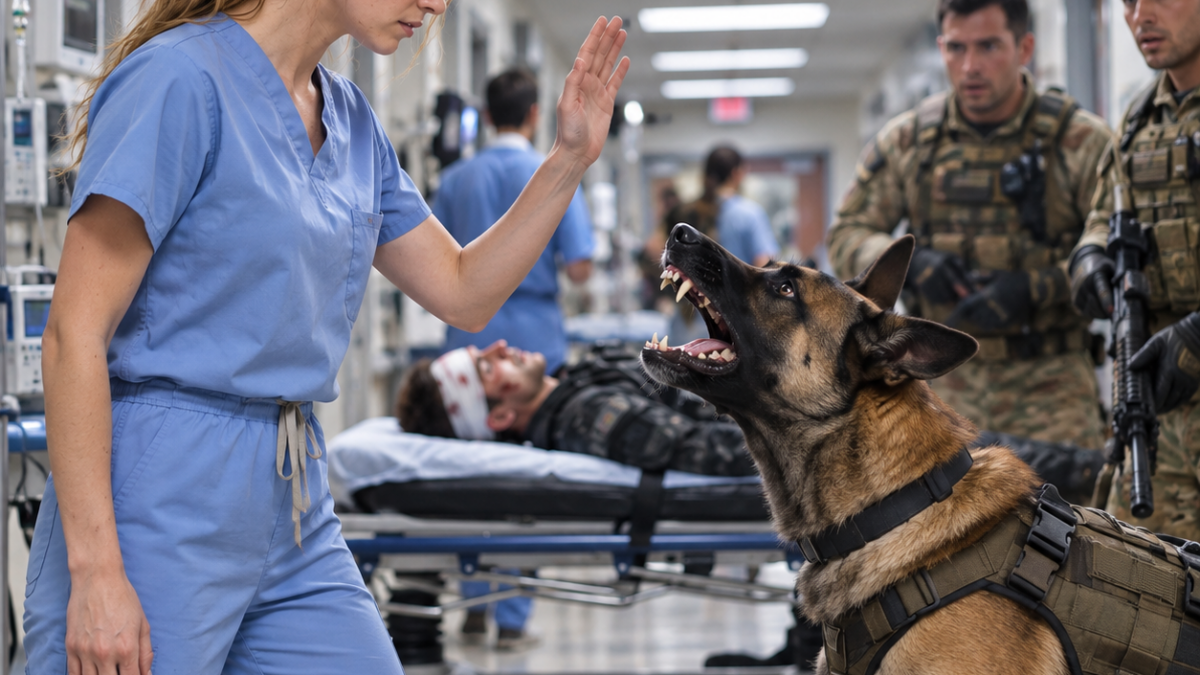
He was monitoring me the whole time, she said. Monitoring and managing?
Yes. She looked at the table, the laminate crack, the ordinary ugliness of a conference room table that had been here longer than anyone had bothered to replace it. and the HR records, she said, his advocacy for my hire.
Was that his initiative or was he instructed to hire me where he could watch me?
The communications don’t resolve that clearly.
Garrett said, “There’s a message from an outside contact 4 days before your hire that references your application and says, quote, “Better to know where she is than not.
Whether that originated with Hol or came from above him, we don’t have that piece yet.”
She nodded.
She wasn’t going to have all the pieces today.
Some of the pieces were going to take months in a federal case and people whose job it was to do this for years.
She understood that it was a different kind of patience than the kind she’d been practicing for 3 years.
But the muscle was familiar. The soldier from the waiting area, she said.
Puit, what’s he facing?
obstruction, accessory liability, depending on what the communications forensics show, potential conspiracy charges if the voice on Ror’s footage matches to anyone in his contact network.
Garrett straightened the tablet on the table, an unconscious organizing gesture, the kind people made when they were finishing something. Hol is facing the consulting arrangement fraud, the fraudulent court filing which he had a hand in creating.
We’ve established that.
and depending on what the staff monitoring communications show, potentially accessory charges related to how the network used that information.
His medical license, she said, “That’s a state board matter, not ours, but we’ll be sharing our findings with the Montana Medical Board.
” He looked at her directly.
He won’t practice again.
I can tell you that with confidence, even if I can’t tell you the precise mechanism.
She let that land, not with the satisfaction she might have expected, with something more mixed than that. The specific texture of justice that was real rather than clean, that came with loose threads and institutional timelines, and the knowledge that some of what had been done to her over 3 years, would never be named or formally addressed because it was too diffuse, too routine, too legible only from
inside the experience of it.
“What about my position here?”
she said. Garrett looked at her steadily.
That’s a hospital administration matter, but I’ll tell you that our findings about the nature of your placement and the monitoring of your activities are going to be communicated to hospital leadership tonight.
What they do with that information will be their decision. He paused.
For what it’s worth, and I recognize it may be worth something or nothing depending on your perspective, what you did today was directly responsible for securing evidence that 14 months of active federal investigation couldn’t secure on its own.
The situation required someone who could get close to that animal, and beyond that, someone who understood the stakes clearly enough to make the right calls under pressure, without backup, without authorization in a building where someone was actively working against the outcome. Another pause.
We don’t usually say this because we don’t usually have occasion to, but your read of this situation today was correct at every decision point.
She looked at him. Ror adjusted that camera for 4 and 1/2 hours.
She said, “Whatever I did today is a footnote.”
Garrett said nothing, which she thought was the right response.
She was at the nursing station at 10:15 writing her end of shift notes, the ones she’d been too occupied to write at the actual end of her shift when Warren Fenton appeared in the corridor.
Mapler Valley’s medical director had the look of a man who’d had a very long day and had spent at least part of it on the phone with people he’d rather not have been on the phone with.
His usual administrator’s composure was present but worn.
the way a jacket looked at the end of a day that had been longer than expected.
He came directly to the nursing station and he looked at Lydia with an expression that she didn’t try to interpret.
Ms. Mercer, he said.
Then he stopped as if he’d planned the beginning of this and hadn’t fully planned the rest.
She waited.
I’ve been briefed by the federal investigators, he said.
On the nature of Dr.
Holt’s arrangement and on, he paused.
on the circumstances of your placement on this floor. He said it carefully like a man aware he was walking on ground that was not fully mapped. I want to say Dr.
Fenton, she said, not cutting him off, just entering the space he’d left.
I know this is a difficult position for the hospital. I know there are legal and institutional processes that need to happen, and I know the communication to staff tomorrow is going to be complicated. She put her pen down on the desk.
What I need to know tonight is whether my position here is secure while those processes run. He looked at her for a moment.
Something in his face shifted towards something more direct than the administrator register he’d come in with.
“Yes,” he said.
“Absolutely, yes.
I want to also.”
He stopped again. This time the stop felt less like preparation and more like genuine difficulty. 3 years is a long time to work under those conditions and the hospital has an obligation.
I know, she said. We can talk about that with the appropriate people in the appropriate setting. She picked the pen back up.
Tonight, I have notes to finish.
Fenton looked at her pen at her notes at the nursing station that she’d occupied for 3 years.
He nodded once.
“Of course,” he said, and left.
She finished the notes. At 11:40, she went upstairs to check on Ror before she left the building.
The ICU unit was quiet in the way IC’s were quiet at that hour.
Not silent because they were never silent, but the particular reduced frequency of late night monitoring, fewer personnel, the sounds of machines doing the work that the daytime staff had set up for them. Kodiak was asleep.
He was on the floor beside the bed in the position working dog slept in, curled but not fully, head on for fourpaws, one ear still mobile even in sleep. The agent inside the unit was awake in a chair near the door, tablet in hand, and she looked up when Lydia came in and then looked back at the tablet.
Ror’s numbers were good, better than good.
Pressure running at the high end of acceptable oxygen saturation at 96. The chest tube output lower than the morning. He was not going to die.
He was going to have a very long and difficult recovery. And at some point, he was going to have to be told things that were going to make that recovery harder.
And none of that was today’s problem.
She stood beside the bed for a moment, looked at the vest hanging on the rail hook, the tactical camera housing was gone now, removed by the custody team, only the vest itself remaining.
Kodiak’s ear moved at the sound of her breathing and then settled.
She put her hand briefly on the bed rail.
Not on Ror’s hand, not on anything that presumed a relationship she didn’t have with him, just on the rail.
A moment of acknowledgement for the record he’d kept for 4 and 1/2 hours in a field while he bled.
Then she left the ICU and went to get her coat. The corridor was quiet.
The building had the hum of its systems, HVAC, monitors, the low background noise of a facility that never fully slept. She was at the elevator when her phone buzzed.
It was Vance. A text, not a call, which meant it was information rather than a request.
Voice print from footage came back. Preliminary match.
Identity is flagged at a clearance level above our unit’s access.
This goes higher than we thought. Stay available. She read it twice.
Then she put the phone in her coat pocket and pressed the elevator button and waited for the doors to open. And what she was thinking was not about herself, not about the 3 years, not about the things that had been confirmed and the things that were still open.
She was thinking about the voice on the footage and the 12 minutes between the call and the team being hit. And the fact that whatever the clearance level was, whatever the elevation of this meant for the scope of the investigation, the camera had run for 6 hours and 47 minutes, and the record was intact.
And the people who’d spent 14 months trying to build something were now holding the piece they hadn’t been able to get without Ror and his dog and a floor nurse who was supposed to be too small for anyone to worry about.
The elevator opened. She stepped in.
As the doors closed, her phone buzzed a second time.
Different number one she didn’t have saved.
Regional prefix she didn’t recognize.
She looked at it for a moment, then answered. Mercer, she said.
The voice on the other end was male, older, and carried the specific register of institutional authority at a level she hadn’t heard directed at her in 3 years.
This is Colonel Raymond Adler, SOCOM investigations coordination. We need you in Washington in 48 hours. The elevator reached the ground floor.
The doors opened onto the hospital lobby, quiet and low lit at nearly midnight. The information desk unmanned, the potted plants in their corners, the framed mission statements on the walls with their expensive fonts.
What for? She said.
Because the voice on that footage, Adler said, belongs to someone who is currently serving in an active command capacity, and you are the only person outside the classified network who has touched this case from the beginning and whose security clearance is still. He stopped. then carefully.
Your clearance was never fully deactivated, Miss Mercer. She stood in the lobby and looked at the front doors of the hospital, where outside the night was cold and the parking lot was mostly empty and the two military helicopters were long gone from the roof.
“I need a name,” she said.
A pause on the line.
“That name is why we need you in Washington,” Adler said.
She stood in the lobby for another 3 seconds after Adler finished speaking, the phone against her ear, the line still open.
“I need 48 hours to arrange coverage for my patients,” she said.
“A pause on Adler’s end that was brief enough to tell her the answer had been anticipated.
You have 36,” he said.
“We’ll arrange transport.”
She ended the call and put the phone in her coat pocket and pushed through the front doors into the Montana night.
And the cold hit her the way cold hit you when you’d been inside a building under pressure for 14 hours, sharper than it should have been, more clarifying than comfortable.
The parking lot was mostly empty. Her car was one of 11 still in the staff section.
She walked to it and sat in the driver’s seat for a moment without starting the engine, looking at the hospital building through the windshield.
The windows on the second floor were still lit. Someone was always working.
Someone was always keeping the machinery running, the charts updated, the medications timed, the monitors interpreted, the invisible infrastructure of keeping people alive that most people only noticed when it failed. She had been part of that infrastructure for 3 years.
She had restocked supplies and pushed medication carts and stood back when told to stand back. And under all of it, running parallel and unagnowledged, she had been watched and managed and kept small by people who understood better than she had at the time what she was capable of when the situation required it.
She started the engine and drove home. The 36 hours were not enough time to do everything and barely enough time to do the necessary things.
She briefed Carla on the patient case load in enough detail that the handoff was clean.
She called Anisha Reyes and told her she was going to be absent for an undetermined period and why in the general terms she was authorized to use and Reyes listened without interrupting and at the end said, “Come back when it’s done.
” In a tone that was not a request.
She went to the ICU once more before she left Breenville. Ror was conscious, not fully.
The sedation was being tapered slowly, which was standard for prolonged ventilator patients, and he was in the between place, aware of the room without being fully oriented to it. His eyes tracked when she came to the bedside.
Kodiak was awake, sitting, and his tail moved twice when he saw her.
“You don’t know me,” she said, pulling the chair close.
“My name is Lydia.
I’m a nurse here.
I was in your trauma bay when you came in.”
She kept her voice low and even. the register she used with patients who were surfacing from sedation. Clear, unhurried, not demanding that they process faster than they could.
Your dog is right here.
He’s been here the whole time.
Ror’s eyes moved toward Kodiak.
Something in his face shifted. Not quite relief. Something below relief.
A more fundamental settling.
The way a person looked when they confirmed something they’d been afraid to check.
His mouth moved around the tube.
He couldn’t speak, but the shape of it was readable.
I know, she said. He did good.
She stayed for 11 minutes.
She didn’t tell him about the footage or about Washington or about Colonel Adler and the voice at the clearance level above Vance’s unit.
That was not her information to give, and it was not something a man with a chest tube and 48 hours of sedation coming out of his system needed to absorb yet. What she told him was that the camera had been secured by the federal team, that the evidence was intact, and that the people responsible for what had happened to his team were in federal custody or under active investigation.
She watched his face when she said it. He closed his eyes just for a moment, opened them again. She stood up.
You’re going to be here for a while, she said.
But you’re going to be okay.
The team here is good, she paused. Kodiak is going to need exercise and actual food at some point.
There’s a soldier outside who’s been managing it, but I’ve left notes for the floor about his handling protocols.
Ror’s hand moved on the blanket.
Not a full gesture. He was too weak for full gestures, but his fingers extended slightly in her direction. She put her hand over his briefly.
1 second, two. Then she stepped back and picked up her bag and walked out of the ICU unit without looking back because looking back was not a thing she did.
And she wasn’t going to start today.
Washington in February was cold in a different way than Montana. Wetter, grayer, the kind of cold that went through fabric rather than hitting it. She was met at Dulles by a man in a dark SUV who did not introduce himself and did not make small talk, which suited her.
The drive took 40 minutes. The building they arrived at was not a building she recognized from her previous life in the operational community, a federal office complex in Northern Virginia that was unremarkable from the outside in the way that buildings housing remarkable things often were.
Colonel Raymond Adler was
60, lean with the posture of someone who’d spent decades in uniform and couldn’t stop even in civilian clothes.
He met her in a conference room on the fourth floor, larger than the Maplerest Valley conference room. better furniture, the same fundamental quality of being a room where difficult things were discussed. He introduced two other people, a woman named Deputy Director Hollands from a federal investigative agency whose full name Lydia was asked not to write down and a man named Fitzgerald who was introduced as legal counsel for the coordinating office.
There was no small talk here either. She appreciated that.
We’re going to show you the segment of footage, Adler said.
Specifically, the communication segment. We need you to listen to the voice and tell us if you recognize it from your period of service. You have a voice print match.
She said, “You told me that we have a preliminary match with a confidence level of 81%.”
Hollands said 81% is not sufficient to move on someone at this level. We need corroboration. And you think I can give you that?
Your service record shows you attended three joint operational briefings during your final deployment where the individual in question was present in a command capacity. We believe you may have direct voice recognition capability. She looked at them.
Who is it? She said. Before I listen to anything, I want a name.
Adler and Holland exchanged the kind of look that she recognized from every institution she’d ever worked in.
the look that preceded information being given to someone who wasn’t supposed to have it first, but who had earned the right to the sequence they were asking for.
Brigadier General Curtis Fallon, Adler said. She sat with that name for a moment.
She knew it. She knew it in the way you knew the names of people who existed at the peripheral edge of your operational world.
Not intimately, not with the specificity of direct reporting relationships, but known a name attached to a presence at briefings, a voice at the end of a conference room table, a level of authority that you registered and then set aside because it was above the plane where your daily decisions operated. Play it, she said. The audio was not clean.
Ror had been moving when he captured it, and the ambient noise of the field environment, wind, the sounds of the terrain, the low background of whatever tactical equipment was running layered under the voice in ways that the analysts had done their best to reduce without fully resolving. But the voice was there, male, 60 or older. The specific cadence of command authority, not loud, not performative, the kind of voice that had spent decades not needing to raise itself because the rooms it spoke in went quiet automatically.
She listened to 42 seconds of it.
Then she said, “That’s Fallon.”
Not because 81% wasn’t enough and she was making up the gap.
Because it was him. the particular quality of the pauses between clauses, the way certain consonants landed.
It was specific to a person the way voices were specific.
And she had been in three rooms with that voice, and her memory for voices was not something she’d been trained out of.
You’re certain, Holland said.
I’m certain.
Holland looked at Fitzgerald. Fitzgerald made a note.
There’s a process that follows from this.
Adler said, “Your statement becomes part of a formal evidentiary package.
The package goes before a military tribunal review board within 72 hours.
Given the rank involved, the process is not it’s not going to be simple or fast.
” “I understand that,” she said.
“There will be pressure applied to question the chain of custody of the footage, to question your credibility as a witness, to question the voice print methodology.
These are standard defense strategies.”
when Colonel, she said, I’ve been working in an environment for 3 years where my credibility was systematically undermined by people who were doing it on instruction.
I know what it looks like when someone tries to make a person smaller than they are.”
She looked at him steadily.
I’ll be a clean witness.
Don’t worry about that.
Adler looked at her for a long moment.
Something in his face was not quite what she’d expected from a man running a process.
It was more personal than that, a recognition that wasn’t about the case.
No, he said, I don’t expect I will.
She was in Washington for 4 days. The formal statement took 7 hours across two sessions.
Fitzgerald was present for both. Hollands asked questions that were precise and occasionally uncomfortable, and Lydia answered them in the same register. Precise, complete, not elaborated beyond what was asked.
She did not perform. She did not manage impressions. She said what she knew and she said how she knew it and she said where the edges of her knowledge were because the edges were as important as the center when you were building something that had to hold.
On the third day they told her that Brigadier General Curtis Fallon had been placed on administrative suspension pending the tribunal review. The language of the official communication was careful and institutional.
But what it meant was that a man who had spent 31 years accumulating rank and authority and the protection that came with both was no longer protected.
The thing that had kept the network running, the altitude of the person at its center, the assumption that certain levels of the command structure were simply above the reach of accountability, had been punctured by 6 hours and 47 minutes of footage, and a floor nurse sitting in a conference room saying, “That’s Fallon.”
with the flat certainty of someone who had nothing to prove. She flew back to Breenville on a Thursday morning. The Montana Board of Medical Examiners moved faster than federal processes usually allowed people to expect, which was either a function of the clarity of the evidence or a function of the particular visibility that the Maplerest Valley situation had acquired in the 3 weeks since it broke.
Dr. Marcus Holt surrendered his medical license on a Tuesday in early March. The formal language was voluntary surrender pending disciplinary proceedings, which was the language used when a person understood that the alternative was a public hearing with a predetermined outcome and chose the version that allowed them to control the narrative in the small ways still available.

