K9 Refused Everyone Near the Wounded SEAL — Until the NURSE Used a SECRET MILITARY Skill – Part 5
Lydia read the notification on her phone during a break and a 12-hour shift.
She stood in the supply al cove, the one she’d stood in dozens of times, the one that ran parallel to the family waiting area, and she read it twice and then put her phone away and went back to work.
The federal charges were not resolved in March. They would not be resolved for months, possibly longer, because that was how federal cases worked, especially cases that had expanded to include a general officer and a network that threaded through multiple contractors and several years of acquisition decisions. Leonard Puit, the man in the heavy coat, the waiting area, the burner phones, entered a cooperation agreement in late February.
Arthur Delaney, the attorney with the fabricated court filing, was not charged with knowing participation, but was referred to the state bar.
The four additional numbers pulled from Puit’s phone led to three individuals who were named subjects and one who remained under active investigation as of the day Lydia stopped asking Vance for updates because at some point the ongoing process of it became something she needed to set down in order to do the rest of her life.
DH Medical Advisory LLC, Holtz Dissolved Shell entity, had received $940,000 over four years from Centurion Acquisitions Group and its affiliated contractors. The financial forensics team found it in 6 days.
the specific connection between those payments and decisions made on the credentiing board and between those decisions and the operational information that had reached Fallon’s network through civilian healthcare channels was the kind of institutional corruption that was both more mundane and more damaging than anything dramatic.
Nobody had done
anything cinematic. They had done something boring and sustained. They had put money in and information had come out and people had gotten hurt and a 28-year-old soldier had spent 4 and 1/2 hours in a field keeping a camera running.
Holt’s monitoring communications, the seven entries with Lydia’s name, were included in the federal evidentiary package.
They were also summarized in the report that Warren Fenton received from the federal investigators, which formed the basis of a formal meeting with Lydia in the second week of March that included the hospital’s legal council, its HR director, and a representative from the board of directors.
She sat across the table from four people who were trying to find the right words for a thing that did not have easy words. And she did not help them find the words because it was not her job to make this comfortable. She let them say what they needed to say.
The formal acknowledgement, the institutional language of regret, the proposals for remediation. And when they were done, she said, I want to run the trauma response training program. Fenton looked at her.
We were going to propose that, he said. I know, she said.
I’m not waiting for the proposal.
I’m telling you what I want.
A small silence.
Fenton’s legal counsel made a note.
The position would include a revised compensation structure commensurate with the HR director started. Send me the numbers, Lydia said.
I’ll tell you if they’re right.
They were not entirely right in the first version. They were right in the third.
Work was discharged from Maplerrest Valley Medical Center on a Thursday in late March, 41 days after the helicopters landed on the roof. He walked out on his own, which the physicians had said was ambitious.
and which he had apparently treated as a scheduling constraint rather than a medical opinion. He was thin in the way serious illness made people thin, not the right kind of thin, the kind that would take months of eating and rebuilding to correct. And he moved carefully with the deliberate pace of someone managing pain that was present but controlled.
Kodiak walked beside him on a leash held by a soldier from his unit who had arrived 3 days earlier to manage the transition. Lydia was at the nursing station when they came through the trauma wing on the way out.
She hadn’t arranged to be there.
She was at the nursing station because it was Thursday morning and she was working and the route to the main entrance from the ICU passed the trauma wing and this was a small building in the way that hospitals were small. Everyone moving through the same corridors in the patterns their jobs required.
Ror stopped when he saw her.
He looked better than the last time she’d seen him awake.
more present, the eyes tracking with clarity rather than the sedation surface awareness of that first brief conversation. He had the look of a person who had been told things since then, many things, and had absorbed them in the incomplete way that people absorbed things when they were also managing the physical reality of significant injury.
Mercer, he said. Ror, she said.
Kodiak crossed the corridor and put his nose against her hand without being directed to. She let him, then scratched behind his ear once before he pulled back to his position beside his handler. They told me what you did, Ror said.
The whole of it, the trauma bay.
And after I did my job, she said that’s not, he stopped.
He was not, she sensed, a man who narrated his feelings easily, and this particular situation was asking him to do it in a hospital corridor in front of his unit soldier and a nursing station staff of three.
That’s not all.
It was, he said finally. No, she agreed.
It wasn’t a moment between them that was not awkward and not elaborate.
Just two people who had been on the same side of something and both knew it and did not need to expand that fact beyond its actual dimensions.
The program they’re talking about, he said, the training program here.
Yes, I heard about that.
He looked at her with a directness that was not the calculating look she’d been on the receiving end of from people who wanted things from her, but something more straightforward.
It’s the right fit.
I think so, she said. He nodded once.
Kodiak trusts you, he said.
He doesn’t do that easily.
I know, she said. I was glad he did. Ror looked at her for another moment, then extended his hand.
She shook it, a firm, brief grip, the kind between people who didn’t need to make it mean more than it was, because it already meant enough.
He turned and walked toward the main entrance, moving at his careful pace, Kodiak beside him, the soldier from his unit a half step behind. She watched them until they went through the corridor junction and out of her sighteline.
Then she turned back to the nursing station and picked up the tablet she’d put down.
The formal military commenation ceremony was not at Maplerest Valley and it was not in Breenville. It was at the S OOOM coordination office in Virginia, 6 weeks after her statement was incorporated into the evidentiary package on a morning in April when the Virginia trees were doing the thing trees did in April that she had not seen in 3 years of Montana winters, going green at a pace
that felt almost aggressive, like something that had been waiting and was no longer willing to wait.
There were people in the room she recognized from her service and people she didn’t.
And Colonel Adler was there and Vance was there in civilian clothes with her hands in her pockets and an expression that was as close to warm as her professional face got.
There was a camera which she hadn’t expected and she almost asked for it to be removed and then decided that was a refusal based on habit rather than preference.
The commendation was read by Adler in the measured formal cadence of official military language, which had always struck her as the most honest language the institution used because it didn’t perform more than it meant.
It named specific actions. It cited specific outcomes. It used the word valor in a context where the word was accurate rather than decorative.
It named the trauma bay intervention, the K9 management, the evidence identification, the investigative cooperation.
It named Ror’s survival in the context of her intervention.
She stood and received it with her hands steady. Adler said after the formal portion concluded and the room shifted into the slightly less structured mode that followed ceremonies.
We’re recommending your name for inclusion in the operational support acknowledgement registry.
That’s not public facing.
It’s internal.
I know what it is, she said. Is that acceptable to you?
She thought about it. Not for long. Yes, she said.
There’s one more thing.
He reached into the folder he’d been holding.
Your clearance. As I indicated, it was never fully deactivated.
We’d like to formally reinstate it.
And he stopped because she was already shaking her head. No. I have a training program to build, she said.
And a trauma floor to cover until I find the staff for it. My clearance can sit where it is. He looked at her steadily.
That offer doesn’t expire, he said.
I know, she said.
That’s why I can say no to it now.
Vance caught her in the corridor afterward while people were still redistributing themselves into smaller conversations. She fell into step beside Lydia without preamble.
Fallon’s tribunal review board convenes in 6 weeks.
She said, “I’ll testify again if they need me to.”
Lydia said, “They’ll need you to then I’ll be there.”
She looked at Vance.
What’s the likely outcome?
Forced retirement at reduced rank. Criminal referral on the obstruction and conspiracy charges. The command structure above him is cooperating because the alternative is being adjacent to him when the full scope of the procurement fraud gets into the public record.
Vance’s voice was dry without being bitter.
31 years of building something and the thing he spent all that effort building is what collapses it. Does it surprise you?
Lydia asked. Vance was quiet for a moment. No, she said it rarely does.
They walked the rest of the corridor without talking, and it was the comfortable silence of people who had been in a difficult situation together and didn’t need to fill the aftermath with noise.
She drove back to Montana 2 days later, not by plane.
She’d arranged her schedule to allow for the drive.
22 hours of road spread across 2 days because she’d found over the years that transitions required space and driving provided it in a way that being moved through the air between departures and arrivals didn’t.
She drove through Wyoming on the first day and stopped in a town whose name she didn’t retain.
Ate at a diner that had the specific quality of diners in small high alitude towns. Not good, not bad.
honest in the way that places were honest when they weren’t performing anything and slept in a motel for eight hours with the particular depth of sleep that came after something had concluded.
She drove into Montana on the second day and the landscape did what it did, which was expand in a way that no other landscape she’d lived in had managed.
the horizon pulling back, the sky gaining altitude, the sense of the world becoming more dimensional rather than less as the density of the eastern states fell away.
She’d never expected to like it here when she’d taken the Maplerest Valley position.
She’d taken it because it was available and because the operational community ran small in the places that offered the kind of work she wanted to do, and Montana had the advantage of being unlikely.
No one who’d known her in her previous life would have looked for her in Breenville.
She’d ended up staying because the mountains were honest about their scale and the work was real.
She pulled into Breenville at 4:00 in the afternoon on a Wednesday. She drove past the hospital on the way to her apartment, not deliberately.
It was on the route and looked at it the way she looked at the landscape with the registering attention of someone who had learned to read her environment for what it actually was rather than what she’d been told it was.
It was a building
where people came when they were broken and left. most of them less broken.
It was a building that had housed a corruption she hadn’t fully understood until the morning it arrived on a stretcher with two helicopters on the roof and a dog that wouldn’t let anyone close.
It was a building where she had been kept small on instruction, and where she had refused in the single most consequential moment to stay small, and where the consequences of that refusal had run further and wider than anyone in that corridor had
anticipated when she stepped forward and said, “I’ve got him.”
She did not feel triumphant about this. She felt something more durable than triumph. the specific unglamorous satisfaction of work that had been done correctly when it mattered, and of a situation that had been endured, not because endurance was a virtue in itself, but because she had understood the difference between a battle worth fighting and an exit worth taking.
She had never left. That was the thing nobody had accounted for.
The people who’d managed her placement had understood her capability and decided to contain it.
But they had not understood that the same quality that made her capable also made her patient in a way that outlasted their management. She had restocked supplies and pushed medication carts and stepped back when told to step back. And she had waited, not strategically, not with a plan, but with the fundamental steadiness of someone who knew who she was without needing the institution to confirm it.
And when Ror came through the roof door on a stretcher, she had stepped forward. The trauma response training program launched in June with a budget that was not as large as it should have been and a staff of two, which was herself and a paramedic named Octavia Reyes, who had 12 years of prehosp experience and an instinct for the specific gap between what training programs taught and what
field situations required. They built the curriculum across eight weeks of evenings and early mornings arguing about methodology in the way that people argued when they both cared and were both right about different things.
Arriving at something that was better than either of them would have built alone.
The first cohort of 16 included nurses, residents, a respiratory therapist, two paramedics on loan from the county, and three people from the hospital’s security staff who Fenton had agreed after some persuasion to include on the grounds that security staff in a trauma situation were an asset if trained and a liability if not.
She did not design it as a heroics program. She designed it as a competence program. What to do when the situation outpaced the protocol, how to make decisions under pressure without either freezing or improvising past the point where improvisation was appropriate, how to communicate clearly when everyone in the room was scared.
She told them on the first day that the most important thing she could teach them was not a procedure. The most important thing, she said, standing at the front of a conference room that was better than the Maplerest Valley conference room, but had the same basic furniture, the same quality of overhead lighting, the same fundamental character of a room where real things were decided, is how to know the difference between a rule that exists because it protects someone and a rule that exists because it protects a system.
Those are not the same thing.
And in this building, on this floor, in the next crisis that walks through those doors, you’re going to have to make that distinction under pressure with incomplete information in front of people who may tell you to stand down.
She looked at the 16 faces in front of her.
“You need to know before that moment what you actually stand for,” she said, “because the moment is too fast for figuring it out.”
Nobody wrote that down.
They didn’t need to.
Dantas work’s testimony at Fallon’s tribunal was delivered by Video Link in August, 3 months after his discharge from Mapler Valley.
He was recovered enough by then to carry himself the way she imagined he usually carried himself, direct, economical, the particular quality of someone who said what was necessary and stopped. His testimony was 11 minutes.
It did not waver under the cross-examination that Fallon’s defense team applied, which was extensive and creative and ultimately unsuccessful because the camera had run for 6 hours and 47 minutes.
And the voice on it was the voice. And there were two people in that room who could say so from direct experience.
Lydia’s testimony was 9 minutes.
She said what she knew and how she knew it and where the edges of her knowledge were. She did not elaborate. She did not perform.
When the defense council asked her whether she had any personal motivation to damage the reputation of a senior military officer, she said, “No, I have a professional motivation to tell the truth accurately.
That’s it.”
The tribunal’s findings were delivered in September.
Brigadier General Curtis Fallon was found to have engaged in conduct unbecoming an officer and in actions constituting criminal conspiracy in connection with the targeting of special operations personnel. The finding carried a mandatory criminal referral, forced retirement at the rank of Lieutenant Colonel, a reduction that was intended to be and was publicly significant, and a referral to the Department of Justice for prosecution on the criminal charges.
The announcement was not public in the dramatic sense. It went through official channels, was reported in defense and federal news outlets, generated coverage that was factual and uncensational.
Lydia read the summary on her phone during a lunch break in October, sitting in the Maplerest Valley cafeteria with a container of soup that had gone slightly cold while she was finishing a procedure documentation. She read it twice, then she ate the soup.
On the same day, the Montana federal court issued the final indictment in the procurement fraud case, which named Hol in connection with Centurion Acquisitions Group and carried charges that his attorney would spend the next year trying to reduce. The reduction would be partial and the outcome would not be what Hol wanted because the financial forensics were as clear as financial forensics got and the cooperation agreements that Puit and two others had signed had provided the kind of testimony that made reduction of the
core charges legally complicated. None of it resolved in a single day or a single moment.
That was not how accountability worked in her experience when it was real rather than performed. Real accountability was slow and institutional and frustrating and full of processes that seemed designed to delay the obvious.
And at the end of it, what you had was not a clean line of justice, but a set of outcomes that were better than the alternative, which was nothing. Hol had lost his license and was facing federal charges.
Fallon was facing criminal prosecution and a public reduction in rank. Puit was cooperating with investigators and would face the consequences of that cooperation, plus the consequences of his own actions in whatever proportion the justice system eventually assigned.
Delaney, the attorney who’d carried the fabricated court filing, was before the state bar.
The network that had run through Centurion and into the command structure and back out through civilian healthcare channels was, if not fully dismantled, no longer intact, no longer operational, no longer protected by the altitude of its highest member. It was enough.
Not everything enough. In November, Kodiak came back to Mapler Valley.
Not on a stretcher this time. Ror came back through the front door on a Tuesday morning walking without the careful deliberateness of March.
And Kodiak was beside him on a working lead. And they came to the trauma floor because Ror had a follow-up appointment with the surgical team.
And because she understood without being told there was something else he’d come to do.
She was at the nursing station.
She saw them come off the elevator and something in her chest did a thing she didn’t try to name.
Carla saw them first and said quietly, “Oh, look at him.”
Meaning Kodiak, who was moving through the corridor with the composed attention of an animal that remembered the space and had filed it as known and non-threatening.
Ror’s appointment was with Anisha Reyes, who met them at the nursing station and took Ror’s chart and looked at his recent blood work with the focused efficiency of a physician for whom the follow-up was the work.
While Reyes and Ror went over the numbers, Kodiak sat beside the nursing station, and Lydia came around the counter and stood beside him, and he put his head against her leg once briefly in the specific way that working dogs indicated something that was not quite affection and not quite professional acknowledgement, but
occupied the space between the two.
Good boy, she said quietly, and meant it the same way she’d meant it in March in the ICU bay when it had all still been unresolved, and she hadn’t known what the next 48 hours were going to produce.
Ror’s appointment took 20 minutes.
When he came back to the nursing station, Reyes beside him, he looked at Lydia with the same directness he’d had in March, the quality of someone who didn’t bother managing the expression on his face toward a more acceptable version.
How’s the program?
He said, “Second cohort starts in January.”
She said, “18 people.
We’re adding a triage decision-making module.”
He nodded.
I’d like to contribute something to the curriculum.
He said, “When I’m back operational, the K9 integration piece.
Civilian medical staff don’t usually have that.”
“No,” she said.
“They don’t.
I’ll send you something in writing.”
He said, “You can tell me if it fits.
I’ll tell you if it fits, she agreed.
Reyes caught Lydia’s eye over Ror’s shoulder and gave her a look that was small and specific and could only have been received by someone who’d known Reyes long enough to understand her scale of expression.
It meant something in the range of look at where we are now. Lydia returned it with the equivalent, small, specific, understood. Ror extended his hand again.
She shook it. He and Kodiak went back to the elevator and she watched them go. And this time when they rounded the corridor junction, she did not look away until they were gone.
But there were things that did not resolve fully because there were always things that did not resolve fully.
The HR records from her hire, and the question of whether Hol had recruited her on instruction or volunteered it remained in the gray zone of documented probability rather than documented fact because the specific communication that would have answered it cleanly had been through a channel that wasn’t preserved.
She had learned to hold that ambiguity without needing it closed. The question of who else in the network had still not been publicly identified, one name remained under active investigation as late as November, was not her question to carry. She had given what she had, and the investigation would go where it went.
What she carried instead was what was hers.
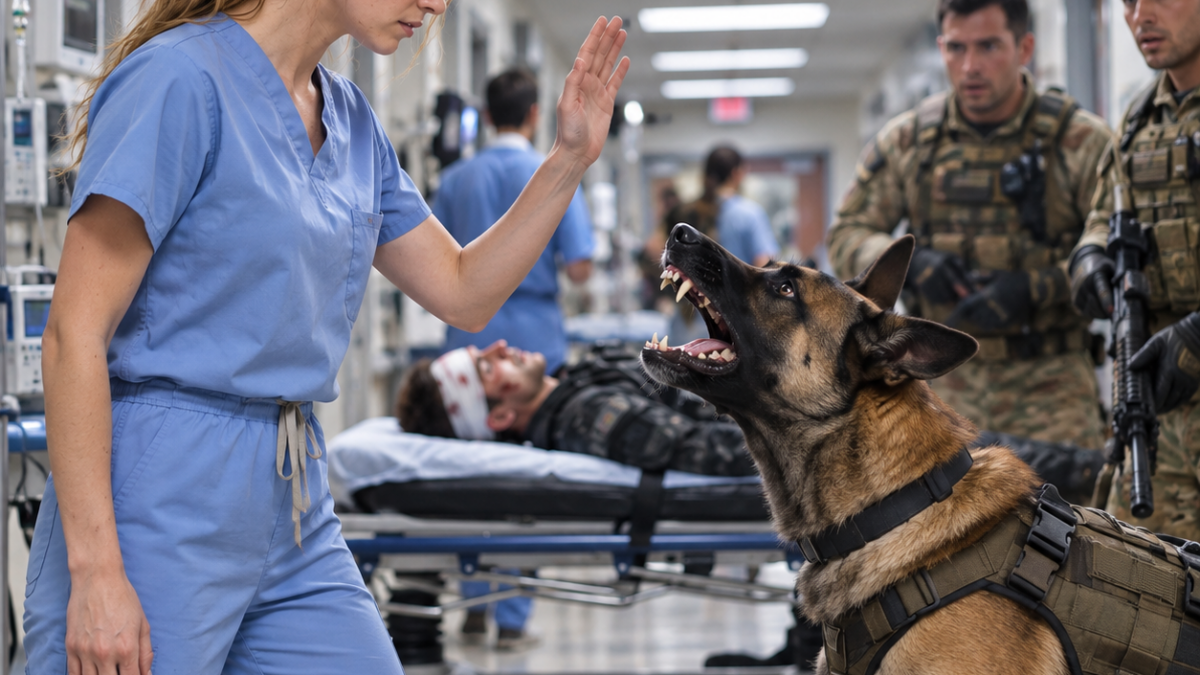
She carried the memory of standing in the trauma bay doorway with Kodiak’s weight of attention on her and the specific quality of that moment when the dog shifted and sat.
Not because she’d done something exceptional, but because she’d done something recognized.
She carried the 11 minutes in bay one when the situation had required someone to function at the level the situation required.
And she had been that person, not because she’d made herself available or announced her capability, but because she’d simply been there and known what to do.
She carried the stairwell in the office and the phone call at midnight in the lobby and the drive-thru Wyoming and the 16 faces in the first training cohort on the first day. She carried 3 years of supply restocking and she carried them differently now than she had in March. Not with anger, though anger had been in the mix at points and was not wrong to have been.
With the specific knowledge that the three years were not wasted time, she had learned things in those three years that she would not have learned in a different position. About institutional systems and how they protected themselves, about the texture of sustained dismissal and how it operated, about the difference between visible authority and actual capability. She had learned which of her colleagues were trustworthy in the specific way that trustworthy meant something.
Carla, Anisha, Reyes, Paulo, who had looked at the ceiling in Bay One and said nothing because there was nothing useful he could say. She had learned the building, every corridor and junction and supply closet and stairwell with a thoroughess that came from years of moving through it in the low visibility positions. All of it had been in the room on the morning the helicopters landed.
She thought about this sometimes, usually in the early part of a shift when the floor was in its particular morning configuration, patients coming awake, the night staff handing off, the day arranging itself around the cases that were already in progress and the ones that hadn’t
arrived yet.
She thought about the specific nature of quiet strength, which was not the strength of people who had been unchallenged or people who had never been dismissed, but the strength of people who had stayed inside themselves while the institution tried to make them into something smaller and had known without needing external confirmation that what they carried was still there and still real. That was the thing about being underestimated. It required the other person to have made a judgment about what you were.
And judgments about people were almost always more wrong than the people making them knew because the thing they were measuring was the surface. And the surface was not the whole. The strongest person in the room was not always the loudest or the highest ranked or the most credentialed or the one who moved through doors with the easy assumption that rooms went quiet when they entered.
Sometimes the strongest person in the room was the one who had stayed quiet for 3 years because quiet was strategic and who moved forward when the moment required it with the full force of everything that the quiet had preserved. The helicopters had landed on a Tuesday morning in February and a dog had looked at her and she had stepped forward.
That was the whole of it and it was enough.

