They Called Her a “PROBLEM PASSENGER” — Until a NAVY SEAL’s K9 Exposed Her HIDDEN MISSION
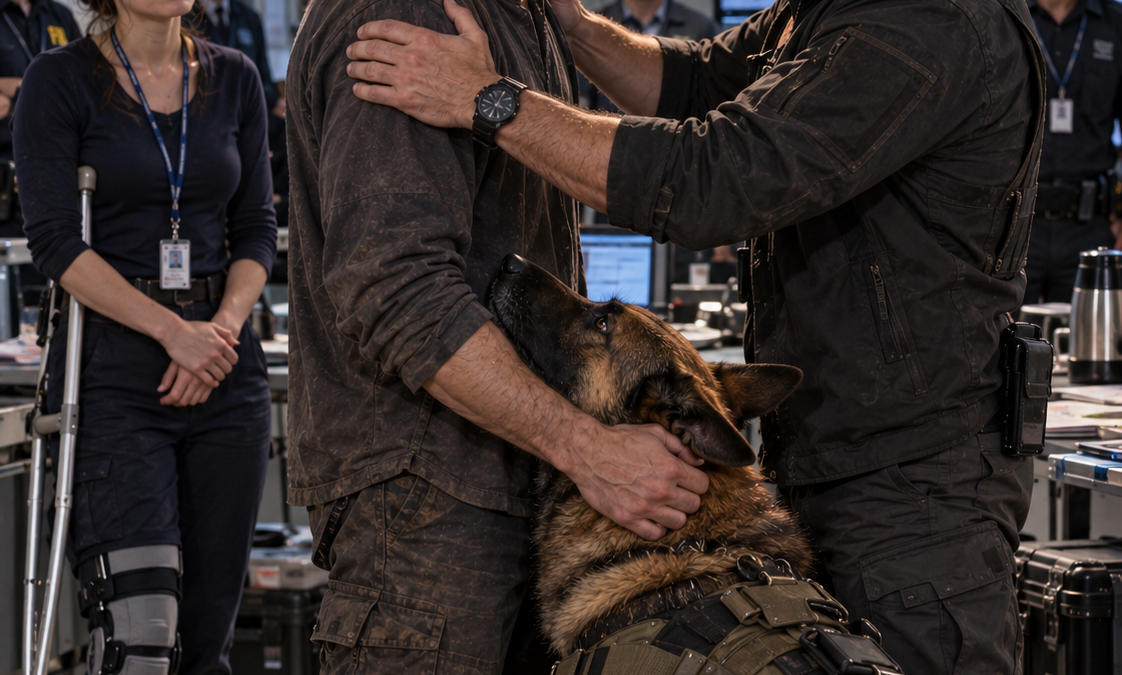
They Called Her a “PROBLEM PASSENGER” — Until a NAVY SEAL’s K9 Exposed Her HIDDEN MISSION
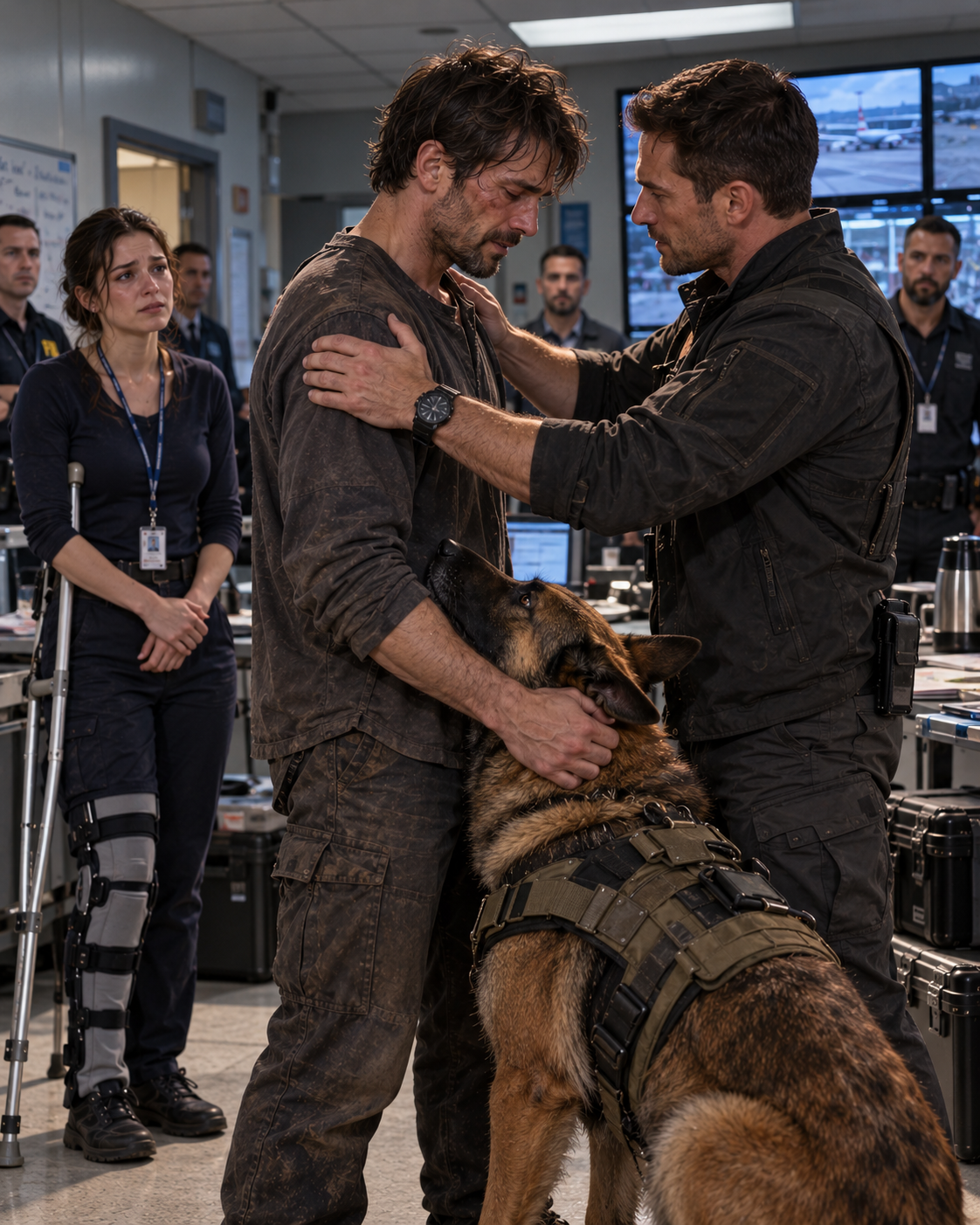
The gate agent looked directly at Elena Voss and announced the flight was closed.
Elena was still 20 feet away, her forearm crutch grinding against the polished floor, her specialized leg brace stuttering with each step. She had checked in on time. She had asked for assistance three separate times.
What nobody in that terminal knew, not the agent who turned her away, not the supervisor who shrugged, not the passengers who watched and said nothing, was that the brace locked around Elena’s left leg contained something that would
bring down an entire criminal network operating inside the United States military rehabilitation system.
They ignored a disabled nurse. They had no idea what they had just activated.
The first thing Elena Voss did every morning was check the brace before she checked her phone.
It was a habit she had built over 3 years, ever since the accident on the I78 overpass outside Harllo City had taken 40% of the functional strength from her left leg and replaced it with scar tissue, titanium hardware, and a medical device she had learned to treat like a second skeleton. The brace was custom fitted, a
rigid outer shell of aerospace grade polymer with an articulated ankle joint and a microprocessor-driven compression system that adjusted its tension depending on how she was walking.
It was not cheap. It was not simple. And it was the only reason she could move through the world without a wheelchair.
She strapped it on in the dark of her hotel room at 4:47 in the morning, working by field because she had done it so many times that she no longer needed to look. The buckles went in a specific sequence.
Midshin first, then knee, then the thigh cuff. And if you skip the sequence, the pressure distribution was off for the entire day. She had made that mistake once in her second month of recovery and spent 6 hours in enough pain to make her cry in a public restroom.
She did not make it again. The hotel was a mid-tier chain near Vaser Falls Regional Airport, the kind of place where the hallway carpet smelled faintly of industrial cleaning fluid, and the bathroom mirror had a crack running diagonally across one corner. Elena had stayed in worse.
She had spent 7 months in a Navy medical facility in Virginia where the ventilation system made a low cyclical grinding noise at 3:00 in the morning that nobody ever fixed. After that, a cracked mirror was nothing. She dressed methodically.
Dark navy travel pants with zip pockets, a long-sleeved thermal shirt, her identification lanyard with her nursing credentials, and her VA medical card. She had learned to keep documentation accessible. People asked questions when they saw the crutch, and some of those questions were less curious than suspicious, as if a woman moving slowly through an airport must be doing something wrong.
Her bag was already packed. She had done that the night before, the way she always did.
Everything rolled tight and placed in order of when she would need it, with her medications in a clear TSA pouch at the very top. Elena was a trauma nurse by training and by instinct.
She organized because disorganization cost people their lives. And that lesson had become so deeply embedded in her that it governed everything, even the way she folded her clothes.
She took the elevator down to the lobby, settled her crutch under her right arm, and walked through the automatic doors into the pre-dawn cold. The airport was 12 minutes away. She had arranged for a ride share the night before and confirmed it again at midnight.
The driver arrived on time, a quiet man in a gray sedan, who nodded when she got in, and did not ask about the crutch or the brace or any of the things that strangers sometimes felt entitled to ask about. She appreciated that more than she could have explained. Basker Falls Regional Airport was a midsized facility, large enough to have three concourses and a food court, small enough that you could still find a parking spot on a weekday.
It handled regional connections and a handful of direct routes. And on a Thursday morning in late November, it was running at maybe 60% capacity.
The terminal was cool and fluorescent lit with that particular airport stillness that exists before the morning rush fills the space with bodies and noise and the smell of coffee from every vendor simultaneously. Elena had a 7:15 flight to Caldwell where she had a connecting flight to Merit Bay. She was visiting her younger brother, Dominic, who had just had a second knee surgery and was living alone in an apartment that was not particularly accessible.
She had taken 3 days off from her nursing position at Harlo City Medical Center to go help him navigate the first week of recovery. It was that simple.
She was going to see her brother. She approached the check-in counter at 5:30, which gave her plenty of time, or it should have. The agent behind the counter was a young man named Ferris.
His name tag said so in capital letters, yellow on blue, and he looked at Elena’s boarding pass, looked at the crutch, and then looked at her in a way that managed to communicate mild inconvenience without saying a single word.
I have a request on file for pre-boarding assistance, Elena said. I filed it when I booked the ticket.
Mobility assistance, gate to gate. Ferris typed something, then he stopped typing.
Then he typed something else.
It’s not showing here, he said.
I have a confirmation email.
I understand that, but the system doesn’t have a flag on your reservation.
You’d need to go to the accessibility desk to re-request.
Elena looked at the accessibility desk. It was on the far side of the terminal, past two moving walkways in a security checkpoint. Where is it relative to security?
On the other side, you’d have to go through security and then so I’d have to clear security, go to the desk, re-request assistance, and then what?
How does that interact with my boarding time? Ferris looked at her with the expression of someone who had been asked a question slightly outside the boundaries of his training.
I’d
recommend going now since the line isn’t too bad yet.
Elena did not argue. She had learned through experience that arguing with frontline employees about procedural failures was a specific kind of futility.
They had not created the system. They were not empowered to fix it, and the energy spent fighting them was energy she did not have to spare. She thanked him, which he did not seem to expect, and moved toward the security line.
Security went fine. The brace required a secondary scan, which it always did.
She had the VA documentation and the manufacturer’s technical sheet in her travel folder, and she handed them over before anyone asked.
The TSA officer, a middle-aged woman with tired eyes who had probably processed 100 people with medical devices, ran through it quickly and professionally. Elena was through in 11 minutes. The accessibility desk on the concourse side was staffed by a single employee who was on the phone when Elena arrived.
The conversation appeared to be personal in nature. Elena stood at the desk and waited.
2 minutes passed, then three. The employee, a woman in her 40s whose name tag read Greta, eventually ended the call and looked up.
I had a pre-boarding assistance request on my reservation that didn’t transfer to the system.
Elena said, “I need a gate escort and wheelchair assistance to the jet bridge.”
Greta pulled up the screen.
What’s the flight number?
Elena gave it to her. I can put in a request, but the gate assistance team is already assigned.
It might be tight for your boarding time. My flight boards at 6:50.
It’s already 6:10.
I know what time it is.
That’s why I’m here.
Can you call ahead to the gate?
Greta looked at the phone, then at her screen, then at Elena’s crutch with an expression that was not unkind, but was something close to calculating.
a quick involuntary assessment that Elena recognized as the kind of look people gave when they were deciding how much of their morning this was going to cost them.
I’ll put the request in, Greta said.
Someone should meet you at the gate. Should will someone will meet you? Nobody met her at the gate.
Elellena arrived at gate 14b at 6:31, which was a 20inut walk from the accessibility desk at her pace, a pace she maintained by focusing on her breathing and her gate. mechanics and refusing to acknowledge the low steady ache building in her hip from the extended effort.
The waiting area was already crowded, she found a seat near the window and sat down, putting her bag in her lap and watching the gate agent desk. There were two agents, one a woman named Darby, name tag blue lanyard, was working through a line of passengers with the mechanical efficiency of someone who had done it 10,000 times. The other was younger, male, talking to a colleague near the desk partition.
Elena waited until the pre-boarding announcement came. Then she stood, adjusted her crutch, and walked to the desk.
“I have a mobility assistance request,” she said to Darby.
“I’m supposed to have gate escort and jet bridge support.
” Darby scanned her boarding pass.
“I don’t see a flag.”
“The accessibility desk said they called it in.”
“When?”
“About 20 minutes ago.”
Darby turned to the younger agent.
“Did we get an assist request from ground ops for this flight?”
He shrugged.
“I didn’t hear anything.”
Darby turned back to Elena with the particular facial expression of someone preparing to deliver disappointing information with as little responsibility as possible.
“We didn’t receive a request.
You can board with general boarding, but I need jet bridge support. The incline on the jet bridge is a fall hazard without assistance.
I filed for this before I booked the ticket.
I understand, but if the request wasn’t received, then someone dropped the request between the accessibility desk and your gate agent system, which is not something I control.
What I need is for someone to walk with me down the jet bridge so I don’t fall.
There was a pause. Darby looked at the line forming behind Elena.
The silent calculus of it was visible on her face. The weight of the passenger queue against the weight of this particular complication. Let me see what I can do, Darby said.
She did not do anything for 7 minutes. Elena stood to the side and watched as general boarding proceeded.
Zone one. Zone two.
She watched families with strollers board. She watched a man with a large carry-on that visibly exceeded the overhead bin limit board without comment. Zone 3 began.
Elena went back to the desk. My zone is boarding, she said.
We’re working on getting someone from ground ops.
Darby said without looking up.
There’s no one to spare.
We’re short staffed this morning.
I understand that, but I need Miss. Darby looked up now, and her voice had acquired an edge.
I told you we’re working on it.
If you’d like to take a seat, I’ve been standing for 30 minutes.
I can’t take a seat and then get up and walk the jet bridge in time.
That’s not how mobility impairment works.
Darby’s expression closed down.
It was a specific kind of shutdown. Not hostile exactly, but finished.
the look of someone who had decided they were no longer going to engage substantively. Final boarding will begin shortly, Darby said. Please wait to the side.
Zone 4 boarded, then zone 5.
Then Darby picked up the gate phone, said something Elena couldn’t hear, and hung up.
She walked to Elena.
I’m sorry, but we’ve just received closing authorization from the captain.
The gate is sealed. Elena stared at her.
The gate is the flight is preparing to push back. I can rebook you on the next available.
I was here. I have been standing here for 40 minutes.
I asked for assistance that was never provided and now you’re telling me I missed my flight because nobody did their job.
I understand this is frustrating. Do you?
Because from where I’m standing, I showed up on time, filed the correct request, followed every instruction I was given, and was systematically ignored until you ran out the clock.
Elena’s voice was steady.
That was something she had worked very hard to maintain. The steadiness, not calm exactly, but controlled.
What is the process for filing a complaint about accessibility failures?
Something in Darby’s posture shifted.
Not guilt necessarily, but awareness. You can speak to our customer service desk, which is I know where it is.
I’m asking if you personally are going to document what happened here.
I’ll note it in the system.
I’d like your name for the record, Darby told her.
Elena wrote it down in the small notebook she kept in her jacket pocket, the same one she had used for 8 years of nursing notes and patient observations. Darby watched her right and said nothing. Elena turned and began walking back toward the main concourse.
She made it 17 ft before the brace failed. It did not fail slowly or gradually. One moment it was functioning, the microprocessor cycling through its pressure adjustments the way it always did, and the next moment the articulated ankle joint locked at an angle it should not have been able to reach, and her left leg went rigid below the knee, and the redistribution of weight threw her balance completely, and Elena went down.
She hit the floor hard,
left hip, left elbow, the heel of her right hand. Her crutch clattered away from her and slid 3 ft across the polished tile.
The impact was loud enough that the nearest passengers turned. For a moment, nobody moved.
Elena lay on the floor of gate 14B’s boarding lane and took stock with the clinical efficiency of someone who had spent years assessing injury.
Hip, bruised, not broken. The brace had absorbed some of the lateral impact.
Elbow, road rash equivalent, minor. Hand stinging, no structural damage. Left leg, the brace was locked.
the ankle joint pressed into a hyperextension position that was already generating real specific pain. She needed to get upright.
She needed to release the brace’s emergency override and reset the microprocessor.
She needed her crutch. Someone she started.
A man in a business suit stepped around her, not over her, around her like she was a piece of luggage someone had left in the corridor. He did not look down. A woman with a rolling carry-on stopped, looked at Elena for approximately 2 seconds, and then looked at her watch and moved on.
“Can someone pass me my crutch?”
Elena said louder this time. A teenage boy, maybe 16, wearing headphones that were half off one ear, walked over, picked up the crutch without any expression of concern or curiosity, and handed it to her.
“Here,” he said.
Then he walked back to his seat and put the headphone back on. She used the crutch to lever herself into a sitting position. The ankle joint of the brace was still locked.
She reached for the emergency release panel on the side of the device, a small recessed button under a protective cover, and pressed it. Nothing happened. She pressed it again.
The button depressed, but the joint did not release. She could feel the microprocessor attempting to cycle.
There was a faint vibration in the device, but the reset was not completing. Something was wrong with the brace. Not the fall.
The fall had been caused by the malfunction, not the other way around. Darby appeared at her elbow.
Ma’am, you need to move out of the boarding lane.
Elena looked up at her. I fell because my brace malfunctioned.
I need a moment to You’re blocking the lane.
There’s nobody in the lane.
The flight is closed. There are ground crew who need access. I need you to move.
I understand that. I am working on getting myself upright. If someone could call for a wheelchair or medical.
We can call a wheelchair, but you’ll need to move to the side first.
Elena took a breath. The brace on my left leg is locked in hyperextension.
I cannot stand on it. I need assistance getting to the side, or I need you to bring the wheelchair to me.
Darby’s expression had moved past impatience into something less comfortable, the specific unease of someone who realized the situation might carry consequences.
She turned and spoke quietly to the younger agent who had appeared behind her. He disappeared through the gate door.
Two ground crew members appeared from the jet bridge. They were large, efficient men who moved with the body language of people who dealt with physical problems as a job function, and they looked at Elena on the floor with straightforward assessment rather than pity or inconvenience.
“Can you put weight on the right leg?”
one of them asked.
“Yes, arms around our shoulders.
We’ll get you to the chairs.”
They moved her without ceremony and without gentleness, but without roughness either. The way skilled people move an injured person efficiently and without drama. She ended up in an airport chair near the gate windows, the brace still locked, her bag in her lap, watching the aircraft push back from the jet bridge outside.
Her flight gone.
She was trying to work the brace’s manual override, a secondary system that required a specific sequence of pressure points on the outer casing.
when she heard the dog not barking. The dog was not barking. It was a specific sound somewhere between a whine and a low sustained vocalization.
The kind of sound a dog makes when it has located something and is communicating the fact to its handler with extreme urgency. Elena looked up.
The dog was a Belgian Malininoa, large, darkcoated with the muscular compactness and alert carriage of a working animal in peak condition. It was on a lead, but barely. Every line of its body was straining toward Elena, and the handler, a tall man in civilian clothes, early 30s, with the specific kind of posture that did not come from a gym, was holding the lead with both hands and clearly
surprised by what was happening.
Atlas, the man’s voice was low and controlled.
Atlas, halt. The dog did not halt.
It pulled steadily, without aggression, without any of the hackle’s tension of an alert that meant danger.
It pulled the way a working dog pulls when it has found what it was trained to find. With certainty and focus and the absolute conviction that the human needed to follow, the handler was being pulled directly toward Elena.
He let the lead out, controlled, deliberate, and the dog closed the last 15 ft and pushed its nose directly against Elena’s brace.
Not her leg, the brace. The outer casing just below the knee where the microprocessor housing was embedded.
The dog sat. In working dog language, a sit was a final indication.
It meant here this. The handler stood above Elena and looked at his dog.
Then he looked at the brace.
Then he looked at Elena with an expression that had moved very far from whatever expression he’d started the morning with.
I’m sorry, he said.
That’s never happened before.
He’s trained for He stopped.
He crouched down eye level with the brace and looked at the housing where the dog had indicated. Elena watched his face change.
Where did you get this brace? He said it was fitted through a veteran rehabilitation program about 8 months ago. Which program?
She told him. Something moved through his expression.
Recognition or something colder than recognition. My name is Mason Riker.
He said, “I’m with Naval Special Warfare, and I think I need you to tell me exactly how you ended up with this device because what my dog just indicated on He stopped again, and when he looked up at her, there was something in his eyes that was not confusion anymore.
It was controlled urgency.
The kind that belongs to people who have spent time in situations where information is the difference between recovery and catastrophe.”
What my dog just indicated on is not a medical component. Elena looked down at the brace locked around her leg. At the microprocessor housing she had pressed and pressed without result.
At the device she had worn for 8 months without question because the program coordinator had been professional and the equipment had been provided through what she had believed were legitimate VA channels. What is it?
She said.
Mason’s jaw tightened.
It’s a militaryra transmitter, he said.
And based on the signal signature Atlas is responding to, I know exactly who put it there. Through the gate window behind them, the aircraft taxied slowly toward the runway.
The terminal hum continued.
Somewhere near the food court, someone’s coffee order was announced over a speaker.
Elena Voss sat in an airport chair with a locked brace, a bruised hip, and a transmitter she had been carrying in her leg for 8 months. And the man crouching beside her had gone very still in the way that people only go still when they have just found something they had stopped believing they would ever find.
“Who?”
she said. Mason looked at her, his hand moved to the communications device clipped to his jacket.
“Someone who’s been missing,” he said, “for a very long time.
” Mason did not make the call.
Standing in the open concourse, he stood, looked once at the gate windows, at the aircraft now rolling steadily toward the far end of the tarmac, and made a decision Elena could see forming on his face before he acted on it. A rapid sequential calculation that compressed several questions into one movement. He unclipped the communications device from his jacket, pressed a button, and said three words into it.
Atlas has indicated.
Then he clipped it back, looked at Elena, and said, “Can you walk if I support the left side?
The joint is still locked.”
I know.
I’m not asking you to use it.
I’m asking if you can move.
She understood the distinction. Yes.
Then we need to get away from this gate. Elena did not ask why.
She had spent enough time around people who operated in highstakes environments, trauma surgeons, paramedics, field commanders rotating through her ward to recognize when someone’s tone had shifted from conversational to operational.
Mason’s tone had made that shift somewhere between militarygrade transmitter and right now.
And it was not a shift that invited clarification. It invited compliance, at least temporarily.
And Elena Voss was not a person who complied with things she didn’t understand, but she was a person who could read a room.
She reached for her crutch. Mason was already positioned on her left, his hand at her elbow, not gripping, just present, available, and Atlas moved to her right side with the calm authority of a dog that understood his job included more than detection.
They moved down the concourse.
“You said someone missing,” Elena said, keeping her voice low.
The airport noise around them was sufficient cover. Rolling luggage, gate announcements, the background roar of an HVAC system that needed maintenance, but old habit made her quiet. Captain Adrien Sult, Mason said, Navy.
He went into a veteran rehabilitation program 11 months ago for a shoulder injury and a TBI evaluation. 73 days later, the program reported he had voluntarily discharged himself and relocated.
His family couldn’t reach him.
His commanding officer filed a concern report. Naval Criminal Investigative Service looked at it for 2 weeks and closed it as a wellness matter. But but Adrien would not have discharged voluntarily in the middle of a TBI protocol.
He had three more weeks of mandatory evaluation.
And the last message he sent me 4 days before he disappeared said he had found something in the program’s records that he wasn’t supposed to find.
Elena processed this without speaking for a moment. The brace was forcing her gate into an awkward compensation pattern. Right leg taking most of the load.
Crutch providing stability. Left leg dragging in a locked forward position that was going to leave her significantly sore by tomorrow. She was already categorizing the physiological consequences with the automatic triage reflex that her nursing brain applied to everything.
The program that fitted this brace, she said. Tell me if the name matches. She told him.
Mason’s jaw set in a way that answered the question before he spoke.
Silver Meridian Veteran Recovery Services, he said.
That’s the one.
They had a contract with the VA facility that was managing my rehabilitation. My orthopedic coordinator referred me. Everything went through proper channels.
I had no reason to question it. I know.
I’m not suggesting you did anything wrong.
I didn’t say you were.
I’m establishing the sequence so we’re both working from the same information.
She glanced at him sideways. How long have you been looking for Adrien Sultt? 8 months.
The same 8 months the brace had been on her leg.
They had reached a quieter section of the concourse near a closed gate at the end of a wing that wasn’t seeing morning traffic.
Mason guided them to a cluster of chairs set apart from the main flow. And Elena sat down with the specific deliberateness of someone whose body had been through something and was managing the aftermath.
Atlas settled at her feet. The dog had not taken his attention off the brace.
Mason crouched in front of her and looked at the device with the careful attention of a man who was trying to see something he couldn’t fully see yet.
“Can I touch the casing?”
“It’s on my leg.”
“I know.
I’ll be careful.”
She nodded. His hands were steady. I examined the section of the outer housing just below the knee, the section Atlas had indicated, running his thumb along the seam between two panels of the polymer casing.
Elena watched his face rather than his hands and saw the moment he found what he was looking for. His breathing changed. Nothing dramatic, just a slight deceleration, the kind that happens when tension is replaced by something colder.
There’s a secondary housing inside this panel, he said.
It’s not part of the standard medical device schematics.
It’s been integrated into the casing without interrupting the primary function, which is why it didn’t trigger any equipment flags.
He looked up at her. Whoever did this knew exactly what they were doing.
This isn’t improvised.
How did Atlas know to indicate on it? Adrien trained with Atlas for 2 years.
The transmitter is running on a frequency that Atlas was specifically conditioned to detect. It was part of a search protocol we used in a recovery operation 2 years ago. If Adrien built this device or modified this brace, he would have known exactly what frequency to use.
Mason was quiet for a moment. He left a trail. He put the trail into a device that would be given to a patient, knowing the patient would travel eventually, knowing that if Atlas was ever within range, he was counting on a Belgian Malininoa being in an airport.
He was counting on me being in this airport.
I’m based out of Vaser Falls Naval Station.
This is the closest commercial airport. Any flight I take commercially goes through here.
Mason’s voice was even, but there was something underneath it.
something that had been held under pressure for 8 months and was only now finding the edge of release. He knew I would come through here eventually.
He just needed the patient to be here at the same time. Elena stared at the brace at the locked joint she had been fighting with for the last 40 minutes at the device she had strapped on in the dark at 4:47 that morning without any knowledge of what she was carrying.
“He used me,” she said.
“It was not an accusation, it was a fact,” stated flatly.
He used your brace.
I don’t think he knew who you were.
Does that distinction matter if I’ve been carrying a transmitter through security checkpoints for 8 months?
Mason didn’t answer immediately, and she gave him credit for that.
A lesser person would have reached for reassurance. He sat with the honest difficulty of the question. No, he said finally.
Probably not. If someone at Silver Meridian identified the transmitter, you would have been in danger regardless of your connection to Adrien. The word landed in the space between them, danger.
Elena had spent four years as a Navy trauma nurse and another 3 years as a civilian trauma nurse at a level one center. She was not unfamiliar with the concept of danger. But there was a specific quality to this particular version of it.
retroactive danger, the kind that revealed itself after the fact and forced you to reexamine everything you had believed was ordinary, that sat differently in the stomach than the immediate visible dangers she was trained to manage.
“What’s on the transmitter?”
she said.
“I don’t know yet.
I need someone with the right equipment to extract the data without destroying it.”
But based on what Adrien told me before he disappeared, Mason reached into his jacket and pulled out a phone, unlocking it and pulling up a photograph. This is the last message he sent me.
Elena looked at the screen. The message was short.
Records falsified. Equipment redirected. People inside.
Don’t let them close this as she read it twice.
Then she looked at Mason. Records falsified.
In what context? Patient records. Veterans in the program.
Adrienne believed Silver Meridian was manipulating patient documentation to extend program enrollment beyond medical necessity, which would allow them to retain equipment allocations, mobility devices, adaptive technology, rehabilitation gear beyond what patients actually needed. The equipment was going
somewhere. He was trying to find out where.
And then he disappeared. And then he disappeared. Elena was quiet for a long moment.
Around them, the airport continued its morning rhythms. A gate announcement for a flight to the coast. The mechanical clunk of a jet bridge connecting somewhere down the concourse.
A child crying briefly and then stopping. Normal things.
She was sitting inside all of them with a locked brace and a hidden transmitter and a picture that was becoming very clear very fast. You need to contact NCIS, she said. I need to contact people I trust inside NCIS.
Those are not the same population. His voice was dry in a way that suggested experience. The first report on Adrien was closed fast, faster than a routine wellness follow-up should close.
Someone either didn’t look carefully or didn’t want to.
How long until your backup gets here? 20 minutes, maybe less.
Then I have a question while we wait. Go ahead.
The airline staff, Elena said, they’re going to come looking for me.
I filed a complaint before I fell and then I fell in front of multiple witnesses and right now the ground crew who moved me is probably filling out an incident report. When your people arrive, this area is going to get complicated. Mason looked at her with an expression that was somewhere between assessment and something that might have been under different circumstances amusement.
You’re thinking about incident management.
I’m a trauma nurse.
I always think about incident management.
What’s your suggestion?
Call your backup now and tell them to make contact through the airport operations office rather than walking the concourse in whatever they’re wearing.
If Silver Meridian has people watching this program, and based on what you just told me, they might, “A cluster of federal types appearing at gate 14B is going to telegraph exactly what we have.
” She looked at the brace.
And I need someone who can release this joint without damaging the transmitter housing.
I don’t know what’s in there, but if it’s evidence, I’m not letting an airport EMT crack it open to free my leg.
Mason looked at her for a moment longer than was necessary. Then he reached for his communications device.
“What’s your name?”
he said, not as if he didn’t remember, as if he was realizing he should have asked sooner.
“Elena Voss, former Navy trauma nursing, Harllo City Medical Center.”
He nodded, keyed the device.
“This is Riker.
Change the approach vector. Come in through airport operations.
Bring a technical asset. I need a non-destructive extraction from a sealed medical housing. A pause.
And tell Harrove I need the silver meridian file on his screen before he walks in the door. He released the button and looked at Elena. 20 minutes, he said.
Then I want to know everything you know about Adrien Salt and what he found. Mason settled into the chair beside her. Atlas had not moved from his position near the brace.
Outside the terminal windows, the sky was beginning to lighten toward pale gray, the kind of November morning that never fully committed to daylight. Mason talked.
Elena listened.
Adrienne Sultt had entered Silver Meridian’s program 14 months ago through a referral from his base physician, a routine pathway for veterans with documented injuries requiring extended rehabilitation.
The program was licensed and VA affiliated with a clean compliance record and strong reviews. On paper, it was exactly what it advertised, a bridge between acute military medical care and long-term civilian adaptive living, specializing in mobility restoration for veterans with muscularkeeletal injuries.
What Adrien had found in his ninth week in the program was a discrepancy in the equipment logs. Specifically, three mobility devices had been issued to a patient named Warick Hol, a veteran with a spinal compression injury requiring a motorized wheelchair and two specialized orthotic braces.
The devices were logged as issued, meaning they left the program’s inventory and were charged against the VA’s equipment fund.
But Warick Hol, when Adrienne had casually checked in on the man 2 weeks later during a shared therapy session, was using none of them. When Adrienne asked Warrick about the equipment, Warick looked at him with the specific expression of someone who had been told not to discuss something and was uncertain whether discussing it anyway would have consequences. He said the coordinator took them back.
Mason said told him they were a different model than what his prescription required, but no exchange was ever logged. The original devices were marked as issued and in use.
They just weren’t.
Where were they?
That’s what Adrienne was trying to find out when they closed his program enrollment.
Mason’s hands were still.
He was not someone who gestured when he spoke. Elena noted he communicated with precision and economy, which was either training or temperament, probably both. His discharge paperwork was filed 6 days after he started asking questions about the equipment logs.
Filed by a program administrator named Lorraine Vth. He was processed out within 48 hours, and nobody flagged that as unusual.
The program said he’d chosen to leave voluntarily.
His signature was on the paperwork. Was it his signature?
Mason’s expression answered that.
Elena stared at the middle distance. The clinical part of her brain was mapping it.
The structure of what was being described, the infrastructure it would require, not just falsifying a single patient record, falsifying records at a systemic level, moving equipment out of program inventory while maintaining the paper fiction that the equipment was in patient use. the VA budget allocations, the licensing compliance reviews, the auditing mechanisms, all of it would have to have been managed, which meant people, multiple people, not a freelance operation.
How much equipment are we talking about?
She said, “We don’t know.
The transmitter might tell us.”
A noise at the far end of the concourse pulled both their attention. Not dramatic, just footsteps at a pace that did not quite match the ambient airport rhythm.
Elena looked without turning her head, using the reflection in the window. Two men in business casual clothing were walking the concourse in the direction of their gatewing, moving with the practiced ease of people who did not want to look like they were moving with purpose. One was carrying a phone at an angle that would let him film what was in front of him without appearing to film it.
Elena said quietly, “We have company.”
Mason had already seen them.
His hand moved to Atlas’s collar.
Not the lead, just the collar. A contact that settled the dog without restraining him. Describe the one on the left.
510, navy jacket, phone at chest height.
He’s angled toward us.
And the other one bigger, staying half a step behind, watching the exits. Mason keyed his calm device without raising his voice.
Riker, I have two possible surveillance assets approaching my position from the northeast corridor.
Where’s my backup?
He listened. How long? He listened again and Elena could not hear the response, but she could read the fractional tightening around his eyes.
Copy. He looked at her.
12 minutes and these two minutes at their current pace. Options.
We can move, but you can’t move fast.
I know that. She looked at the brace, at the locked joint, at the device she had been wearing for 8 months.
Can Atlas work off lead? Mason looked at her carefully.
Why? Because a large working dog moving freely in an airport terminal is going to redirect a lot of attention.
Security will respond. Security response means cameras, staff, official presence, all of which creates a buffer. She met his eyes.
And it buys you 12 minutes without requiring me to walk. He was quiet for exactly 3 seconds.
Atlas. His voice dropped to a register. Elena felt more than heard.
The dog’s ears moved.
Perimeter.
Atlas stood, moved away from Elena’s feet, and began a slow, deliberate circuit of the gate area.
Not running, not alarmed, just moving with the focused intentionality of a trained working animal performing a task. Within 60 seconds, two TSA officers appeared from the main concourse.
Within 90, the two men in business casual had slowed. The one with the phone had lowered it. The buffer held, but the man in the navy jacket did not leave.
He positioned himself near a row of chairs at the edge of the gate area and sat down with the particular stillness of someone who had decided to wait out the interference. His colleague drifted to the food kiosk at the corridor junction.
They were not leaving. They were adjusting. Elena looked at the brace again at the panel Mason had identified at the evidence locked inside a device that had been on her body for 8 months.
evidence that someone had worked very hard to keep concealed. Evidence that a man named Adrien Sult had apparently decided was worth whatever it cost him to hide it. She thought about what it meant to carry something without knowing you were carrying it.
To be a vessel for someone else’s desperate plan, selected not because you were important to anyone, but because you were going somewhere, because you used an airport.
Because eventually proximity and probability would do what human planning couldn’t.
It made her tired in a way that was different from physical exhaustion. Then it made her angry.
Not at Adrien Sultt who had been desperate and cornered and doing what people in those situations do using whatever resource was available but at Silver Meridian at Lorraine Vth and the people behind her at the entire architecture of exploitation they had built on the assumption that disabled veterans were manageable, documentable, forgettable. That a man with a TBI and a
shoulder injury could be shuffled out of a program and nobody would push hard enough to find out why. that a nurse with a mobility brace could be ignored in an airport until she fell on the floor and even then the primary concern would be clearing the boarding lane.
“Tell me about the complaint process,” she said.
Mason glanced at her.
“What?”
“The airline, Darby, the gate agent.
I filed a verbal complaint before I fell, and I have her name, the time, and the sequence of events documented in my notebook.”
She held up the small notebook. When your people get here, I need someone to interface with airport operations about the accessibility failure separately from the transmitter issue.
You want to file a complaint right now? I want the record made while the evidence is fresh.
The security footage will show how long I waited, how many people were in that boarding lane, and exactly what happened when the brace failed.
If I don’t make that record today, it disappears.
She looked at him evenly. The transmitter is your problem to handle.
The way those agents treated me today is mine. Mason studied her. In his expression, there was something Elena had not seen since she was in uniform.
The specific regard of someone who had revised their assessment of a person mid-con conversation and was acknowledging the revision without making a production of it.
I’ll add it to the operations contact, he said.
The man in the Navy jacket stood up. Elellanena watched in the window reflection as the man moved toward the corridor junction, stopped near his colleague at the kiosk, and spoke briefly.
The colleague looked at his phone. Then both men looked directly at the gate area, not at Mason, not at the circling dog, at Elena.
The specific focus of it, two men at the same moment orienting their attention to the woman in the chair with the locked brace, clarified something that had been forming at the edges of Elena’s understanding since Mason had said the word danger.
They were not surveillance, or not only surveillance, they knew what was in the brace.
“Mason,” she said, keeping her voice flat and even.
He had already seen it. He was already on the comm device.
“Rikker, move it up now.”
Atlas came back from his circuit and sat directly in front of Elena, between her and the corridor, between her and the two men who were no longer pretending to be incidental.
And the dog’s entire posture had changed.
No hackles, no sound, just presence, dense and absolute and pointed in exactly the right direction. The man in the navy jacket reached into his jacket, and the first federal badge appeared at the corridor entrance behind him, not walking, moving.
Two people in civilian clothes with the unmistakable carriage of authority arriving with intention, ID already in hand, eyes already on the situation with the comprehensive attention of people who had been briefed in transit and arrived knowing exactly
what they were walking into.
The man in the Navy jacket’s hand stopped inside his jacket.
I was doing the same calculation Elena had been doing. the geometry of the moment, the number of people, the presence of the dog, the cameras, the arriving federal agents, and whatever he found in that calculation made him very slowly withdraw his empty hand.
His colleague at the kiosk turned and walked away, not running, just walking with the careful, deliberate pace of a man who had decided to be somewhere else before any of this became a matter of formal record. The federal agents let him go for now.
One of them reached Mason and spoke quietly. Mason listened, nodded twice, and then looked at Elena with an expression that had moved fully into the territory of controlled urgency.
We need to move you to a secure operations room, he said. Right now.
What’s happened?
He crouched, met her eye level, and his voice dropped to something she had to lean forward to catch. The file Harard Grove pulled on Silver Meridian before he walked in here.
He said, “The VA compliance audit from 8 months ago.
The one that came back clean.
What about it?”
It was signed off by a senior program inspector named Darren Quill. Mason paused.
Darren Quill retired from federal service 14 months ago. He retired, Elena.
He wasn’t working for the VA 8 months ago.
He was not in a position to sign off on anything. The terminal noise continued around them.
A gate announcement, rolling luggage, a child laughing somewhere down the concourse.
Someone used a retired inspector’s credentials to sign a federal audit.
Elena said, “Someone used a retired inspector’s credentials to close a federal audit.”
Mason said, “There’s a difference.
The audit wasn’t routine.
It was triggered by a complaint.”
He held her gaze. A complaint filed by a patient who had been forcibly discharged from Silver Meridian and was trying to report equipment fraud.
Elena’s stomach dropped 3 in.
“Adrien,” she said.
“He tried to report it through official channels,” Mason said, and someone inside the federal inspection system killed the report before it ever reached anyone who would act on it.
He stood. The federal agent beside him was watching the corridor.
“Which means this isn’t just Silver Meridian,” Elena said.
“No,” Mason said.
“It isn’t.”

