A Poor Nurse Saved 9 Injured Bodyguards in 2 Hours — Mafia Boss Watched And Changed Her Life – Part 1
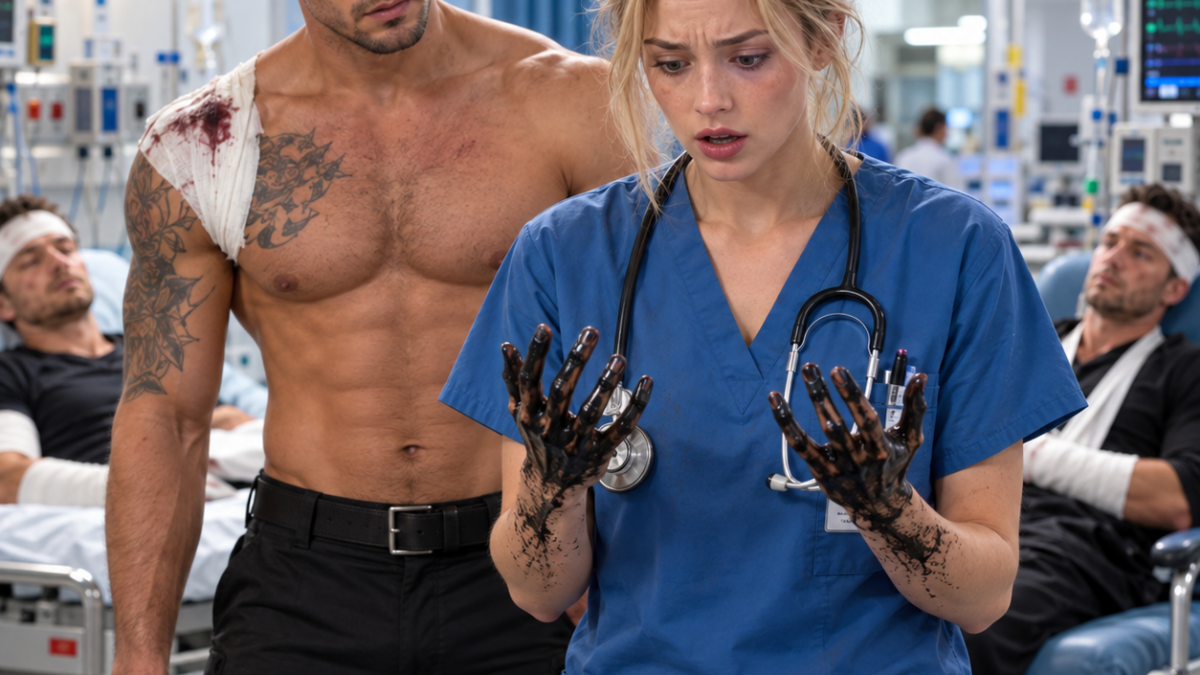
A Poor Nurse Saved 9 Injured Bodyguards in 2 Hours — Mafia Boss Watched And Changed Her Life

The ceiling lights of Northgate Urgent Care flickered twice as the glass doors flew open, and the snow came in with nine men in black suits. No ambulance, no sirens, only three battered SUVs still steaming in the lot outside in the middle of a February blizzard in Charles Town, Boston, and the man leading them tall in a long black wool coat he never bothered to button, a pale scar running along his jaw, carrying the youngest of his men in his arms. His name was Rafael Vitalale.
And in that city, nobody ever said his name louder than a whisper. There were only two people on duty that night. A front desk clerk shaking too hard to hold a pen.
And Adeline Cross, the night nurse, a woman who years earlier had her license stripped away by a board in Philadelphia, and had been called three words she still heard in her sleep. She stood frozen for exactly one breath.
Then she pulled the marker from her scrub pocket, walked to the man nearest her, and did the one thing she had forbidden herself to do for all those years. She took command.
She ordered the two men still standing to press down on their friend’s wound.
She ordered the clerk to hold the flashlight steady and not to cry.
And she ordered Raphael Vitali, bleeding from the shoulder, and telling her he was fine down onto the floor, to hold his best friend’s head straight and not move a single inch, he obeyed.
For two hours, the most powerful man on the Boston waterfront knelt on cold tile and followed every word of a woman whose name he did not know, all nine of them lived. Then, when the last one was breathing steadily again, he stood up, took three steps, and collapsed at her feet. Adeline saved the 10th man, too.
3 days later, three different SUVs pulled into that same lot. This time, they had not come for help. They had come to ask her one question.
the one question she had never dared answer herself. Why would a woman the medical system had crushed and thrown away?
Spend two hours keeping alive the very men this city wanted to see put down. 7 hours before that glass door burst open, Adeline Cross was driving down Rutherford Avenue with one windshield wiper that refused to move.
The one on the right had died sometime in the fall, and she still hadn’t taken the car in to have it fixed.
So, whenever the snow thickened across the windshield, she leaned to the left, pressed her shoulder against the driver’s door, and watched the road through the narrow fan-shaped patch, the wiper on her side could still clear.
She had been driving that way all winter. She knew exactly where the pavement dipped, which traffic light lagged half a beat before changing, and where she had to slow down because of a pothole the city had promised to repair the year before.
A person could get used to almost anything when there was no other choice. On the passenger seat, sat a canvas purse with both handles worn thin, and inside it, tucked between a hardbound notebook and a half empty tin of mints, was an ivory envelope with the stamp already affixed.
There was no return name in the upper left corner, only the recipient’s address, written by hand.
A house on Green Street in the Germantown neighborhood of Philadelphia. Inside was cash folded once in half with no letter.
This was the 72nd envelope. She had dropped the first one into a mailbox at a gas station outside the city. Her hands still trembling.
And every month since then, she had done the same thing as regularly as someone taking medicine.
That money hadn’t come from nowhere.
Her engagement ring had been sitting behind the glass of a pawn shop on Chestnut Street for so long that she could barely remember the last time she had seen it, and she had never gone back to look.
her mother’s car, a moss green sedan that Ruth Anne, her mother, had driven for 20 years, had been sold to a man who paid cash in a church parking lot, and Adeline had stood there watching it turn the corner before walking home.
On weekends, while other people went to football games or took their children out into the snow, she picked up shifts in the morg of a funeral home in Somerville, doing the work no one wanted to do for people who no longer needed anyone’s help.
She told no one about it. Her phone buzzed as she turned into the Northgate parking lot. It was Bernardet Kowalsski, whom everyone at the station called Birdie, her voice rough and raw as though she had either just finished shouting at someone or started smoking again after quitting three times.
She said the road leading out of her neighborhood was buried in snow up to the axles.
The tow trucks were tied up in Somerville, and she wasn’t going to make it in before daylight.
Then she went quiet for a beat and added that Adeline had better not take another double shift. that 30 years in the profession had taught her one thing.
The human body knew how to keep a debt, and one day it would come to collect. Adeline told her she sounded exactly like her mother. Birdie said that was why she was saying it.
At night, Northgate was only half alive.
Meridian Health Group had begun pulling its funding from the facility at the start of winter, and it had done so in exactly the way corporations usually did, which meant it hadn’t shut the place down outright.
It had simply cut away piece by piece until the place could die on its own. Three examination rooms in the back had been locked. The staffing board had gone from 14 names to four.
The illuminated sign above the entrance still said open 24 hours because taking it down would cost money, too.
and all the equipment from the old emergency department, everything that hadn’t yet been moved elsewhere, had been packed into a storage room at the end of the east corridor behind a steel door with an electronic lock and a strip of blue security seal printed with the corporation’s name.
Adeline had been the last person to sign the inventory sheet before that door was locked. She still remembered the code, and she had written her name in the final box in the same slanted handwriting her mother used to say looked like the handwriting of someone who knew what she was doing.
The receptionist working with her that night was only 22, had been on the job for 6 weeks, and still had the habit of greeting every patient by both first and last name. She handed him a container of noodles from the microwave, and told him to eat before the weather got any worse.
Beyond the glass doors, the snow had begun falling sideways instead of down.
It was a sign Adeline had learned over three Boston winters, a sign that meant the wind had shifted, and that this night wasn’t going to be like the others.
She hung her coat on the hook, tied her hair back with the rubber band she kept in the drawer, and clipped a felt tip marker into the pocket of her lab coat the way she had done for years, never knowing that only a few hours later she would use that very marker to draw lines across the chests of nine men she had never seen before. Nine men lay across the tiled floor of an emergency station that was only half alive.
And Adeline stood among them, counting, then counting again until she understood something she didn’t put into words for anyone in that room.
There was nothing in her hands, nothing in that building. That was enough to keep all nine of these men alive until morning. The onduty supply cabinet held gauze, IV fluids, and the kinds of things meant for someone who sliced a hand while chopping onions at midnight.
It hadn’t been designed for a night like this one.
She asked why they hadn’t kept going to a larger hospital, and the tall man in the black wool coat answered her in three very short sentences.
The bridge behind them had been completely blocked, and none of the vehicles could turn around. Any emergency department at a major hospital would be required to call the police when several people arrived injured at the same time in circumstances like these. And inside the three vehicles, smoking outside were things that if the police saw them would mean these nine men would never go home again, whether they lived or not.
Adeline didn’t ask another question.
She turned, walked down the east corridor, and stopped in front of the steel door at the end. The blue security seal was still intact, printed with the name Meridian Health Group, and the date the room had been closed was written in black ink near the bottom corner.
She stood there for the length of one breath, exactly one breath. And within that breath, she saw with perfect clarity everything that would come afterward.
An incident report, a meeting, a sheet of paper placed in front of her with an empty space waiting for her signature, and the profession she had once been forced to crawl on her knees to win back would be taken from her a second time. She entered the code.
The door opened with the rasp of hinges no one had touched in a long while, and the blue seal tore cleanly in two, falling to the floor like an old ribbon. Inside was everything Meridian had decided this place was no longer worthy of keeping. Three portable ventilators still sealed in their boxes, a small refrigerator filled with IV fluids, chest decompression kits, factory sealed and unopened, arranged in two rows on the third shelf from the bottom.
She pulled an entire supply cart out into the corridor.
its wheels squealing across the tile, and she didn’t look back at the door even once.
When she returned to the lobby, she pulled the felt tip marker from the pocket of her lab coat and began doing the kind of work no school could teach, the kind only sleepless nights could teach. She moved from one man to the next, bending down, looking, touching, and drawing marks across the fronts of their shirts.
One line for the man who could wait, two lines for the man who had to be treated immediately, three lines for the man she would return to first if anything changed. She finished all nine in less time than it took for a song to play.
And when she straightened, the entire room had fallen silent with her, including the large men standing nearby with no idea what to do with their hands. The youngest man lay closest to the door, and there were three lines across his shirt. His name was Tobias Rener.
He was 24 years old, and Adeline knew because she had asked, and she had asked because she wanted to hear how much breath he still had left in his voice. His lips had begun turning a shade of gray she had seen exactly four times in her life, and all four times had been in rooms that smelled of disinfectant.
She knelt beside him, opened the kit she had just taken from storage, and did what had to be done. Then she sat still, one hand resting on his chest as she counted the rhythm, watching the gray recede from his lips.
Little by little until they returned to the color they belonged on a 24-year-old man.
She didn’t cheer.
She simply moved to the next person. Raphael Vitali was kneeling on the cold tile a few steps away.
Both hands holding his closest friend’s head straight, exactly as she had ordered him to do, and he had remained in that position for so long that the knees of his trousers had darkened with melted snow.
The man in his hands was Gideon Marsh, 46 years old, and he was trying to say something no one could make out. Rafe looked up at Adeline and asked whether she knew who she was touching.
Adeline didn’t lift her head.
She said she was touching a lung and told him to keep his hands exactly where they were and not move.
When the last of the nine men was breathing steadily, and the young receptionist had sunk down onto the floor at the foot of the counter, with the flashlight still glowing in his hand, Rafael Vitali rose from the tile, slowly lifted his hands away from Gideon Marsh’s head as carefully as someone setting down something fragile, took three steps toward the door, and collapsed.
Adeline heard the sound of a body hitting the floor before she had time to turn.
and she knew immediately who it was because there was only one person left in the room who didn’t have marker lines across his shirt.
She pulled back the collar of his wool coat and saw that the fabric beneath his left shoulder had been dark for a long time. So dark that it was almost impossible to distinguish from the black of the coat itself, and she understood that he had been standing there for 2 hours while knowing exactly what condition he was in.
She called over the two men who were still able to stand and had them carry him onto the old examination table in room three. the one with a piece of pressed wood wedged beneath one leg because the floor had settled and she worked beneath the light of a desk lamp instead of the ceiling fixture because the electricity to that section had been shut off since the fall.
He woke partway through.
He didn’t startle, didn’t ask where he was, didn’t try to sit up the way men like him usually did.
He simply opened his eyes and looked at her. Adeline kept her head lowered as she finished what she was doing. Needle and thread beneath the dull yellow light.
And she told him that if it hurt, he should say so because she didn’t have anything stronger to give him than what she had already injected.
He told her it didn’t hurt.
She said everyone said that. He was quiet for a long while, then asked whether she intended to ask him any questions. Adeline replied that all she wanted to know was whether he was allergic to any medication and that every other question fell outside her job.
And for the rest of that time, Rafael Vital lay still on the examination table with one uneven leg, watching the woman stitching his shoulder, and realized that this was the first time in his life anyone had looked at him without seeing his name, without seeing the harbor, without seeing the
things people whispered about him over dinner tables in the north end, and had seen only a shoulder that needed to be put back together. Birdie Kowalsski arrived when dawn was close, her hair wet with snow, roads salt still clinging to her boots, and she stopped dead at the threshold of the east corridor.
She didn’t look at the nine men.
She didn’t look at the supply carts.
She looked at the steel door at the end of the hall, looked at the two halves of the blue security seal lying on the floor, and stood there for a very long time with her mouth slightly open and no sound coming out. 30 years in the profession had given her enough words for almost everything, except this.
The convoy left when the world outside had turned the gray of a morning that hadn’t quite begun.
The nine men were helped into the vehicles. Gideon Marsh was wrapped in a blanket, and one of them nodded to Adeline as he passed. She nodded back.
Raphael Vital was the last to leave, his left hand resting loosely inside the pocket of his unbuttoned coat, and before stepping outside, he placed a thick envelope on the reception counter, setting it down very gently, as though he had done this hundreds of times, and no one had ever refused. Adeline picked
up the envelope, followed him three steps, and pushed it back into his hand before he reached the door. He looked at her, she said nothing.
He took it, slipped it into the inside pocket of his coat, and walked out into the snow. On the tiled floor of Northgate Emergency Station, nine dark stains remained along with a felt tip marker that had run out of ink.
The meeting took place the following afternoon in the second floor boardroom at Northgate, a room that, since Meridian had begun pulling its funding, was opened only once a month, and where the whiteboard still carried the numbers from the previous quarter because no one had bothered to erase them. Adeline arrived 10 minutes early, wearing a gray sweater instead of her uniform, and sat in the chair they indicated for her, the one at the end of the table nearest the door.
Across from her sat the facility’s executive director, a man she had greeted every morning for 3 years, and had never spoken to for more than two sentences at a time.
Along with the head of human resources, and between them sat a third person she had never seen before. He introduced himself as legal counsel for Meridian Health Group.
Woree a charcoal suit with seams as sharp as a paper cutter, and possessed the kind of politeness that sent a colder feeling down a person’s spine than any shout ever could.
The politeness of a man who knew with certainty that he was going to win, and therefore had no reason to raise his voice even once. He called her Miss Cross. He asked whether she had slept well after a night like that.
He poured her a glass of water before pouring one for himself. Then he opened his leather briefcase and everything began.
Not one person in that room mentioned the nine men. No one asked whether they were still alive, what their names were, or whether they had made it home.
The meeting wasn’t about that.
The meeting was about a blue security seal printed with the corporation’s name, about a steel door at the end of the east corridor, about three portable ventilators and a refrigerator of IV fluids, and a medical kit that had been removed from its original packaging.
all of them assets in the process of liquidation that had been sealed according to procedure and about an unauthorized nurse who had taken it upon herself to unlock that door using a code that should have been deactivated when the inventory was
handed over.
The legal council said that he deeply appreciated what had happened that night, that he personally didn’t question her motives for a single second, but that the corporation had obligations to its shareholders and that procedures existed to protect people exactly like her.
Then he placed a sheet of paper on the table, turned it so that it faced her properly, and slid it toward her along with a pen. On that sheet, written in language so polished that it had to be read twice before its meaning became clear, she was being asked to acknowledge that she had acted alone, outside the scope of any directive, without the authorization of any supervisor, and that she accepted full responsibility for breaking the seal, and for any consequences arising from that action. Birdie Kowalsski shot to her feet.
She stood so quickly that the chair behind her scraped against the tile, and she drew in a breath to speak, loud enough that everyone in the room heard it.
Adeline didn’t look at her.
She simply reached over, rested her hand on Bird’s wrist, and gave the slightest downward pull.
That was all, a very gentle tug, almost tender.
the gesture of someone who had sat in rooms like this too many times and knew exactly that one more sentence would only cost the person speaking something else and knew that the person about to lose it wouldn’t be her.
Birdie sat back down. Adeline read the paper from the first line to the last slowly twice in a silence no one dared disturb.
Then she set the pen down on the table, pushed the document back to the center and said she wouldn’t sign it.
The legal council nodded as though that were an entirely reasonable answer, closed his briefcase, and said that he understood that she had the right to consult an attorney of her own, and that in the meantime, she was being suspended from duty pending the outcome of the review. He wished her a pleasant afternoon. Adeline walked down the stairs, left the building, and climbed into her car at the farthest corner of the parking lot.
She turned the key. The engine gave three dry coughs and died.
She tried again, then stopped. Snow began falling once more, spreading a thin layer over the windshield, then a thicker one, and she sat there without moving, both hands resting on the steering wheel, watching the world outside slowly blur behind the white until darkness settled completely, and the tall parking lot lamp above her
switched on by itself.
Three black SUVs pulled up in front of the apartment building above the laundromat. On a morning when the sky had not yet fully brightened, and the man who stepped out of the first vehicle was already waiting on the sidewalk.
When Adeline opened the door, he carried nothing in his hands. He addressed her by her last name, said that someone wanted to speak with her and opened the rear door of the middle vehicle.
No one touched her. No one said another word for the entire drive. and Adeline sat watching the city slowly recede behind her across the bridge past industrial districts that were still closed for the morning.
Then along a narrow road following the shoreline where winter waves struck the rocks and built gray shelves of ice against the base of the seaw wall. Nant in February was nearly deserted.
The iron gates opened before the vehicle had fully stopped. The house stood at the end of a gravel drive so long that it took nearly half a minute to reach it. and it looked nothing like the things people usually imagined when they thought about money.
There were no white columns, no statues, nothing displayed for anyone to admire. It was simply old and right, gray granite quarried from the region itself, a black slate roof, floor to ceiling windows facing directly toward the restless sea, and a row of cypress trees trimmed flat along the drive without a single stray branch even in the middle of winter.
She was led into the foyer and invited to sit in a leather armchair beside the fireplace.
The floorboards beneath her feet were wide planks polished by years of use, the kind of wood a person couldn’t simply order over the phone.
On the mantle lay a watch face up, its dial white, its leather strap worn nearly through at the third hole, the sort of watch no one would pay more than a few dozen dollars for if it were put up for sale. It was the only thing in the room that looked as though it belonged to an ordinary person.
A woman brought her a cup of coffee on a saucer, then withdrew, leaving Adeline alone with the sound of the fire and the waves. The door to the room on the left stood open by about the width of a hand.
She couldn’t see anything inside.
Only a strip of light falling across the wooden floor and the shadow of a table leg, but she could hear.
The first voice belonged to an older man, and he was speaking very quickly, talking over himself as he explained something about a shipment, about a third man who had made him a promise, about the fact that he had four grandchildren, and a loan he hadn’t finished paying.
And with every sentence, his voice broke a little more until it no longer sounded like the voice of a grown man. Then there was a silence.
And after that silence came a second voice.
It didn’t rise, it lowered.
It dropped so low that Adeline had to hold her breath to hear it.
And what sent the cold along her spine wasn’t what the voice said, but its rhythm.
The calm rhythm of someone discussing the weather. The voice asked the old man whether he wanted to lose the warehouse or lose his name in this business.
It added that he was allowed to choose only one and that it would wait. Then there was nothing else, no noise, no chair falling over, nothing at all, only a silence that lasted long enough for Adeline to hear the wood crack in the fireplace and the waves outside. The door opened afterward, and the older man came out holding his knit cap against his chest, the way a person held a hat at a funeral.
His face drained white all the way to his ears.
He walked past where she sat less than two steps away and didn’t dare look at her even once.
He didn’t look at anyone else either.
He went straight to the front door and someone closed it very gently behind him. Raphael Vitali came out about a minute later.
He wore a white shirt with no tie and his left shoulder was still slightly stiff when he moved. The shoulder she had stitched beneath the desk lamp in room 3.
He didn’t speak right away.
He stopped in the middle of the foyer, lifted his right wrist, and refassened the cuff link that had come loose, doing it slowly and precisely. His eyes lowered to his wrist until it clicked back into place.
Then he looked up at Adeline, and when he opened his mouth, he spoke to her in exactly the same voice she had just heard, that low, even voice, not half a note louder. He said he had a few questions he wanted to ask her, and that he hoped she would answer truthfully, because he already knew most of the answers.
The room he led her into wasn’t an office, but a small library overlooking the sea.
And on the long wooden table in the center of the room lay a thin file, the edges of the papers aligned down to the last millimeter, the kind of arrangement made by someone accustomed to working with documents rather than people. The woman who had prepared it stood by the window around 40 years old, her hair tied low, a wool coat draped over one arm, and Rafael Vital introduced her as Karen Vance and said nothing else about her.
He opened the file and slid each item toward Adeline slowly, one after another, like a man dealing cards. Three Philadelphia newspapers, their edges yellowed with age, all original print copies rather than screenshots.
And on an inside page of each was the same employee identification photograph of her, the face of a woman far younger than she was now, a woman who still had no idea what was about to happen to her. Beside them was the order suspending her license to practice, stamped and dated, specifying a period of 18 months. Though guilt had kept her from ever attempting to reinstate it, since with a single line explaining the reason in the cold administrative language, she had read so many times that she knew every comma by heart.
And finally, there was a sheet of paper that was almost blank. Karin Vance spoke for the first time to explain that page. She said there had been a settlement agreement connected to the incident at Sacred Heart Hospital, that it had been created at the time, that it had been sealed by court order, and that none of its contents could be accessed through any avenue she knew.
She said she had tried three different approaches, and all three had stopped at exactly the same place. The only thing she had been able to obtain was its outer cover, a page listing the case number and filing date with two signature boxes at the bottom. Both boxes had been signed.
Both signatures had been blacked out. Karen Vance said that in 11 years of doing this work.
This was only the second time she had ever had to tell the person who hired her that she couldn’t go any farther.
Rafael Vital didn’t ask Adeline what she had done.
That was what made her lift her head.
He didn’t ask whether she had switched the medication.
Didn’t ask whether she had been drunk.
Didn’t ask whether she had fallen asleep or slipped outside for a cigarette.
the questions she had been asked in every possible form in rooms of every possible size for years. He sat on the edge of the table with one hand resting on his knee and asked her something entirely different.
He asked why someone who had been crushed by that very system and thrown into the street would still spend 2 hours keeping nine men alive when half the city would have preferred to see them fall. Adeline was silent for a long time. Outside the window, a wave struck the stone seaw wall and burst into white spray.
Then she tugged the sleeve of her sweater a little farther down without realizing she was doing it. The small motion hiding the faint scar running along the outside of her left forearm, the scar she had gotten during her final shift at Sacred Heart when she reached out to catch a falling instrument tray without having time to think about what was lying on it. And then she said something she had never told anyone in this state.
She said that night she had checked the batch of IV fluid three times, not once as procedure required, but three times because something about the code printed on the label had made her uneasy and she had reported it and they had told her to continue. She said that after the third check, she had taken the pen from her pocket and copied the entire lot number into her notebook along with the date, the time, and the name of the person she had reported it to.
She said that when everything fell apart, no one asked her about that notebook. Not once, not through the entire process. And she said that notebook still existed.
Raphael Vital watched her for a long time after that last sentence.
And Adeline realized he didn’t believe her.
It wasn’t that he thought she was lying.
He simply hadn’t decided yet.
And he was the kind of man who wouldn’t decide until he had looked long enough.
He stood, walked three steps toward the window, then turned back, and placed an offer on the table. His nine men needed someone to look after them until they could stand on their own again.
She had no job and she had a car that wouldn’t start.
He would pay her three times her old salary. He would make sure the suspension file at Northgate stayed quiet. And in return, she would live in the east wing of the house until the last man got out of bed.
He said it in the voice of someone discussing a shipping contract.
Adeline understood perfectly well that it wasn’t kindness.
It was the way a man like him kept something he didn’t yet understand within sight.
Adeline had been gone from the room for quite some time when Karen Vance opened the second file, the one she had deliberately kept off the table while an outsider was still present.
She said she had reconstructed the entire night on the bridge, and that it wasn’t anything like what everyone in this house had believed.
Casper Lund hadn’t sent men out there to kill anyone.

