She Gave The Mafia Boss A Christmas Gift—His Hands Trembled As He Opened It
She Gave The Mafia Boss A Christmas Gift—His Hands Trembled As He Opened It

They called him the architect of Chicago. Julian Vane didn’t feel fear. He didn’t feel love. He only felt the cold steel of the city he owned. He had buried his enemies, his conscience, and his past.
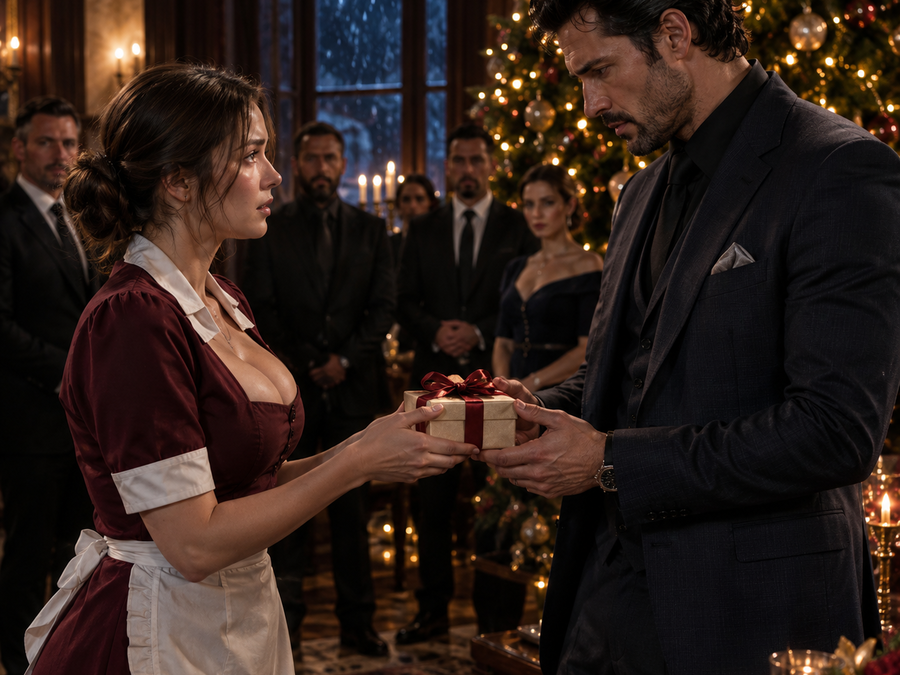
But on a freezing Christmas Eve, a 23-year-old waitress named Ara did the impossible. She didn’t pull a gun on him. She didn’t beg for her life. She simply placed a small, poorly wrapped box on his table. When he opened it, the music stopped. The guards drew their weapons.
But Julian didn’t move. For the first time in 20 years, the devil of Chicago was shaking. He looked up, tears in his eyes, and whispered, “Where? How did you find this?”
The unspoken rule at the Obsidian Lounge was simple. You see everything, but you witness nothing. Ara Vance knew this rule better than the back of her chafed red hands. She had been working the VIP floor for three years, maneuvering through the haze of expensive Cuban cigar smoke and the cloying scent of designer perfume. She was invisible. That was her superpower.
She was just the girl who refilled the crystal tumblers. The girl who wiped the condensation off the mahogany tables. The girl who didn’t exist once the heavy oak doors closed. It was December 24th in Chicago.
Outside, the wind off Lake Michigan was screaming down Michigan Avenue, turning the city into an ice box. Inside the Obsidian, the heating was cranked high, and the jazz band was playing a slow, melancholic rendition of “Silent Night.” The club was mostly empty, save for the scattering of made men and high rollers who had nowhere else to be on Christmas Eve. And of course, him.
Julian Vane. He sat in booth four, the secluded circular booth in the far corner, draped in shadows. He was a man who looked like he had been carved out of granite and dressed by an Italian tailor. He was 38, though his eyes looked ancient. He was the head of the Vane Syndicate, the organization that effectively ran the logistics, shipping, and underground gambling from the Loop to the South Side. He never drank alcohol on Christmas Eve.
That was the anomaly. Every other night, Julian Vane drank Macallan Rare Cask neat. On Christmas Eve, he ordered a pot of Earl Grey tea and sat in silence for exactly three hours.
“Table four needs a refill on hot water,” the floor manager, Marcus, hissed. Marcus was a sweaty man who owed too much money to the wrong people, which made him jumpy. “Don’t look him in the eye, Ara. He’s in a mood tonight. Rumor is the Moretti family tried to hit one of his shipments on I-90 this morning.”
“I know the drill, Marcus,” Ara said softly. She adjusted her black apron, checking the pocket. Her heart hammered against her ribs. It felt like a trapped bird.
In her pocket was a small box. It was wrapped in cheap brown paper she had salvaged from a grocery bag, tied with a piece of red yarn. It looked pathetic compared to the diamonds and Rolexes flashing around the room, but she knew it was worth more than the entire building. She picked up the silver teapot and walked across the plush carpet. The closer she got to booth four, the heavier the air felt. Julian Vane had a gravity to him.
His bodyguards, two massive men named Silas and Cole, stood by the pillars, their eyes scanning the room like sharks. They knew her. They let her pass. She reached the table. Julian was looking at his phone, his brow furrowed. He was typing a message, his fingers moving with lethal precision.
“Your water, Mr. Vane,” Ara whispered.
Julian didn’t look up. He just tapped a finger on the table, indicating she should pour. Ara’s hands were steady as she poured the steaming water, but her mind was racing. Do it now. If you don’t do it now, you never will. She had found the object three weeks ago, not in a safe, not in a gutter, but in an old velvet coat she had bought from a Salvation Army on the West Side for $12.
She had felt a lump in the lining, cut it open, and found it. At first, she thought it was junk. Then she saw the inscription. Then she did the research at the public library, scrolling through microfiche of newspapers from 1998.
She knew what it was, and she knew who it belonged to. Most people would have pawned it or thrown it away, or if they were stupid, tried to blackmail him. Ara wasn’t stupid, but she was desperate.
Not for money, though she had bills piled high on her kitchen counter, but for something else. Redemption, maybe. Or perhaps she just hated seeing a man sit alone on Christmas Eve, looking like he was waiting for a ghost.
She finished pouring. Julian finally locked his phone and placed it face down. He reached for the cup. “Is there anything else, sir?” she asked.
Julian froze. He looked up. His eyes were the color of steel, cold and impenetrable. He rarely heard the wait staff speak unless spoken to. “No,” he said. His voice was a low rumble like distant thunder. “Leave.”
Ara took a breath. It was a risk. A massive, potentially fatal risk. “Actually, Mr. Vane,” she said, her voice trembling slightly. “There is one thing.”
Silas, the bodyguard nearest to them, took a step forward, his hand moving inside his jacket. Julian held up a hand to stop him. He narrowed his eyes at Ara, analyzing her face. He saw the fatigue under her eyes, the cheap makeup, the fraying collar of her uniform.
“I’m not in the market for company,” Julian said coldly. “And I don’t give handouts.”
“It’s not that,” Ara said. She reached into her apron. Silas lunged. “Hands! Let me see your hands!”
The jazz band stopped playing. The few patrons in the club turned, sensing the sudden spike in violence. Ara froze, her hand halfway out of her pocket. “I’m not armed,” she said quickly, staring at Julian. “It’s a gift. For Christmas.”
Julian stared at her. The absurdity of the statement seemed to confuse him. A waitress giving the mafia boss a Christmas gift. “Check it,” Julian ordered Silas.
The bodyguard roughly patted her down, grabbed her wrist, and pulled the small brown box from her hand. He shook it. It didn’t tick. It was light. He sniffed it. “It’s just a box, boss,” Silas grunted.
“Put it on the table,” Julian said.
Silas placed the pathetic little package on the polished mahogany. It sat there, an alien object in a world of luxury. “Open it,” Julian commanded. “You open it.”
Ara stepped forward, her fingers fumbling with the red yarn. She pulled the paper away. Inside was a tarnished silver locket suspended on a broken chain. The metal was scorched on one side, black with soot that had never been cleaned off. She pushed it toward him. Julian looked at it with disinterest at first. Then his gaze caught the scorching marks. Then the specific engraving of a lark, a small bird, on the front.
The color drained from his face so fast it looked like he had been shot. He reached out, his hand, usually steady enough to aim a pistol at 50 yards, was shaking. Visibly shaking. The ceramic cup rattled in its saucer as his elbow bumped the table. “Where?” Julian’s voice cracked. He cleared his throat, but the steel was gone. He sounded like a child. “How did you find this?”
“Open it,” Ara whispered.
Julian pried the locket open with a trembling thumbnail. Inside, preserved under a cracked layer of glass, was a tiny sepia-toned photo of a boy and a girl. The boy was Julian. The girl was laughing, her hair in pigtails. It was the locket his sister Sarah had been wearing the night the Vane family estate burned down 20 years ago. The night Sarah Vane died. The night Julian Vane became an orphan and a monster.
Julian slammed his hand onto the table, standing up so abruptly his chair fell backward with a crash. “Who sent you?” he roared. The grief was gone, replaced by a terrifying, feral rage. He grabbed the collar of her uniform, pulling her face inches from his. “Was it Moretti? Is this a sick joke? She burned. She burned to ash. Where did you get this?”
“I didn’t steal it,” Ara cried out, tears springing to her eyes. “I bought a coat. A vintage coat. It was sewn inside the lining. I saw the date on the back. 1998. I looked it up.”
Julian’s breathing was ragged. He stared into her eyes, looking for the lie. He was a human lie detector. He could smell deceit. But in Ara’s welled, terrified hazel eyes, he saw only fear and truth. He looked back down at the locket in his hand. The soot, the smell of smoke that seemed to linger on it even after two decades.
“Silas,” Julian said, his voice dropping to a whisper. “Bring the car around. Now.”
“Boss, we have the meeting with the alderman in an hour,” Silas protested.
“Cancel it,” Julian snapped. He didn’t let go of Ara. “You’re coming with me.”
“I—I have to finish my shift,” Ara stammered, looking around at the terrified manager.
“You’re done working here,” Julian said. He released her collar but grabbed her hand, his grip iron tight. “You’re done working anywhere until I find out the truth. Because this,” he held up the locket, “this was supposed to be in a grave.”
The ride was silent and suffocating. Ara sat in the back of the armored Mercedes SUV. The leather seats were softer than her bed at home, but she felt like a prisoner on the way to the gallows.
Julian sat next to her, staring out the window at the blurred lights of Chicago. In his hand, he kept rubbing the scorched metal of the locket with his thumb. He hadn’t spoken a word since they left the club. They didn’t go to his penthouse in the Loop. Instead, the driver took the highway north, heading toward the wealthy, secluded estates of Lake Forest.
They pulled up to a massive iron gate on a street Ara recognized only from news reports about the ultra-rich. Vignola Drive. The gates opened. The car wound up a long snow-covered driveway lined with pine trees that looked like sentinels in the dark. The house was a fortress, modern concrete and glass, but dark.
“Inside,” Julian ordered as the car stopped.
Ara stepped out into the biting cold. “Am I going to die tonight?” she asked. She didn’t mean to say it aloud, but the words slipped out.
Julian stopped at the front door. He turned to look at her. The porch light illuminated his face, the sharp cheekbones, the scar running through his left eyebrow. “If I wanted you dead, you would have never left the club. Get inside.”
The interior was minimalist and cold. Greystone floors, black furniture, no Christmas tree, no decorations. It was a house where people slept, not where they lived. Julian walked to a wet bar and poured a glass of water. He didn’t offer her any. “Sit,” he pointed to a solitary armchair.
Ara sat, keeping her coat on. She was shivering, partly from cold, mostly from adrenaline. “My sister,” Julian began, his back to her. “Sarah. She was seven years old. I was 18. Our house in the South Side. It was firebombed. Rival gang.”
“I made it out. My parents didn’t. Sarah…” He paused, taking a sip of water. “The firefighters found remains in her room. They found the chain of that locket, but they never found the locket itself.” He turned to face her. “So tell me, how does a waitress end up with a dead girl’s necklace sewn into a coat that she bought 20 years later?”
“I told you,” Ara said, her voice gaining a little strength. “I shop at the Salvation Army on Halsted. I bought a gray wool coat. It was heavy. I was fixing the hem because it was dragging, and I felt something hard in the lining. I cut it open.”
“Where is the coat?” Julian demanded.
“At my apartment in Pilsen.”
Julian nodded at Silas, who was standing by the door. “Go to her apartment. Tear it apart. Find the coat. Bring everything.”
“No,” Ara stood up. “My roommate is there. You can’t just bust in.”
“Sit down,” Julian said calmly. “Silas will be polite unless he finds out you’re lying.”
Silas left, the heavy door thudding shut. Julian walked closer to Ara. He pulled a chair opposite her and sat, leaning forward, elbows on his knees. He dangled the locket between them. “You said you looked it up. Why?”
“Because of the inscription,” Ara said. “To my little lark, love, Jay. And the date. December 24, 1998.”
It was Christmas Eve. The fire. Everyone in Chicago knows about the Vane Fire. It’s an urban legend. “I Googled the date and the name Vane. The articles mentioned you called her Lark.”
“You’re smart,” Julian said. It wasn’t a compliment. It was an accusation. “Too smart for a waitress who pours water.”
“I was studying pre-law before my dad got sick,” Ara shot back defensively. “I had to drop out to pay his medical bills. I’m not an idiot.”
Julian studied her. He looked at her hands, rough, calloused. He looked at her shoes, worn out. She was telling the truth about her poverty. “Why give it to me?” he asked softly. “You could have sold it. A collector of macabre murder memorabilia would pay five grand for this.”
Ara looked down at her hands. “Because you looked lonely,” she whispered. “Every year I see you. You stare at that empty seat. I thought… I thought having a piece of her might bring you peace. I didn’t know it would make you angry.”
Julian went silent. The vulnerability in her voice disarmed him. He wasn’t used to kindness. He dealt in favors, debts, and leverage. Altruism was a foreign language.
Suddenly, Julian’s phone buzzed. He ignored it. It buzzed again and again. He frowned and pulled it out. It was a text from his chief of security. Code red. “The warehouse on Fourth is burning. They hit us.”
Julian stood up, his face hardening back into stone. But before he could issue an order, the lights in the safe house flickered and died. Total darkness.
“Stay down!” Julian shouted, diving toward Ara. Crash! The floor-to-ceiling glass window of the living room shattered inward. A canister hissed across the stone floor, spinning and spewing white smoke. Flashbang!
Boom! The sound was deafening. Ara screamed, covering her ears. She felt a heavy weight tackle her, slamming her to the floor behind the thick leather armchair. It was Julian. He was covering her body with his own.
Gunfire erupted. Automatic weapons. The bullets chewed up the furniture, sending stuffing and wood chips flying into the air. “Stay down!” Julian roared over the noise. He reached into his suit jacket and pulled out a black handgun. He popped up, fired three controlled shots into the darkness. Bang! Bang! Bang! And ducked back down. There was a grunt of pain from the other side of the room.
“How did they find us?” Ara screamed, coughing in the smoke. “This is a safe house.”
Julian looked at her, his eyes wild in the strobe-light flashes of muzzle fire. “Someone knew I was coming here. Someone knew I was distracted.” He looked at the locket, which he had shoved into his pocket. “The locket,” Julian realized, his voice cold. “It wasn’t a gift, Ara. It was a tracker.”
Ara’s eyes widened in horror. “What? No, I didn’t—”
“Shut up,” Julian grabbed her arm. “We have to move. If we stay here, we’re dead.”
He dragged her across the floor, staying low. The bullets were tearing the house apart. The Christmas gift had just brought a war to his doorstep, and Ara Vance was right in the middle of it.
The hallway of the safe house was a tunnel of smoke and noise. Julian moved with a fluidity that terrified. He wasn’t running. He was hunting while retreating. He kept one hand firmly clamped on Ara’s wrist, dragging her low along the wall, while his other hand fired the semi-automatic pistol with rhythmic, deafening precision.
“Kitchen. Now,” Julian barked. They burst through the swinging doors of the kitchen. A man in black tactical gear was climbing through the window over the sink. Julian didn’t hesitate. He fired twice. The man fell backward into the snow without a sound.
“Don’t look,” Julian commanded, pulling her toward the pantry.
“I—I can’t breathe,” Ara gasped, her lungs burning from the acrid smoke of the flashbang.
“You breathe when I say you breathe,” Julian snapped. He kicked open a hidden panel at the back of the pantry. It revealed a narrow concrete staircase plunging into darkness. “Down. Go.”
Ara stumbled down the stairs. The air was damp and smelled of mold and earth. Julian followed, closing the panel behind them and bolting it shut. The muffled sounds of gunfire and shouting from above seemed miles away now. They were in a tunnel. It was narrow, lined with piping.
“Move,” Julian said, pushing her forward. “This comes out three blocks away in a drainage ditch near the ravine.”
They ran. Ara’s cheap work shoes slipped on the wet concrete, but she kept moving, fueled by a primal fear she didn’t know she possessed. After five minutes of jogging in the dark, they reached a rusted grate. Julian kicked it open, and the freezing winter air hit them like a physical blow. They scrambled out into a snow-filled ravine. The wind howled through the bare trees. They were out of the house, but they were exposed.
“My car is gone,” Julian said, scanning the road above the ravine. “They’ll be watching the perimeter.”
“We can take the bus,” Ara said, her teeth chattering so hard she could barely speak. “There’s a stop on Sheridan Road. It runs all night.”
Julian looked at her as if she were insane. “I am Julian Vane. I do not take the bus.”
“You are Julian Vane, and you are currently being hunted by a hit squad,” Ara countered, the adrenaline making her bold. “Nobody looks for a mafia boss on the number 22 bus.”
Julian stared at her for a split second. A flicker of something—respect? annoyance?—crossed his face. “Fine.”
Twenty minutes later, they were sitting in the back of a nearly empty city bus heading south toward the city. Julian had ditched his blood-splattered suit jacket in a dumpster, leaving him in a white dress shirt that was rapidly soaking up blood from a graze on his shoulder. He sat stiffly, his eyes scanning every passenger who got on or off. Ara sat next to him, her arms wrapped around herself. The bus was overheated, smelling of wet wool and floor cleaner.
“Give me the locket,” Julian said quietly.
Ara reached into her pocket and handed it to him. Julian took it. He didn’t look at the picture this time. He took a heavy silver pen from his pocket and jammed it into the seam of the locket, prying the backing off with brutal force. Snap! The silver back plate popped off. Hidden behind the sepia photo of the children was a small, flat black disc no larger than a watch battery. A red light blinked on it slowly.
“A tracker,” Ara whispered, horrified. “I swear. I swear to God I didn’t know.”
Julian crushed the device between his thumb and forefinger until the plastic shattered, then dropped the pieces onto the floor of the bus and crushed them under his expensive leather boot.
“I believe you,” Julian said, his voice flat.
Ara blinked. “You do?”
“If you were working for them, you wouldn’t be sitting here shivering. You’d have led them to me and disappeared. You’re not the assassin, Ara. You’re the bait.”
He turned to look at her. The harsh fluorescent lights of the bus highlighted the exhaustion on her face. “Someone wanted me to find this locket,” Julian analyzed, his mind working like a computer. “They knew that if I saw my sister’s necklace, I would act irrationally. I would isolate myself. I would go to the one place where I felt close to her memory. The Vignola house.”
“It was a trap designed to use my grief against me.”
“Who hates you that much?” Ara asked.
Julian looked out the window at the passing city. “Everyone. But only a few people know about the locket. That information died in the fire 20 years ago. Or so I thought.” He looked back at her. “You said you found it in a coat.”
“Yes. A gray wool coat.”
“We need that coat,” Julian said, his eyes narrowing. “The locket was the bait. The coat might be the map.”
“Silas is at my apartment,” Ara said, panic rising again.
“If the bad guys are tracking me, then Silas is walking into an ambush,” Julian finished. He pulled out a second, smaller burner phone from his ankle holster. He dialed a number. “Silas,” Julian said into the phone. “Abort the search. Get out of the building. Bring the package if you have it. Meet me at the foundry.”
He hung up and looked at Ara. “We’re getting off. Next stop.”
The foundry was not a club. It was a defunct steel mill in the industrial wasteland of South Chicago, a relic of a time when the city built skyscrapers instead of trading stocks. It was also where Julian Vane stored his off-book assets. They entered through a rusted side door.
Inside, the space was cavernous, smelling of oil and cold iron. In the center of the vast floor, a single office module had been converted into a living space. Julian pushed Ara inside. It was warm. There was a leather couch, a first aid kit, and a wall of monitors showing camera feeds of the exterior.
“Take off your shirt,” Ara said.
Julian froze, his hand on his holster. “Excuse me?”
“Your shoulder,” Ara pointed. “You’re bleeding through the white shirt. It looks bad. I can dress it.”
Julian looked down at his shoulder. The adrenaline was fading, and the pain was setting in. He grunted and unbuttoned his shirt, sliding it off. Ara tried not to stare. Julian’s torso was a map of violence. There were scars from knives, scars from bullets, and a long, jagged burn mark running down his right side, a souvenir from the fire that killed his family. He was built like a gladiator, muscle layered over trauma.
She grabbed the antiseptic and bandages from the kit. “Sit.”
Julian sat on the edge of the desk. Ara worked, cleaning the graze. The silence between them shifted. It wasn’t the silence of predator and prey anymore. It was the intimacy of survival.
“You have gentle hands,” Julian murmured, almost to himself. “For a waitress.”
“Waitressing is hard work,” Ara said, focusing on the bandage to avoid his intense gaze. “You carry heavy trays, you dodge drunk customers. You stand for 12 hours. You have to be strong but careful. If you drop a glass, you don’t get tips.”
“I haven’t had anyone take care of me in a long time,” Julian admitted. The confession seemed to surprise him. “I pay people to protect me. I pay people to serve me. But care? That’s not in the budget.”
Ara finished taping the bandage. She looked up, and their faces were inches apart. She could smell the scent of him—gunpowder, expensive cologne, and the metallic tang of snow. “Why did you save me?” Ara asked softly. “Back at the house, you could have left me.”
“You gave me a gift,” Julian said, his eyes searching hers. “Even if it was a trap, the intent was yours. You tried to give me Christmas. I owe you a debt for that.”
The heavy metal door of the warehouse rolled open with a screech. Julian was on his feet in a second, gun drawn. It was Silas. The giant bodyguard walked in looking disheveled. His suit was torn, and he had a split lip. He was carrying a large plastic garbage bag.
“Boss,” Silas nodded, breathing heavily. “Moretti’s guys were waiting in the lobby of her building. I had to go up the fire escape. Barely got out.”
“Did you get it?” Julian asked, holstering his weapon.
“Yeah. Grabbed the whole closet just to be sure. But I think this is the one.”
Silas dumped the contents of the bag onto the desk. A few cheap hoodies, a denim jacket, and a heavy charcoal gray wool coat spilled out. It was elegant but worn, the style distinctly vintage.
Julian reached out and touched the fabric. He ran his hand over the lapel. “This isn’t just a coat,” Julian whispered. He grabbed the coat and held it up to the light. He turned it inside out, looking at the lining where Ara had cut it open to find the locket.
“Ara,” Julian said, his voice trembling again. “Where exactly did you buy this?”
“The Salvation Army on Halsted. Three weeks ago. It was just hanging there.”
Julian ripped the coat open further, searching for the inner tag. He found it near the bottom hem. It was a faded silk label from a custom tailor. Marino and Sons, Milano. “My mother shopped at Marino’s,” Julian said, his face pale. “She was Italian. She had her coats custom made.”
“So, it’s your mother’s coat?” Ara asked. “From the fire?”
“No,” Julian said. “That’s the problem. Look at the dry cleaning tag.”
He pointed to a tiny, yellowed paper tag stapled to the care label, the kind dry cleaners use to track garments. The ink was faded but legible. Cleaners: West Loop Press. Date: 02/14/2005.
The room went dead silent.
“The fire was in 1998,” Silas rumbled, doing the math.
“Your mother died in 1998, boss. This tag says 2005.”
Julian said, his voice barely a whisper. “Seven years after the fire. This coat was cleaned in Chicago seven years after my mother was buried.”
Ara stepped closer, looking at the tag. “That means…”
“That means she didn’t die,” Julian said. He looked up, and the look in his eyes was terrifying. It was a mix of hope and absolute devastation. “Or someone stole her identity. Or someone has been playing a very long game.”
“The locket,” Ara realized. “It was in the lining. If your mother, or whoever wore this, hid the locket in the lining in 2005, why did it surface now in a thrift store?”
“Because someone died recently,” Julian said, “or someone got careless. Whoever was keeping this coat, they lost it.”
He grabbed the coat and threw it over his shoulder. “Silas, get in the car. The real car.”
“Where are we going, boss?”
“West Loop Press,” Julian said. “The dry cleaner is still in business. I drive past it every week. I never stopped. I never thought to look.”
He turned to Ara. He reached out and cupped her face with his hand. His thumb brushed her cheekbone. “You have no idea what you’ve started, Ara,” he said. “You didn’t just find a Christmas gift. You dug up a grave.”
“I’m coming with you,” Ara said firmly.
“It’s going to get dangerous. Moretti is just the hired gun. Whoever is behind this, they are family. Or they used to be.”
“I have nothing left to lose,” Ara said. “My apartment is compromised. My job is gone. And I want to know the end of the story.”
Julian stared at her for a long moment, then nodded. A dark, dangerous smile touched his lips. “Then let’s go get your Christmas present,” he said. “I think it’s my turn to give you one.”
“What’s that?”
“Revenge,” Julian said. “And the truth.”
West Loop Press was a relic of a bygone era. It was a small brick building wedged between two glass condos, stubborn and grime-streaked. It was 3:00 a.m. on Christmas morning. The neon sign buzzed erratically, casting a sickly pink light on the snow. Julian killed the engine of the real car, a nondescript Ford sedan he kept for emergencies. Silas sat in the back, checking the magazine of his Glock.
“Stay here,” Julian told Ara.
“No,” Ara said, reaching for the door handle. “If the owner is an old man, he’s going to have a heart attack if he sees two giants in bloodstained shirts barging in. I’m coming. I look innocent.”
Julian looked at her. Her uniform was torn. Her hair was a mess, and she looked like she had walked through a war zone. But she was right. She didn’t look like a killer. “Fine. Stay behind me.”
They approached the glass door. It was locked. Julian didn’t bother with lockpicks. He took off his heavy boot and kicked the glass right near the deadbolt. It shattered with a surprisingly quiet crunch. He reached in and flipped the lock.
They stepped into the smell of steam, starch, and old chemicals. The racks of clothes on the conveyor belt looked like hanging ghosts in the shadows.
“Who’s there?” A voice quavered from the back room. “I have a shotgun.”
An elderly man in pajamas stumbled out, holding a double-barreled shotgun that looked older than he was. His hands were shaking violently. “Mr. Henderson,” Julian said, his voice calm but commanding. He stepped into the light.
The old man squinted. He lowered the gun slightly. “Mr. Vane? Is that you? I thought I saw… on the news. The fire.”
“Put the gun down, Arthur,” Julian said. “I need to see your ledger. The physical one from 2005.”
“The ledger?” Henderson wiped sweat from his forehead. “Mr. Vane, it’s Christmas.”
“I don’t—” Julian took a step forward. The menace rolled off him in waves. “I don’t have time for nostalgia. A coat was cleaned here. A gray wool coat. Marino and Sons. The ticket number ends in 402.”
Henderson paled. He dropped the shotgun onto a pile of laundry. “The lady in red,” he whispered.
“Who?” Ara asked, stepping out from behind Julian.
Henderson looked at Ara, then back at Julian. “She never gave a name. But she came every month for 10 years. Always brought the same three coats. Always paid in cash. Crisp $100 bills.”
“Ten years,” Julian felt the room spin.
“When did she stop coming?”
“Two weeks ago,” Henderson said. “Her driver, a big man, bald, scary. He came in, said she wouldn’t be needing the services anymore. Said she was expired. He told me to donate the clothes. I sent them to the Salvation Army on Halsted.”
“Describe the driver,” Julian demanded.
“Huge. Tattoos on his neck. A spiderweb.”
Julian exchanged a look with Silas. “The Spider,” Julian growled. “That’s a heavy for the Russo family. Low-level muscle.”
“Why would a Russo enforcer be driving a woman who owns my dead mother’s coat?” Julian asked the air, his mind racing.
“Mr. Vane,” Henderson interrupted nervously. “There’s… there’s something else. The last time the lady was here, about a month ago, she seemed agitated. She slipped something into the pocket of that gray coat right before she handed it to me. She looked me in the eye and said, ‘If he ever comes, tell him the bird has flown the coop.'”
“The bird?” Ara whispered. “The Lark.”
“Did she say anything else?” Julian grabbed the old man’s shoulders.
“No, I swear. But she left a forwarding address for the receipt. Usually, she took it. This time, she forgot it. It’s in the book.”
Henderson scrambled behind the counter and pulled out a dusty, leather-bound ledger. He flipped through the pages with trembling fingers. “Here. November 28th.” He pointed to a scrawl of blue ink. “Room 302, St. Jude’s Hospice for the Memory Impaired, 4400 W. Ogden.”
Julian stared at the address. St. Jude’s. It was a facility run by the church but funded by the syndicate. It was where they put the old gangsters who had lost their minds to dementia, the ones who knew too many secrets but couldn’t remember them anymore.
“She was right under my nose,” Julian whispered. The pain in his voice was jagged. For 20 years, she was five miles away.
“We have to go,” Silas said, watching the street. “Police scanners are lighting up about the safe house.”
“Thank you, Arthur,” Julian said. He pulled a wad of cash from his pocket, thousands of dollars, and stuffed it into the old man’s shirt pocket. “Forget we were here. Buy a new door.”
As they walked back to the car, Ara grabbed Julian’s hand. He flinched, then squeezed it back. His grip was desperate. “We’re going to find her,” Ara said firmly.
“She’s dead, Ara,” Julian said, his voice hollow. “The driver said she expired. That’s why the coat was donated.”
“Maybe,” Ara said. “Or maybe she just wanted everyone to think she was dead again.”
St. Jude’s Hospice was a fortress of solitude. It was a Gothic brick building surrounded by a high iron fence. At 4:00 a.m., it was as silent as a tomb. They didn’t break in this time. Julian Vane owned the land the hospice stood on. He walked up to the front buzzer and pressed it.
“Deliveries are in the back,” a crackly voice said.
“This is Julian Vane,” he said into the intercom. “Open the gate, or I burn the building down with you inside.”
The gate buzzed open instantly. They stormed into the lobby. The night nurse, a terrified young man, was already standing with his hands up.
“Room 302,” Julian barked. “Who was in it?”
“J-Jane Doe,” the nurse stammered. “We didn’t have a name. The bills were paid anonymously by a shell company. Redwood Logistics.”
Julian froze. Redwood Logistics. That was his uncle’s company. Dante Vane. His father’s brother. The man who had raised Julian after the fire. The man who sat at his right hand during every board meeting.
“Uncle Dante,” Julian whispered. The betrayal hit him harder than a bullet. Dante had saved him from the fire. Dante had groomed him to be the boss. All the while, Dante had been keeping Julian’s mother—and maybe his sister—locked away in a hospice, feeding off the Vane fortune.
“Take me to the room,” Julian ordered.
The nurse led them to the third floor. The hallway smelled of lavender and antiseptic. Room 302 was at the end of the hall. The door was open. The room was stripped bare. The bed was made with military precision.
“She passed away two weeks ago,” the nurse said softly. “Heart failure. It was peaceful.”
Julian walked into the room. He touched the empty bed. He walked to the window and looked out at the snowy courtyard. He looked like a man whose soul had been scooped out.
Ara didn’t look at the bed. She looked at the nightstand. She looked at the floorboards. She was looking for what wasn’t there. “Where are her things?” Ara asked the nurse.
“The driver took most of them. We donated the clothes.”
“Did she leave anything else?” Ara pressed. “A book? A Bible?”
“Actually,” the nurse hesitated. “She used to hide things. She was paranoid. She thought people were listening to her. I found this taped under the drawer when I was cleaning up yesterday. I was going to throw it out, but…”
The nurse reached into his pocket and pulled out a small, leather-bound notebook. It was cheap, the kind you buy at a drugstore. Julian snatched it. He opened the first page. The handwriting was shaky but unmistakable. It was his mother’s elegant script.
My dearest Julian,
If you are reading this, Dante finally made a mistake. Or I am dead. I hope it is the latter because as long as I am alive, he has leverage over you.
Julian’s hands shook so hard he almost dropped the book. Ara stepped to his side, reading over his arm.
He didn’t just take me, Julian. He took Sarah. He told me that if I ever tried to contact you, if I ever left this room, he would kill her. He sent me photos every year. She is alive. She is grown. He sold her, Julian. He sold her to the Moretti family as a peace offering to keep the war from ending us in ’98.
She isn’t dead. She is married to Enzo Moretti’s son. She is a prisoner in plain sight.
The coat. I knew my time was coming. I paid a nurse to sneak the coat out to the cleaners, hoping the tag would eventually lead you here. I sewed the locket inside. It was my Hail Mary.
Don’t mourn me. I died the night the house burned. Go get your sister. Burn them all, my son. Burn them all.
Love, Mom.
Silence filled the room. Heavy, suffocating silence. Julian closed the book. He didn’t cry. The tears that had threatened to fall earlier had evaporated, replaced by a heat that was terrifying to witness. He turned to Silas.
“Call the boys,” Julian said. His voice was no longer human. It was the voice of a war machine. “Call everyone. The North Side, the South Side, the dock workers. Everyone.”
“What’s the order, boss?” Silas asked, sensing the shift.
“We are going to the Moretti estate,” Julian said. “And we are going to kill everyone who isn’t my sister.”
“And Dante?” Ara asked softly.
Julian looked at her. “Dante is coming to Christmas dinner. I want him alive. I want him to watch.”
He turned to leave, but Ara blocked his path. “I’m coming,” she said.
“No,” Julian said. “This is war, Ara. Real war. Bullets, bombs. You go back to the foundry. You stay safe.”
“You need me,” she said.
“I don’t need anyone,” Julian shouted, the stress finally cracking his composure.
“Yes, you do,” Ara shouted back, grabbing his lapels. “You’re angry. You’re blind with rage. You’re going to walk into a trap. Dante knows you’ll come for Sarah. He’s expecting this. You need someone who isn’t thinking like a gangster. You need someone who thinks like a… like a nobody. Like a waitress.”
Julian stared down at her. Her hazel eyes were fierce, burning with a fire that matched his own. “I found the locket,” she said. “I found the coat. I found the ledger. I got you this far. Let me finish it.”
Julian hesitated. He looked at the notebook in his hand. “Burn them all.”
“You stay in the car,” Julian said. “If I die, you run.”
“Deal,” Ara lied.
Julian turned to Silas. “It’s Christmas morning, Silas.”
“Yes, boss.”
“Let’s go deliver some presents.”
The Moretti estate was not a house. It was a fortress of white stone sitting on a cliff overlooking the frozen expanse of Lake Michigan. It was Christmas morning, 7:00 a.m. The sun was rising, casting a blood-red hue across the snow-covered grounds. Inside the estate, the mood was festive yet tense. The long dining table was set with silver and crystal. At the head sat Enzo Moretti, the aging don. To his right, his son, Luca. To his left, a woman with hollow eyes and expensive diamonds: Sarah Vane.
And beside her, sipping espresso with a relaxed smile, was Dante Vane. They were celebrating a merger. The Vane territory was being carved up. Dante was signing over the rights to his nephew’s empire in exchange for safety and a seat at the table.
Outside, the silence of the morning was broken by the low rumble of engines. Not one car. Fifty. A convoy of black SUVs, trucks, and sedans swarmed the front gates. They didn’t stop for the intercom. The lead truck, a reinforced snow plow stolen from the city fleet, smashed through the wrought-iron gates with a shriek of tearing metal. The alarm claxons began to wail.
“What is this?” Enzo Moretti stood up, knocking over his wine glass.
Dante Vane walked to the window, his face pale. “It’s Julian. He’s supposed to be dead. My men said he was trapped in the safe house.”
“You said you handled him,” Luca Moretti shouted, drawing a gold-plated pistol.
Outside, the grounds erupted into chaos. Julian’s men poured out of the vehicles. They weren’t just street thugs. They were dock workers, union men, the people of Chicago who had been fed and protected by the Vane Syndicate for decades. They clashed with the Moretti guards in the snow.
In the center of the storm walked Julian Vane. He wore a heavy tactical vest over his dress shirt, an assault rifle in his hands. He didn’t run. He didn’t hide. He walked with the terrifying inevitability of the Grim Reaper.
“Silas, take the West Wing,” Julian commanded into his earpiece. “I want the dining room.”
“Boss, you have a shadow,” Silas’s voice crackled.
Julian turned. Ara was running behind him, ducking low behind the marble fountain. “I told you to stay in the car,” Julian roared, firing a burst of suppression fire at a balcony sniper.
“I’m not a soldier, but I know how to find lost things,” Ara shouted back. “You’re going to kill everyone. You need someone to find Sarah before the crossfire gets her.”
Julian didn’t have time to argue. A grenade exploded near the garage, sending a plume of black smoke into the sky. “Stay behind me. If you die, I will kill you myself.”
They breached the front doors. The lobby was a mess of shattered glass and expensive art. Julian moved like water, clearing the corners, dropping two Moretti guards with precise shots. They reached the great oak doors of the dining hall. Julian kicked them open.
The room froze. At the far end, Enzo and Luca Moretti were using the heavy oak table as cover. Dante stood near the fireplace, holding a gun to the head of the woman seated there. Sarah.
“Hello, Uncle,” Julian said. His voice was calm, which made it all the more terrifying. He lowered his rifle, letting it hang by its strap, and drew his handgun.
“Julian,” Dante smiled nervously, pressing the barrel harder into Sarah’s temple.
Sarah looked at her brother. She didn’t scream. She didn’t cry. Her eyes were dead. Twenty years of captivity had taken the light out of them. “You look terrible,” she said. “Rough night?”
“I found the coat, Dante,” Julian said, stepping over a body on the floor. “I found the ledger. I know everything.”
“That coat,” Dante sneered. “Your mother was a sentimental fool. She should have stayed dead.”
“Let her go,” Julian said, raising his gun.
“You drop the weapon, or she dies,” Luca Moretti shouted from behind the table. “We have you outnumbered, Vane.”
“Do you?” Julian asked.
Suddenly, the windows behind the Morettis shattered inward. Silas and three of Julian’s best enforcers swung in on rappelling lines from the roof, crashing through the glass. In the confusion, Luca turned to fire at Silas.
Bang! Luca dropped, a bullet hole in his chest. But the shot didn’t come from Silas. It didn’t come from Julian. It came from Sarah.
In the split second of distraction, Sarah Vane had pulled a steak knife from the table and jammed it into Dante’s thigh. As he screamed and dropped the gun, she grabbed it and shot her husband, Luca, dead center in the heart.
“Sarah!” Julian shouted, rushing forward.
Dante, bleeding and desperate, scrambled backward toward the fireplace. He grabbed a heavy brass poker, swinging it wildly. He lunged—not at Julian, but at the closest target.
Ara had moved forward to help Sarah. She didn’t see Dante coming.
“Ara, move!” Julian screamed. He dove. He didn’t fire. He threw his body between Ara and the swinging brass weapon.
Crack! The poker struck Julian’s head with a sickening sound. He went down hard, blood spraying onto the white tablecloth.
“No!” Ara screamed. She didn’t retreat. The adrenaline of the night, the anger at the injustice, boiled over. She grabbed a heavy crystal decanter from the table and smashed it into Dante’s face with all the strength of a woman who had carried heavy trays for five years.
Dante stumbled back, blinded by brandy and glass. Sarah stood up. She walked over to Dante, the gun trembling in her hand.
“Sarah, don’t,” Dante gurgled, blood pouring from his nose. “I kept you alive. I—”
“You kept me as a pet,” Sarah whispered. Her voice was raspy from disuse.
She pulled the trigger. Once, twice, three times. Dante Vane fell into the fireplace, the flames licking at his expensive suit. Silence fell over the room. The gunfire outside had stopped. The Vane men had secured the perimeter.
Ara dropped to her knees beside Julian. He was conscious, but barely. Blood was streaming down his face, blinding one eye. “Julian!” she sobbed, pressing her hands against the wound on his head. “Julian, look at me.”
He blinked, his steel-gray eyes finding hers. His hand, usually so steady, reached up and took hers. It was shaking. “Did… did we get it?” he whispered.
“Get what?” Ara cried, tears falling onto his face.
“The gift?” he murmured. “Did we get the gift?”
Ara looked up. Sarah was standing over them. She looked at her brother. Then at the locket that had fallen out of Julian’s pocket during the fight, the scorched silver locket.
Sarah dropped the gun and fell to her knees, embracing Julian. “Jules,” she wept. “You came.”
Julian smiled, a weak, genuine smile that transformed his scarred face. He looked at Ara. “Best Christmas ever,” he wheezed before his eyes rolled back and he passed out.
One year later, the Obsidian Lounge was closed to the public. The sign on the door said, “Private Event.” Inside, the club was unrecognizable. There were Christmas trees in every corner, draped in gold and silver. A massive feast was laid out on the tables. There was laughter. Loud laughter echoing off the walls.
Sarah Vane sat at the bar. She looked different. Her hair was cut in a sharp bob. Her dress was stylish, and the light was back in her eyes. She was running the Vane Foundation, now turning the family’s blood money into orphanages and shelters. She was laughing at a joke Silas had just told.
In the circular booth in the back, booth four, sat Julian Vane. He had a faint white scar on his temple, hidden mostly by his hair. He wasn’t drinking tea. He was drinking champagne.
Ara slid into the booth next to him. She wasn’t wearing a waitress uniform. She was wearing a stunning emerald green dress that matched the season. She placed a hand on his knee. “You look nervous,” Ara teased.
“I don’t get nervous,” Julian lied, adjusting his tie. “I am the architect of Chicago.”
“You’re shaking,” she pointed out, lifting his hand. There was a slight tremor.
“It’s cold,” he grumbled.
“It’s 70 degrees in here, Julian.”
He sighed and reached into his jacket pocket. He pulled out a small velvet box. “Last year,” Julian said, his voice dropping to that intimate rumble that still made her shiver. “You gave me a gift that destroyed my life. You burned down my business, got me shot, got me concussed, and started a gang war.”
“You’re welcome,” Ara grinned.
“But,” Julian continued, his eyes softening, “you also gave me back my sister. You gave me back my past. And you gave me a future.”
He opened the box. Inside wasn’t a diamond the size of a skating rink. It was a ring, yes, but the stone was unique. It was a custom-cut gemstone, deep hazel with flecks of gold. The exact color of Ara’s eyes. And engraved on the gold band was a tiny, delicate lark.
“Ara Vance,” Julian said, sliding off the booth to one knee. The music in the club stopped. Sarah stood up and clapped her hands over her mouth. Silas grinned. “I don’t want to be alone in the dark anymore. Will you marry me?”
Ara looked at the man who had been a monster, who had become a savior, and who was now just a man terrified of rejection. “How did you find this?” she whispered, mimicking his words from a year ago.
“I found it,” Julian said. “Because I was looking for you.”
“Yes,” Ara said, tears spilling over. “Yes, you idiot. Yes.”
He slid the ring onto her finger. His hands were still shaking, but as she wrapped her arms around his neck and kissed him, the shaking stopped. For the first time in 21 years, the architect was steady.
Outside, the snow began to fall on Chicago, covering the scars of the city in a blanket of pure, clean white. And that is how a $10 thrift store coat and a waitress with a brave heart brought the mafia to its knees.
Julian Vane thought he was paying for a sin, but he ended up buying a second chance. It turns out the most dangerous weapon in the underworld isn’t a gun or a bomb. It’s the truth wrapped in brown paper and tied with red yarn.

