“She’s just a disabled girl” They Sneered—Until the Navy SEAL’s K9 Recognized the One Who Saved Him – Part 1
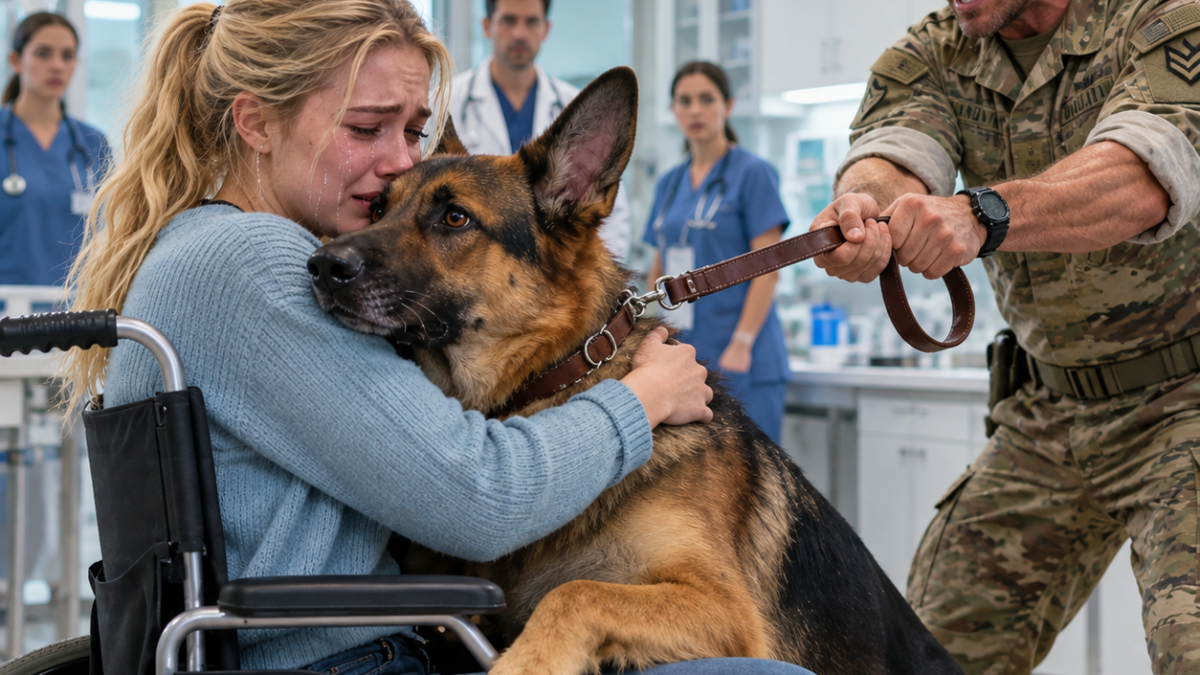
“She’s just a disabled girl” They Sneered—Until the Navy SEAL’s K9 Recognized the One Who Saved Him
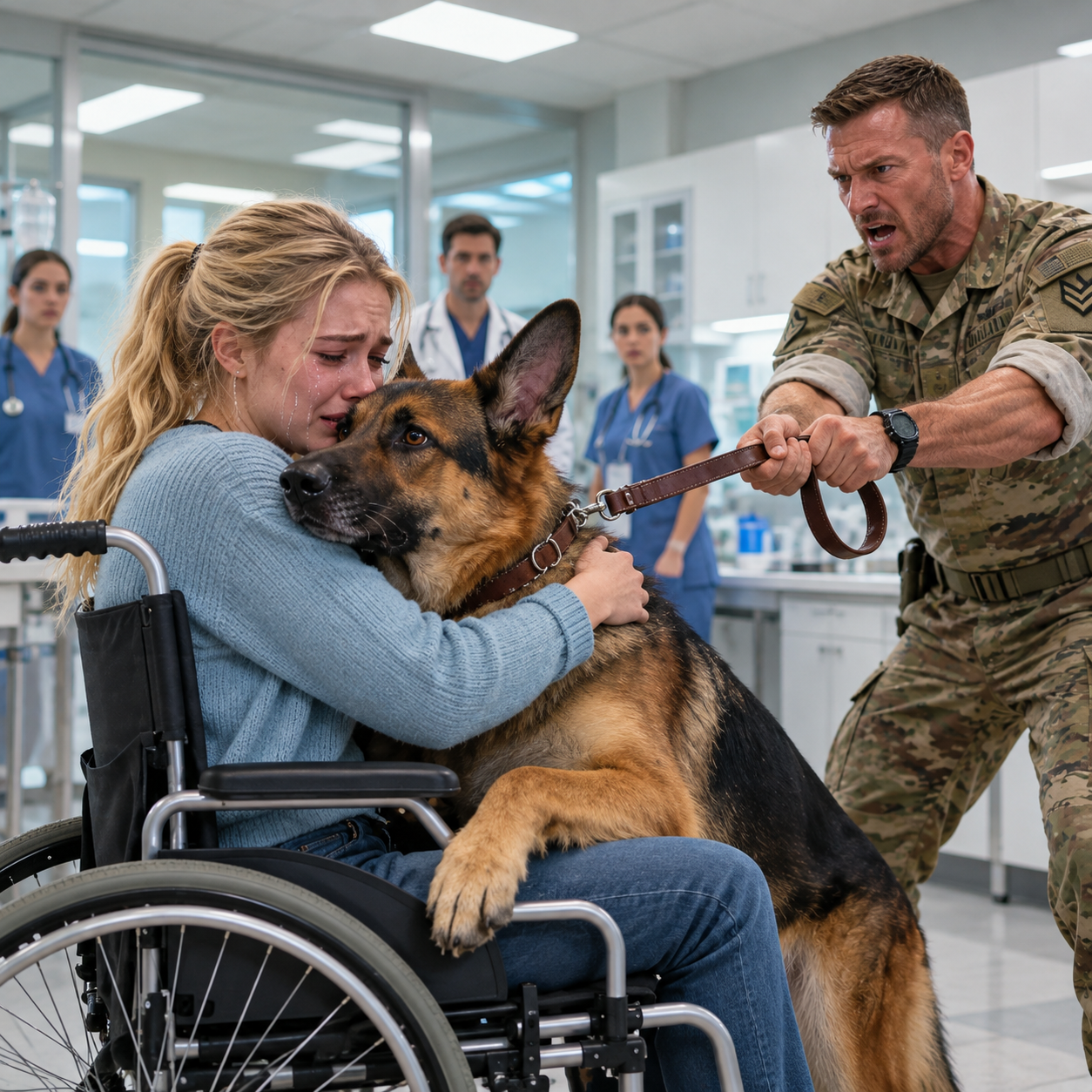
The dog walked into the clinic like he owned it.
200 lb of muscle, scar tissue, and military training. And every person in that waiting room took a step back.
Every person except her. She sat in her wheelchair near the window, the one everyone pretended not to see.
And when that massive German Shepherd locked eyes on her across the crowded room, he stopped breathing. The handler grabbed the leash, staff members froze.
The dog wasn’t growling.
He was trembling like he recognized something like 5 years of war and blood and gunfire had just collapsed into a single moment in a small clinic in Willow Creek, Montana. She reached out her hand and the dog that had survived three combat deployments lowered his scarred head and wept.
The rain had been falling since Tuesday.
By Thursday morning, it hadn’t let up.
Just settled into that lowg gray permanence that Montana does in early November, where the clouds sit so close to the ground you feel like you’re living inside them.
The kind of weather that makes small towns feel smaller, that makes the distance between one person and another feel like it has weight. Willow Creek sat in a valley between two ridgeel lines that blocked most of the afternoon light, even in summer.
In November, it was dark by 4. The Bridger Rehabilitation and Recovery Center occupied what used to be a county hospital on the north end of Main Street, three stories of pale brick with aluminum window frames that fogged over in the cold, a parking lot that flooded every spring, and an interior that
smelled like aneptic and old coffee no matter how many times the maintenance crew mopped.
It wasn’t a bad place.
It just wasn’t a good one either.
Amelia Carter had been coming here 5 days a week for 7 months. She arrived at 8:45 every morning in the same dark blue accessible van driven by a man named Gerald who never talked before 9 and always had a country 1005 station playing at a volume just slightly too loud to ignore.
She wheeled herself through the front entrance, signed in at the desk and made her way to the physical therapy wing in the east corridor, past the reception area with its motivational posters that were starting to peel at the corners. Past the vending machine that ate quarters without apology. Past the row of chairs where the waiting patient sat and stared at their phones or at the floor or at her.
Always at her. Not all of them, but enough.
There was a language in the way people looked at someone in a wheelchair that most able-bodied people didn’t realize they were speaking.
It wasn’t always cruel.
Sometimes it was just absent. Like the wheelchair subtracted something from the equation of her personhood, reduced her to a category rather than a woman.
Disabled, tragic, needs help. Look away. Amelia had stopped being angry about it around month three.
What replaced the anger was something quieter and harder to name. Not acceptance exactly, more like a cold familiarity with the shape of it.
She was 25 years old. She had brown hair she kept in a braid because it was easier that way. Eyes that were a dark gray green that her mother used to call stormc colored.
And hands that were strong from 7 months of pushing her own wheels everywhere she was able. She wore the same kind of clothes most days.
Dark jeans, a thermal shirt layered under a canvas jacket, trail runners on feet that couldn’t feel the ground beneath them.
She brought a battered paperback in the bag hanging from the back of her chair. She drank black coffee from a stainless steel thermos. She did not ask for help unless she had to.
Her injury was T6 incomplete, a spinal cord trauma at the sixth thoracic vertebra sustained 18 months ago when a drunk driver ran a red light at an intersection in Billings and hit the passenger side of a car she was riding in at 62 mph. The driver of the other vehicle walked away with a dislocated shoulder.
Amelia spent 9 days in intensive care and 3 months in acute rehabilitation before transitioning to outpatient therapy here in the town where she’d grown up, where her aunt lived, where the only apartment she could afford that was accessible enough to manage was a converted firstf flooror unit above a dry cleaning shop on Elm Street.
She didn’t dwell on the calculus of that, or she tried not to.
Her PT was a woman named Sandra Reeves, 50something, practical and unsentimental in the way that good physical therapists tended to be. Not cold, but honest.
She didn’t tell Amelia she was going to walk again.
She told her they were going to work on what her nervous system could still do, and that the goal was function, not miracle. Amelia appreciated that more than she could say. This particular Thursday morning, she was 15 minutes into a MAT exercise when she heard the commotion in the main lobby.
not loud, more like a shift in pressure, the kind of collective pause that a room full of people makes when something unexpected walks in. She ignored it for a while.
Sandra was guiding her through a prone extension, stomach down on the mat, pressing her palms against the surface and lifting her upper torso. And Amelia had learned to tunnel her attention during these sessions to block out the ambient noise of the clinic and focus on the specific conversation between her muscles and her brain, which was still 18 months later an imperfect one.
Some signals got through, others didn’t.
The ones that did arrived like voices through bad radio reception, present, but fragmented.
“Push through it,” Sandra said.
Amelia pushed. Then the doors to the physical therapy wing swung open.
She didn’t see him immediately.
She was still face down on the mat, arms trembling with effort. And the first thing she registered was the sound. Not footsteps, but the specific rhythm of a working dog moving on lenolium.
Four beat. Deliberate.
Heavy.
Then Sandra made a sound that wasn’t quite a word.
Amelia turned her head. The dog was enormous.
That was the first thing. the sheer scale of him. German Shepherd, but built like a different order of animal than the breed usually suggested.
His coat was the standard black and tan, but darker than average, and his frame was brought across the shoulders in a way that spoke of years of physical conditioning rather than the soft domesticity of a pet. He wore a tan tactical harness with a handle on the back and several pouches along the sides, the kind of rig that working military dogs were fitted with. A leash ran from the harness to the hand of the man walking beside him.
The man was tall, 6’2, maybe 63, with the kind of lean, economical build that came from years of being asked to carry things over long distances.
Dark hair cut short, a jaw that needed shaving, wearing civilian clothes that somehow looked like a uniform. Anyway, late 30s, maybe.
There was a quality to the way he moved through the space. Not aggressive, but aware.
Like someone who had spent a long time in rooms where the exits mattered, he paused just inside the doorway and scanned the PT wing the way Amelia suspected he scanned every room he walked into, quickly, systematically, logging positions and distances and variables without appearing to do anything at all. His eyes landed on the desk at the far end where the PT coordinator, a young man named Tyler, was standing with his mouth slightly open. Commander Logan Hayes, the man said, not loud.
Clear. I have an 8:00 consult with Dr. Reeves.
Tyler blinked. Dr. Sandra Reeves.
She’s she’s with a patient right now.
I can see that.
He didn’t move.
Sandra straightened. She was already moving toward them, pulling off a latex glove.
Commander Hayes, I was told 9.
I’m sorry.
Let me 8:00. he said again without accusation, just correction. Right.
Yes, my mistake. She looked at Amelia. Give me a few minutes.
Amelia sat up on the mat slowly, using both hands on the surface to push herself upright, a maneuver she’d practiced until it stopped feeling humiliating and started feeling like just a thing her body did.
She reached for the wheelchair parked beside the mat and transferred herself with the efficiency of someone who’d stopped making it a performance.
The dog watched her the entire time. She noticed that, not in a paranoid way, just noticed it.
Most dogs looked away eventually.
This one didn’t.
His amber eyes tracked her movement with a quality of attention that felt different from simple animal curiosity. Not threatening, not quite that, just focused.
She picked up her thermos, unscrewed the cap, drank.
The dog’s nose worked.
She glanced at it at him. He was still watching her.
“What’s his name?”
she asked.
She wasn’t sure she was asking anyone in particular.
Logan Hayes looked at her for the first time.
“Rex, is he friendly?”
“Depends on your definition.
Can I don’t not harsh, just flat.”
She put the thermos down and looked at Rex again. He had a scar on his left shoulder, visible beneath the harness where the fur was shorter there, a pale seam running about 3 in along the muscle.
Combat injury, probably.
She’d read enough about MWDs in the last 2 years to know the language of their damage.
Then she looked at his front leg, left foreg, the dog equivalent of a wrist. There was a scar there, too.
Smaller, older, almost hidden in the fur.
She didn’t say anything.
She looked away, drank her coffee, told herself she was imagining things.
The morning she found the puppy, she’d been 20 years old and driving home from a double shift at the grocery store on Route 9, the one with the bad intersection where the gas station light flickered.
It was April, cold still, the way Montana April could be. Not winter cold, but the stubborn lingering kind that came back at night when you thought you were done with it. It was raining.
She almost didn’t see him.
He was off the shoulder of the road, down in the drainage ditch, barely visible against the dark mud.
She’d slowed down for the curve and caught him in her headlights for just a second.
A small tan and black shape, motionless, eyes catching the light. She pulled over.
She didn’t think about it.
She just stopped the car and got out in the rain and slid down into the ditch and found him there. a German Shepherd puppy, eight weeks, maybe, soaking wet and shaking, and too weak to lift his head. His left fore leg was torn.
Something had gotten him, a car or an animal or both. And the wound was deep enough that she could see what she suspected was tendon.
She didn’t look at it for long.
She took off her jacket and wrapped him in it and got back in the car.
She didn’t have a plan.
She just couldn’t leave him there.
She lived in her parents’ house at the time, a fact that complicated things considerably.
Her father believed pets were an unnecessary expense, and her mother had a complicated relationship with anything that shed. She brought the puppy in through the side door and hid him in her bedroom, towling him off and pressing a clean cloth against the wound on his leg until the bleeding slowed.
He made a sound against her hands. Not quite a whine, more like a question.
You’re here.
You’re here.
Are you staying? She named him Buddy because she was 20 and tired and it was the first word that came to mind.
And later she’d think maybe that wasn’t such an unsophisticated choice after all.
She kept him hidden for 3 weeks. She used money from her tips to buy puppy food and antiseptic and gauze.
And every morning before anyone else was up, she’d sit on her bedroom floor with him and hold his bad legs steady while she changed the dressing.
He bore it without complaint. By the second week, he was eating.
By the third, he was following her across the floor in a lopsided gallop. The injured leg favoring but functional, his tail doing a thing that she could only describe as determined.
The scar healed clean, small and pale, just above the joint.
She’d memorized it without meaning to.
She didn’t say anything to anyone about the scar on Rex’s leg.
What would she say? I think your military working dog might be a puppy I rescued 5 years ago and then lost. She understood how that sounded.
She understood that German Shepherds were a common breed, that scars were common in working dogs, that the probability calculus of what she was imagining was essentially zero. She told herself that for most of the morning, Rex was situated in the PT wing while Logan Hayes met with the clinic director in the administrative office upstairs.
Sandra had explained in the corridor that the commander had sustained a shoulder injury during his last deployment, nothing structurally catastrophic, but enough to require specific PT under guidance, and that the dog came with him everywhere he went, that the dog was retired, that the dog had his own documented trauma history, and that separation from his handler was not currently recommended.
“Is he going to be here everyday?”
Tyler asked.
for the foreseeable future,” Sandra said.
The rest of the PT Wing’s patients handled Rex with varying levels of grace.
An older man named Dale, who was there for knee replacement recovery, gave the dog a wide birth and then pretended to be very interested in the window. Two women who came in together for what appeared to be a group session on gate training whispered to each other and kept glancing over.
A man named Garrett, who Amelia had privately categorized over seven months as the most comprehensively unpleasant person she’d encountered at this clinic, mid-4s, back injury, a contractor of some kind with the specific brand of dissatisfied energy that came from a man who expected the world to accommodate him and found it frequently failing.
Looked at Rex and then looked at Amelia and then said loudly enough to carry, “What’s that wheelchair chick doing with a war dog?”
Amelia was not with the dog. The dog was sitting near her chair because that was where he had positioned himself when his handler left the room and she had not invited him and had not touched him and had in fact moved her chair slightly to create additional distance. She did not respond.
“Garrett,” Sandra said in the voice she used when she was 2 seconds from escalating.
“I’m just asking,” Garrett said, hands up.
“Animals been in combat.
You want it sitting next to someone who’s going to startle it?
I won’t startle him,” Amelia said.
She hadn’t meant to say anything.
The words came out anyway.
“Yeah.
” Garrett smiled in a way that didn’t involve his eyes.
“And how do you know that?”
“Because he sat down next to me.
He had options.”
A short silence. Garrett looked at the dog.
Rex was looking at Garrett with an expression of complete professional neutrality that was somehow more unsettling than aggression. Whatever, Garrett said and went back to his resistance bands.
Amelia looked at Rex. Rex looked at Amelia.
She looked away first. The situation with the lobby happened at 12:40.
She was done with PT for the day, waiting for Gerald and his Country 105 station to collect her, sitting in the lobby with her book open to a page she hadn’t actually read in 20 minutes.
The waiting area had about a dozen people in it. Patients, family members, someone doing paperwork near the window. Garrett came through from the corridor.
He had two men with him today. Friends or co-workers. Amelia had seen them before, the same category of person filling the same space in the room the same way.
They stood near the entrance together talking, getting louder.
At first, it wasn’t about her, but Garrett’s eye kept finding her the way a bad habit finds you.
She could feel it without looking up. Whole place is like a daycare anymore, one of the other men said.
Half the people in here aren’t even trying to get better, just here for the attention.
Some of them, Garrett said. Yeah.
Amelia turned a page she hadn’t read.
I mean, what’s the point, right?
If you can’t walk, you can’t work.
If you can’t work,” the man shrugged.
The rest of the sentence was understood. She was aware that the room had gotten quieter, that the receptionist was looking at her desk very intently.
That Dale near the water fountain had gone still.
“She can hear you,” a woman across the room said.
One of the gate training women from this morning, older with white hair.
“Good,” Garrett said.
Amelia closed her book.
She didn’t look at him.
That was the thing she had learned over these seven months that looking at them directly was what they wanted. They wanted the reaction.
They wanted to see the cost of what they were doing register on her face because the registration proved to them that they had power here. That she was lesser and they were not.
So she looked at the door. She heard them moving closer.
Heard Garrett’s voice drop into something more personal, more specific, the way these things always eventually did.
a comment about the chair, about her looks, about what exactly a woman in her situation expected to accomplish in the world. And then the door from the corridor opened. Rex came through first.
Logan was behind him, phone in hand. Conversation apparently concluded, but Rex had moved ahead of him, the leash pulling taught, and there was something different about the way the dog was moving now. Not the careful, deliberate walk of a professional animal in a controlled environment, something more purposeful, more direct.
He crossed the lobby in about 4 seconds.
He positioned himself in the space between Amelia’s wheelchair and the three men standing near her.
Not growling, not showing teeth. He simply stood there. 200 lb of trained military animal, perfectly still, amber eyes moving from Garrett to the man next to him to the man beyond him with the methodical calm of something that had assessed worse threats than this, and found them manageable.
Garrett took a step back, couldn’t help it.
It just happened. Rex.
Logan’s voice was quiet and even.
Rex did not move.
“Hey,” Garrett said.
“Control your Don’t finish that sentence.”
Logan said. Something in his tone, not loud, not heated, just absolutely certain made Garrett look at him fully for the first time.
Really look. the way people sometimes looked at a thing when they finally perceived its actual dimensions.
He didn’t finish the sentence.
Logan crossed the lobby, reached Rex, put a hand on the dog’s shoulder.
Rex didn’t relax.
Just acknowledged the touch without releasing his attention from the three men.
“These gentlemen bothering you?”
Logan asked. He was asking Amelia. She looked up at him.
He was looking at her with a directness that she hadn’t seen directed at her in she couldn’t remember how long.
Not pity, not performance, just asking.
“I’ve had worse mornings,” she said.
He held her gaze for a beat, nodded. Then he looked at Garrett with an expression that was almost bored. The expression of a man to whom Garrett represented so small a category of threat that assigning significant emotion to him would be wasteful.
We’re going to go get lunch, Logan said to no one in particular.
And these three are going to make good choices. He turned, started walking toward the exit. Rex turned with him, and then stopped, looked back at Amelia.
Logan paused. Rex, come.
Rex didn’t come.
He turned back toward Amelia’s chair and took one step toward her, and she didn’t know why she did what she did next.
She reached down without thinking, the same instinct that had sent her down into a ditch in the rain 5 years ago, and held out her hand. Rex came to her hand.
He lowered his head and pressed his nose against her palm, and then slowly pressed his whole jaw against it, the way a dog does when it’s not asking anything, just confirming something.
You, it’s you.
She felt the fur under her fingers, the hard ridge of his skull, the warmth. And then she felt the scar.
She wasn’t looking for it.
Her fingers just moved down his face, down his neck, down his leg, and found it without looking. Small, pale, just above the joint. Her hand went still.
Every sound in the lobby went somewhere else.
The receptionist’s phone, the fluorescent hum overhead, Garrett’s voice saying something she didn’t register.
She turned Rex’s leg over slowly.
She looked at the scar.
Her throat closed around something she couldn’t name.
“Where did you get him?”
Her voice came out wrong, too quiet. Logan had turned around.
He was watching her with a different expression now.
Not guarded exactly, but reccalibrated, like something in the room had shifted in a way his training hadn’t prepared him for.
He was recruited out of a rescue program four years ago. They found him as a stray somewhere in Montana, she said. Logan stopped.
Route 9, she said. April about 5 years ago in a ditch.
His leg was She stopped, pressed her lips together. There was a wound on this leg right here.
Her finger traced the scar, not moving, just there. The lobby was completely silent. Rex pressed his jaw harder against her hand.
Logan’s expression had gone very still.
Not skeptical. She might have been able to handle skeptical. Something else.
Something like a man standing at the edge of a thing he hadn’t expected to be standing at the edge of.
What did you call him? He asked.
She looked up.
Before, he said, “When you found him, what did you call him?”
She almost didn’t say it.
“Buddy,” she said.
Rex lifted his head. He pulled back just enough to look her full in the face, and his amber eyes, those particular eyes that had tracked her across the PT wing all morning, that had watched her transfer from the mat without looking away, that had stood between her and three men without being told to.
Those eyes did something she didn’t have language for.
His tail started to move. Not the cautious professional wag of a working animal in public, something older than that, something that predated the harness and the training and the combat deployments and all the things that had made him wreck. He remembered Amelia Carter pressed both hands against the jaw of the dog she had saved from a ditch in the rain, and she did not cry because she was in a public lobby, and she had gotten very good at not crying in public.
But the thing that was happening in her chest was large enough that she thought she might need to put it somewhere it would fit. Garrett and his friends were no longer in the room.
She hadn’t noticed them leave.
Logan stood very still near the exit, watching, and his face had the particular expression of a man who had seen a great deal and thought he had a reasonable inventory of the things the world was capable of producing, and was now discovering that his inventory had a gap. Rex stayed.
He pressed himself against the side of her wheelchair, his shoulder warm against her armrest, his breathing slow and steady, and he did not move again. Nobody moved for a long moment.
The lobby had that particular quality of silence that happens when a room full of people all decide simultaneously to pretend they aren’t witnessing something.
The receptionist had found something very important to study on her computer screen.
The white-haired woman who’d spoken up earlier had gone back to her magazine.
Dale, near the water fountain, was examining his paper cup like it contained answers. Logan Hayes stood near the exit with his hand loose at his side and his eyes on Amelia and his dog, and he had the expression of a man doing rapid internal recalculation.
Rex hadn’t moved.
He was pressed against the side of Amelia’s wheelchair with his shoulder warm against her armrest, and his tail was still doing that thing.
Not the cautious working animal acknowledgement, but something older, something that came from a place before training had taught him to manage his responses. Every few seconds, it swept left, then right, slow and deliberate, like a metronome set to a tempo only he could hear. Amelia had both hands on his jaw.
She wasn’t crying.
She had made a decision about crying in public a long time ago around month two of acute rehab when she’d realized that it made the staff softer in ways that stopped being helpful.
The careful voices, the extra pauses, the implicit suggestion that she needed managing. So, she had learned to hold things internally until she got somewhere private and she was holding something very large right now and it took most of her available processing power. That rescue program, she said.
Her voice was steady. She was proud of that.
Where was it based? Logan crossed the lobby back toward her. Not fast.
He moved through spaces at the same speed regardless of circumstance.
She was starting to notice as if hurrying were a habit he’d trained out of himself.
Great Falls. Four years ago, they pulled him from an open intake.
He’d been recovered from someone had turned him over to animal control.
No history on file.
They wouldn’t have had one.
Amelia said, “I kept him off the books.
My parents didn’t know.
Logan crouched down so he wasn’t standing above her.
She registered that without commenting on it.
He put a hand on Rex’s back between the shoulder blades and Rex’s tail continued its slow rhythm.
The injury on his leg. It was documented at intake. The vet noted it was an old wound well healed.
Said it had been treated by someone who knew what they were doing. I had a first aid manual in YouTube.
Amelia said something moved at the corner of Logan’s mouth.
It wasn’t quite a smile.
It was the shape a smile made before a man who didn’t smile much remembered he didn’t do that.
Still, most people would have dropped him at a vets and left him.
I didn’t have the money for a vet.
Most people would have left him in the ditch. She looked at Rex.
Rex was looking at her with those amber eyes that were doing things she didn’t have categories for.
I couldn’t leave him in the ditch.
Logan watched her for a moment, then he stood back up. His files will have the intake date and location. I can pull them.
A pause.
If you want confirmation, I don’t need confirmation, she said.
He looked at her. I know that scar, she said.
I changed the dressing on it every morning for 3 weeks.
I’d know it in the dark.
Rex pushed his nose against her palm once firmly, like punctuation. Logan was quiet for a beat, then.
Okay, it wasn’t a big word.
She wasn’t sure why it landed the way it did.
Um Gerald arrived at 1:15, 7 minutes late. Country 105 audible from the parking lot before the van even stopped.
Amelia wheeled herself toward the entrance and Rex stood up and followed her to the door. Still on leash, Logan managing it without apparent effort, but following. At the door, she stopped.
Rex stopped with her. She looked back at him. He was watching the van with professional attention, cataloging it.
And then his eyes came back to her face the way they kept doing. That specific return, like a compass needle finding north.
I’ll be back tomorrow, she told him.
She wasn’t sure who she was telling.
She went through the door.
The ramp was on the left side of the entrance, a gentle slope to the parking lot that she’d navigated so many times the concrete had started to feel familiar under her wheels.
Gerald was already out of the van, pulling the side door open, the lift platform descending.
“Good session,” he asked.
“Strange day,” she said.
“Hm.”
He held the platform steady while she positioned her chair.
“Country 105 is doing an all9s Thursday.
Gar Brooks until 6.”
“Great,” she said.
She didn’t hear a single song on the drive home.
The apartment on Elm Street had been modified before she moved in. Her aunt Carol had managed it, had hired someone to widen the bathroom door and install grab bars and lower the kitchen counter on one side.
It wasn’t perfect.
The bedroom closet was too narrow, and the shower threshold was still a/2 in higher than it should have been, and the building had no elevator, but the unit was on the ground floor, and the entrance had a proper ramp, and that was enough. She made coffee.
She sat at the kitchen table that was the right height for her chair, and she looked at her hands.
The right one still felt the pressure of Rex’s jaw against it, the specific weight of his skull, the texture of the scar under her fingertips, that raised, pale seam she’d watched heal from raw tissue to close skin over 3 weeks in her childhood bedroom while the rain came down outside and her parents slept 20 ft away.
She opened her laptop.
She didn’t know exactly what she was looking for.
She typed military working dog German Shepherd Rescue Montana and got nothing useful. She tried MWD training pipeline intake process and read for 40 minutes about the evaluation criteria, the basic training structure, the deployment cycles.
She’d read some of this before.
In the months after the accident, when reading had been one of the only things her body would cooperate with, she had consumed enormous amounts of material on random subjects following chains of interest wherever they led. Dogs had been one of them.
Working dogs specifically, the mechanics of how an animal learned to trust a handler, and what that trust looked like under pressure, and what it cost both of them. She closed the laptop. She thought about the way Rex had positioned himself between her and Garrett, not on command.
Logan had been upstairs. There had been no command. The dog had made a decision, had assessed the room, assessed the vectors, and moved to cover.
That was not pet behavior. That was not even basic trained behavior.
That was something an animal did when it had internalized a directive so completely that it executed without waiting to be asked. She thought about who had taught him that and what it had taken and what it had cost him.
She thought about a puppy in a drainage ditch in the rain, too weak to lift his head, making a sound against her hands like a question.
She went to bed at 9:00 and didn’t sleep until well past midnight.
She was at the clinic by 8:40 the next morning. Gerald had been quieter than usual, which she appreciated.
The rain had paused overnight and come back around 6:00, and the streets had that wet black shine that made Willow Creek look more cinematic than it actually was. The storefronts and parked cars all reflected in the asphalt like a second town running parallel below the real one.
The lobby was quieter on Fridays. The reception desk was staffed by a different person.
A man in his 30s named Phil, who always said, “There she is.”
when she came in, which she found mildly irritating, but he meant well.
“There she is,” Phil said.
“Morning,” she said.
She signed in, wheeled toward the PT- wing, paused at the corridor entrance because Rex was already there. He was sitting outside the PT- wing door with the specific upright posture of a dog that had been told to stay and had decided to upgrade the instruction to something more formal.
Logan was not visible.
Rex’s eyes found her at the end of the corridor and his tail began to move.
She came down the corridor, stopped in front of him.
“Hey,” she said.
Rex pressed his nose against her knee. Then he sat back and looked at her with patient attention the way he did like she was a situation that required monitoring but not alarm.
“Where’s your person?”
she asked him.
“Getting coffee,” Logan said from behind her.
She turned. He was coming from the direction of the vending al cove.
A paper cup in each hand wearing the same category of civilian clothes as yesterday. Dark cargo pants, a gray thermal boots. He held out one of the cups.
She looked at it. I have a thermos. Your thermos is in your bag, he said.
And this is already in my hand. She took the cup. It was black.
She didn’t ask how he knew.
He sat down on the bench along the corridor wall. The bench was there for patients waiting for the PT wing to open.
It was 7 minutes before 8 technically, and Sandra wasn’t in yet.
Amelia stayed in her chair and drank the coffee. Rex positioned himself between them, equidistant, and put his head on his paws.
“I pulled the intake files last night,” Logan said.
She looked at him over the rim of the cup.
“Great Falls City Animal Control, October 14th, 4 years ago.
He had a phone out. Intake notes. Adult male German Shepherd approximately one-year-old at evaluation.
No microchip. Documented scar on left foreg proximal to carpass.
Wound fully healed. Consistent with the laceration treated approximately 6 to 12 months prior. He set the phone down.
Shatas. That would put the original injury around April, 5 years ago. The corridor was quiet.
Someone down in the lobby dropped something. A clipboard maybe.
and the sound echoed and faded.
“Who turned him in?”
she asked.
Logan’s expression shifted slightly.
Something careful came into it. The name on the form is a Raymond Kowalsski address on Birch Street.
A pause. You know him?
She knew the street.
She didn’t know the name.
No.
He told intake he’d found the dog wandering.
No collar.
Said he’d had him about a week.
Logan set his phone face down on his knee.
The intake officer’s notes mentioned that the dog appeared well socialized, but was showing signs of, and I’m quoting here, separation distress consistent with recent loss of primary bond.
The heat from the paper cup moved through her palms.
“He was looking for you,” Logan said.
Not sentimental, just matterof fact, the way he said most things. Like facts were facts, and there was no reason to dress them up.
He wouldn’t have known where to look.
She said I was in Billings. When did you move to Billings?
I was already there.
I’d been in Billings for about 8 months when the accident happened.
I left Willow Creek for a job. He would have She stopped, reworked the timeline in her head. He would have ended up back at my parents house.
My dad.
She said the word with a flatness that wasn’t quite neutral.
My dad didn’t know about him.
When I left, he was still hidden. After the accident, I was in ICU.
And then I was in rehab and I couldn’t, she stopped again.
I lost track.
Logan didn’t say anything.
I thought he’d run away, she said.
Or that my dad found him. And she set the coffee cup down on her armrest.
I didn’t know.
Rex lifted his head off his paws and looked at her.
He’s been with me for 3 years, Logan said.
Before that, he was in basic MWD training for about 8 months.
Before that, he was in the rescue program’s evaluation period.
He picked up the coffee, drank, set it back down.
Three combat deployments, Fallujah, Kandahar, and a location I can’t tell you about because it doesn’t officially exist.
How is he? She meant it clinically, or she meant it to sound clinical.
He’s functional, Logan said, which was clearly the most honest word he could find.
He has some noise sensitivity that wasn’t there before the third deployment.
He’s on a reduced work schedule.
That’s why we’re here.
The transition to retirement is its own process. For both of you, she said.
He looked at her. For both of us. The PT-wing door opened.
Sandra Reeves came through it pulling on her jacket. Saw them both in the corridor. assessed the scene with the efficient calm of someone who had stopped being surprised by the range of human circumstance her job produced.
8:00 people, she said.
You’re both early.
Habit, Logan said. Sandra looked at Amelia.
Good night. Productive, Amelia said. The problem with Dr.
Nathan Holt was that he was technically good at his job. Amelia had learned to navigate around technically competent people who were also condescending because the competence gave them cover. With Hol, it was the particular condescension of a physician who had decided somewhere in his residency that he understood the emotional state of his patients better than his patients did and that this understanding entitled him to shape what they were told.
He was the clinic’s rehabilitation medicine specialist.
He did a monthly evaluation on each patients progress trajectory and adjusted the PT plan accordingly.
Amelia’s evaluation was scheduled for Friday afternoon.
She had been through five of these. She had not enjoyed any of them.
Holt’s office was on the second floor, accessible via the elevator that worked about 80% of the time.
Today, it worked. She went up at 2:15 and waited in the chair outside his office for 11 minutes. she counted because she had noticed that he ran late for her appointment specifically and she wanted to be precise about it.
And then his door opened and he appeared in it with his reading glasses pushed up on his forehead and a tablet in his hand.
“Amelia,” he said, “come in.”
His office had a desk that was slightly too large for the room and framed credentials on the wall and a model of the human spine on the corner of the desk that she privately found oppressive.
“How are we feeling this week?”
he asked, settling into his chair. She had been through this enough times to know that how are we feeling was not a question about her feelings.
It was an opener that established the register of the conversation. Clinical managed is frame.
She had also learned that matching that register was the fastest way through the appointment.
7 months in, she said, “Proprioceptive response is improving in the left leg.
Sandra has me doing standing framework three times a week. He was reading something on his tablet.
H I see Sandra’s notes.
A pause.
She’s got you marked as motivated.
The way he said motivated carried something inside it. A small extra weight, like a word being used as a carrier for a different word.
Is that a problem? Amelia asked. Not a problem, he set the tablet down, folded his hands.
He had the composed, measured delivery of a man who had given difficult news often enough that he developed a personal style for it.
I just want to make sure we’re managing expectations.
T6 incomplete. You know the range of outcomes.
Some patients see significant functional return.
Some plateau earlier than they’d like.
I know the range, she said.
And you’ve been doing excellent work.
Sandra’s notes are genuinely positive.
I just He paused, adjusted his glasses.
I want to make sure we’re not building toward a goal that becomes a source of distress if the timeline extends.
What goal are you referring to? He seemed to choose his next words with care. Walking independently.
I know that’s the the north star for most patients in your situation and I want to be clear that we’re not ruling anything out, but at the seven-month mark with your current sensory presentation, I think it’s worth having an honest conversation about what recovery might look like if the neural pathway regeneration doesn’t progress as aggressively as we’d hope.

