“She’s just a disabled girl” They Sneered—Until the Navy SEAL’s K9 Recognized the One Who Saved Him – Part 2
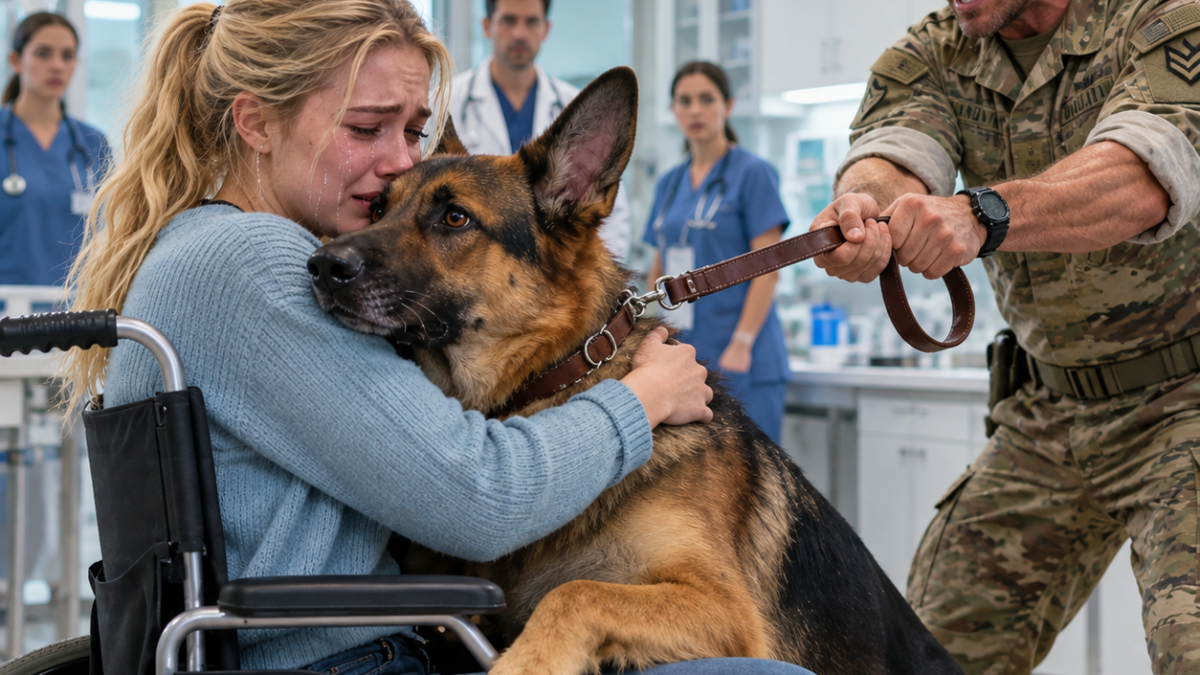
She looked at him. She was very familiar with what he was doing.
She had a clinical name for it now, one she’d found in a paper she’d read around month four.
Anticipatory grief induction, the practice of preemptively walking a patient through the emotional experience of a loss that hadn’t yet occurred, framed as preparation, which in practice functioned as a ceiling being installed over the patient’s head.
Dr. Hol, she said, has Sandra indicated that my progress has stalled?
not stalled. But have my most recent sensory tests shown regression?
They haven’t.
But then I’m going to go ahead and keep my Northstar where it is, she said.
And I’d appreciate it if you’d update my file to reflect that I’ve been informed of the range of outcomes and have elected to continue current protocol.
A silence.
Holt’s expression did a specific thing that she recognized.
the micro compression of a man who had not expected to be handled and was reorganizing around it.
Of course, I’ll note it.
She started moving toward the door.
The dog, he said, “I heard there was an incident in the lobby yesterday.”
She stopped with the military animal and some of our other patients. He managed to make some of our other patients sound like a neutral category.
I want you to know we take that kind of situation very seriously. Which kind of situation? She asked.
Tension, conflict.
It’s not a healthy environment for rehabilitation.
She turned around. Garrett called me a burden to my face in the waiting room. The dog stood between me and him.
I’m not sure what part of that constitutes an incident I need to be concerned about.
Holt was quiet.
If Garrett’s behavior is what’s being addressed, she said, I don’t have a problem with that process.
If the dog’s behavior is what’s being addressed, he positioned himself between a patient and an aggressive individual without contact, without vocalization, and without any injury to anyone.
So, I’d also like to understand what aspect of that was problematic.
Another silence. Holt put his reading glasses back down over his eyes.
We’re just monitoring the situation, he said.
Great, she said.
I’ll see you next month.
She went back to the elevator, pressed the button, waited. Her hands were steady. Her chest felt like something was sitting on it.
Not hard enough to matter, but present. The elevator opened. She went in.
Downstairs in the PT wing, Logan was at the end of his session. Sandra putting him through what looked like a cable resistance sequence for the shoulder.
Logan moving through it with the focused discomfort of a man who did not enjoy being limited by his own body and was doing something about it. Rex was positioned near the door.
He tracked Amelia when she came in. She sat near the window, got out her book, did not read it. After a while, Rex got up and walked over to her.
He didn’t ask anything.
He just stood next to her chair and let her put her hand on his back and they both watched the rain on the window. Bad meeting? Logan asked from across the room.
Monthly evaluation, she said. Holt, you know him?
Logan’s expression said that he’d been in the clinic long enough to form opinions.
He told me Rex was a liability in the clinical environment first day. What did you say?
I said Rex had three combat deployments and four commenations and had never bitten anyone who wasn’t actively trying to kill an American service member.
How’d that land?
about as well as you’d expect.
He rotated the shoulder carefully, grimaced. He backed off. Sandra handed him a resistance band.
Again, he did it again. Amelia watched him work.
There was something in the way he moved through pain that was different from the way most people in the clinic did. Not absence of pain.
She didn’t think it was that, more like a negotiated relationship with it.
He knew where the edges were and he worked up to them.
And then he backed off and came back and he didn’t flinch and he didn’t comment on it and she found herself calibrating something against that picture without quite being able to name what she was calibrating.
“What was the third deployment?”
she asked.
“Condar.”
Sandra looked up. Logan was quiet for a moment.
“Long.”
“You don’t have to.”
Um, “It was a 14-month rotation,” he said.
“Extended twice.
Rex was with me the whole time. He changed hands on the resistance band.
He located seven IED placements in the first four months.
Cleared forward positions before entry on I don’t remember exactly.
A lot of times he said it the way he said most things without decoration like the number was too large to make small by surrounding it with language. Is that where he got the shoulder scar?
She asked. Logan looked at Rex.
No, that was earlier. He got between me and a guy with a knife in a compound outside Kandahar.
Knife was meant for me. A pause.
He’s fine.
Muscle healed clean, but he he stopped. He remembers it, Sandra said quietly.
Yeah, Logan said. He remembers things.
Rex’s tail moved once, then went still.
Amelia thought about that, about what it meant to be a body that carried its history in specific ways. A scar above a joint, a flinch at certain sounds, a decision made in a lobby without waiting to be asked.
She thought about the way her own body held the accident, not in the place where the injury was, paradoxically, because that place was mostly quiet now, but in her hands, which sometimes shook for no mechanical reason, and in the base of her throat, which closed when she was not expecting it. He remembered me, she said after 5 years and three deployments and everything.
Logan looked at her.
Yeah, that’s She didn’t finish the sentence because she didn’t know how.
I know, he said. She looked at her hands.
Can I ask you something? Logan said.
Sure. The accident. You said you were in Billings, were you?
He stopped.
Sorry, that’s not passenger in a car.
She said drunk driver intersection. She had this down to a sequence of facts she could deliver without much attached to them. 18 months ago.
Who was driving? Odd question.
A friend.
She uh she’s fine.
Minor injuries. Are you still in contact?
She looked at him. Why?
He was wrapping the resistance band around his hand slowly, not looking at her. No reason.
I was just He stopped again.
I’ve got a habit gathering information.
Occupational hazard. Sandra said mildly. She moved to Portland.
Amelia said, “We it got complicated after.”
Logan nodded like he understood something about things getting complicated after. And she suspected he probably did.
Rex put his head on her knee. She put her hand on his ear, that specific warm velvet fold of it, and he pressed up against her palm, and his eyes went heavy-litted. And for a moment the PT wing, with its lenolium and its fluorescent lights, and its faint aniseptic smell, became a place where something very old was being quietly settled between two creatures who had found each other on the wrong side of too much time.
Then the door opened. It was Phil from reception. He was holding a piece of paper with the expression of a man who did not want to be the one delivering its contents.
Ms. Carter, he said, Dr.
Holt asked me to. He wanted you to have this before you left today. He held the paper out.
She took it. It was a formal letter on clinic letterhead.
She read the first paragraph, then she read the second. By the third, she had the specific, very controlled sensation of standing at the edge of something that had been coming for a while. and had finally arrived.
The letter stated that effective the following Monday, her PT sessions would be reduced from 5 days per week to three, citing she read the exact phrase twice, progress plateau assessment and resource reallocation in the interest of optimizing patient outcomes across the clinic roster. 7 months in, without a conversation, without warning, without asking her. Logan had stopped moving.
He was reading her face.
“What is it?”
he asked. She folded the letter precisely in thirds and put it in her bag.
“Progress plateau assessment,” she said.
The room went quiet. Rex lifted his head from her knee and looked at the door Phil had just come through and then back at Amelia, and something in his posture shifted.
The same gathering readying quality she’d watched him move into yesterday in the lobby.
“He can do that?”
Logan asked, just unilaterally.
“Apparently,” she said.
She picked up her thermos, screwed the cap on. The motion was mechanical and precise and used up some of whatever was pressurizing inside her chest.
I’m going to need to make some calls, she said.
She started moving her chair toward the door, and she was aware of Rex getting up and following her.
Not because Logan told him to, because he hadn’t, but because Rex had made another unilateral decision in a room where the exits mattered.
and his decision, as it had apparently been for the better part of 5 years and three deployments and more distance than she could measure, was to stay close to the person who needed covering. The calls took 3 days and accomplished almost nothing. Amelia had made them from the kitchen table of the apartment on Elm Street in the evening with the overhead light on and her coffee going cold beside her laptop.
She’d called the clinic’s patient advocacy line, a recording call back within five business days.
She’d called the main administrative number and been transferred twice before reaching a woman named Denise, who was very sympathetic and completely unable to help.
She’d looked up the Montana Department of Public Health and Human Services complaint process, which involved a form, a waiting period, and a review timeline of up to 90 days.
90 days. She set her phone down and looked at the ceiling. The letter had been precise and bureaucratic and insulated from argument by its own language.
progress plateau assessment. The phrase was designed to sound clinical, objective, like something produced by measurement rather than decision.
She understood the mechanism. Holt had built a frame around her progress and then pointed at the frame and called it evidence.
Three sessions a week instead of five meant slower recovery. Slower recovery would eventually confirm the assessment. The assessment would then justify further reduction.
She understood it.
That didn’t mean she could stop it.
What she had practically was two options. Find a different clinic or fight the decision through channels that moved at a speed that would make the fight irrelevant before it concluded.
There was a third option that she didn’t spend much time on.
Accepting it, but it kept appearing at the edges of her thinking the way things did when you were tired enough. She was tired enough. On Sunday evening, Carol came over.
Carol was her mother’s younger sister, 61, a former ER nurse who had retired early due to a back problem of her own, and now made and sold handmade quilts online, and kept a kitchen garden, and had the particular brand of steady, practical love that Amelia had come to depend on in ways she rarely said out loud.
She brought soup and bread from the bakery on Fifth, and sat across the kitchen table, and listened to the whole situation without interrupting.
When Amelia finished, Carol said, “What does your PT say?”
Sandra can’t counter Man Holt.
He’s above her in the structure.
What does Sandra say off the record? Amelia was quiet for a moment.
She said she didn’t agree with the assessment.
That’s something.
It’s not enough.
Carol tore a piece of bread, ate it, and the man with the dog. Logan, what does he say? Amelia had not told Logan about the calls.
She’d told him about the letter on Friday afternoon in the corridor of the PT wing, and he’d listened with that particular quality of attention he brought to things.
Fully present, nothing filtered out.
And then he’d said he was going to make a call of his own, and she’d told him not to, and he’d looked at her in a way that suggested he’d heard her and would make his own determination on the matter.
“I don’t know what he’s doing,” she said.
“OL handed her the soup.
Eat. She ate.
He came back, Amelia. Carol said.
She looked up. The dog. Carol was looking at her with the calm, clear gaze of a woman who had spent 20 years in emergency rooms and had developed an economy with sentiment that made the sentiment she did express carry significant weight.
After everything, he came back.
That’s not exactly I know it’s not a plan.
I’m not saying it’s a plan, but Carol folded her hands around her own bowl.
I’m saying it’s something and you should let it be something instead of reducing it to a logistics problem.
Amelia looked at the soup.
I’m not reducing it.
You’ve been on the phone for 3 days trying to build a case file.
Someone has to.
Yes, Carol said, “And it’ll keep for tonight.”
Uh, then Monday came with hard frost and a sky the color of old pewtor. Amelia arrived at the clinic at 8:40 as she always did.
Gerald had been quiet again, which she appreciated. The frost had whitened the parking lot, and the ramp had a thin skim of ice that she navigated carefully, testing her front wheels before committing her weight. The lobby was already populated.
Phil at the desk, a few patients in the waiting chairs, the vending machine humming its quarterly complaint. Rex was in the corridor. He was sitting outside the PT wing the way he had been on Friday morning, upright and formal.
But this morning, there was something different in his posture, a readiness that hadn’t been there before, or that she hadn’t been tuned to notice.
His ears were slightly forward. His eyes found her at the lobby entrance and held. Logan was on the bench.
He had two paper cups. She came down the corridor.
“I told you I have a thermos,” she said.
“You do,” he said.
And yet he held out the cup. She took it.
What did you do? I made a call.
Logan to the clinic director, not Hol. Marlene Chver.
She stopped. Chver runs the whole facility.
Yes, she’s above Holt.
By two levels, Logan said. She looked at him.
What did you say? I said I was a patient here and that I had concerns about the quality of care being provided to another patient and that those concerns were specific and documented and that I would like an opportunity to present them in a formal review context. He drank from his own cup.
I also mentioned that I had previously worked in environments where documentation of procedural irregularities tended to move quickly once the right people were paying attention to them. Did you threaten her?
I stated facts. The conclusion she drew from them was her own. Amelia looked at the ceiling.
Logan, she’s meeting with you at 10:00.
She brought her eyes back down. What?
She called me back Saturday afternoon. The meeting is at 10:00.
Her office, third floor. He set his cup down on his knee. You can be angry about it later.
For right now, you need to know what you’re walking into, and I have 40 minutes to get you ready.
She stared at him. Rex put his nose on her knee.
He agrees,” Logan said.
She looked at the dog, then back at Logan.
I don’t need you to.
I know you don’t need me to.
He said it straightforwardly. No edge in it.
You’ve been handling this alone for 7 months and you’ve been handling it well.
I’m not suggesting otherwise.
A pause.
I’m suggesting you don’t have to handle this particular thing alone.
and that there’s a difference between not needing help and not taking it when it’s available.
A long moment. What do I need to know? She said.
He reached into the side pocket of his cargo pants and produced a folded sheet of paper. Sandra gave me her session notes from the last 3 months.
Off the record, every measurable marker, proprioceptive response, voluntary motor activation, standing tolerance, they’re all trending positive.
Some of them are trending significantly positive. He held the paper out.
Holt’s assessment conflicts with Sandra’s documented findings.
That conflict is either an error or a decision. Either way, Chver needs to hear it from you directly. She took the paper, read it.
She was familiar with most of the numbers. Sandra had shown her versions of these findings in session. But seeing them arranged this way in sequence with the trend lines visible, it was different.
It was a rebuttal. It was exactly the kind of document that could not be answered with progress plateau assessment.
She documented all of this.
Amelia said, “Sandra Reeves has been a PT for 26 years and she knows what she’s looking at.”
Logan said she also knows what it looks like when an assessment doesn’t match the data.
Amelia folded the paper, put it in her bag. She was aware of something realigning inside her.
Not hope exactly because she’d learned to be careful with hope, but something structural, a correction.
Thank you, she said. He nodded once.
Don’t do it again without asking me first, she said.
Understood.
Rex’s tail moved.
The meeting with Marlene Chver lasted 47 minutes.
Chver was a small woman in her early 60s with silver hair cut practically short and reading glasses she kept taking on and off with the focused energy of someone who processed information at a speed that most rooms couldn’t keep up with.
Her office on the third floor had a window that looked out over the parking lot in the ridge beyond it, and she sat behind a desk that was covered in organized stacks of folders in a way that suggested a system only she fully understood. Holt was there, too.
She hadn’t expected that.
She should have, of course, Chver would have told him, but she hadn’t anticipated sitting across from him in the same room, and the first 30 seconds were a recalibration exercise she managed with varying success.
Holt sat to the side, slightly back from the desk, with his tablet on his knee, and his expression carefully neutral. He looked like a man who had been asked to attend a meeting and had decided correctly that the best strategy was to occupy as little space as possible.
Chver did not waste time.
Miss Carter, uh, I’ve reviewed the letter Dr.
Hol sent on Friday.
I’ve also reviewed Commander Hayes’s concerns and I’ve looked at your session history.
Tell me what you want to tell me. Amelia told her. She was precise and specific, and she did not editorialize.
She laid out Sandra’s documented findings against Holt’s assessment.
She described the timeline, the letter arriving without a prior conversation, without a formal review meeting, without any documented process being followed. She was careful with her language.
She did not say, “He wants me gone.”
Even though that was the sentence that lived underneath everything else she said, she let the documents do it. When she finished, Chver looked at Holt.
Holt said, “The assessment is a clinical judgment.
I stand by the methodology.
Your methodology conflicts with Sandra’s documented findings, Chver said.
Sandra is a PT. Her scope her scope includes measuring the exact markers you claimed had plateaued.
Chver said her tone hadn’t changed.
It didn’t need to.
Can you walk me through the specific data points you used? A pause.
Not long. Long enough.
I can prepare a detailed response.
I’d like to hear it now.
The specific data points it emerged over the next 12 minutes were thinner than the letter had implied.
Holt’s assessment had waited a single evaluation session over Sandra’s cumulative 3 months of data.
There was no written protocol requiring that. There was no documented rationale for the waiting.
There was Chver noted at one point looking at her screen no second opinion obtained before the letter was issued. Holt was not a stupid man. He knew what was happening.
He didn’t fight it.
He retreated into procedure, into language about individual physician authority and clinical judgment, which were real things that carried real weight. Chver knew that, too. The meeting was not going to produce a reversal on the spot.
That wasn’t how these things worked.
But at the end of it, Chver put her glasses back on and looked at Amelia and said, “Your sessions will continue at 5 days per week pending a formal review of the assessment protocol.
That review will include Sandra Reeves and an independent evaluator. It will be completed within 30 days.
Amelia said, “Thank you.”
She was out of the elevator and back on the ground floor before she let herself breathe all the way out.
She told Logan in this parking lot beside Gerald’s van.
He listened, nodded.
30 days is enough time for the independent eval to confirm what Sandra’s numbers show.
“Yes,” she said.
“Holt’s going to be careful now.
He knows someone’s watching.
That’s all I needed, she said.
Just someone watching. Rex sat beside her chair in the wet cold of the parking lot, pressed against her wheel, and Logan stood with his coffee and the frost whitened asphalt around them and the ridge in the near distance that was just beginning to catch the first angle of the late morning sun.
“Why did you do this?”
she asked. He considered the question with the seriousness it apparently deserved. because it was the right call.
He said, “You didn’t know me 3 days ago.
I knew enough.”
She looked at him. He looked at Rex.
He made a judgment call in that lobby. I trust his judgment.
A pause most of the time. Rex looked up at Logan with the expression of a dog that was aware he was being discussed and had opinions about it.
She almost smiled. Bad. The weak moved differently after that.
Not faster, not easier, but differently. The way terrain changes when you know someone is watching the perimeter.
She still went through the same motions. Gerald in the country station, the ramp, the lobby, the PT wing, Sandra, and the exercises that were still hard and sometimes dispiriting and always exhausting.
But something had shifted in the geometry of the place. Holt passed her in the corridor on Tuesday and said nothing, which was not unusual, but the texture of his silence had changed. The reception staff were slightly, almost imperceptibly, warmer.
Phil said, “There she is at the same volume, but with a different energy behind it.”
Sandra, for her part, said nothing about the meeting. She did, however, add 15 minutes to their standing frame session on Wednesday.
And when Amelia said her legs were shaking, Sandra said, “Good.
” In the tone of someone who had been waiting to be allowed to push harder.
Rex was in the wing every day. He had settled into the space with the ease of an animal that had decided somewhere in his operational history that the best way to function in a new environment was to understand it completely.
And he had applied that approach to the Bridger Rehabilitation and Recovery Center with thoroughess. He knew where Sandra kept the resistance bands.
He knew which patients were nervous around him and gave them extra distance. He knew that the vending machine made a specific sound at 11:15 when it cycled, and he knew it was not a threat.
He had also developed what appeared to be a particular opinion about the PT wing’s lenolium floor.
He preferred the section near the window where the light came in, and he returned to it between sessions with the deliberateness of a being executing a personal preference. He stayed near Amelia when she was in the building.
Not always close. Sometimes he was across the room or out in the corridor or sitting near Logan during the shoulder sessions. But she was aware that he was always positioned such that if she moved, he could track her.
And that awareness did something she couldn’t fully articulate, filled in a kind of peripheral silence that she hadn’t noticed the shape of until something had moved into it.
On Wednesday afternoon, she stayed late. Sandra had gone. Logan had finished his session and was in the administrative wing for something.
Amelia was doing a solo standing frame set. She had a protocol she could run independently, basic weightbearing practice, and she preferred to do it alone when she could because the quality of her concentration was different without an audience.
She locked her chair, positioned the frame, got her hands on the bars. The first two repetitions were standard, controlled rise, hold, controlled descent. Her left leg, which had been the more responsive since the early months, cooperated.
Her right leg, which had its own timeline and didn’t consult her about it, offered approximately 60% of what she asked of it.
The third repetition she held longer, counted out a 30-second static stand, feeling the complex negotiation between the frame and her arms and her nervous system and gravity, which remained entirely indifferent to anyone’s recovery goals.
On the fourth repetition, something different happened. It started in her left foot, a sensation that she had been chasing for 7 months. The way you chase something in peripheral vision, always slightly off to the side, always disappearing when you looked directly at it.
Pressure, not pain. Pressure like the floor was pushing back against her foot, like there was a conversation happening between the sole of her shoe and the surface beneath it.
She’d had hints of this, fragments.
She had learned to be careful about them, to note them and report them to Sandra and not build anything too heavy on them because the nervous system at T6 incomplete was not a reliable narrator. But this was longer than a fragment.
She stood there in the empty PT wing with the gray afternoon light coming through the window and held the sensation for as long as it lasted, 43 seconds. Then it faded.
She got back in her chair. Her arms were shaking.
She’d been on the frame longer than she’d intended.
She sat there breathing and looking at the floor, and she did not perform any particular emotional response to what had just happened because she was alone, and there was no performance required, and what she actually felt was something too specific and too large and too fragile to be handed a name right now. Rex appeared in the doorway. He crossed the room and sat in front of her chair, put his chin on her knee, looked up at her.
“Hey,” she said.
His tail moved once.
“I felt it,” she said.
“Just for a minute.”
His chin pressed slightly heavier on her knee. A response.
She put her hand on his ear, the warm velvet fold of it. She had been doing this for days now, reaching for this specific texture the way other people reached for a phone or a familiar mug, something that occupied the hand when the mind was working on something else.
Don’t tell him, she said.
Rex looked at her. I mean it. Not yet.
He made a low sound in his throat. Not quite a word. Something that occupied the space where a word would go.
She was still sitting there when Logan came back. He read the room the way he read most things, quickly without announcing it.
He looked at her face and then at Rex and then at the standing frame, which was still positioned where she’d left it, and something moved in his expression that he didn’t comment on.
Done for the day? He asked.
“Yeah,” she said.
He called Rex with a gesture, and Rex got up, but he put his nose on her hand first before he moved. One firm press.
She kept her hand open after he stepped away. But Thursday morning, the situation with Garrett came back. She had not thought about him much since the lobby.
He was there in the clinic. She was aware of that. She saw him in the corridor sometimes, and he always looked somewhere else now, which was its own kind of acknowledgement.
But he was not, she had decided, someone she needed to allocate significant attention to. She revised that assessment at 9:15. She was in the PT wing doing a Matt session with Sandra.
Logan was in the secondary room off the main wing, a smaller space used for individual sessions with Rex. The main wing had several other patients.
Dale with his knee, a teenager in a neck brace working with one of the junior PTs, and two people she didn’t know well doing upper body work near the window.
Garrett came in at 9:15 with a different energy than usual. She noticed it peripherilally.
The way he moved through the door, the set of his shoulders, the specific expression on his face that was not the usual dissatisfied performance, but something more pressurized. He had a support brace on his lower back, which was standard.
And he went to his usual area near the cable machines, and for the first few minutes, it was normal. Then he started talking, not to her.
He wasn’t even looking at her.
He was talking to one of the men doing upper body work nearby, a man she’d seen him talk to before.
Similar category, similar frequency. The conversation was low, but not quiet with a particular volume that was calibrated to Carrie.
Whole review thing is a joke.
Chver doesn’t know what she’s doing.
Holt’s a good doctor and they brought in some outsider who’s never been in a clinic context.
The man said something she couldn’t hear.
just because she made a complaint and now everyone has to deal with Sandra’s hand on her shoulder.
Not pressure, just contact.
Don’t.
Amelia focused on the exercise. Whole vibe of this place has changed since the wheelchair got here. She heard Sandra take a breath.
Saw Dale across the room set down his resistance band with a controlled deliberateness.
“Garrett,” Sandra said.
Her voice was level and final, and she did not look up from what she was doing.
That’s your first warning.
I’m having a private conversation.
You’re having it at a volume that guarantees it isn’t private.
A brief silence.
Then Garrett said, “Lower, whatever.”
It didn’t stop.
It just went underground. Muttered, angled away.
Plausibly deniable. She caught fragments. Situation.
Special treatment. Dog in a medical facility is already insane.
She stopped trying to hear specific words and focused instead on Sandra’s voice, counting through the exercise and the feeling of the mat under her palms and the work in her arms.
Then the door to the secondary room opened. Rex came out first. He had heard something.
That was the only explanation.
His hearing was acute, and he had been in the building long enough to catalog the acoustic signatures of the main wing, and something in the room’s sound profile had reached him through a closed door and told him something was wrong.
He stood in the
doorway, ears forward, amber eyes moving. They found Garrett. They moved to Amelia.
They moved back to Garrett. Logan appeared behind him in the doorway.
He assessed the room in approximately 3 seconds. Amelia could see the calculation happening, not visible in his expression, which remained even, but in the adjustment of his posture, the small shift of his weight.
“Rex,” he said quietly.
Rex did not move toward anyone.
He went instead to the center of the room and sat down precisely in the middle of the space between Amelia’s mat and Garrett’s station.
He sat with the upright formality of a dog that had decided that presence was sufficient, and he looked at nothing in particular, and he was 200 lb of trained military animal positioned such that everyone in the room was acutely aware of where he was. The room went quiet. Logan came in and sat on the bench near the door.
He did not say anything to Garrett. He did not say anything to anyone.
He sat with his elbows on his knees and watched the room with the same professional attention he brought to every environment he occupied.
Garrett’s conversation had stopped.
She kept doing the exercise. Sandra counted.
The junior PT on the other side of the room resumed working with the teenager in the neck brace. Dale picked his resistance band back up. For 12 minutes, nothing happened.
Then Garrett, collecting his gear to leave, walked past the mat where Amelia was working. He stopped.
She could see his feet, the specific planted stance of a man deciding whether to say something he’d been suppressing.
“You think this changes anything?”
he said. She looked up.
His face was controlled, but just.
“You think getting Chver involved, getting your your Navy buddy to make calls, you think that fixes anything?”
His jaw was tight.
You’re still in that chair.
That’s not changing.
The room was very still. Rex turned his head and looked at Garrett. Logan on the bench looked at Garrett.
Dale looked at Garrett. Sandra stopped counting.
Amelia held Garrett’s gaze.
She was aware of her own heartbeat. The thing that was happening in her chest was not what she might have predicted.
It wasn’t anger exactly, or at least not only anger.
It was something cleaner than anger. Something that came from the place where you stop defending and start knowing.
You’re right, she said.
He blinked.
I’m still in this chair.
And in 45 minutes, I’m going to wheel it out to that parking lot and go home and be back tomorrow and the day after.
She held his gaze.
And you’re going to keep coming in here with that same brace and that same bad back and that same everything.
and nobody’s fixing anyone today.
So, a long silence.
Something moved in Garrett’s face that she had not seen there before.
Not softening, nothing as clean as that, but a fractional disorientation like a man who had brought a specific tool for a specific job and found the job had changed shape. He left. Nobody said anything for about 30 seconds.
Then Dale said from across the room, “Well,” and somehow that was exactly right.
The single word dropped into the silence like a stone into water, and the rings from it moved out to the edges of the room, and then it was just a Thursday morning in a PT wing, with the frost on the parking lot outside the window, starting to melt in the late morning sun, and Sandra’s voice picking the count back up where she’d left it.
Rex walked back to his spot near the window.
Logan was looking at Amelia with an expression she hadn’t seen on him before and couldn’t fully read.
Not impressed, that wasn’t quite it.
Something more like recognition, like a man who had looked at a thing from one angle for several days and had just understood what he was actually seeing. She went back to the exercise, her arms held, her left foot against the mat was doing something.
She didn’t say anything.
She breathed through it. She counted with Sandra.
She felt the pressure, real, insistent, specific, against the surface beneath her.
And she held it inside herself like something that hadn’t happened yet, like something that needed more time before it could be what it was.
41 seconds, then 42.
Then Sandra’s voice.
Amelia. She looked up. Sandra was looking at her legs.
Her face had the specific quality of a clinical professional encountering data that reorganizes the frame.
Your right foot,” Sandra said.
Amelia looked down. Her right foot was pressing against the mat. Not fully, not a clean movement, but pressing.
Her toes curled slightly against the surface. The tendon along the top of her foot raised, the ankle making a minor, fractional, imperfect, completely unmistakable adjustment. It stopped after a moment, but it had happened.
Logan stood up from the bench. Rex lifted his head. Sandra took her glasses off and put them back on and pulled out her phone and opened her documentation app with the precise movements of a woman making sure she captured what had just happened before the atmosphere in the room made her doubt it.
I need to document this right
now, Sandra said, and her voice was completely steady and gave nothing away except that her hands were moving slightly faster than usual. Amelia looked at her foot.
The PT wing was quiet around her. The frost outside dissolving into the morning and the wait of seven months and 47 minutes with Chver and three days of phone calls and one lobby and one ditch in the rain all sat somewhere just behind her sternum. Not resolved, not finished, not anything as simple as that, but present.
Real. She pressed her foot against the mat again.
Nothing. She waited.
She pressed again and the floor pushed back. Sandra documented it in real time. thumbs moving across her phone screen with the focused precision of someone who understood that the window between an event and its official existence was narrow and needed to be closed immediately.
Voluntary motor activation, right ankle dorsif flexion, she said aloud as she typed it, the clinical language landing in the room like something solid. Duration approximately 4 seconds.
Repeatable. She looked up.
Do it again. Amelia looked at her foot. She pressed.
The floor pushed back. The toes curled.
The tendon rose along the top of her foot in that fractional, imperfect, entirely real way. Sandra typed faster.
Logan was standing near the bench with his arms crossed and his weight forward on the balls of his feet, which she had come to recognize as his version of attentiveness. The body position of a man whose default state was operational and who expressed interest through readiness rather than leaning in.
Rex had gotten up from his spot near the window and walked to the edge of the mat where he stood watching her foot with the same focused attention he brought to everything he monitored.
“How long has this been happening?”
Sandra asked.
“Yesterday,” Amelia said.
In the standing frame, I didn’t I wasn’t sure it was real.
Sandra looked at her over the top of her phone.
“Why didn’t you tell me?
I’m telling you now.
Yesterday, Amelia, I didn’t want to report something that wasn’t reproducible.
Sandra made a sound that was not quite agreement. She typed another line.
Right. Okay. The standing frame session yesterday.
How long did the sensation persist? 43 seconds the first time.
43. Sandra stopped typing, looked at her.
That’s not a fragment.
That’s not a flicker.
43 seconds of sustained proprioceptive return is she stopped herself, put the phone down, picked it up again. I need to call the independent evaluator today. Not in 30 days today.
The review The review is already scheduled.

