A Navy SEAL Stayed Awake for Five Motherless Dogs and Found His Daughter Again – Part 2
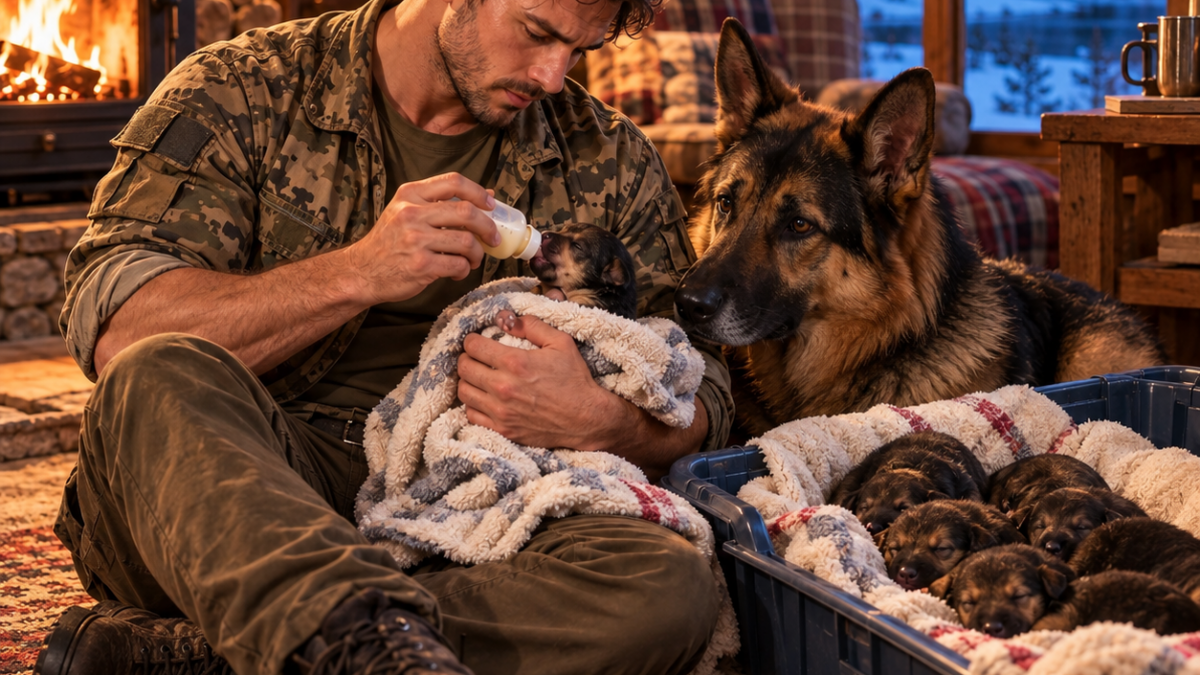
She took the puppies one by one, checking weight, hydration, breathing, and temperature. Her hands were firm but gentle, moving with the certainty of a person who had spent years translating what animals could not say.
River had gained a little. June was steady.
Milo had gained the most, which surprised no one. Ash remained quiet but warm. Pip had gained less than Mara wanted, but he had gained.
Still fragile, she said, touching Pip’s side lightly.
But not worse. Anson let out a breath he had not realized he was holding. Then he showed her the photos of the label.
Mara’s mouth flattened.
Missouri, she said. That mean anything?
It can mean plenty. Or nothing.
There are reputable breeders there. There are also large commercial operations that move dogs through brokers. She scrolled through the photos on his phone, frowning.
Show me the crate. In the examination room, under better light, Mara inspected the puppies again, not as patients this time, but as pieces of a pattern.
She leaned close to River’s ear, then June’s.
On the inside rim of River’s left ear, nearly hidden beneath soft fur, was a faint line of dark ink.
Not a tattoo carved into skin. More like a temporary lot mark that had bled into the fuzz.
June had one, too. Mara took a small light and checked Milo, Ash, and Pip.
No clear marks on the others. Then she examined the bedding Anson had saved from the crate.
In a fold of the damp thermal blanket, caught in a seam, she found a softened paper band no bigger than a child’s bracelet.
most of the print had washed away but a few characters remained they matched the visible part of the shipping label mara did not speak right away that was how anson knew she had found something worse than a guess these puppies didn’t wash out of somebody’s back yard she said at last Not with this.
Anson looked at the paper band in her gloved hand. What are you saying?
I’m saying they look like part of a sorted transport batch.
Too young to be where they were, too young to be away from their mother. And if they were in legal care, someone should be able to explain the label, the band, and why a crate with five pups ended up in flood debris. Rook, from his place near the wall, gave a low sigh.
Mara glanced down at him. Yes, Your Honor, that is the professional opinion.
Despite himself, Anson almost smiled. Then he remembered Duane calling them property. The smile disappeared.
Mara placed the paper band in a small evidence bag from her office supplies and labeled it with date, time, and where it had been found. She did not make a ceremony of it. That made it feel more serious.
You need Nora, she said. Nora called well.
She knows rescue paperwork better than anyone within three counties, and she hates fake rescue papers the way Baptists hate wet hymnals. Colorful.
She’s earned it.
Nora Caldwell’s rescue sat at the edge of town on a patched piece of land behind an old feed warehouse.
The sign read, Caldwell’s Second Chance Animal Rescue, hand-painted in green and white, with paw prints marching along the bottom.
The place was not pretty. It was too full, too loud, too tired, but it was clean in the way that mattered.
Bowls had water. Pens had blankets. Dogs barked with the offended hope of creatures who still believed humans might improve.
Nora came out of the main building carrying a clipboard under one arm and a roll of paper towels in the other. She was 44, wiry, with short black curls escaping a plastic clip and a rescue logo hoodie covered in enough dog hair to qualify as insulation.
Her eyes were green. quick and sharper than her tired smile suggested.
If this is about the goat in my laundry room, she said before Anson spoke, I’m not discussing it without legal counsel.
Anson glanced at Mara. Mara shrugged.
Told you not to ask? Nora waved them into a small office that smelled of coffee, disinfectant, and dog biscuits.
A bulletin board on the wall held adoption photos, vaccination reminders, and a child’s drawing of a three-legged hound wearing sunglasses.
Anson laid Duane’s papers on the desk.
Nora’s humor faded as she read.
Bright Mercy Animal Rescue. Her fingers stopped halfway down the first page. Where did you get this?
Man named Duane Tully brought it to the lock, said he represented them.
Nora’s face changed color, not dramatically.
not like a woman in a movie, but slowly, as if something cold had entered the room and settled behind her eyes. Bright mercy used to exist, she said. Dr.
Harold Venn’s group.
Small operation. Mostly older dogs.
Medical cases. Owner surrenders.
Harold did more good with two kennels and a station wagon than most people do with grant money. Used to? Anson asked.
Nora looked at him. Dr.
Venn died last year. Mara, standing behind Anson, went still.
Nora turned the contract around and tapped the signature line. This is dated two months ago.
There are moments when a lie stops being paper and becomes a living thing in the room. Anson stared at the signature.
Harold Venn. Dark ink. Confident slope.
A dead man’s name pretending to walk.
Nora pulled open a drawer, rummaged through folders, and produced an old brochure for Bright Mercy.
on the back was a scanned thank you note signed by dr venn years earlier the letters were similar enough that a careless eye might accept them different enough that nora’s face hardened with each second this isn’t right she said But Evelyn should see it.
Evelyn, his daughter. The drive to the old Venn Clinic took 15 minutes along a two-lane road lined with sycamores and wet ditches bright with spring weeds.
Anson followed Nora’s truck while Mara rode with him, the evidence bag on her lap.
Rook stayed in the back seat, nose toward the cracked window, ears tuned to everything. The former clinic stood behind a white fence, its sign faded but still readable.
Venn Animal Care. The building had the quiet look of a place people still respected too much to disturb. Behind it sat a small house with cream siding, a narrow porch, and wind chimes made from old rabies tags that tinkled softly in the damp breeze.
Evelyn Venn opened the door before Nora could knock twice. She was 58, slender, with gray-brown hair pinned in a low bun and a cardigan the color of oatmeal. her face was gentle but tired around the eyes the way people look when they have learned to keep grief folded neatly so visitors will not trip over it nora she said Is this about Dad?
Nora’s expression answered before her voice did.
Evelyn let them in. The front room held shelves of labeled boxes covered with white cloth, not abandoned, preserved. On one wall hung a photograph of Dr.
Harold Venn kneeling beside a golden retriever with a graying face. He had kind eyes and the slightly rumpled look of a man more comfortable with animals than ceremonies.
Anson felt a strange discomfort standing there in his camo shirt, muddy boots carefully placed on the mat, carrying someone else’s trouble into a house that already knew loss.
Evelyn read the contract slowly. When she reached the signature, she did not gasp. She did not weep.
She placed one hand flat on the table and kept it there.
That is not my father’s signature, she said.
Her voice was calm enough to make the sentence heavier. She left the room.
and returned with a tin box. Inside were old veterinary licenses, letters, checks, and adoption agreements signed by Dr.
Venn.
She laid three originals beside Duane’s contract.
Even Anson could see it then. The real signature had a slight hesitation before the V, a loop in the H, a downward pull at the end, as if Dr.
Venn’s hand always remembered gravity.
The contract signature was smoother, too smooth. a copy made by someone who had studied the shape but not the soul evelyn touched the old papers my father spent thirty years trying to make sure unwanted dogs were seen as lives not leftovers she said if someone is using his name to move animals like inventory She stopped, swallowing the rest.
Anson thought of Lena’s name on Rook’s tag.
How the dead could still be held, gently. How they could also be used.
I’m sorry, he said.
Evelyn looked at him then. Do not be sorry yet, Mr. Pike.
Be careful. Whoever did this counted on people being too busy, too tired, or too trusting to check. Anson looked down at the forged signature.
Too busy. Too tired.
Too trusting.
He thought of the alarm ringing every two hours of Hattie asking him to read Pip’s name from the notebook of Duane’s clean shoes in a muddy lot.
I can do careful, he said. By afternoon, the matter had grown beyond the circle of a lock operator, a vet, a rescuer, and a grieving daughter. Brynn Sutter met them in a small conference room at the County Agricultural Extension office.
She was 37, tall and spare. with dark bobbed hair tucked behind one ear and eyes that seemed to sort the world into columns before she ever touched a pen her navy utility jacket was plain her badge clipped inside it flashed only when she moved she did not greet the evidence with outrage that reassured anson outrage burned fast Brynn looked like a woman built for slow fires.
She arranged the copies in order.
Duane’s contract, crate photos, shipping label images, the paper band, Mara’s notes, Evelyn’s signature samples, Anson’s feeding log, and photos from the morning the puppies were found.
Tell me what you know, she said. Anson did.
He did not embellish. He did not guess.
He described the flood debris, the crate, the visible label.
Dwayne’s visit, the paperwork, the puppy’s condition.
When he finished, Brynn asked three questions that sounded alike but were not. Then she wrote something in blue ink. Do not contact Mr.
Tully, she said.
I wasn’t planning to.
Do not let him bait you into a conversation that is not documented. Anson nodded.
Do not turn over the animals unless directed through a verified legal channel.
Wasn’t planning that either.
Brynn looked up. And do not investigate this yourself.
Rook, lying beneath the conference table because no one had successfully told him he could not come in, huffed. Brynn glanced down. Your counsel objects?
He objects to most things, Anson said. For the first time, Brynn almost smiled. Then her expression settled again.
Your job is to keep the puppies alive and keep clean records. The evidence can speak if no one smudges it.
The phrase stayed with Anson. Let the evidence speak. He had spent years distrusting speech.
Words had failed him in hospital rooms, at gravesides, on the front porch, when Hattie asked why he had to leave so soon. But evidence was different. Evidence was a thing that had survived the flood.
A label under a crate.
Ink on a dead man’s name.
A paper band caught in a blanket. Feeding times written in a notebook because a little girl insisted Pip should remember who he was.
That evening, Hattie called. This time, Maribel stayed near enough that Anson could hear her moving in the background, but she did not interrupt.
Hattie’s face filled the phone screen at an angle, one braid half undone.
Did Pip eat? He did.
How much? Anson read the number. Is that good?
It’s better than yesterday.
Hattie nodded solemnly, accepting progress as if chairing a medical board. Anson hesitated.
He did not want to put adult ugliness into her small hands, but he also did not want to lie. Hattie had a way of making lies look shabby.
before they were even spoken.
Someone may have used a name they shouldn’t have, he said carefully.
On papers about the puppies. What name?
A doctor who helped dogs. Dr. Venn.
He died last year. Hattie frowned so hard her nose wrinkled. A dead doctor signed paper?
No. But the paper says he did? Yes.
She was quiet for a moment. Then she asked, Can dead people sign? No, Bug.
So a living person lied for a dead person. Anson looked at the phone. The house seemed to draw still around him.
Even Rook, beside the basket, lifted his head.
Hattie’s voice was small, but not uncertain.
That’s very bad, she said.
Because the dead person can’t say, hey, don’t use my name.
Anson felt the simple truth of it move through him like cold water. Grownups had words for fraud, misrepresentation, liability, interstate transfer, documentation irregularities.
Hattie had found the bone underneath all that meat. Someone had lied for a person who could not answer. Yes, Anson said, it is bad.
You have to tell Pip the truth then. The truth?
That his name is Pip, not property. Anson closed his eyes.
From the kitchen basket came a soft squeak, as if Pip had heard his cue. I will, Anson said.
Later, after Hattie hung up, after the nine o’clock feeding and the eleven o’clock feeding, after Rook had made his nightly inspection and Ash had fallen asleep against his paw, Anson sat at the table with the copies Brynn had told him to keep.
Duane’s contract lay on top.
Bright Mercy Animal Rescue.
Harold Venn’s false signature.
A name dressed like kindness. At 11. 42 p.
m. , his phone buzzed.
Not the alarm. An email from an address he did not recognize. Attached was a formal letter from a law office in Chattanooga.
The language was polished, cold, and certain. It alleged improper possession of animals, subject to lawful transfer.
It warned of recovery costs, civil action, and potential claims if the puppies were not returned within 48 hours. Anson read it twice.
Then he printed it. Then he photographed the envelope header, forwarded a copy to Brin, and placed the pages in a folder. beside the shipping label photographs.
His hands did not shake. That surprised him. Once, pressure had made him want to move, to solve, to confront.
Now the sleeping basket near the stove held him in place better than any order ever had. Rook stood and came to the table.
The old dog placed his muzzle near Hattie’s drawing of Pip in the crooked crown.
Anson looked at the forged signature again. He had thought the crate had brought him five puppies.
but maybe it had brought him a question far older than duane tully older than bright mercy older even than his own grief what did a man do when the helpless were renamed as property and the dead were made to sign permission the alarm rang at midnight anson rose in the basket pip stirred beneath the green threaded towel His eyes were still barely open, his body still too small for the size of the trouble gathering around him. Anson warmed the bottle.
Outside, the Tennessee River moved in darkness beyond the trees, quieter now than on the morning of the flood. But Anson knew better than to mistake quiet water for harmless water.
The papers on the table no longer looked like paper. They looked like tracks. And somewhere beyond the reach of his porch light, something larger had begun to move.
Pip did not grow the way the others did. River had begun to move toward sound, especially the small silver water bowl Rook used in the kitchen, whenever water trembled in that bowl.
River’s head lifted as if the world had spoken his name in river language.
June fed slowly, but with steady dignity, her little pale chest rising and falling like a candle flame that knew its own strength. Milo had become round enough that Anson privately thought of him as a biscuit with opinions. Ash rarely complained.
He simply pressed himself against the warmest thing nearby and seemed to believe quietness was a form of wisdom. Pip remained light.
Too light.
He fit in Anson’s palm with an ease that made the man afraid to close his fingers.
At the clinic, Dr. Mara Whitcomb weighed him twice. then checked the number with a frown she tried to soften and failed.
The exam room smelled of clean towels, disinfectant, and warm puppy formula. Outside the closed door, a retriever complained about something in a voice of tragic importance.
Inside, Mara adjusted her glasses and looked at Anson the way doctors looked at men who were already blaming themselves for a thing that had not yet happened. He gained a little, she said, but not enough. I said a little.
Anson stood beside the table in his faded desert camouflage shirt. Sleeves rolled to his forearms. His shoulders looked too large for the little room.
Pip lay in a nest of towel beneath the heat lamp, the pale dot under his chin bright against his dark fur.
Mara touched Pip’s side with two fingers.
He was cold when you found him. Weak. Away from his mother too early.
Bottle feeding can be done right and still be hard on one this small. She paused, choosing each word as if it might break if dropped.
There’s a risk of aspiration pneumonia if he takes milk wrong or breathes it where it shouldn’t go.
Anson’s jaw tightened.
Mara saw it. That is not me saying you did something wrong.
He looked at the puppy instead of her. Mara, I mean it.
Her voice, sharpened just enough to make him hear. You follow the angle. You feed slow.
You stop when he tires. You keep him warm. You call me if his breathing changes.
After that, you are not God, Anson. You are a tired man with a bottle. He gave a short, humorless breath.
That’s supposed to be comforting?
It’s supposed to be true.
Comfort can come along later if it behaves. Rook, lying beside the exam table, lifted his silvered muzzle and let out a deep sigh. Mara glanced down.
And you, sir, may keep your legal opinions to yourself. For half a second, Anson almost smiled.
Almost. That was the trouble with Pip. He turned every room into a chapel and every joke into a candle burning too close to the draft.
At home, Pip’s care became its own small kingdom.
Hattie invented the title. She had come that Sunday afternoon in her yellow coat, carrying a paper crown made from green construction paper and an authority far larger than her body.
Maribel brought her, as always, and stood in the kitchen doorway with a careful face while Hattie set the crown on the shelf above the laundry basket.
That is Pip’s crown, Hattie announced.
Anson looked from the crown to the basket. Pip is not currently ruling anything. He rules small brave things.
Does he? Yes.
Like crumbs, baby socks, and very tiny spoons. Rook, from his post beside the basket, sneezed. Hattie pointed at him.
Rook agrees. Rook has seasonal allergies.
Daddy, don’t argue with the kingdom.
Anson should not have laughed. Pip had barely finished half a feeding that morning.
Mara’s warning still sat in his chest like a stone.
Duane’s lawyer’s letter had been forwarded to Brynn Sutter, but not answered yet.
The house carried too many worries for laughter to fit.
But Hattie’s seriousness made it impossible.
he laughed quietly and the sound did not frighten river this time river apparently maturing as a citizen slept through it hattie knelt near the basket but did not reach in without asking That small restraint learned from Anson touched him every time. She waited for him to wash his hands, place a towel across her lap, and settle Pip carefully in the fold of it. Pip opened his mouth once, then closed it, exhausted by the idea of trying.
Hattie looked down at him with solemn tenderness. Pip, remember to breathe polite. Maribel made a small sound from the doorway.
It might have been a laugh.
It might have been pain, wearing a Laff’s coat.
Anson prepared the bottle. His hands moved with a precision that had once belonged to weapons, ropes, and steel controls. Now that precision belonged to milliliters of formula, the tilt of a nipple, the warmth of a towel, the pause between swallows.
He held Pip angled, the way Mara had shown him. Slow, Hattie whispered.
I know. Not too much. I know.
Royalty can get tired. Hattie. She pressed her lips together.
Pip took three small pulls from the bottle, then stopped. Anson waited. No rush.
No forcing.
The puppy’s breath remained soft, uneven, but clear enough.
Rook watched from inches away, not moving, his amber eyes steady beneath silver brows. After a while, Pip swallowed again.
Hattie’s face lit as if a star had been approved for the sky.
He remembered how. Anson did not trust himself to answer. Later, Hattie left a note, folded beside the basket, before Maribel drove her back to Knoxville.
Pip, remember to breathe good. Anson almost corrected the grammar.
Then he tucked the note under the edge of the green paper crown instead. Over the next days, the house became divided into two worlds.
Inside, there was Pip’s small kingdom.
There were towels warming in the dryer. formula cooling in a bowl of water, a notebook that now contained columns for each puppy, plus a separate page for Pip because Hattie had insisted monarchs needed special records. There was Rook lying close enough to the basket that Ash could press against his paw.
There was Milo discovering his voice at unfortunate hours. There was June learning to feed with patient rhythm.
There was River wobbling toward every sound like a tiny explorer with no map. There was Pip, who remained light, stubborn, and difficult to measure by ordinary hope.
Outside, beyond the porch light, Brynn Sutter’s world grew heavier.
She called in the evenings, always precise, never wasting a word. The fragments from the shipping label had matched part of a routing series used in interstate pet transport.
The paper band found in the blanket did not prove everything, but it did not match Duane’s version either.
Nora had identified two more cases in neighboring counties where dogs had arrived under rescue transfer paperwork from groups that barely existed beyond a mailbox and a borrowed name.
It’s a pattern, Bryn told Anson over the phone.
He stood in the kitchen, one hand on the counter, watching Rook sleep beside the basket. How big? Too early to say.
That means bigger than small. It means do not speculate.
Mara says that when she’s worried.
Mara is wise.
She’d like hearing that.
Do not tell her. Anson looked at the contract copy on his table. Nora called it laundering.
She’s not wrong in plain language.
Commercial source puppies represented as rescue transfers. It can make them easier to sell in places where buyers believe they are avoiding certain sources.
Rescue on paper. Exactly.
He thought of bright mercy. The name still made him angry in a quiet way. Mercy should not be something printed over a lie.
Bryn continued. You keep records. You keep the pups in veterinary care.
You do not engage Tully beyond documented channels.
I haven’t.
Good. The call ended.
Anson stood a moment longer, listening to the kitchen. Rook opened one eye.
I’m not engaging, Anson said.
Rook closed the eye again, unconvinced but patient. That was the shape of those days.
Pip inside, paperwork outside, Hattie’s notes on the shelf.
legal letters on the table, warm towels in one room, cold language in another, Anson began to understand that evil did not always arrive with a raised voice. Sometimes it came wearing clean shoes, carrying forms, calling living things inventory until someone objected.
The next Saturday, rain returned. Not flood rain. Just a steady Tennessee spring rain that darkened the porch boards and turned the yard soft.
Maribel brought Hattie in the afternoon because Hattie had declared the kingdom required inspection. Anson suspected Maribel had almost refused.
He saw it in the older woman’s tight mouth when she stepped into the cabin and looked at the folder of documents on the table.
But she had come. That mattered.
Hattie sat on the kitchen floor with her chart, adding a crown to Pip’s green pea portrait.
Rook lay beside her, his tail occasionally sweeping close to the crayons with suspicious timing. Do not attack the kingdom, Hattie told him. Rook sighed.
Maribel stood near the sink, watching Anson prepare formula. You look thinner, she said.
I’m eating.
Coffee is not a food group. It should apply for recognition. She did not smile, but her eyes softened for a second.
Then gravel crunched outside. Rook lifted his head before Anson heard the engine. The sound of the vehicle stopped at the road, not in the driveway.
That was what made Anson set the bottle down. Maribel looked toward the window.
Hattie kept drawing, unaware. A man stood beyond the fence in a beige field jacket, made darker by rain. Dwayne Tully.
He did not shout. He did not come onto the porch. He simply stood near the gate, holding one hand up as if greeting an old neighbor.
That made it worse. A loud threat would have been easier.
Easy things were tempting.
Anson’s first instinct rose in him clean and fast.
Not rage, exactly. Something colder.
A trained part of him measured distance, angle, approach, exit. For a breath, his body remembered a language his soul was trying to forget. Then Pip made a soft sound from the basket.
Small. Neating. Present.
Anson looked at Hattie on the floor. She had not noticed Duane yet. Rook had moved without instruction and placed himself between Hattie and the front door, not tense, not snarling, only there.
That was when Anson chose. Not the old language.
This one, Maribel, he said quietly. Would you take Hattie to the back room for a minute?
Maribel saw his face and did not argue.
Hattie, come help me find more paper for Pip’s royal decrees.
I have paper. Special paper.
That worked. Royal administration, apparently, could move mountains.
Once Hattie was down the hall, Anson stepped onto the porch. Rook came with him and stood at the threshold. A silent wall of gray muzzle and old loyalty.
Rain whispered along the eaves. Duane remained at the fence.
Mr. Pike, he called. I was hoping we could avoid unnecessary escalation.
You’re on private property.
I’m on the road.
You’re at my fence.
Duane smiled thinly. Public road, private fence.
Life is full of boundaries. Anson did not move off the porch.
You need to leave.
I need my client’s animals returned.
This situation has already become more complicated than it needed to be. Then talk to the investigator.
I’m talking to the man holding the inventory.
Rook’s ears angled forward.
Anson’s voice stayed low.
They’re not inventory.
Duane’s gaze flicked toward the house, then back.
You know, a man with your history should be careful. Family court, custody arrangements, old service records, unstable situations around a child people can misunderstand things. A heroic story can look different on paper.
Anson felt the words land exactly where Duane aimed them. Not at his pride.
At Hattie. At Lena. At the fragile bridge Anson had only begun to rebuild.
For one second, the porch seemed to tilt beneath him. Then Rook stepped forward half a pace and stopped. Not a threat.
A reminder. Anson took out his phone.
Duane’s smile faded.
What are you doing? Calling Deputy Reed. That seems unnecessary.
So was coming to my house. He dialed. Deputy Amos Reed arrived 15 minutes later in a county cruiser washed clean by rain.

