A Navy SEAL Stayed Awake for Five Motherless Dogs and Found His Daughter Again – Part 5
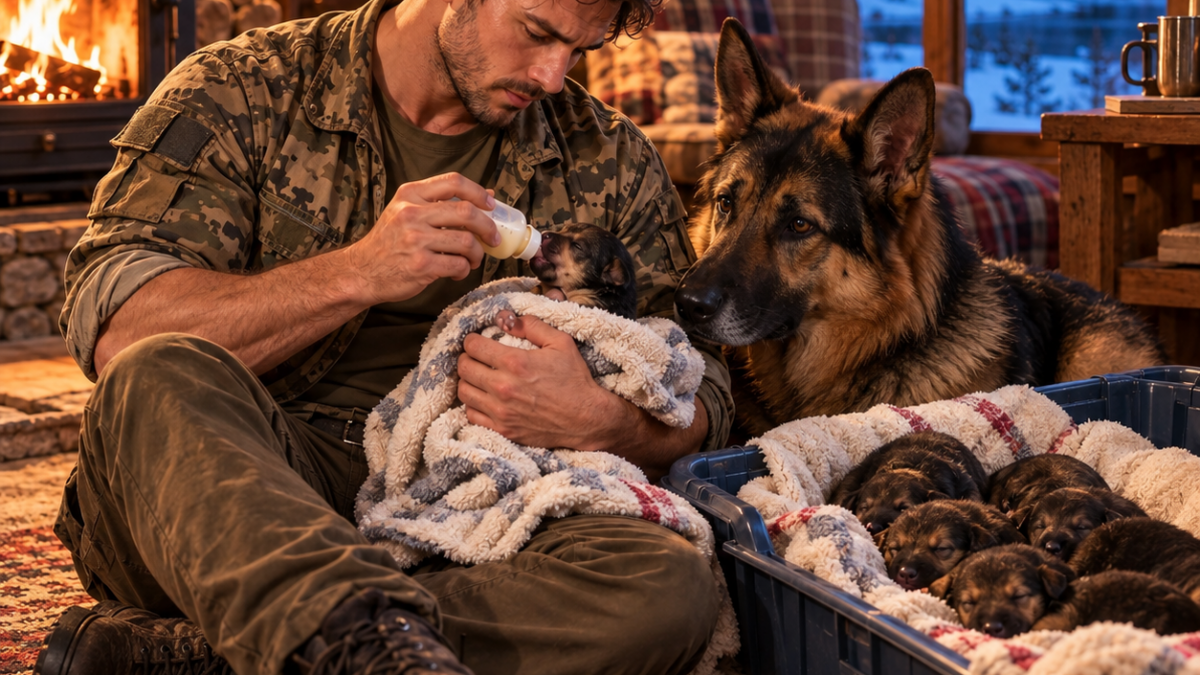
No committee language. No phrasing Brynn would put in a report. Just a child holding up the truth like a candle in both hands.
Later, Brynn explained the option carefully over the phone. If the family agreed, Hattie did not need to testify about Duane.
threats, tires, or forged paperwork, she could attend with Maribel and, during a short public comment segment, hand over Pip’s drawing.
Nothing more. No pressure, no questions directed to her unless Maribel allowed it.
Maribel opposed it immediately.
No, she said in Anson’s kitchen that evening, after Hattie had gone to the guest room to choose which crayon color best represented important sadness.
Walter sat at the table, silent, one hand around a mug of coffee gone cold. Maribel stood near the sink, arms folded tight across her cardigan. No, she has lost enough.
She does not need a room full of adults staring at her grief. Anson leaned against the counter.
I agree she should not be used. Used?
Maribel’s eyes flashed.
This whole thing has already used her. She worries about puppies.
She worries about you. She asks if dead people know when their names are stolen.
She should not know such things. I know. She is six, Anson.
I know. You keep saying that like knowing is enough. The old version of him would have lowered his eyes and accepted the blow.
Every accusation, deserved or not, had once seemed like a tax he owed for surviving Lena. This time he did not look away.
I’m afraid too, he said.
Maribel blinked. He continued, voice low.
I’m afraid she’ll lose more because of me.
I’m afraid she’ll remember this as another reason her father brought trouble to the door.
I’m afraid every time she cares about something fragile, the world will teach her it was a mistake.
His hand touched the counter edge.
But I don’t want her to learn that safety means loving nothing small enough to lose.
Maribel’s face changed, as if the words had reached a place anger had been guarding.
Anson took a breath. I am not asking her to carry adult pain.
I won’t let anyone do that.
But Pip was hers, too. The name was hers.
The crown was hers. If all the committee sees is numbers and transport codes, then people like Duane win a little, even if the forms prove them wrong.
Walter lifted his eyes. Anson looked at Maribel, not pleading, not defending his past, not wearing guilt like a chain. I failed Lena by not being there.
I know you think it. I think it, too. Every day.
Maribel’s lips parted.
But I can’t keep living like one absence is the whole truth of me, he said.
I want to be here now, not as a hero, not as some man who fixes everything, just as a father who is learning late. The kitchen was silent, except for the hum of the refrigerator and the soft breathing of puppies. From the guest room, Hattie called, Grandma, is purple too fancy for sadness?
Maribel covered her mouth with one hand. Walter, after a long moment, said, Maybe sadness can dress up once in a while. No one laughed loudly, but the room loosened.
That night, after Maribel agreed to think about it rather than refuse outright, the house settled into an uneasy peace. Hattie slept in the guest room under a quilt Lena had once chosen from a church sale. Walter snored faintly from the old recliner because he had insisted he was only resting his eyes.
Maribel washed dishes that were already clean. Anson fed River, June, Milo, and Ash by lamplight, while Rook supervised with the grave authority of a saint in fur. After the last feeding, Anson sat in the chair beside the basket.
He meant to stay awake. Instead, exhaustion folded over him. Maribel found him there just after midnight.
The lamp was still on. His faded camo sleeve was rolled to the elbow.
One hand rested near the basket, close enough that Ash had managed to press his nose against Anson’s knuckle through the towel.
In Anson’s other hand was a photograph.
Maribel stepped closer, without meaning to. It was an old hospital photo of Hattie as a newborn.
She was wrapped in a white blanket, eyes closed, face impossibly small. Someone had written Hattie Pike on a card near the bassinet. Maribel had seen that picture before.
She had not known Anson carried it.
For six years she had imagined his distance as coldness, or shame, or a coward’s convenience dressed as grief.
Perhaps it had been all those things at times. Pain was rarely pure.
But in the chair before her sat a man asleep like a guard who had failed too many nights and was trying, at last, to keep watch. One hand by the puppies.
One hand around the child he had been too afraid to hold. Rook opened his eyes and looked at Maribel.
The old German shepherd did not wag.
He only watched, calm and knowing, as if he had been waiting years for her to see this exact arrangement of a broken man’s hands.
Maribel stood in the doorway for a long time.
Then she crossed the room, took the quilt from the back of the couch, and laid it gently over Anson’s shoulders.
He did not wake. Ash psyched in his sleep.
Outside, the Tennessee River moved through the dark, no longer in flood, but never still.
Maribel looked at the photograph in Anson’s hand, then at the basket, then toward the hallway where Hattie slept.
Somewhere between those three points something in her softened not enough to erase grief, not enough to excuse the years, but enough to admit a possibility. Maybe some people did not stand far away because they had stopped loving. Maybe they stood there because they feared arriving late so deeply that they mistook distance for mercy.
Maribel turned off the kitchen light, leaving only the lamp beside the basket glowing warm and low. In that small circle of light Anson slept on.
For the first time in many years, he did not look like a man trying to leave before dawn. He looked like one preparing, however clumsily, to stay.
The hearing room in Nashville was too clean for the story it had been asked to hold. Its walls were painted a pale cream that reflected the morning light without warmth.
The long table at the front shone with polished wood. Microphones waited in neat black rows. Paper cups stood beside water pitchers.
Name plates sat straight before people who had slept in hotels, worn press jackets, and walked in without mud on their boots. Anson Pike sat near the aisle, with his hands folded between his knees. His desert camouflage was gone for the day.
He wore a dark denim shirt over the same olive t-shirt, brown work pants, and boots he had cleaned twice before dawn. He had not shaved smooth, but he had trimmed the rough edges.
Beneath the shirt, hidden against his chest, his dog tag rested beside Lena’s ring.
Rook was not allowed inside the hearing room. That had been explained kindly and firmly by three different people.
The old German shepherd waited outside in the custody of Walter Keene, who had grumbled about being assigned dog duty, and then spent fifteen minutes telling Rook he was the only sensible creature in the building.
Anson missed the weight of Rook’s presence.
He missed the old dog’s ability to make silence feel less empty.
Beside Anson sat Maribel, her hands folded around Hattie’s drawing of Pip.
Hattie sat between Maribel and Walter’s empty chair, wearing a pale blue cardigan and a serious expression that made her look like a very small judge.
Her feet did not reach the floor. She swung them once, then stopped when Maribel placed a gentle hand over her knee. This room smells like pencils, Hattie whispered.
Anson leaned slightly toward her. Important pencils.
She considered that. Do they know Pip had a crown?
They will. The answer steadied him more than it steadied her.
At the front, Brynn Sutter arranged her files with the precision of someone setting stones across a river. She wore a navy suit, hair tucked behind one ear, blue pen clipped to the top of her folder.
Nora Caldwell sat two chairs away in a green blouse and brown blazer, looking deeply uncomfortable in clothing that did not contain visible dog hair. Dr.
Mara Whitcomb sat with her report in front of her, glasses low on her nose, expression plain and unreadable. Evelyn Venn sat very still.
She wore her brown blazer and the little paw-print pin that had belonged to her father’s clinic.
In her lap was the tin box of Dr.
Harold Venn’s old signatures, licenses, and adoption forms.
Her face did not show anger. Anger would have been easier to read.
Evelyn carried something older.
The duty of a daughter asked to defend a good man’s name after he was no longer there to defend it himself.
Agent Colin Reeves sat near the side wall. He looked exactly as he had in the extension office, composed, watchful, and almost offensively calm. A black folder rested on his knee.
If he felt the weight of the room, he did not show it. The hearing began without thunder.
No shouted accusations. No dramatic interruption. No villain dragged into the light.
Just a chairperson tapping a microphone and saying the committee would hear testimony related to gaps in animal transport verification and rescue transfer documentation. Anson looked at the table of papers. He thought of the blue crate on the workbench.
A river could roar. A puppy could squeak. A child could ask one question and undo a grown man.
But sometimes the fate of small lives was decided in drier places, inside signatures, routing codes, license numbers, and names typed neatly on forms by people who never heard the breathing on the other side. Brin spoke first. She did not decorate the facts.
She laid them down. The crate recovered at Cumberland Lock.
The partial shipping label under the bottom lip. The visible routing code. The Missouri origin.
The contract presented by Dwayne Tully under the name Bright Mercy Animal Rescue. The forged signature attributed to Dr. Harold Venn after his death.
Similar documents, similar phrases, similar routes. Every similarity was a thread.
Together they began to look like a net. Evelyn was called next. She opened the tin box with both hands.
Her voice remained steady as she explained who her father had been, a veterinarian who had run a small rescue beside his practice, a man who kept old dogs because he said they understood gratitude best, a man whose handwriting had grown shakier in his last year but never careless. Then she placed three original signatures beside the disputed one. My father did not sign this, she said.
No tromble. No performance. Just truth.
Nora explained the difference between rescue and a costume made out of rescue language. She spoke of intake records, foster homes, medical checks, transport logs, and the messy fingerprints of real care.
She said legitimate rescue paperwork carried the burden of living animals. Fake paperwork, she said, often looked too smooth because no actual dog had ever drooled on it. Someone at the committee table almost smiled.
Nora did not. Dr.
Mara’s testimony was shorter.
She described the puppies’ approximate age, their condition when found, and the care they required.
She did not use language designed to shock. She did not need to. The quiet facts were enough.
they were too young and too fragile for the kind of transfer described in those documents mara said whatever those papers claimed the animals i examined required immediate warming bottle feeding and monitoring responsible transport would have accounted for that agent colin reeves spoke last among the officials he did not promise punishment He did not say the case was solved. He only confirmed that the documents and transport indicators were sufficient to warrant federal review because they appeared to involve interstate movement and possible document fraud. Anson liked that he did not make it sound finished.
Finished would have been too easy. Justice, he thought, was not a gate slamming shut in one clean motion.
Justice was more like one of the puppies opening its eyes. Slow, cloudy at first, needing warmth, needing time, needing people patient enough not to declare it blind before it learned to see. Then his name was called.
Anson stood. The room felt larger when he walked to the microphone. Not physically.
The walls remained the same. But grief had a way of lengthening distances. The aisle became a bridge.
The microphone became a cliff. The chair in front of him became every chair he had ever avoided sitting in beside Hattie for too long. He placed his hands on the sides of the podium.
For a moment, he saw nothing but the red light on the microphone. Then he saw Hattie.
She sat very straight beside Maribel, holding the edge of her cardigan. Walter had slipped back into his seat behind her. Rook was still somewhere beyond the doors, probably judging the building.
Anson breathed. My name is Anson Pike, he said. I operate Cumberland Lock on the Tennessee River.
His voice sounded low, rough, but steady enough. He did not say Navy SEAL. Not first.
Not his armor. He told them about the morning after the flood. About Rook hearing what he almost missed.
About the blue crate wedged in the debris. about five puppies wrapped in a wet thermal blanket, too small to understand the trouble adults had made around them.
He described the schedule. Every two hours. formula, warm towels, weight checks, notes.
The notebook that began as a medical record and became, without his permission, a roll call. River. June.
Milo. Ash.
Pip. He paused on the last name.
Across the room, Hattie lowered her eyes to the drawing in Maribel’s lap.
Anson continued. My daughter named Pip, he said. She said if he had a name, He would know where to come back when he got lost.
A few people shifted in their seats. Anson kept his gaze on the microphone. There were papers that called them property, inventory, transfer subjects.
I understand paperwork has to use categories. I operate locks.
I know systems need names for things. But in my kitchen, they were not categories.
They were five living creatures who needed somebody to wake up when the alarm rang. His hands tightened once, then released. I am not here to say what punishment belongs to whom.
That is not my work. My work was keeping them warm and keeping clean notes.
But I am asking this committee to remember that when paperwork lies, the first thing it steals is not money. It steals the truth of what something is.
He looked up then, and those puppies were not a shipment error. They were lives.
The room remained silent, not frozen.
listening anson stepped back he had expected shame to follow him down from the microphone it did not exhaustion did a shaking in his knees did but shame for once stayed behind like something he no longer had to carry for everyone then maribel rose
with hattie anson’s chest tightened they had agreed to this they had talked through it Hattie would not be questioned.
She would not speak about Duane, the tire, the fence, or the legal letters.
She would only bring Pip’s drawing during the short community statement portion if she still wanted to.
Now she wanted to. Hattie walked beside Maribel with both hands around the picture. She was so small against the polished room that Anson almost stood up.
Walter’s hand touched his shoulder once, not holding him down, only reminding him to trust the agreement they had all made.
Hattie stood before the committee table. Maribel placed a hand lightly at her back.
My name is Hattie Pike, she said. A few people leaned closer, not because she spoke softly, but because sincerity often arrives without volume. She held up the drawing.
Pip stood on his cloud, crowned, watching over River, June, Milo, and Ash.
Rook’s crayon mustache remained glorious.
This is Pip, Hattie said. He was the littlest one. She looked at the picture, not the adults.
My daddy woke up every two hours. He wrote down every bottle.
He told Pip his name. If the papers said everything was okay, why did those puppies need my daddy to be their mom?
No one moved. Not because a child had solved anything.
She had not. The evidence remained in folders.
The investigators still had work. The law still had its own slow road to walk.
But Hattie’s question did what no routing code could do.
It opened a window in a room full of paper, and for one breath, everyone inside could smell warm milk, wet towels, river mud, and the small, bright kingdom of a puppy with a crown. Maribel accepted the drawing when Hattie handed it to the clerk.
Then she guided her back.
When Hattie reached Anson’s row, she did not climb into his lap.
Not there. Not in front of everyone.
She only touched two fingers to his sleeve as she passed. It was enough.
After the hearing, there were no trumpets. There were handshakes, copied reports, scheduled follow-ups, and careful phrases. Operations connected to Duane Tully were suspended pending investigation.
Several transport documents were frozen for review. Bright Mercy Animal Rescue was formally noted as inactive and improperly used after Dr.
Venn’s death.
Federal investigators began widening the review of routes between Missouri and destination states. Duane did not appear as a shouting monster dragged from a storybook cave. He appeared in memos, emails, signatures, phone records, and the spaces where honest information should have been.
That made him less dramatic and more real. A man caught not by a fist, but by the patient return of facts.
Weeks passed.
River’s eyes opened fully, and he grew into his name.
He went to a retired couple who lived near a quiet lake and promised to let him listen to water every morning. June went home with Nora Caldwell, who claimed she was only fostering and then bought a pink collar within 24 hours.
No one believed the fostering part after that. Milo joined a family with two children who liked reading aloud to dogs.
During his first visit, he fell asleep before the end of Chapter 2 and snored through the moral lesson. Ash stayed. Nobody discussed it as a formal decision at first.
Ash simply remained where he had always wanted to be.
Near Rook, near Anson’s boots, near the warm places in the house where silence had become less frightening.
Rook treated Ash with the long-suffering dignity of an old king forced to tutor, a knight made entirely of paws and bad ideas.
Ash climbed onto Rook’s blanket.
Ash gnawed the corner of Rook’s old leather collar.
Ash once bit Rook’s tail and seemed shocked to discover it belonged to someone important.
Rook sighed often, dramatically. But every night, when the cabin cooled and the Tennessee woods darkened beyond the windows, Rook shifted just enough to leave Ash the warmest spot.
Anson watched them and understood. Loyalty did not end when age slowed it. It learned to pass itself on.
Maribel and Walter withdrew the request for supervised visits. There was no grand announcement. Maribel simply called one evening and said, Hattie asked if she could spend Saturday with you.
We think that would be all right.
Anson stood in the kitchen with the phone in his hand, looking at the place where Pip’s crown drawing still rested on the shelf.
All right, he said. because if he said more, his voice might fail.
He did not become perfect after that. No one does, except in cheap stories and funeral speeches.
He still sometimes stood in doorways too long.
He still grew quiet when Lena’s name entered the room.
He still had to remind himself not to hand Hattie a gift and retreat before she could hand him affection back. But he called before he came to Knoxville.
He arrived on time. He stayed through dinner. He put his phone away when Hattie spoke.
He let her miss Pip without trying to fix the missing. He let himself miss Lena without turning that missing into a wall tall enough to hide behind.
One early summer afternoon, Hattie came to Anson’s cabin with a backpack full of crayons, mismatched socks, and an urgent plan to teach Ash proper manners before he became a public embarrassment.
Ash failed the lesson immediately. He stole a crayon.
Then he tripped over his own paws. Then he fell asleep, with one ear folded inside out. Hattie declared progress uncertain but promising.
By late afternoon, sunlight had turned the cabin gold. The windows stood open. The Tennessee River moved somewhere beyond the trees, no longer flood-brown and angry, but bright in the distance, carrying broken pieces of sunlight like coins.
Hattie played with Ash until both of them wore themselves out. Rook lay beneath the front window.
muzzle silver in the light, eyes half-closed but never entirely off-duty.
Ash curled beside Anson’s boot, twitching in puppy dreams.
Hattie climbed onto the couch with a book open across her knees. She made it halfway through a page about a rabbit in a hat before sleep took her.
Anson stood near the kitchen table and watched. She lay on her side, one hand under her cheek, hair spilling across the cushion in honey-colored curls. Her yellow socks did not match.
One had stars, one had ducks. Her mouth was slightly open in the careless trust of children who believe the room will hold while they are gone from it. The old fear rose, not as a storm this time, as an abbot.
His arms remembered every reason they had avoided this. Hattie was not a puppy in a towel. She was not a crate pulled from the river.
She was Lena’s last gift and his greatest failure and the living proof that love could survive a man’s absence.
For six years, he had lifted heavy things without fear. Ropes soaked with river water, metal gates that fought the current, crates, tools, feed bags, the limp weight of exhaustion itself.
He had carried puppies smaller than his palm through nights measured in alarms. But the child asleep on the couch made his hands tremble, not because she was heavy, because she mattered beyond strength. Anson looked down at Rook.
The old German shepherd opened one eye. There was no command in it, no miracle, no ghostly message from Lena shining through the room.
Only patience. The same patience Rook had offered beside the basket.
Beside the porch door, under the tulip poplar, outside the locked rooms of Anson’s heart.
Anson crossed to the couch. He crouched slowly, giving himself time to turn back. He did not.
He slid one arm beneath Hattie’s shoulders and the other beneath her knees.
She made a small, sleepy sound and settled against him before she fully knew she had been lifted. Her cheek came to rest against his chest.
Anson stopped breathing for one terrible… beautiful second. Then Hattie sighed, not afraid, not waking, just resting.
As if some part of her had always known his arms were a place she could come back to, even when he had forgotten. Anson sat in the old armchair by the window, holding her. At first he held too carefully, as if she might vanish if his hands admitted how much they wanted to keep her.
Then, gradually, his arms learned what the rest of him had resisted.
Rook rose with effort and came to lay his head across Anson’s boot.
Ash, disturbed by the movement, crawled over and tucked himself against Rook’s side.
Outside, the Tennessee River went on carrying the afternoon toward evening. Maribel arrived near sunset to find the cabin quiet.
She stopped in the doorway. Anson looked up. For a moment, the old apology rose toward his mouth.
Sorry I am holding her. Sorry I did not before. Sorry I was late, but Maribel put one finger to her lips.
Then she stepped back onto the porch and closed the door softly. Anson looked down at Hattie. She slept through it all, warm and real in his arms.
The sun lowered. Gold turned amber.
Amber turned blue at the edges of the room. His shoulder ached. His back stiffened.
He did not move. There are embraces a man gives too late.
There are lullabies that arrive after the child has already learned to sleep without them. There are names written on hospital cards, on dog tags, on forged papers, on crayon crowns, each name asking to be remembered rightly. Anson could not go back and stand beside Lena in that final room.
He could not become the husband who arrived on time. He could not give Pip more mornings than Pip had been able to hold. But he could hold his daughter through one full afternoon.
He could stay until she woke. He could let love be imperfect and present at the same time. Rook breathed against his boot.
Ash dreamed. The river shone beyond the trees like a road made of soft gold.
When Hattie finally stirred, she did not pull away. She opened her eyes, saw where she was, and placed one small hand against the dog tag beneath his shirt. Hi, Daddy, she murmured.
Anson bent his head over hers. Hi, Bug.
She closed her eyes again. And Anson, who had spent six years believing his arms were too late to be useful, held her as the last light left the room.
Somewhere beneath the tulip poplar, a paper crown had softened with rain and sun.
Somewhere in the house, Pip’s name remained in a notebook.
And in the chair by the window, a father finally understood that love did not always return in thunder, triumph, or perfect repair.
Sometimes it returned as warm milk at midnight, as an old dog guarding a doorway, as a child’s drawing laid before strangers, as four puppies growing toward morning, as one small girl asleep against a heart that had been waiting all along to learn how to open.
Some losses never fully leave us. They become quiet rooms inside the heart, places we visit when the world grows still.
But Anson’s story reminds us that love does not have to arrive perfectly to be real.
Sometimes grace comes in the smallest ways, a puppy’s breath in the dark, an old dog standing guard, a child’s drawing, or one more chance to stay when fear tells us to step away.

