A Navy SEAL Stayed Awake for Five Motherless Dogs and Found His Daughter Again – Part 4
Walter looked down. Maribel pressed a hand to her mouth, as if she had not meant to say it so plainly.
But after six years, plainness sometimes broke out like weather. Anson looked toward the window.
Hattie had made Rook wear a paper badge that said, Royal Guard. Rook looked insulted and magnificent.
I stepped back because I thought I was protecting her from me, Anson said.
Maribel’s eyes filled.
And now? He swallowed.
Now I’m trying to learn the difference between stepping back and standing steady.
No one answered. Inside, Hattie laughed.
That evening, the house grew too quiet in a new way.
PIP would not take much formula at the 8 o’clock feeding.
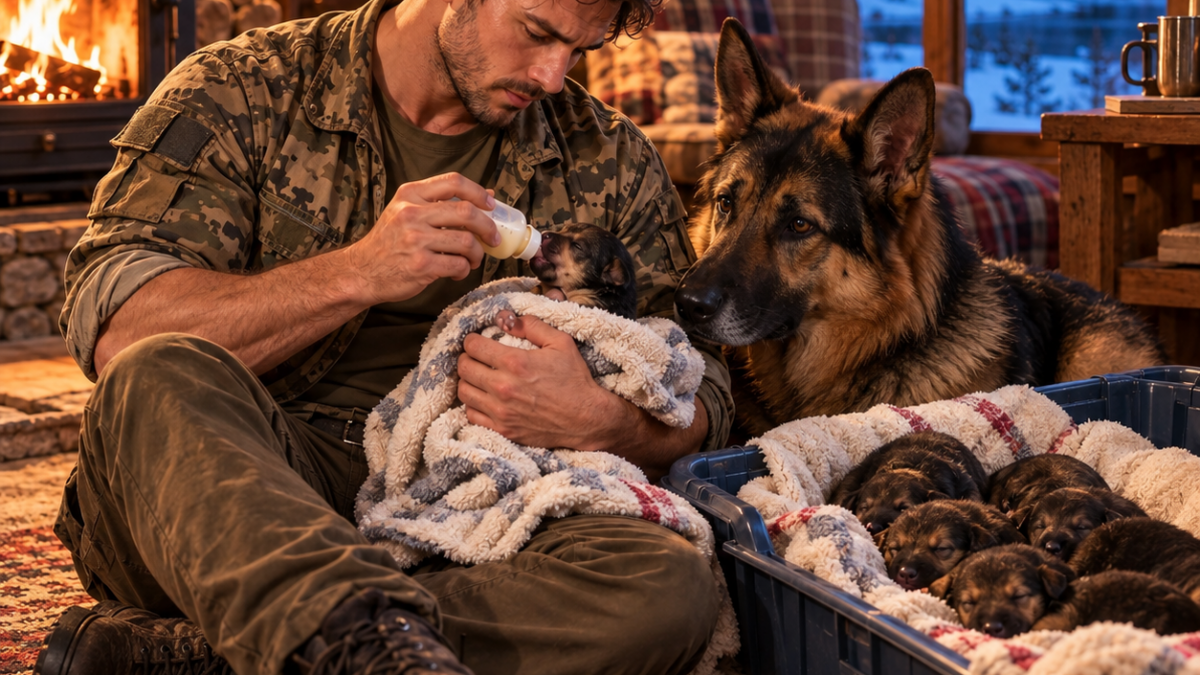
Anson did not force him. He warmed the towel, checked the angle, tried again after a rest, wrote everything down. Rook lay closer than usual, his gray muzzle almost touching the edge of the basket.
At ten, Pip slept. At midnight, Anson woke before the alarm. He found Rook already sitting up.
That was when he knew. No thunder, no struggle, no terrible scene. Only the kitchen light, soft and yellow.
The old clock ticking above the stove, a bottle still warm in a bowl of water. River, June, Milo, and Ash, asleep in their towel nest. Pip in the small cloth Hattie had chosen because it had tiny green leaves along one edge.
Anson lifted him. Pip was warm, then less warm. There are losses so small the world does not stop for them.
No siren sounds, no gate closes, no river changes course. But inside one kitchen in Tennessee, a man who had survived storms, training, distance, and years of self-punishment sat down very slowly with a puppy in a green-edged towel, and the silence became enormous. Rook came to him.
The old German shepherd placed his muzzle beside the towel on Anson’s knee and stayed there, not whining, not pawing.
only present as he had been from the first moment by the basket. Anson bowed his head. I was here, he whispered.
The words were not a defense. Not yet. They were a question he did not know how to ask.
At dawn, light touched the kitchen window. Anson called Mara first.
Mara answered on the second ring. She listened.
She did not fill the silence with instructions. When she finally spoke, her voice was low.
You did everything right, Anson. He closed his eyes.
Don’t say that if it isn’t true.
I don’t.
After that, he called Maribel. Hattie came to the phone a little later. Anson could hear the soft shuffle of morning in Knoxville, the murmur of Maribel close by, the careful quiet of a house trying to protect a child from pain without lying to her.
Daddy, Hattie said. Anson gripped the edge of the table. Bug, he said, and the word nearly broke.
There was a long silence after he told her. Not the silence of confusion, the silence of a child carrying a truth larger than her hands. Then Hattie asked, Did you wake up on time?
Anson looked at the bottle still beside the sink. Yes.
Was Rook there? Yes. Were you holding him?
Yes. Another silence. When Hattie spoke again, her voice was small, but not angry.
Then Pip wasn’t by himself.
Anson could not answer. He had spent six years believing love was measured by whether he arrived before the end. Lena had called for him, and he had not been there.
That absence had become his name inside his own mind. Late. Missing.
Unworthy. But Hattie, with the terrible mercy of children, offered him another measure. Not saving.
Staying. Not victory. Presence.
Anson covered his eyes with one hand. No, he said at last.
He wasn’t by himself.
That afternoon, under the tulip popper behind the cabin, they buried Pip wrapped in the soft cloth Hattie had chosen. There was no ceremony large enough for what Pip had meant. So Hattie made a small one.
She placed the green paper crown on a flat stone. It sagged slightly in the damp air, brave and ridiculous. She had written Pip on it in letters that leaned into one another like tired friends.
Rook lay beside the tree, his head on his paws. River, June, Milo, and Ash slept inside the cabin, warm and unaware that their smallest brother had become part of the earth under the roots.
Maribel stood behind Hattie, one hand near the girl’s shoulder but not touching unless invited.
Walter stood a little farther back, cap in both hands. Anson stood behind them all.
Too far, maybe. He knew it the moment he noticed.
Hattie looked down at the little stone. He was king of small, brave things, she said.
Anson’s throat tightened.
Yes, he managed. The wind moved through the tulip poplar leaves. Somewhere beyond the trees, the Tennessee River kept going, indifferent and faithful at once.
Hattie stepped backward.
Anson’s body prepared to move away.
It was an old habit, older than thought. Tenderness approached, and he made room for it by disappearing. But Hattie did not turn.
She simply leaned back until her small shoulders rested against his legs. Anson froze. Maribel watched.
Walter looked at the ground. Rook lifted his head.
Hattie did not ask to be picked up. She did not ask him to explain death or lawyers or why some puppies stayed and some could not. She only leaned there, trusting his body to be a wall that would not vanish.
Anson’s hands opened at his sides.
He did not lift her. Not yet. But he did not step back.
After a moment, he lowered one hand and rested it lightly on the top of her yellow hood. Hattie leaned a little more. The green crown trembled on the stone.
In that quiet, Anson understood something he had avoided for six years. Maybe fatherhood was not a room he had been locked out of on the day Lena died.
Maybe it was a threshold, and every day he either stepped away from it or stayed. The wind passed.
Rook lowered his head again, and Anson stayed. For two days after Pip was buried beneath the tulip poplar, Anson Pike considered giving the remaining puppies away. Not because he no longer cared.
Because he did. River, June, Milo and Ash had begun to fill the cabin with the soft disorder of lives still deciding whether the world was safe.
River wobbled toward every sound of water. June fed with solemn patience.
Milo complained as though hunger were a personal insult invented hourly.
Ash had taken to crawling toward Rook’s front paws and falling asleep there, dark and quiet as a coal beside an old hearth.
That should have comforted Anson. Instead, it frightened him. Care had become a doorway, and doorways had always seemed dangerous to him.
A man could stand in one too long, letting light touch his face, and begin to believe he belonged inside. Then, something could happen. A tire could be cut.
A letter could arrive. A child could ask why bad papers could steal dogs. A tiny puppy with a paper crown could leave before sunrise.
So, on Monday morning, Anson called Nora Caldwell and asked what room she might have if he brought the four survivors. Nora did not answer right away. In the silence, Anson heard barking in the background, a metal bowl clatter, and Nora telling someone named Beatrice not to climb the shelving unit.
Finally, Nora said, Is this because they need placement or because you’re scared?
Anson looked at the laundry basket by the stove. Rook was lying directly in front of it, body arranged across the floor like a barricade built of fur, age, and stubborn loyalty.
Ash had crawled halfway onto Rook’s paw and gone to sleep.
Nora, Hansen said, that is not an answer.
They’re safer away from me.
Another pause.
This time, Nora’s voice lost its humor.
Are they? Anson had no clean reply.
If you bring them here because they need medical rotation, foster support, supplies, fine, she said.
I’ll help.
If you bring them because you want to disappear before the story gets harder, I may still help, but I will be deeply annoying about it. Despite himself, he glanced at Rook. The old German shepherd had opened one amber eye.
it held judgment enough for a courtroom i’ll call you back anson said good think first panic later he ended the call and stood in the kitchen rook did not move you’re in the way anson told him rook closed his eye again anson stepped closer That is not your decision.
Rook’s tail moved once, very slowly, as if signing a royal decree.
Denied.
Ash sighed in his sleep against the old dog’s paw.
And from somewhere so far inside memory, it felt like a voice behind water. Anson heard Lena laughing.
Rook doesn’t listen to you, she had once told him, years earlier, when the shepherd refused to leave her side during a winter fever.
He listens to the better part of you. Anson had teased her for making the dog sound like a prophet.
Now, in the kitchen, with formula cooling on the counter and Pip’s green paper crown still visible outside beneath the tulip poplar, the joke returned wearing a different robe.
Rook was not guarding the puppies from danger. He was guarding Anson from retreat.
That afternoon, a padded envelope arrived from Knoxville.
Hattie’s name was printed in uneven letters across the back flap.
Inside was a drawing done in crayon, carefully folded twice. Anson opened it at the kitchen table.
Pip stood on a cloud, wearing his green crown. The crown was far too large, sliding over one ear, but Pip looked dignified anyway because Hattie had given him a serious little mouth. Beneath the cloud stood River, June, Milo, and Ash.
Rook was drawn beside them with an enormous silver mustache, though German Shepherds did not traditionally have mustaches. Above the whole scene, the son wore a worried face.
At the bottom, Hattie had written, Daddy, don’t quit when it is almost morning.
Anson sat very still. It was not a polished sentence.
It leaned, misspelled nothing, only because Hattie had asked Maribel for help and pressed too hard in places where the crayon had nearly torn the paper. But it found him, not as an accusation, as a rope.
He placed the drawing beside the notebook, where Pip’s final page remained marked by a green thread.
Then he called Nora back.
They’re staying for now, he said.
Nora exhaled loudly enough to rattle the phone. Good.
I was already preparing my annoying speech. Sorry to deprive you.
I’ll survive.
Barely, by the end of the week, the papers began to speak in a language even Anson could understand. Bryn Sutter gathered them in the county agricultural extension office, where the fluorescent lights hummed overhead and coffee tasted like it had been brewed through a folded napkin. On the table lay the shape of something larger than one crate, one letter, or one man in a beige field jacket.
Duane Tully’s contract was not alone.
Bryn had found other transfer documents bearing the name of Dr. Harold Venn after his death.
Not dozens yet. Enough.
Each one used similar language. Rescue transfer, temporary foster designation, interstate relocation, wellness pending. Soft words.
Words with clean shoes.
Evelyn Venn sat at the table with her father’s old tin box in front of her.
She wore a brown blazer and a small paw print pin that had belonged to Dr.
Venn’s clinic.
Her grief had grown sharper since their first meeting, not louder. Every time she saw the false signature, her fingers touched the pin as if checking that at least one true thing remained fastened to her. Nora Caldwell brought examples of legitimate rescue paperwork, veterinary intake forms, foster home approvals, vaccination logs, transport health certificates, adoption agreements with follow-up contacts.
She spread them out like a teacher, showing students the difference between a quilt and a curtain painted to look like one. A real rescue leaves footprints, Nora said, messy ones.
Vet bills, foster names, phone calls at midnight, photos of dogs on ugly couches, fake paperwork is too smooth. No dog hair on it. Dr.
Mara’s report was shorter and heavier.
The puppy’s estimated age, their condition when found, the risks of early separation, the inconsistencies between their state and the claim transfer.
Mara had written in clean, careful language, but Anson could hear her voice inside every line. Do not dress neglect as procedure. Deputy Amos Reed added his reports.
Dwayne’s appearance at Anson’s property, the tire incident, the neighbor’s unclear footage, and his advice that future contact remain documented.
He did not embellish.
Amos’s strength, like a well-built fence, was in not leaning.
Brynn arranged the documents by date and entity. Her blue pen moved from one page to another.
making small marks that tied things together, rented mailbox addresses, repeated phone numbers, the same intermediate transport company, the same phrasing around rescue transfer, the same secondary contact tied more than once to Duane Tully. This is not enough to prove the whole machine, she said. Anson sat across from her, hands folded.
But it is enough to show the machine may exist, she continued. and that the pike crate was not an isolated clerical accident.
Evelyn’s face tightened at the phrase pike crate, as if the puppies had become part of an archive.
Anson did not like it either. River had finally opened his eyes that morning.
Barely. Two cloudy slivers staring at nothing and everything. He was not a crate.
Bryn tapped one page. I am contacting a federal investigator who handles interstate animal transport fraud and document schemes.
His name is Colin Reeves. Nora leaned back.
Is he useful? He is very useful.
Does he smile? Rarely. Good.
Smiling men in paperwork cases make me nervous. Agent Colin Reeves arrived the next day with no drama at all. He wore a dark gray suit, a white shirt, and glasses with thin black frames.
He was 41, compact and composed, with close-cut black hair and the face of a man who could read shipping records for six hours and consider it a decent afternoon. He did not stride in like a hero.
He did not promise arrests. he set a black folder on the table greeted each person by name and asked anson to tell the story from the beginning then he asked again starting from the moment duane appeared then again beginning with the crate not because he doubted anson because as brin later explained reeves liked to see whether truth kept the same bones when approached from different doors it did When Anson finished for the third time, Colin removed his glasses and cleaned them with a cloth.
This crosses state lines, he said. If these documents are connected to movement from commercial sources into rescue-labeled channels, that may involve federal jurisdiction. I cannot discuss investigative steps beyond that, Nora muttered.
Federal for things are about to get complicated. Colin looked at her. She looked back.
After a moment, he said, That is not inaccurate. Anson almost smiled.
Almost. Then Colin turned to him.
You have been asked to testify at the State Agriculture Committee hearing next week.
Anson’s shoulders stiffened.
Bryn’s pen stopped.
I was what? The committee was already reviewing gaps in animal transport and rescue verification after several complaints, Colin said. Your case has become relevant.
They want a factual account from the person who found the crate and maintained the care logs. No. The word came out before Anson dressed it in manners.
Colin did not react. Bryn watched him closely. Anson looked at the table.
Signatures, labels, reports, copies, forms. He could face all of that in a small room. He could hand over records.
He could wake every two hours. He could stand by a grave under a tulip poplar and not move away when Hattie leaned against him. But a microphone was different.
A hearing room was different. To speak meant letting strangers look at what he had kept hidden beneath work, silence, and distance.
it meant saying aloud that he had taken five puppies home because the smallest one moved against his finger and because six years ago he had not held his daughter when he should have it meant letting his grief become part of a public record i’m not the right person he said brin’s voice was quiet you are the person who was there i can give them the notebook they want the notebook to have a human voice anson stood the chair scraped back with more force than he intended everyone looked at him Rook, who had been allowed into the room by the collective surrender of all present,
lifted his head.
Anson pressed his palms to the table. I am not a witness for pity, he said. No one asked you to be, Brynn replied.
I’m not putting Hattie near this.
No one is asking that either. But Hattie heard about the hearing anyway.
Children in families under strain learn to hear the shape of adult conversations through doors, pauses, and words that stop when they enter rooms. She knew something important was coming because Maribel folded laundry too neatly, Walter fixed the same cabinet hinge twice, and Anson ended calls when her face appeared on the screen.
During their supervised visit that weekend, Hattie sat at Anson’s kitchen table with a new drawing.
The four surviving puppies slept nearby, fatter now, warmer, their tiny bodies beginning to believe in mornings.
Rook lay beside Hattie’s chair.
Is there a meeting about Pip? she asked.
Anson looked at Maribel.
Maribel’s expression said, Tell the truth gently.
There’s a meeting about papers, Anson said, and about dogs like Pip.
Hattie continued coloring. Grown-up papers?
Yes. Bad papers?
Some of them? Are you going?
I don’t know, she looked up.
You should bring Pip’s picture.
The room went still. Anson looked at the drawing she had mailed him, now kept on the shelf beside the notebook. Hattie.
Not me talking about scary things, she said quickly, as if anticipating the adults. Just the picture.
So they know he had a crown.
Maribel’s face tightened.
Hattie, sweetheart.
He wasn’t just a number, Hattie said.
There it was. No legal vocabulary.

