A Former Navy SEAL Said, “No Woman Would Want Me”… She Whispered, “Then You Forgot About Me” – Part 2
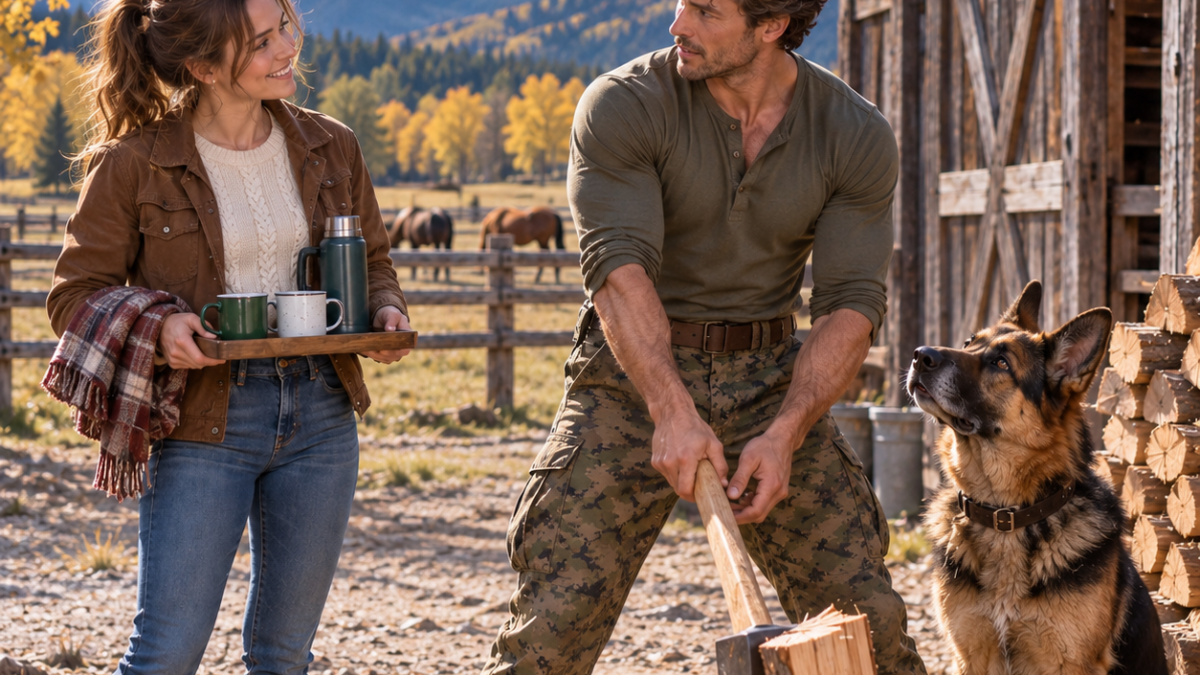
Emily looked at him.
You don’t have to.
I know. The answer came easily enough that he noticed it only after saying it. Maker was already standing.
Emily looked from Jack to the dog. I see the committee has voted.
Mako doesn’t vote.
The German Shepherd moved to the end of the driveway and waited. Emily nodded.
Very convincing. Jack locked the shed and joined them.
The road to Walters was narrow, bordered by pasture on one side and a line of cottonwoods on the other. The leaves had begun thinning overhead, enough sunlight coming through to make moving patches across the gravel. The morning had started cold, but by then it was warm enough that Jack pushed his jacket sleeves up before they had gone a quarter mile.
Maker walked between Heel and Freedom, drifting ahead to inspect the road shoulder before returning without being called. Emily noticed.
He still checks back with you. Habit yours or his?
Jack considered it. Both?
They walked on. Emily told him Walter had called the previous afternoon because he could not find an invoice he was certain he had paid.
She found it in a kitchen drawer under two seed cataloges and an expired fishing license. Jack asked whether that counted as filing. Only if the system is designed to defeat investigation.
That might explain some of your other clients. She gave him a sideways look.
You’ve been thinking about my clients?
No. That was fast.
Jack almost smiled. One of them still sending blurry receipts. Yesterday, I got a photograph of a fuel receipt taken through a windshield.
Artistic choice. He said the lighting was bad.
The windshield help? Apparently not. There was something different about talking to her away from either ranch.
At Old Orchard Gate, they had both been working. At Prairie Hall, the room had been full of other people and too much movement.
Out here, there was only the road, the soft tick of Mako’s collar tags, and the occasional truck in the distance.
Emily did not hurry to fill every quiet stretch. Jack began noticing that.
A few minutes might pass before one of them spoke again. She looked across a pasture at cattle gathered near a feeder or stepped around a wash out at the road edge or adjusted the folder beneath her arm. Silence never seemed to make her nervous.
Jack had spent years around people who understood that quality. Most of them had worn uniforms.
He had not expected to recognize it here. Near an old culvert, Mako stopped to investigate a scent in the grass. Jack gave a quiet two-on-te whistle, and the dog turned immediately.
Emily shifted the grocery bag from one arm to the other. Something metallic caught the light near the opening of her canvas tote. Jack looked again.
A small compass hung from an inside loop by a faded green cord. He stopped walking for half a step.
Where’d you get that?
Emily followed his eyes. This?
She lifted the compass. The plastic housing had been scratched pale at the corners, and the cord was newer than Jack remembered, but there was no mistaking it.
You still have that thing. Emily put it back.
You gave it to me. I know.
That was about 16 years ago. Still points north.
That’s a low standard for sentimental value.
She smiled, but kept walking. The memory returned more clearly than Jack expected. Emily had been around 10 when she wandered past the old orchard while following what she insisted were deer tracks.
She had never been truly lost. She could still see part of the Harper barn through the trees.
But by the time Jack found her, she had become sufficiently offended by the landscape for him to spend the rest of the afternoon teaching her the simplest possible way to read the little compass clipped to his pack. Before he left again, he gave it to her.
Not because the thing mattered much. He simply told her to stop getting lost behind the orchard.
Jack looked at the tote again. You kept it all this time.
Emily shrugged lightly. You told me not to get lost. She said it without looking at him, then asked whether Mako had always disliked cattle guards.
The subject moved on before Jack could decide whether there had been anything more in the answer. He was grateful for that.
Walter Keen’s house stood behind a low windbreak of spruce trees, with an old farrier shed, leaning slightly beside the driveway.
A pair of horses occupied the small pasture behind it, both too old to be useful for much beyond eating grass and watching vehicles arrive. Walter opened the door before they reached the porch. He stood with one hand braced against the frame.
I told you I wasn’t dying.
Emily climbed the steps.
And I told you soup isn’t hospice care.
Walter accepted the grocery bag. Then he looked at Jack.
What did she bring you for? Supervision. Waste of manpower.
Walter’s back was clearly bothering him, but the condition had not reduced his opinion of his own capabilities.
He refused Jack’s offer to carry in firewood, then waited until Jack went outside for something else before moving only half as much wood himself and pretending that had been the plan.
Emily warmed stew on the stove while Walter sat at the kitchen table with the folder she had brought. She did not hover over him. That was one of the first things Jack noticed.
When Walter stood, she let him stand. When he complained about the pharmacy changing the shape of one of his bottles, she checked the label rather than telling him he was imagining it.
She placed two receipts beside the appropriate bill, showed him which payment had already cleared, and slid the rest of the folder across the table so he could look through it himself. Walter grumbled that paperwork had been invented by men too weak to shoe horses.
Emily told him those same men had apparently also invented late fees. Jack sat near the end of the table, drinking coffee Walter had made strong enough to remove paint.
The conversation moved slowly. Walter asked about North Fork.
Jack asked whether either of the old horses needed their feet looked at.
Emily mentioned that one of Walter’s utility payments had increased and suggested he check whether a rate adjustment had been applied correctly.
No one tried to turn the visit into charity. Walter would have hated that. At one point, Emily carried empty bowls into the kitchen, and Walter watched her go.
Then he looked at Jack. He did not lower his voice enough.
For a fellow who used to get paid to notice what everybody else missed, you overlook some pretty obvious things. Jack kept his attention on his coffee.
My hearing’s fine, Walter.
Good. Saves me repeating myself. From the kitchen came the unmistakable sound of one cabinet being opened, followed by another.
Emily had apparently developed an urgent interest in locating something. Jack looked toward the doorway, then back at water.
Your back doesn’t seem to have affected your mouth.
Only part of me still working at full capacity. Jack shook his head.
Walter looked pleased with himself and let the matter drop. They stayed another 40 minutes.
By the time Emily had put the kitchen in order, and Walter had extracted a promise from Jack to look at a sagging rail sometime before winter, the sun had moved higher, and the chill had gone out of the morning. Walter stood on the porch to watch them leave.
“Come back when you’ve got less paperwork,” he called to Emily.
“That depends on you.
” “Then never mind.”
Mako trotted ahead down the drive.
For the first part of the walk home, neither Jack nor Emily mentioned Walter’s comment.
Jack was glad. He was also becoming aware that he did not mind the silence with her nearly as much as he probably should. They took the same road back, but it seemed shorter now.
Emily stopped once to pick up a horseshoe nail near the shoulder because she did not want it ending up in a tire. Jack noticed she tucked it into the same pocket where she kept a small folding knife and a pencil. The pieces kept accumulating.
Not the way she had looked in the burgundy dress. That memory was still there, but it was being joined by other things now.
The way she let Walter keep his dignity while still getting the work done.
The way she understood enough about people’s finances to tell them what the numbers meant without pretending their choices belonged to her.
The old compass. The fact that she could walk half a mile without treating silence as an emergency.
Near the turnoff for North Fork, Emily slowed. Thanks for coming.
Jack looked down the road toward Walter’s place.
You would have been fine. I know.
There was no accusation in it. She adjusted the empty thermos under her arm. It was nicer with company.
Then she crossed toward Harper Ridge. Jack stood near the road with Mo beside him and watched until she reached the gate. He had spent the morning telling himself he was simply being useful.
By then, even he knew better. The walk had not been long enough. By the middle of October, Jack had stopped pretending that his conversations with Emily were accidents.
He still did not seek her out without a reason. That would have required admitting there was something to seek. But when he passed Harper Ridge and saw her pickup near the barn, he noticed.
When Mako lifted his head at the sound of it on the county road, Jack noticed that too, and twice that week he found himself taking the route past Old Orchard Gate, when another gate would have served just as well. He blamed the fence line. Mako offered no opinion.
The weather had been steady for several days, cold before sunrise and clear by midm morning, with the kind of dry October light that made every ridge in the Wawas look closer than it was. Jack had been moving hay that morning when the barometer on the wall of the mudroom began falling faster than he liked. By noon, the western sky had flattened into gray.
He checked the forecast again, secured two loose tarps beside the equipment shed, topped off the water trough nearest the barn, and made sure the north pasture gate was latched. None of it felt urgent.
Mountain weather changed quickly in autumn, and most of the time preparation meant preventing small annoyances from becoming expensive ones. The first hard gust arrived a little after 3. Maker was standing beside Jack near the barn when a line of cottonwoods along the road turned their pale undersides toward the wind.
Leaves moved across the yard in sudden sheets. Somewhere beyond the ridge, thunder rolled once, distant enough to be more warning than threat. Jack looked toward Harper Ridge.
A few minutes later, his phone rang.
“Paul, one of the east gates kicked loose,” he said.
“We’ve got the herd back together, but Emily’s count says we’re one short.”
Jack was already walking toward the mudroom. How youngling he red tag?
Any signs she crossed the road?
Not that we’ve seen.
I’m coming over.
There was no urgency in Jack’s voice because none was needed yet.
By the time he reached Harper Ridge with Mo in the truck, a short burst of rain had passed through, leaving the packed earth dark and the wind colder behind it. Paul stood near the east lot in a rainshell, checking numbers against the tag list. Emily was beside the UTV with her hair tied back beneath a cap, mud already stre across one knee of her jeans.
Jack stepped out. What have you got?
Paul pointed toward the east pasture. Latch lifted when the wind hit. Most of them stayed close.
One didn’t.
Emily handed Jack a red nylon halter.
She’s worn this enough to know it.
Jack took it without comment and crouched near the open gate. The old military part of him never announced itself with drama.
There was no change in posture anyone else would have called remarkable. His attention simply narrowed.
The latch had not broken. Wind pressure had pushed the gate hard enough against a warped post to let the chains slip over the hook.
Several cattle had crowded the opening, leaving the ground churned into a confusion of tracks before Paul and Emily got them back. Jack moved past the deepest mud.
Emily watched him study the grass beyond it. You seeing anything? Maybe.
He pointed to a strip where the flattened stems angled away from the main group. One animal peeled east before the others bunched up. Paul looked toward the lower pasture.
That takes her toward the drainage. Jack nodded.
Or the grove. Emily was already looking in the same direction. The ditch is deeper than it looks from here.
She wouldn’t cross it below the old pump road.
Jack glanced at her. You sure?
I’ve pulled calves out of that pasture every spring since I was 16.
If she went east, she’d use the uppercut.
That was enough. Take the UTV. Check it.
He did not ask Paul to confirm. The decision registered only after Emily drove away. Jack gave Mako the halter.
The dog took in the set, then looked up at him. Track. Mako lowered his head and moved through the gate.
His pace was controlled rather than fast. He followed the trampled ground for several yards, broke away, came back, then angled toward a patch of wet grass near the fence line. Jack moved with him, watching the dog more than the ground.
Now Paul stayed behind to secure the gate and keep the rest of the cattle settled. The trail held for roughly 200 yd. Then they reached a strip of hardpacked ground used by feed trucks during summer.
Mako stopped. He worked left, crossed back, checked the wind, and returned to the same point.
Jack waited. Years earlier, impatience around a working dog had been one of the fastest ways to ruin useful information.
Mako did not need encouragement every 3 seconds. He needed room to solve the problem.
The dog circled once more and moved north. Jack followed. The wind had pushed the last of the rain away, but water still dripped from the lower branches.
Mako reached a narrow opening between sage brush and stopped again. The UTV engine came from somewhere ahead.
Emily appeared on the old pump road and pulled alongside him. Nothing at the lower ditch. Jack pointed toward Mako.
He wants north. Emily looked past them.
There’s an old cattle trail behind that rise.
Nobody uses it much now. Where does it come out? East Grove.
Jack climbed into the passenger side. Mako jumped into the rear bed only after receiving the signal.
Emily turned the UTV around. She drove quickly enough to cover ground, but not so fast that the wet road became its own problem. Jack watched the drainage line while she handled the ruts without needing instruction.
At the fork, Emily took the left trail. Jack looked at her.
She caught it. What?
I would have gone right. Right. Dead ends at an old irrigation trench.
He looked ahead again.
How long’s that been there?
Longer than you’ve owned North Fork.
Fair answer. They stopped near the top of the rise and continued on foot. Mako picked up the line again where the grass narrowed between two stands of brush.
The dog moved with more certainty now, nose low, tail level. Once he veered toward a cluster of willows, checked the ground, and returned.
Emily stayed several paces back, giving him space.
That caught Jack’s attention, too.
Most people unfamiliar with working dogs wanted to help by talking to them, pointing or calling their names. Emily did none of it.
She watched Jack and took her cues from him without needing an explanation. They reached the grove as the clouds began breaking apart in the west.
The missing heer was standing beside a patch of green grass sheltered beneath the trees. She looked up at them, chewed once, then went back to eating. Emily stopped beside Jack.
For a moment, neither spoke. They had spent nearly an hour tracking an animal that appeared to have spent the same hour enjoying herself. Emily folded her arms.
She looks devastated by the trouble she’s caused.
Jack studied the heer. deep remorse.
Mako stared at the animal. Jack glanced down.
Don’t start an argument you can’t win.
Mako looked up at him, then back at the heer. Emily laughed. The sound carried farther in the damp grove than Jack expected.
Getting the animal home took longer than finding her. Emily moved ahead to open the upper gate, while Jack and Mako kept enough distance to encourage the heer toward the road without pressing her. They used the UTV only when the terrain widened, and by the time Paul met them at the pasture entrance, the young animal seemed entirely unaware that she had caused anyone inconvenience.
Paul counted the herd again. This time, the number was right. The wind picked up once more before they could finish.
Another brief shower crossed the ranch, sending all four of them toward the barn. Rain rattled against the metal roof for less than 10 minutes. Paul went to check the repaired gate.
Emily stood near the tack room door, wiping mud from her hands with an old shop towel.
Jack crouched beside Mo and ran his fingers beneath the dog’s collar, checking for burrs and bits of brush caught in the coat around his neck.
“He still likes having a job,” Emily said.
Jack worked a small twig free from the fur.
“He likes knowing what the job is.”
“So do you.”
Jack looked up. Emily was not teasing him.
He considered the statement for a second, then went back to Mako. Usually, the barn smelled of damp hay, leather, and wet earth carried in on boots. Water ran from the edge of the roof outside in a steady line.
Somewhere in the stalls, a horse shifted and shook rain from its coat. Emily tossed the muddy towel into a bucket.
I’ve never seen you two work like that.
Not much cool for it anymore. Mako seemed pretty happy about the exception.

