A Female Marine Saved a Doctor and His K9—15 Days Later,One Clue Changed Everything – Part 1
A Female Marine Saved a Doctor and His K9—15 Days Later,One Clue Changed Everything
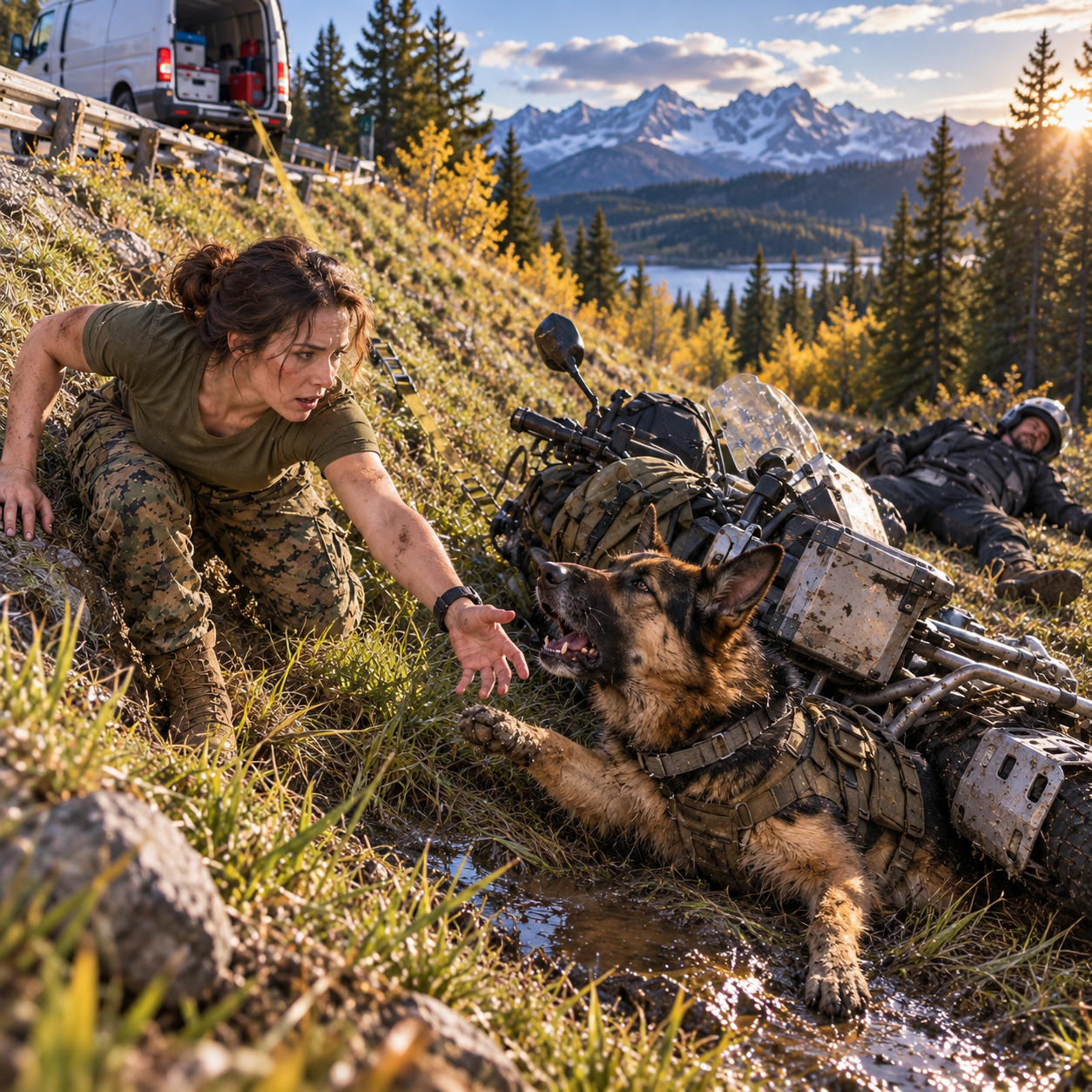
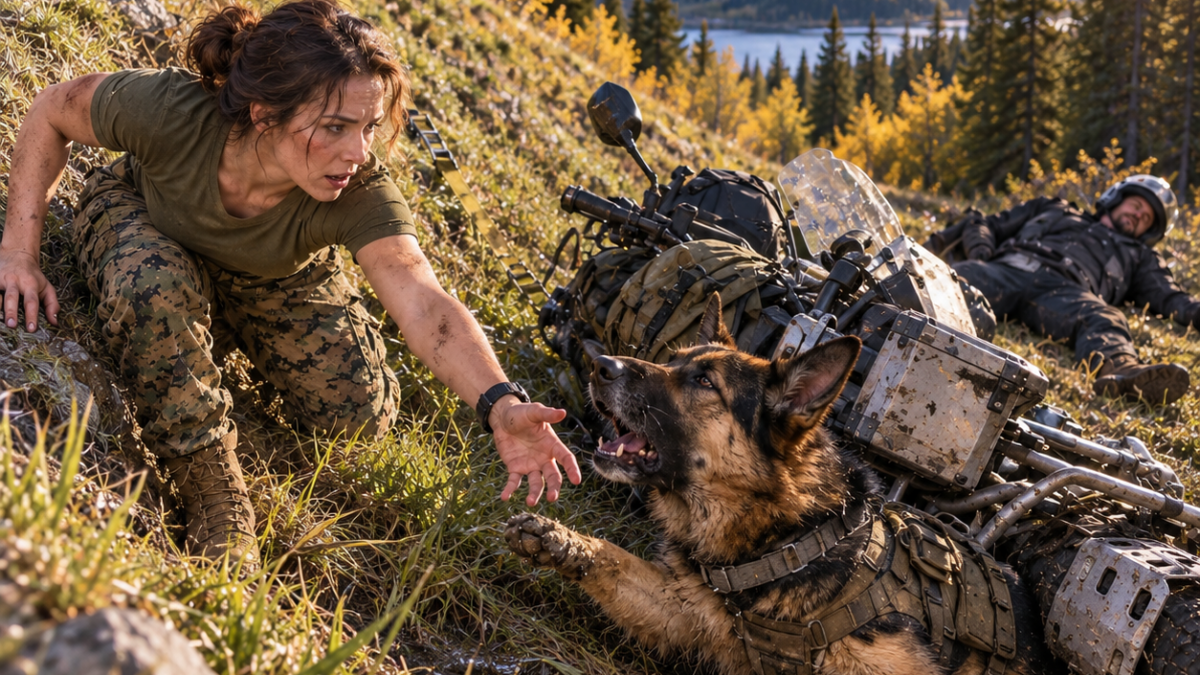
A female marine found a wreck below a deserted Montana milepost nearly 24 hours too late. A doctor lay unconscious nearby while his trapped K-9 had refused to abandon him. Marorrow survived, but the crash took one eye, most of the hearing in one ear and the life he once knew.
15 days later, the wounded dog returned to the motorcycle and froze beside a hidden seam. What police found beneath the seat proved the town had been hunting the wrong man.
But exposing the truth could not answer the only question Maro still carried to his owner’s silent bedside.
The delivery van had been climbing for 2 hours when the navigation screen turned gray. Rowan Hail watched the blue root line disappear beneath a blank square of Montana mountains, then glanced at the paper manifest clipped beside the wheel.
The rural clinic expected six cardiac monitors before sunset. Turning back would cost 90 minutes, and the old county road still appeared on the printed map. She took the western fork.
At 30, Rowan carried the compact strength of a career marine in the set of her shoulders and the economy of her movements. Copper Auburn hair was secured in a low bun, and her olive drab shirt made her look more prepared for field duty than medical freight. She had learned to distrust roads that became too quiet.
This one narrowed between yellow grass and dark pines until even the tires seemed reluctant to make noise. A faded barrier marked a closure left by a spring slide, but one lane remained passable.
Rowan slowed. 50 yards beyond it.
A section of wire fence leaned downhill. Broken black plastic lay in the weeds, too clean to have weathered there.
She stopped beside Mile 117, and walked back. A fresh scrape crossed the gravel shoulder, vanished over the edge, and continued through crushed grass below.
The air smelled of wet stone and cold metal. She called out, heard nothing, then caught a movement near a cluster of young furs.
One upright ear appeared above the grass and disappeared again. The slope revealed the wreck in pieces.
An adventure motorcycle rested against its protective frame, partly tangled with a reinforced canine carrier. Beneath the luggage rack lay a sabled German Shepherd, powerful even in exhaustion, its rear leg trapped in the narrow space between metal and earth. Its coat was dark with rain and dirt.
One eye followed Rowan, the other was swollen closed. Several yards away, a man lay on his side in a riding jacket and helmet. The dog tried to drag itself toward him and could not.
Easy, Rowan said, keeping her voice low. I see him. The shepherd did not welcome her, but it stopped fighting the weight.
Rowan checked the man first without moving his neck. His breathing was shallow, but present. His helmet had taken damage without splitting, and there was no sign of catastrophic blood loss.
His skin was cold. A cracked smartwatch showed its last complete activity record from the previous afternoon, nearly 24 hours.
The realization passed through Rowan like the shadow of a cloud. All night the dog had been close enough to see its owner and unable to reach him.
She returned to the van for blankets, wheel blocks, a hydraulic jack, and cargo straps. The motorcycle stood on unstable ground, so she anchored its frame to the van before touching the jack.
Wooden shipping blocks widened the base. She lifted the machine only a few inches, watching every shift in the soil, then slid a folded cargo blanket beneath the dog and drew him clear.
He made one restrained sound, and turned immediately toward the man. Rowan covered him, left water within reach, and moved to the writer. A sharp flash came from the grass.
For one second, she thought it was water, but the object caught the pale sun again, a curved piece of smoky blue lens beside a streak of white paint. It lay uphill from the motorcycle slide path. Rowan photographed it with the mile marker in frame and flagged the spot with orange survey tape.
She did not pick it up. The road above had held another vehicle. Her satellite unit finally connected.
Rowan gave coordinates, two patients, and the likely duration of exposure.
While waiting, she stabilized the rider’s head, insulated him from the ground, and monitored each thin breath.
A wallet identified him as Dr. Adrien Cross, 39, of Northstar Regional Medical Center.
The dog’s collar carried one word, Marorrow.
Rowan spoke both names aloud, as if giving the empty road something it could return. The weight lasted 31 minutes.
Rowan measured it by Adrienne’s breaths and by the intervals at which Marorrow tried to rise.
She offered the dog water in small amounts, keeping the bowl on his seeing side, and checked the trapped leg without forcing it straight. Whenever the wind moved through the furs, Marorrow lifted his good ear and searched for an engine.
Once he nudged the blanket covering Adrienne’s shoulder, then settled against its edge.
Rowan understood the choice. During the cold night, the dog had likely divided himself between guarding his injured body and keeping contact with the only person he trusted. The knowledge made the silence at mile 117 feel inhabited rather than empty.
The first sheriff’s unit arrived with paramedics, followed by a veterinary transport.
Sheriff Ellen Ward, a lean woman in her early 40s with brown skin, black hair threaded with early silver, and a patient way of looking twice before speaking once, took Rowan’s photographs and secured the lens fragment.
Paramedics moved Adrien to a helicopter landing zone. A veterinary technician examined Marorrow and promised that the injured leg had circulation.
Another vehicle arrived after the scene was taped off. A white Northstar maintenance truck. Its driver, Dale Voss, was a broad man near 50 with clipped blonde hair and a face made heavy by sleeplessness or habit.
He said the hospital had lost a medical sample case assigned to Adrien and had sent him to receive any recovered property. Elena kept him outside the line.
Marorrow had endured uniforms, radios, engine noise, and unfamiliar hands without more than watchful tension. Then he saw Dale.
His body became rigid. A low warning rose from his chest, quiet enough that only Rowan and the veterinary technician heard it.
Dale stopped, glanced at the dog, and placed both hands where everyone could see them. Shock, he said.
Poor animal doesn’t know anyone.
Marorrow knew something.
Rowan could not say what, and she refused to turn an injured dog’s fear into an accusation.
Still, when the helicopter lifted Adrien toward the north and the veterinary van prepared to carry Marorrow east, the shepherd kept his right eye fixed on Dale until Rowan stepped between them. Only then did he look at her. The doors closed on two separate vehicles, taking man and dog in different directions.
Rowan remained beside mile 117 with the wind pulling at the survey tape and the unmistakable sense that the person who had abandoned them had not stayed away.
The helicopter disappeared before Rowan’s delivery manifest stopped trembling in her hand.
She finished the route because the mountain clinic still needed its monitors. But by the time she reached Northstar Regional after dark, the bright corridors felt like another road she had entered without knowing where it led. Adrienne was in surgery.
A nurse could tell her nothing beyond that. Marorrow had been transferred to a veterinary hospital across town where the waiting room smelled of disinfectant and damp fur.
Dr. May Lynn met Rowan near midnight. She was a small, straightbacked veterinarian in her 50s with iron gay hair cut at her jaw and the calm voice of someone accustomed to explaining painful truths without making them cruer.
Marorrow’s spine was intact and the trapped rear leg had suffered muscle damage rather than a major fracture.
His right ear had lost much of its hearing. The left eye could not be saved. He can adapt, May said.
Dogs do not mourn an idea of symmetry the way people do, but he will need someone to teach him where the world moved. The surgery ended before dawn.
Marorrow woke disoriented, the left side of his face protected by a clean dressing. He would not eat.
He tolerated May and the technicians, but pushed himself backward whenever they tried to move him from the kennel. When Rowan entered wearing the same olive shirt from the slope, his remaining eye settled on her. His breathing slowed.
Northstar called while she sat on the floor outside his enclosure. Adrienne had survived surgery. Dr.
Helen Brooks, the neurologist in charge, described diffuse brain injury, a bruised lung, several broken ribs, dehydration, and hypothermia. His brain still showed organized activity, but he had given no purposeful response.
The prognosis was grave, not final.
The words returned Rowan to a military roadside years earlier where she had kept pressure on a friend’s shoulder and promised help was coming.
Help had come. It had not been enough. Since then, Rowan had preferred rescue tasks with measurable endings.
A door opened, a person transferred, a signature obtained.
Adrienne’s survival had no clean edge.
It extended beyond the act of finding him.
Animal control located Marorrow’s microchip and confirmed Adrien as his owner.
The emergency contact listed in the record had died two years earlier. May requested an emergency foster placement because Marorrow responded to Rowan and because a crowded holding facility would complicate his recovery. The county approved 48 hours renewable after review.
Rowan signed carefully. This is not adoption, she told May.
No, May agreed. It is tonight.
Marorrow came home in a padded crate with medication, a support sling, and written instructions.
Rowan’s small rental cabin had never held an animal.
She blocked the stairs, cleared furniture from his path, and placed his bed so his seeing side faced the door.
He refused food until she laid Adrienne’s recovered scarf beside the bowl.
Then he ate three bites and stopped. At dawn, he slept with his right eye turned toward her boots.
The practical work steadied Rowan. Medication at 6, assisted steps at 8, water measured rather than guessed. Marorrow hated the sling, but accepted it when she let him see each buckle before fastening it.
At the porch threshold, he froze, unable to judge the drop on his blind side. Rowan placed her boot against the edge and tapped twice. He tested the distance with one paw and crossed.
It was the first agreement they made that did not depend on Adrienne’s scent.
Back inside, Rowan wrote the method beside May’s instructions as though a few lines of ink could make the unfamiliar house navigable for both of them.
Elena visited that afternoon. The preliminary explanation was fatigue and impaired driving.
A low level of sedative had been found in Adrienne’s blood.
His route records showed long hours, and no second vehicle appeared on the nearest functioning road camera. Rowan described the blue lens and white paint again, then mentioned the sealed travel mug that had been recovered with his belongings.
“If the drug was in the mug, that matters,” she said.
“If it wasn’t, it still matters.”
Elena nodded.
“The mug is sealed.
The lab will handle it.”
The television murmured behind them. A local report showed Dale Voss beside a Northstar truck telling a camera that the hospital was cooperating fully. His image appeared without warning.
Marorrow’s left ear turned toward the sound when he shifted his head and caught Dale with his right eye, his paws pressed hard into the bed.
He backed against Rowan’s leg.
The room went quiet around one small mechanical click from the television. Rowan rested a hand near Marorrow without touching him.
The dog had not recoiled from paramedics, deputies, May, or the hospital courier who delivered Adrienne’s scarf.
His fear had shape. It had a face. Elena recorded the reaction but did not call it evidence.
Recognition can mean many things.
She said, “I know.”
That evening, Northstar approved a supervised visit.
Marorrow traveled in his crate and entered the neurological unit with May’s clearance.
He could not see Adrien through the first door. Yet, he angled toward the room before Rowan guided him. Inside, machines measured what Adrienne could not express.
Marorrow lay beside the bed and placed his muzzle near the hand that did not move. The visit lasted 5 minutes. There was no miracle.
On the way out, Dr. Brooks told Rowan the laboratory had matched the sedative in Adrienne’s blood to residue in his travel mug.
Someone could have placed it there without his knowledge. They did not know who. Rowan looked through the glass at Adrien, then down at Marorrow, who had turned his good eye toward her for direction.
Mile 117 was no longer the end of an exhausted driver’s mistake.
It was where someone had expected a drugged man and his dog to disappear. The road had delivered them to separate doors, but the same hidden hand had closed both behind them. 3 days after the rescue, Elena invited Rowan to the state evidence garage for one purpose.
Keep Marorrow calm while technicians examined Adrienne’s motorcycle.
The dog wore a support sling and moved in short, deliberate steps. Rowan stayed on his left, protecting the side he could not see, and stopped at the yellow line marked for observers.
Everything beyond it belonged to the warrant and the people documenting the search. Sergeant Isaac Cole supervised the examination. He was a tall black man in his late 40s, clean shaven, precise in speech, and unhurried around conclusions.
Cameras recorded every item. The reinforced carrier had protected Marorrow from the full weight of the motorcycle, but its mounting brackets showed a hard lateral strike. White transfer paint marked the frame.
The locator unit was gone, its cable cut cleanly after the crash. The rear cargo case contained an empty insulated sample box. A receipt bore the signature of Nolan Reed, a Northstar driver who had not reported for work since the night of the collision.
Nolan’s fingerprints appeared on the luggage rack and box latches.
Adrienne’s phone held messages demanding that Nolan return a shipment before people were harmed.
A folded map marked an abandoned medical depot west of town. Each discovery narrowed the story in the same direction.
Fleet records placed Nolan’s truck near the old road.
A roadside diner camera showed a man matching him seated one table from Adrien hours before the crash.
Investigators also learned that $10,000 had entered Nolan’s account through a consulting company.
Local news began describing him as a fugitive before Elena had used the word suspect. Elena explained the distinction to Rowan outside the garage.
Nolan’s prints on equipment he transported were expected.
His truck near a work route was suspicious only in context.
The money required tracing and the diner image did not show anyone touching Adrienne’s mug.
None of those cautions survived the evening broadcast where separate facts were arranged into a single confident sentence. Rowan had seen the same thing happen after military accidents. Uncertainty was treated as weakness.
While a clean story sounded like competence, she reminded herself that resisting a premature conclusion did not mean declaring Nolan innocent. It meant leaving enough room for the evidence to remain evidence.
Rowan watched Marorrow rather than the reporters outside. He sampled the air around the motorcycle, ignored the empty box and pulled gently toward the seat.
When the leash stopped him at the evidence line, he lowered his nose and breathed along the floor. The reaction was focused, not fearful.
“What is he trained to find?”
Cole asked.
people, roots, personal emergency gear,” Rowan answered.
May had obtained a summary of Marorrow’s search and rescue records.
Adrienne used the same canvas medical pouch in his drills.
Cole crouched without crossing into the dog’s space.
A seam along the rear seat had been resone with thread, a shade darker than the original. Marorrow pressed his nose toward it and held still. The fluorescent light above them flickered once, and a loose buckle tapped against the frame.
Marorrow flinched toward his deaf side, unable to place the sound, then looked to Rowan. She gave the hand signal May had taught her. Steady, he returned his attention to the seam.
The damaged world had moved again, and he had found his place in it. The warrant covered containers and removable cargo, not destructive examination of the seat. Cole refused to cut it open.
Elena prepared an affidavit for expanded authority using the mismatched thread and the missing locator as physical grounds.
Marorrow’s behavior went in the report only as the reason officers noticed the alteration.
Analysis of the smoky blue fragment produced a second lead.
It matched a lamp assembly used on a series of commercial maintenance trucks, including Northstar’s fleet.
The hospital submitted records stating that every vehicle had returned without damage. Then Cole compared timestamped yard photographs. One truck had worn an older lamp on the evening before the collision and a new assembly by 10 the next morning.
The maintenance entry called it routine replacement. No damaged part had been retained.
The evidence still pointed at Nolan. He had handled the cargo, appeared at the diner, received money, and vanished.
The truck could have been stolen or used with his help. Elena would not clear him because a dog trusted his scent. Rowan respected that caution even as the speed of the public verdict disturbed her.
At the hospital, Morrow was allowed another five-minute visit. Adrienne remained motionless except for the involuntary rhythm of breathing supported by machines. Rowan placed no hope on his hand and asked him no questions.
She simply told him that the motorcycle had been recovered and that Maro had eaten breakfast.
The dog rested his muzzle near Adrienne’s wrist.
Dr.
Brooks watched from the doorway and noted that Adrienne’s heart rate changed slightly when Marorrow settled, then returned to baseline.
She refused to interpret it as awareness. Rowan appreciated the restraint. Hope offered too cheaply could become another kind of harm.
She guided Marorrow away when the allotted time ended, using a hand signal on his right side. He looked back once, memorizing the distance to the bed.
Outside the room, a screen showed Grant Mercer addressing reporters.
Northstar’s director was a silver-haired man with a warm, practiced face and the slightly stooped posture of a doctor accustomed to leaning toward frightened families.
He promised transparency and urged Nolan to surrender. He also said Adrienne had been under great strain. By evening, the judge approved the supplemental warrant.
Cole called Rowan because the seam would be open the next morning. The lab confirmed the thread is newer, he said.
Different material, different age. Someone built a compartment or repaired one.
Rowan looked at Marorrow asleep beside Adrienne’s scarf.
The motorcycle had offered investigators a neat story about Nolan Reed, but its most guarded part told another. Whatever Adrienne had hidden beneath the seat, he had expected someone to search everywhere else first.
Marorrow’s recovery did not move in a straight line.
On the second morning, he refused food until Rowan placed Adrienne’s scarf beside the bowl.
On the fifth, he learned to turn his left ear toward her voice, then walked into a chair because the missing eye had erased part of the room. He stood trembling with anger more than pain, as if the furniture had betrayed a rule he remembered. Rowan moved the chair, but did not empty the cabin of every obstacle.
May said adaptation required a world that remained real. They developed a language of position.
Rowan approached from Marorrow’s seeing side, tapped the floor before touching him, and used broad hand signals in his right field of view.
During sling exercises, he placed the injured leg carefully and searched her face after every third step. His trust did not arrive as affection. It arrived as permission to continue.
May made Rowan keep a recovery log. The pages recorded distance, appetite, balance, and the moments Marorrow startled at sounds he could not locate.
Rowan added observations that had no medical column.
He disliked the kettle’s whistle, preferred morning light, and slept facing Adrienne’s scarf.
The notes prevented bad hours from erasing good days.
They also exposed Rowan’s own habit of measuring worth only through outcomes.
Marorrow could stumble at noon and still have walked farther at dawn. Both facts were true.
Supervised hospital visits divided the days.
Adrienne’s room stayed almost unchanged while Marorrow changed around it.
The dressing came off his face. The swelling receded, leaving a closed scar where the left eye had been. He could walk farther, rest, and walk again.
Adrienne gave no purposeful response. Rowan stopped treating the silence as an empty space she needed to fill.
She reported small facts. Rain on the cabin roof, three bites becoming a full meal.
The first morning, Marorrow waited at the door. Grant Mercer visited on day 12.
In person, Northstar’s director carried his authority quietly.
At 57, he had thick silver hair, pale blue eyes, and careful hands that rarely moved without reason. He spoke of Adrien as a gifted physician who had once stayed through a blizzard to treat stranded families.
Northstar, he said, would cover every bill. He also offered to move Marorrow to a rehabilitation center owned by a hospital partner.
Rowan has county foster authorization, May replied. Changing placement now would set him back.
Grant accepted the answer graciously. When he stepped near Marorrow, the shepherd turned his good eye toward him and sampled the air. His body tightened, though not with the immediate fear Dale had caused.
Rowan noticed a layered odor on Grant’s shoes, hospital disinfectant over machine oil, and the faint plastic scent of insulated packing.
None of it was rare. Together, it reminded her of the sample carrier at the evidence garage. She stored the observation without giving it a name.
Day 15 arrived under clear light. May approved a brief controlled visit to the garage. Marorrow wore a padded support harness and could work for no more than 10 minutes.
Elena and Cole had already opened the seat under the expanded warrant, preserving the seam and adhesive before removing a narrow waterproof compartment. The moment the sealed tray appeared, Marorrow leaned forward.
Inside lay a strip of canvas cut from Adrienne’s familiar medical pouch, a brass key, a memory card, and folded paper.
The canvas explained the dog’s alert.
It carried the target odor from years of training, deliberately placed where Morrow could find it if Adrien could not speak. Cole unfolded the note beneath a camera.
Adrienne’s handwriting had been verified from hospital records.
Four words stood alone. Not Nolan.
Follow Cold Chain. For several seconds, the garage held only the hum of ventilation.
Rowan felt the paws settle through everyone differently. Elena saw a new investigative direction. Cole saw an evidentiary problem to authenticate.
Marorrow saw the piece of the person he had been searching for and reached toward it with his nose. The compartment had not been built during the chase. Adhesive curing and wear marks showed it had existed for days.
Adrien had prepared it before meeting Nolan, anticipating that his visible cargo might be taken. The memory card was encrypted. The key carried a numbered tag from a specimen storage system used by rural clinics.
Financial analysts returned another result that afternoon.
The $10,000 in Nolan’s account had come through Blackpine Consulting, a company with no staff and a mailing address shared by a contractor in Northstar’s distribution network.
The transfer had been initiated after Nolan’s last confirmed public sighting.
It looked less like payment than a label attached to a missing man. Grant responded cautiously when Elena informed him that the investigation had widened.
He suggested Adrienne may have been confused or pressured by Nolan. He offered unrestricted access to hospital records subject to patient privacy and counsel. His cooperation was polished enough to make suspicion feel impolite.
Elena accepted the offer in writing and requested preservation of fleet logs, cold storage records, internal video, and access histories. Grant agreed before council could answer for him.
Rowan saw the exchange from the corridor and understood why the town trusted him. He never pushed against authority. He opened the door, named the rules, and made everyone feel unreasonable for wondering what might have been moved before they entered.
At the neurological unit, Marorrow completed his longest walk since the crash.
He reached Adrienne’s bed without the sling, bearing his full weight, and laid his chin beside the still hand.
Nothing changed on the monitor. Rowan felt the old instinct to leave before Hope demanded too much.
Instead, she pulled a chair closer.
“Not tonight,” she said softly.
Marorrow shifted until his shoulder touched her boot. Adrienne had not awakened, but the message hidden 15 days earlier had done what his body could not. It had told them whom not to hunt and where to look next.
Outside the window, the last light moved over the mountains from one ridge to another, like a road visible only when the angle was right.
Grant Mercer answered Elena’s questions in a conference room overlooking Northstar’s ambulance bay.
He brought counsel, but spoke before the attorney could frame his replies, offering fleet records, internal video, and access logs with the ease of a man opening doors he owned. He described Adrien as brilliant, exhausted, and increasingly suspicious during the previous month. Nolan Reed, he said, had exploited that strain.
Outside, a volunteer group hung banners for Northstar’s winter charity drive.
Grant’s name appeared beneath photographs of rural clinics, rescued budgets, and smiling families.
He had guided the hospital through near bankruptcy, funded free examinations, and persuaded donors to keep emergency rooms open across three counties.
Suspicion against him had to pass through years of public gratitude before it reached anyone’s mind.
The brass key from Adrienne’s hidden compartment belonged to a specimen locker at Pine Hollow Clinic, closed since summer repairs.
Elena obtained a warrant.
Rowan accompanied the team only because Marorrow’s foster agreement and search history made her his handler.
The shepherd moved slowly, Scar turned away from doorframes, his right eye checking Rowan’s hand whenever the building changed around him.
Locker 214 contained inspection seals peeled from approved devices, a defective infusion valve, serial number lists, and a photograph of Adrien beside Nolan among stacked cartons. Nolan was thick set with a dark beard graying at the chin and weary eyes that made the still image look defensive.
A jacket bearing his name hung from a hook. Marorrow approached it without fear and lay down, the trained indication for a familiar safe scent.
Inside the pocket, technicians found gauze carrying Adrienne’s blood and several strands of Marorrow’s fur.
The discovery appeared damaging until laboratory analysis showed the gauze had wrapped a wound. The stain pattern came from pressure and contact, not an assault.
Adhesive residue matched a roadside first aid kit registered in Nolan’s truck.
A service station archive added context. Days before the crash, its camera had recorded Adrien unsteady but walking, supported by Nolan after a disturbance beyond the frame. Marorrow followed close, unharmed.
Nolan cleaned a minor injury on Adrienne’s arm, offered the dog water, and drove them away.
The man described as Adrienne’s enemy, had already brought him to safety once.
The recovered image froze on the screen with a soft electronic chime.
Marorrow raised his head at Nolan’s voice, then rested it again.
Rowan watched the dog choose calm. Records could be rearranged. His body remembered how a person had treated him.
Cole reconstructed the earlier rescue from ordinary details.
The gauze wrapper had Nolan’s fingerprint beneath the fold, placed there before it touched blood.
A receipt showed he bought bottled water and bandages 10 minutes before the service station recording.
Adrienne’s minor injury had been cleaned, wrapped, and checked again.
Nothing proved Nolan was innocent of later crimes, but it destroyed the claim that the stained jacket showed violence. Elena amended the public timeline without identifying protected evidence.
The correction received a fraction of the attention given to the accusation. At the clinic, Marorrow also found a shallow scrape along the locker base.
Technicians recovered a broken plastic seal printed with the same lot prefix as the defective valve.
The seal had no evidentiary meaning until serial analysts compared it with Northstar’s purchase database.
It belonged to an approved device officially delivered to a mountain clinic. Yet that clinic possessed a different unit under the same number.
One identity had been given to two machines. The fraud was no longer a theory built around missing cargo.
It had a measurable duplicate.
Grant dismissed the footage as proof that Nolan had earned Adrienne’s confidence before betraying it.
His explanation was possible, which made it useful.
He then released a statement urging Nolan to surrender and promised that Northstar would protect Adrienne’s reputation regardless of what the investigation uncovered.
Digital auditors found that the fleet account used on the night of the collision belonged to a dispatcher dead for 3 years. Both Dale and Grant had authority to restore archived credentials during emergencies.
The action had been routed through an administrator terminal, but a maintenance window erased the local identifier. Elena could show access, not identity.

