Deputy Bullied Disabled Woman Alone — Until a Navy SEAL and K9 Arrived – Part 2
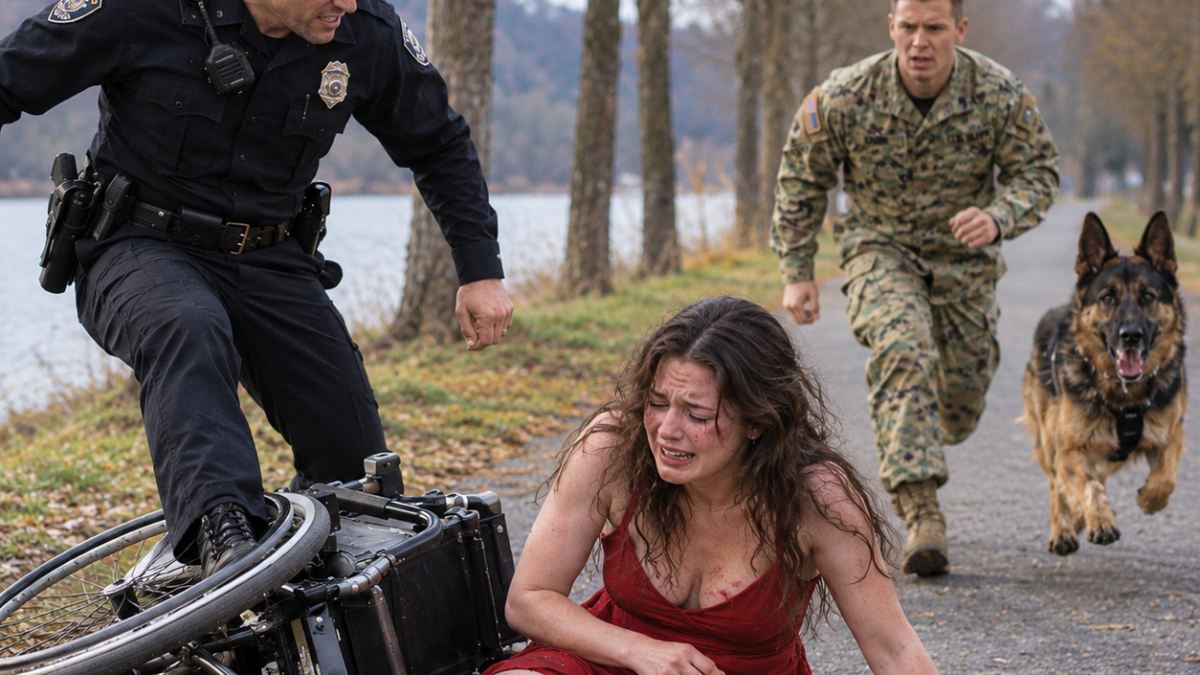
When men like that panic, they start talking to supervisors, to colleagues, to whoever will listen. And every version of the story they tell is slightly different from the last one.
That’s what we want.
We want him talking. Emily absorbed this.
You’ve done this before, she said.
Not this exactly, Daniel said. But close enough. There are patterns his in how people respond when they realize a situation they thought was controlled is no longer controlled.
Cole thought he was leaving a park last night with a disabled woman on the ground and no witnesses. He is this morning recalculating an entirely different set of variables. He looked at her.
That recalculation costs him. Every hour he spends thinking about it costs him.
Sandra was watching Emily carefully. How are you doing? She said not professionally, personally.
Emily thought about the honest answer. The honest answer was complicated. The honest answer involved two months of grief that had been temporarily displaced by 45 minutes of something that required her full operational capacity.
And the grief was still there, still waiting, still living in a brown armchair by a window. But sitting alongside it now was something else.
Something that had an edge and a direction.
I’m okay, Emily said.
Sandra’s mouth moved in something that was almost a smile.
I’ve heard that before from people in your position, she said.
Usually what they mean is I am keeping it together long enough to do what needs to be done.
That’s what I mean.
Emily said, “Good,” Sandra said.
“Keep doing that.”
They worked for another hour at that table. Sandra made notes and asked specific questions about the sequence of physical events. She asked about the exact language Cole had used at each stage.
She asked about the citation that had been voided and whether Emily had retained any portion of it. and Emily said no. He had not given her any paper.
And Sandra wrote something down and underlined it twice.
She asked about the state of Emily’s wheelchair prior to that evening and whether there was any existing documentation of its condition.
And Emily said she had a maintenance record from a service appointment 8 weeks ago.
And Sandra said, “Get me that document today.
” Daniel sat across from them and was mostly quiet.
He spoke when Sandra addressed him directly, which was not often, and he refilled Emily’s coffee without being asked when he went for his own.
And Ranger stayed under the table and occasionally pressed his head against Emily’s ankle in a way that was so subtle and so steady that she almost did not notice it until she did.
And then she did not stop noticing it.
At 12:40, Sandra’s phone buzzed.
She looked at it. Something changed in her face. Emily watched the change.
What? She said. Sandra set the phone down face up on the table so they could both see the screen.
It was a text from a number identified as a colleague at her firm.
It said, “FYI, County Sheriff’s Department called the office 20 minutes ago asking if we represent Emily Carter.
I said I couldn’t confirm or deny.”
They left a number for a Sergeant David Marsh and said he want to speak with Carter’s attorney at her earliest convenience.
Emily stared at the screen. Daniel made a sound.
It was quiet and short and it was not quite a laugh, but it was something adjacent to it. He panicked, he said.
He panicked. Sandra confirmed. She picked up the phone.
They called my office, which means Cole talked to someone last night or early this morning, which means someone in that department is already trying to get ahead of this. She looked at Emily, which means they are already afraid of what you have.
Emily felt her heart rate do something she had not expected. Not fear, not relief, something closer to the feeling of ground solidifying under your feet after a long time of walking on ice. They think I have an attorney, Emily said.
As of this morning, you do, Sandra said.
They’re calling you before we even file.
Emily said, which tells us, Sandra said that they know something is wrong.
They don’t know what we have yet.
They’re reaching out to find out.
She set the phone down.
We don’t call back yet.
Let Sergeant Marsh wait.
Every hour he waits is an hour he’s wondering.
Daniel had his laptop open again. He turned it toward Emily.
While you were talking, he said, “I found Patricia Dano.”
Emily looked at the screen, a Facebook profile. A woman in her late 50s, Sandyhaired, in a profile photo standing in a garden with her arms around two teenagers who were clearly her grandchildren. She looked like a woman who had learned to present the parts of herself that were uncomplicated.
She’s still in the county, Daniel said.
Lives on Hartwell Road. I have a phone number. Emily looked at the photo for a long moment.
She looked at the face of a woman who had filed a complaint against Ryan Cole and then withdrawn it, who had spent 11 months not talking about it.
“Can I be the one to call her?”
Emily said. Sandra and Daniel both looked at her.
I think Emily said that hearing from another woman, not a lawyer, not a former soldier, another woman who was in a similar situation, I think that might be different. Sandra was quiet for a moment. It could backfire.
She said she might not want to revisit it. She might feel cornered or Emily said she might have been waiting for someone to call her for 11 months. Sandra looked at Daniel.
Daniel looked at Emily. Okay. Sandra said.
Emily dialed from the number Daniel showed her. It rang three times.
A woman’s voice answered cautious.
Hello, Miss Delano.
Emily said, “My name is Emily Carter.
I don’t know if you remember filing a complaint against a deputy Ryan Cole about 2 years ago.”
Silence.
Not the silence of someone who doesn’t know what you’re talking about.
The silence of someone who knows exactly what you’re talking about and is deciding what to do with the fact that you’ve said it.
I remember Patricia Dano said. Emily took a breath. Something happened to me last night.
She said with the same deputy and I’m sitting right now with an attorney and and a witness who both believe we have a strong case, but I wanted to call you first before any of the official things happen because I thought you deserve to know that you weren’t the only one.
Silence again, longer this time. Then Patricia Dano said in a voice that was very quiet and very controlled in the specific way of someone who has practiced keeping something in. What did he do to you?
Emily told her. She told her the way she had told Sandra that morning chronologically precisely without editorial.
She heard Patricia’s breathing change on the other end of the call about three sentences in became shallower faster.
When Emily finished, Patricia said, “He grabbed your chair from behind.”
Yes, Emily said without asking. Another pause.
He did that to me, Patricia said. Not a wheelchair.
My arm. I was standing in my own doorway.
And he grabbed my arm and moved me to the side like I was a door he needed to open.
And when I told him he couldn’t do that, he said I was obstructing a welfare check and that he could detain me if I kept being difficult.
Her voice wavered at the edges. Then steadied.
I filed the complaint because my daughter made me. I withdrew it because two weeks after I filed it, I found a county vehicle parked outside my house for four straight evenings.
Not doing anything, just parked. Emily felt the air go out of the room. Daniel had heard enough of the conversation from across the table that his expression had gone somewhere, very still and very focused.
Sandra was writing. Miss Delano, Emily said carefully.
Would you be willing to speak with an attorney? A long pause.
He’s not going to get away with this one, is he?
Patricia said it was not quite a question. It was more like something she was testing out loud, trying the shape of it. Not if I can help it, Emily said.
Patricia Delano said, “Give me the attorney’s number.”
Emily looked across the table at Sandra Okafor, who was already sliding her business card across the table. Emily read out the number.
When the call ended, Emily set her phone down on the table and her hands were not entirely steady. Sandra was already dialing. Daniel was looking at Emily with the expression she was coming to recognize as his version of something deeply felt kept precisely managed.
You did that well, he said quietly. She was waiting, Emily said.
She’s been waiting 11 months for someone to call.
A lot of people wait, Daniel said. Most of them never get the call. Sandra ended her brief call and looked at them both.
Patricia Delano is willing to supplementary witness statement describing her own incident with Cole and the fact that she withdrew her complaint under what she will now characterize as an atmosphere of intimidation. She set her phone down. We now have a pattern, a documented, dated, corroborated pattern with physical injury, eyewitness testimony, photographic evidence, and a prior victim who was intimidated into silence.
She looked at Emily.
“Miss Carter, I want to file today.”
Emily said, “Then file today.”
Sandra gathered her papers and made a call from the table that lasted 6 minutes and involved language. Emily only partially followed jurisdictional specifics and statute numbers and procedural terminology that turned what had happened at a lake on a Tuesday night into something with official dimensions.
Daniel closed his laptop.
Ranger emerged from under the table and sat beside Emily’s chair without being called.
Emily put her hand on his head.
She was thinking about Cole this morning, about where he was right now, whether he was on patrol, whether he had been called into his sergeant’s office, whether he had spent the night revising and rehearsing his version of events, polishing the story he planned to tell.
She was thinking about how certain he had been standing over her in the dark. That what he had done was contained, that she was just a disabled woman alone in a closed park with no one watching.
She was thinking about how wrong he was. Her phone buzzed.
A text from a number she didn’t recognize.
She opened it.
It said, “Miss Carter, this is Sergeant David Marsh, Mil Haven County Sheriff’s Department.
I understand there may have been an incident at Mirror Lake Park last night involving one of our deputies. I want to assure you that we take all complaints seriously and I would very much like to speak with you directly at your earliest convenience to discuss what happened.
Please call me at your earliest convenience. Emily read it twice. Then she turned the phone around and showed it to Daniel and Sandra.
Sandra read it.
He’s not calling it a complaint yet.
She said he’s calling it an incident.
That’s intentional.
They want to get you on the phone before you have legal representation locked in so they can characterize whatever you say as informal. She looked at Emily. Do not respond to that text.
I wasn’t going to, Emily said.
Good. Sandra stood.
I’m going to the office to file.
I’ll have a confirmation number for you by 3:00.
She looked at Emily with a direct professional gaze she had maintained through the entire morning. Miss Carter, what happened to you last night was not an aberration. It was not a misunderstanding.
It was the result of a man who has been operating in a system that protected him from the consequences of his behavior. And that system is about to be asked to account for itself.
She paused. That process is not going to be short.
It is not going to be comfortable. There will be moments when it feels like nothing is happening.
when everything is happening and there will be moments when it feels like the wall isn’t moving even when it’s about to fall.
She put her hand briefly on Emily’s shoulder, the careful kind, asking before it landed, “Are you ready for that?”
Emily thought about the night before the ground, the cold, the man standing over her, the weight of two months of grief underneath all of it. She thought about Patricia Delano waiting 11 months for a phone call that finally came.
She thought about her mother’s voice, saying, “The people who decide you are small are always the ones who are afraid of of how big you actually are.”
“Yes,” Emily said.
“I’m ready.”
Sandra Okafor left. Daniel sat across from Emily, and the coffee shop moved around them with its ordinary Tuesday afternoon sounds, and neither of them said anything for a moment.
Then Daniel said, “You should eat something.
You haven’t eaten since you sat down.”
Emily looked at him.
“How do you know that?”
Because I watched you hold that coffee cup for 2 hours and drinkly four sips, he said. And because the last time you probably ate was before you drove to the lake last night. Emily considered arguing with this.
Then she considered that he was correct. Okay, she said. Daniel signaled for a menu.
Ranger put his head on Emily’s knee and somewhere across town in a county sheriff’s department that had spent seven years protecting a pattern it was about to be forced to name.
A deputy’s phone buzzed with a notification he had not yet learned to fear as much as he should.
The filing was in.
Sandra’s confirmation number came through at 2:57 in the afternoon.
Emily was at home when it arrived, sitting at her kitchen table with her maintenance records for the wheelchair spread out in front of her.
the service appointment from 8 weeks ago, the technician’s notes describing the footrest joint as fully functional with no existing damage, the receipt with the date, and the technician’s signature.
She had already photographed all of it and sent it to Sandra’s email.
She had photographed her elbow again at noon, the bruise darker now, more defined, the shape of the impact precise enough that Sandra had texted back within minutes saying, “That photograph is going to do a lot of work.”
When the confirmation number came through, Emily stared at it for a long time. It was 11 digits. It looked like nothing.
It looked like a tracking number for a package.
And yet, it meant that what had happened Tuesday night at Mirror Lake Park had crossed from the territory of her word against his into the territory of an official record that existed in a state database with a timestamp and a case number and a civil rights attorney’s name attached to it.
She texted it to Daniel immediately. He called her 30 seconds later.
“Good,” he said.
“How are you feeling?”
“Strange,” Emily said.
“It feels real now in a different way than it felt real last night.”
“That’s normal,” Daniel said.
“Last night it was survival.
Today, it’s a process.
Processes feel different than survival.
Less adrenaline, more weight.”
Emily looked at the maintenance records on her table. Sandra said 72 hours were critical.
She said, “We’re already most of the way through day one.
The filing is in.”
Daniel said. Sandra sent the letter to Sheriff Bower this afternoon as well. He has until Thursday at 5 to respond formally.
Emily did not know the sheriff’s name until that moment.
Thomas Bower.
She had lived in this county for 3 years and she had never had reason to know his name and now his name was on a letter sitting on his desk that had her name on it and a case number from the state attorney general’s office attached to it.
What’s he like?
Emily said the sheriff. A brief pause. I did some reading this afternoon.
Daniel said Thomas Bower 17 years in the department sheriff for the last six ran unopposed in the last two elections.
has a reputation for being steady and politically careful, which usually means he doesn’t make waves and doesn’t appreciate waves being made.
Daniel paused again.
He’s also the man who reviewed the second complaint against Cole 2 years ago and found that Cole had acted within policy guidelines.
Emily felt something shift in her chest. He protected him, she said. He closed the complaint, Daniel said.
Whether that’s protection or incompetence or both, I don’t know yet.
But it means he has a personal stake in how this resolves.
Because if the state AG’s office finds that Cole had a pattern of misconduct, the next question is going to be why that pattern was never caught internally.
He let that land.
Bower is not just managing Cole’s problem.
He’s managing his own.
Emily sat with that for a moment. The chessboard was bigger than she had understood it to be 48 hours ago.
It was not just a deputy and a park and a Wednesday morning complaint. It was a department and a sheriff and seven years of closed files and a system that had been quietly deciding who deserved protection and who did not.
Daniel Emily said, “Yeah, how does this usually end?”
She said she asked it without softening it. She needed the real answer, not the encouraging one.
Cases like this when it’s one person against a department in a small county, how does it usually end?
The silence lasted 4 seconds. Honestly, Daniel said. Emily said inconsistently, he said.
Sometimes it produces change and sometimes it produces nothing and often it produces something in between that feels like nothing until 3 years later when something shifts because of the groundwork that was laid.
I’m not going to tell you this is guaranteed to end with Cole losing his badge.
I don’t know that.
He paused. What I know is that before Tuesday night, there were three closed complaints against him and a pattern that existed only a pattern, not as a named, documented, legally pursued thing. As of 257 this afternoon, it is a named, documented, legally pursued thing.
And named things are harder to ignore than unnamed ones. Emily breathed. Okay, she said.
Okay, Daniel said, “Get some sleep tonight.
Tomorrow is going to be busy.”
She almost asked him why tomorrow was going to be busy. Then she decided she would find out tomorrow and let tonight be tonight.
She ate dinner, real dinner, not just toast, because Daniel had made her eat a real lunch and she’d noticed that food was helping in the direct biological way that she sometimes forgot to when grief made eating feel beside the point.
She sat at her table and ate and looked at the brown armchair and thought about her mother. Her mother had been a woman who wrote letters, not emails.
Letters on actual paper in her small, precise handwriting, to elected officials and newspaper editors and schoolboard members and anyone else she felt needed to hear from a private citizen who had something to say. Emily had grown up watching her mother sit at this same kitchen table with her good stationery and her fountain and and compose paragraphs that were unfailingly polite and utterly unambiguous about what she wanted and why.
She had written to her state representative four times about accessible sidewalk funding. She had written to the county health department about a clinic that had removed its accessible parking without notice. She had never received a response that satisfied her and she had never stopped writing.
Emily had always found it quietly heartbreaking.
Her mother’s faith in the letter.
The idea that sitting down and writing clearly and honestly to the right person in the right words would eventually produce the right result. Now she sat at the same table in the same kitchen and realized she was doing the same thing. Different medium, different mechanism, but the same fundamental act.
The act of a person who refuses to accept that what happened to them does not matter to anyone with the power to address it. She washed her dishes and went to bed.
She slept better than the night before. In the morning, Daniel texted at 7:52.
Patricia Dano wants to meet with you today if possible. Her house 11:00. Sandra will be there.
Emily typed back.
I’ll be there.

