Deputy Bullied Disabled Woman Alone — Until a Navy SEAL and K9 Arrived – Part 5
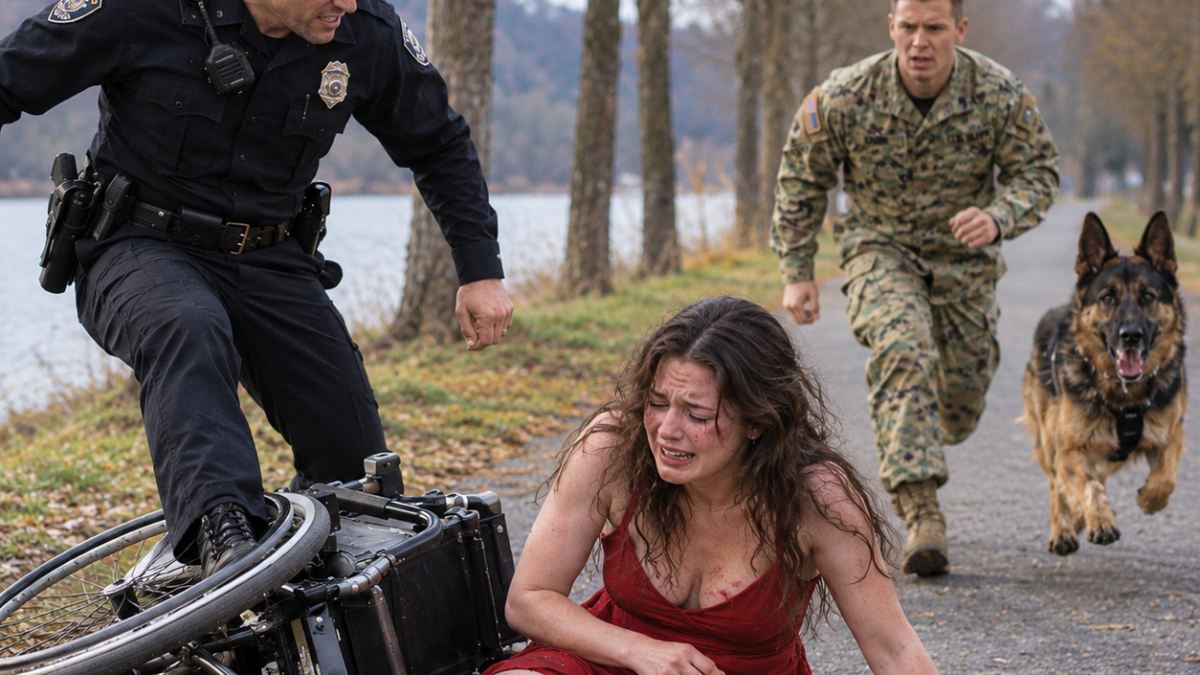
The fact that your account and his account describe the same physical event with irreconcilable differences is significant. The fact that we now have a prior complainant who withdrew under circumstances that suggest intimidation supported by journal documentation of vehicle surveillance is very significant. He closed his notebook.
I am not in a position to tell you what the outcome of this investigation will be, but I can tell you that this case is not going to be filed in a drawer. Emily sat across from Robert Chen in a small interview room and listened to the first official voice in synthe process say out loud that what had happened to her was not going to be filed in a drawer.
She did not cry. She had gotten very good at not crying at the moments when the feeling arrived at its strongest.
But Sandra’s hand found hers briefly under the table.
A small and precise contact and Emily pressed back once and let go.
“Thank you,” Emily said.
They were outside 30 minutes later.
Daniel was leaning against his truck, the same same position he had been in that morning in Emily’s driveway and Ranger was beside him and both of them looked up when Emily and Sandra came through the door.
Daniel read Emily’s face in about 2 seconds.
Good, he said. Not a question. Good, Emily confirmed.
Sandra stayed for another 10 minutes to debrief. And then she had another meeting and she left with the particular energy of a woman who was moving from one important thing to to to another important thing and found that pace sustaining rather than draining. Emily watched her go.
Then it was just Emily and Daniel and Ranger in the parking area. You hungry?
Daniel said.
Always apparently when you ask Emily said they went to the same coffee shop on Main Street where they had sat with Sandra 4 days ago and they took the same corner table and Ranger took the same position under the table at Emily’s feet.
The coffee shop was busy with the Monday lunch crowd, and the ordinary sounds of it, orders, and conversation and the door, were the same ordinary sounds they had been on Wednesday. And the contrast between the ordinary and the enormous thing that had just happened in a small room 20 minutes away was so complete that Emily felt it almost as a physical sensation.
He said, “It’s not going to be filed in a drawer,” Emily told Daniel.
Daniel looked at her steadily.
“Good,” he said again.
simply.
He said the documentation was among the most thorough he’d received at intake.
Emily said, Daniel nodded. You told me to write it down, Emily said.
The night it happened. You told me to write everything in order before I slept.
You’re the one who did it, Daniel said.
At 11:43, Emily said 15 minutes before Cole filed his version. Daniel looked at her across the table and something moved through his expression that was not surprise because he had known about the time stamp since Thursday, but was something else. Something that had to do with what 15 minutes meant.
What it meant that a woman on the ground in a closed park in the cold had understood before she even got back into her damaged chair that the truth needed to be written before the other version could take hold. Your mother taught you to write things down.
Daniel said it was not a question. Emily looked at him. How do you know that?
Because you write the way someone writes who was taught that writing matters. He said, not like someone who started because they had to.
Like someone who always knew. Emily thought about the kitchen table, the good stationery, the fountain pen, the letters to people who needed to hear from a private citizen who had something to say. She did.
Emily said she wrote letters her whole life to representatives, to board members, to editors. She believed the right words addressed to the right person would eventually matter.
She was right, Daniel said. Emily looked at him.
Most of the time they didn’t produce any visible result, she said.
Most of the time visible result isn’t the point, Daniel said.
The point is that you said it, you named the thing.
You put it in writing and you sent it and you didn’t stop.
That’s what your mother did.
That’s what you did Tuesday night.
That’s what you’ve been doing all week.
He paused. Named things are harder to ignore than unnamed ones.
Your mother knew that. Emily sat with that.
Then she said, “What happens to you after this?
When the case runs its course?”
Daniel looked slightly surprised by the question. Not uncomfortable, surprised. What do you mean?
He said, “You said you came back from service 14 months ago.”
Emily said, “You said you were trying to find your purpose.
The crisis documentation work. Is that it?
Is that what you’re building?”
Daniel looked at his coffee cup for a moment. When he looked up, his expression was the most open. Emily had seen it.
The careful management slightly relaxed. The way people look when a question has found something they have not fully articulated yet, even to themselves. I spent 22 years doing a specific thing in a specific way for a specific reason, he said.
And when that ended, I kept waiting to feel done. Like the mission was complete, and now there was an after. He paused.
There isn’t an after.
There’s just what you do next.
And what I can do next is help people who end up in situations where the official record doesn’t match reality, and they don’t know how to change that.
He looked at her.
Tuesday night was the first time I showed up somewhere and it wasn’t a practice run.
It was real and it mattered and I knew exactly what to do. Emily looked at him.
It wasn’t a coincidence, she said.
No, Daniel said.
It wasn’t.
Ranger pressed against Emily’s ankle.
6 weeks later on a Wednesday morning in late November, Emily Carter received a call from Sandra Okafor at 8:15. Emily was in her kitchen.
The brown armchair was still by the window. She had sat in it three times since the Thursday night she had first lowered herself into it and each time was slightly different from the last. Slightly less like loss and slightly more like presence.
She did not think this was healing exactly. She thought it was more like learning the actual shape of something rather than the shape you feared it had.
Emily. Sandra said I need you to sit down.
I’m already sitting.
Emily said good.
Sandra said the AG’s investigation concluded faster than any of us anticipated.
Robert Chen called me 20 minutes ago. A brief pause that was doing something.
Emily could tell that Sandra was allowing for effect. Deputy Ryan Cole has been placed on unpaid administrative leave pending a formal disciplinary hearing.
The county sheriff’s department has received a civil rights compliance directive requiring mandatory retraining on ADA related conduct for all patrol deputies.
The directive specifically cites the pattern of complaints identified in our filing and Patricia Datano’s supplementary statement.
Another pause and Sheriff Thomas Bower has announced he will not seek re-election. Emily heard those words in the order they were delivered and let each one settle before the next one arrived.
Cole on leave, mandatory retraining, compliance directive. Bower not seeking reelection.
the falsification finding.
Emily said the incident report pre-existing mechanical issue under review by the county district attorney’s office.
Sandra said Chen told me that the inconsistency between Cole’s report and the technical assessment from Gil Hartman combined with the timestamp evidence has been referred for a separate inquiry.
That process has its own timeline. Emily sat at her kitchen table in the quiet of a Wednesday morning and held the phone and breathed.
Emily Sandra said her voice was different now, softer around its professional edges. This is not everything.
Cole hasn’t lost his badge yet.
The DA’s inquiry could take months.
The disciplinary hearing will be contested. There will be more to do. I know, Emily said.
But today, Sandra said, “What we set in motion on Wednesday afternoon, 6 weeks ago, produced a real result, a compliance directive with your case cited as the basis.
a pattern named officially in a state document. A prior complainant vindicated. She paused.
Patricia Dano cried when I told her.
Emily thought about Patricia’s hand on the blue journal with the unit numbers.
The woman who had spent 11 months thinking about a choice she made because she was scared. Is she okay?
Emily said. She said she feels like she can breathe again.
Sandra said. Emily looked at the brown armchair. She called Daniel next.
He answered on the second ring, which meant he had been near his phone, which meant he had probably known Sandra was calling this morning. I heard, he said. Sandra told you already.
She texted me 2 minutes ago, he said.
She said, “Call Emily.
She’s going to need someone to be happy with.”
Emily laughed. The same slightly broken laugh she had produced when Marcus mentioned the good coat, but fuller this time.
More room in it.
“Are you happy?”
Daniel said. Emily thought about the question honestly.
I’m something, she said.
I keep coming back to that word.
I’m something.
The something keeps changing, but it’s always something forward.
That’s the right answer.
Daniel said, “How’s the elbow?”
Fully healed.
Emily said, “The bruises gone, the chair fully repaired,” she said.
Gil did excellent work. And the other thing, Daniel said he did not specify.
He did not need to. He meant the thing that had been there before Tuesday night. The grief, the apartment, the chair by the window, the soup with the right amount of salt.
Emily looked at the brown armchair. Still there, she said, but different. Less like a wall and more like a door.
A brief pause.
That’s progress, Daniel said.
Yeah, Emily said it is. She asked about Ranger. Daniel said Ranger had caught a tennis ball that morning with a particular satisfaction of an animal who had decided that retirement included certain pleasures that active service had not permitted.
Emily said that sounded right. Daniel said he agreed before she hung up.
Emily said, “Daniel, yeah, what you did?”
She said, “Not just Tuesday night, all of it.
The photographs and the calls and the coffee shop and driving me on Monday and all of it.”
She paused, finding the words.
I’ve been trying to figure out how to say thank you in a way that means what I actually mean by it.
And I can’t find a way to do that that feels sufficient.
So, I’m just going to say it and hope, you know, there’s more behind it than the words.
Daniel was quiet for a moment.
Then he said, “You did the work, Emily.
You wrote it down. You asked for the procedural basis. You called Patricia.
You sat in that interview room and you answered every question precisely.
And you didn’t let anyone rewrite what happened.
He paused. I was a witness.
That’s what I was.
The work was yours. Emily held the phone. Ranger helped.
She said Daniel’s voice shifted with something that might, if you were listening carefully, have been what a man who had spent 22 years in Esposians operations sounded like when he was close to something.
He did not allow himself often. Yeah. He said Ranger helped.
3 weeks after that, on a Saturday in December, Emily drove to Mirror Lake Park.
She drove the 3 mi up the mountain road in the early afternoon, the same road she had driven four or five nights a week for 4 months to sit at the water’s edge after her mother died.
She had not been back since the night of the incident. She had told herself she would go back when it felt right. And she had waited for the feeling.
And this Saturday morning, she had woken up and understood that the feeling had arrived without announcing itself, the way feelings sometimes do. Daniel met her in the parking area.
He was already there when she pulled in, leaning against his truck. Ranger beside him.
Both of them looking toward the park entrance with a particular quality. Two beings who have learned to wait without impatience. Emily operated her lift and rolled out and they looked at each other for a moment in the December air.
“Ready?”
Daniel said.
“Yes,” Emily said.
They went in through the main entrance, not the service road, the front entrance, past the green sign that said, “Park closes at dusk,” which Emily read as she rolled past it the same way she always had and felt differently about than she ever had before.
They
walked the path to the lake. Daniel and Ranger on one side of Emily, the other side open, the three of them moving at a pace that was easy and unhurried and not performing anything for anyone. The park was mostly empty on a December Saturday.
A man with a dog in the distance, a couple near the other end of the water.
When they reached the spot at the lakes’s edge where Emily always sat, the three of them stopped.
The water was still. The mountains behind it had their winter color, the deep gray brown of bare trees against pale sky. The air was cold and clean in the way December air in mountain towns is clean, the kind of cold that makes you aware of being alive in a direct and uncomplicated way.
Emily sat at the edge and looked at the water. She thought about Tuesday night in October.
The gravel and the footsteps and the single word ID, the hands on the handles, the ground coming up fast, the cold and the dark, and the feeling of being alone with something too heavy. She thought about four words. I saw what happened.
She thought about her written account sent at 11:43.
She thought about Patricia Dano’s blue journal with the unit numbers.
She thought about Donna Reeves on her porch with the folded paper and Gil Hartman writing on shop letter head and Sandra Okafor’s voice saying not going to be filed in a drawer woman he was protecting.
She thought about her mother’s letters, the fountain pen and the good stationery and the faith that the right words addressed to the right person would eventually find their mark.
She thought about sitting in the brown armchair for the first time in 3 months and feeling not only loss but presence. Ranger pressed against her wheel and stayed there.
Emily put her hand on his head.
“Thank you,” she said quietly.
“Not to Daniel.
To the dog, to the animal who had frozen in the dark on a Tuesday night, because he heard something wrong and made a choice.”
Ranger was warm and steady and entirely present, the same as he had always been, the same as he would be. Daniel said nothing. He stood beside her and looked at the water and let the moment be what it was.
Emily looked at the lake. She had come here for four months to escape the weight of grief.
To find the 20 minutes before dark that belonged only to her, to sit beside something that did not remind her of anything she had lost. She had needed that.
She did not regret it. The lake had given her what she had come for.
But sitting here now on a December Saturday afternoon with a retired Navy Seal and a retired military dog beside her and a state compliance directive with her case number on it in a filing system somewhere. The lake gave her something different.
It gave her back not to what she had been before October or before August or before the 18 months of her mother’s illness.
Not to any version of herself that existed before the accumulating weight of the last 2 years to what she was now. A woman who had been on the ground in the dark and had not stayed there.
A woman who had written the truth 15 minutes before someone tried to replace it. A woman who had called a stranger who had been waiting 11 months for someone to call.
A woman who had sat in her mother’s chair and felt presence alongside loss and understood that both could exist in the same place without one erasing the other.
A woman whose disability had never taken her dignity, no matter how many times someone with authority tried to make her believe otherwise. Emily Carter looked at Mirror Lake on a December afternoon and she was not the same person who had driven here on Tuesday nights to survive.
She was something harder than that now and something more open at the same time. Which was the paradox of people who have been tested and come through.
That the testing makes you both tougher and more human simultaneously. That the wall you build is not around yourself but around the thing you are fighting for. She was fighting for the right to exist in the world without someone else deciding what that existence was worth.
And she had learned in the six weeks since a Navy Seals dog heard her fall that she was not alone in that fight.
That there were people who wrote things down, who kept journals with unit numbers, who showed up at doors with folded papers because 3 years ago they hadn’t and they were not going to make the same choice again.
that there were attorneys who moved their interview up 4 days because something was already in motion. That there were investigators who said not going to be filed in a drawer and meant it. And that sometimes when the night is at its worst and you are on the cold ground and no one is supposed to be watching, someone is watching.
Not because the universe arranges protection for people who deserve it because it does not. because the world is not built that way.
And Emily Carter was honest enough to know it, but because sometimes a man and his dog are on a trail and the dog freezes and the man follows his instincts.
And those four words, “I saw what happened,” are enough to change the shape of everything that comes after.
Ranger lifted his head from under Emily’s hand and looked at her.
She looked back at him.
“You started it,” she told him.
His amber eyes held hers clear and steady and completely certain. And Emily Carter turned back to the lake and she breathed the December air and she was exactly where she was supposed to be doing exactly what she was supposed to be doing which was living her life in the full and complete and unddeinished way that had always been her right.

