Part 2: “I need to know you’re not after my son’s money.”
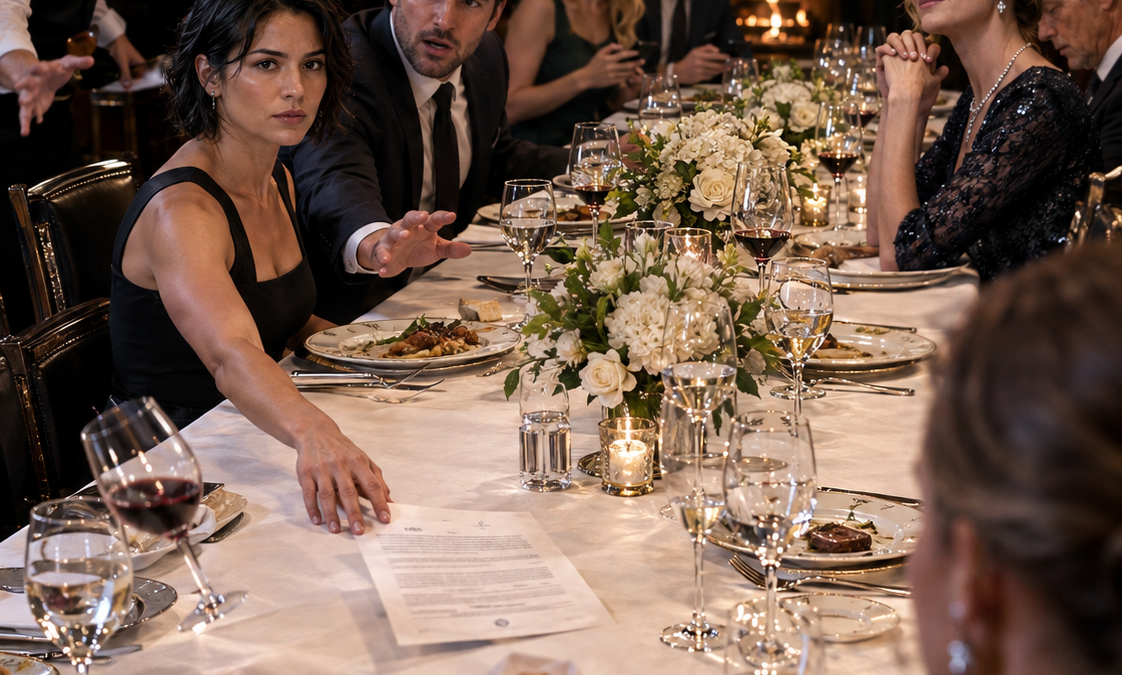
PART 6 — THE HEARING
The disciplinary hearing was held in a conference room on the fourteenth floor of a state office building downtown. There was no jury. There was no judge. There was a panel of three attorneys, a court reporter, and a stack of documents on the table.
I arrived at 8:30. Anika was already there. She had on a dark suit and a string of pearls. She looked like she could eat a man alive.
“You ready?” she asked.
“I’m ready.”
“Good. Because Dunhill is here. And he brought his own lawyer.”
I looked across the hall. Charles Dunhill was standing by the window, talking in low tones to a woman in a gray suit. He was a tall man, silver-haired, with the kind of patrician bearing that comes from a lifetime of being the most important person in the room. He didn’t look at me.
Diane was not there. Yet.
We went into the hearing room. We sat down. The panel introduced themselves. The court reporter started the recording.
And then the door opened.
Diane walked in.
She was alone. She had on a dark blue dress and no jewelry. She looked older than I had ever seen her.
She sat in the back row. She didn’t look at me.
The hearing began.
Charles Dunhill was called first. He was sworn in. He testified that he had accessed financial records of family members as part of routine estate planning. He testified that he had shared those records with Diane as part of his professional duty. He testified that he had never done anything wrong.
Anika cross-examined him.
“Mr. Dunhill,” she said. “Did you access the financial records of Kevin Whitmore without his consent?”
“I did so as part of—”
“Did you access the financial records of Marcus Whitmore without his consent?”
“I was acting in the best interests of the—”
“Did you access the financial records of Elena Vasquez-Reyes without her consent?”
Dunhill paused.
“I was asked to do so by my client.”
“Who is your client?”
“Diane Whitmore.”
“And did you inform Elena Vasquez-Reyes that you were accessing her records?”
“No.”
“Did you inform her that you were sharing them with Diane Whitmore?”
“No.”
“Did you obtain a warrant or a subpoena?”
“No.”
“So you accessed the private financial records of a person without her knowledge, without her consent, and without any legal authority to do so?”
Dunhill’s face was red.
“I was acting on behalf of my client.”
“Who is not Elena Vasquez-Reyes.”
“No.”
“Thank you.”
Anika sat down.
The panel asked a few more questions. Dunhill’s lawyer objected to some of them. The panel overruled. Dunhill testified for another hour.
Then it was my turn.
I stood up. I walked to the witness chair. I sat down. I raised my right hand. I swore to tell the truth.
Anika asked me the questions.
I answered them.
I told them who I was. I told them about my service. I told them about my business. I told them about my investments, my accounts, my portfolio. I told them about the paper Diane had put on the table at my rehearsal dinner. I told them about Roland Trask and the polygraph machine. I told them about the phone call I had received on my wedding night.
Then Anika asked me one more question.
“Ms. Vasquez-Reyes,” she said. “Is there anything you would like to say to the panel?”
I looked at the panel. Then I looked at Diane.
“Yes,” I said. “There is.”
I turned to face the room.
“Mrs. Whitmore,” I said. “You wanted to know if I was after your son’s money. You hired a man to put me on a lie detector machine. You tried to humiliate me in front of your family. You tried to make me prove I was worthy of your son.”
Diane looked at me. Her face was pale.
“But you never asked me the real question,” I said. “You never asked me who I was. You never asked me what I had done. You never asked me what I had built. You just assumed that because I didn’t come from your world, I couldn’t possibly be worthy of your son.”
I reached into my purse.
I pulled out a single sheet of paper.
“This is a summary of my personal financial holdings,” I said. “It was prepared by my financial manager, David Chen, who works for a firm called Meridian Capital. It lists all of my accounts, all of my investments, and all of my real estate holdings.”
I set the paper on the table in front of the panel.
“The total net worth listed at the bottom of this page is approximately fourteen million dollars,” I said. “Which, as of the date of this hearing, is more than the combined net worth of Diane Whitmore and her husband, Gerald.”
The room was silent.
Diane’s mouth opened.
“That’s—” she started.
“That’s the truth,” I said. “You can verify it. Mr. Chen is here. He’s prepared to testify. The records are available. Every dollar is documented. Every dollar was earned honestly, through my service and my business and my investments.”
I turned to face her.
“You wanted to know if I was after your son’s money,” I said. “I’m not. I never was. And now you know why.”
Diane stared at me.
She didn’t say anything.
She couldn’t.
Anika stood up.
“The witness is excused,” she said.
I stood up. I walked back to my seat.
I sat down.
Anika leaned over.
“That was good,” she said.
I didn’t answer.
I just looked at the paper on the table.
The number was still there.
Fourteen million.
I had earned every penny.
PART 7 — THE VERDICT
The panel took two hours to deliberate.
Anika and I waited in the hallway. Marcus arrived at noon — he had been at work, but he had taken the day off when he heard the hearing was going forward. He sat next to me. He didn’t say anything. He just held my hand.
Diane stayed in the hearing room. I don’t know what she was doing. I don’t know what she was thinking.
At two o’clock, the panel called us back in.
The chair of the panel, a woman with gray hair and a no-nonsense expression, read the findings.
The bar found that Charles Dunhill had violated multiple rules of professional conduct. He had accessed confidential financial records without authorization. He had shared those records with a third party without consent. He had failed to maintain the confidentiality of his clients. He had engaged in conduct involving dishonesty, fraud, deceit, and misrepresentation.
The panel recommended that Dunhill be suspended from the practice of law for three years and that he be required to complete an ethics course before he could be reinstated.
Then the panel turned to Diane.
“The panel has determined,” the chair said, “that Diane Whitmore directed her attorney to access confidential financial records of family members without their knowledge or consent. The panel finds this conduct to be a serious violation of privacy and an abuse of the attorney-client relationship. The panel is forwarding its findings to the district attorney’s office for review of potential criminal charges.”
Diane’s face went white.
She stood up.
“This is absurd,” she said. “I was protecting my family.”
The chair looked at her.
“Mrs. Whitmore,” she said. “You were not protecting your family. You were violating the law.”
Diane stared at her.
Then she turned and walked out of the room.
After the hearing, Marcus and I walked out of the building together. The sun was bright. The city was loud. People were walking by, carrying coffee, talking on phones, going about their lives.
Marcus didn’t say anything for a long time.
Then he stopped walking.
“Elena,” he said.
I turned.
“I’m sorry,” he said.
“For what?”
“For not seeing it. For not seeing her. For not seeing what she was doing.”
I looked at him.
“You saw it,” I said. “You just didn’t know how to stop it.”
“That’s not good enough.”
“No. It’s not. But it’s what happened.”
He swallowed.
“What happens now?” he asked.
“I don’t know,” I said. “What do you want to happen?”
He looked at me.
“I want to be married to you,” he said. “I want to build a life with you. I want to have kids with you. I want to be your partner. I don’t want to be my mother’s son anymore. I want to be your husband.”
I looked at him.
“Okay,” I said. “Then that’s what we’ll do.”
He took my hand.
We walked to the car.
We drove home.
The story didn’t end there. It couldn’t.
Diane was charged with two counts of unauthorized access to confidential records. The case was plea-bargained down to a misdemeanor. She paid a fine and agreed to a year of probation. She also agreed to a restraining order that prohibited her from contacting me or Marcus without our consent.
Gerald filed for divorce three months later. He had known about the spying, it turned out, but had never said anything. He had let his wife control the family for forty years because it was easier than fighting her. When the scandal broke, he decided he was done.
Claire cut off contact with Diane. She and Kevin went to counseling. They’re still together. They had a baby last spring.
Charles Dunhill was suspended from the practice of law. He moved to Florida. I don’t know what happened to him after that.
Roland Trask lost his certification. He closed his office and retired.
Marcus and I bought a house on the west side of town — a small place with a big yard. We have a dog. We have a garden. We have a life.
Diane lives alone now. She doesn’t see her children. She doesn’t see her grandchildren. She has money and a house and no one to share it with.
I don’t feel sorry for her. I did what I had to do.
But sometimes, late at night, I think about the paper on the table at that rehearsal dinner. I think about the look on her face when she realized who I really was. And I think about something my old team leader used to say, back when I was young and angry and thought that strength was something you showed.
He used to say: “The strongest person in the room is the one who doesn’t need to prove it.”
I didn’t need to prove it. I just needed to survive. And I did.
PART 8 — THE QUIET AFTER
The summer after the hearing, Marcus and I went to El Paso.
It was the first time I had been back in four years. My mother had died the year before — a stroke, sudden, no warning. I had flown in for the funeral and flown out the next day. I hadn’t stayed. I hadn’t been able to.
But now I wanted to go back. I wanted to see the house. I wanted to walk the streets I had grown up on. I wanted to show Marcus where I came from.
We drove. It took two days. We stopped in a small town in New Mexico and ate dinner at a diner where the waitress called us “hon.” We stayed the night in a motel with a pool that was closed and a sign that said “NO REFUNDS.”
The next morning we drove into El Paso.
The house was smaller than I remembered. A one-story bungalow on a street with cracked sidewalks and a chain-link fence. The yard was dry. The paint was peeling. A young woman with a toddler on her hip was standing on the porch, talking on the phone.
I pulled up across the street. I didn’t get out.
“You okay?” Marcus asked.
“Yeah,” I said.
“You want to go in?”
“No. It’s not my house anymore.”
We sat there for a while.
“My mother worked two jobs,” I said. “She worked at a nursing home during the day and a dry cleaner at night. She came home at ten o’clock every night and made dinner. I used to wait up for her. I used to sit on the porch and watch for her car.”
Marcus was listening.
“She never had new clothes,” I said. “She never went on vacation. She never bought anything for herself. Everything went to me. Everything.”
“Did she know?” Marcus asked. “About what you did? About what you became?”
“She knew I was in the Marines. She knew I was in Recon. I didn’t tell her the details.”
“Why not?”
I looked at him.
“Because I didn’t want her to worry,” I said. “And because some of it I couldn’t tell her. Some of it was classified. And some of it was just too hard to say out loud.”
He reached for my hand.
“She would be proud of you,” he said.
I smiled. Just a little.
“Yeah,” I said. “She would.”
We sat there for another minute. Then I started the car.
“Come on,” I said. “I want to show you the school I went to.”
We spent the rest of the day in El Paso. We drove by my old school. We ate lunch at a restaurant that had been there since I was a kid. We walked through the plaza downtown and looked at the murals.
That night, we checked into a hotel. I took a shower. I put on a T-shirt and shorts. I sat on the bed and looked at my phone.
There was an email from Anika.
The district attorney had decided not to pursue criminal charges against Diane. The statute of limitations had expired. The civil case was still pending, but it was unlikely to go anywhere.
I read the email. I set the phone down.
Marcus came out of the bathroom.
“What?” he said.
“Diane’s not going to be charged,” I said.
He sat down on the bed.
“Are you okay?” he asked.
“I don’t know,” I said. “I wanted her to face something. Something real.”
“She faced the bar. She faced her family. She faced me.”
“That’s not the same thing.”
“No. It’s not.”
He took my hand.
“But it’s what happened,” he said. “And we’re still here. We’re still together. We’re still alive.”
I looked at him.
“Yeah,” I said. “We are.”
He kissed me.
“Come on,” he said. “Let’s go get dinner.”
We found a restaurant on the river. Outdoor seating, string lights, a view of the water. We ordered margaritas and tacos. We ate and talked and watched the sun go down.
At one point, a man at the next table overheard us talking about the military. He leaned over.
“Excuse me,” he said. “I couldn’t help but hear. Were you in the service?”
I looked at him. He was a man in his sixties with a thick mustache and a Vietnam-era hat.
“Yes,” I said. “Marines.”
“Semper fi,” he said.
“Semper fi.”
He nodded. He went back to his table.
Marcus looked at me.
“You don’t talk about it much,” he said.
“No.”
“Why not?”
I thought about it.
“Because it’s not something you talk about,” I said. “It’s something you carry. It’s something you live with. It’s not a story you tell at dinner parties.”
He nodded.
“I want to know,” he said. “Someday. When you’re ready.”
I looked at him.
“Okay,” I said. “Someday.”
We finished our dinner. We walked back to the hotel. We fell asleep with the window open and the sound of the river in the background.
It was a good night.
PART 9 — THE REUNION
Two years later, I got a call from Tanya.
“You remember Sergeant Cruz?” she asked.
“Of course.”
“He’s dying.”
I stopped what I was doing.
“What?”
“Cancer. It’s bad. He’s at a hospice in San Diego. He’s been asking about the old team.”
I sat down.
“When?”
“They think a few weeks. Maybe less.”
“I’ll be there.”
“Good. I’ll send you the address.”
I hung up.
Marcus was in the kitchen. He came out when he heard me.
“What’s wrong?” he asked.
“Sergeant Cruz. My old team leader. He’s dying.”
He sat down next to me.
“I’m sorry,” he said.
“I need to go to San Diego.”
“I’ll come with you.”
“You don’t have to.”
“I know. I want to.”
I looked at him.
“Okay,” I said.
We flew out the next morning.
Sergeant Cruz was in a small room in a hospice facility near the ocean. He had lost weight. His skin was gray. But his eyes were the same — sharp, clear, watching.
He smiled when he saw me.
“Vasquez,” he said. “You came.”
“I came.”
He reached up and took my hand.
“You look good,” he said.
“You look like hell.”
He laughed. It turned into a cough.
“Still a smartass,” he said.
“Still a Marine.”
He nodded.
We sat with him for hours. Other members of the team came and went. We told stories. We laughed. We cried. We talked about the ones who weren’t there anymore.
At one point, Sergeant Cruz looked at me.
“You remember the ditch?” he asked.
“Yeah,” I said. “I remember.”
“You were the toughest damn Marine I ever served with,” he said. “You know that?”
I didn’t say anything.
“I mean it,” he said. “When we pulled you out, I thought you were dead. You weren’t breathing. You weren’t moving. But you came back. You always came back.”
I looked at him.
“I learned it from you,” I said.
He smiled.
“No,” he said. “You learned it from yourself. You just didn’t know it yet.”
He died three days later.
I was in the room when it happened. Tanya was there. Two other members of the team were there. We held his hands and we told him we loved him and we watched him go.
It was the hardest thing I’ve ever done.
At the funeral, I wore my dress blues.
I hadn’t worn them in years. They still fit. I stood at attention while they played taps. I folded the flag. I presented it to Sergeant Cruz’s widow.
She took it and held it to her chest.
“Thank you,” she said.
“He was a good man,” I said.
“He was.”
She looked at me.
“He talked about you all the time,” she said. “He said you were the best he ever trained.”
I didn’t say anything.
“He said you were going to do something important with your life,” she said. “He said you were going to make a difference.”
I looked at her.
“I hope I did,” I said.
“You did,” she said. “You were there for him at the end. That’s what matters.”
She hugged me.
I held her for a long time.
That night, Marcus and I sat on the balcony of our hotel room and looked at the ocean.
“You okay?” he asked.
“I don’t know,” I said.
“You want to talk about it?”
I thought about it.
“When I was in the service,” I said, “I learned that you don’t leave anyone behind. No matter what. No matter how bad it gets. You go back. You get them out. You bring them home.”
Marcus was listening.
“Sergeant Cruz was the one who taught me that,” I said. “He was the one who came back for me when I was in the ditch. He was the one who pulled me out.”
“He was a good man,” Marcus said.
“He was the best.”
I looked at the ocean.
“I’m going to miss him,” I said.
“I know.”
We sat there for a long time.
PART 10 — THE AFTER
A year later, Marcus and I had a daughter.
We named her Rosa, after my mother. She has my eyes and his laugh. She is the best thing that has ever happened to me.
I think about the life I want for her. I think about what I want to teach her. I want to teach her to be strong. I want to teach her to be kind. I want to teach her to stand up for herself. I want to teach her to stand up for other people.
I want to teach her that she doesn’t have to prove anything to anyone.
I want to teach her that the strongest person in the room is the one who doesn’t need to prove it.
Diane never met Rosa.
She tried, once. She sent a letter. She said she was sorry. She said she wanted to make amends. She said she wanted to be part of her granddaughter’s life.
I read the letter. I thought about it for a long time.
Then I wrote back.
I said: “You had a chance to be part of my life. You chose to try to destroy it. You had a chance to be part of Marcus’s life. You chose to spy on him and lie to him. You had a chance to be part of your daughter’s life. You chose to violate her trust and invade her privacy. I don’t know if you’re sorry. I don’t know if you mean it. But I do know that some things can’t be undone. And some trust can’t be rebuilt. I wish you well. But I don’t want you in my daughter’s life.”
I sent the letter.
She never wrote back.
Marcus and I are still married. We’ve been married for five years now. We have a house and a dog and a daughter and a life.
I don’t think about Diane much anymore. She’s a part of my past. A part of my story. But she’s not part of my present.
What I think about is my mother. I think about the way she worked two jobs and never complained. I think about the way she sat on the porch and watched the sun go down. I think about the way she told me, when I was leaving for boot camp, “You’re going to do great things. I know it.”
I think about Sergeant Cruz. I think about the way he smiled at me when I walked into the hospice. I think about the way he held my hand. I think about the way he told me I was the toughest Marine he ever served with.
I think about the ditch. I think about the night I almost died. I think about the way my team pulled me out and brought me home.
I think about the woman I used to be. The woman who was afraid. The woman who didn’t know who she was.
I’m not that woman anymore.
I’m a mother. I’m a wife. I’m a veteran. I’m a businesswoman. I’m a survivor.
I’m Elena Vasquez-Reyes.
And I don’t need a lie detector to prove it.