ASSASSIN Entered the ICU to Kill a NAVY SEAL — Until ONE NURSE Ruined His Entire Mission – Part 2
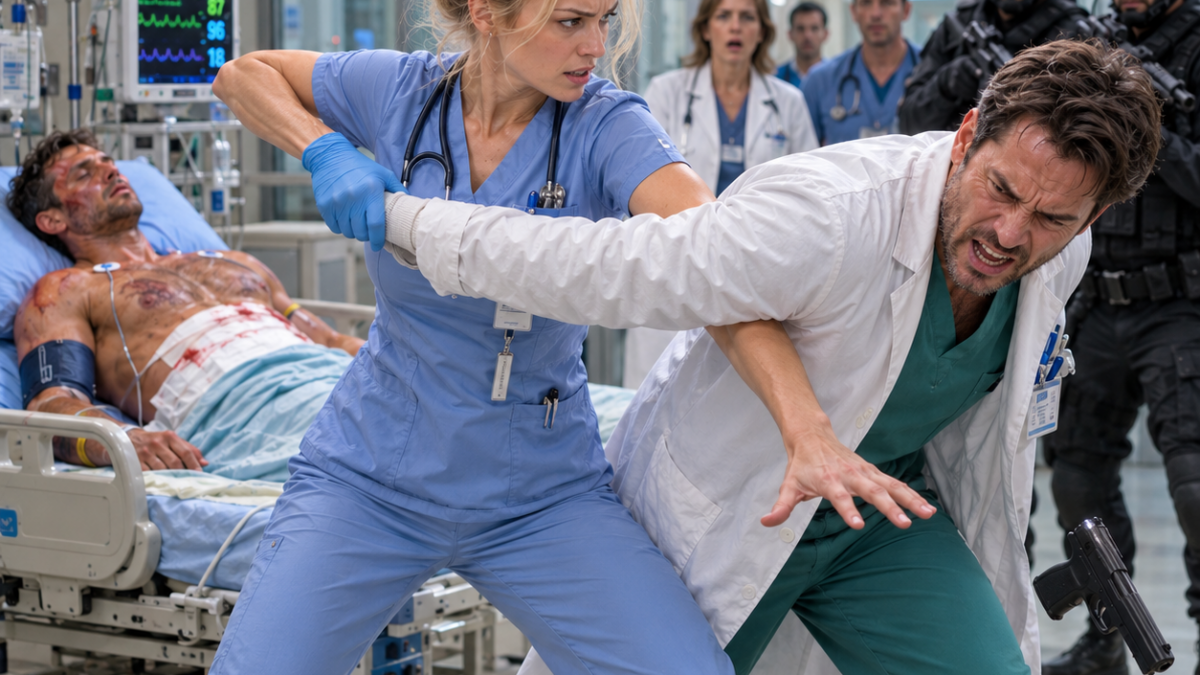
He was quiet for a moment. She could see him working through the sedation haze, pulling himself toward coherence through sheer will.
“Something happened tonight,” he said.
Not a question. Yes. Stopped.
Yes. He looked at the ceiling again.
His jaw worked. How? He said.
She looked at him calmly. There was a nurse on duty.
A long pause. His eyes came back to her. He was still putting it together.
She could see it happening behind his eyes. The slow reconstruction.
And then something else appeared in his expression.
Something she didn’t fully expect.
Not surprise, not confusion, concern.
They’ll try again, he said.
I know, she said. He tried to move, pushing himself upward against the mattress with one arm.
She put a firm hand on his shoulder and held him down with exactly enough pressure. Not yet, she said.
You don’t understand what I Commander.
Her voice was quiet, but it landed precisely. He stopped. She met his eyes.
I understand the situation better than you think. And right now, what you need to do is stay still.
Can you do that? He looked at her. The calculation was back like reading her, reading the room, reading whatever it was that people like him read when they were trying to understand what they were dealing with.
His arm relaxed. Yeah, he said. The word was almost nothing.
Good. She went back to charting.
At 5:47, she heard footsteps in the corridor that were different from the federal agents footsteps. Purposeful but civilian fast.
She looked up. Dr. Avery Tolman, chief medical officer of Hartwell General, was walking toward the nurses station in a cashmere coat and a face arranged into professional concern.
He was 61 years old, silver-haired, and moved through the hospital the way men of his stature moved through things they owned. Not quickly, not urgently, but with a settled authority that expected the world to organize itself around his arrival.
He hadn’t been called in.
Nobody on the third floor had called him. He had come on his own. Emily watched him come down the corridor and felt the air on the floor change in the specific way that a room changes when something has crossed over from threat to evidence.
She looked at Briggs stationed near the stairwell. He had already seen Tolman. His hand was at his radio.
His eyes found Emily’s and in them was a look she recognized from a completely different life.
The look of a person holding still because moving too soon would cost them everything they’d built toward in the last several hours.
Tolman reached the nurse’s station.
He looked at Emily with the polished, practiced expression of a man in complete control of his narrative.
“Miss Vasquez,” he said, “I heard there was an incident tonight.
I came to make sure staff were supported.”
He smiled, the kind of smile that boards of directors found reassuring.
“Are you all right?”
Emily looked at him. She thought about the camera on the fourth floor repositioned in the dark. She thought about the phone ping 6 hours ago from an office two floors above her.
She thought about the man in zip ties whose shoulder she had pulled apart in room 9, who had walked in with two new scrubs and the calm of someone who had been told the floor was secure. She thought about Rowan Tiger lying in room 9 with a cracked rib and evidence in his memory that someone in this building had spent considerable effort trying to bury. She kept all of that off her face.
I’m fine, Dr.
Tolman, she said. Thank you for coming in.
She reached for her pen. I was just updating the patient chart, she said. Would you like to wait or the stairwell door opened?
Briggs came through it. He was not alone.
Behind Briggs came two people Emily hadn’t seen before.
a man and a woman, both in dark jackets with federal identification already displayed on lanyards, moving with the specific economy of people who had been awake for a long time and had learned to operate cleanly inside that state.
Behind them came the man who made rooms reorganize, whose name Emily still didn’t have.
And behind him came someone in army dress uniform whose rank insignia Emily clocked in under a second brigadier general with a J A branch identifier on the lapel. A military lawyer. At 5:47 in the morning, Tolman turned at the sound of the stairwell door.
His expression held for a beat. the practiced version, the board of directors version, and then something shifted in it that was very small and very telling.
Not fear, more like the micro reccalibration of a man who had walked into a room expecting to hold all the cards and had just noticed the deck was different than he remembered. He recovered quickly.
Agent Briggs, he said smoothly. I was just checking on our staff.
Dr. Tolman.
Briggs stopped about 6 ft away.
He didn’t extend his hand.
We actually need a few minutes with you. Of course.
Tolman’s smile didn’t waver.
My office here is fine. A pause.
Brief. Loaded.
Here. Tolman repeated. His eyes moved around the corridor.
The agents, the uniform general, Emily at the nurses station.
Priya frozen near the medication al cove with a chart she’d stopped pretending to read.
here. Briggs said again.
The JAG officer stepped forward and said, “Dr.
Avery Tolman, I’m Colonel Dana Marsh, Judge Advocate General’s Corps.
We need you to come with us for questioning related to an ongoing federal investigation.
You are not under arrest at this time.”
She said it cleanly, precisely, the language worn smooth by practice.
However, I would strongly advise you not to access any communications devices until we’ve concluded our conversation.
Tolman looked at her, then at Briggs, then at the man who made rooms reorganize. He looked briefly at Emily. Something passed through his eyes then that Emily would think about later.
Not guilt exactly, or not only guilt. something more complicated, something that looked for just a second like the expression of a man who had told himself a story about who he was for a very long time and had just felt it develop its first crack. He turned back to Colonel Marsh.
I’ll want my attorney, he said.
That’s your right, she said.
You can make that call once we’re in the consultation room.
He nodded once, adjusted his cashmere coat with the small reflexive gesture of a man reasserting his dignity. Then he walked down the corridor ahead of them without being led, which was, Emily thought, a very specific kind of performance.
The performance of a man who intended to control the narrative of his own walk to a federal interview. Briggs waited until the group had moved past, then looked at Emily.
“You good?”
he said.
“Yes.”
She watched the consultation room door close at the end of the corridor.
“Did you have enough before he walked in, or did walking in give you something?
Walking in gave us something. He paused.
Specifically, the fact that nobody called him.
Shift supervisor didn’t call him.
Administration didn’t call him.
Nobody in this building had his number on a contact list for an incident notification at this hour. He looked at the closed door.
He came because he needed to see what had been contained and what hadn’t.
And he didn’t know you’d already tied the ping to his office.
No. Emily looked at the consultation room door.
Then she looked at Priya, who was still standing near the medication al cove, and she recognized the expression on Priya’s face.
It was the expression of someone absorbing information that retroactively rearranged the furniture of their entire recent past. The charge nurse had worked at Hartwell for 7 years.
She had worked under Tolman’s authority for all of them.
Emily went back to the nurse’s station and sat down.
She pulled Commander Tiger’s chart and updated his waking observation, time, responsiveness, verbal coherence, pain assessment.
She noted the movement in his left arm and the deliberate self-inventory. She wrote it all down the way she wrote everything down, exactly without editorializing in the language of clinical fact.
Her hands were steady. Her coffee was cold. She drank it anyway.
At 6:10, the dayshift began filtering in. The first nurse through the door was a woman named Rosalyn Park, who had 12 years on the floor and an almost physical sensitivity to the atmosphere of a unit. She could tell within 30 seconds of walking onto a floor whether the night had been difficult, and she could tell degrees of difficulty the way a sailor reads wind.
She came through the door, stopped, and looked at the federal agents, the military people, the consultation room with its closed door, and Emily at the nurses station at 6:00 in the morning with a cold coffee and an expression that gave away nothing.
“Okay,” Roslin said slowly.
“What happened?”
Emily began the handoff briefing. She was 20 minutes into it, covering patient status, medication changes, the incident documentation, the chain of clinical events, when the consultation room door opened and the JAG colonel came out, crossed to Briggs, and said something in a voice too low for Emily to catch. Briggs listened, nodded once, and walked quickly toward the elevator.
Whatever had happened in that room had moved something. Rosalind, to her credit, kept her eyes on Emily and her attention on the handoff.
The man in room 9, she said. What do I need to know clinically?
He’s awake as of 57 minutes ago.
BP is stable in a range I’ve been adjusting towards since 0230.
The shoulder wound is clean, but he’s going to want to pick at the dressing.
Watch for that.
He’s alert and oriented, but don’t let him convince you he’s more mobile than he is.
Emily paused.
He’ll try.
Noted. Rosalyn made a note.
and the situation around him. Federal case active.
You’ll have two agents on the door.
Anything clinical goes through you. Anything else goes through agent Briggs.
Rosyn looked at the closed consultation room door. Is that Dr. Tolman in there?
Yes. Rosyn said nothing for a moment.
Then, “All right.”
She was a good nurse. She took what was given, processed it efficiently, and moved. Emily finished the handoff, collected her bag from the locker, and was walking toward the elevator when Pendleton came around the corner from the stairwell.
He was still in his street clothes, which meant he’d been in the building since she’d last seen him and hadn’t left.
He looked tired in the way that people look tired when they’ve spent several hours with information they haven’t been able to resolve.
He stopped when he saw her. She stopped. The corridor was empty of other staff at this exact moment, which meant the thing that happened next happened without an audience, which was, Emily thought, probably better for both of them.
He said, “I owe you an apology.”
She waited.
“Not just for tonight,” he said.
He looked like the words had cost him something to locate.
“They probably had.”
“I’ve been,” He stopped.
“I’ve been doing the thing where I decide what someone is before I look at them properly.
I’m good at it.
It’s a bad habit I’ve gotten good at.
He looked at the floor briefly, then back at her.
I’ve been doing it to you for 14 months.
Emily looked at him. He was not a bad person.
She’d never thought he was a bad person.
She’d thought he was a specific type of person, capable, confident, and therefore incurious about his own blind spots.
And she’d understood that such people didn’t usually change unless something made the cost of not changing visible enough to be unavoidable.
Something had. I know, she said.
I’m going to do better, he said.
Okay. He looked at her.
That’s it.
That’s it.
She said, I’ll see you tomorrow.
She went to the elevator. She was almost at the lobby when her phone buzzed.
A text from a number she didn’t recognize.
Don’t leave the building.
Briggs’s number, she assumed, since nobody else had it.
She stopped in the lobby. She turned around. She went back upstairs.
At 7:15, she was in a different consultation room on the fourth floor, a larger one, clearly an administrative space, with an actual conference table and chairs that didn’t have foam coming through the upholstery.
The man who made rooms reorganized was at the head of the table. Colonel Marsh was to his right.
Briggs was standing near the window and next to him was someone new. A woman in civilian clothes who carried herself with the particular posture of someone whose job involved being unremembered. Not invisible, just unmemorable.
The kind of person whose presence in a room never quite registered until after they’d left it.
Emily sat down.
“Dr.
Tolman is being taken into federal custody,” the man at the head of the table said.
No preamble. He made several statements during the interview that implicated himself in a communication chain that goes back approximately 11 months.
He wasn’t the originating source of the breach.
He was a conduit. Someone used him. Used him?
How? Emily asked. Financial pressure initially.
His private medical practice has been running at a deficit for about 3 years.
Malpractice settlement 2 years ago that wasn’t fully covered by insurance.
He started providing scheduling information to a third party approximately 11 months ago.
Didn’t know the full downstream use of it initially.
The man paused. By the time he did, he was in deep enough that stopping felt more dangerous than continuing.
Emily sat with that for a moment. The texture of it, a man not fundamentally criminal, but fundamentally cornered, and the ways those two things could produce the same outcomes. Who was he passing to?
She said.
That’s what we’re working, Briggs said from the window.
The chain above Tolman is still opaque.
What we know is that whoever is at the top of it had enough access to operational intelligence to know about Commander Tiger’s extraction and his transit timeline.
That’s not a low-level contact.
The woman who carried herself to be unremembered spoke for the first time.
Her voice was precise and slightly flat, the voice of someone who’d learned to drain effect out of delivery because effect left traces.
What we need, she said, is Commander Taigga to be stable enough to provide a full debrief before whoever sits at the top of that chain identifies that tonight’s operation failed and moves to second contingency.
Emily looked at her.
What’s second contingency?
A pause.
We don’t know, the woman said.
Which is the problem? Emily thought about Rowan Taigga in room 9.
awake now with cracked ribs and a sedation hangover and something locked in his memory that had already gotten people killed and would get more people killed if it didn’t get out of him and into the right hands in time.
What’s his current clinical picture?
The man at the head of the table asked. Improving, Emily said.
But he’s not ready for a full debrief.
His cognitive load is going to be compromised by the sedation and the pain management we have him on.
You push him too hard too fast, you’re going to get fragmented.
recall that you can’t trust the sequence of how long at his current trajectory.
If we pull back on the sedation carefully and give him 4 to 6 hours to clear, you’ll have better information in a longer session than you’d get from a degraded session in the next 90 minutes.
Colonel Marsh made a note.
That’s a clinical recommendation, the man said.
Yes, Emily said.
We’re also making a security recommendation, he said.
He looked at her steadily. We want you to remain on the floor.
She looked at him. My shift ended.
We know you’d be here in an advisory capacity, not a clinical one.
Rosalyn Park has the clinical lead. But Tiger responded to you.
He’s oriented around you in his first window of consciousness, and we’d like that consistency maintained going into the debrief period.
He paused.
Also, and I want to be direct about this, we don’t know the shape of the second contingency.
We know it’s likely to come through the building again because the alternative is an extraction operation that creates its own exposure.
If something moves on this floor in the next several hours, I want someone there who has already proven she can handle it. The room was quiet.
Emily looked at the table. She thought about her apartment, the drive home, the particular quality of morning light in Brunswick that came in low and golden through the kitchen window, the coffee she would make, the nothing she would do for the 6 hours she usually slept before doing it all again.
She thought about what it felt like to be that person, the night shift nurse nobody briefed on federal cases, the woman in scrubs in the corridor who was easy to look past.
She thought about Rowan Tiger’s hand tensing on the mattress.
Okay, she said. She went back downstairs. The third floor felt different in the daylight hours.
Busier, louder. The dayshift energy that was distinct from nights compressed quiet. Rosalind had the unit running cleanly.
The federal agents on room 9’s door had been rotated to fresh people.
The corridor near the nurse’s station had been cleared of the overnight’s accumulated temporary infrastructure, the extra chairs, the secondary radio station someone had set up near the stairwell door, the general residue of a floor that had briefly become something other than a hospital floor.
Emily went to room 9.
Taigga was awake, more awake than she’d expected.
The sedation was clearing faster through his system than a standard patient, which told her something about his baseline physiology, which was itself data she filed away.
He was propped slightly on the adjustable frame, and he was looking at the door when she came through it, which meant he’d been watching the door, which meant he’d been tracking sound in the corridor and had heard her before she arrived.
“You came back,” he said.
His voice was better. Still rough, but carrying more structure. I work here.
She said your shift ended. You heard that? Sound carries in hospitals.
He watched her cross to the bedside. Why are you still here?
They asked me to stay. She checked his pressure without making it a production.
And your trajectory is good, but not so good that I wanted to hand it off without seeing the next window. He was quiet for a moment. She could feel him deciding how much to press.
The person who came in last night, he said, in custody. He was sent by someone. We know that someone, he stopped, adjusted his breath around the rib pain.
They know the operation timeline, which means they have access to something above the tactical level.
That’s the current assessment.
Yes. He looked at her.
His eyes were clear now. Fully clear. The sedation entirely burned off by whatever metabolic efficiency drove people like him.
There was something very direct in the way he looked at people.
Like he’d never developed the social habit of softening his attention.
“Who are you?”
he said.
“Not the version from earlier, the confused surfacing version.
This was the deliberate version. I told you.
Emily Vasquez, night shift nurse.
Before that,” she held his gaze.
Army specific 75th Rangers then FST forward surgical team attached to special forces three rotations. Something in his face shifted.
Not surprise.
He’d had time to think and he’d clearly been using it.
More like the settling of a conclusion he’d been working toward.
How long out? He asked. 14 months.
What happened? She looked at him. It was a direct question invasive.
of the way direct questions between people who came from similar places could be invasive, not rude, just unfiltered.
They came from cultures that didn’t tend to wrap difficult things in social insulation.
I. e. D.
She said, I was on the wrong side of a vehicle. Traumatic injury to the left knee, partial nerve damage.
She paused. I was operational for about 8 months after that.
Then I wasn’t.
He was quiet.
I’m fine,” she said.
It came out slightly shorter than she intended.
“It’s not a thing that comes up, except when you’re taking down contractors in ICU rooms.”
“Except then,” she agreed.
He almost smiled. It was a ghost of something.
She could see where it would have been on a face that wasn’t managing pain and processing the residue of a compromised operation.
“The thing I’m carrying,” he said.
He touched his left chest again, and she registered that it was now a deliberate gesture rather than an instinctual one.
It’s not physical.
I know. They explained it to you. Enough.
He looked at the window. The morning light was coming through the blinds in horizontal slats, laying pale stripes across the foot of his bed.
Six people died on the operation that got me out, he said. His voice was flat.
Clinical. The way you said things when you decided the only way to say them was without color. Six of my people.
The operation was 3 weeks in planning, fully compartmented. There were four people who knew the full timeline and the insertion coordinates. Emily waited.
One of those four people, he said, is currently on the joint chiefs. The room was very quiet.
Emily looked at him. He looked back.
That’s why, he said.
That’s why they want me dead before I can say it in a room with a recorder running.
She held the information, felt the weight of it, the particular weight of something that reorganized the scale of everything around it.
What she’d stopped last night, what Briggs was working, what Tolman had been unwittingly feeding.
It wasn’t a contractor hit on a military witness.
It was something covering a much larger surface.
“Have you told Briggs?”
she asked.
“Briggs isn’t senior enough for what I know.”
He looked at her. The people who came down from the helicopter last night, who were they? DIA and Army, from what I could tell, the man running it.
I don’t have his name.
What did he look like? She described him.
The way rooms organized themselves around him, the coffee he carried and didn’t drink, the face that had spent time at altitude.
Taigga’s expression changed.
“That’s Kesler,” he said.
“Douglas Kesler.
He’s DIA deputy, counter intelligence directorate.
He paused.
If Kesler’s running this personally, they already have a longer thread than they’ve told you.
Emily processed that. He told me the source chain above Tolman was still opaque. Then he was managing what he told you.
He looked at her steadily, not lying, managing.
She thought about Kesler’s face, about the recalibration she’d seen happening behind his eyes, about the things he’d said and the shapes of the things he hadn’t.
“Okay,” she said.
“What?”
“I’m not surprised,” she straightened.
“He’s running a federal counter inelligence operation at 4:00 in the morning in a civilian hospital.
He’s going to manage what he tells the nurse.”
Taigga watched her.
“Does that bother you?”
She thought about it honestly.
“A little,” she said.
But it doesn’t change what I’m doing.
He was quiet for a moment.
You’re different than I expected.
He said, “People usually are.”
She adjusted his drip rate, made a note, and was turning to leave when he said her name. Just her last name, Vasquez. The way people from that particular background said names, stripped of prefix or title, person to person.
She looked back.
“Thank you,” he said.
She nodded once and went out. in the corridor.
She nearly walked into Kesler.
He was standing just outside the door, not eavesdropping, or if he had been, he was past the point of pretending he hadn’t been.
He looked at her with the expression of a man who had just received confirmation of something he’d been uncertain about.
She looked back at him.
“You heard,” she said.
“I was coming to tell you myself,” he said.
“I was waiting for a better moment.”
“He told me about the joint chiefs.”
Kesler’s jaw moved slightly.
How much does he trust you? Enough to tell me whether he trusts me beyond that. She shrugged.
You’d have to ask him.
Kesler looked at the closed door. The debrief needs to happen in the next 3 hours, not 4 to 6. 3.
We’ve had a development.
Her attention sharpened. What development? He looked at her, made a decision visible in real time.
The phone that was recovered from last night’s contractor, the metadata we were running, it had a second contact on it, made 31 minutes ago.
She stared at him. 31.
She recalibrated. He made contact from custody.
He had a secondary device sewn into the lining of his jacket. We found it when we processed him at the federal holding facility.
Kesler’s voice was controlled, but there was something underneath it.
Not panic, but the predecessor of panic, the recognition of a closing window. The call was 43 seconds.
We don’t have the recipient yet.
We’re running it.
If they know he’s been taken, they know the operation failed and he’s in custody.
Yes. He looked at her, which means second contingency is already in motion. Emily thought fast.
Clinical facts first.
He’s not ready for a hard debrief.
His cognition is coming up, but we’re talking about precise recall under pressure.
If you push on a compromised nervous system, you’re going to get sequence errors that contaminate the testimony.
I know that, but you need whatever he has in 3 hours. Less than three, she looked at the door, looked at Kesler, made her own calculation. Let me talk to him first, she said.
Not a debrief, a conversation.
Give me 20 minutes and I’ll tell you what he’s capable of and what sequencing will get you the cleanest account.
Kesler held her gaze. You have 15, he said. She went back into room 9.
Taigga looked at her when she came back in. His eyes went past her to the closed door and she saw him correctly read the changed pace of her movement.
Something happened, he said. The contractor made a call 30 minutes ago from custody secondary device.
She didn’t soften it.
They know he failed. Second contingency is active. He was already pushing himself upright and she put her hand on his arm.
Not forcing, just contact. You need to debrief in the next 2 hours.
She said, “I need to know what you can give them cleanly and what’s going to fragment.”

