“We Haven’t Eaten…”— A Navy SEAL & K9 Stopped Then Uncovered a 7-Month Secret
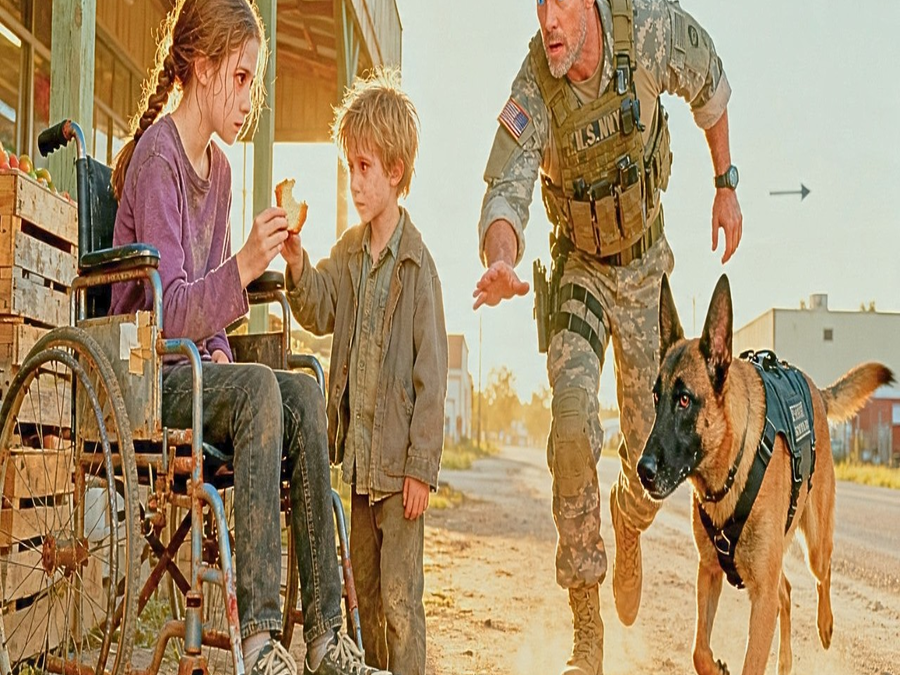
“We Haven’t Eaten…”— A Navy SEAL & K9 Stopped Then Uncovered a 7-Month Secret
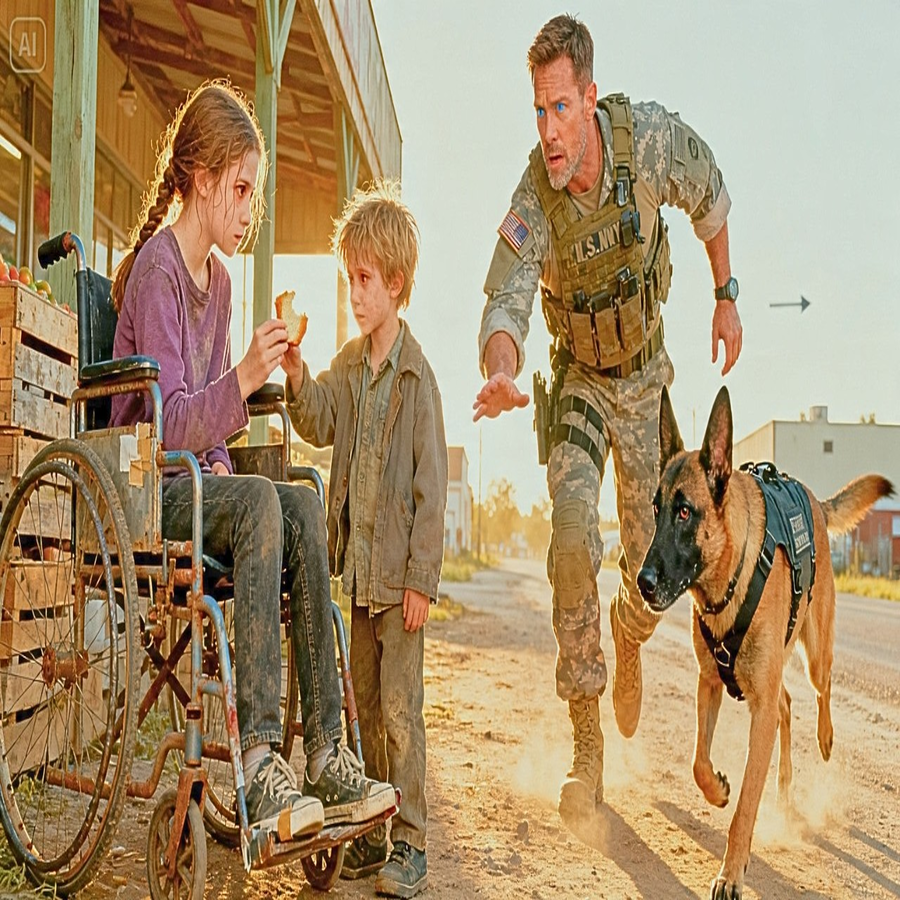
He had walked through firefights in three countries.
He had carried wounded men out of burning buildings and made peace with the fact that some nights you don’t sleep because of what you’ve seen.
Nothing prepared him for two kids picking through garbage behind a produce market in rural Missouri.
A 10-year-old girl in a broken wheelchair.
A 5-year-old boy clutching a ripped grocery bag like it was the most important thing he’d ever owned.
and a retired military working dog that knew before Ethan did that something was very
very wrong.
Discharge paperwork for Ranger had taken longer than Ethan’s own.
That was the joke he’d made to Master Chief Delgato on the way out of Naval Station Great Lakes.
And Delgato had laughed the way men laugh when something is almost funny
but mostly just true.
The US Navy didn’t give up its working dogs lightly.
Ranger had logged four deployments
two in Afghanistan
one in Iraq
one classified op that Ethan still couldn’t discuss in mixed company.
The dog had a service record that would make most human enlisted personnel look like they’d spent their careers filing TPS reports.
But at 9 years old, RERS’s hips had started going.
The vet had been blunt about it.
The dog could still function
could still work
could probably still put the fear of God into anyone who looked sideways at him.
But the repetitive physical demands of operational service were done.
He needed a quieter life.
Ethan had adopted him the same afternoon.
That had been 3 weeks ago.
Now they were driving south through Missouri on a two-lane state highway with the windows down because Ranger liked the wind and Ethan liked not thinking.
And the dashboard thermometer read 83° despite it being October
which felt like Missouri’s way of being difficult about seasonal transitions.
The radio was off.
Ethan didn’t want music.
He wanted the sound of tires on road and the dogs breathing and nothing else.
He had 2 weeks before he had to report back to his unit.
14 days of leave that his commanding officer
Lieutenant Commander Reeves
had practically ordered him to take after Ethan had missed three separate scheduling appointments for mandatory post-deployment counseling.
You’re not hiding from anything
Harrow Reeves had said
not quite asking
not quite accusing.
No, sir.
then go home, decompress, do something that isn’t this.
What Reeves hadn’t accounted for was that Ethan didn’t have a home to go to.
His apartment in Coronado had been sublit to a junior petty officer named Park while Ethan was forward deployed.
Park was a good tenant.
The apartment was fine, but it wasn’t home in any meaningful sense.
It was a box with his clothes in it.
So, he was driving to his aunt’s place in Red Hollow, Missouri.
population 1100
two stoplights
one diner
one bar
and a seasonal produce market that had been operating in various states of health since before Ethan was born.
His aunt Carol was 71 and growing slower with it
but she kept a spare room made up with clean sheets
and she cooked actual meals.
And Ethan hadn’t had either of those things in 8 months.
He had called ahead.
She’d said, “Bring the dog.”
He was maybe four miles from Red Hollow when Ranger moved.
The dog had been lying in the back seat with his head on his paws
doing that thing dogs do where they appear to be asleep
but are actually monitoring everything within a half mile radius.
Then something changed.
Ethan felt it before he saw it.
Ranger rose to all four feet in the back seat
pressed his nose to the window
and made a sound low in his chest.
Not a growl, not distress, something between attention and alarm.
Ethan checked his mirrors.
Nothing behind him.
He looked ahead at the road.
On the right side
a cluster of wooden vendor stalls
most of them shuttered
with a handpainted sign reading Callaway’s Country Market seasonal.
Few crates of pumpkins
some late season squash
a single vendor still open at the near end
an older man in a canvas apron unloading boxes from the back of a flatbed
and to the left of the vendor stalls near the drainage ditch
where someone had piled up cardboard boxes and discarded crates
two children.
Ethan pulled over without fully deciding to.
He sat in the truck for a moment and looked at them through the windshield.
The girl was maybe 9 or 10.
She was seated in a wheelchair
a battered one
the kind that looked like it had been repaired with zip ties and prayer.
The left rear wheel tilted slightly outward
like the axle had been bent
and never properly fixed.
She was thin in that specific way Ethan recognized
not from being a small child
but from not eating enough.
Her clothes were clean
he noticed that immediately
because it mattered a purple long-sleeve shirt and dark jeans
both worn
but deliberately cared for.
Her hair was pulled back in a neat braid that had started to come loose on one side.
The boy was younger
five
maybe six
standing beside an overflow pile of discarded mark crates
was wearing a jacket two sizes too big and holding a torn plastic grocery bag.
The bag wasn’t full.
He was picking through the discarded produce at the base of the crates
the stuff the vendors had pulled and thrown out.
bruised apples
a zucchini going soft at one end
a cluster of grapes that had started to shrivel.
The girl said something to him that Ethan couldn’t hear.
The boy held up what looked like a peach
slightly bruised
but intact
still firm
and his face broke into a smile like he’d found gold.
The girl said something else.
The boy held the peach out to her.
She shook her head.
The boy pressed it forward more insistently.
She shook her head again and said something that made the boy look at her with an expression
“No 5-year-old should have the have the expression of someone who has learned to be careful about what they believe.”
Ranger was still standing in the back seat, utterly still watching.
Ethan got out of the truck.
His boots hit the gravel and the girl looked up immediately.
She had dark eyes and the composure of someone who had been startled by adults before and had learned to manage the adrenaline.
She didn’t panic.
She assessed him quick.
Practiced the way someone does when they’ve gotten used to being in situations that could go wrong.
“Hey,” Ethan said.
He kept his distance.
He’d done enough crisis response to know that walking straight at a frightened person was never the move.
“Sorry, I just pulled over to check on you.
We’re fine,” the girl said.
Her voice was even controlled.
A kid who had practiced that line.
The boy was still holding the peach, looking at Ethan with enormous eyes.
“Okay,” Ethan said.
He glanced at the grocery bag.
“It had maybe a handful of items in it
the bruised grapes
a partial ear of corn
something wrapped in a piece of paper towel.
You guys shopping?
Markets almost closed
” she said
which wasn’t an answer to the question he’d asked.
He looked at her wheelchair
the bent axle
the cracked armrest
the footrest on the right side that was duct taped at the joint.
Then he looked back at her face because he didn’t want her to think he was cataloging everything wrong with her situation.
She’d already noticed him looking.
I’m Ethan, he said.
I’m visiting my aunt over in Red Hollow.
Haven’t been out this way in a while.
A Clara, the girl said then reluctantly.
the way she was deciding whether to give him anything at all.
That’s Owen.
Owen raised one hand in a small wave.
He was still holding the peach with the other.
Good peach?
Ethan asked him.
Owen looked at the peach, then at Clara, then back at Ethan.
Clara should have it, he said seriously.
She didn’t eat breakfast.
The silence that followed lasted about 2 seconds.
Clara’s jaw tightened.
Owen
you didn’t
the boy said simply with the devastating honesty of a 5-year-old who hasn’t yet learned the social function of tact.
You said you weren’t hungry, but you made that face.
What face?
The face where you actually are hungry.
Ethan let that sit sit.
He didn’t jump in.
He’d been in enough tense situations to know that sometimes the best thing you can do is let the air clear on its own.
Then he said, “There’s a gas station about a mile back.
has a pretty decent deli counter.
Why don’t I grab some sandwiches?
Clara looked at him the way she’d been looking at him since he walked over measuring.
Suspicious, not unkind.
She was trying to figure out what he wanted.
“We don’t take charity,” she said.
“It’s not charity.
My dog needs a break from the truck anyway.
I was going to stop somewhere.
” He nodded toward the truck where Ranger was now visible through the back window
his large dark head tracking the conversation with professional attentiveness.
He gets restless.
Owen made a sound that was somewhere between a gasp and a word.
Is that a dog?
That’s Ranger.
He’s retired military navy.
Used to do search and detection work.
Can I Owen started Owen?
Clara said, can I see him?
Let me introduce you properly.
Ethan said he’s trained.
He won’t do anything without a cue from me, but I should bring him out.
He walked back to the truck before Clara could mount another objection
opened the rear door
and and clipped Ranger’s lead.
The dog stepped down from the back seat with the careful dignity of a large animal who knew exactly how large he was.
A Belgian Malininoa
78 lb
with the kind of stillness that well-trained working dogs carry
sense that they are always assessing
always ready.
But choosing in this moment patience, Ranger looked at Owen.
Owen was standing absolutely still.
The way children freeze when they’re trying not to scare something they desperately want to get close to.
Hold your hand out flat, Ethan said.
Like you’re going to hold something.
Let him come to you.
Owen’s hand came out, palm up, trembling slightly with excitement.
Ranger walked to him with three measured steps and put his nose in Owen’s palm.
Owen made a sound like all the air went out of him at once.
Clara watched her brother’s face light up and something moved across her own expression
something unguarded
something real before she put it back where it came from.
Ethan seen in that, too.
He sat down on the tailgate of the truck and said nothing because he was good at that and because Clara was the kind of person who would close back up the moment she felt crowded.
After a moment, she wheeled herself closer.
The chair’s bent axle made the approach awkward across the gravel the wheel kept catching and she navigated it with the practiced efficiency of someone who had been compensating for equipment that didn’t work right for a long time.
Ethan watched but didn’t move to help.
She stopped about 6 ft from Ranger
who had now sat down besides Owen and was tolerating the boy’s careful
reverent hands on his ears with the equinimity of a dog who had worked in combat zones and found a 5-year-old considerably less stressful.
He really was in the Navy, Clara asked for deployments.
He did scent detection
building searches
open area tracking
EOD support for a while.
That’s explosive ordinance.
His nose is Ethan thought about how to phrase it.
Better than any instrument we have.
By a lot.
Clara looked at the dog.
What’s wrong with his hips?
Ethan blinked.
He hadn’t mentioned Rers’s hips.
How’d you know?
The way he walked down from your truck.
He compensated.
A beat.
Yeah, left hip.
The vet says it’ll get worse.
He retired early because of it.
Clara nodded.
She seemed to file this information somewhere.
Does it hurt him?
some days more than others.
He doesn’t complain.
Dogs don’t,” she said.
Then, as though she hadn’t meant to say it, they just keep going.
Ethan looked at her.
She was looking at Ranger.
“You guys live around here?”
he asked.
“Close.”
The word was precise, deliberately uninformative.
“Parents nearby.”
The pause before her answer was less than a second
but Ethan had spent years reading pauses.
“Our grandma passed,” Clara said.
earlier this year.
She said it the way someone says a thing they have rehearsed because if you say it plainly enough
it almost sounds like it’s okay
like it’s a fact and not a wound.
I’m sorry, Ethan said.
Clara shrugged.
The shrug was practice, too.
“Are you staying with someone?”
he asked carefully.
“We’re managing.”
Owen looked up from RER’s ears.
“We live in the Owen.”
Clara’s voice was quiet.
Not she never spoke sharply to the boy, but firm.
the kind of firmness that had weight behind it.
The kind that comes from being the person responsible for everything.
Owen looked at her.
He seemed to remember something.
He looked back at the dog.
Ethan said, “I’m going to get those sandwiches.
You want to stay here with Ranger while I walked down.”
Owen looked at Clara.
Clara looked at Ethan for a long moment.
In that look was the full weight of a 10-year-old who had learned that adults made promises they didn’t keep.
that kindness had conditions attached
that strangers who seemed helpful had their own reasons.
“Okay,” she said finally.
The word was neither warm nor cold.
It was the admission of someone who was out of moves.
Ethan walked the mile to the gas station
bought four sandwiches
turkey and Swiss
because that was what they had
two waters
two juice
a banana
and a bag of pretzels.
He also bought a plastic container of dog treats because Ranger had been patient and patient dogs deserved acknowledgement.
He walked back.
When he came around the bend in the road
Owen was lying on his back in the grass beside the parking area with Ranger standing over him and Clara was watching them both with an expression that was the closest thing to peaceful he’d seen on her face.
Then she heard his footsteps and the expression shifted back to neutral.
He handed out the sandwiches without ceremony.
Owen attacked his like he hadn’t eaten in a day
which Ethan suspected was accurate.
Clara ate hers with careful, deliberate bites.
The eating of someone managing how much hunger they showed.
You said your grandmother passed earlier this year.
Ethan said he kept his voice conversational.
The way you do when you’re asking something that matters
but don’t want the other person to feel interrogated.
How long ago is earlier?
Clara looked at her sandwich.
March.
It was the first week of October
7 months
and it’s just been the two of you since March
he asked.
We have people checking on us, she said immediately.
It was the wrong kind of specific.
Not the specificity of truth
but the specificity of a story that had been held together with careful wording.
Who, he asked.
Adults we know, people from the church.
He didn’t push it.
He looked across the road at the market stalls at the discarded crates where Owen had been picking through thrown away produce.
“CL,” he said.
“I’m not going to report anything or call anyone.
I’m just asking.”
She looked at him for a long moment.
Then she looked at Owen
who had fallen asleep against Rers’s side in the grass with his sandwich half finishedish in his hand.
“The way children fall asleep sudden and complete
like someone threw a switch.
” The girl’s jaw worked for a moment.
We have a place, she said quietly.
It’s okay.
It’s clean.
I keep it clean.
Okay, we have money.
I made some selling bookmarks at the market.
The vendors let me set up sometimes.
Okay
we were going to be fine
she said
and her voice cracked just once
just barely
like a single fault line in concrete before she sealed it back up.
Ethan didn’t say anything.
He’d learned long ago that sometimes the worst thing you can do for someone is tell them they’re going to be fine.
He let Ranger stay awake while Owen slept
and he sat with Clara until the sun shifted and the market vendor across the road began loading the last of his unsold stock.
She told him things gradually.
The way information surfaces when someone has been keeping its submerged a word here.
A pause there.
And if you were patient enough and quiet enough
eventually it came up on its own.
The grandmother’s name had been Ruth Wyn.
She’d been their primary guardian for 2 years before she passed cardiac event fast without warning.
Clara had been home when it happened.
She did not say more than that, and Ethan did not ask.
There were other relatives.
a great uncle in Kansas City who’d helped for a month and then stopped calling.
A cousin of their mothers who’d sent money twice before that dried up too.
No one had formally stepped in.
Clara had made the calculation at 10 years old that if she told anyone in authority
they would be separated
put in different placements.
She’d seen it happen to a girl in her class 2 years ago.
Siblings split up, placed in different counties.
The girl had cried everyday for a month.
Clara was not going to let that happen to Owen.
So, she had not called anyone.
She had kept them fed
kept them housed
kept Owen clean and reading
and as close to normal as she could manage on the resources available to her
which were a jar of coins beneath a bed
a market that let her sell bookmarks sometimes
and the discarded produce that vendors threw away at the end of
each day.
She told him about the bookmarks the way someone describes a business
not a coping mechanism.
She’d made them from card stock and pressed leaves
tied them with ribbon she’d found in their grandmother’s craft drawer.
Sold them for050 each.
Some vendors had been generous a dollar, sometimes two.
How much is in the jar?
Ethan asked.
$83 and change, she said.
She said it with precision.
The way you say a number you have counted many times.
$83 for two children since March.
Ethan breathed in.
He breathed out.
========== PART 2 ==========
He looked at the the sky.
“Where is this place you’re staying?”
he asked.
Clara looked at him for a long moment.
Whatever she was deciding, it was serious.
Then she said, “I’ll show you, but I need you to understand something first.”
“Okay, I don’t need someone to fix things,” she said.
“I’ve been doing fine.
I just need people to leave us alone.”
Her voice was steady.
Her eyes were not.
The cottage was behind the market down a rutdded lane that RERS’s nose had already identified from 50 yards.
Ethan had watched the dog’s body language shift when they turned onto the path.
The subtle change in how he carried his head
the way he pulled slightly forward on the lead.
Working dogs remembered sense the way humans remembered phone numbers.
The dog had been tracking these children since the parking area.
It was a caretaker’s cottage once used by whoever had managed the market grounds
maybe 200 square ft
a single room structure with a small porch
a propane camping stove
a cot
a narrow wooden bed
and a bathroom that still worked because the well and septic
system were on the same property as the market.
Ethan stood in the doorway and took it in.
It was clean.
That was the first thing
and it hit him harder than anything else might have.
floor was swept.
The narrow bed was made with military precision
a word he hated using
but it was accurate
the corners tucked
the single blanket smoothed flat.
Owen’s cot had a stuffed bear propped against the pillow.
Their clothes were folded in two stacks on a wooden crate that had been repurposed as a dresser.
On the floor beside Clara’s bed was a mason jar.
Even from the doorway, Ethan could see the coins inside.
On the crate was a small stack of books
children’s chapter books
a battered paperback
and a notebook.
The notebook had Clara’s name on it in her own handwriting
and beneath the name
in smaller letters
Owen’s reading progress.
She had been tracking her brother’s literacy development.
At 10 years old
managing two children’s survival in an abandoned cottage with $83
she had kept a log of what words her brother could read.
Ethan looked at that notebook and felt something in his chest that he didn’t have a name for something that was grief and fury and awe all at once compressed into a single moment.
He kept his face neutral.
He had practice at that.
It’s good
he said
because it was
and because she needed to hear that it was
not because it was enough.
It was nowhere near enough
but because she had done something extraordinary with almost nothing
and the least he could do was say so.
Clara was watching him from behind.
It’s temporary, she said.
Her voice was defensive in the way that pride is defensive.
When I turn 11, I was going to figure out something more.
Clara.
He turned to face her.
I said, “It’s good.
I meant it.”
She looked at him.
Something flickered behind her eyes.
Ranger had walked past both of them
and was now sitting in the middle of the cottage floor
taking in the space with his dark
professional gaze
cataloging it the way he’d been trained to catalog rooms.
Then he walked to Owen’s cot
sniffed the stuffed bear carefully
and lay down beside it.
Owen
who had woken up during the walkover
watched this with an expression of pure happiness.
“He likes it here,” Owen said.
“Yeah,” Ethan said.
He looked at Clara.
She was looking at the mason jar beneath her bed.
He drove back to his aunt’s house after dark and sat at Carol’s kitchen table.
While she made tea
she knew he wouldn’t drink
and he told her what he’d found.
Carol set down the kettle.
Ruth W’s grandchildren, she said slowly.
“My God, I heard Ruth passed.”
“I didn’t know about the children.
Nobody checked.
Carol’s face did something complicated.
People assumed someone had handled it the way people assume.”
She sat down across from him.
How long have they been out there?
7 months.
Ethan, I know.
I know.
He said again.
He was quiet for a moment.
I’ve got 14 days of leave.
I need to figure out what I can actually do in 14 days.
That doesn’t make things worse when I leave.
Carol looked at him for a long time.
What does the girl want?
She wants to stay with her brother, Ethan said.
That’s all she wants.
She’s been making every decision for seven months around that one thing.
Carol picked up her tea.
Set it down again.
There’s a woman, she said carefully.
Martha Keane.
She was a teacher at the elementary school before she retired.
She knew Ruth.
I believe she knew the family.
She volunteers with some county program now.
Where does she live?
About 2 mi down on Fulton Road.
But Ethan, she paused.
The girl Clara.
Is she okay?
He thought about the notebook.
the mason jar, the corner tucked blanket on Owen’s bed.
She’s the toughest person I’ve met in a long time, he said.
And she’s 10 years old.
And that’s the problem.
Carol nodded slowly.
Ranger
who had been lying under the kitchen table
lifted his head and looked at Ethan.
Ethan looked back.
He had spent his career walking into situations where the objective was clear and the danger was visible.
Trained for it.
You rehearsed.
You had a team, a radio, a plan.
This was different.
He had 14 days
two children
and the bone deep certainty that if he didn’t handle this carefully
he would break the only thing Clara had managed to hold together.
He reached down and put his hand on Rers’s head.
“We’re not leaving yet,” he told the dog.
Ranger didn’t move.
Outside the Missouri night settled in around Red Hollow
full of crickets and the smell of dry leaves.
And somewhere down a ruted lane behind a shuttered market
a 10-year-old girl lay awake in a clean
dark cottage
listening to her brother breathe and waiting for the world to confirm what she already believed
that everyone left eventually
that she would have to be enough.
The next morning
Ethan was back at the cottage by 7:30 with groceries in two paper bags and Ranger at his side.
He had not called anyone yet
had not contacted Martha Keane or any county service or any authority of any kind.
He’d thought about it all night and come back to the same place.
Clara’s fear of separation wasn’t irrational.
It was based on real knowledge of how these systems worked.
And if he moved too fast in the wrong direction
she’d take Owen and disappear.
And then there would be no network, no plan, no safety net.
There would just be two children gone.
He needed her to trust him first.
That meant showing up.
He knocked on the cottage door.
Owen opened it immediately
which meant the boy had been watching from the window.
“Came back,” Owen said like it was surprising.
“Told you I would,” Ethan said.
He hadn’t actually.
He’d said goodbye and driven away and then driven back to his aunts.
But apparently the fact of his return was carrying more weight than any promise would have.
Owen looked at the grocery bags.
“Did you bring a eggs?”
He glanced past Owen into the cottage.
“Is your sister awake?”
“She didn’t sleep,” Owen said simply.
Clara appeared behind her brother
fully dressed
hair rebraided with new precision
expression arranged carefully to suggest she had absolutely slept and was perfectly fine.
You didn’t have to do this, she said.
I know.
He held up the bags, but I also had to eat breakfast somewhere.
My aunt’s house is a 15-minute drive, and she makes terrible coffee.
Clara looked at him.
Your aunt lives here, Carol Harrow.
Down on Route 9.
Something shifted in Clara’s face.
something Ethan couldn’t quite read.
Then she stepped back from the door and let him in.
They ate breakfast on the cottage’s small porch Clara’s idea
and Ethan suspected it was because she wanted to be able to see in all directions the instinct of someone who monitored exits.
Owen fed Ranger pieces of toast in careful
deliberate portions
checking with Ethan each time for permission.
Ethan watched Clara eat a full bowl of cereal and half a glass of orange juice and felt something uncurl in his chest.
I want to ask you something, he said.
And you can say no. Clara looked at him over her bowl.
Your wheelchair.
He kept his voice even.
When was the last time it was properly fitted?
Her jaw tightened.
It works.
I know it works.
You make it works.
That’s not the same thing.
A long pause.
Owen was watching them both.
Our grandma got it from a donation program.
Clara said finally before she died.
It’s not the right size, but it moves.
There might be options, Ethan said carefully.
Equipment grants, county programs.
I’m not talking about charity.
I’m talking about resources that exist and that you qualify for.
It would be worth checking.
Clara looked at him for a moment.
Why?
Why?
What?
Why does it matter to you?
You showed up yesterday.
You don’t know us.
It was a fair question.
Ethan looked at the treeine past the market stalls at the pale October light coming through the branches.
He thought about what to say.
He could have said something about service, about the instinct to protect.
He could have made it about Ranger, about the dog’s reaction.
Instead
he said
“Because Owen told me you didn’t eat breakfast and the way you looked when he said it
he stopped
started again.”
I recognize that look.
Someone who’s been carrying too much for too long.
I’ve seen it in the field.
I’ve had it myself.
He paused.
You didn’t make the situation.
You were handed it.
And you’ve been handling it alone.
And that’s He looked at her.
That’s something I’m not willing to just drive away from.
Clara didn’t say anything for a moment.
Then Owen said, “I knew you’d come back.”
Owen.
Clara started.
I did.
The boy said serenely.
Ranger told me.
Ethan looked at the dog
who was lying with his head on Owen’s knee and his eyes half closed.
“Ranger told you,” Ethan said.
“He didn’t leave either,” Owen said with the iron logic of a 5-year-old.
Last night when you drove away, Ranger looked back at us.
“Dogs don’t look back unless they’re coming back.”
“Ethan had no answer for that.
” Clara was looking at her brother with an expression that broke something open in the room.
love so enormous and exhausted and fierce it barely fit in a face.
That afternoon
while Owen napped with Ranger in the cottage
Ethan and Clara sat on the porch
and she told him something she hadn’t told anyone.
The county case worker had come in June.
Someone had reported them she didn’t know who, and she never found out.
A woman from the county department of family services had arrived at the cottage on a Thursday morning.
Clara had been there with Owen and she’d answered the door and she’d looked this woman in the eye and said that their aunt was staying with them temporarily that there had been a miscommunication that everything was fine.
The woman had written something in her notebook.
She had looked around the cottage.
She had looked at Clara’s wheelchair.
She had asked, “Is there an adult I can speak with?”
And Clara had said she just went to get groceries.
She’ll be back in a little while.
The case worker had given Clara a card and left.
She had not come back
and Clara had spent every day since June waiting for her to.
I lied, Clara said.
She was looking at her hands.
I know I lied.
But if I told her the truth, she might have separated you, Ethan said.
She definitely would have, Clara said.
Owen and me aren’t the same age.
They put you with families that match.
An older kid in a wheelchair and a 5-year-old boy.
Her voice flattened out.
That’s two different placements.
That’s what happens.
Ethan sat with that.
It might not have been permanent, he said.
Might not, she agreed.
But Owen doesn’t know that.
He’s five.
He’d think I left him.
She looked up.
I’m not going to let him think I left him.
The October light was long and gold across the porch.
Somewhere inside
Owen murmured something in his sleep
and RER’s tail thumped once against the floor.
“Okay,” Ethan said.
Okay, what?
Okay, we figure this out the right way together.
No one moves until we know it’s safe.
He looked at her
but I need you to trust me
which I know you have no particular reason to do.
Clara studied him.
There was something measuring in it still, but also something else.
Something that was not quite hope, but was in the same neighborhood.
You leave in 14 days, she said.
13 now, he said.
Yeah.
And then what?
It was the right question.
It was the only question that mattered.
And Ethan didn’t have an answer yet, not a complete one.
But he looked at this 10-year-old girl who had been keeping a log of her brother’s reading progress in a battered notebook in an abandoned cottage.
And he said the only true thing he had.
Don’t know yet.
But I’m not building something here that falls apart when I leave.
That’s a promise.
Clara looked at him for a long time.
Then she said, “You should probably talk to Martha Keane.”
Ethan blinked.
My grandma mentioned her.
Clara said quietly before she died.
She said if something ever happened, she stopped, looked at her hands again.
She said Martha Keane was a good woman.
She had been holding that name for 7 months
and she was handing it to him now.
Ethan nodded.
I’ll go see her tomorrow.
The evening was coming in soft and cool across the Missouri fields.
A crow called somewhere in the treeine.
The market was quiet
most of it shuttered now
only the distant sound of the last vendor loading his truck.
Inside the cottage
Owen said something in his sleep again
something cheerful and blurred with dreaming.
Clara stood up from the porchstep
gripped her wheelchair’s push rims
and transferred back into it with practiced efficiency.
She looked at Ethan one more time before she went inside.
“Thank you for breakfast,” she said.
“Anytime,” he said.
She went in.
Ethan sat on the porch for a while
longer in the gathering dark
listening to the Missouri night
turning the shape of the next 13 days over in his mind.
The way you turn a problem when the stakes are too high to get it wrong.
Then his phone buzzed.
He looked at it.
A text from an unknown number.
No name.
Just a message.
Heard you were asking about the Windchildren.
We need to talk first.
Don’t contact Martha Keane until you hear from me.
Ethan stared at the message.
He read it twice.
Then he looked up at the cottage door
closed now
lamplight just visible at the base of it.
Someone knew he was here.
Someone knew what he was doing, and they wanted him to stop.
Ethan read the message a third time.
The screen light was the only thing breaking the dark on the porch
and the dark had come in fully now
the kind of rural dark that cities never get.
No ambient glow
no street lights
just the stars and the sound of something moving in the tree line.
That was probably a deer and probably nothing to worry about.
He typed back, “Who is this?”
No response.
He waited 3 minutes.
Five.
The three dots that meant someone was typing appeared once, then disappeared.
Nothing.
He looked at the cottage door.
The lamp light at the base of it was steady.
Inside he could hear Owen murmuring still half asleep or waking slowly in the low sound of Clara’s voice answering him.
The ordinary sounds of a family’s night
ordinary and fragile in equal measure.
Ethan pocketed his phone, stood from step, and walked back to his truck.
He sat in the driver’s seat for a moment without starting the engine
running through the variables the way he’d been trained to run through variables systematically
without feeling.
Because feeling came later, and right now what mattered was information.
Someone in Red Hollow knew he was here.
Knew he’d been asking about the windchildren, but he hadn’t been asking.
Not publicly.
Not yet.
He’d told Carol.
That was the only person he’d told.
Carol
who had mentioned Martha Keane
which meant either Carol had told someone or someone had been watching the cottage
or both.
He started the engine and drove back toward his aunt’s house.
And the whole way there
he kept checking the rear view mirror with the automatic habit of someone who had spent years in environments where being followed was not a hypothetical.
Carol was still up when he got back.
She was sitting in the living room with a crossword and reading glasses and she looked at him over the top of the glasses when he came through the door.
You look like someone just stepped on your grave.
She said, “Did you tell anyone I was looking into the wind kids?”
Carol set the crossword down.
I mentioned it to Darlene Foss at the post office this morning when I went to get the mail.
We were talking about Ruth about how the market used to give her a good price on end of season produce and it came up that her grandchildren were she stopped.
Oh, Darlene Foss, Ethan said she’s not a gossip.
Well, she is a gossip, but she means well.
Who does she know?
Everyone, Carol said, which was not helpful, but was probably accurate.
Ethan, Red Hollow is,00 people.
If Darlene Foss hears something at 9:00 in the morning
it’s it’s in eight kitchens by noon.
That’s just what it is.
Ethan sat down in the armchair across from her and showed her his phone.
Carol read the message, her mouth tightened.
You know who this is?
He asked.
Could be, she said carefully.
She took her reading glasses off and cleaned them in that way she always had when she was stalling.
There’s a man named Gerald Tate.
He’s on the county family services advisory board.
He’s been he’s been involved in placement decisions in the county for a long time.
She paused.
He’s not a bad man necessarily
but he has opinions about how these things should be handled.
Why would he want me to stop before talking to Martha Keane?
Carol set the glasses on her knee.
========== PART 3 ==========
Martha has been trying to get someone to look at the county’s placement protocols for 3 years.
Gerald doesn’t like her very much because she’s a problem for him because she asks questions he doesn’t like answering.
Ethan leaned back.
Is there a reason Clara and Owen haven’t already been formally placed?
If someone on the county board knew they were out there?
I don’t know that anyone formally knew, Carol said.
But she said it the way people say things they’re not entirely sure of.
The way guilt sounds when it’s wearing uncertainty’s clothes.
Ethan looked at her.
Carol
I didn’t know about the cottage
she said
and her voice was firm on that.
I didn’t know they were out there alone
but I knew Ruth had passed and I knew she had grandchildren and I assumed you assumed someone had handled it.
She didn’t answer.
He stood up.
I need Martha Keane’s address.
Ethan, the text said, I know what the text said.
He looked at his aunt.
Whoever sent it can contact me directly and explain themselves
but I’m not taking instructions from an anonymous number while two children sleep in an unheated caretaker’s cottage.
Carol looked at him for a long moment.
Then she got up and wrote the address on the back of a grocery receipt.
He went to see Martha Keane the next morning.
He left Ranger with Owen
partly because the dog’s presence had become something Owen structured his mornings around
and partly because Ethan needed to move fast and efficiently
and a large Belgian Malaninoi was not always an asset in a first conversation.
Martha Keane’s house was a small yellow Victorian on Fulton Road with a porch full of potted mums and a doormat that said welcome in plain black letters.
She answered the door before he knocked the second time
which meant she had either seen him coming or had very fast reflexes for a woman in her early 70s.
She was small
maybe 5’2
with white hair cut practically short and eyes behind wireframe glasses that were the color of winter sky and considerably sharper than the rest of her presentation suggested.
You’re Carol’s nephew, she said.
Not a question.
Ethan Harrow.
Yes, ma’am.
She called ahead.
Martha said, come in.
The house inside was organized the way teachers organized things with an underlying logic that wasn’t immediately obvious
but that you suspected was very precise.
Bookshelves on every wall
filing boxes stacked in the hallway
a kitchen table covered in folders with color-coded tabs.
Martha poured coffee without asking whether he wanted it and sat down across from him.
“Tell me about the children,” she said.
He told her.
“All of it, including the text message.”
She listened without interrupting
which was a quality Ethan had come to regard as rare and valuable.
When he finished
she picked up her coffee
held it without drinking
and looked at the table.
“I suspected Ruth’s grandchildren were still in the area,” she said.
“I didn’t know the specifics.
I should have pushed harder to find out.”
She set the coffee down.
“It’s on me.”
“Did you know Ruth?”
“Well enough.
She was a private woman.
She didn’t ask for help easily and she taught those children the same.
Martha looked at him over her glasses.
Clara is 10.
Yes.
And she’s been running that household since March.
Yes.
Martha was quiet for a moment.
The text you received.
Did you save it?
He showed her his phone.
She looked at it carefully.
The way someone looks at something they recognize.
Gerald Tate, she said.
That was my aunt’s guess, too.
It’s not a guess.
She handed the phone back.
That’s his communication style.
Indirect, preemptive.
He positions himself as an authority without committing to a statement that can be challenged.
She leaned back in her chair.
Gerald has had his hands in county placement decisions for 11 years.
He’s not corrupt in the obvious way.
He doesn’t take money.
He doesn’t benefit personally.
He benefits institutionally.
He’s built a system that runs a certain way and he defends that system because he believes in it.
and because he’s tied his identity to it and the system would separate Clara and Owen.
Ethan said almost certainly the standard protocol for a 10-year-old with mobility limitations and a 5-year-old without prior identified placement preferences is to treat them as two separate cases
different needs
different family profiles.
They go on different lists.
She said it plainly the way she’d said it many times with the exhaustion of someone who had been arguing against a thing for a long time.
I’ve been trying to get a sibling priority amendment into the county’s placement guidelines for 3 years.
Gerald has blocked it at every advisory meeting.
Why does he have that much influence?
Because he’s been there 11 years and the board turns over every three.
He’s the institutional memory.
He’s the one who knows how things work.
New members defer to him.
She paused.
And because most of the time his way does work, it places children.
It’s not malicious.
It’s just not flexible.
Ethan looked at the table.
What can you do?
Martha folded her hands.
I can volunteer as temporary guardian while a proper arrangement is completed.
I’ve done it before.
The county has to approve it, but I have standing.
I’m certified.
I have a clean record.
I’ve completed all the required checks.
She paused.
Complication is that Gerald will be involved in that approval.
And if he finds out you’ve been talking to me
he may move to expedite a standard placement before we can establish an alternative.
How much time do we have that?
I can’t tell you.
Caseworks June visit is documented.
If Gerald is monitoring the file
and I think he is
given that text
he knows the situation is active.
He may already be preparing a formal intervention.
Ethan felt the timeline shifting.
He thought he had 13 days.
He might have considerably less.
What do you need from me?
He asked.
Documents.
Anything that establishes their current living situation and the community support that’s already in place.
If I walk into a county review and it’s just me against Gerald’s procedural argument
I lose.
If I walk in with evidence of a functioning support network
a community that’s already engaged
a volunteer guardian
school enrollment
medical access
then the argument changes.
I’m not asking for an exception.
I’m presenting a superior placement outcome.
Ethan thought of what he’d built in less than 48 hours.
Two paper grocery bags and a dog that had decided to belong to a 5-year-old boy.
I can build that network, he said.
I have 12 days.
Martha looked at him over her glasses for a moment.
“You’re still active duty,” she said.
“Yes, Navy, Chief Petty Officer.
EOD and special operations support.”
She seemed to turn this over.
“You’re used to working with a team under time pressure
generally with more firepower available
” he said.
But yes, for the first time, the corner of her mouth moved, almost a smile.
Then let’s talk about who else is in this town.
They spent 2 hours at Martha’s kitchen table.
she had filed.
The woman had files on everything community organizations
volunteer records
county service providers
local businesses that had contributed to various programs.
She moved through them with the precision of someone who had been building a case for a long time and had been waiting for someone to help her present it.
Picture that emerged was not of a town that had failed Clara and Owen through malice.
It was a town that had failed them through the specific ordinary human failure of assuming someone else was handling it.
People had noticed Ruth’s grandchildren.
People had wondered.
People had not asked the direct question that would have required a direct answer.
People don’t want to intrude, Martha said.
Especially in a community like this where privacy is respected.
Ruth was a private person.
Nobody wanted to presume.
7 months, Ethan said.
I know a 10-year-old girl was managing this for 7 months because nobody wanted to presume.
Yes.
Martha’s voice was quiet and steady.
And that’s the thing that should keep all of us up at night, including me.
She looked at him directly.
I’m not asking you to absolve anyone.
I’m asking you to help me fix it.
He nodded.
Who do we start with?
The market owner’s name was Dale Callaway
the same Callaway of the faded sign
and he was 64 years old
had run the seasonal market for 22 years
and had indeed known that the children were using his discarded produce crates.
He admitted this within 40 seconds of Ethan sitting across from him at his kitchen table without Ethan having to work for it at all.
I didn’t know their situation entirely, Dale said.
He had large hands and the permanent tan of someone who spent most of their life outdoors and he was looking at those hands now.
I knew they came around at closing time.
I thought Ruth used to come around at closing time too the last couple of years.
Got hard for her to afford full price.
I let it go because it was going to waste anyway.
And after Ruth died, the girl kept coming with the little one.
He paused.
I told myself someone knew.
Someone was watching out for them.
Someone was, Ethan said.
Clara was watching out for both of them.
Dale was quiet.
I need your help, Ethan said.
He wasn’t the type to soften the approach when directness would get there faster.
Not charity, a program, something sustainable.
The market sets aside produce that would otherwise go to waste
not the discards
the actual surplus
and makes it available to families in need properly with the market’s name on it.
Dale looked at him.
You want me to start a food program?
I want you to formalize what you were already doing.
Give it structure.
Get a couple of the other vendors on board.
It becomes something the county can point to as a community resource.
Dale turned his coffee cup around in his hands.
Why does the county need to point to it?
Because I’m trying to keep two children together, Ethan said.
And I need the county to see a community that’s invested
not a gap that needs to be filled by the system.
Dale was quiet for a while.
Not the quiet of resistance, the quiet of a man recalibrating.
I can talk to the other vendors, he said.
Morales runs the produce stall over on the east end.
Henderson does the apple orchard stand.
They’re good people.
They’ll want to help if they understand what happened.
They need to understand it quickly, Ethan said.
How quickly?
Days.
Dale looked at him.
UX military active duty on leave.
Figured he stood up.
I’ll call Morales today.
By the end of the second day, Ethan had talked to six people.
Dale Callaway had called two other vendors.
Martha had reached out to doctor Elise Warren
who ran a county family support volunteer organization out of a shared office space in the next town over.
carpenter named Roy Dillard
who had done work on several properties near the market
and who Martha described as someone who built things the right way and didn’t talk about it
had heard through Dale that there was a child in a wheelchair using a cottage with no accessibility modifications and had showed up at Ethan’s aunt’s house at 7:00 in the morning on the third day
with a pickup truck full of lumber and a tape measure.
Ethan had not called Roy Dillard.
Roy had heard and come anyway.
That was the thing about a small town Ethan was learning.
The same quality that had allowed Clara and Owen to slip through the insolerity.
The assumptions that someone else knew could run in the opposite direction when properly activated.
Information moved fast.
Once people understood what had actually happened
the response was not gradual.
It was immediate.
It was also, he had to admit, somewhat overwhelming to coordinate.
He spent the mornings with Clara and Owen.
He spent the afternoons moving through Red Hollow like a man with a 12-point operational checklist and no backup team
which was not entirely unlike certain forward deployed situations
except that the threats here were bureaucratic rather than kinetic
and the stakes were in some ways higher.
Clara watched him do this with guarded attention.
She didn’t ask him to stop, but she didn’t fully relax either.
There was always a part of her that was waiting.
He could see it in the set of her shoulders.
The way she tracked the road whenever a car came down the lane
waiting for the thing that would undo it.
The adult who stopped calling.
The plan that fell through.
The system that asserted itself.
On the fourth day, he brought Martha to the cottage to meet the children.
He had told Clara in advance.
He’d explained who Martha was
what her role might be
what it would and wouldn’t mean.
He’d given her the option to say no. Clara had said
“Does she know about the county process?”
Better than anyone.
Does she know about the text message?
She knew who sent it before I told her.
Clara had thought about it for a full minute.
Owen had been pretending to read his book, but was clearly listening.
“Okay,” Clara said finally.
“But I’m not talking to her alone.”
“You won’t have to,” Ethan said.
Martha arrived at the cottage on a Tuesday afternoon with a plate of oatmeal cookies that she placed on the porch railing without comment.
And she sat down in the chair.
Ethan set out for her and looked at Clara in the direct non-condescending way of someone who had spent 40 years looking at children and had learned to see them accurately.
“Your grandmother spoke well of you,” Martha said.
Clara went very still.
“We talked about you sometimes.
At the school where I used to teach
we had a program for students with mobility needs.
Your grandmother came to one of our information sessions years ago before you were in school here.
She was preparing.
Martha paused.
She was always preparing for you.
She wanted to make sure things were in place.
Clara’s hands were flat on her wheelchairs armrests.
She didn’t tell me that.
Clara said she wouldn’t have wanted you to worry.
Martha said simply.
She was the type who handled things quietly.
Owen had abandoned all pretense of reading and was watching Martha with wide eyes.
I’m not here to tell you what’s going to happen.
Martha continued.
I want to explain your options and then I want to hear what you think because your opinion matters in this process and anyone who tells you otherwise is wrong.
Clara looked at her for a moment.
The county wants to place us separately.
Clara said it wasn’t a question.
The county’s current protocol would likely result in separate placements.
Yes, that’s the standard approach.
Martha folded her hands.
I’ve been working to change that for some time.
In the meantime, there is an alternative pathway.
I can apply to serve as your temporary guardian while a more permanent arrangement is identified that keeps you together.
It keeps you in Red Hollow.
Keeps you in your school.
What’s the catch?
Clara said.
Martha blinked.
Owen made a small sound.
Clara, Owen said.
No, it’s a fair question, Martha said.
She didn’t look offended.
She looked, if anything, more focused.
The process requires county approval.
There is a man on the county advisory board who prefers the standard protocol.
He’ll argue against the exception.
We’ll need to demonstrate that this alternative arrangement serves your best interest better than the standard one.
She paused.
That’s what Ethan has been building.
Evidence that this community is already invested in your well-being
that you already have a support network.
Clara turned and looked at Ethan.
He said nothing.
He’d learned that with Clara
explanations given before she was ready for them didn’t land.
He waited.
And if the county says no, Clara asked.
Then we appeal, Martha said.
And we have time to appeal before any placement action can be finalized.
But I don’t expect them to say no. Not if we present this correctly.
Silence.
Owen reached over and put his hand on RER’s back.
The dog
who had been lying at Owen’s feet with his head down
lifted his head at the touch and then lowered it again.
“She’s going to fight for us,” Owen said quietly.
“He wasn’t asking.
He was observing the way he had observed about Ranger looking back when Ethan drove away.”
Martha looked at the boy for a moment.
“Yes,” she said.
“I am.”
Clara exhaled
a long controlled breath that she tried to make invisible and didn’t entirely manage.
“Okay,” she said.
Roy Dillard arrived at the cottage on the fifth day with two other men
a neighbor named Phil Cruz and a 20-some named Marcus
who did not seem to have a last name that anyone used
and they began the ramp.
Ethan had given Roy the measurements of the door frame and the porch step height.
Roy had gone quiet in the way of people who were calculating
and then he’d said he’d handle it
and he had.
The ramp was solid pine
sanded smooth with anti-slip strips at 3-foot intervals and a railing on both sides fitted to the right height for someone in Clara’s chair.
It took them 6 hours.
Roy wouldn’t accept money and got irritated when Ethan pushed the point.
I’m not doing it for money
Roy said with the flat patience of someone who had said that once and found it sufficient.
I’m doing it because it should have been done 7 months ago.
Don’t make it weird.
Ethan did not make it weird.
Clara came out onto the new ramp that evening after the men had gone and sat at the top of it looking down at the lane.
Ethan was sitting on the porch behind her.
Ranger was beside Owen in the doorway.
She didn’t say anything for a long time.
Then it doesn’t wobble.
No, Ethan said.
The old one at our school wobbles.
I’ll mention it to Roy.
A pause.
You don’t have to do that.
I know.
Another pause.
Ethan.
She said his name carefully like she was being precise about something.
What happens when the county approves Martha?
What does it actually look like?
Daytoday.
Martha lives 2 miles from here.
She has a car and she drives.
She’d be available for school pickup
medical appointments
whatever the routine requires.
She’s already cleared by the county for this type of arrangement.
She’s done it before.
He paused.
The cottage would need a few more upgrades.
Heat, proper kitchen setup.
The county would inspect it
========== PART 4 ==========
but Dale’s already offered to cover the utility hookup and the neighbor on the east side.
The Burks, Clara said.
Yeah.
Mrs. Burke said she’d do meals twice a week until things are properly He stopped.
I’m not going to pretend it’s a perfect system from day one.
But it’s real.
It’s people who live here, who know this place, who aren’t going anywhere.
Clara looked at the lane.
The evening light was going gold again.
Owen’s going to be so loud about all of this.
She said there was something under it that was almost humor.
He’s going to be insufferable.
Ethan agreed.
She made a sound that was not quite a laugh
but was the closest thing he’d heard from her.
Then the sound stopped
and she was quiet again
and he let her be quiet because some things needed the space around them.
On the seventh day, Gerald Tate made his move.
Ethan found out through Martha
who called him at 6:40 in the morning in a voice that was controlled
but running at a higher temperature than usual.
Gerald has filed for an expedited formal review of the children’s situation.
She said he cited the June caseworker visit and the unresolved documentation status.
He scheduled a county board session for 4 days from now.
4 days.
Ethan’s leave had 6 days left after that.
Can we be ready?
He asked.
We have to be, Martha said.
I need everything you’ve got commitments from the vendors
the ramp documentation
the school’s accessibility plan.
Doctor Warren’s assessment of the children’s current needs and at least two letters from community members willing to go on record can get that.
There’s something else.
A pause.
Gerald is likely to argue that you
a transient party with no permanent connection to Red Hollow
engineered this situation specifically to circumvent standard protocol.
He’ll say the network you’ve built isn’t organic
that it wouldn’t have existed without your intervention.
It wouldn’t have existed without my intervention, Ethan said.
I know
but the question is whether it will exist after you leave
and that’s the question the board will be asking.
Another pause.
Is it real, Ethan?
The things you’ve put in place
will they hold when you’re not here to hold them?
He stood in his aunt’s kitchen in the early morning
the coffee going cold on the counter
Ranger watching him from the doorway.
He thought about Dale Callaway
who had called Morales before Ethan got back to his truck.
About Roy Dillard
who had shown up with lumber before being asked
about Owen’s voice saying
“She’s going to fight for us with the certainty of a child who had decided to trust something and was going to trust it all the way.
” “Yes,” he said.
“You’re sure.
I’m sure.”
He picked up the cold coffee.
But Tate’s going to push on me specifically on who I am and why I’m here and whether I’m connected enough to this community to matter in this decision.
He will.
Martha agreed.
Ethan thought about something Clara had said on the first day.
Something that had been sitting in the back of his mind since you said your grandmother passed.
How long ago is earlier?
And then she said Martha Keane was a good woman.
Ruth Wyn had known Martha
had trusted her
had held her name like a key for 7 months in a 10-year-old’s memory.
That was a thread.
In Ethan’s experience, threads mattered.
Tell me everything you know about Gerald Tate, he said.
Not his public record, what you actually know.
Martha was quiet for a moment.
Why?
Because I want to understand what he’s actually protecting, Ethan said.
And whether there’s a way to make this easier for him instead of harder.
a man who’s been doing a job for 11 years and believes in it.
He’s not the enemy.
He’s someone who needs a better argument than the one he’s using.
Martha was quiet for longer this time.
That’s a more generous read than I usually give him.
She said
“I’ve dealt with a lot of people who were right about the rules and wrong about the situation.”
Ethan said
“It’s more useful to find the overlap than to fight them straight on.
” He heard Martha shift on the other end of the line.
Come over, she said.
I’ll make fresh coffee.
Bring the dog.
Owen will want to know what’s happening
and he should probably hear it from you.
Ethan looked at Ranger.
We’ll be there in 20 minutes, he said.
He put his boots on
clipped the lead
and walked out into the Missouri morning
which was cool and clear with the smell of the fields after a night of light frost.
And he walked fast because he had four days and a county advisory board and a man named Gerald Tate who had 11 years of institutional momentum behind him.
And he had something Tate didn’t.
He had a girl who had kept her brother’s reading log in a battered notebook for 7 months and called it managing.
He was not going to waste that.
The text from the unknown number came again at 8:15 while he was walking.
You should have stopped when I asked.
This won’t go the way you think.
Ethan read it, put the phone in his pocket, and kept walking.
Ranger at his side glanced up at him once.
“I know,” Ethan said.
The dog looked forward again.
Whatever Gerald Tate thought was coming
whatever move he thought he’d already made
he hadn’t yet accounted for the fact that Ethan Harrow had spent 15 years being sent into situations that wouldn’t go the way anyone thought.
He was very good at that.
The walk to Martha’s house took 18 minutes because the frost had made the shoulder of Fulton Road slick in patches
and Ethan wasn’t moving fast enough to be careless about it.
Ranger picked his way beside him with the careful deliberation of a dog whose hips made uneven ground something to be negotiated rather than ignored.
Ethan used the 18 minutes to think.
Gerald Tate had filed for an expedited review.
That meant Tate had been monitoring the file, the June caseworker visit.
the unresolved documentation and had been waiting for a triggering event.
Ethan’s appearance in Red Hollow
asking questions
building a network was that event.
Tate had decided that an outsider engineering and alternative placement pathway was a threat to his process and he was moving to foreclose the option before the alternative could be properly established.
It was Ethan had to admit a
competent move.
The problem was that Tate had made it 4 days out
which meant he either underestimated how much ground Ethan had already covered
or he was confident that the board would side with his procedural argument regardless of what Ethan presented.
Either way, Ethan had 4 days.
He’d worked faster with less.
Martha’s porch light was on when he came up the front walk
and she opened the door before he knocked
which was becoming a pattern.
Inside
the kitchen table had been cleared of its usual organized chaos and replaced with two stacks of folders
a yellow legal pad
and a fresh pot of coffee.
Martha poured without preamble.
Tell me what you’re thinking, she said.
I’m thinking Tate’s argument is procedural.
He’ll say the standard protocol exists for good reasons.
The exception pathway exists for extraordinary circumstances and my situation doesn’t qualify as extraordinary because the support network I’ve assembled was manufactured under artificial time pressure by a party with no permanent standing in this community.
Ethan sat down and wrapped his hands around the mug.
He’s not wrong about any of those facts.
He’s just drawing the wrong conclusion from them
which is that facts about how something was assembled tell you something about whether it’ll hold.
He paused.
Roy Dillard showed up with lumber before I called him.
Dale Callaway had been setting aside produce for Clara for months without being asked.
This community had already chosen these children.
I didn’t manufacture that.
I just made it visible.
Martha was watching him with those sharp winter sky eyes.
That’s a good argument, she said.
Can you prove it?
Dale’s produce records go back to April.
He’s got them in a ledger.
The man is meticulous.
He can testify that he began consistently setting aside produce shortly after Ruth passed
which predates my arrival by 6 months.
Ethan picked up his coffee.
Roy will say whatever Roy actually believes
which is fortunate because Roy actually believes the right things.
Martha tapped the legal pad.
What about the case worker?
The woman who came in June, her visit is documented.
It should be.
County visits generate intake forms whether or not a case is formally opened.
Martha’s expression shifted slightly.
If that form exists and shows that a caseworker made contact
assessed the situation
and took no action
that’s a problem for Tate’s narrative.
It means the county was already aware and chose to not intervene at the standard protocol level
which undercuts his argument that standard protocol is what’s needed now.
Ethan looked at her.
Can you get that form?
I can request it.
It’ll take time and Tate will know I’ve requested it.
She paused.
But yes, I can get it.
Do it today.
Martha picked up her pen.
He spent the morning at her table building the packet that Martha would present to the board.
It was in structure, not unlike an operational brief.
Established situation
identify key personnel
document assets
define the objective
anticipate counterarguments.
The format was familiar, even if the content was different.
Dr. Elise Warren drove out from the next town and arrived at 10 with a canvas bag full of her own files and the energy of someone who had been waiting for exactly this kind of fight.
She was mid-40s
practical-faced with the particular competence of a person who worked in underfunded systems and had learned to compensate with thoroughess.
She and Martha clearly had a history the shorthand of two people who had been allies in the same long argument.
Gerald’s going to push on the developmental assessment
Elise said
pouring herself coffee without being offered.
He’ll argue that Owen needs early childhood services that a temporary guardian situation can’t provide.
That the county’s placement system has access to those services and a private arrangement doesn’t.
Does it?
Ethan asks.
Technically, yes.
Practically
the wait time for county linked early childhood services in this county is 4 to 7 months.
Owen could be enrolled in kindergarten at Red Hollow Elementary within the week
which has a support coordinator who’s already flagged him as a priority.
She dropped her bag on the table and started pulling folders.
I need to document that.
I need the school’s written assessment.
School knows about Owen.
Elise and Martha exchanged a look.
Clara brought Owen to the school 3 weeks ago, Martha said.
She walked him in and asked to speak to someone about enrollment.
She told them she was his legal guardian.
She is not his legal guardian
but she was 10 years old and she was trying to get her brother into kindergarten.
So
the enrollment coordinator
a woman named Patricia Hill
who is one of the more sensible people in this building
took the information and said she’d follow up.
Ethan stared at her.
Clara tried to enroll Owen in school 3 weeks ago.
He thought about he thought about that.
He thought about a 10-year-old girl in a bent wheelchair going to an elementary school and telling them she was her 5-year-old brother’s legal guardian because she needed him to have something normal.
“Patricia Hill,” he said.
“Can she provide a letter?”
“She already has,” Martha said.
She pulled a single page document from one of the folders and set it in front of him.
It was on school letterhead and it was careful
measured
and exactly what they needed.
Ethan read it twice.
How long have you been building this?”
he asked.
Martha looked at him steadily.
“Since March,” she said.
“I just didn’t have what I needed to make it move.
I knew something was wrong.
I didn’t have the specific information to act on.”
She paused.
“You gave me that.”
He looked at the letter, then at the stack of folders.
“What’s missing?”
he asked.
“Two things,” Elise said.
She ticked them off on her fingers.
“CL’s current medical and mobility assessment.
We need a professional to document that her wheelchair is inappropriate for her needs because that’s both a health issue and a quality of life issue.
And it supports the argument that the county’s standard protocol has been failing her for months.
And we need someone to go on record about the community food program.
Not just Dale’s verbal commitment, but a written structure plan.
I can get the food program documentation from Dale today.
Ethan said the wheelchair assessment.
There’s a pediatric occupational therapist in Carver County.
Elise said about 40 minutes from here.
She does proono assessments for county cases.
I’ve worked with her before, but she’s booked.
How booked?
3 weeks out normally.
Can you call her directly?
Elise looked at him for a moment.
I can try.
Tell her we have 4 days.
He stood up.
Tell her what the situation is.
Tell her there’s a 10-year-old girl who has been using an improperly fitted wheelchair since before March who has been managing her own mobility in an unmodified environment and that a county board is meeting in 4 days to decide whether she and her 5-year-old brother get to stay together.
Tell her all of that.
Elise pulled out her phone.
He was back at the cottage by noon.
Owen was on the new ramp with a picture book open in his lap.
Ranger stretched out beside him in a patch of October sun.
When Ethan came up the lane, Owen looked up and said, “Martha called.”
She told Clara something important.
“Where’s Clara?”
“Inside.”
Owen’s voice was careful in the way it got when things were serious.
She was quiet after.
Ethan went in.
Clara was at the small table the one Royy’s friend Marcus had brought two days ago to replace the overturned crate they’d been using with her notebook open in front of her.
Not Owen’s reading log, a different notebook.
She was writing something.
And when Ethan came in
she closed it without hurrying
which meant she’d heard him on the ramp.
Martha told you about the board meeting, he said.
Thursday, Clara said, “Yeah.”
She looked at the closed notebook.
She said, “There’s a man named Tate.
Gerald Tate.
He’s on the county advisory board.
He filed for an expedited review.
What does that mean actually mean?”
Ethan sat down across from her.
It means he wants the county to make a formal decision about your placement before the alternative arrangement Martha’s guardianship can be fully established.
He’s trying to get ahead of us.
Clara’s expression didn’t change significantly
but something behind her eyes did.
The specific recalibration of someone who has been waiting for the other shoe to drop and has now heard it.
And if the board decides on standard protocol, she said sped.
It wasn’t a question.
She already knew what standard protocol meant.
The board won’t, Ethan said.
But if they do, he looked at her.
He was not going to lie to her.
She had spent 7 months not being lied to by anyone because there hadn’t been anyone available to lie to her
and that had forged in her a very precise instrument for detecting The board decides on standard protocol.
Martha appeals.
There’s a process.
It takes time, but it doesn’t happen overnight.
There would be notice periods, additional review.
Nothing would happen the day of the meeting, but it could happen eventually.
Clara, I need to know, she said.
Her voice was steady.
I need to know the actual worst case, not the reassuring version.
He held her gaze.
The actual worst case is that the board votes for standard protocol.
The appeal takes long enough that a formal placement is initiated.
And yes
in that scenario
you and Owen could end up in separate interim placements while the appeal continues.
He paused.
That is the worst case.
It is not the likely case.
Martha has been building toward this for 3 years and she has a strong argument and she has documentation and she has community support that predates my arrival.
But you ask for the actual worst case and that’s it.
Clara looked at the table.
A long silence.
What can I do?
She asked.
He hadn’t expected that.
What to help?
What can I actually do?
She looked up at him.
I’ve been sitting here for a week while you build things.
I’m the one this is about.
What can I do?
Ethan looked at her for a moment.
50 different instincts fired at once.
Protect her from the process.
Keep her out of the adult machinery.
Let her be a child for 5 minutes.
He overrode all of them.
The board is going to argue that the alternative arrangement isn’t in your best interests.
He said, “The most powerful counter to that argument is you.
If you’re willing and if Martha agrees
you could speak at the meeting
not formally
not as a legal party.
But the board members are human beings.
And if a 10-year-old girl who has been managing her own survival for 7 months
looks them in the eye and tells them what she needs.
That’s not nothing.”
Clara was quiet.
“I’m not saying you have to,” Ethan said.
“I’m not saying you should.
I’m saying you asked what you could do.
What would I say?
Whatever is true.
She turned that over.
Owen would want to come, she said.
Probably.
He’d try to bring Ranger.
Despite everything, Ethan almost smiled.
Also, probably.
Clara looked at the window.
Outside, Owen’s voice floated in.
He was reading aloud to the dogs
sounding out words with the careful deliberation of someone who was working hard and knew it
and was proud of the work.
Okay, she said.
I’ll talk to Martha.
The occupational therapist’s name was Dr. Sandra Ye
and she arrived Wednesday morning
one day before the board meeting in a sensible sedan
with a bag of assessment equipment and the slightly preoccupied energy of someone who had rearranged three appointments to be here.
Elise had called her, had apparently told her everything.
Dr. Yei’s first question when she arrived
directed at Clara
was
“How long have you been using this chair?”
about 2 years, Clara said.
Dr. Yei looked at the wheelchair with the expression of a professional assessing damage.
She did not say what she was thinking
which Ethan suspected was significant and not entirely positive.
The assessment took 90 minutes.
Ethan stayed outside with Owen and Ranger.
========== PART 5 ==========
Dr. Ye was patient and methodical and treated Clara with the matter-of-fact respect of someone who worked with disabled patients every day and had no tolerance for the alternative.
When she came out
she spoke to Ethan for 3 minutes and then sat down at the porch table and wrote for 20 minutes without stopping.
The report she produced was four pages.
Ethan read it standing up and handed it to Martha when she arrived an hour later without saying anything because there were situations where words added nothing to the weight of a document.
Martha read it.
Set it down.
This changes things.
She said quietly.
Yeah.
Ethan said.
The report documented that Clara’s current wheelchair was two sizes too small for her current body dimensions.
That the bent axle created a measurable lateral spine load during extended use.
that the lack of proper cushioning had resulted in documented pressure distribution issues and that the absence of appropriate mobility equipment constituted an ongoing health risk that had been unressed for a minimum of 7 months.
Dr.
Dr. Yei had also noted in careful professional language that despite this
Clara had developed compensation strategies of significant sophistication
postural adjustments
path planning habits
timing patterns for fatigue management that indicated a high degree of self-awareness and adaptive capability.
she had written in the final paragraph.
The patients functional outcomes despite inadequate equipment suggest not a child requiring extensive intervention
but a child who has been denied access to appropriate tools.
Provision of correct equipment and support services would likely produce rapid and significant quality of life improvements.
She’s saying Clara’s been winning with the wrong gear, Ethan said.
Yes
Martha said
and she’s saying it in language a county board can understand.
Thursday arrived the way significant days tend to with the anticclimactic normaly of a morning that looks exactly like any other morning.
Frost on the grass, Rers’s breath visible in the cold air.
Owen eating cereal with the focused intensity he brought to anything involving food.
Clara was dressed in her best clothes
the ones Ethan had bought on day three
because her existing wardrobe
while clean
was not appropriate for a county board meeting
and she had accepted this without argument for the first time
which told him how seriously she was taking it.
Dark slacks
a gray sweater
her hair braided with the precision she always brought to it.
She looked, Ethan thought, like someone preparing for something important.
She looked terrified and determined in equal measure
which was the only honest way to look before something important.
“You don’t have to do this,” he said one more time.
“I know,” she said.
“Let’s go.”
The county administrative building in Carver County was 40 minutes from Red Hollow
a low brick structure from the early ‘9s that smelled of carpet cleaner and institutional paper.
The board meeting room had 12 chairs around a long table and a projector screen at one end that was showing a county logo screen saver.
Four board members were present.
Gerald Tate sat at the far end of the table.
He was not what Ethan had expected, which was his own failure of imagination.
Ethan had built a picture of a bureaucratic antagonist
gray
obstructive
a face that looked like paperwork.
Gerald Tate was instead a trim man in his mid60s with a neat gray mustache and the bearing of someone who had been in charge of things for a long time and found it unremarkable.
He looked at Ethan with the careful neutrality of someone making an initial assessment and finding the subject not quite what they expected either.
Martha was already there.
Elise was beside her.
Roy Dillard had driven over
which Ethan had not expected
and Dale Callaway was in a chair against the wall in his good jacket with his market ledger on his knee.
Clara positioned her wheelchair at the table.
Owen sat beside her.
Ranger was in the truck.
The board chair
a woman named Helen Doss
called the meeting to order with the brisk efficiency of someone with a full calendar.
Gerald Tate spoke first.
He was good.
Ethan had to grant him that.
Tate’s argument was precisely what Ethan had anticipated measured procedural
not unkind in tone.
He expressed genuine concern for the children.
He spoke of the county’s obligations and the wisdom of established protocols.
He acknowledged that a community had mobilized around Clara and Owen and said carefully that this spoke well of Red Hollow’s character.
Then he said that character was not a placement plan
that good intentions assembled in 10 days did not constitute a stable long-term arrangement
and that the county had a responsibility to act in the children’s best interests by ensuring access to all services and resources that a formal placement could provide.
He was, Ethan noted, not wrong about any individual fact.
He was building a fortress out of correct facts.
Martha presented their case with the same precision she’d brought to everything.
OOL letter
Dale’s ledger
Dr. Yei’s assessment
her own certification and prior guardianship record
the community support letters
11 of them
which was more than Ethan had known she’d collected.
Tate listened with attention and the practiced patience of someone waiting for the opening he needed.
He found it in Dr. Yei’s report.
This document confirms that Clara has been in an inadequate mobility situation for at minimum 7 months.
Tate said the report is clear on that and I appreciate Dr. Ye’s assessment
but I’d ask the board to note what it implies that the support network this community claims to have provided has not in fact provided one of the most basic necessities for a child with mobility limitations.
The wheelchair situation was not addressed until an outside party arrived and identified it.
He let that sit for a moment.
That’s not an indictment of anyone’s goodwill, he continued.
It’s an observation about capacity.
Goodwill and capacity are not the same thing.
County’s placement system has both, and that is why it exists.
One of the board members
a younger man named Brent
who had been taking notes
looked up
“Mr. Tate
the report indicates the wheelchair chair issue is being addressed now.
Equipment has been ordered, I believe.
Through what mechanism, Tate asked.
Martha said, a state equipment grant.
Dr. Yei filed the application this morning.
Standard processing time is 3 to 5 weeks.
And in the interim
in the interim
Clara has a ramp accessibility modifications to her current residence
and the cottage is being an abandoned caretaker’s cottage.
Tate said
not sharply
but with precision
which is the current residence in question.
Helen Doss looked up from her notes.
The cottage has been assessed.
It has not been formally assessed by the county, Tate said.
Because it has not been formally identified as a placement site.
We’re prepared to submit to a county home assessment, Martha said.
We requested that process 2 days ago.
The request is on file, Tate confirmed.
The assessment is scheduled for next week.
Then we’re already in the process.
Martha said, “You’re in a process.”
Tate said
“The question is whether the board wishes to proceed under the existing voluntary arrangement pending that assessment or whether the county’s responsibility to these children requires formal protective action.”
Now
Ethan had been sitting against the wall out of the formal proceedings watching.
He had prepared for this specific moment.
He and Martha had talked about it and Martha had said she would handle the procedural argument and he should stay quiet unless there was something that couldn’t be addressed any other way.
He looked at Clara.
She was watching Gerald Tate with the same steady measuring gaze she’d turned on Ethan the first day.
She wasn’t frightened.
She was reading him.
Tate was making his final point.
He was building toward a recommendation for formal intervention protective placement pending full assessment which would mean removal from the cottage which meant the caseworker coming which meant the exact scenario Clara had been managing against for 7 months.
The board members were nodding at intervals not enthusiastically but in the way people nod when an argument they’ve heard many times in many forms continues to be logically coherent.
Ethan looked at Martha.
Martha looked at him.
He stood up.
Mr. Helen Doss began.
I’m sorry, Ethan said.
I know I’m not a formal party to this proceeding.
I’m asking for two minutes, one statement.
He looked at Helen Doss and then I think Clara would like to say something if the board is willing to hear her.
A pause.
Helen Doss looked at Clara.
Clara sat with her hands on her armrests, looking back at the board chair.
Two minutes, Helen said.
Ethan looked at Tate
not with hostility
with the directness of one professional addressing another.
Mr.
Tate, I want to respond to the argument about capacity.
You’re right that goodwill and capacity are different things.
You’re also right that the wheelchair situation wasn’t addressed until I arrived.
He paused.
But I’d ask you to look at the sequence of what happened when it was.
Roy Dillard built a ramp in 6 hours.
Dale Callaway had been preserving produce for these children for 6 months before I got here.
Patricia Hill at Red Hollow Elementary took Clara’s enrollment request seriously and didn’t report it
didn’t dismiss it
didn’t immediately escalate it.
She held space for it because she understood what she was seeing.
Dr. Sandra Ye rearranged her schedule to perform a proono assessment with 4 days notice.
He let that land.
None of those people were waiting for me to activate them.
They were waiting for someone to give them permission to help.
That’s different from a capacity failure.
That’s a coordination failure.
And coordination failures are fixable, Tate said carefully.
A coordination failure that resulted in two children going without adequate support for 7 months.
Yes.
Ethan didn’t argue the point.
And the county’s formal process missed them for those same seven months.
Miss Mister Tate, the caseworker visit in June is documented.
No action was taken.
So if we’re accounting for failures of oversight
the board should account for all of them.
Silence in the room.
Tate’s expression did not change significantly
but something behind it adjusted.
The June visit, he said.
The case worker’s intake form noted an adult guardian present.
There was no adult guardian present, Ethan said.
Form documents what Clara told the case worker.
Clara told her an aunt was getting groceries.
Clara was 10 years old and terrified of being separated from her brother.
He paused.
The case worker chose to accept that.
I don’t know why
but the intake form is not evidence that the situation was stable.
It’s evidence that a 10-year-old girl was persuasive enough to convince a county professional that she had adult support because the alternative was losing her brother.
Another silence.
This one had a different quality.
Helen Doss set her pen down.
Ethan turned to Clara.
He nodded once.
Clara looked at the board members, all four of them.
She took them in the way she’d been taking in her environment since she was old enough to understand that her environment required management.
Then she spoke.
I know what happens in standard placement, she said.
Her voice was clear.
I know Owen and me would go to different homes.
I know it might not be permanent.
I know there are people here who would say it’s temporary.
She paused.
Owen is five.
He doesn’t know what temporary means the way adults mean it.
He knows what it means when someone leaves and doesn’t come back.
And if they take me somewhere else
that’s what he’ll think happened
that I left.
Owen was sitting beside her very still, his hands in his lap.
I’ve been taking care of him since March, Clara continued.
I’m not saying that because I want credit for it.
I’m saying it because it’s what the situation was
and someone needs to say it plainly.
There was no one else.
I was what he had.
She looked at Tate directly.
The people in this room have been trying to help us for 10 days.
That’s real.
I can see the difference between people trying to help and people just going through a process.
Her eyes moved from Tate back to the board.
This town didn’t fail us because it’s a bad town.
Failed us because no one had permission to step in.
Now people have permission and they’re using it.
She stopped.
The room was quiet.
Owen reached over and put his hand on Clara’s armrest.
He didn’t say anything.
He just put his hand there and Clara turned and looked at him and something passed between them that no one else in the room could fully read
but that everyone felt.
Tate was looking at the table.
He had the expression of a man who was still thinking
but thinking differently than he had been 10 minutes ago.
Helen Doss cleared her throat.
I’d like to call a 15-minute recess before the board deliberates,” she said.
Ethan stood in the hallway outside the boardroom with his back against the wall and his eyes on the floor and felt the particular exhaustion of a thing that has gone as far as it can go under your own power.
He had done what he could do.
He had built what he could build.
The rest was the board’s decision.
Martha came and stood beside him.
“That was well done,” she said quietly.
“I don’t know yet.”
No. She paused.
But Brent took four pages of notes and Helen Doss put her pen down when you mentioned the June visit.
That means something.
Ethan looked at the door.
Tate, he said.
When he was looking at the table after Clara spoke.
He saw it.
What was he thinking?
Martha was quiet for a moment.
I think he was thinking about why he does this work, she said.
Which is the right thing to be thinking about.
Down the hall
Owen had found a water fountain and was pressing the button and watching the ark of water with the absorption of a scientist studying a phenomenon.
Ranger was in the truck in the parking lot
and Owen periodically looked toward the building’s front door
as though calculating whether a trip to visit the dog was logistically feasible.
Clara sat in her wheelchair beside the boardroom door
her hands in her lap
her back straight.
Ethan walked over.
She looked up at him.
You did good, he said.
She looked away.
I almost didn’t say the part about Owen thinking I left him.
Why did you?
A pause.
Cuz it’s the truest thing.
Everything else, the community, the programs, the ramp, those are all good.
But the truest thing is that Owen can’t afford to think I left him.
She looked at her hands, so I said it.
Ethan looked at this 10-year-old girl and thought, “Not for the first time.”
That she was operating at a level of emotional precision that most adults spent their entire lives failing to reach.
“You did good,” he said again because it bore repeating.
The boardroom door opened.
Helen Doss stood in the doorway.
“We’re ready to reconvene,” she said.
And then
before she stepped back inside
she looked at Clara with an expression that was not practiced neutrality.
It was something else.
They went back in.
Ethan took his chair against the wall.
Martha and Elise sat at the table.
Clara rolled to her position and Owen materialized beside her as though he’d never been anywhere else.
Gerald Tate was looking at the document in front of him.
He straightened it once.
Then he set his hands flat on the table.
Helen Doss said
“Before the board delivers its decision
Mr. Tate has asked to make a brief statement.”
Ethan stilled.
Tate looked up.
He looked at Clara first, then at Ethan, then at Martha.
I’ve been in this work for 11 years.
He said
“I’ve seen good intentions create bad outcomes
and I’ve seen bad systems produce acceptable results
and I’ve learned not to trust the way things feel over the way they function.”
He paused.
“The argument I made today was a functionally correct argument.
I believe that.”
He paused again and something shifted in his face.
A minor almost invisible concession, the kind that costs something.
I also believe that this specific situation calls for looking at what is actually functioning and what is not
which I have not fully done.
The June intake visit, I was not aware that the form was inaccurate.
That changes my read on the situation.
He was quiet for a moment.
I’m not going to oppose the alternative arrangement, he said.
Look
I am going to request a formal 30-day check-in and a county home assessment within the week.
Those come back satisfactory.
I’ll support the guardianship application on record.
The room was very quiet.
Martha’s pen had stopped moving.
Helen Doss said the board will reflect Mr.
Tate’s position in its decision.
Are there other statements?
There were not.
The vote was four to zero in favor of proceeding with Martha’s temporary guardianship pending the home assessment.
Out outside in the parking lot
the October sun had burned off the morning chill and was sitting warm and clear above the treeine.
Owen went to the truck and threw his arms around Ranger through the open window
and Ranger tolerated this with the expression of a dog
for whom small humans had become an entirely expected and not unwelcome feature of his retirement.
Dale Callaway shook Ethan’s hand.
Roy Dillard nodded once, which was Royy’s version of a celebration.
Elise Warren was on her phone before she was fully out of the building
already scheduling the follow-up processes.
Martha stood beside Clara.
Clara was looking at the building’s front door.
It’s not over, she said.
No, Martha agreed.
The assessment
the 30-day check-in
the formal application process
it’s not over.
She paused.
But it’s a different situation than it was this morning.
Clara looked at the parking lot at Owen and Ranger.
Ethan standing with Roy and Dale.
He changed his mind.
She said about Tate.
Why?
Martha thought about it.
Because he heard something he hadn’t considered before.
What?
Martha looked at her.
That Owen would think you left him.
She paused.
That wasn’t a procedural argument.
That was the truth.
And it landed somewhere in him that procedures don’t reach.
She put a hand on Clara’s shoulder briefly, a light touch, not presumptuous.
That was you, Clara.
That was entirely you.
Clara looked at the ground for a moment.
Her jaw moved.
Then she looked up and called, “Owen.
” “Don’t let Ranger lean out the window.
He’ll fall.”
“He won’t fall,” Owen said confidently.
“He might.
He’s a Navy dog,” Clara.
“He knows what he’s doing.”
Ranger
as though to settle the debate
pulled his head back into the truck with complete dignity.
========== PART 6 ==========
Owen looked at Clara with an expression of pure vindication.
And Clara
despite everything
despite the weak
despite the boardroom
despite seven months of being the only person holding the weight
laughed
a real one
short and bright
and startled out of her
and it rang in the parking lot like something that had been kept under pressure for a very long time
and had finally found its way out.
Ethan heard it from across the lot.
He looked at Ranger, who was looking back at him.
6 days of leave left.
enough time to make sure this held.
The drive back to Red Hollow took 40 minutes and nobody talked much.
Owen fell asleep against Clara’s shoulder before they cleared the county line
which was a body’s b way of processing intensity.
He absorbed everything fully and then his system simply shut down for maintenance.
Clara let him sleep against her
one hand resting on his arm without making a production of it
her face turned toward the window and the passing fields.
Martha drove.
Ethan rode in the front passenger seat with his elbow on the window ledge and watched the road.
The decision had gone the right way.
He knew that.
He also knew that a 4 to0 vote and a Gerald Tate concession were the beginning of a process
not the end of one.
The home assessment was scheduled for Monday.
The 30-day check-in meant everything they’d built needed to still be standing in a month.
Martha’s guardianship application had to clear the full county review.
Dr.
Yei’s equipment grant had a 3 to 5 week processing window.
Owen’s kindergarten enrollment was contingent on the guardianship being formalized.
Each of those things was a step that could be tripped on.
He made a list in his head the way he always made lists not written down
just sequenced
prioritized
assigned.
EOD work had made him meticulous about sequence.
The order in which you approached a problem was as important as the approach itself because the wrong order turned a manageable situation into an unreoverable one fast.
Step one, the cottage assessment needed to be perfect on Monday.
That meant a full day Saturday and Sunday making sure every square foot of that building was compliant
proper heating
adequate kitchen facilities
structural soundness of Royy’s ramp
ventilation in the bathroom
which had been on his list since day two.
Step two
Dale Callaway’s
food program documentation needed to be in Martha’s hands before the county assessor arrived because the assessor would ask about food security and the answer needed to be institutional
not personal.
Step three, you’re doing it again, Martha said.
He looked at her.
What the planning face?
She kept her eyes on the road.
You get very still and your jaw moves slightly like you’re running scenarios.
I’m running scenarios.
Can they wait 20 minutes?
He looked at the road.
Probably.
Let it sit for a little while.
She said, “You won both rooms today.
The boardroom and the one before it.”
A pause.
That counts for something.
Let it count for 5 minutes before you start building the next thing.
He wasn’t good at that.
He knew he wasn’t good at that.
He’d had the same conversation with his commanding officer twice and with his last relationship once right before it ended.
He looked out the window.
The Missouri fields ran flat and brown in the October afternoon
broken up by tree lines and the occasional barn
the kind of landscape that looked simple from a car window
and was full of difficult details up close.
He’d grown up not far from here.
He remembered the specific quality of fall light in this part of the state
the way it went gold and long in the afternoon
and made everything look like the establishing shot of a film about a quieter life than the one he’d chosen.
He’d chosen it for reasons that had seemed clear at 18 and were more complicated now.
He let the fields pass.
After a while, Clara said quietly without turning from her window, Ethan.
Yeah.
When you go back to the Navy, how long before you come back?
He’d been expecting the question for 3 days.
He’d been thinking about the answer for most of that time.
It depends on the deployment cycle, he said.
Could be 3 months, could be six.
There are communications phone, email.
I’d be reachable.
A pause.
That’s not the same, she said.
Not accusing, just accurate.
No, he said.
It’s not silence.
Martha will be here, he said every day.
That’s the point of the arrangement.
I know.
Clara’s reflection in the window was faint, just the outline of her face.
I know Martha will be here.
That’s not what I was asking.
He looked at her reflection.
She was 10 years old and she was asking whether he specifically was going to disappear because every significant adult in her life had disappeared one way or another.
and she was old enough to understand that people who showed up in a crisis did not always stay past the end of it.
He didn’t have a clean answer for that.
He was active duty military with a deployment schedule that was not his to control.
He had a career that had been his entire life for 15 years and a leave that ended in 6 days and a commanding officer who would not accept personal circumstances as an operational variable.
What he had was intent.
I’m going to be part of this, he said carefully.
Not the way Martha is not the daily presence
not the one you call when something goes wrong at school.
But I’m not going to be someone you meet once during a crisis and then never hear from again.
That’s a promise I can keep.
Clara said nothing.
Owen shifted in his sleep and made a small sound.
Okay, Clara said finally one word, quiet and careful.
The way she extended trust precisely in small amounts
testing the weight
Martha drove
and the fields went gold
and Ethan looked out the window and thought about what a promise actually required of you when you made it to someone who had learned to count on nothing.
He called Lieutenant Commander Reeves that evening from his aunt’s kitchen
while Carol made dinner she didn’t need to be making and pretended she wasn’t listening.
Call went to voicemail.
He left a message.
Situation update.
Nothing operational.
Personal development.
He wanted to inform the command of standard courtesy call.
Reeves called back 43 minutes later.
Harrow.
His co’s voice had the particular quality it got when he was in his office with the door closed.
Focused.
You sound like you’ve been busy.
Yes, sir.
Define busy.
Ethan laid it out concise.
the way he’d been trained to brief situation
key personnel
actions
take
current status
anticipated developments.
He did not editorialize.
He presented it the way he’d present an operational summary
and let Reeves draw his own conclusions.
Reeves was quiet for a moment after Ethan finished.
So
you found two children in an abandoned cottage
assembled a community support network in 10 days
went up against a county advisory board
and got a 40 vote.
That’s accurate, sir.
On leave.
Yes, sir.
Another pause.
Arrow.
Most people take leave to decompress.
I understand that, sir.
Are you decompressed?
Ethan thought about it honestly.
Not in the traditional sense.
He could hear Reeves exhale.
Not frustrated.
Something else.
The sound of a man recalibrating his assessment.
What’s your status with the children’s situation?
Temporary guardianship is proceeding.
County home assessment Monday.
I leave Tuesday morning.
You’re confident the arrangement is stable without you.
I’m confident the structural elements are solid.
The community engagement is genuine.
It predates my arrival.
Martha Keane is certified and capable.
The county board is engaged now in a way they weren’t before.
He paused.
There are variables I can’t control at distance.
That’s always true.
It is.
Reeves agreed.
He was quiet for a moment.
You’ve been to counseling twice since your last deployment.
Both sessions were, let’s say, abbreviated.
Yes, sir.
The counselor flagged low social reintegration indicators.
Said you weren’t engaging with civilian context.
Ethan looked at the wall.
She said that in clinical language.
The translation is approximately what I just said.
Reeves paused.
I’m looking at what you just described.
And I’m noting that it sounds like civilian engagement to me, Harrow.
For whatever that’s worth.
Ethan was quiet.
I’m not your counselor, Reeves said.
And this isn’t a session.
But I’m asking as your co are you okay?
Questions sat in the kitchenair.
Carol had stopped moving around the stove.
I’m functional, Ethan said.
That wasn’t what I asked.
He looked at the window at the dark outside and his own reflection in it.
found something worth doing, he said.
That helps.
Reeves was quiet for a moment.
Then do it right, he said.
And report back Tuesday.
Yes, sir.
The call ended.
Carol set a plate in front of him without comment.
He ate and she sat across from him and did the crossword
and Ranger was under the table doing what Ranger did
which was exist with a constancy that Ethan had come to find in a way he couldn’t have predicted
stabilizing.
He sounds like a decent man.
Carol said about Reeves.
He is, Ethan said.
Good officers usually are.
She wrote something in the crossword.
Your father was.
Ethan looked at his plate.
His father had been army
not ne and had been decent in the ways Carol meant and difficult in several others
and had died 11 years ago from something slow and ordinary that had nothing to do with service
which had felt like a particular cruelty at the time.
He didn’t talk about it much.
Yeah.
He said.
Carol wrote another answer in the crossword.
Those children remind you of yourself a little.
She said it wasn’t a question.
Clara does.
He said before he decided to say it.
He looked at his plate.
The managing.
The not asking for help, counting everything twice.
Carol looked at him over her glasses.
Said nothing.
I was fine.
He said it was different.
I know it was different.
She said I didn’t say it was the same.
He drank his water.
She’s doing it better than I did.
You were doing it at a different age with different tools and without a ranger.
Carol said, “Stop grading yourself on a curve you invented.”
He looked at her.
She went back to the crossword.
He ate his dinner.
Saturday and Sunday dissolved into work.
Roy Dillard showed up Saturday morning again without being called with Phil Cruz and a county building code checklist he’d gotten from a contact in the assessor’s office.
not insider information
just public record available to anyone who asked
and they spent 6 hours going through the cottage with the thoroughess of a pre-mission equipment check.
Ventilation in the bathroom was inadequate.
Roy fixed it with 2 hours of work and materials he’d brought in his truck bed.
The kitchen’s propane setup was functional
but not up to code for a permanent residence
Dale Callaway
who had arrived midm morning with his wife
Linda
and a covered dish of something that smelled like cornbread
made a call to a plumber he knew
and by 4 in the afternoon
there was a proper gasline connection being evaluated.
Clara watched all of this from the porch ramp
with the expression she’d been wearing since Thursday’s vote not relaxed
but no longer braced.
There was a difference.
It was subtle.
Something in the shoulder line, something in the way she held her hands.
Owen had appointed himself Roiy’s assistant
and spent the day handing tools when asked
and asking questions when not asked
which Roy tolerated with the patience of a man who had grandchildren and had long since made his peace with curiosity.
What’s that for?
Owen asked, holding up a box level.
Tells you if something is flat or not.
How?
The bubble.
See the bubble in the liquid?
If it’s centered, it’s level.
Owen stared at the bubble with the intensity he brought to all phenomena.
What if the bubble is a little off?
Then the thing isn’t level.
What happens if a thing isn’t level?
Depends on the thing.
Could be nothing.
Could be it falls down eventually.
Owen looked at the bubble.
We should check everything.
That’s the idea, Roy said.
Owen held the level against the wall for a moment
then against the floor
then against Rers’s back.
Ranger looked at him.
Ranger is level, Owen reported.
Good to know, Roy said.
Sunday afternoon, Gerald Tate called Martha.
Martha called Ethan.
He wants to meet you, she said.
Ethan was painting the porch, railing a job nobody had assigned him.
But the wood had been bare
and the weather coming in meant it needed to be done.
He set the brush down.
What for?
He didn’t say specifically.
He was Martha paused.
He was different on the phone.
He asked if you’d be willing to talk to him before the assessment Monday.
Just him or a formal meeting.
Just him.
His words were
“I’d like to understand what Harrow thinks happens after Tuesday.”
Ethan wiped his hand on a rag.
He looked at the half-painted railing at the clean streak of red brown paint against the weathered gray of the older wood where he suggested the diner on Main Street.
neutral ground.
When?
6:00.
I’ll be there.
The diner was called Mabel’s and had been there since the 70s.
The kind of place with laminated menus and coffee that came automatically and booths worn smooth from decades of use.
Gerald Tate was already in a corner booth when Ethan arrived.
He had a cup of coffee in front of him and his jacket on the seat beside him and the look of someone who was here by his own choice
but was still deciding whether that had been the right choice.
Ethan sat down across from him.
The waitress came.
Ethan ordered coffee.
She left,” said, “Thank you for coming.”
“Sure.”
A pause.
Tate turned his coffee cup in his hands.
A gesture Ethan recognized from Dale Callaway.
The involuntary rotation of a man working through something.
I want to be direct with you.
That would be appreciated.
I was wrong about the June visit, Tate said.
Not about the protocol.
The protocol was correct given the information on the intake form.
I was wrong not to dig further when an intake form showed an unverified adult presence in an unusual living situation.
That’s on the caseworker, and it’s on me for not flagging it in review.
He paused.
I don’t say that to seek absolution.
I say it because I think you deserve to know where I actually stand.
Ethan looked at him.
Okay.
Where I actually stand is the board decision Thursday was the right outcome for these specific children.
Martha Keane is a capable guardian and and the community support is genuine.
Tate paused.
My concern is not about this case.
My concern is about precedent.
If I support an alternative arrangement every time a motivated outside party assembles a network in 10 days
the standard protocol becomes optional.
And the standard protocol exists because the alternative ad hoc arrangements assembled under pressure fails children regularly
not dramatically
quietly over time.
Ethan listened.
What I need to know
Tate said
is whether what you’ve built here actually holds.
not for the 30-day check-in long-term.
He looked at Ethan directly because if it doesn’t
those children end up back in front of a board in 6 months
and by then the optics are worse for everyone.
Ethan picked up his coffee.
What specifically are you concerned?
You’re gone Tuesday.
The community enthusiasm is high right now because a situation has been resolved and people feel good about their role in it.
That feeling has a half-life.
Tate said it without cruelty, just flatness.
The flatness of someone who had seen it many times.
6 months from now, Roy Dillard is busy with other projects.
Dale Callaway’s food program gets three participants and loses momentum.
The school support fades because there’s a budget pressure somewhere.
And Clara’s needs are no longer urgent.
Martha is one person.
One person gets sick.
Has a family emergency moves.
What then?
It was a real question.
Ethan could see that Tate wasn’t arguing against the outcome.
He’d voted for it, or at least conceded it.
He was asking about the architecture of a thing he was now responsible for monitoring.
I’ve thought about that, Ethan said.
I assumed you had.
Dale’s food program has three vendors committed in writing.
The structure I wrote with him isn’t dependent on crisis energy.
It’s built around waste reduction
which is economically rational for the vendors regardless of how they feel about Clara and Owen.
They have a financial incentive to maintain it.
He paused.
Roy Dillard’s involvement was always going to be projectbased.
He built a ramp.
He’s not being asked to build a relationship.
The relationship is Martha’s.
And Martha Martha’s been doing this for 3 years before I showed up.
She’s not riding a wave of momentum.
She filed for Clara’s equipment grant before the board meeting because it was the right thing to do
not because it helped the case.
That’s the kind of person who sustains things.
Tate was quiet.
You can’t guarantee any of this, he said.
No, Ethan said.
Can’t guarantee it.
Neither can the standard protocol.
Placement failures happen to kids in the system who fall through
who age out without support
who get moved four times in 3 years.
You know that better than I do.
He paused.
What I can tell you is that this specific arrangement has more genuine human investment in it than most formal placements.
Question isn’t whether it’s perfect.
The question is whether it’s better than the alternative for Clara and Owen specifically.
And I think it is.
Tate looked at his coffee.
The girl, he said, what she said in the boardroom.
Yeah, I have a granddaughter.
Tate said he said it the way you say something you hadn’t planned to say.
She’s seven.
Different situation, completely different life.
But there’s something he stopped, started again.
When Clara said Owen would think she left him
the specific way she said it
he picked up his coffee
set it down.
I’ve been doing this work for 11 years
and I’ve heard a lot of statements in a lot of boardrooms
and most of them are prepared.
That one wasn’t.
No, Ethan said it wasn’t.
She’d been carrying that for 7 months.
Yes, Tate was quiet for a long moment.
I’m going to be honest with you about the text messages, he said.
Ethan waited.
I sent them, Tate said.
I’m not going to pretend otherwise.
I learned from Darlene Foss that an outsider was building toward an alternative placement arrangement
========== PART 7 ==========
and my first instinct was to preempt it because in my experience
those arrangements collapse and the children pay the cost.
He looked at Ethan.
I was wrong to send them.
That’s not how I should operate and it’s not how I want to operate.
I’m telling you because you deserve to know and because if I don’t say it directly
it stays between us in a way that’s not honest.
Ethan looked at him.
Tate was not a simple obstacle.
He was a man who had spent 11 years trying to protect children with the tools he had
who had calcified around those tools in the way people calcify around what they know
and who had cracked slightly Thursday afternoon in a boardroom when a
10-year-old girl said something true.
I appreciate that.
Ethan said it doesn’t fix anything.
No, but it’s a decent thing to say.
Tate picked up his coffee and drank.
They sat in the worn vinyl booth in the diner that had been there since the 70s
and outside the October dark was full
and the main street of Red Hollow was quiet except for the occasional truck going through and the sound of the diner’s kitchen working.
“What do you actually need from me?”
Ethan asked.
Not the board, not the formal process.
What do you need to feel like this works?
Tate thought about it.
A contact, he said.
Someone who can tell me honestly 6 months from now whether the arrangement is functioning.
Not Martha.
She has a stake in it.
Someone who will tell me if something’s going wrong before it becomes a crisis.
He paused.
You’re leaving Tuesday, but you have a phone.
I do, Ethan said.
I know you can’t guarantee anything from a deployment.
I can guarantee that if Martha tells me something’s wrong
I’ll tell you
Ethan said.
And if Martha’s the problem, someone else will tell me.
The network isn’t just Martha, it’s a dozen people.
Someone will see it if the structure starts failing.
Tate looked at him for a long moment.
All right, he says.
He put his hand across the table.
Ethan shook it.
Not warmly.
They weren’t warm with each other
and manufacturing warmth would have been dishonest
but with the specific respect of two people who had argued about something real and found a way through.
Monday arrived, and the county assessor came.
Her name was Carol Anne Briggs
which was confusing because Ethan’s aunt was also named Carol and he spent the first 20 minutes slightly off balance because of it.
Briggs was thorough and professional and went through the cottage with a checklist and a tablet
photographing things
measuring doorways
checking the plumbing and the heating and the ventilation and the kitchen setup.
She spent 40 minutes on the accessibility elements alone.
Royy’s ramp passed.
The bathroom modifications passed.
The doorway widths were acceptable.
The kitchen gas line properly connected as of Saturday afternoon passed.
The heating
which had been the longest outstanding concern because the cottage’s original electric baseboard heaters were undersized for Missouri winters
was addressed by a portable propane unit that Dale had contributed and that met the county standards for temporary residential heating.
Briggs
took notes on the food program documentation
the school enrollment letter
the community support letters.
She did not say much.
She asked clear questions and received clear answers and wrote things on her tablet.
At the end
she stood on the porch ramp and looked at the lane and the treeine beyond it and the market stalls in the distance.
This was a caretaker’s cottage, she said.
Not accusatory, observational.
Yes, Ethan said.
Not designed for residential use.
No, but it functions.
She wrote something.
The permanent plan is for the children to remain here under the guardianship arrangement while a more permanent solution is identified.
Yes.
Martha Keane is 2 miles away.
The school is accessible.
The community infrastructure is in place.
Briggs looked at her tablet.
The girl’s mobility equipment is pending.
Grant application filed.
3 to 5 weeks.
In the interim, she’s using the current chair.
Yes, with the ramp and the modifications, she manages.
Briggs wrote something.
She left 40 minutes later without giving Ethan any indication of her conclusion
which was exactly what assessors were trained to do.
He stood in the lane and watched her car disappear down the road and felt the specific helplessness of a situation that had passed entirely out of his hands.
Clara came up beside him.
She didn’t say anything, Clara asked.
They don’t say anything during the visit.
The report goes to the board.
When?
She said 48 hours.
Clara looked at the road where Brig’s car had been.
Two more days, she said.
Yes.
You leave Tuesday.
Yeah.
She was quiet.
Ranger came to the top of the ramp and looked down at them both
tail moving slowly.
I need to show you something, Clara said.
He looked at her.
She turned and went back up the ramp and into the cottage, and he followed.
Owen was at the table with his reading notebook
the one Ethan had bought him in week one
not the one Clara kept about Owen’s progress
his own working through something with his tongue
pressed to his lip in concentration.
He didn’t look up.
Clara went to the small shelf that Roy had built into the wall above her bed
an addition
not required
something Roy had done because the original cottage had no shelving
and children needed places to put things.
She reached up and took down a small flat object and turned and held it out to Ethan.
It was a bookmark
card stock
pressed leaves of maple and two oak leaves
flat and rust red and perfectly preserved.
A length of dark green ribbon tied at the top on the back and Clara’s precise handwriting C plus O red hollow.
October, you make these, Ethan said.
Made that one yesterday.
She was looking at it, not at him.
You should take it.
He took it carefully.
This is one of the ones you sell, he said.
I was going to sell it, but she paused.
She was still not looking at him.
You should take it.
He looked at the bookmark in his hand
the pressed leaves
the careful ribbon
the handwriting on the back
the date
the names.
He folded it carefully and put it in his shirt pocket.
Thank you, he said.
Clara went to her chair and picked up a book and opened it to somewhere in the middle
which meant she wasn’t actually reading it
just putting something between herself in the moment.
Ethan sat down at the table across from Owen.
Owen looked up from his notebook.
I wrote a sentence, he said.
Let me see.
Owen turned the notebook around in large
careful letters
working hard on every individual character.
Ranger is my best friend.
Ethan looked at it for a moment.
That’s a good sentence.
True, Owen said.
I know it is.
Owen looked at him with those enormous direct eyes.
Are you going to come back?
Ethan looked at the boy at the sentence in the notebook.
At Ranger
who had come in from the porch and was now lying under Owen’s chair with his head on his paws.
Yes, he said.
Owen studied him.
The same consideration Clara brought to everything
miniaturized
a 5-year-old version of the same essential assessment.
Is this real?
Does this person mean it?
Can I trust the weight of this?
Okay, Owen said.
He turned his notebook back around and looked at his sentence and picked up his pencil.
I’m going to write another one.
What are you going to write?
Owen thought about it with his pencil raised.
Then he put the pencil to paper and wrote slowly and carefully.
Ethan will come back.
He showed it to Ethan.
Now it’s true, too, Owens said.
matter of fact
like writing something down made it a fact
which at 5 years old it essentially did.
Ethan looked at the sentence.
He thought about the photo he’d already arranged to print the one Dale’s wife
Linda
had taken Thursday afternoon in the parking lot of the county building.
The four of them, Owen, pressed against Rers’s side.
Clara with the first real smile Ethan had seen on her face.
Ethan beside them looking at the camera with the slightly uncertain expression of someone who had just won something he hadn’t known he needed to win.
He’d had it printed at the gas station’s photo kiosk that morning on photo paper
clear and sharp.
It was in his truck.
He’d planned to give it to them tomorrow morning when he left.
Goodbye thing.
Looking at Owen’s sentence
he thought maybe he should give it to them tonight instead.
Not as a goodbye, just as a thing that was true.
The board’s assessment report came back Tuesday morning at at 6 47 43 minutes before Ethan’s planned departure time in an email to Martha that she forwarded to him immediately with no message attached because no message was necessary.
He read it standing beside his truck in the early morning.
The engine running, Ranger loaded in the back, his bag in the bed.
The assessment was favorable.
All structural and safety elements met the county’s residential standards.
The guardianship arrangement was approved for a 60-day trial period
not 3060
which was the board’s way of giving the situation room to breathe.
Follow-up assessment was scheduled at the 45day mark.
Dr. Yei’s equipment grant had been flagged as a priority case by the assessor’s recommendation.
Owen’s kindergarten enrollment was formally cleared.
He forwarded the email to Clara’s phone
the old cracked screen phone that had been Ruth’s that Clarus still used.
That still worked if you held it slightly tilted with no message.
Just the forward.
He waited.
3 minutes later, his phone buzzed.
A text from Clara’s number.
Just forward.
We got 60 days.
He looked at it.
He typed back.
That’s the start.
He got into the truck and pulled down the lane toward the road.
Turn.
He stopped in the rearview mirror.
Clara was on the porch ramp.
Owen was beside her.
Ranger had his head out the truck’s rear window looking back at them.
Owen raised both hands over his head in the maximum commitment wave of a 5-year-old who wanted to make sure no one missed it.
Clara lifted one hand.
Not a wave exactly, more like an acknowledgement.
A thing that said, “I see you.
I know you’re going.
I believe what you said in the notebook.”
Ethan raised a hand back through his open window.
Then he turned onto the road and drove toward the highway
and the morning was cold and clear
and the fields on both sides were white with frost that would be gone by 9.
And the bookmark was in his shirt pocket with its pressed leaves and its careful handwriting.
And Ranger settled in the back seat and put his chin on his paws and exhaled.
14 days.
That was all the leave had been.
14 days.
And somewhere in Red Hollow
two children were sitting on a porch ramp that hadn’t existed two weeks ago
reading an email about 60 days of something real.
He drove.
The highway opened up past the county line
and Ethan drove with the cruise control set in his left hand on the wheel and the bookmark in his shirt pocket pressing lightly against his chest every time he breathed.
He had a 14-hour drive ahead of him back to Coronado.
He’d planned to stop once
maybe twer out and walked
eat something from a drive-thru that he wouldn’t taste the kind of drive you do on autopilot because the destination is mandatory and the journey is just the distance between where you were and where you have to be.
His phone buzzed on the seat beside him at 8:15.
Martha, he answered on the second ring.
The school called, she said.
Owen’s enrollment is confirmed.
He starts Thursday.
That’s fast.
Patricia Hill expedited it.
She’s been holding the spot.
A paused.
Clara cried when I told her.
Ethan kept his eyes on the road.
Did she let you see?
No.
She went into the bathroom and came out 3 minutes later with her face rinsed and told me she had a headache.
Martha’s voice held something quiet and warm.
But I heard her.
He didn’t say anything.
Drive safe, Martha said.
I’ll send updates, please.
He drove.
The updates came in over the following weeks with the rhythm of a life slowly normalizing
which was its own kind of remarkable.
Owen’s first day of kindergarten produced a photo that Martha texted without commentary.
Owen in a backpack that was slightly too large for him
standing beside Clara on the new ramp
both of them facing the camera.
Owen was grinning with the uncomplicated joy of a child about to do something new.
Clara was looking at him instead of the camera.
Her expression doing that thing it did fierce and tender and quietly overwhelmed.
All of it compressed into a face that was still learning how much it was allowed to show.
Ethan saved the photo and looked at it twice during a training briefing that did not require his full attention.
The 45-day assessment came back clean.
The county filed no objections.
Martha’s guardianship was extended to 90 days with a recommendation for permanent formalization
which meant the county’s legal machinery was moving in the right direction at the specific speed that county legal machinery moved
which was slow
but now at least forward.
Dr. Yei’s equipment grant cleared at the 38day mark.
The new wheelchair was delivered on a Wednesday.
Martha sent a video 12 seconds long of Clara rolling down the cottage ramp in it
a chair that actually fit with proper cushioning and a straight axle and armrests at the right height.
And the difference was visible even in 12 seconds of shaky phone footage.
The way she moved
the absence of the constant microcorrections she’d been making without knowing she was making them.
Clara texted Ethan that evening.
It’s weird.
I don’t have to fight it, he wrote back.
That’s what equipment is supposed to feel like.
A pause.
Then I know that now.
Dale Callaway’s food program formalized as the Callaway Market Community Pantry
which was not the most elegant name
but was the one Dale had chosen.
And Dale was not a man whose choices you second guessed
ran its first official distribution on the first Saturday of November.
11 families.
Martha had sent a photo of the table, fresh produce, canned goods.
The market’s surplus bread
nothing dramatic
just food
set out on a table available to anyone who needed it without the requirement of searching through discarded crates.
Ethan had looked at that photo for a long time.
He thought about Clara at 10 years old
tilting her wheelchair in the dirt beside overflow trash crates
pushing an edible peach back toward her brother.
He thought about the distance between that moment and this one.
He came back to Red Hollow on the first weekend of January.
He’d arranged the leave through Reeves
who had approved it with the specific brevity of a commanding officer who has decided not to ask questions about something he’s already decided
is fine.
4 days
not 14
not even close
but 4 days was real and 4 days was what he had.
He didn’t tell them he was coming.
He’d thought about it.
had considered calling Martha
sending a text
giving Clara the window to prepare herself in Owen
and then he decided against it because the preparation was its own kind of wall
and he didn’t want to arrive at a wall.
He wanted to arrive at whatever was actually there.
He turned off the highway onto the state road
and then onto the country route that passed Callaway’s market.
And the January morning was cold and bright
and the fields were brown gray under a sky
the color of old pewtor
and there was smoke coming from the cottage chimney.
He stopped the truck at the top of the lane.
Ranger was up and standing in the back seat before Ethan fully registered why.
The cottage door was open.
Owen was on the porch ramp in a winter coat two sizes better than the one he’d had in October
and he was looking down the lane with his hand raised to shield his eyes against the morning glare.
And then his hand dropped
and he took three running steps to the top of the ramp
and stopped because Clara’s voice came from inside
sharp and automatic.
“Don’t run on the ramp, Owen.”
Owen froze at the ramp’s edge.
Then he turned back toward the door and shouted something Ethan couldn’t hear from the truck.
Clara appeared in the doorway.
She looked down the lane.
She looked at the truck for a long moment at RER’s head visible through the window at Ethan in the driver’s seat.
She didn’t move for several seconds.
Then she said something to Owen
and Owen looked at the truck and his face broke open into an expression of such complete and unguarded happiness that it was almost hard to look at directly.
Ethan got out of the truck.
Owen came down the ramp at the speed of a child who has been told repeatedly not to run on the ramp and is technically walking
but at a pace that violated the spirit of the instruction
and Ranger was out of the truck before Ethan had the door fully open and crossed the lane in 3 seconds.
And Owen
went to his knees in the cold dirt
and Ranger put his nose on the boy’s face
and Owen made the same sound he’d made the first day.
All the air going out of him at once
complete and total
like something had been held under pressure for three months and had finally found its way home.
Ethan walked up the lane.
Clara was at the bottom of the ramp.
The new wheelchair moved easily on the ramp’s smooth surface.
No compensation, no micro corrections.
She stopped at the lane’s edge and looked at him.
She had grown.
He wasn’t sure how much it had been 3 months
but there was something different in her face.
Not just the inches, but something else.
Something that had to do with weight she was no longer carrying alone.
You didn’t call, she said.
No, Martha didn’t know.
Noah pause.
That was a little inconsiderate.
Probably.
He agreed.
She looked at him for another moment.
And then something happened in her face that he’d only seen once before in the parking lot of the county building in October when the laugh had surprised her.
a different version of it now
quieter
less startled
like something that didn’t surprise her anymore.
Come inside, she said.
Martha’s here.
========== PART 8 ==========
She’s going to be insufferable about the fact that she didn’t know.
I can handle that.
You’ll have to, Clara said.
I’m not defending you.
She turned the chair and went up the ramp, and he followed.
And the cottage was warm and smelled like coffees and something baking.
And Martha was at the small table with a mug and a folder of papers.
and she looked up when Ethan came in and said with the precise dryness of a 71-year-old woman who had once run an elementary school and did not rattle easily.
I see you still believe ambush is an appropriate arrival strategy.
I’ve had some success with it, he said.
Sit down, she said.
I have things to tell you.
She told him over coffee with Clara at the table and Owen periodically drifting through on ranger related business the way a satellite drifts through a larger orbit.
County had approved the formal guardianship application
not the 60-day extension
not the 90-day extension
the full application.
Martha Keane was Clara and Owen W’s legal temporary guardian pending a permanent family arrangement
which was now being actively pursued through a process that involved the county
a family advocate
and two relatives who had been re-engaged with considerably more structure than their previous attempts.
The greatuncle in Kansas City
the one who had helped for a month before stopping
had been contacted by the family advocate and had agreed to a supervised involvement plan.
Not custody, not yet, possibly not ever, but present, regular visits.
A financial contribution to the cottage’s operating costs that was small but consistent.
He felt guilty.
Martha said when someone explained the full picture to him
not just that the children needed help
but what had actually happened in the time he wasn’t there.
He felt guilty in a way he could act on.
She paused.
People sometimes just need the complete information.
What about the cousin?
Ethan asked.
She has three children of her own and a work schedule that doesn’t allow for regular involvement.
She’s been video calling Owen on Sundays.
Martha looked at Clara.
Owen has started asking her questions about their mother.
Clara’s expression shifted slightly.
Not grief exactly something more complex.
The specific expression of someone who has protected themselves from a thing for so long that when the protection begins to ease
they don’t quite know what the feeling underneath is.
“That’s good,” Clara said.
Her voice was even.
“Yes,” Martha said.
“It is.”
Ethan looked at Clara.
She was looking at her coffee mug.
He didn’t say anything.
Some things needed to be left in the space where they lived.
Owen came back through with Ranger and a picture book and stopped in the middle of the room.
“Ethan, I can read this whole thing,” he said, holding up the book.
“The whole thing?
The whole thing?
Even the hard words.”
He opened it to a page near the middle and read slowly but without stopping.
A full paragraph about a fox who was trying to find his way home.
Nobody interrupted.
When he finished, Owen looked up.
“Good,” Ethan said.
“Because it was.”
Owen nodded as though this confirmed something he’d already established in his own accounting.
He went back to the porch with Ranger
leaving the door slightly open so cold air crept in around the frame
and Martha got up to close it
and Clara shook her head at the empty doorway with the expression of someone who had been managing Owen for 5 years
and found him consistently
specifically himself.
Gerald Tate called Ethan’s cell at 10 that morning.
Ethan stepped outside to take it
standing on the porch ramp in the January cold with his jacket open because he’d come out fast.
I didn’t know you were in Red Hollow, Tate said.
Just got in.
How’d you know?
Dale Callaway called me.
A pause.
I’m not sure why.
I think he wanted someone to know.
Ethan looked at the lane.
Ranger was at the bottom of it
standing with his nose up
reading something on the wind that Ethan couldn’t access.
How are things looking from your end?
Ethan asked.
Good, Tate said.
And then
with the care of someone choosing a word precisely
better than I expected.
A pause.
The food program had 19 families last month.
19.
That’s not a crisis response.
That’s a community asset.
Yeah.
I’ve been talking to the county about the sibling priority amendment.
A longer pause.
Martha’s amendment.
The one she’s been pushing for 3 years.
He said it the way you say something you’ve been working up to.
I withdrew my objection at the last board meeting.
It passed.
Ethan stood on the ramp in the January cold and looked at the lane.
Martha, no?
He asked.
I told her yesterday.
She was Tate paused.
She was gracious about it.
More gracious than I deserved.
She’s good at that.
She is.
Another pause.
I’m not going to pretend this changes everything.
There are structural problems in the county system that one amendment doesn’t fix.
But siblings won’t be automatically separated as a default anymore.
That’s something.
It’s significant.
Ethan said it should have been significant 3 years ago.
Tate said flatly.
It is now.
He hung up, which was abrupt and also characteristic.
And Ethan stood on the ramp for another moment with his phone in his hand
looking at the frost stiff grass along the lane’s edge
the bare tree line beyond the market
the smoke still rising from the cottage chimney.
He thought about the text messages that had come in October.
You should have stopped when I asked.
This won’t go the way you think.
He thought about Gerald Tate’s careful
neutral face in the boardroom and his hands flat on the table when he conceded the point.
He thought about a man who had spent 11 years defending a system because he believed in it and who had cracked slightly in the specific place where systems always cracked at the point where a human truth was too particular for a general rule.
He didn’t feel
victorious about it.
He felt tired and glad which was a different thing.
That afternoon
Dale Callaway stopped by the cottage with Linda and two other vendors and the excuse of dropping off surplus produce
which was true
but also clearly not the only reason they’d come.
They stayed 2 hours.
Roy Dillard came by at some point.
Owen fell asleep on Ranger in the middle of the gathered people
and nobody moved him.
Ethan sat on the porch ramp in the cold with a cup of coffee and watched it all through the open door.
Clara came out at some point and positioned herself beside him.
Both of them looking in at the warm room full of people.
This is strange, she said.
In a good way or a bad way.
She thought about it.
Both, she said.
It’s strange in a good way that there are this many people here who actually know us.
Strange in a bad way because 7 months ago there weren’t.
A pause.
Those are the same people.
They were here in March, too.
They just weren’t looking.
Ethan said.
Weren’t looking?
She agreed.
They sat with that for a moment.
Martha told me about the amendment.
Clara said the sibling thing.
Yeah, that means other kids, not just us.
Yeah, that’s what it means.
Clara looked at the room.
Owen asleep on the dog at Dale Callaway’s big hands wrapped around a mug at Linda laughing at something Martha had said.
“My grandma would have liked Martha,” Clara said.
“I think so, too.
She would have thought you were too serious.”
Ethan looked at her.
You think I’m too serious?
I think you get the face, Clara said.
Planning face.
Martha told me what to call it.
Martha talks too much.
Martha is right about things
Clara said with the precision of someone stating a fact.
That’s different from talking too much.
He almost smiled.
Almost.
I’m glad you came back, she said.
She said it the way she said true things directly without softening.
the way she’d learned to say true things in a boardroom in October when it mattered.
I know it’s 4 days and then you’re gone again.
I know it’s going to keep being like that for a while
but I’m glad you came back.
He looked at her.
I told Owen I would, he said.
I know, Owen told me.
She paused.
He wrote it in his notebook.
He showed me the sentence.
Ethan will come back.
He said it made it true.
She was quiet for a moment.
I didn’t tell him that’s not how truth works.
Maybe it is, Ethan said a little.
Clara looked at the lane at the market stalls in the winter distance.
Their shuddered fronts pale in the January light.
She looked at them the way you look at a place that has been the sight of something the dirt where something hard happened that you can’t unmake.
But that is also somehow not only that there’s going to be a spring market
she said.
Stale said he’d give me a proper stall, not just room on the edge.
An actual stall for the bookmarks.
For the bookmarks.
A pause.
I’ve been making different ones.
With winter leaves, cedar, and oak, Owen helps press them now.
He’s bad at it, but he’s enthusiastic.
That’s most of the battle, Ethan said.
That’s exactly what Martha says.
He looked at her.
She was 11 now.
Had crossed the birthday in November with a small party at Martha’s house.
Martha had told him about it with the specific careful happiness of someone who had organized something they knew mattered.
Clara had received a proper set of bookbinding supplies
which she had apparently looked at for full minute without saying anything before saying thank you in a voice that didn’t sound like the voice she usually used.
She was 11 and she had survived something that would have broken a lot of adults.
and she was sitting on a porch ramp in January planning her spring market stall and teaching her brother to press leaves and it was not a perfect outcome and it was not a clean ending because nothing was but it was real and it was hers and it was going to
keep being hers.
Clara, he said, “Yeah, you’re going to be okay.”
She looked at him
the measuring look
the one she’d been turning on him since the first day in the parking lot when he’d gotten out of the truck and kept his distance and waited for her to decide.
I know, she said.
And she meant it, he could tell.
Not the performed confidence of someone who had learned to say the right thing
the actual thing
the real weight of it.
I know as a statement of fact by someone who had tested themselves in the worst conditions available and found they did not break.
He nodded.
Inside
Owen woke up from his nap with the sudden alertness of a child who remembered something important.
He sat up from Rers’s side and looked around the room and found Ethan through the open door and pointed at him.
“We didn’t eat the pie,” Owen said.
Martha brought pie.
“There’s pie,” Ethan said.
“Apple
” Owen said with the gravity of someone announcing something consequential.
Martha from inside said, “It’s been sitting on the counter for two hours.
” Owen, “Still there?”
Owen said, “It’s still there.”
Owen turned back to Ethan.
“Come inside,” he said.
“We’re eating pie now.”
Clara shook her head and turned her chair toward the door.
Ethan stood up from the ramp.
He looked at the lane one more time at the market in the distance
at the frost on the grass
at the ordinary winter afternoon that was not ordinary at all
because of everything it had taken to arrive at it.
Then he went inside into the warm room full of people who had learned to look
and he ate apple pie at a table in a repaired cottage in Red Hollow
Missouri
and Ranger lay under Owen’s chair
and the smoke rose from the chimney into the January sky
and it was enough.
It was more than enough.
3 months later in April
a small wooden sign went up beside the market entrance.
Callaway Market Community Pantry open Saturdays.
Below it in smaller text
someone had added a handlettered note on card stock attached with two small ts.
The card stock had a press leaf border cedar and oak.
And on it
in the careful handwriting of a girl who had once sold bookmarks for0 50 cents each to buy groceries
it read
“Nobody should have to look away to survive.
Come eat.
” Nobody knew exactly when it appeared.
Dale Callaway said he hadn’t put it there.
Martha said she hadn’t either.
Roy Dillard said nothing, which was Royy’s version of a smile.
stayed up through the spring and the summer and the following fall.
And the market built a proper enclosure around the pantry table for winter
and the sign stayed up through that
too.
Its card stock laminated now by someone practical-minded
its pressed leaves still visible beneath the protective coat.
Ethan saw it in a photo Martha sent in late April after he’d gone back.
He looked at it for a long time in a bunk room at Naval Station Coronado with the California afternoon loud outside the window.
And then he set the phone down and looked at the ceiling.
He thought about a dusty back road in October.
A girl in a broken wheelchair and a boy holding a torn grocery bag like it was the most important thing he’d ever owned.
A dog who had looked back.
He had stopped because Ranger looked back.
He had built 14 days into something that had outlasted the days.
And two children had taken what he built and made it into a sign that fed 19 families on Saturdays and would feed more in the months after that and would keep feeding people long after anyone remembered how it started.
He picked the phone back up and texted Clara.
I saw the sign.
3 minutes later, her response, Owen wrote the last line.
Told him it was too short.
Ethan read that twice.
Then he wrote he was right.
A longer pause this time.
Then yeah, he was.
He put the phone in his pocket and went back to work.
Some rescues are loud.
The firefight won.
The building cleared.
The person carried out.
And some are quiet.
A ramp built in 6.
A jar of coins counted twice.
A sentence written in a child’s notebook that makes a thing true.
The greatest thing you can do for someone is not always to carry them out of the dark.
Sometimes it is simply to stay long enough to look back so they know they are not carrying it alone.

