They Called Her a “PROBLEM PASSENGER” — Until a NAVY SEAL’s K9 Exposed Her HIDDEN MISSION – Part 2
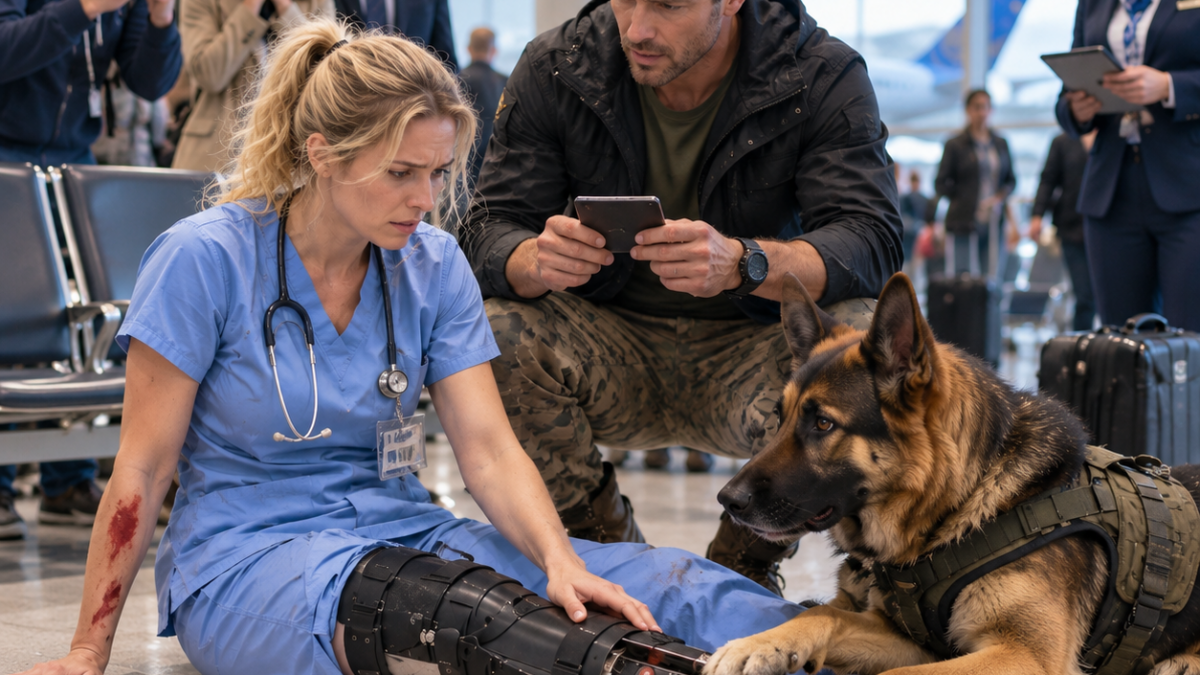
No hackles, no sound, just presence, dense and absolute and pointed in exactly the right direction. The man in the navy jacket reached into his jacket, and the first federal badge appeared at the corridor entrance behind him, not walking, moving. Two people in civilian clothes with the unmistakable carriage of authority arriving with intention, ID already in hand, eyes already on the situation with the comprehensive attention of people who had been briefed in transit and arrived knowing exactly
what they were walking into.
The man in the Navy jacket’s hand stopped inside his jacket.
I was doing the same calculation Elena had been doing. the geometry of the moment, the number of people, the presence of the dog, the cameras, the arriving federal agents, and whatever he found in that calculation made him very slowly withdraw his empty hand.
His colleague at the kiosk turned and walked away, not running, just walking with the careful, deliberate pace of a man who had decided to be somewhere else before any of this became a matter of formal record. The federal agents let him go for now. One of them reached Mason and spoke quietly.
Mason listened, nodded twice, and then looked at Elena with an expression that had moved fully into the territory of controlled urgency. We need to move you to a secure operations room, he said.
Right now.
What’s happened?
He crouched, met her eye level, and his voice dropped to something she had to lean forward to catch. The file Harard Grove pulled on Silver Meridian before he walked in here.
He said, “The VA compliance audit from 8 months ago.
The one that came back clean.
What about it?”
It was signed off by a senior program inspector named Darren Quill. Mason paused. Darren Quill retired from federal service 14 months ago.
He retired, Elena.
He wasn’t working for the VA 8 months ago.
He was not in a position to sign off on anything. The terminal noise continued around them. A gate announcement, rolling luggage, a child laughing somewhere down the concourse.
Someone used a retired inspector’s credentials to sign a federal audit.
Elena said, “Someone used a retired inspector’s credentials to close a federal audit.”
Mason said, “There’s a difference.
The audit wasn’t routine.
It was triggered by a complaint.”
He held her gaze. A complaint filed by a patient who had been forcibly discharged from Silver Meridian and was trying to report equipment fraud.
Elena’s stomach dropped 3 in.
“Adrien,” she said.
“He tried to report it through official channels,” Mason said, and someone inside the federal inspection system killed the report before it ever reached anyone who would act on it.
He stood. The federal agent beside him was watching the corridor.
“Which means this isn’t just Silver Meridian,” Elena said.
“No,” Mason said.
“It isn’t.”
Atlas pressed his flank against Elena’s left leg, steady, warm, immovable.
“Can you walk?”
Mason said. Elena gripped her crutch and stood on one leg and one locked brace.
And whatever was living in her chest in that moment, the anger, the exhaustion, the cold clarity of realizing exactly how deep this went, she filed it into the back of her mind with the same efficiency she used to file everything
that couldn’t be dealt with until the patient was stabilized.
“Yes,” she said.
she walked. The airport operations room was not designed for the kind of meeting that was now taking place inside it.
It was a functional space, two folding tables pushed together, a wall of monitors showing terminal camera feeds, a whiteboard with flight status annotations in three colors of marker, and chairs that had been purchased for utility rather than comfort. The overhead lighting was fluorescent and unforgiving.
A half empty coffee pot sat on a filing cabinet in the corner, and the smell of it had been burning for long enough that it had stopped smelling like coffee and started smelling like something else entirely. Elellena sat at one end of the table with her left leg extended, the brace still locked, and a rolled jacket that one of the federal agents had offered without being asked positioned under her knee to reduce the compression angle. It was a small thing.
She noted
it. The federal agent who had done it was named Harg Grove specialist Lena Hargrove, NCIS, who had arrived through the airport operations corridor with two colleagues in a hard-sided equipment case that she handled with the specific care of someone transporting something that mattered. She was compact and precise with the kind of stillness in her movements that came from spending time in situations where unnecessary motion was a liability.
The other two agents, a man named Destin Okafor and another who had introduced himself only as Price, had positioned themselves near the door and the window respectively with the instinctive geometry of people who thought in terms of exit vectors. Mason stood at the end of the table opposite Elena.
Atlas had been directed to a corner where he sat with the patience of a dog who understood that his current assignment was to stay out of the way and wait. He was managing it imperfectly. His eyes kept returning to the brace.
“We have two problems,” Hargrove said, setting the equipment case on the table.
“The first is extracting the data from the transmitter without destroying it, which requires a non-invasive approach, and about 30 minutes, I’m not sure we have.
The second is the man from the gate area who walked away.
He’s being tracked,” Mason said.
“We have eyes on him until he exits the terminal.
After that, we’re relying on the airport’s external camera coverage, which has gaps.”
Hargrove looked at Elena. You said the gate agent, Darby, filed a complaint acknowledgement before your fall.
Is that accurate?
She said she’d noted in the system, whether she did is a different question.
We need that documentation.
If Silver Meridian’s people are in this airport, and given the surveillance response to your position, that’s no longer a question.
They may have access to the airlines complaint system.
If there’s a flag on your name from this morning’s incident, they know you’re in the building.
Elena looked at her.
They already know I’m in the building.
That man at the gate was looking directly at me. Right.
But there’s a difference between someone spotted you and your name is in a searchable database with your flight record attached.
Hargrove paused. Your flight record includes your home address. The room was quiet for a moment.
Then we have three problems, Elena said. Hargrove opened the equipment case.
Inside, nested in foam, was a device that Elena recognized as an electromagnetic scanning unit, a more sophisticated version of the equipment used in hospitals to locate embedded metallic components without invasive procedures.
Beside it was a secondary unit she didn’t recognize, smaller and sealed in its own housing.
The transmitter is running on a frequency Atlas was conditioned to detect, Harrove said, looking at Mason. Do you have the original conditioning protocol documentation?
in my kit at the base. I can have it transmitted to your secure system in too slow.
What do you remember about the frequency band? Mason gave her a number. Harrove typed it, looked at the screen on the scanning unit, typed a second number and a parameter adjustment.
It’s running a compressed burst transmission, she said after a moment.
15-second intervals, which means the data isn’t a continuous signal.
It’s packaged.
Whoever Adrian used to build this knew how to avoid standard detection sweeps. She looked at the brace.
The burst pattern is designed to look like microprocessor noise from the medical device itself. Even a targeted scan would likely miss it. Which is why it passed security for 8 months, Elena said.
Which is why it passed security for 8 months, Hargrove confirmed. And why the joint locked?
I think the locking mechanism wasn’t a malfunction.
I think it was an activation sequence. The transmitter intensifying its signal to draw attention when it detected something in its environment.
Elena stared at her.
Atlas’s conditioning frequency.
The dog’s presence triggered an escalation in the transmitter output, which caused the microprocessor to receive conflicting signals, which locked the joint.
Hargrove met Elena’s eyes with something that was almost an apology.
Your brace functioned exactly the way it was supposed to. Adrien Salt engineered it to fail in a way that would force someone to pay attention. The understanding of it settled over Elena in layers.
had not been an accident. The pain in her hip and her elbow, the floor of the boarding lane, the passengers who had walked around her, all of it had been, in a clinical sense, intentional.
A disabled woman falling in an airport was not something that drew immediate serious response. It was something that people looked away from or stepped around or filed paperwork about.
Adrienne had known that. He had known that a locked brace would ground her in one place long enough for the right person to find her.
He had known because he had been inside the system long enough to understand exactly how it worked. I want to be angry about this, Elena said.
I’ll deal with that later.
Right now, how do we get the data out?
Harrove was already positioning the scanning unit near Elena’s leg.
I can extract the burst packet without opening the housing. The secondary device, she indicated the smaller sealed unit will capture and decode the transmission, but I need silence in about 20 minutes of stability. Define stability.
Don’t move the leg.
Elena settled her hands in her lap and did not move the leg. The scanning process was not dramatic. Hardgrove worked with quiet concentration, adjusting parameters and watching readouts, occasionally typing a command and waiting.
The room held the particular silence of people who understood that the wrong kind of noise at the wrong moment had consequences. Price, near the window, had his eyes on the external camera feed on a tablet. Okapor had stepped into the corridor and was talking quietly into his phone.
Mason came and sat in the chair beside Elena. Not close, just in proximity. The way people sit when they are performing the opposite of abandonment.
Your brother, he said quietly. Dominic, you were going to him.
Yes.
We’ll need to notify him that your travel plans have changed.
I know. She paused.
He’ll be fine.
He’s had one surgery before.
He knows what he’s doing.
She paused again.
He’ll also be furious on my behalf about the airline thing, which will give him something to focus on besides the pain.
So, in a way, this is fine. Mason looked at her sideways.
Something in his expression shifted in a way she hadn’t seen before.
Brief and unguarded, like a door opening and closing. You do that a lot, he said. Do what?
Find the functional angle on something bad occupational habit. She looked at the scanning unit.
“You do it, too?”
“Yeah,” he said.
“I do.”
Harrove said, “I’ve got the packet.”
Everyone in the room reoriented toward her. Hargrove was watching the secondary devices screen with the intense focus of someone reading something important fast.
“Give me 60 seconds,” she said.
The 60 seconds were long. Elena counted them without meaning to, the way she counted seconds during a code when she needed to track CPR intervals without looking at a clock. Old reflex.
Okay. Harrove sat back. Her face was controlled, but something in it had shifted.
The specific quality of someone who has just read something larger than they expected. There are three files.
The first is a patient record database. Looks like it contains documentation of equipment allocations for veterans in the silver meridian program going back at least four years. Partial records enough to show the pattern of items logged as issued that were never actually in patient use.
How many patients? Mason said. Hargrove looked at the number.
At minimum 212 documented cases. The room absorbed that. The second file is financial.
She continued, “Transfer records, equipment serial numbers matched against private resale documentation.
The devices were being sold, not scrapped, not redirected to another program.
Sold through a secondary market broker operating under a Shell company.”
She looked up.
“The Shell Company’s registration traces back to a holding entity in Delwick County.
Price from the window said, “Delwick County is where Silver Meridian’s regional headquarters is.”
“Yes,” Harg Grove said.
And the third file, Mason said. Hargrove paused in a way that was not hesitation. It was preparation.
The third file is a list of names, she said. 14 names.
Federal employees, VA program officers, one active duty officer in the inspector general’s office.
And she stopped.
And Darren Quill, the inspector whose credentials were used to close Adrienne’s complaint.
Elena said his credentials weren’t stolen.
Hargrove said his name is in the file as a co-signer, a participant.
He didn’t retire and then have his credentials used without his knowledge.
He retired and then continued to provide sign off on compliance reviews through an informal arrangement that kept him off the official payroll while keeping him useful. She set the device down.
He knew he was part of it. Mason was very still. 14 names, he said.
14, Argrove said, and the list includes the NCIS case officer who closed Adrienne’s original wellness report.
Nobody spoke for a moment.
Elena could hear the HVAC system cycling, the faint sound of a gate announcement from somewhere in the terminal, and a noise from the corridor that made Okaphor’s voice cut off.
Then Okaphor opened the door.
“We have a problem,” he said.
His face had the specific tightness of someone who had just received information that made the current situation significantly more complicated. The man from the gate one in his Navy jacket.
He didn’t leave the airport.
He went to the airlines customer service counter.
Harrove said he’s accessing her travel record.
He accessed it. Okafor said past tense.
And then he made a phone call 22nd call.
And then the airport’s external camera feed on the north access road went offline.
The room’s atmosphere changed in the way that rooms change when people who are trained to recognize escalation recognize escalation simultaneously.
They’re calling in assets.
Mason said it was not a question. Someone cut the camera feed.
That’s not a solo operation.
Okapor looked at Elena. Your address is in the travel record.
If they have people mobile, my brother, Elena said. The word came out flat. She had already done the calculation before Okafor had finished the sentence.
The address in the travel record was her home address in Harlo City, not Dominic’s address, but Silver Meridian had patient records.
They had a rehabilitation file.
They had the program intake documentation, which included emergency contact information, Dominic’s name, Dominic’s address.
I need a phone, she said. Mason had his in her hand before she finished the sentence.
She dialed. It rang four times and went to voicemail.
She tried again. Three rings.
Voicemail. He may be sleeping, she said. Her voice was steady.
Her hands were not. He had surgery 6 days ago.
He sleeps heavily because of the pain medication.
He doesn’t always hear his phone.
She looked at Mason. I need someone at his address. Harlo City is 40 minutes from here.
Ahor said. Harlo City PD can be there and no. Harrove said and her voice was precise.
If Silver Meridian has contacts in federal systems, we don’t know the extent of it.
Running a local police call through dispatch creates a record.
We don’t know who’s reading those records.
Elena looked at Harrove.
You’re saying we can’t trust local police.
I’m saying we don’t know the boundaries of the network yet.
Until we do, every official channel is a potential leak. The understanding was ugly.
The data on the secondary devices screen represented 14 names in federal and military roles, the visible ones, the ones Adrian had been able to document. The actual network could be larger.
It could reach into local enforcement. It could reach into hospital systems. It could reach into the rehabilitation infrastructure that had fitted this brace and sent Elena Voss through airports for 8 months without her knowledge.
The scope of it was large enough to be disorienting if she let it be. She did not let it be. options.
She said, “I have a contact in the Marshall Service who is not on this list and who I would trust with my life.”
Argrove said, “I can have him dispatched to your brother’s location with a cover reason that doesn’t require running it through standard channels.
15 minutes.
” “Make the call,” Elena said.
Hargrove was already on it. Mason moved to the window beside Price and looked at the tablet showing the external camera feeds, the ones that were still functioning. Elena watched his profile and saw the things she recognized from the ward, the things she had seen on the faces of experienced people in critical moments.
The simultaneous management of multiple timelines, present and projected, running parallel calculations and prioritizing actions by consequence rather than urgency. The man who walked away from the gate is still in the building, she said. Probably, Mason said.
And he knows we’re in this room.
He knows we went to operations.
He doesn’t know which room.
How long before they narrow it down? Mason looked at the door at the single camera mounted above it showing the corridor.
At the airport badge hanging from Aquafor’s lanyard, which was a visitor credential and not a staff credential and would not open every door in this building.
They won’t come through the front, he said.
Too visible. Too many cameras still running in the main terminal.
They’ll find a service access point.
He looked at Price. The north camera feed that went down.
What does that corridor access? Price checked the tablet. His expression told Elena the answer before he spoke.
Loading dock, he said. And the service corridor that runs behind the operations wing. The door at the far end of the room, the one Elena had assumed led to a utility closet, was a service access door.
She looked at it at the gap under it, at the fact that it had a different lock mechanism than the main door, older with a key cylinder rather than a keypad. That door, she said.
Everyone looked. The gap under the service door showed light on the other side.
It had been showing light since they entered the room. Elena had registered it automatically and filed it as ambient, a corridor light left on. She registered it now differently as a corridor light that had not been on when they first entered, that had come on at some point in the last 40 minutes while they had been focused on the scanning unit and the data files in the phone call to Dominic that had not been answered.
Someone’s in the service corridor, she said.

