Part 3: “I don’t talk about it because the only story I have is about a man who died in my arms.”
PART 8 — THE REUNION
I thought about it for two weeks.
Every day, I told myself I wasn’t going to go. Every night, I lay in bed and stared at the ceiling and thought about all the reasons it was a bad idea.
I didn’t want to see the pity in their eyes. I didn’t want to answer questions. I didn’t want to remember.
But I kept thinking about Mike’s letter. Being strong means letting people in.
And I kept thinking about Marcus. You can’t hide forever.
So on a Friday afternoon in late April, I got in the truck and drove to Virginia Beach.
The bar was called The Anchor. It was a small place on Shore Drive, tucked between a seafood restaurant and a surf shop. There were motorcycles in the parking lot and a flag over the door.
I sat in the truck for a minute.
I could see them through the window. A dozen men, maybe more, sitting at tables, standing at the bar, laughing. They looked older. Grayer. Softer around the edges. But I recognized them.
I recognized all of them.
I got out of the truck. I walked to the door. I opened it.
The noise hit me first. The laughter. The clinking of glasses. The low hum of conversation.
Then Marcus saw me.
He was standing near the bar, a beer in his hand. His face lit up.
“Jack!”
He walked over. He hugged me. The room went quiet.
One by one, they turned. They looked at me. They recognized me.
“Jack Morrison.”
“Holy shit, Jack.”
“Morrison’s here.”
A man stepped forward. He was older, heavier, with a thick beard and a scar over his left eye. I knew him. Tom Delaney. He’d been my first team leader. He’d taught me everything I knew.
He looked at me for a long moment. Then he said, “You son of a bitch.”
He hugged me.
“You’re alive,” he said.
“I’m alive.”
“We thought you were dead. We thought you’d disappeared. We thought—” He stopped. He shook his head. “Where the hell have you been?”
“Here,” I said. “Just here.”
He pulled back. He looked at me. His eyes were wet.
“You look good, Jack.”
“You look old, Tom.”
He laughed. A big, booming laugh. “That’s because I am old. Come on. Let me buy you a drink.”
I spent the next three hours talking.
I talked more in those three hours than I had in the previous three years.
I talked to Tom. To Marcus. To a dozen other men I’d served with, men I’d trained with, men I’d fought beside. Some of them I hadn’t seen since the day I’d left the teams. Some of them I hadn’t seen since the day Mike died.
They told me about their lives. About their families. About their jobs. About their struggles. About the things they’d done and the things they’d seen and the things they couldn’t forget.
I told them about mine.
Not everything. Not all at once. But enough.
I told them about Carol. About her death. About the letter she’d given me. About the promise I’d made.
I told them about my father. About his death. About the last thing he said to me.
I told them about Brian. About the jokes. About the heart attack. About the way he’d cried in the hospital.
I told them about Mike.
About the ambush. About the grenade. About the way he’d thrown himself on top of me. About the last words he said.
Tell my mom I’m sorry.
When I finished, Tom put his hand on my shoulder.
“He was a good man,” he said.
“He was the best of us.”
“He was.” Tom paused. “And so are you, Jack. You always were.”
I looked at him. He looked back at me.
“You’re not responsible for what happened. You know that, right?”
“I know.”
“Do you?”
I didn’t answer.
“Jack.” Tom’s voice was firm. “Mike made a choice. He made the choice that every one of us would have made. He died so you could live. That’s not your fault. That’s his gift.”
I closed my eyes. I felt the tears come. The first time I’d let myself cry in years.
Tom pulled me into a hug. He held me while I cried.
“It’s okay,” he said. “It’s okay.”
The reunion went on until midnight.
I stayed until the end. I drank a beer. I told stories. I laughed. I remembered.
When it was over, Marcus walked me to my truck.
“You okay?”
“Yeah. I’m okay.”
“You’re going to stay in touch, right?”
“I will.”
“Good.” He paused. “There’s something I want to tell you. Something I’ve been working on.”
“What is it?”
“The Navy is doing a ceremony next month. At the Naval Special Warfare Command. They’re dedicating a memorial to the SEALs we lost in Afghanistan and Iraq.”
I looked at him. “A memorial?”
“Yeah. And I’ve been asked to speak. As a representative of the teams.”
“That’s an honor, Marcus.”
“It is.” He paused. “I want you to be there.”
I looked at the ground. “I don’t know, Marcus.”
“I know it’s hard. I know it’s painful. But I think it would be good for you. To be with the others. To remember Mike together.”
I looked at him. His eyes were earnest. Hopeful.
“Okay,” I said. “I’ll be there.”
He nodded. He put his hand on my shoulder.
“Good. That’s good.”
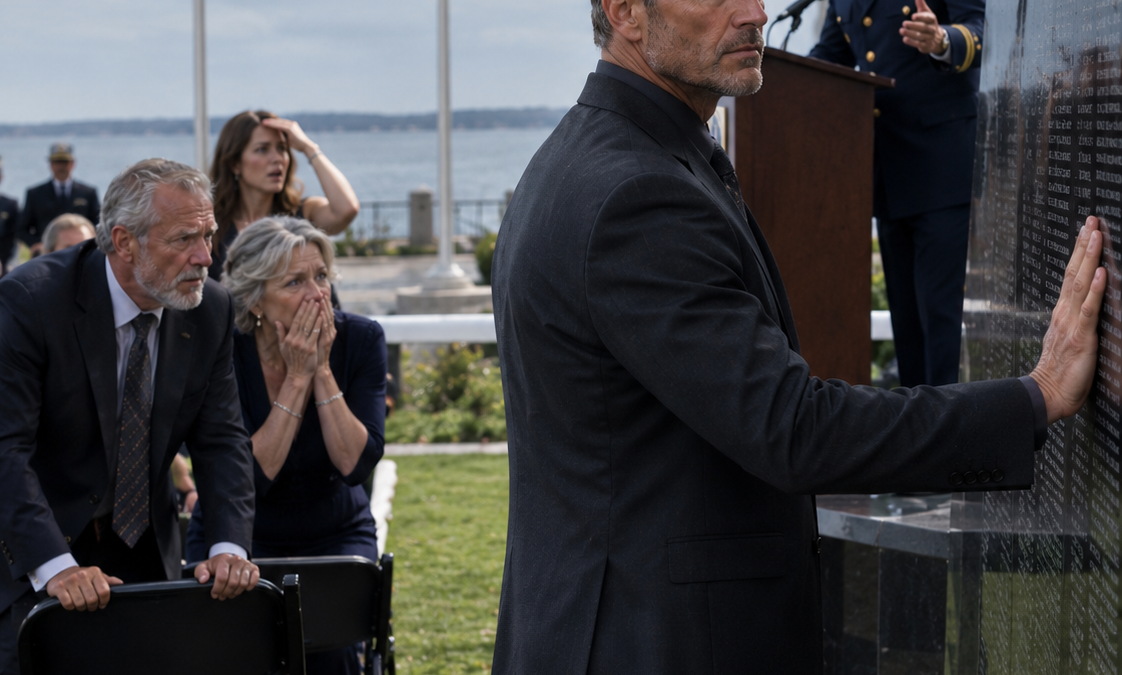
The ceremony was three weeks later.
I drove down to Virginia Beach again. The Naval Special Warfare Command was a sprawling compound on the water. There were flags everywhere. There were sailors in dress blues. There were SEALs in khakis.
There were families.
I parked the truck. I walked to the memorial site.
It was a low wall of black granite, curved like a wave. Names were carved into it. Hundreds of names. Men who’d died in service to their country. Men who’d made the ultimate sacrifice.
I walked along the wall. I read the names.
I stopped when I found his.
Michael J. Brennan.
I stood there for a long time. I looked at his name.
Tell my mom I’m sorry.
I reached out. I touched the letters. The stone was cold.
“I’m here, Mike,” I whispered. “I’m here.”
Marcus spoke.
He stood at a podium near the wall. He was in his dress blues. He looked tall and strong and serious.
He talked about the teams. About the brotherhood. About the sacrifice. About the men and women who served and the families who supported them.
Then he talked about Mike.
“Michael J. Brennan was a SEAL,” he said. “He was a son. A brother. A friend. He was a man who loved his mother and his team and his country. He was a man who gave his life so that others could live.”
I stood in the back, near the wall. I listened.
“He was not alone when he died,” Marcus said. “He was with his teammate. His friend. His brother. A man who carried him off the mountain. A man who held him as he passed. A man who has spent every day since trying to honor his memory.”
I felt my chest tighten.
“I want to recognize that man today. I want to thank him. I want to tell him that he is not forgotten. That his sacrifice is not forgotten.”
Marcus looked at me. The crowd turned. They looked at me.
“Jack Morrison. Would you come forward?”
I stood there. I couldn’t move. I couldn’t breathe.
But then I thought about Mike. About his letter. About what he’d written.
Live your life. For me.
I walked forward.
I stood beside Marcus at the podium.
I looked out at the crowd. At the families. At the SEALs. At the sailors. At the men and women who’d come to honor the fallen.
“I’m not going to give a speech,” I said. My voice was quiet. Steady. “I’m just going to say one thing.”
I looked at the wall. At Mike’s name.
“Mike Brennan was the best man I ever knew. He was my friend. He was my brother. He died so I could live. And I’ve spent every day since trying to be worthy of that.”
I paused.
“I’m still trying. But I’m going to keep trying. For him. For his mom. For all of you.”
I stepped back. The crowd applauded.
Marcus put his hand on my shoulder.
“Thank you, Jack.”
I nodded. I walked back to the wall. I stood by Mike’s name.
And for the first time in years, I felt something other than pain when I thought about him.
I felt peace.
PART 9 — THE GIRLS
I went to Boston in May.
Marcus had been asking me for weeks. “Come up. Meet the family. See the house. The girls have been asking about you.”
I kept putting it off. I had excuses. Work. The boat. The apartment. Things I needed to do.
But then I ran out of excuses.
I flew out on a Friday morning. It was a short flight, an hour and a half. Marcus picked me up at Logan. He was in jeans and a polo shirt, looking nothing like the surgeon I’d seen in Norfolk.
“You came,” he said.
“I came.”
He hugged me. Then he drove me to Cambridge.
His house was a big Victorian on a quiet street. There was a porch and a swing and a lawn that needed mowing. There were bicycles in the driveway and a basketball hoop over the garage.
It looked like a home. A real home.
We walked in. The girls were in the living room, waiting.
“This is Jack,” Marcus said. “The man I told you about.”
The older girl stepped forward. She was ten, dark-haired, serious. She looked at me with the kind of gaze that made you feel like you were being measured.
“I’m Maya,” she said. “I’m named after Mike.”
I looked at her. I felt my throat tighten.
“I know,” I said. “Your dad told me.”
“Were you there? When he died?”
I looked at Marcus. He nodded.
“Yes,” I said. “I was there.”
“What was he like?”
I knelt down. I looked at her. She had her father’s eyes.
“He was funny,” I said. “He was always making jokes. He could make anyone laugh, even when things were bad.”
She nodded. “Dad says he was brave.”
“He was the bravest man I ever knew.”
She looked at me for a long moment. Then she stepped forward and hugged me.
I hugged her back. I closed my eyes.
“Thank you for saving my dad,” she said.
I didn’t say anything. I couldn’t.
The younger girl was eight. Her name was Lena. She was shy at first, hiding behind her mother’s leg. But by dinner she’d warmed up.
“Are you a SEAL too?” she asked.
“I was,” I said.
“Was it scary?”
“Sometimes.”
“Did you have a gun?”
“Lena,” her mother said.
“It’s okay,” I said. “Yes, I had a gun.”
“Did you shoot people?”
“That’s enough, Lena,” Marcus said.
I looked at the girl. She was curious. Innocent. She didn’t understand what she was asking.
“Sometimes,” I said. “When I had to. To protect my friends.”
She nodded. She seemed satisfied.
“Okay,” she said. She went back to her dinner.
I stayed for three days.
We went to the aquarium. We went to a Red Sox game. We walked around Harvard Square. We ate dinner at a restaurant where the girls knew the owner by name.
I played catch with Maya in the backyard. I pushed Lena on the swing. I sat on the porch with Marcus and his wife and talked about nothing in particular.
It was normal. It was ordinary. It was the kind of life I’d never imagined for myself.
And it was good.
On the last night, Marcus and I sat on the porch.
The girls were in bed. His wife was inside, reading. The night was warm and quiet. The streetlights glowed. The crickets sang.
“You look better,” Marcus said.
“I feel better.”
“Good.”
We sat in silence for a while.
“I’ve been thinking,” I said.
“About what?”
“About what to do. With the rest of my life.”
Marcus nodded. “And?”
“I don’t know. I’ve been doing the same thing for years. The job. The routine. The apartment. It’s not… it’s not enough anymore.”
“What do you want to do?”
I looked at the sky. The stars were faint, washed out by the city lights.
“I want to help people,” I said. “I want to do something that matters.”
Marcus was quiet for a moment. Then he said, “You know, there are organizations that help veterans. Transition programs. Mentorship. Things like that.”
“I know.”
“You’d be good at it. You’ve been through it. You understand.”
I thought about it. About the men and women coming home from deployments. About the ones who struggled. About the ones who didn’t make it.
“Maybe,” I said.
“Just think about it.”
“I will.”
I flew back to Norfolk on a Monday morning.
I went back to work. I sat at my desk. I did my job.
But something was different. Something had shifted.
I started looking at the world differently. I started noticing things I’d been ignoring.
The way Dave’s hands shook when he was stressed. The way Tyler got quiet when someone mentioned their father. The way one of the women in accounting — Sarah, her name was — always sat alone at lunch.
I saw myself in them. The way I used to be.
I started saying hello. I started asking how they were. I started listening when they answered.
It wasn’t much. But it was something.
Brian came back to work full-time in June.
He was different. Quieter. Slower. He didn’t slap desks or high-five people. He didn’t tell stories about his bachelor party or his college lacrosse days.
He just did his work. And he was kind.
One day, I saw him talking to Dave. Dave looked upset about something. Brian had his hand on Dave’s shoulder. He was talking in a low voice. Dave nodded. He seemed calmer when he walked away.
Brian saw me watching. He shrugged.
“He’s going through some stuff at home. His dad’s sick.”
“I didn’t know.”
“He doesn’t talk about it.” Brian paused. “I get it now. Why people don’t talk about stuff.”
I nodded. “Yeah.”
“You know what the hardest part was? Lying in that hospital bed. Thinking about all the time I wasted. All the years I spent being an asshole instead of being a person.”
“You’re not an asshole, Brian.”
“I was.”
“Maybe. But you’re not now.”
He looked at me. He nodded.
“Thanks, Jack.”
The dinner happened in July.
Brian invited me to his house. His wife, Karen, made lasagna. His kids — two boys, eight and six — ran around the backyard like maniacs.
I sat at the table with them. We ate. We talked. We laughed.
Karen asked me about my time in the Navy. She asked the right questions. Not the ones Brian used to ask. Real ones.
“What was the hardest part?”
“The loss,” I said. “Losing people you love.”
She nodded. She didn’t push.
After dinner, Brian and I sat on the back porch. The kids were inside, watching a movie. Karen was cleaning up.
“You know,” Brian said, “I used to think you were weird.”
“I know.”
“I used to think there was something wrong with you. The way you never talked. The way you kept to yourself.”
“There wasn’t anything wrong with me. I was just… surviving.”
Brian nodded. “I get that now.”
We sat in silence for a while.
“Can I ask you something?” he said.
“Sure.”
“Are you happy?”
I looked at him. It was a simple question. A fair question.
“I don’t know,” I said. “I’m getting there.”
“That’s good. That’s something.”
“Yeah. That’s something.”
The summer passed.
I worked. I went out on the boat. I talked to Marcus every week. I had dinner with Brian and his family. I started saying hello to people at work.
I was still alone. I was still quiet. But I wasn’t closed off. Not anymore.
I started looking into veteran organizations. I made some calls. I did some research. I found a place in Virginia Beach — a nonprofit that helped veterans transition to civilian life. They were looking for mentors.
I called them. I set up an interview.
The interview was on a Tuesday afternoon. I took the day off work. I drove down to Virginia Beach.
The office was small. Two rooms and a reception area. There were posters on the walls. Flags. Photographs of veterans and their families.
The woman who interviewed me was named Patricia. She was in her fifties, a former Navy nurse. She’d been running the organization for ten years.
“Why do you want to do this?” she asked.
I thought about it. I thought about Mike. About the letter. About everything that had happened.
“Because I know what it’s like,” I said. “To come home and feel like you don’t fit anymore. To carry things you can’t talk about. To think you’re alone.”
She nodded. “And you’re not alone?”
“I’m learning that.”
She smiled. “We’d love to have you, Jack. When can you start?”
I started the next week.
I met with veterans one-on-one. I listened to their stories. I helped them find jobs, find housing, find counseling. I didn’t fix anything. I just showed up.
That was the most important thing. Showing up.
Some of them reminded me of myself. The way I used to be. Closed off. Angry. Scared.
I told them about Mike. About the medal. About the letter. I told them about the years I’d spent hiding and the moment I’d decided to stop.
“It doesn’t get easier,” I said. “But it gets better. If you let it.”
Some of them listened. Some of them didn’t. Some of them came back. Some of them didn’t.
That was okay. That was how it worked.
One day, a young man came in.
He was twenty-four, maybe twenty-five. He’d been a Marine. He’d done two deployments in Afghanistan. He’d lost friends. He’d lost himself.
He sat across from me. He wouldn’t look at me. He wouldn’t talk.
“I’m not going to make you talk,” I said. “I’m just going to sit here. If you want to say something, I’ll listen.”
He didn’t say anything for a long time. Then he looked at me.
“Why are you doing this?”
“Because someone did it for me.”
He stared at me. “Who?”
“A friend. A man who died. He wrote me a letter before he died. He told me to live my life. For him. For myself.”
The young man’s eyes were wet. He looked at the floor.
“I don’t know if I can,” he said.
“I know,” I said. “I didn’t either. But I’m trying. That’s all you have to do. Try.”
He looked at me. He nodded.
“Okay,” he said. “I’ll try.”
PART 10 — THE DRAWER
Two years passed.
I stayed at Kessler. I kept the same cubicle. I kept the same routine. But everything else changed.
I still went to the gym at 5 a.m. I still went out on the boat. I still ate dinner standing at the counter.
But I wasn’t alone anymore. Not really.
Brian and I became actual friends.
Not the kind of friends who talk every day. Not the kind who go on vacation together. The kind who understand each other without needing to explain. The kind who can sit in silence and be comfortable.
He came over to my apartment one Saturday in the fall. The first time he’d ever been there. He walked in and stopped.
“Whoa.”
I looked around. The apartment was the same as always. Sparse. Functional. Clean.
Then I saw what he was looking at.
The wall.
The medal. The photograph.
He walked over. He stood in front of the frame.
Michael J. Brennan. For conspicuous gallantry and intrepidity at the risk of his life above and beyond the call of duty.
He was quiet for a long time.
“This is him?” he said.
“Yeah.”
“The guy you told me about.”
“Yeah.”
Brian looked at the photograph. Seven men in desert camouflage. Mike in the middle, his arm around my shoulders.
“That’s you,” he said. He pointed at me. “On the left.”
“Yeah.”
“You look… different.”
“I was different.”
He looked at the medal. Then back at me. Then back at the medal.
“I didn’t know,” he said. “I mean, I knew you were a SEAL. But I didn’t know…”
“I know.”
“You never told anyone.”
“No.”
“Why?”
I thought about it. The question deserved an honest answer.
“Because it wasn’t mine,” I said. “The medal. It belongs to him. To Mike. I just carry it.”
Brian looked at me. His eyes were wet.
“That’s the saddest thing I’ve ever heard,” he said.
I shrugged. “It’s the truth.”
He nodded slowly. He didn’t say anything else.
We stood there for a while, looking at the wall.
Then he said, “You should tell people. Not for you. For him. So people know who he was.”
I looked at Mike’s face. His smile. His eyes.
“Maybe,” I said. “Maybe someday.”
The reunion became a yearly thing.
Every spring, a group of us got together at The Anchor. We drank beer and told stories and remembered the ones who weren’t there.
Tom Delaney came every year. He was retired now, living in Florida, but he flew up for the reunion. He always made a point of sitting next to me.
“You’re looking better every year, Jack,” he’d say.
“Speak for yourself, old man.”
He’d laugh. That big, booming laugh. And we’d drink to Mike.
Marcus came too. Sometimes with his family, sometimes alone. His daughters were getting older now. Maya was twelve. Lena was ten. They called me Uncle Jack.
I’d never been an uncle before. I liked it.
The veteran center became my second home.
I went there three days a week. I met with young men and women who’d served. I listened to their stories. I helped them find their way.
Some of them reminded me of myself. The ones who wouldn’t talk. The ones who sat in silence and stared at the floor.
I’d sit with them. I wouldn’t push. I’d just be there.
“You don’t have to talk,” I’d say. “You just have to know you’re not alone.”
Sometimes they’d talk. Sometimes they wouldn’t. Either way, I’d come back the next week.
That was the job. Showing up.
Patricia made me a mentor coordinator after the first year. I trained new volunteers. I ran group sessions. I spoke at events.
I didn’t like speaking at events. But I did it anyway.
Once, at a fundraiser, I stood in front of a room full of people and told Mike’s story. The whole story. The ambush. The grenade. The last words.
Tell my mom I’m sorry.
I told them about the medal. About the drawer. About the years I’d spent hiding.
“I thought I was protecting myself,” I said. “But I was just hiding. Hiding from the pain. Hiding from the memories. Hiding from the people who loved me.”
I paused. I looked out at the crowd.
“I’m done hiding.”
Afterward, a woman came up to me. She was older, gray-haired, with tears in her eyes.
“My son was a Marine,” she said. “He died in Fallujah. I’ve been hiding too.”
I looked at her. I took her hand.
“You don’t have to,” I said. “Not anymore.”
She nodded. She squeezed my hand.
My mother died in November of that second year.
It wasn’t sudden. She’d been sick for months. David called me every week with updates. I drove down to Richmond every other weekend.
She was in a nursing home by then. She’d sold the house. She couldn’t take care of it anymore.
I sat with her on her last day. She was weak, barely conscious. But she knew I was there.
“Jack,” she said. Her voice was a whisper.
“I’m here, Mom.”
“You came.”
“I came.”
She smiled. It was a small smile, but it was real.
“Your father was proud of you,” she said. “He told me. He told me at the end.”
I nodded. I couldn’t speak.
“He was proud of you,” she said again. “I was proud of you too.”
I held her hand. I sat with her until she passed.
It was peaceful. Quiet.
I closed her eyes. I kissed her forehead.
“Goodbye, Mom,” I whispered.
David and I got closer after that.
We were the only ones left. The only two people who remembered the way things used to be. The only two who knew what our parents were really like.
We talked on the phone every week. We met for lunch once a month. He came to Norfolk sometimes. I went to Richmond.
We talked about the past. About our father. About our mother. About all the things we’d never said.
“I’m sorry,” he said one day. “For all the years I resented you.”
“I know. You’ve said that.”
“I know. I just want to keep saying it. Until you believe it.”
I looked at him. My brother. The golden child. The one who’d stayed.
“I believe it,” I said.
He nodded. He smiled.
“Good.”
I went back to the wall in the spring.
The memorial ceremony had become an annual event. Every year, families and teammates gathered at the Naval Special Warfare Command to remember the fallen.
I went every year.
I stood by Mike’s name. I touched the letters. I said a few words.
“I’m still here, Mike,” I said. “I’m still trying.”
The stone was cold under my fingers. But it wasn’t painful anymore.
It was peaceful.
Marcus came up to me after the ceremony.
“You’re doing good, Jack.”
“I’m trying.”
“You’re doing more than trying. You’re helping people. You’re living.”
I looked at him. He was right. I was.
“I couldn’t have done it without you,” I said.
“You could have. You just needed someone to remind you.”
“That’s what I mean.”
He smiled. He put his hand on my shoulder.
“Mike would be proud of you.”
I looked at the wall. At Mike’s name.
“I hope so.”
I went home that night.
I made dinner. I ate standing at the counter. I cleaned up. I sat on the couch and stared at the wall.
Then I got up. I walked to the bedroom. I opened the drawer.
The letter was there. Mike’s letter. I’d read it a hundred times since that night.
I took it out. I unfolded it. I read it again.
Live your life. For me. For Mom. For yourself.
I folded it. I put it back.
Then I went to the living room. I stood in front of the wall. The medal. The photograph.
Seven men. Mike in the middle. Me on the left.
I looked at Mike’s face. His smile. His eyes.
“You were right,” I said. “It gets better.”
I stood there for a long time.
Then I went to bed.
The next morning, I woke up at 4:45 a.m.
I lay in the dark for a minute. I looked at the ceiling.
I thought about Mike. About Carol. About my father. About my mother.
I thought about Brian. About Marcus. About Tom. About all the people who’d helped me along the way.
I thought about the veterans I’d worked with. The ones who’d made it. The ones who hadn’t.
I thought about the drawer. About the medal. About the letter.
I got up. I made coffee. I drank it standing at the kitchen window, looking out at the gray water of the bay.
The sun was coming up. The sky was the color of gold.
I finished my coffee. I put the mug in the sink.
I looked at the wall one more time.
Then I grabbed my keys and went to work.
At lunch, Brian found me in the break room.
“Hey. You okay?”
“Yeah. I’m okay.”
“You look… different today.”
“Different how?”
“I don’t know.” He shrugged. “Lighter. Like you’re not carrying something anymore.”
I looked at him. He was right.
“I’m not,” I said.
He nodded. He sat down across from me.
“Good,” he said. “That’s good.”
We sat there in silence. The break room hummed. Someone walked in, got a soda, walked out.
“How’s the veteran thing going?” Brian asked.
“Good. Busy.”
“Helping people?”
“Trying.”
“That’s what matters.” He paused. “You know, I’ve been thinking.”
“About what?”
“About what you said. About telling people. About Mike.”
I looked at him.
“You should do it,” he said. “Tell his story. Let people know who he was.”
I thought about it. I thought about the ceremony. About the wall. About the words I’d said.
“Maybe,” I said.
“Not maybe. Do it.” He leaned forward. “I can help. I can set up a website. I can talk to the local news. I can—”
“Brian.”
He stopped.
“Okay,” I said. “Okay. Let’s do it.”
He smiled. A real smile. The kind that reached his eyes.
“Good,” he said. “That’s good.”
The story ran in the Virginian-Pilot three weeks later.
A reporter came to my apartment. She sat on my couch and asked me questions. She looked at the medal. She looked at the photograph. She listened to the story.
I told her about Mike. About the ambush. About the grenade. About the last words.
I told her about the drawer. About the years I’d spent hiding. About the moment I’d decided to stop.
I told her about Carol. About the letter. About the promise I’d made.
When the story came out, I didn’t read it. I couldn’t.
But Brian read it. He called me that night.
“Jack. You need to see this.”
“What does it say?”
“It says you’re a hero. It says Mike was a hero. It says—” He paused. “It says you’re a good man.”
I didn’t say anything.
“It’s a good story, Jack. A really good story.”
“Thanks, Brian.”
“You’re welcome.”
I hung up. I sat on the couch. I looked at the wall.
The medal. The photograph.
Michael J. Brennan.
I nodded.
“You’re welcome too, Mike,” I whispered.
The years passed.
I kept working. I kept helping. I kept living.
I wasn’t alone anymore. I had friends. I had a purpose. I had a life.
It wasn’t the life I’d imagined. It wasn’t the life I’d planned. But it was mine.
And it was enough.
One day, a young man came into the veteran center.
He was twenty-two, maybe twenty-three. He’d just gotten out of the Army. He’d done one deployment. He’d lost a friend.
He sat across from me. He wouldn’t look at me. He wouldn’t talk.
“I’m not going to make you talk,” I said. “I’m just going to sit here.”
He didn’t say anything for a long time.
Then he looked at me.
“Does it get better?”
I looked at him. I thought about Mike. About the letter. About everything that had happened.
“Yeah,” I said. “It gets better.”
“How do you know?”
I smiled. A small smile.
“Because someone told me,” I said. “A long time ago. And he was right.”
I went home that night.
I made dinner. I ate standing at the counter. I cleaned up. I sat on the couch and stared at the wall.
Then I got up. I walked to the living room. I stood in front of the medal. The photograph.
Seven men. Mike in the middle. Me on the left.
I looked at Mike’s face.
“Thank you,” I said.
Then I went to bed.
The next morning, I woke up at 4:45 a.m.
I lay in the dark for a minute. I looked at the ceiling.
I thought about Mike. About his laugh. About his smile. About the way he’d put his hand on my shoulder and say, “Let’s go get ’em, old man.”
I got up. I made coffee. I drank it standing at the kitchen window, looking out at the gray water of the bay.
The sun was coming up. The sky was gold.
I finished my coffee. I put the mug in the sink.
I looked at the wall one last time.
Then I grabbed my keys and went to work.

