“No One Will Come”—A Navy SEAL & K9 Found Her Then Her Stepmother’s Lie Collapsed
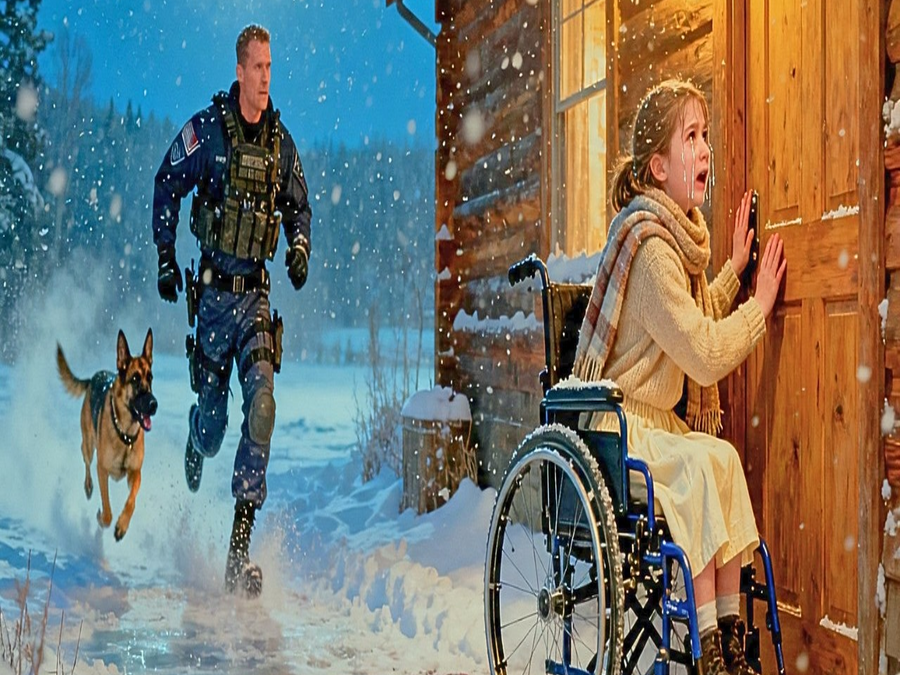
“No One Will Come”—A Navy SEAL & K9 Found Her Then Her Stepmother’s Lie Collapsed
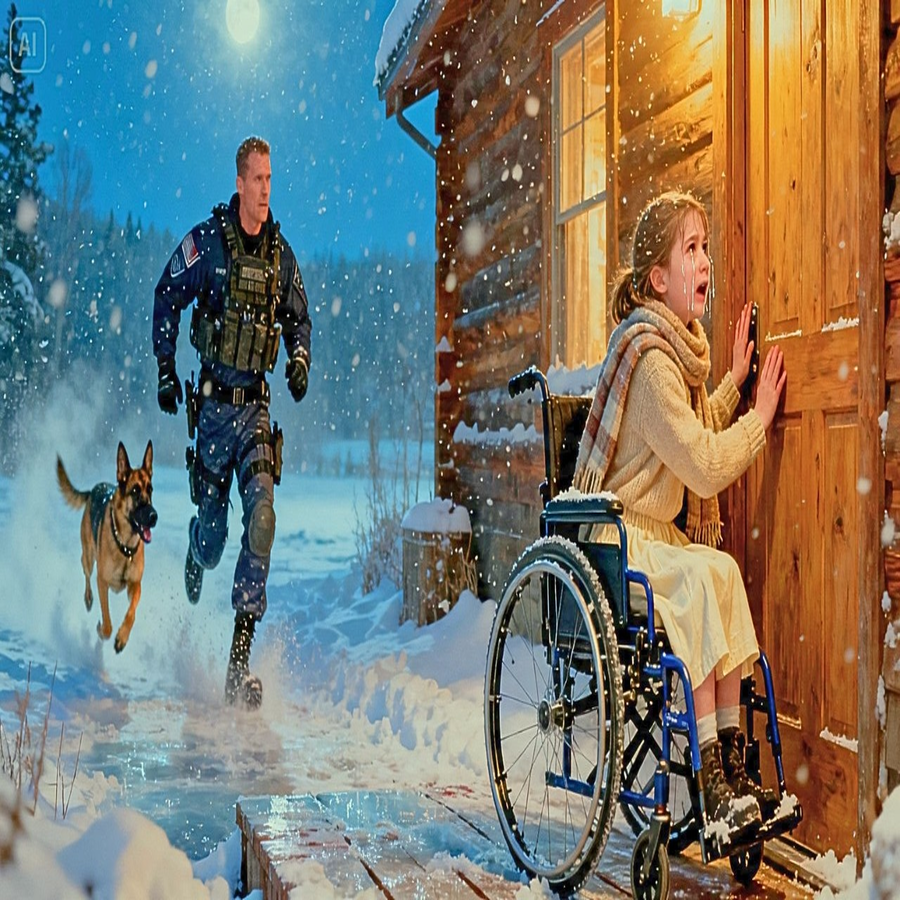
She was 10 years old
strapped to a wheelchair and left alone in a Montana blizzard.
The front door was locked from inside, the lights cut, car gone.
And the woman who did it already on the phone crafting the story she’d tell before anyone thought to ask Emma.
But Emma had a recorder in her backpack.
And somewhere out on that frozen road, a dog was already barking.
The cold came in sideways.
That was the thing about December in Silver Creek.
It didn’t fall straight down like snow was supposed to.
It came in at an angle driven by wind off the Rockies that had nothing between it and your skin except whatever you’d had the sense to wear.
And Emma Holloway had not dressed for the porch.
She had a blanket
her mother’s old knitted scarf
creamcoled
pillballed from years of being held instead of worn.
A fleece jacket she’d grabbed because Denise had said just for a minute.
And you didn’t grab your full winter coat for a minute.
You didn’t grab your gloves.
You didn’t brace yourself against the kind of cold that settles into a body and decides to stay.
Emma was 10 years old and she’d been outside for 43 minutes.
She knew because she’d counted.
She’d started counting at 5 minutes because 5 minutes felt too long.
And somewhere around 20
she’d stopped believing the minute thing and started believing something else
something she didn’t have a word for yet.
But that sat behind her sternum like a stone.
The wheelchair’s rubber hand grips were cold.
Couldn’t push herself far, even if she’d wanted to.
The porch was narrow.
The ramp was on the far side of the house
and the snow had already covered the path to it in a way that would be difficult to navigate in daylight
let alone now.
She had tried the front door twice.
The handle didn’t move.
She’d knocked twice after that.
Nothing.
The light above the door was off.
The light in the front room was off.
Denise’s car was gone.
Emma wrapped her mother’s scarf around both hands and held them against her chest.
The nearest neighbor was a/4 mile down a gravel road that turned to packed ice in December.
The Kowalsski place she knew the name because her dad mentioned them sometimes.
Said they kept to themselves.
Said they were good people but quiet.
She’d never spoken to them.
She wasn’t sure they’d hear her if she called.
She didn’t call.
Not yet.
What she did was think.
Emma was the kind of kid who thought first and panicked second.
mostly because panicking hadn’t gotten her far in the two years since the accident.
Accident that left her spine partially damaged at T6 that took walking off the list of things she did and put it on the list of things other people did while she watched.
You learned to think in a wheelchair.
You learned to plan routes in your head before you committed to them.
You learned that momentum mattered and wasted effort cost you.
She thought
“Dad shift ends at 6:00 a.m. It is probably close to 10:00 p.m. now.”
She thought Denise’s phone goes to voicemail when she doesn’t want to pick up.
She thought my phone is on the table inside charging.
That last one burned.
She’d left it plugged in because Denise had told her the battery was almost dead and she needed to charge it before bed.
Emma had done what she was told.
She’d done a lot of things she was told this past year because every time she didn’t
the house got quiet in a way that felt worse than being yelled at.
Wind pushed through the porch rails and took some of her blanket with it.
Emma grabbed it back, tucked it under her wheels, tried to make it stay.
She was shivering now.
She hadn’t been before, or she had, but she hadn’t noticed.
Now she couldn’t not notice.
Her fingers were the worst.
Her legs
because of the nerve damage
didn’t register cold the way they used to
which was either lucky or not
depending on whether you thought feeling nothing was better than feeling bad.
Emma had decided long ago feeling nothing was not better.
She stared at the road.
She thought about her mother.
Rachel Holloway had died three years ago from a brain aneurysm that gave no warning and left Patrick Holloway alone with a seven-year-old girl and a house that still smelled like her perfume for months after.
Emma remembered the perfume.
She didn’t remember the specific smell anymore.
Not exactly
just the memory of it the way it existed before she could name it.
Garf still had something close to it, she thought.
Or maybe that was just what she told herself.
Patrick had met Denise 14 months later.
Emma understood in the way that kids who’ve been through real things understand things that her father was not okay after her mother died.
He worked.
He cooked dinner.
He asked about school and helped with homework and showed up for the things he was supposed to show up for.
But there was a version of Patrick Holloway that had gone somewhere else.
And the part that stayed was just going through the steps.
Denise was pretty and laughed at his jokes and made him seem like a person who still lived in his body.
Emma had not hated Denise at first.
She’d been quiet and watchful in the way she was with new things
letting her impressions form slowly
giving the benefit of a doubt.
The doubt ran out.
It ran out in small increments.
Photograph moved from the mantle to a drawer.
An explanation given to Patrick about why Emma seemed upset that didn’t match what had made Emma upset.
tone of voice used only when Patrick wasn’t in the room.
Not unkind.
Exactly.
More like a customer service voice dialed down to its flattest frequency.
The voice that said, “I’m doing my job here.
Don’t make it harder than it is.”
And tonight, tonight, there had been an argument about the photographs.
It had started at dinner.
Emma had asked plainly and without drama where the pictures of her mom had gone from the hallway.
There had been three of them.
Rachel in front of a lake, sunglasses on, laughing at something off camera.
Rachel and Patrick at a wedding, someone else’s.
Both of them dressed up, her dad with his tie loosened like he always did.
The second he thought no one official was looking.
And the last one
Emma’s favorite
Rachel holding newborn Emma in the hospital
looking down at her with an expression that Emma had studied so many times she’d memorized every crease of it.
All three were gone.
The wall was bare.
There were two new prints up mountain landscapes
the kind of thing you ordered online.
I rearranged a few things, Denise said.
The frames didn’t match the new color scheme.
Emma looked at her.
Those were my mom’s pictures.
They’re still in good shape.
I put them somewhere safe.
Where?
Denise had set down her fork with a patience that wasn’t patience.
Emma
I understand those pictures are important to you
but this is our home
and sometimes homes get updated.
It’s my mom’s home.
The table went quiet.
Patrick was looking at his plate.
Emma had waited for him to say something.
He hadn’t.
After dinner
Emma had asked Denise directly if she could have the photographs for her room.
Denise had said, of course, she’d get them.
It wasn’t a big deal.
Emma had followed up 20 minutes later.
Denise had said she was busy.
Emma had asked again after that and Denise had turned to her in the hallway Patrick out of earshot in the back bedroom and her voice had dropped to that flat register the customer service one.
You know what your problem is, Emma?
You hold on to things.
You think keeping everything exactly the same is how you keep her alive.
But she’s not alive.
And the sooner you understand that this family is moving forward
the easier this will be for all of us.
Emma had stared at her.
Your father needs a life that isn’t a museum.
Something in Emma had gone very still.
She’d learned that if she reacted
if she cried or yelled or let the hurt show
Denise would be calm and composed when Patrick came in
and Emma would be the upset one
the difficult one
the one who made everything harder.
So, she didn’t react.
She just looked at her.
And Denise had said, “Why don’t you get some air?
Porch is covered.
You’ll be fine.”
She had not expected the door to lock behind her.
She had not expected the lights to go off.
She had not expected the car to leave.
That was 43 minutes ago.
Emma heard the dog before she saw anything.
It was a single bark
not frantic
not warning alarm bark
but a sharp declarative thing like a person saying here
then quiet.
Then the sound of footsteps on packed snow
the particular crunch of it
and the low beam of a flashlight sweeping the edge of the road.
She didn’t call out.
She watched.
The figure was large.
Male
she could tell that much tall
broad across the shoulders
moving with a kind of deliberate economy that didn’t waste steps.
He wore a heavy canvas jacket and a wool hat pulled low.
The dog was at his left side
a big dark animal she couldn’t identify in the low light
moving with the same quiet purpose as the man.
They stopped at the edge of her yard.
The flashlight found the porch.
Found her.
Emma sat still and held the scarf.
The man didn’t rush forward.
He didn’t call out immediately.
He took a beat.
She could see it the way he assessed the situation before committing to it.
Then he raised one hand
palm out
non-threatening
and spoke in a voice that was even and unhurried.
“Hey, you okay up there?”
Emma said nothing.
“I’m not trying to scare you.”
My dog pulled me over here.
I was driving past and he about came through the window.
He paused.
I’m going to stay right here unless you want me to come closer.
That’s your call.
Emma looked at the dog.
The dog was sitting now
not straining toward her
not doing the things dogs did when they wanted something.
Just sitting
looking at her like it had found what it was looking for
and didn’t need to prove anything about it.
What kind of dog is that?
Emma said.
Belgian Malinoa.
He’s trained search and rescue.
His name’s Ranger.
He works best in the county.
Emma pulled the blanket tighter.
The doors locked.
I didn’t lock it.
A pause.
How long have you been out here?
She considered lying.
She didn’t know why habit maybe habit of protecting the household from outside perception.
Then she thought about how cold her fingers were and the habit lost.
43 minutes, maybe more now.
She heard the man exhale.
Not dramatically, just a breath.
That meant he’d understood something.
Can I use my phone?
I’m going to call this in not because you’re in trouble
but because you’re cold and you probably need to be somewhere warm.
Is that okay?
Will my dad come?
What’s your dad’s name?
Patrick Holloway.
Where does he work tonight?
Montana Power.
Overnight utility shift.
He’s not done until 6.
Okay.
The man had his phone out.
My name’s Ethan Cade.
I live about 8 m north.
I’m going to make a call and then I’m going to sit right here on this step if that’s all right until someone comes.
Ranger can stay down here.
He sat on the bottom porch step without asking again.
It was what he’d said he’d do.
He did it.
Emma watched him make the call.
His voice was direct.
No fumbling, no repeating himself.
Address
situation
child’s age
approximate
exposure duration
no apparent injuries
accessible location
requesting non-emergency medical.
He gave his name and a call back number.
Stayed on long enough to confirm the response unit, then hung up.
Then he sat there.
Ranger hadn’t moved.
You’re not going to try to bring me inside somewhere?
Emma asked.
Doors locked.
And I don’t know you.
You’re safer out here with paramedics on the way than going somewhere with a stranger.
Even a cold outside.
I’ve got a space blanket in my kit.
Can I toss it up to you?
She thought about it.
Okay.
He pulled a folded silver emergency blanket from a bag on his back
shook it open without standing up
and lobbed it gently onto the porch
floated
and landed across her lap.
Emma pulled it around her shoulders.
It crinkled with every movement
but she felt the warmth start to trap almost immediately.
That’s Miler, Ethan said, reflects body heat back.
I know what Miler is.
He made a sound that might have been close to a smile.
How old are you?
10.
You seem older.
People keep saying that like it’s a compliment, isn’t it?
Emma looked at Ranger.
He’s really calm.
He’s got a job right now.
He knows it.
What’s his job?
making sure you’re okay until I can hand that off to someone qualified.
Emma turned that over.
Ranger hadn’t moved from his spot
but his dark eyes were on her
steady and unblinking in the porch lights reach.
There was something about the way he held himself that was different from any dog she’d been around.
Not tense
not restless
patient in the way that things are patient when they aren’t waiting so much as they are present.
My mom liked dogs, Emma said.
She hadn’t meant to say it.
Ethan didn’t push on it.
He just said, “Yeah.”
She wanted to get one.
Dad said we’d look into it.
She stopped.
She died before we did.
Beat.
“I’m sorry,” Ethan said.
The word landed flat and real without the usual coding of social performance that adults put on sympathy.
Emma had heard I’m sorry about 400 times in the past 3 years
and this one sounded different
like he meant it without needing her to respond to it.
She didn’t respond to it.
They sat in the quiet.
Somewhere down the road
distant and then less distant
red and white lights moved through the snow.
Paramedics were professional and efficient.
A woman named Coreo
with short
dark hair and warm hands
did the assessment while her partner
a younger man
handled the equipment.
Emma’s temperature was down, but not dangerous.
Fingers white at the tip’s early frostbite risk.
They called it, not committed.
They’ve wrapped her in a second thermal layer and got a heated blanket running from their unit’s power supply.
“Can the dog come?”
Emma asked when they said they were taking her to Silver Creek Regional.
Curio looked at Ethan.
He’ll stay with the unit, Ethan said.
He looked at Emma.
But I’ll be there when your dad arrives.
Emma nodded once.
The paramedics loaded her smooth and practiced.
Ethan stood at the edge of the driveway and watched.
Ranger sat beside him.
And as the ambulance doors closed
Emma caught one last look at the dog sitting straight and still in the snow
watching her go like he was making sure she made it all the way into the light.
Silver Creek Regional was a small hospital regional in name.
Community and practice.
The ER waiting area had three chairs with worn armrests and a water dispenser that made a clicking sound every 40 seconds.
Emma counted the clicks the way she’d counted minutes on the porch.
It was a habit she’d developed.
When you can’t control what happens next, you count what you can.
A pediatric nurse named Flores had taken her in
checked her over thoroughly
and declared her recovered enough to wait in a standard room rather than a treatment bay.
Emma’s fingers had gone from white to pink to slightly swollen
which Flores said was exactly what they were supposed to do.
She gave Emma hot cocoa in a paper cup and a pair of hospital socks with rubber dots on the bottom.
Emma had asked twice if her dad had been called.
Both times, yes.
She didn’t ask who else had been called.
At 11:47 p.m., she knew because there was a clock on the wall.
Patrick Holloway came through the ER entrance in his work jacket
still wearing the orange safety vest with the haunted look of a man who’d been driving too fast and praying the whole way.
He came straight to her room without stopping at the desk because someone must have pointed him through.
And when he saw her sitting up in the bed with the rubber dotted socks and the paper cup
something in his face broke and reset in the space of a second.
He crossed the room and held her.
Emma let him.
I got here as fast as I could, he said into her hair.
I got here as fast as I could, M.
She didn’t say anything.
She held the scarf in one hand between them.
He pulled back enough to look at her face.
His eyes were red.
What happened?
Tell me what happened.
Emma opened her mouth.
And then behind her father, Denise walked in.
She had been crying or she had done something to make it look like she had the eyes were right.
The posture was right.
The way she pressed her lips together before speaking.
She was still wearing her good coat, the charcoal wool one.
She hadn’t changed.
Oh, thank God.
She touched Patrick’s arm.
I’ve been sick with worry the whole drive here.
Denise Patrick’s voice was flat in a way Emma had never heard before.
What happened?
She got upset about the pictures.
I don’t know.
I’ve been trying to understand it.
I told her to take some time and she went out to the porch to calm down.
And when I checked on her, she wasn’t there.
I thought she’d gone around to the the door was locked.
Emma said quiet.
Denise turned to her and for just a moment
just a second
there was something behind her eyes that wasn’t grief.
Then it was gone.
Sweetheart, I don’t know what you think happened, but I would never.
Door was locked from inside.
I tried it twice.
Both handles.
You must and your car was gone.
Denise looked at Patrick.
I was frightened.
I thought she’d gone to the neighbors and I drove to check.
Which neighbors?
Emma said.
A pause.
Almost imperceptible.
Kowalsskus, did you knock?
========== PART 2 ==========
I Denise stopped, reorganized.
I could see there were no lights on.
So, there’s a clock there, Emma said.
She wasn’t raising her voice.
She was doing the things she’d taught herself
staying level
staying clear outside their garage
read digital numbers.
It was 43 minutes from when you left to when Mr. Cade found me.
The room was very quiet.
Patrick was looking at Denise.
Denise was looking at Emma and Emma looked back at her with 10 years of practice at reading what adults showed and what they hid.
In the doorway
Ethan Cade stood with his hat in his hands and Ranger sat at heel beside him.
No one had noticed when they arrived.
Patrick turned.
He looked at Ethan.
Then he looked at the dog, then back at his daughter.
“This is the man who found you,” he said.
“Yes.”
Patrick walked to Ethan and shook his hand.
His jaw was working.
He didn’t trust his voice enough for more than thank you.
She was sharp the whole time.
Ethan said counted the minutes.
Kept herself calm.
She gets that from her mother.
Ethan nodded once.
Something crossed his face quick, unreadable, and then it was gone.
Denise had composed herself again.
She put her hand on Patrick’s back.
We should let Emma rest.
The important thing is she’s okay
and I think there’s just been a terrible misunderstanding.
Ranger moved.
not toward anyone, not aggressively.
He simply lifted his nose and turned his head toward Emma’s backpack
which was hanging from the handle of her wheelchair in the corner.
His nostrils worked.
He looked at Ethan.
Ethan looked at the bag, “Emma,” he said quietly.
“Is there anything in your bag?
Anything that was running tonight?”
Emma blinked.
And then she remembered.
the voice recorder
the little gray one she used for school for capturing oral history assignments when she interviewed her dad or grandma Holloway on the phone.
She’d been using it that afternoon for a project on family memory.
She’d left it in her backpack when dinner started.
She hadn’t turned it off.
Her eyes found Ethan’s.
He wasn’t looking at Denise.
He wasn’t telegraphing anything to Patrick.
He was just watching Emma with the same even focus he’d used on the patient present letting her decide.
Emma looked at her backpack.
Then she looked at Denise.
Denise was watching her with a smile that didn’t reach anything.
There’s a recorder.
Emma said in the front pocket.
I forgot it was on.
Patrick frowned.
What kind of voice for school?
Emma’s voice was steady.
It was running during dinner and after.
The smile on Denise’s face didn’t disappear.
It just stopped working.
The muscles were still arranged the right way
but something behind them had gone somewhere else.
Patrick reached for the backpack.
Denise said, “Patrick, let’s not make this into something it isn’t.
She’s exhausted.
She’s been through a scare
and I think the last thing she needs right now is unzipped the front pocket.
The little gray recorder sat in the corner of it
the red recording light still blinking.
He held it in his hand and looked at his wife.
Then he looked at his daughter.
Emma said nothing.
She just held her mother’s scarf and let the silence do what it was going to do.
Patrick pressed play.
The first voice that came through the tiny speaker was Denise’s calm measured coming through the recorder’s lowquality audio like something being broadcast from a long way away.
You know what your problem is, Emma?
You hold on to things.
The recording lasted 4 minutes and 11 seconds.
Nobody moved while it played.
Patrick stood with the little gray recorder in his palm like it was something that might break if he gripped it wrong.
The audio was rough.
The recorder had been buried in the backpack’s front pocket.
So everything came through muffled and compressed
voices flattening through the cheap microphone.
But the words were clear enough.
Denise’s voice first
that flat customer service tone that Emma had been listening to for 14 months in rooms where Patrick wasn’t present.
Then Emma’s voice
smaller and more careful than her usual register
asking about the photographs.
Asking again.
Then Denise’s response
the one about museums
about holding on to things
about Rachel not being alive anymore.
Then the sound of a door closing.
Then Emma’s voice alone saying, “Denise, can I come back inside?
Silence.
Denise.
Wind sound.
The creek of the porch under a wheelshift.
More silence.
Then very quietly
Emma’s voice again
not calling out
just talking to herself the way people do when they realize no one is coming.
Okay.
Okay.
Okay.
Okay.
Patrick stopped the playback there.
He didn’t look at Emma.
He didn’t look at Ethan.
He stood with his head slightly bowed and the hand holding the recorder dropped to his side.
and he breathed through his nose in a slow
deliberate way that was clearly c costing him something.
Denise said, “That doesn’t capture the full context.”
“Stop.
” Patrick’s voice was quiet.
Not loud quiet, the kind men do when they’re performing restraint.
Just quiet like the volume had gone out of him.
Patrick
I need you to hear me out because what that sounds like and what actually I said stop.
She stopped.
He turned to look at her and Emma watched him do it and whatever was on in his face made Denise take one small step back without appearing to decide to.
A nurse appeared in the doorway Flores who had brought the cocoa and read the room in about a second and a half.
She looked at Ethan who gave a small nod toward the hallway.
Flores said, “I’ll give you folks a few minutes.”
And disappeared with the particular efficiency of someone who had learned that the most useful thing medical staff could do in certain moments was not be present.
Ethan stayed.
He hadn’t moved from the doorway.
He had his hat in both hands, and he wasn’t looking at Denise or Patrick.
He was looking at Emma with the same watchful steadiness he’d had on the porch.
Ranger was still at heel
sitting with his weight settled back
nose working the air in slow
quiet intervals.
I want her out of this room, Emma said.
Patrick looked at his daughter.
Emma didn’t say it again.
She’d said it once.
She held the scarf in both hands and waited.
Patrick looked at Denise.
Go wait outside.
Patrick, go.
Wait.
Outside.
Denise went.
She carried herself carefully through the door, spine straight chin level.
And if she looked at Emma on the way out, Emma didn’t acknowledge it.
She was looking at her father.
Patrick sat down on the edge of the bed.
He put the recorder on the blanket between them like he was setting down something heavier than it was.
I know, she said.
I need you to tell me.
I know, she said again.
I know you need to go ahead.
So he asked and she told him not everything at once she told it the way she’d experienced it in the order it had happened without editorializing.
The photographs
the argument
the porch
the door
the lights
the car leaving.
She told him how long she’d counted and what she’d done while she waited and what the cold had felt like when it started getting serious.
She told him about Ethan finding her and about what he’d done and hadn’t done.
and she told it clearly and without crying because she’d already done something like crying on the porch in the form of those 43 minutes of stillness.
And she didn’t have it in her right now to perform distress for anyone.
Patrick listened to all of it.
When she finished, he put his face in his hands for a moment.
Just a moment.
Then he straightened up and looked at her.
I’m sorry, he said.
Not the social version.
The other kind.
Emma nodded.
I’m going to fix this.
he said.
She nodded again
but more slowly this time because she was 10 and she’d already learned that I’m going to fix this and fixing things were not the same sentence.
What happened next did not happen fast.
That was the part nobody tells you about the part that comes after the dramatic moment after the recording plays and the truth sits out in the open.
Nobody swoops in.
No authority appears to immediately sort everything into the correct boxes.
What happens is paperwork and phone calls and and pe people who have seen worse saying they’ll look into it and the long institutional machinery starting to turn at its own pace indifferent to urgency.
Child services intake call was made from the hospital at 12:40 a.m.
A duty worker took the information and told Patrick that an assigned case worker would contact them within 24 to 72 hours for an initial interview.
Patrick had said, “Voice controlled and careful.
My daughter was left outside in below freezing temperatures for 43 minutes by my wife.
She is 10 years old and uses a wheelchair.
She was treated for frostbite risk at Silver Creek Regional tonight.”
There was a pause on the other end of the line.
Then the duty worker had said, “I’m noting this as a priority intake.”
Which meant something different from an emergency
but something different from a routine check.
It meant what it meant.
Denise had not left the hospital.
She’d waited in the small family lounge area at the end of the corridor.
And when Patrick came out
she spoke to him quietly and at length
and Emma didn’t know what was said because she was in her room with nurse Flores and Ethan.
But she watched through the narrow window in the door.
She watched the body language.
Denise touched Patrick’s arm twice.
Patrick moved his arm both times.
small adjustments that weren’t quite pulling away but weren’t staying either.
His head was down.
He wasn’t looking at her face.
Ethan was sitting in the chair beside Emma’s bed.
He’d accepted a cup of coffee from Flores and was holding it with both hands
not drinking it.
Ranger was lying on the tile floor between them
his head across his front paws
watching the door.
“Does she do this a lot?”
Emma asked.
Ethan looked at her.
“Talk herself out of things,” Emma said.
Make people see it differently.
I don’t know her.
This is the first time I’ve met your family.
I know.
I’m Emma turned back to the window.
She’s good at it.
She always has an explanation.
Everything has a reason that makes sense if you look at it from where she’s standing.
She paused.
Keep thinking.
Maybe I’m wrong.
Maybe I’m not seeing it right.
You had 43 minutes of evidence that you’re seeing it right.
People can convince themselves of things.
Sure they can.
Ethan said.
That’s different from what happened to you tonight.
Emma was quiet for a moment.
How do you know?
You weren’t there for the before part.
Ethan considered that.
He didn’t rush past it the way adults usually did when kids asked something uncomfortably direct.
He sat with it for a second and gave it actual weight.
I don’t know the before part, he said.
But I know what a kid looks like when they’ve been waiting for someone to come back for a long time and aren’t sure they will.
That’s not a single night thing.
That’s a pattern a person’s body learns.
He looked at the window where Patrick and Denise were still talking.
You weren’t surprised when no one came.
You were prepared for it.
Emma looked at him.
She didn’t say anything.
Ranger made a small sound
not quite a wine
more like an exhale with texture.
And Emma reached down without thinking and rested her hand on his head.
Fur was short and dense and warm.
Ranger didn’t move.
just let her hand be there.
He’s letting me, Emma said.
He decides who he lets.
I don’t make him.
What if he didn’t want to?
Then he’d move and I’d respect that.
Ethan finally drank some of the coffee.
Made a face.
Set it down.
He usually knows before I do.
Knows what.
Who needs him?
Patrick came back in at 1:15 a.m. He was alone.
His face was the kind of tired that isn’t about sleep.
She’s going to stay with her sister in Callispel for now, he said.
until things get sorted.
Emma said she doesn’t have a sister in Callispel.
Do stopped.
She has a college friend there.
Dana, they had a falling out two years ago.
Emma held the scarf.
She told you she was going to her sisters.
The muscle in Patrick’s jaw worked.
Okay, he said finally.
It wasn’t agreement.
It was the sound of something being filed.
Ethan stood up.
He put his coffee cup on the tray table and picked up his hat.
I’ll get out of your way.
Patrick turned to him.
You don’t have to.
It’s late.
Emma’s okay.
You’ve got family stuff to deal with.
Ethan looked at Emma.
You did everything right tonight.
You kept your head.
You didn’t lock the door.
Emma said most people would have.
Brought me inside.
You didn’t know me.
Some people don’t ask.
Some people shouldn’t be trusted.
He held her gaze.
You made the right call, waiting, keeping distance, making sure.
He pulled on his hat.
Good instincts.
Ranger stood up
stretched his back legs one at a time
and moved to Ethan’s left side.
“Can he come back?”
Emma asked.
“Ranger, can he visit sometime?”
Ethan glanced at Patrick.
Patrick said, “If Emma wants that, I don’t have any objection.”
“We’ll see how it goes,” Ethan said.
“Not a yes and not a no, just honest.
” He reached down and touched Rers’s shoulder
and they went out together
and Emma watched them go down the corridor.
Ethan’s particular way of walking
something economical and grounded about it
and the dog matching his pace without any leash to require it.
She watched until the corridor Ben took them.
She stayed overnight for observation.
Patrick slept in the recliner chair.
He didn’t really sleep.
She could hear when his breathing changed in the dark
and it didn’t change the way it did when he actually went under.
He lay there in the dark with his eyes closed and Emma lay there in the bed with her eyes open and they stayed like that for several hours.
Each of them not sleeping in their own particular way.
Some point Emma said quietly
“Dad
yeah
the pictures are probably in the storage boxes in the garage.”
Silence.
Denise has been putting things in boxes since August.
I saw her.
She said she was clearing out the spare room.
Emma paused.
She was asking you about converting it to a nursery.
I heard her.
Patrick was quiet for a long time.
Why didn’t you tell me?
He said.
Emma turned that question over.
The honest answer had several layers and she was tired and 10.
And she picked the layer closest to the surface.
Tried twice.
You said Denise meant well and was adjusting.
She paused.
After the second time, I stopped trying.
That sat in the dark between them for a while.
Okay.
Patrick said.
Okay.
Emma said she went to sleep not long after that.
She didn’t know when he did.
The case worker’s name was Gail Tmaine.
She arrived 3 days after the hospital in a gray Subaru that needed a new front bumper
wearing a green down vest and carrying a canvas briefcase that looked like it had been to more difficult places than this.
She was in her mid-40s
compact
with the kind of practical haircut that communicated
“I have 17 other cases and I need to be able to get moving quickly.”
She interviewed Emma first alone in the living room of the hallway house.
Patrick waited in the kitchen.
“The rules were the rules,” Tmaine explained.
“Not unkindly
the interview needed to be without a parent present so that Emma didn’t feel pressure to say things a certain way.
” Emma thought
“This is the first conversation today where I feel like what I say will be recorded accurately.”
She told Tmaine everything the same way she’d told Patrick with the same level directness in the same order
photographs
the comments
the porch.
But she also told her the before the smaller things that didn’t have timestamps
the way certain conversations happened only when Patrick wasn’t in the room.
the messages she’d tried to send her dad from her tablet three times in October about things Denise had said and how her dad had come home and said Denise had shown him Emma’s messages and it seemed like Emma was having a hard time adjusting and maybe she needed to talk to someone.
Emma had realized then that the messages had gone to Denise first.
She hadn’t been able to prove it.
She hadn’t tried to explain it because she’d known at seven and 8 and nine that explaining requires someone willing to hear.
She told Tmaine about that, too.
Tmaine wrote steadily.
She didn’t look up often
but when she did
her expression was the professional version of neutral
not disbelief
not performed sympathy
just a person listening with the goal of getting it right.
You said you tried to send your father messages about things, Denise said.
Tmaine repeated back.
How were you sending them?
My tablet.
I’d message his work number because his personal phone Emma stopped.
Thought about it.
His personal phone settings.
Denise set those up.
The message filters.
Tmaine’s pen stopped.
She helped him set up his phone when he got the new one.
Emma said slowly.
Last spring.
She said she’d handle it because he was bad with technology.
Emma looked at the middle distance assembling something.
His work line has a separate number.
That’s the one I used.
My regular messages go to his personal phone.
Did the messages you sent to his work number reach him?
I don’t know.
He never said anything about them.
Emma paused.
She doesn’t have access to his work phone.
Tmaine looked at her directly.
Emma
I want to ask you something and I want you to know there’s no wrong answer.
Did anyone ever tell you that what was happening wasn’t that serious?
That you were imagining it or overreacting?
Denise said I was overly sensitive
that I hadn’t processed my grief in a healthy way
and I was projecting negativity onto a new family situation.
Emma said it flatly from memory
the way you repeat something that’s been said to you often enough to stick.
She said it to my dad in front of me.
How old were you when she started saying that?
8 and a half.
Tmaine wrote something.
========== PART 3 ==========
Then she put the cap on her pen and looked at Emma with an expression that had moved slightly away from professional neutral.
You’ve been handling a lot, she said.
I know, Emma said.
That shouldn’t have been yours to handle.
Emma looked at her mother’s scarf folded across her lap.
I know that, too.
I just didn’t have anywhere else to put it.
The investigation moved faster than Patrick had expected and slower than Emma had hoped
which was roughly how these things went.
Tmaine subpoenaed Patrick’s personal phone call and message logs
a process that required him to authorize access
which he did
sitting at the kitchen table with his hands flat on the surface
the way people sit when they are choosing to do a hard thing and they don’t want their body to talk them out of it.
The logs showed the filter parameters Denise had set.
Incoming text from Emma’s tablet number had been sorted into a suppressed folder titled low priority Ottawa archive.
The folder contained 61 messages going back 9 months.
Patrick read them on a Tuesday afternoon.
Emma was in her room when he did it.
She heard him come to her door around 400 p.m. Knock once and she said
“Come in.”
And he came in and sat on the floor next to her desk on the floor because the chair was at her desk and he didn’t want to crowd her.
And he said, “I read them.”
Emma waited.
61, he said.
I thought it was closer to 50.
61.
He put his arms across knees.
The first one is from March.
It says restarted.
It says, “Dad, when you get a chance, can we talk?
Something happened today that I don’t know how to explain
but I think you should know.”
And then there’s a period.
And that’s it.
He looked at his hands.
I never answered.
You never got it.
I know
but I should have I should have noticed you were trying to tell me something in person through how you were.
I kept letting Denise translate.
His voice had something rough in it.
She was always explaining you to me
telling me what you meant when you acted a certain way.
And I listened because it was easier than asking you directly.
And that stopped again.
That’s on me, Em.
Emma was quiet for a moment.
You were sad, she said.
That’s not an excuse.
I know.
I’m not saying it’s an excuse.
I’m saying it’s why she turned the scarf in her hands.
You went somewhere else when mom died.
I understood it.
I went somewhere else, too.
She looked at him.
I just came back faster than you did.
Patrick looked at her with an expression that belonged to a grown man who had just been accurately described by a child and didn’t know where to put it.
I’m back now, he said.
I know, she said.
I could tell at the hospital something was different.
He sat on her floor for another few minutes.
He didn’t try to hug her again or make large promises.
He sat there in her space on her level.
And then he got up and asked if she wanted dinner and she said yes and they went to the kitchen and he cooked.
It was the first time in about 8 months that he’d cooked without Denise organizing what was in the refrigerator first.
Ethan Cade came back on a Saturday 12 days after the hospital.
He called ahead, which Emma appreciated.
He didn’t just show up.
He called Patrick’s work number.
Emma had given him the number herself through a nurse at the hospital
specifically his work number
and asked if a visit would be all right.
Patrick had said yes without hesitating, which surprised Emma a little.
He arrived at 10:00 a.m. in a gray pickup that had seen several Montana winters.
He wore the same canvas jacket.
Ranger rode in the back seat in a crate
and when Ethan let him out
the dog dropped to the driveway
shook himself
and moved directly to Emma’s chair without being told.
Emma had been waiting on the porch
the same porch
but now in daylight with the front door open and the lights on
and the temperature somewhere near 40°
which felt almost warm by comparison.
Ranger put his head in her lap.
Emma put her hand on his head.
They stayed like that for a moment while Ethan and Patrick did the thing men did when they didn’t know each other well
but were trying to establish that they were okay with each other
a handshake.
Some comments about the weather.
A look around the property that wasn’t really about the property.
You do search and rescue, Patrick asked.
Teach it mostly.
Used to work active ops in the teams.
Ethan didn’t elaborate.
Patrick didn’t push.
Navy 11 years.
Patrick nodded in the way that meant he had some framework for what that meant.
He worked utility infrastructure.
Not military, but Silver Creek was the kind of town that had enough veterans.
You knew what 11 years looked like roughly.
You were close by when you found her.
Patrick said it wasn’t quite a question.
I patrol those roads sometimes after nightfall in winter.
Not official, just something I do.
Ethan looked at Emma on the porch.
Ranger picks things up.
I follow his nose.
Lucky he did.
Ethan was quiet for a moment.
Not lucky.
He’s trained.
Trust him.
He paused.
She had good instincts, too.
Stayed calm.
Stayed put.
Didn’t try something that could have made it worse.
You raised her right.
Patrick absorbed that.
He didn’t look like a man who felt he deserved it
but he didn’t deflect it either.
I’m still working on the raising part, he said.
Ethan looked at him sideways.
Most people who say that are the ones doing it.
The three of them spent an hour and a half outside in the thin December sun.
Ethan walked Ranger through some basic patterns
not a performance
just the dog needing to work through his paces
which Ethan did daily regardless of where they were.
Emma watched with close attention
asking questions about the commands
about the difference between a search pattern and a tracking sequence
about whether Ranger could find people underground or just on surface.
He can find below grade, Ethan said.
Concrete soil about 6 ft down under certain conditions.
It depends on the air flow.
How does the scent travel through concrete?
Ethan looked at her through the expansion gaps.
Concrete’s not sealed.
It breathes.
Scent particles move through the gaps in the pore seams.
He reads the concentration gradient and works toward the source.
Emma sat with that, so he’s doing math.
Ethan seemed to consider that.
Yeah, sort of.
He’s doing math.
Can I try something?
Can I hide something and see if he finds it?
What do you want to hide?
Emma reached into her jacket pocket and pulled out a folded piece of cloth
a small square cut from one of her mother’s older scarves
one she didn’t wear
but kept in her room.
She held it out to Ethan.
He looked at it, then at her.
You sure you want to use that?
I want to see if he can find it.
It matters to me, so it’ll be worth finding.
Ethan took it.
He held it near Rers’s nose.
one presentation pulled it back.
Standard scent introduction.
Rers’s nose worked twice and then went still and focused in the specific way that meant he had it.
Patrick took the cloth to the far corner of the yard and tucked it under the edge of a fence post while Ranger sat with his eyes closed.
Emma made him do that.
She wanted it to be a real test.
And when Patrick came back, Ethan said, “Find it.”
Ranger was at the fence post in 40 seconds.
He sat down beside it.
didn’t paw or dig, just sat and looked back at Ethan and waited.
Emma laughed.
It was the first time she’d laughed since the hospital
and it surprised her came out louder than she intended.
And then she didn’t try to stop it.
Patrick watched her from across the yard.
His expression was a complicated thing.
Relief and grief together.
The way those two things coexist when you’ve been reminded how close you came to something irreversible.
He crossed the yard and retrieved the cloth and brought it back to Emma and she tucked it into her pocket.
Then she looked up at him.
“He’s really good,” she said.
“He is,” Patrick said.
“Ethan’s good, too.”
Patrick glanced at Ethan
who was putting Ranger through a cool down sequence near the truck
not paying attention.
“Yeah,” Patrick said.
He is.
Emma smoothed the front of her jacket.
He knew, Mom.
Patrick went still.
He didn’t say it
but when you said she gets that from her mother
something happened in his face.
Emma looked at her dad.
He knew who she was or something about her.
I don’t know how.
Patrick was very quiet.
I’m not saying it’s bad, Emma said.
I just noticed.
She’d noticed.
She’d been noticing things all her life it was what happened when the people around you required careful reading for survival.
You got good at it.
You got so good that it stopped feeling like skill and started feeling like just how seeing worked.
Patrick looked across the yard at Ethan
who had crouched to examine something in Rers’s paw
a stone or a burr
and was working it free with the careful attention of someone who did not rush small things.
I’ll ask him, Patrick said.
Not yet, Emma said.
Why not?
She thought about it.
Because some things you find out better when they’re ready to be found.
Patrick looked at her.
She was 10 years old and she had her mother’s scarf in her pocket and her father beside her in the December sun.
And whatever had been broken and what could still be fixed was somewhere in the specific distance between where they were standing now and where they’d been 3 weeks ago.
It wasn’t close, but it was measurable.
And Emma had learned a long time ago that measurable was where you started.
question about Ethan knowing Rachel sat in the hallway house for 11 days before it answered itself.
It didn’t answer the way Emma had expected
not through a conversation
not through Patrick asking directly the way he’d said he would.
It answered through a photograph
which was appropriate considering where the whole thing had started.
Tmaine’s investigation had included a full inventory of the storage boxes in the garage.
three boxes of Rachel’s belongings
the ones Denise had been quietly relocating since August.
Tmaine had documented them
photographed them for the case file
and then Patrick had brought them inside and set them in the living room on a Saturday morning in January.
and he and Emma had gone through them together the way you go through something that belonged to a person who is gone carefully and not all at once taking breaks when the weight of a particular object got too specific.
Most of it was what you’d expect
books
a few pieces of jewelry in a velvet roll.
Some of Rachel’s work materials from her years in nonprofit administration binders and folders of various programs she’d run or supported.
And at the bottom of the third box
underneath a folded wool sweater that still held something like her smell
a Manila envelope of photographs
Patrick and Emma sat on the living room floor and went through them one at a time.
Most were family shots Rachel with her own parents
now both gone at holidays and summer events.
Rachel and Patrick before Emma
young and laughing in the way people do when life hasn’t yet handed them the specific weight that reshapes a face.
Rachel pregnant.
Rachel in the hospital looking exhausted and radiant and slightly terrified in the particular way new mothers do when they realize the thing they’ve been anticipating for 9 months has now actually arrived.
And then near the back of the stack, a group photograph.
Eight people standing outside what looked like a community center.
Snow on the ground behind them
all of them in civilian clothes
but with a posture about several of them that wasn’t quite civilian.
Someone had written on the back in blue pen
Mountain View Family Support Initiative
Winter Gathering
December
no year.
Rachel was in the group second from left in a red coat
smiling her actual smile
the one that showed the slight overlap of her front teeth that she’d always been self-conscious about and which Patrick had always said was the best thing about her face.
and standing at the far right of the photograph
younger but recognizable
the jaw
the posture
particular way he stood like he was managing the space around him rather than just occupying it was a man Emma had seen most recently in her driveway crouching to check a dog’s paw for
burrs.
Emma held the photograph for a long time.
Then she said, “Dad, look at the right side.”
Patrick leaned over.
He was quiet for long enough that Emma could hear the heat register ticking in the corner of the room.
That’s the community support program, Patrick said slowly.
Your mom did that for 3 years.
She helped run it veterans coming back from deployment
helping them reconnect families.
He stopped.
She never talked about specific people.
She was serious about that about privacy.
But she knew him.
She knew him.
Patrick sat back against the couch.
He had the photograph in one hand and he was looking at it like it was explaining something to him
but he hadn’t gotten to the last line yet of all the roads in Silver Creek.
Ranger found me, Emma said.
I know.
That’s not coincidence.
That’s training.
He trained the dog to work those roads in winter.
I know, Em.
She looked at the photograph.
He just stopped because Ranger told him to.
Patrick was still looking at the photograph.
Emma said, “Are you going to tell him?”
Patrick thought about it.
“For real
” she could tell because he went quiet in the particular way that meant he was actually weighing something
not just waiting for the right words.
“Next time he comes,” Patrick said.
“Okay,” Emissa said.
She took the photograph and set it carefully on the coffee table face up
and they went back to going through the box.
Ethan came the following Saturday as he had been doing with Ranger and without announcement after the first time.
Emma had told him the open invitation Saturday mornings if he wasn’t working
if it wasn’t too much trouble.
He’d said it wasn’t too much trouble in a way that made clear he wasn’t saying it to be polite.
Patrick met him at the door this time.
Emma was in the living room positioned so she could see both the door and the coffee table where the photograph still sat.
She watched Patrick hand Ethan the photograph without a word.
Ethan looked at it.
He looked at it for a long time long enough that Emma started counting
which was her habit when she needed something to do with the tension of waiting.
She got to 11 before he looked up.
Where did this come from?
His voice was level, but the quality of the level had changed.
Storage box.
My wife had packed it away with some other things.
Patrick paused.
She ran that program for 3 years.
Rachel
she never talked about specific clients
but she kept photographs of the gatherings.
Ethan looked at the photograph again.
You were there, Patrick said.
That winter.
I was.
Ethan handed the photograph back slowly like he was aware of what he was handing back.
He looked at the wall, then the window, then somewhere that was neither.
I wasn’t doing well that year.
The last deployment had there were things I came back with that I hadn’t figured out how to put down yet.
He stopped.
She ran a group Tuesday evenings.
She brought in food every week.
Didn’t make a thing about it.
Just put it on the table and let people eat while they talked or didn’t talk.
He exhaled through his nose.
She was the kind of person who didn’t need you to be okay.
She just needed you to show up.
Patrick’s throat moved.
She told me once
Ethan said that the hardest part of the work wasn’t getting veterans to talk.
It was getting them to believe their families still wanted them back.
He looked at Patrick.
She was right about that.
Emma held the scarf in her lap.
Ethan looked at her.
He’d clearly known she was there the whole time.
She was your mother, he said.
Yes, she was a good person.
I know.
Emma smoothed the scarf.
She would have liked Ranger.
Ethan looked at the dog who was sitting beside Emma’s chair with his chin on her knee in the way he’d developed a habit of doing.
“Yeah,” he said.
She would have.
They stayed in that room together for a few minutes with the weight of it
and nobody tried to move it along
and that was the right thing.
The formal hearing for the child services case was scheduled for the third week of February.
The timing meant 6 weeks of Denise living at Dana Kepler’s house in Callispel.
while the case was active 6 weeks during which she had retained a family attorney named Garrett Press who specialized in what his website described as complex domestic disputes and false allegation defense.
Tummaine had informed Patrick that Puce had already submitted a preliminary response challenging the interpretation of the voice recording and questioning Ethan Cad’s presence at the scene and his role in escalating what Pruess termed a routine family communication breakdown.
Had read the preliminary response twice and then put it in a drawer face down.
Emma read it once.
She read it at the kitchen table while Patrick was in the shower
pulling it from the drawer with the specific care of someone who has decided they need to know what they’re dealing with.
She read it the way she read everything straight through.
No skimming
letting each sentence land and sense and settle before moving to the next.
It was 12 pages.
She read all 12.
Press had structured the response around several claims.
First, that the voice recording was incomplete and lacked context.
that the section captured represented only a portion of an extended conversation and could not be accurately interpreted without the full exchange.
Second
that Emma had a documented history of difficulty adjusting to family changes following her mother’s death and that her perception of events could be influenced by this history.
Third
that Ethan Cad’s intervention
while perhaps well-intentioned
========== PART 4 ==========
had introduced an outside party into a private family situation before the circumstances were fully understood
and that his account of Emma’s condition
and the duration of her time outside was based on the word of a distressed child rather than independent verification.
That last part
made Emma set the document down on the table.
She sat with it for a moment.
Then she picked up her tablet and opened the notes application she used for school and began typing.
Not quickly
methodically
the way she did things when she needed to make sure she got them right.
She typed for about 20 minutes.
When Patrick came in and found her at the table, she closed the app.
“What are you doing?”
he asked.
“Homework,” she said.
It wasn’t homework, but she wasn’t ready to show him what it was.
and she’d learned she was still learning.
It was a daily practice that the difference between keeping a secret and knowing when you were ready was worth paying attention to.
The week before the hearing
Denise’s attorney made a move that nobody had anticipated.
Pruis filed a motion requesting that the case include a formal assessment of Ethan Cade’s background and his pattern of interaction with the Holloway family since the incident.
The motion cited his military service record and specifically referenced a fitness for duty evaluation from late in his Navy career
a document Pruess had obtained through a process Emma didn’t fully understand
but Tumains described on the phone with Patrick as aggressive discovery.
The
evaluation noted that Ethan had undergone mandatory psychological support following a specific operation and had been assessed as having significant stress responses that required monitoring.
The implication in the motion was not subtle
that Ethan Cade was a damaged individual with a documented psychological profile
that his judgment on the night in question could not be fully trusted
and that his continued presence in Emma’s life represented a risk factor the court should consider.
Patrick found out about
the motion on a Thursday.
He called Ethan that afternoon.
Emma was in her room and could hear her father’s voice in the kitchen.
Not the words, just the tone.
Flat and deliberate and trying to stay that way.
She opened her door and listened without going into the hallway.
She could hear enough.
When Patrick hung up, she rolled to the kitchen doorway.
He was standing at the counter with his phone still in his hand.
“What did he say?”
Emma asked.
Patrick set the phone down.
He already knew.
Tmaine had called him first.
What did he say about it?
Patrick looked at her.
He said it was what it was.
that this kind of thing gets used and he was used to people using it.
Is it true?
The evaluation.
Emma, is it true that he had to do a psychological evaluation?
Quiet.
Dad, I’m the one they’re using it to discredit.
I should know.
Patrick pulled out a chair and sat down across from her at the kitchen table.
He put both forearms on the table and he looked tired in a specific way.
Not physically
but the way a person gets tired when they’ve been fighting a current for a long time
and they can see the opposite bank
but can’t quite get there yet.
He came back from a mission where people died, Patrick said.
People under his command.
He had a hard time for a while afterward.
He got help.
He did everything the Navy asked of him
and then he did more than that on his own.
He paused.
The evaluation is real.
What Puce is saying about what it means is not real.
Emma absorbed that.
“He saved my life,” she said.
“I know.
And they’re going to use the fact that he asked for help when he was struggling as evidence that he can’t be trusted.”
Patrick looked at his hands.
“That’s the argument,” he said.
Emma looked at the table surface.
“There was a scratch there from when she was seven and had pushed a metal Matchbox car across it too hard.
Her mother had been annoyed and then not annoyed
and Emma had not been allowed to bring cars to the table after that.
But the scratch had stayed because Rachel had said scratches in a table meant the table had actually been used.
She thought about that for a moment.
I need to be at the hearing.
Emma said, “You’re already scheduled.”
Tmaine, not as a witness.
I mean, I want to speak directly, not through Tmaine summarizing.
Emma looked at him.
I want to be in the room and I want to say what happened myself
not as a report.
Patrick was quiet.
She gets to have a lawyer stand up and say what she says about me.
Emma said I should get to stand up and say what I know about myself.
You’re tenim.
I know how old I am.
She held his gaze.
I’ve been managing what’s been happening in this house since I was 8.
I think I can handle a room.
Patrick looked at her for a long time.
Then he picked up his phone and called Tmaine.
Tmaine said it was possible.
It was uncommon for children Emma’s age to address a formal hearing directly
but it was not prohibited.
And given the specific claims process had made about Emma’s reliability as a witness
given that her perception and clarity were themselves being argued about
there was a case to be made that direct testimony was not only appropriate but necessary.
She said she would need to meet with Emma in advance multiple times.
She said it would not be a pleasant experience and that Emma should understand that Prus would attempt to challenge everything she said.
Emma said, “I know how that works.”
Tmaine looked at her.
“People have been challenging what I say for 2 years,” Emma said.
“I’ve been getting practice.
They met four times before the hearing.”
Tmaine’s office was on the second floor of a building on Main Street that also housed a dental practice and a real estate office
and it smelled like old carpet and radiator heat and the faint ghost of someone’s lunch.
Emma liked it.
It was functional and unimpressive in a way that felt honest.
Tmaine walked her through the process
how the hearing would be structured
who would be in the room
what Pruss would likely focus on.
She explained cross-examination in plain terms that Puce’s job was to find inconsistencies
to suggest alternative interpretations
to make the things Emma knew to be true seem uncertain.
He’s good at his job, Tmaine said.
That’s not a reason to be afraid of him.
It’s a reason to be accurate.
What if I don’t remember something?
Exactly.
Say so.
I don’t remember is not a weakness.
Making something up to fill a gap is a weakness because he will find the gap anyway.
and it will be worse if you tried to cover it.
Emma nodded.
What if he asks me something that makes me look bad?
Like what?
Emma thought about it.
Like he might ask me about the times I got upset at Denise.
Times where I wasn’t She searched for the word where I wasn’t perfectly behaved.
Tmaine tilted her head.
Were there times like that?
I slammed my door once in September.
She’d told dad that I’d thrown a tantrum and she hadn’t felt safe
which wasn’t what happened
but I did slam the door.
What made you slam it?
She had gone into my room and moved things on my desk.
She said she was tidying.
My recorder was there
the same one that got the recording
and she’d moved it.
I didn’t know if she’d looked at it.
I got scared.
And then I got angry and I slammed the door and she used it for 3 weeks.
Tmaine wrote something down.
when he asks about your behavior because he will tell exactly that.
Not the angry version, not the ashamed version, the accurate version.
What happened before, what you did, and why.
Don’t skip the before.
Emma looked at her.
You’re good at your job, too.
Tmaine made a sound that might have been a laugh that didn’t fully commit.
I’ve been doing this a while.
Do you believe me?
Pause.
Not a long one.
Yes, Tmaine said.
Not the way people said things they were required to say.
the other way.
Emma looked at the window.
People kept not believing me, started wondering if I was wrong.
That’s what happens when someone tells you often enough that your perception is wrong.
Tmaine said, “It’s not a character flaw that you doubted yourself.
Predictable result.”
Emma turned that over.
She filed it in the place where she kept things she needed to keep.
Okay, she said.
What’s next?
The hearing was a Tuesday.
Silver Creek didn’t have a dedicated family court building.
The proceedings took place in a conference room at the county administrative building
a room with a long table
institutional carpet and windows that looked out onto the parking lot.
A hearing officer named Dalton was assigned to the case.
A compact man in his 50s with reading glasses he kept taking off and putting back on.
Tmaine was there.
press was there taller than Emma had expected in a charcoal suit that probably cost more than Patrick’s monthly truck payment.
Denise was there at the far end of the table with the careful presentation of a person who has spent time with a mirror before an important event.
Patrick sat in the row of chairs along the wall, not at the table.
Emma was at the table beside Tmaine.
Press looked at Emma once when she rolled in.
His expression didn’t change, but there was an assessment in it.
Quick, practiced, the kind of look that files things.
Emma looked back at him directly and let him finish the assessment.
He looked away first.
Dalton opened the proceedings at 9:00 a.m. and explained the purpose and scope of the review.
It was structured, but not adversarial in the legal sense.
No jury, no dramatic objections.
What it was was a formal inquiry into whether the evidence supported a finding of child endangerment and what protective measures should follow.
Cru could question
Tmaine could respond
and Dalton asked questions of his own throughout.
Emma’s portion came at 11:15.
Tmaine walked her through the evening of December 9th.
Emma told it the same way she’d told it every time in order without editorializing accurate about what she knew for certain and what she’d inferred.
She described the argument.
The porch
the door
the lights
the car
the counting
Ethan arriving
the hospital
then Pruset stood up.
He was good at it.
That was the honest thing.
He was good at it the way some people are good at things you wish they weren’t good at.
He moved through questions with a conversational smoothness that was designed to make her comfortable enough to stop being careful.
Emma, I want to be clear that I’m not here to upset you, he said.
I just have some questions, okay?
You’ve been very brave today.
Emma looked at him.
You don’t have to say that.
He blinked.
Say what?
That I’ve been brave.
You’re going to try to challenge what I said.
That’s your job.
You don’t need to be nice about it before you start.
Dalton made a small sound.
It might have been a cleared throat.
It might have been something else.
Puce recalibrated.
He dropped the conversational warmth and shifted to the professional register
which Emma actually preferred it was clearer
and she’d had enough of professional warmth being used as a tool.
He asked about the door.
Was she certain it was locked
or could it have stuck old houses sometimes had doors that stuck in cold weather?
Emma said the handle didn’t move in a stuck doorway.
It moved in a locked way and she knew the difference because the door stuck sometimes in summer and the handle moved but didn’t release.
Locked didn’t move at all.
He asked about her history of difficulty adjusting to family changes
specifically whether she acknowledged she’d had conflicts with Denise that Patrick had had to mediate.
Emma said yes.
He asked whether she thought those conflicts might have affected how she perceived Denise’s intentions that night.
Emma said
“You mean
did I decide she locked me out because I already didn’t like her?”
“I’m asking whether your relationship with Mrs. Holloway might have colored your interpretation of events.”
“The door handle didn’t move,” Emma said.
The lights were off.
Car was gone.
There’s 43 minutes of ambient audio on a recorder that I didn’t know was running.
She looked at Puce.
I didn’t interpret that.
I experienced it.
Puess moved to the recorder.
Was she certain she hadn’t turned it on herself
perhaps accidentally during the argument?
Emma said it was in her backpack in the kitchen during dinner.
She’d had the backpack on her chair the whole evening.
She could demonstrate the exact position of the pocket if needed.
He asked about Ethan.
Had she ever met him before that night?
No. Was she certain he’d identified himself correctly?
He told her his name
described the dog’s training
called emergency services within 90 seconds of finding her
and remained below porch level until paramedics arrived.
That was not correctly identifying himself.
She wasn’t sure what would satisfy that standard.
Dalton wrote something.
Press shifted.
He asked whether Emma had expressed in conversations with the caseworker or with her father any desire to have Denise removed from the home.
Emma said yes.
So the outcome of this hearing Denise being removed would be something you wanted.
Yes.
Does it concern you that you might have shaped the events of that evening consciously or otherwise in a way that would she left me outside in December in a wheelchair?
Emma said her voice was even not loud, not angry.
Even I didn’t shape that.
I sat in it for 43 minutes while my fingers went white.
I didn’t want that to happen.
I wanted to come inside.
She held Prussess’s gaze.
I wanted my mother’s photographs back.
That’s what I wanted before any of this started.
The room was very quiet.
Press looked at her for a moment longer than felt professional.
Then he said, “No further questions.”
Ethan read Rachel’s proposal twice that evening
the second time slower than the first.
sitting at the kitchen table in his own house
a small place 8 mi north of Silver Creek that he’d bought because it had a large fenced yard for Ranger and a back porch that faced east
which meant the morning light came in flat and clean and didn’t ask anything of you.
He had a cup of coffee that had gone cold an hour ago
and the 14 pages spread across the table
and Ranger lying under his chair with his chin on Ethan’s boot
which was a thing the dog did when he sensed that the sitting was going to be long.
He read the final paragraph again.
The goal is not to make these spaces accessible as an accommodation.
The goal is to make them accessible as a baseline so that no child arrives already understanding themselves as an exception.
He set the last page down.
He sat with it for a while.
The particular quality of sitting that isn’t rest but isn’t quite thought either.
The in between state where something is being processed below the level where you can watch it happen.
Ranger shifted under the chair.
Outside the wind moved through the fur trees at the back of the property in the low continuous way it did on February nights.
Not gusting, just pushing.
Ethan had not thought about that Tuesday group in a long time.
Not because he’d forgotten it.
He hadn’t forgotten it the way you don’t forget the periods in your life when you were genuinely not certain you were going to find your way back.
He’d thought about it plenty.
He just hadn’t talked about it because talking about it required explaining what had come before.
And explaining what had come before required a level of exposure that he’d spent years learning to be precise about.
He gave what was useful.
He kept what wasn’t anyone else’s to carry.
But Rachel Holloway had been one of the people who met him on the far side of Kandahar and didn’t ask him to explain himself before she put food on a table and made room for him to be a human being rather than a case.
He owed her something he hadn’t been able to pay.
He understood now
looking at the 14 pages on his kitchen table
that he’d been given away to pay it.
Not to her she was gone.
and he’d learned the hard way that debts to the dead couldn’t be settled directly
but forward
the direction they’d always intended.
He pulled his laptop across the table and opened it.
He typed Dr.
Celeste Hang’s name into his contacts.
He’d had it for 2 years from a SAR conference in Billings where she’d presented on adaptive outdoor therapy outcomes and he’d taken her card meaning to follow up on something and hadn’t because the timing had never felt right and he’d gotten good at using timing as a reason not to do things that scared him.
He looked at the email address for a moment.
Then he opened a new message and started writing.
He was not a careful writer.
He wrote the way he talked directly and without much architecture.
And the email came out as four short paragraphs that described the project in plain terms without selling it.
What it was
what was missing
what he thought she might be able to contribute.
He read it back once
changed two words
and sent it before he could reconsider the decision.
Then he called Patrick.
It was 10:40 p.m. Patrick picked up on the third ring
sounding like a man who hadn’t been sleeping
but had been pretending he might.
“Did I wake you?”
Ethan said.
“No.” “How’d you do with the proposal?”
“I read it twice.
” A pause, and Ethan looked at the pages on the table.
She built the right frame.
The rationale is solid.
The population targeting makes sense
and the mentor model she’s describing is closer to current best practice than most professionals I know are working with.
He paused.
Operational gap is real.
She knew it was there.
She flagged it in the margin on page nine.
She wrote
“Need someone who has actually run this kind of program in the field.”
And then she ran out of time.
Patrick was quiet for a moment.
She would have found you eventually.
Patrick said if she’d had more time.
Ethan didn’t say anything to that.
He wasn’t sure what to say to it that wasn’t too much or not enough.
========== PART 5 ==========
So he let it sit and moved forward.
The land parcel, he said, the one you mentioned.
Can you send me the details tonight?
Tomorrow’s fine.
I’ll send them tonight, Patrick said.
And Ethan could hear in his voice the sound of a man who had been holding something carefully for a long time and had just been given somewhere to set it down.
Ethan, yeah, thank you for reading it.
Ethan looked at the cold coffee.
She wrote something worth reading.
He hung up.
He sat at the table for another 20 minutes
not doing anything specific
just being in the same room as the decision he’d made.
Ranger got up from under the chair
walked to his water bowl
drank
walked back
and put his head in Ethan’s lap.
Ethan put his hand on the dog’s head automatically.
He thought about Fuller Ridge
about Colt breaking from his sector and going where the scent was
ignoring the grid
following something real.
He thought about what he’d said to Emma afterward
that Colt was further along than he’d thought
that an early live fine changed the certification timeline.
He thought about Emma saying he went where the scent was.
That was the thing about training.
Ethan knew you could teach a dog a grid
teach him a pattern
teach him to cover assigned sectors in a methodical sweep.
But the training only worked because underneath it was something the animal already had.
The instinct to go toward what mattered
to follow what was real
even when it broke the plan.
The grid was the method.
The instinct was the point.
He looked at the 14 pages.
Rachel Holloway had followed her instinct.
She’d seen what was needed and moved toward it and built the frame for something real.
And then she’d run out of time before she could finish it.
And the pages had gone into a box.
And the box had gone into a garage.
And the garage had been locked by a woman who didn’t understand what she was locking away.
But the pages had come out.
They’d come out because a 10-year-old girl had refused to be quiet
and a dog had followed his nose down a winter road
and a chain of events had assembled itself in the specific way that chains of events assemble when enough people refuse to stop moving toward what matters.
Ethan closed his laptop.
He picked up Rachel’s proposal and squared the pages carefully against the table edge and set them in the center where he’d see them first thing in the morning.
Then he went to bed and for the first time in longer than he could accurately remember.
He slept without interruption until the eastern light came in flat and clean through the back porch window and landed on the table where 14 pages waited
patient as a dog at heel for the work that was coming.
Dalton recessed the hearing at 11:47 a.m. He said he needed time to review the full record before making findings
which was standard language
but he said it looking at his notepad rather than at Pruschius
which was not nothing.
He scheduled the finding session for the following Thursday.
One week
Emma rolled out of the conference room behind Tmaine with the particular careful posture of someone who has been holding something tightly for 2 hours and is now trying to set it down without dropping it.
Patrick fell in beside her in the
hallway.
He didn’t say anything.
He put his hand briefly on her shoulder as they moved toward the elevator and she let it stay there.
Denise was still in the conference room when they left.
Emma didn’t look back.
In the elevator, Patrick said, “You did well.”
Emma said, “I just told what happened.”
“I know.
That’s what doing well looks like.”
She looked at the elevator doors.
He’s going to appeal whatever Dalton decides.
Press.
That’s what lawyers like him do.
Probably.
Are we ready for that?
Patrick was quiet for a moment.
We’ll get ready.
The elevator opened.
They went through the lobby and out into the parking lot where the February air was sharp and dry and the sky was the particular flat white of a Montana winter that had been going on long enough that it stopped feeling dramatic and started feeling like the permanent condition of the
world.
Ethan’s truck was in the lot.
He was leaning against the passenger side with Ranger sitting beside him.
And when Emma came through the door
he stood straight but didn’t move toward her.
He waited the way he always waited
letting people come to the distance they were comfortable with.
Emma pushed across the salt asphalt to where he was.
“How’d it go?”
he said.
Press tried to say I wanted it to happen.
What did you say?
I told him what I actually wanted.
Ethan looked at her
which was my mother’s photograph
and to come back inside.
She stopped beside Ranger
and the dog immediately pressed his head against her knee.
I didn’t get dramatic about it.
I just said what was true.
Ethan nodded slowly.
He asked about you.
Emma said the evaluation.
He tried to use it to say you weren’t reliable.
Ethan’s jaw shifted slightly.
Not anger.
Something quieter than anger.
I know.
Tmaine told me.
I didn’t let him get far with it.
He looked at her.
I said that a man who calls emergency services in 90 seconds
stays below porch level to keep from frightening a child
and hands off cleanly to paramedics is not demonstrating impaired judgment.”
She paused.
I said I’d experienced firsthand what his judgment looked like under pressure
and I trusted it more than I trusted a 12page document written by someone who wasn’t there.
Ethan was quiet for a moment.
“You said that,” he said.
Dalton wrote it down.
Ethan looked out at the parking lot.
Something in his face moved through a few positions and settled somewhere she couldn’t read.
“Thank you,” he said.
“It came out without the usual scaffolding people put around.”
“Thank you.
” “Just the two words, direct.
You came when Ranger told you to,” Emma said.
“That’s all.”
Patrick had come up behind her.
He and Ethan looked at each other across the top of Emma’s chair
and something passed between them that didn’t need words.
the specific acknowledgement of two people who have both been in over their heads at different times and recognized it in each other.
Coffee, Patrick said.
Yeah, Ethan said.
Coffee.
He’s good.
They went to a diner two blocks from the county building a place called Normma’s that had been there since before anyone currently living in Silver Creek could remember with booths that had seen 30 years of hard use and a coffee that came in a white ceramic mug and was reliably bad in a way that had become its own selling point.
Emma had a hot chocolate.
Patrick and Ethan had the coffee without remarking on its quality.
They talked through what came next.
Dalton’s findings in a week
the likely scope of the protective order
what Puce might file in response
and on what timeline.
Tmaine had given Patrick a realistic picture that morning.
She expected the finding to be in their favor.
She expected Pruss to challenge it
and she expected the challenge to fail
but fail slowly.
These things took months, sometimes longer.
The goal right now was to establish the protective order
which would formalize Denise’s removal from the household while the broader proceedings continued.
“What happens to her?”
Emma asked.
Patrick looked up.
“What do you mean legally?”
“What happens to Denise?”
“What can they actually do to her?”
Patrick and Ethan both looked at her with the slight delay of adults
recalibrating to the specificity of the question.
“Child endangerment charges are possible,” Patrick said carefully.
Tmaine said the recorder changes the calculus.
Without it
it might have been treated as a one-time incident with contested facts.
With it and the messages
Emma said the filter
that’s potentially a separate thing.
Interfering with communication between a parent and child.
Tmaine is looking at it.
Emma wrapped both hands around her mug.
She won’t admit it.
Any of it.
That’s not who she is.
Patrick looked at his coffee.
I need you to understand something.
Emma said she was talking to Patrick
but she wasn’t excluding Ethan
and he didn’t look excluded.
She’s not going to have a moment where she tells the truth about what she did.
She’s going to keep explaining it until she has a version she can live in.
Emma looked at her father.
You’re going to hear that version eventually
probably more than once
and it’s going to sound almost right.
Patrick looked at his daughter.
I know, he said.
I just need you to remember the 61 messages.
It landed.
She could see it land not as a wound
but as the specific weight of something true.
He nodded once, and she could tell he meant it.
Ethan drank his coffee.
He hadn’t said anything for a few minutes
which was a thing Emma had come to understand about him.
He talked when he had something to say
and he was comfortable enough in his own silence that it didn’t feel like absence.
The motion PUS filed, he said now the one about my background.
Patrick nodded.
He pulled the evaluation out of a fitness for duty review from 2019.
The review was part of a standard process after a mission in Kandahar province.
Ethan set his mug down.
He wasn’t looking at either of them specifically more at the table at the neutral surface of the thing.
We lost two guys on that mission.
Petty Officer Marcus Webb and Chief Vince Okafor.
I’d served with both of them for four years.
I was the senior man on the ground.
He stopped.
The review was protocol.
Anyone who made it back from that op went through the same process.
Patrick said, “You don’t have to explain this.
I know I don’t.”
Ethan looked at him.
“I’m explaining it because Prus is going to make it mean something it doesn’t
and I’d rather you hear what it actually is.”
He paused.
I had some bad months after.
I wasn’t sleeping.
I had a hard time being in rooms with a lot of people.
I went through the program the Navy had for it and I did the work and I came out the other side functional.
Not fixed.
You don’t fix that.
You learn to carry it.
But functional.
He looked at Emma.
The evaluation cleared me.
Puce is using the fact that the evaluation existed, not what it said.
Emma said, “I know.
” I wanted to say it out loud, though.
So
it wasn’t just He made a small gesture
something I was carrying on my own.
Emma looked at him.
“My mom used to say that the things you keep secret stop being yours and start owning you.”
Ethan was quiet.
“She was talking about grief at the time,” Emma said.
“But I think it works for most things.”
He looked at her with an expression that a person only gets when someone much younger than them has just said something that hit closer to home than they’d prepared for.
“Your mom was smart,” he said.
“She really was,” Emma said.
Dalton’s findings came Thursday.
The ruling was 22 pages.
Fain walked Patrick through it over the phone that evening while Emma sat at the kitchen table doing homework she was not doing.
She had the worksheet open in front of her
but her pencil hadn’t moved in 15 minutes and she was listening to her father’s side of the conversation in the adjacent room.
Okay, Patrick said.
And then okay.
And then a longer silence.
And then what about the messages?
The phone filter.
Another silence.
That’s separate, right?
And that timeline is pause.
Okay.
Yeah, I understand.
He came into the kitchen and sat across from Emma.
Protective order granted.
He said Denise is formally removed from the household pending the resolution of the broader proceedings.
Cannot contact me.
Contact Emma or come within 500 ft of the house or Emma’s.
He folded his hands on the table.
The endangerment finding is supported.
Dalton found the voice recording credible and material.
He specifically noted Emma’s testimony.
As Patrick looked at his hands
he said
“The child’s account was consistent
detailed
and demonstrated a level of clarity not attributable to coaching or distortion.”
Those are his words.
Emma looked at the worksheet.
She felt something release in her chest.
Something she’d been holding since before the hearing.
Since before the hospital, since maybe a long time before all of it.
It released quietly without drama.
The way air comes out of something that’s been slowly leaking and finally reaches empty.
She picked up her pencil.
M.
Patrick said.
She looked up.
I’m sorry.
I’m sorry it took this long for someone official to say what you already knew.
She held the pencil.
She thought about what to say and landed on the honest thing.
I’m glad it got said.
Patrick nodded.
They sat there for a minute.
Then Emma said, “Will you cook dinner tonight?”
Something real, not frozen.
He got up and went to the refrigerator and started pulling things out.
And Emma did her homework at the kitchen table with the sound of her father actually present in the same room.
And that was enough for a Thursday.
Prruess filed his challenge the following Monday.
Tmaine had predicted it.
The challenge cited procedural grounds
specifically that Emma’s direct testimony had been admitted under parameters that press argued had not followed established guidelines for child witnesses in administrative hearings.
He was not wrong.
Technically, the parameters were a gray area.
Dalton had made a judgment call in allowing Emma to address the hearing directly rather than through Tmaine’s summary and process was pulling that thread.
It would delay things, not reverse them.
Tummaine was clear about that.
The protective order stood during any challenge.
But the broader findings would go into a review period
and that review period had a timeline measured in months
not weeks.
Patrick told Emma about it on a Saturday morning over breakfast.
She ate her toast.
She drank her orange juice.
She listened to the full explanation.
Then she said, “He’s doing his job.”
Patrick blinked.
That’s it.
What else is there to say?
He’s doing what she’s paying him to do.
We knew this was coming.
She set down her juice.
The protective order stands.
She’s not here.
That’s the part that matters right now.
Studied her.
When did you get this calm about it?
Tmaine told me to expect it.
I practiced being calm about it for a week.
Emma looked at him.
It works if you practice enough.
He almost smiled.
Not quite.
The kind of almost smile that acknowledges something is true without committing to lightness before lightness is earned.
Ethan called.
Patrick said.
Emma looked up.
He’s doing a winter training exercise up at Fuller Ridge next weekend.
He asked if he’d want to come watch.
Said Ranger has a new tracking sequence he’s been working on.
Emma was quiet for a moment.
She thought about Fuller Ridge.
She’d never been there, but she knew the name.
About 12 mi north of Silver Creek in the foothills, Forest Roads.
She thought about logistics
about whether her chair could handle the terrain
about whether Ethan had thought about that before asking or after.
Did he say anything about access?
She said he said the staging area is on a pack gravel lot and there’s a raised observation point that’s flat.
He measured it.
He measured it.
Emma felt something small and warm in her chest at that.
Okay, she said.
I want to go.
Fuller Ridge in February was the kind of cold that had given up pretending to be temporary.
The sky was clear and hard
and the trees were stripped
and the snow had packed into a dense layer that crunched underfoot with each step
like walking on compressed styrofoam.
The staging area was what Ethan had described a flat gravel lot beside a forest service road with a raised wooden platform at the treeine that looked like it had been built for fire spotters at some point and was now used for whatever needed a 15 ft elevation advantage.
Ethan had four other people with him, all former or current first responders.
Emma gathered
two of them from the county SAR unit and two civilians who were training toward certification.
They were running wilderness search patterns on a 200 acre grid using Ranger and a second dog
a young shepherd mix named Colt
who was 6 months into his training and had the particular enthusiastic incompetence of something that hasn’t yet learned to filter.
Emma watched from the observation platform
which Patrick had helped her transfer onto using a small ramp Ethan had built and brought in his truck.
She had binoculars.
She had a thermos of coffee
actual coffee this time
not the Norma’s version.
She had her tablet because she’d started taking notes.
Below her
the exercise played out with the controlled
methodical rhythm of people who trained for things that were real.
Ethan moved through the grid the way he did everything.
No wasted motion, all economy.
He communicated with his team using a combination of hand signals and brief radio calls that Emma strained to hear.
The signals she recognized from a book she’d borrowed from the county library two weeks ago
a SAR field manual
the civilian version of protocols she suspected were close to what Ethan had used in contexts much more severe.
She’d
spent a week with that manual.
She had questions.
After the morning session
when the team broke for lunch at the staging area thermoses and sandwiches on the tailgate of Ethan’s truck
Emma rolled up to him.
the grid pattern, she said.
You’re running a parallel hasty, not a standard sweep.
Why?
Ethan looked at her
then at the manual she had tucked on the side of her chair.
Fuller Ridge has a high density of natural depressions
he said without commenting on the manual.
Gullies, deadfall pockets.
A standard sweep passes over the depressions rather than into them.
Hasty first, then we fill the gaps.
And Colt isn’t covering the northern sector.
He drops his nose too fast when he picks up a strong scent.
Sends him in the wrong direction about 30% of the time.
We’re keeping him on the clear sectors until he learns to work through the cone.
Emma wrote something on her tablet.
One of the other trainees
a woman named Sorenson
mid30s
county EMT
was watching Emma with an expression that had started as mild curiosity and was shifting into something else.
How old are you?
Sorenson asked.
10.
You reading SAR manuals at 10:00?
Someone has to.
Sorenson laughed.
========== PART 6 ==========
Not a polite laugh, a real one.
She looked at Ethan.
Where’d you find this kid?
She found me, Ethan said.
He said it simply
without embellishment
and looked at Emma in the way he had of looking at her level and direct
and without the slight condescension that most adults couldn’t fully suppress when talking to someone her age
like they were managing a diminished version of a real conversation.
Emma appreciated that more
than she’d told him.
During the afternoon session
something happened that wasn’t in the exercise plan.
Colt broke from his sector.
It happened fast one moment.
He was working the designated grid with his handler
a man named Puit
and then he hit something in the air and his body language changed completely
the unfocused energy dropping out of him
and something sharper and more urgent taking its place.
He pulled hard west toward a section of the ridge that was outside the exercise grid
and Puit called it in on the radio.
Immediately, Ethan’s voice came back.
Let him run.
Stay with him.
What’s the terrain?
Heavy deadfall.
There’s a drainage cut about 40 m west.
Anybody off grid on that side?
A pause, then negative.
Grid’s clean.
Another pause.
Let him work, Ethan said.
Emma had her binoculars up.
She watched Colt disappear into the treeine.
Puit jogging after him.
And then there was a period of radio silence that stretched long enough that she started counting again the old reflex
the one from the porch.
She got to 22 before Puit’s voice came back.
Contact hiker male adult down in the drainage.
Looks like he slid possible ankle.
Conscious and verbal.
Staging area moved not chaotically with the deliberate velocity of people who know exactly what to do and have rehearsed the order of it.
Ethan was already moving.
Sorenson grabbed the medical kit.
Patrick
who had been standing near the truck
stepped back automatically to clear the path.
Emma lowered her binoculars.
She looked at Patrick.
He looked at her.
That wasn’t part of the exercise, she said.
No, he said.
Colt found him.
Colt found him.
Emma looked at the treeine where the team had disappeared.
He was supposed to be in the other sector.
Yeah, but he went where the scent was.
Patrick looked at her.
What are you thinking?
Emma was quiet for a moment.
She was looking at the treeine, but she was seeing something else.
The image from the photograph in the box.
Rachel in a red coat standing in a group of people outside a community center.
Folded binders in the bottom of the storage box.
The unfinished thing.
Nothing yet, she said, but something.
Yeah, she said.
Something.
The hiker was a man named Terrence Bole
51
from Billings
who had gone out for what he’d told his wife
was a 2-hour walk
and had been down in the drainage for about 90 minutes with a fractured right ankle before Colt found him.
He was cold and scared and deeply embarrassed
which Sorenson addressed with the practical kindness of an EMT
who had seen enough to know that embarrassment was a sign you were functional enough to care about appearances.
Ethan came back to the
staging area while the county ambulance was working Boil’s ankle.
He looked tired in the specific way of someone whose adrenaline has finished its job.
Emma said, “Is he okay?
He’ll be fine.”
Clean fracture.
They’ll cast it and he’ll be hiking again in 8 weeks.
Colt found him.
Colt found him.
Something in Ethan’s expression that was close to pride
but more complicated than pride.
The expression of watching something young and uncertain do the thing it was trained to do before it was sure it could.
He’s further along than I thought.
What are you going to do with that?
Accelerate his certification timeline.
If he can handle a live find at 6 months
he’s ready for harder terrain by spring.
Emma was quiet.
She had her tablet on her lap and she hadn’t been writing
but she opened it now and looked at the notes she’d been taking since the morning.
I want to ask you something, she said.
Ethan sat down on the edge of the platform
bringing himself to approximately her level.
He did that sometimes, and she didn’t think he did it consciously.
It was just a thing his body did.
Ask my mom had a proposal.
In her files, Patrick found it in the same box as the photographs.
Emma looked at the tablet.
It was for a program.
Outdoor access for kids with mobility disabilities running alongside veteran rehabilitation.
She’d been developing it for a couple of years before she died.
She looked at him.
Did she tell you about it?
Ethan’s face was careful and still.
She mentioned it, he said once in the group.
She said she’d been thinking about how to connect the veteran support work with something that could help disabled kids experience outdoor environments.
She had a theory that both groups had the same core problem.
What theory?
that the world is designed for people who can move through it without thinking.
And when you can’t move through it without thinking
you start to believe the problem is you
not the design.
He paused.
She said she wanted to build spaces that reset that.
Emma held the tablet.
The proposal is unfinished.
She had the framework
the model
the population she was targeting
some thoughts on funding
but she didn’t get to the operational side
the how.
Ethan was looking at her carefully.
Patrick’s been reading it, Emma said.
He reads it in the evenings sometimes.
I’ve seen him.
She paused.
I’ve read it, too.
I know.
She looked at him.
How do you know?
Because you’ve spent 2 weeks reading a SAR field manual and asking questions about grid patterns and dog certification timelines.
You don’t do that for fun.
He looked at her level.
You’re doing reconnaissance.
Emma held his gaze.
The operational gaps in her proposal, she said.
The one she didn’t finish.
You know how to close them.
Ethan was quiet.
The veteran component, the mentor structure, that’s your work.
You know how to build that.
You’ve been building a version of it for years with your training program.
She looked at the tablet and the access infrastructure
the trails
the certifications for accessible outdoor design.
I’ve been researching that.
There’s a federal accessibility grant through the Department of the Interior that specifically funds rural adaptive outdoor programs.
Window opens in April.
Ethan looked at her.
He didn’t say anything for a long moment.
Then you’re 10.
I’m aware.
You’re 10 and you’re pitching a federal grant application.
I’m not pitching it.
I’m telling you what I found.
She put the tablet down in her lap.
My mom started something.
She didn’t get to finish it.
And I think she stopped, reorganized.
I think you and Patrick and I are the people who are closest to what she was building.
And I think if we don’t try, it just stays in a box.
Ethan looked out at the ridge.
The afternoon light was going flat and golden the way winter light did in the last hour before it gave up.
The trees threw long shadows across the snow.
I’m not good at programs, he said.
Administrative stuff.
I can build the field component
the actual work
but the paperwork
the grant writing
the Patrick handles infrastructure contracts for a living.
Emma said he reads technical specifications for fun.
He thinks the federal grant language is
and I’m quoting him
not that bad once you understand their formatting preferences.
Ethan turned back to look at her.
you already talked to your dad last Tuesday and he said he said he’d need to see what you thought because you’re the one who’d have to build the veteran program from scratch and he didn’t want to commit to something you weren’t actually in on.
She paused and he said he didn’t know if it was his place to ask.
Ethan looked at the ridge again.
He had his elbows on his knees and his hands loosely linked
the same posture she’d seen him in on the hospital porchstep.
And for a moment
he looked like a man doing the exact math that she’d watched him do.
Assessing what was being asked
calculating the distance between where he stood and where the thing was
deciding if the route was workable.
He looked at Ranger
who was lying in the snow near the truck
monitoring the hiker situation from a distance with calm
professional detachment.
“Rachel’s proposal,” he said.
“Can I read it?”
Emma unzipped the side pocket of her bag and pulled out a folded sheath of papers.
She held them out.
He looked at them, then at her, then he took them.
He didn’t open them right away.
He held them and looked at the ridge and the long gold light moving across it.
And Emma let him have the moment without filling it because she’d learned that some things needed space before they became decisions.
After a while
he said
“Your mother started this for people she thought were worth something.”
Yeah, Emma said.
I’m not sure I’m what she had in mind.
Emma looked at him.
She had a photograph of you on the wall of her community center.
That landed.
Ethan looked at the papers in his hands.
She thought you were worth something.
Emma said she thought you were worth showing up for every Tuesday evening and putting food on a table without making it a thing.
She held his gaze.
I’m my mother’s daughter.
I think the same thing.
The ridge held the last of the light.
Ranger got up from his spot
crossed the staging area without being called
and lay down beside Emma’s chair in the easy
settled way he had not seeking anything
just choosing to be adjacent.
Ethan watched him do it.
Then he opened the proposal and started reading.
He read all 14 pages standing up.
Emma didn’t rush him.
Patrick had come back from walking the perimeter of the staging area and read the situation’s Ethan with the papers.
Emma waiting and quietly poured himself the last of the thermos coffee and leaned against the truck and looked at the ridge.
The three of them stayed like that while the light finished going gold and started going gray.
And Sirinen and Puit packed the equipment into the support vehicle and spoke in low voices and didn’t intrude.
Ethan turned the last page.
He stood with it for a moment
looking at the final paragraph Rachel’s last written thought on the subject
which Emma had read enough times to have memorized.
The goal is not to make these spaces accessible as an accommodation.
The goal is to make them accessible as a baseline so that no child arrives already understanding themselves as an exception.
He folded the papers along their original creases and held them.
She wrote this 2 years before she died, he said.
Yes, Emma said.
I found a date on the second page.
She’d been revising it.
The veteran mentor model she outlined.
The ratio she’s proposing
one mentor per two participants
that’s not random.
That’s a therapeutic standard from the VA’s adaptive outdoor pilot program from 2016.
He looked at the papers.
She did her research.
She did everything that way, Patrick said from the truck.
Ethan looked at him.
If Rachel decided something was worth doing
Patrick said she found out how it was actually done before she started telling people it was possible.
She didn’t pitch things she hadn’t stress tested.
He paused.
She’d been talking to a VA program coordinator in Missoula.
I found the email thread.
She was 2 months from a formal consultation meeting when she died.
Ethan was quiet.
She was close.
Emma said she just didn’t get there.
Ethan looked at the papers one more time.
Then he held them back out to Emma.
She took them and put them in her bag.
April, he said.
Emma looked at him.
The grant window.
You said April.
April 14th.
Application deadline.
That’s 11 weeks.
10 and a half.
Emma said.
Ethan looked at Patrick.
Patrick looked at him.
Something moved between them.
Not a plan yet, not a commitment, but the precursor to one.
the thing that exists in the space between this might be worth doing and we’re doing this.
I need to look at what the federal requirements say about program director qualifications
Ethan said
and I need to know what the land access situation is.
Federal land, state, private, that changes what’s possible.
I’ve been looking at a parcel, Patrick said.
He said it carefully
like he’d been waiting for the right moment and wasn’t entirely sure this was it
but was going ahead anyway.
about 40 acres four miles north of Silver Creek.
Got a flat central area and the north end borders the national forest.
The owner’s been trying to sell it for 3 years.
It’s priced below market because the access road needs work.
Ethan looked at him.
You’ve been looking at land.
I’ve been looking at a lot of things since January.
How long?
Since I read Rachel’s proposal the first time.
Patrick held his coffee mug with both hands.
I didn’t say anything because I didn’t know if you’d be interested and because it felt he stopped.
It felt like something I shouldn’t start without knowing who else was in it.
Ethan stood in the flat gray winter light and looked at the two of them
a 42-year-old utility worker with a coffee mug and his late wife’s unfinished work in his head and a 10-year-old girl in a wheelchair with a SAR manual and a federal grant application window on her tablet and her
mother’s scarf in her pocket and something in his face settled into a place it hadn’t been before.
Not resolved, not certain, something more honest than either of those.
Let me make some calls, he said.
The calls took three weeks.
Ethan called the VA adaptive program coordinator in Missoula
the same one Rachel had emailed
whose name was Doctor Celeste
who had been running outdoor rehabilitation programs for 12 years
and who
when Ethan described what they were building
said
“We’ve been waiting for something like this in western
Montana for a decade.”
He called two colleagues from his search and rescue network who had civilian therapy backgrounds and who were interested in the veteran mentor component.
He called a land use attorney in Great Falls who specialized in federal grant compliance and who told him the parcel Patrick had found was eligible for the Interior Department program and that the access road sit situ was fixable.
Patrick spent three weekends driving out to the parcel with Emma
who had taken to bringing the manual and her tablet and making notes about the terrain while Patrick walked the acreage and talked to the owner
a retired rancher named Gus Walters
who had been trying to sell the land for 3 years and had gotten to the point where he was more interested in what happened to it than what he got for it.
On the third visit
Walters came out to the truck with two cups of coffee and looked at Emma in her chair by the fence line.
“What’s she doing?”
he said, mapping the accessible routes.
Patrick said
“She’s been developing a terrain assessment rubric based on federal ADA outdoor standards.
” Walters looked at her then at Patrick.
How old is she?
10.
Walters drank his coffee.
My granddaughter is 11.
Mostly concerned with whether her phone is charged.
Emma’s concerned with that, too.
Patrick said she just does other things while it charges.
Walters made a sound.
He watched Emma wheel along the fence line
stopping at intervals to write something.
What are you trying to build out here?
Patrick told him the full version
Rachel’s proposal
the veteran mentor structure
the adaptive outdoor access model
the federal grant.
He didn’t sell it.
He just described it the way you describe something.
when you believe in it enough that you don’t need to perform the belief.
Walters was quiet for a long time.
What’s your price?
Patrick asked.
Walters named a figure.
It was below the already below market listing price.
Patrick looked at him.
I’m 73 years old.
Walter said, “I’ve got more money than I’ll spend.
What I don’t have is enough time to see good things get built.
This seems like a good thing.
” He watched Emma come back along the fence line
tablet in her lap
and wave at them with the focused wave of someone who has something to report.
You’re going to need a ramp at the east gate.
The grade’s too steep right now for a chair.
I know, Emma said, arriving beside them.
I put it in the assessment.
The east gate and the north trail junction both need grading.
I have the specifications.
Walters looked at her for a moment.
young lady.
He said
“If you find yourself needing a rancher with a tractor and nothing else to do
you have my number.”
Emma looked at Patrick.
Patrick said, “We’ll take the land, Gus.”
The grant application took 6 weeks.
Patrick wrote the operational and financial sections.
Ethan wrote the program design and veteran component.
Dr. Hang contributed a supporting letter and three pages of evidence-based outcomes data from comparable programs in Colorado and Oregon.
Emma
who had technically no official role in the application
wrote the participant impact statement
a two-page narrative explaining what accessible outdoor programming meant from the perspective of a child who used a wheelchair and had grown up understanding herself as someone for whom certain kinds of experience were not designed.
She showed
the draft to Patrick one evening.
He read it at the kitchen table.
He read it all the way through without saying anything.
And when he finished
he set it down and looked at the scratch in the table surface for a moment.
Good, M.
He said, “This is really good.”
Tmaine’s parallegal looked at it.
She said
“The language is clear and the specificity is appropriate for the grant format.
It’s not the format I’m talking about.”
He looked at her, the part about the porch.
Emma had written about the porch
not the December night specifically
but the experience.
It represented the understanding that had lived in her body for a long time before it had words.
That a world that doesn’t build for you is a world that is telling you something and that what it’s telling you is wrong.
She’d written it plainly
without anger
the way Tmaine had taught her to say true things accurately and without editorializing
letting the facts do the work.
I wasn’t sure about including it, Emma said.
Leave it in, Patrick said.
every word.
She left it in.
========== PART 7 ==========
The application went in on April 13th, 1 day before the deadline.
Hatrick submitted it at 11:47 p.m. from his laptop at the kitchen table.
Emma was in her room, but she’d asked him to tell her when it was done.
So, he knocked on her door and said it was done, and she said okay.
And that was that.
The waiting period was 60 days.
Emma turned 11 in May.
Patrick took her to a state park 2 hours south of Silver Creek that had an accessible trail system packed gravel
moderate grade
good sight lines.
Ethan came, Ranger came.
Sorenson from the SAR team came because Emma had over the preceding months arrived at something like a friendship with her
the kind that develops between people who are 25 years apart in age when one of them is not interested in the condescension and the other one is not interested in offering
it.
They spent 4 hours on the trails.
Ethan and Ranger ran the upper loop for a training session while Patrick and Sorenson walked with Emma on the accessible route.
Emma pushed herself for most of it and let Patrick help on the steep sections which she’d gotten at asking for help on the sections that warranted it without letting it color the rest.
At a clearing with a bench and a view across a river valley, Emma stopped.
She looked at the view for a while.
Mom would have liked this, she said.
Patrick stood beside her.
Yeah, she would have argued for a better bench, though.
She always says park benches were designed by people who only used them for 30 seconds.
Emma almost laughed.
She was right.
She was right about a lot of things.
They stayed there for a while
not saying anything in particular
just being in the place together in the way that had slowly become possible.
Again over the month since December
the two of them in the same space without the weight of everything that had been in between them
not gone exactly
but sat down enough to stand beside each other at a riverview without it taking over.
Sorenson had tactfully gone to look at something further along the trail.
Dad, Emma said, “Yeah, when the center opens.”
If she paused
“I want to help run the participant orientation
the first session for new kids.”
Patrick looked at her.
You’re 11.
I know.
I’m not saying give me a salary.
I’m saying I want to be there.
At the beginning part when kids first arrive and they don’t know what to expect yet.
She looked at the river.
I remember what that feels like.
Not knowing if the place was designed for you or just tolerating you.
She paused.
I want to be there so they see someone in a chair before they see anything else.
So they know the place was built for them to actually be in, not just access.
Patrick was quiet for a long time.
“I’ll talk to Ethan,” he said.
“I already did.”
He looked at her.
He said it was the best idea anyone had had about the program.
He said it should have been in the design from the beginning.
She tucked the scarf slightly tighter around her hands.
He said, “She’s not a program feature.
She’s the point of the whole thing.”
Rick looked out at the river valley.
He said that verbatim.
Patrick rubbed the back of his neck in the way he did when something hit him in a place he hadn’t fully prepared for.
“Okay,” he said.
“Okay,” she said.
The grant came through on June 19th.
Tmaine called Patrick at 7 in the morning with the news because she’d been checking the federal portal daily for a week.
She’d helped review the compliance language in the final application and felt entitled to early notification.
Patrick called Ethan.
Ethan
who answered on the second ring despite it being 7:00 a.m.
said nothing for a moment and then said okay in the specific way that meant considerably more than okay.
Patrick told Emma at breakfast.
She was eating cereal and reading something on her tablet
and she stopped reading and looked at him.
Full funding, she said.
Full funding.
2-year initial grant with renewal eligibility.
Emma set the tablet down.
She sat with it for a moment
the particular stillness of someone absorbing something they’ve been working toward long enough that its arrival requires a second to become real.
Then she picked up the tablet and went back to reading.
M Patrick said, “I’m reading the approval conditions.
There’ll be compliance requirements and reporting timelines we need to understand before we celebrate.”
She scrolled.
The environmental assessment certification needs to be completed within 90 days of grant acceptance.
That’s the first critical path item.
Patrick stared at her.
She looked up.
What your mother
he said
would be absolutely insufferable right now about being right about you.
Emma considered this.
She would have been very calm about it actually and then made a list.
The insufferable part would have been the calm.
Emma smiled.
actually smiled the full version
the one that showed both front teeth
the same overlap her mother had had.
Patrick’s saw it and didn’t say anything about it
just looked at his coffee and gave himself a private moment with it.
The legal proceedings with Denise concluded in August.
Price’s procedural challenge had extended the review period
but had not overturned Dalton’s findings.
The review panel upheld the original ruling with two modifications to the language
neither of which changed the substance.
Child endangerment finding stood.
The protective order was made permanent.
A separate finding on the phone message filter
the 61 suppressed messages
resulted in a civil fraud determination that Puce had spent considerable effort trying to characterize as a technical misunderstanding and had failed.
Denise did not appear at the final hearing.
She’d submitted a written statement through PUS that covered familiar territory that she’d had difficulty adjusting
that the situation had been more complicated than the record reflected
that she wished Emma well.
The statement did not include the word sorry.
Emma had read it once and put it away.
The final hearing
Patrick had been asked if he had anything to add to the record.
He had said
“My daughter spent 2 years trying to tell me something was wrong in my own house.
She sent 61 messages I never received.
She told me directly twice
and I accepted another person’s explanation instead of asking her.
” The court’s findings matter.
But the mistake I’m going to spend the longest time accounting for is the one I made before any of this happened
which is that I stopped listening to my own child.
He’d paused.
I want that on the record.
Not as mitigating context.
Fact.
Tmaine had not advised him to say that.
He’d written it the night before alone at the kitchen table and he’d read it to Emma before the hearing and she’d told him to read it exactly as written.
After the hearing
walking out through the same parking lot as February
Emma said
“You didn’t have to say that.”
“I know.”
Patrick said it was good that you did.
Yeah.
They got to the truck.
Patrick helped her in, folded the chair, loaded it.
Standard process, the choreography of a 100 departures.
As he started the engine, Emma said, “I forgive you.
Just so you know, I have for a while.”
She was looking out the passenger window.
“I just needed to get through the other stuff before I could say it out loud.”
Trick kept both hands on the wheel.
“Thank you,” he said.
“Don’t make it weird,” she said.
“I’m not You’re making a face.
I’m not making a face.
You’re absolutely making a face.
He drove them home.
Neither of them said much else, and neither of them needed to.
The Holloway Cade Adaptive Adventure Center opened the first Saturday of the following December.
It was not a grand opening in any formal sense.
There were no banners.
Ethan had specifically vetoed banners.
What?
There was a packed gravel lot with clean lines
a flat staging area
and 800 m of trail that had been graded
surfaced
and certified to federal accessible outdoor standards.
The east gate had a ramp that Gus Walters had helped build on a Saturday in September
driving his tractor out at 700 a.m.
and refusing to leave until the grade was right.
The North Trail Junction had been rerouted around the steep section entirely
adding 40 m to the loop in exchange for a route that any chair
any mobility aid
any small child on unsteady legs could handle without help.
There were four accessible shelters with benches designed by Patrick
who had spent a month studying ergonomic outdoor seating specifications and had made Rachel’s complaint about park benches part of the design brief.
There were six veteran mentors, all vetted through Ethan’s program.
They ranged in age from 29 to 57.
Two used mobility aids themselves.
None of them were smooth or polished or in any way performing wellness.
They were people who had done hard things and come out the other side carrying what they carried and who had decided to be useful with what they’d learned.
That was what Ethan had looked for, not recovery stories, useful people.
Dr. Huang had driven from Missoula.
Sorenson had taken the day off.
Tmaine came in the green vest
looking like she had 17 other places to be and had decided this one was worth it.
Gus Walters came with his wife.
The county SAR unit sent four people
including Puit
who brought Colt
now 11 months old and certified
wearing a vest that made him look considerably more serious than he was.
Ranger wore the blue service harness that Emma had chosen.
It was the particular blue of the sky on a clear Montana morning
and Emma had driven 40 minutes to a specialty outfitter in Great Falls to find exactly the right shade.
Ethan had not commented on this.
He had put it on Ranger on the morning of the opening and not said anything about it
which Emma understood was his version of being moved.
First participants arrived at 10:00 a.m. 12 kids ages 7 to 14.
various mobility situations
four in chairs
two with walkers
three with other adaptive equipment
three ambulatory
but with conditions that made standard outdoor terrain difficult or exhausting.
They came with parents or caregivers
most of whom wore the particular anxious alertness of adults who have spent years navigating spaces not designed for their children and expected to spend this morning doing it again.
Emma was at the entrance when they arrived.
She’d positioned herself at the gate
not blocking it
not making herself a gatekeeping presence
just being there
visible in her chair
in her jacket
with Ranger sitting beside her and her mother’s scarf at her throat.
The veteran mentors were
arranged in a loose, informal cluster 20 ft back.
Ethan had briefed them specifically, “Don’t swarm the entrance.
Let the first contact be Emma.”
She knows what the first minute feels like for a kid who doesn’t know what to expect.
He was right.
She did know.
The families came in ones and twos spread across about 15 minutes.
Some kids looked around with open curiosity.
Some looked at the ground.
Some pressed close to the adults they’d come with and didn’t look at anything specific.
Emma greeted each one, not with a speech, not with prepared language.
She introduced herself
said she was one of the people who had helped build the trails
said the trails were actually good
and she’d tested every section personally.
Said the dogs were trained and calm
and you didn’t have to interact with them if you didn’t want to
but most people ended up wanting to.
She was direct and ordinary about it.
Not inspirational
not performing her own situation as evidence of anything
just a kid talking to other kids about a place she knew.
The seventh arrival was a boy named Marcus
8 years old
in a manual chair with a bright orange cushion.
He came in with his mother
a woman named Deb
who had the specific exhaustion of someone who had fought many bureaucratic battles on behalf of her child and was braced for this to be another one.
Marcus looked at the ground when they came through the gate.
Then he looked at Ranger.
He pulled back slightly.
Emma watched this.
She held her position
didn’t move the dog
didn’t move herself
just stayed where she was at the distance she was.
“He won’t come to you unless you want him to,” she said to Marcus.
Marcus looked at her.
“My name’s Emma.
I’m 11.
I use a chair, too.
” She tilted her head toward the trail.
The first section has a slight uphill, but it’s short.
After that, it’s flat for almost 400 m.
Timed it.
Marcus looked at the trail.
“What if the wheels stick?”
he said came out quickly like he’d been holding it.
There’s a surface treatment on the gravel.
It’s the same material they use on accessible sports courts.
Your wheels won’t dig in.
She paused.
I asked the same question before I tested it.
So Marcus looked at her then at Ranger again.
He’s really sitting still.
Marcus said he knows his job right now is just to be here
not to do anything
just to be present in case someone wants him.
Marcus was quiet for a moment.
He looked at his mother
who was watching Emma with an expression that was working through several things at once.
“Can I roll next to him?”
Marcus said.
“Not touch.”
“Close.”
Emma looked at Ethan, who was 20 ft back.
Ethan made no gesture.
He trusted her to read it.
Emma looked at Ranger.
Rers’s ears were soft.
His weight was settled.
“Yeah,” Emma said.
“Come on.”
Marcus rolled forward slowly.
Emma held her position.
Rangers stayed down
only his eyes tracking Marcus’ approach with the patient watchfulness of an animal that has been trained to wait and has learned to trust its own patience.
Marcus stopped 2 feet from Ranger.
Ranger looked at him.
Marcus looked at Ranger.
Nothing happened, and it was exactly the right thing.
After a moment
Marcus reached out not quickly
not grabbing and rested the back of his hand against Rers’s shoulder the way Emma had shown him
without showing him by example
without having planned to.
Ranger exhaled.
Deb pressed her fingers to her mouth and looked away.
Emma let the moment be what it was.
She didn’t say anything about it, didn’t frame it, didn’t explain it.
Some things explain themselves if you left them space.
Then she said, “You want to see the first section?
There’s a viewpoint about 300 m in.
You can see the whole valley.”
Marcus looked at the trail.
“Is it actually good?”
“It’s actually good,” Emma said.
“I wouldn’t have helped build it otherwise.”
He almost smiled at that.
The beginning of one.
They started down the trail together, Emma and Marcus.
Deb following, Ranger walking quietly at Emma’s left side.
The other mentors began moving their own groups forward.
staging area filled with the specific sound of people beginning to move through a space that had been built for them
which was a different sound than the sound of people navigating a space that wasn’t less vigilant
less effortful.
Particular release of a body
that has stopped bracing for the next obstacle.
Top of the viewpoint where the trail widened into a flat observation area and the valley opened out below the river silver in the December light.
the mountains going white at the ridge line
the whole enormous ordinary beauty of the place just sitting there being itself.
Marcus stopped his chair at the rail and was quiet for a long moment.
“Okay,” he said finally.
“It’s actually good.”
Emma stopped beside him.
“Yeah,” she said.
“It is.”
At the far end of the staging area
Patrick and Ethan stood with coffee that was also not the Norma’s version
watching the trail fill with people.
Patrick watched his daughter at the viewpoint railing
her chair beside Marcus’
both of them looking at the valley.
She’s going to run this place someday, Patrick said.
Ethan drank his coffee.
She’s running part of it now.
You know what I mean?
I know what you mean.
Ethan looked at the trail.
She’s got her mother’s way of seeing what a thing could be before it is
and she’s got your way of actually making it happen.
He paused.
That’s a useful combination.
Patrick looked at his cup.
Rachel would have he stopped, started again.
She would have been something seeing this.
Ethan was quiet for a moment.
The comfortable kind.
She saw it first.
He said, “That’s enough.”
Patrick looked at him.
She saw it and she wrote it down and she put it in a box with her photographs
Ethan said.
And then a dog followed his nose down a road on a December night and found the person who was going to finish it.
He looked at the trail at Emma and Marcus at the railing.
That’s not luck.
That’s a thing that was going to happen finding its way to happening.
Patrick didn’t say anything for a while.
Then I’ve been thinking about the second grant cycle.
There’s a state wellness program that co-unds with federal initiatives.
If we can show 2-year outcomes data, we could apply for an expansion.
Patrick
that would let us extend the trail system into the national forest boundary
which would give us Patrick.
Ethan looked at him.
It’s opening day.
Patrick stopped.
Drink your coffee.
Ethan said, “Look at the trail.”
Patrick looked at the trail.
His daughter was showing a boy named Marcus the Valley and Ranger was lying in the snow beside their chairs and the mentors were moving with their groups in the careful unhurried way of people who understand that this kind of work is not measured in transactions but in time.
And the December light was doing what December light does in Montana when it decides to show up going gold and long and particular across the snow in a way that makes everything it touches look like it was placed exactly where it was meant to be.
Drank his coffee.
He stood in that light and let it be what it was.
Later
when most of the families had finished the trail and were gathered at the staging area for the informal lunch
Sorenson had organized soup from thermoses sandwiches.
Slightly chaotic warmth of a lot of people who’d shared a morning
discovering they were more comfortable than they’d expected
Emma found Ethan at the edge of the lot.
He was crouching to check Rers’s paws.
After the hours on the trail
the careful inspection of someone who knows the small things matter.
Emma rolled up beside him.
“How is he?”
she said.
“Good.
One small stone in the right rear pad.”
“Nothing serious.
He worked it free.
He worked hard today.
He always works hard.
” Ethan looked at the pad for a moment, then let Rers’s paw down.
The dog stood and shook himself and looked around the lot with the alert satisfaction of an animal that has had a good day at his job.
Emma looked at the trail entrance where Marcus and Deb were talking to one of the veteran mentors
a man named Carol
52
who moved with a slight hitch in his left leg from a prosthetic below the knee and who had spent the morning walking beside Marcus’s chair at exactly the right pace without making anything of it.
He’s going to come back, Emma said.
Marcus?
Probably.
His mom relaxed about halfway through the trail.
I could see it from behind.
She stopped scanning for the next problem.
Ethan looked because she ran out of problems to scan for as the place didn’t make any.
Emma held the scarf.
That’s the whole thing really.
The whole point of all of it
not the programming or the grant language or the metrics we’ll report.
Just making a place that doesn’t make problems for the people who come to it.
Ethan looked at her.
Your mom said something like that.
He said that night in the group a Tuesday in February years ago.
She said
“The goal of any support system should be to become unnecessary
to build people up enough that they don’t need the system anymore.”
He paused.
She said
“The measure of whether you’d done it right was if the people you helped went out and built something for someone else.”
Emma held that.
She looked at the staging area at Marcus and Carol
at Sorenson handing soup to a woman in a motorized chair who was laughing at something
at Gus Walters explaining something to Patrick with the enthusiastic precision of a man who has decided he has opinions about trail grading and they should be heard at Puit with Colt
who was trying to be professional and mostly managing it
at
her father
who looked up from Walter’s explanation and found her across the lot and made a face at the the engineering discussion he’d been captured in.
And Emma made a face back and he laughed
actually laughed
kind he didn’t produce by trying
and went back to listening to Walters.
She had not seen her father laugh like that in 3 years.
It was a small thing.
It was not a small thing.
Emma put her hand down beside her chair
and Ranger pressed his head into her palm
warm and solid and present.
And she held her mother’s scarf at her throat with her other hand
and she looked at everything they had built out of a terrible December night and a box of stored photographs and 14 pages of unfinished work and 61 messages that had finally
in their own way
arrived.
It wasn’t finished.
It was never going to be finished.
There was a second grant cycle and an expansion trail and more children and more mentors and the 10000 ordinary difficulties that any real thing accumulates as it grows and becomes actual.
Patrick would worry about it at the kitchen table.
Ethan would push back when he thought they were overreaching.
Emma would want to go faster than was practical and have to learn the patience of building things that last.
None of it was going to be smooth.
All of it was going to be worth it.
That terrible night had not made her who she was.
It had revealed who she already was.
The girl who counted minutes so she wouldn’t panic.
Who read the silence between words.
Who held her mother’s scarf and waited because she understood at 10 years old that someone worth trusting would come if she held on.
She had been right.
And now she was the someone who came.
That was how it worked.
Emma had learned not in grand gestures or dramatic reheversals
but in the quiet accumulation of people who decided to show up for each other and then did again and again until the showing up became the shape of a life.
Being rescued gives you a story.
What you build afterward gives you a purpose.
And the truest measure of how far you’ve come is the moment you realize you’ve become the light you once desperately needed to find.

