Part 2: “Reaper Two-One. That was his call sign.” — Richard Hollister
PART 5 — THE INVITATION
The divorce filing came eleven days later.
Patricia didn’t waste time. She had a lawyer by the end of the first week. She had a settlement proposal by the second.
Richard called me on a Tuesday night.
“She wants the house.”
“What else?”
“She wants full custody of Tyler. She wants the Palm Beach property. She wants half of everything.”
“What does she want to give you?”
“Nothing.”
I sat down on the porch. The night was cold. My knee ached.
“What are you going to do?”
“I don’t know. I don’t have a lawyer.”
“Why not?”
“I’ve never needed one.”
“You need one now.”
“I know.”
I thought about it.
“I’ve got a guy,” I said. “He handles veteran cases. He’s good.”
“Mac. I can’t afford—”
“Don’t worry about the money. I’ll call in a favor.”
He was quiet for a moment.
“Why are you doing this?”
“Doing what?”
“Helping me. You don’t owe me anything.”
“I know.”
“Then why?”
“Because you’re a good man. And because Tyler doesn’t deserve to lose his father.”
He didn’t say anything for a long time.
“Thank you,” he said finally.
“Call me tomorrow. I’ll give you the name.”
The lawyer’s name was Marcus Webb. He was a former JAG officer who’d gone into private practice. He’d represented veterans in custody cases before. He knew the terrain.
I met him for coffee the next morning.
“So,” he said. “Tell me about the case.”
I told him. Not everything. Just enough.
He listened. He took notes. When I finished, he sat back.
“So the wife found out he was special forces. And she’s using that against him.”
“Yeah.”
“That’s not going to fly.”
“You sure?”
“I’m sure. She can’t use his service against him in a custody case. Not legally. Not morally. It might work in the court of public opinion. But not in a courtroom.”
“What about the house?”
“That’s more complicated. But we can work with it.”
I nodded.
“One more thing,” I said.
“What?”
“His son. Tyler. He’s seventeen. He’s going to have a say in where he lives.”
“Good. That helps.”
“Why?”
“Because if the kid wants to live with his dad, the judge is going to listen.”
I thought about Tyler. The way he sat on the front steps. The way he looked at his father.
“He wants to live with his dad.”
“Then we’ve got a chance.”
I didn’t hear from Richard for a week. I figured he was busy. Lawyers. Paperwork. Moving.
But on Sunday morning, Emma came into the kitchen with her phone in her hand.
“Dad. Tyler just texted me.”
“What did he say?”
“His dad moved out. He’s staying at a hotel in Arlington.”
“Which one?”
“I don’t know. Tyler said it’s near the courthouse.”
I put down my coffee.
“Dad. Can we do something?”
“Like what?”
“I don’t know. Can we… can we have him over for dinner? Tyler’s really upset. He says his mom’s been crying all week. And his dad won’t answer his calls.”
I looked at her.
“He won’t answer Tyler’s calls?”
“He texted once. Said he needed space. But Tyler thinks something’s wrong.”
I thought about Richard. The way he looked in the study. The way he talked about being a ghost.
“Give me his number.”
Emma sent it to me. I called.
It rang four times. Then voicemail.
“Richard. It’s Mac. Call me back.”
I hung up. Waited.
An hour later, my phone rang.
“Mac.”
“Richard. Where are you?”
“A hotel.”
“Which one?”
He told me. It was a budget place near the courthouse. Not the kind of place a man with a four-million-dollar house should be staying.
“Are you okay?”
“I’m fine.”
“You don’t sound fine.”
“I’m fine. I just… I need time.”
“Time for what?”
“To figure out what I’m doing.”
“Richard. Tyler’s worried about you. He says you’re not answering his calls.”
Silence.
“Richard.”
“I can’t talk to him right now.”
“Why not?”
“Because I don’t know what to say. I don’t know how to explain this to him. He’s seventeen. He shouldn’t have to deal with this.”
“He’s already dealing with it. You not talking to him makes it worse.”
Another silence.
“I know.”
“Then call him.”
“I will.”
“When?”
“Tonight.”
“Promise?”
“Promise.”
I hung up.
Richard called Tyler that night. They talked for an hour. Tyler came over the next day and told Emma about it.
“He’s staying in a hotel,” Tyler said. “He said it’s temporary. He said he’s going to find an apartment.”
“What about your mom?”
“She’s still in the house. She won’t talk about it.”
“Are you okay?”
“No.”
Emma hugged him.
I watched from the kitchen. Two kids. Seventeen years old. Trying to hold together something that was falling apart.
I thought about my own daughter. The day her mother died. The way she looked at me. Like I was the only thing she had left.
I’d held it together for her. I’d done what I had to do.
Richard was doing the same thing. Just in a different way.
Two weeks passed. The divorce moved forward. Marcus Webb filed a response. The custody hearing was set for January.
Richard found an apartment. A one-bedroom in Clarendon. He moved in with a suitcase and a laptop.
I went to see him.
The apartment was small. Bare. A couch. A TV. A mattress on the floor.
“You need furniture,” I said.
“I know.”
“I can build you a bed.”
He almost smiled.
“You’d do that?”
“Sure.”
“What would it cost?”
“Nothing.”
“Mac—”
“Richard. Shut up and let me build you a bed.”
He laughed. It was the first real laugh I’d heard from him since the dinner.
“Okay,” he said. “Thank you.”
“You’re welcome.”
I sat down on the couch. He sat on the floor.
“How’s Tyler?”
“He’s okay. He’s staying with Patricia for now. But he wants to live with me.”
“That’s good.”
“I know.”
“How’s Patricia?”
“She’s not talking to me. Her lawyer’s handling everything.”
“Typical.”
“Yeah.”
We sat there for a while.
“Mac. Can I ask you something?”
“Sure.”
“Why are you still here? Why are you still helping me?”
I thought about it.
“Because I’ve been where you are.”
“What do you mean?”
“After my wife died. I was lost. I didn’t know what to do. I had a daughter to raise and a life to rebuild and I didn’t know how.”
“What did you do?”
“I found people who helped me. Other veterans. Friends. Family.”
“I don’t have that.”
“You have me.”
He looked at me.
“Why?”
“Because that’s what we do. We take care of each other.”
He nodded.
“I never had that.”
“Now you do.”
The invitation came three weeks later.
It was in my mailbox. A heavy envelope. Cream-colored paper. Gold lettering.
I opened it at the kitchen table.
The Force Recon Association cordially invites you to the 20th Anniversary Memorial Ceremony honoring the men of Task Force Ironclad.
I stared at it.
Task Force Ironclad.
That was the name. The unit I’d been attached to in 1999. The mission I never talked about.
I hadn’t heard that name in twenty years.
I read the rest of the invitation. The ceremony was in two weeks. At Camp Lejeune. A memorial for the men who died. A recognition of the survivors.
I sat there for a long time.
Then I called Richard.
“Did you get something in the mail?”
“Yeah.”
“From the Force Recon Association?”
“Yeah.”
“Are you going?”
Silence.
“I don’t know.”
“Richard.”
“I can’t, Mac. I can’t go back there.”
“Why not?”
“Because I’ll see their faces. The men who died. I’ll see their families. I can’t—”
“Richard. Listen to me.”
He stopped.
“You need to go. Not for them. For you.”
“I can’t.”
“You can. You’ve been carrying this for twenty years. You need to put it down.”
“I don’t know how.”
“By showing up. By looking their families in the eye. By telling them you’re sorry. By letting them forgive you.”
He was quiet.
“You think they’ll forgive me?”
“I don’t know. But you’ll never know unless you try.”
Another silence.
“Will you go with me?”
I looked at the invitation. Task Force Ironclad. The men I couldn’t save. The men I’d carried out of that compound.
“Yeah,” I said. “I’ll go.”
PART 6 — THE CEREMONY
Two weeks passed.
Richard called me every few days. He was nervous. More nervous than I’d ever heard him.
“What do I wear?”
“It’s a memorial. Dress uniform if you have one. Otherwise a suit.”
“I don’t have a uniform anymore.”
“Then wear a suit.”
“What color?”
“Dark.”
“What shoes?”
“Richard.”
“What?”
“You’re overthinking this.”
“I know. I’m sorry.”
“It’s fine. Just wear a dark suit. You’ll be fine.”
He didn’t sound convinced.
The night before the ceremony, Emma came into my workshop.
“Dad.”
“Yeah.”
“You’re going tomorrow.”
“Yeah.”
“Are you nervous?”
I put down the sandpaper.
“A little.”
“Why?”
“Because I haven’t seen those men in twenty years. Some of them I don’t even remember. And the ones I do remember… I remember them dying.”
She sat down on a stool.
“Were you close to them?”
“Some of them. Others I only knew for a few days.”
“But you still think about them.”
“Every day.”
She was quiet.
“Dad. Can I ask you something?”
“Sure.”
“Did you ever think about not going?”
“Yeah.”
“What made you decide to go?”
I looked at her.
“Your mother.”
“What?”
“She used to tell me that running from things doesn’t work. That you have to face them. That the only way out is through.”
“She said that?”
“All the time.”
Emma smiled.
“She was smart.”
“Yeah. She was.”
I picked up the sandpaper again.
“Dad.”
“Yeah.”
“Tyler’s dad is lucky to have you.”
I didn’t say anything.
“I mean it. He’s lucky.”
“I don’t know about that.”
“I do.”
She stood up and kissed me on the cheek.
“Goodnight, Dad.”
“Goodnight, Em.”
She went inside. I sat there for a long time. Thinking about the next day. Thinking about the men I’d lost. Thinking about the man I’d saved.
We drove down the next morning. Richard met me at my house at six. He was wearing a dark suit. His shoes were polished. His tie was straight. He looked like he hadn’t slept.
“You okay?” I asked.
“No.”
“Me neither.”
We got in my truck. The drive to Camp Lejeune took four hours. We didn’t talk much. Just watched the road.
About halfway there, Richard said, “I looked up the names.”
“What names?”
“The men who died. I looked them up online. I wanted to know about them.”
“Did you find anything?”
“Yeah. Most of them. Two of them had families. Kids. One of them was engaged.”
I didn’t say anything.
“I didn’t know that. When I was there. I didn’t know anything about them. Just their call signs.”
“That’s how it works.”
“I know. But it still feels wrong.”
“It’s not wrong. It’s how you survived.”
He nodded.
“I guess.”
We drove the rest of the way in silence.
Camp Lejeune was exactly what I remembered. Long roads. Pine trees. The smell of salt water in the air.
We parked near the chapel. There were already cars there. Flags. Men in uniforms. Men in suits. Women in dresses.
I saw a few faces I recognized. Old faces. Gray hair. Lines around the eyes.
Richard stood next to me. He was pale.
“You ready?” I asked.
“No.”
“Let’s go anyway.”
We walked toward the chapel. A man in a Marine uniform stopped us at the door.
“Names?”
“Daniel McKenna. Attached to Task Force Ironclad.”
He checked a list.
“McKenna. Got it.”
“Richard Hollister. Also attached.”
The man looked at the list. Then at Richard. Then back at the list.
“Hollister. Yeah. You’re on here.”
He stepped aside.
We walked in.
The chapel was full. Maybe two hundred people. Families. Veterans. Friends. A few reporters in the back.
I found us seats in the middle. Richard sat down next to me. His hands were shaking.
“You okay?”
“No.”
“Do you want to leave?”
“No.”
“Then stay.”
He nodded.
A chaplain came to the front. He gave a short prayer. Then a colonel stood up and gave a speech about sacrifice. About honor. About the men who didn’t come home.
I listened. I didn’t feel anything. Not yet.
Then they started reading the names.
“Sergeant Marcus Webb.”
A woman in the front row stood up. She was older. Gray hair. She accepted a folded flag.
“Corporal James Dyson.”
A young man. Maybe twenty. He accepted a flag.
“Petty Officer First Class Thomas Reilly.”
A woman with two children. She accepted a flag.
The names kept coming. One after another. I watched the families stand up. I watched them accept their flags. I watched them cry.
Richard was staring straight ahead. His face was blank.
Then they called his team.
“Task Force Ironclad. The survivors.”
I stood up. Richard stood up next to me.
We walked to the front. There were four of us. Two SEALs. One other Force Recon guy. And Richard.
The colonel shook our hands. He gave us each a medal. A small pin. A memorial coin.
“Thank you for your service,” he said.
I nodded.
Richard didn’t say anything.
We sat back down.
After the ceremony, there was a reception in the hall next door. Coffee. Sandwiches. People talking in low voices.
I saw the woman with gray hair. The one who’d accepted the flag for Sergeant Webb.
I walked over.
“Ma’am.”
She looked up.
“Yes?”
“I’m Daniel McKenna. I was attached to Ironclad.”
Her eyes changed.
“You were there?”
“Yes, ma’am.”
“Were you with my son when he died?”
I thought about it. I didn’t want to lie. But I didn’t want to hurt her either.
“I was there when he died,” I said. “He was a good man. He fought hard.”
She nodded.
“Thank you.”
“I’m sorry for your loss.”
She reached out and took my hand.
“He was my only son.”
“I know.”
“He was twenty-four years old.”
“I know.”
“He wanted to be a teacher.”
“I didn’t know that.”
She smiled.
“He loved kids. He used to volunteer at the elementary school near our house. He said he wanted to make a difference.”
“That sounds like him.”
“You knew him?”
“Not well. But I knew he was brave. And I knew he was loved.”
She squeezed my hand.
“Thank you.”
I nodded and walked away.
Richard was standing by the coffee table. He hadn’t touched his drink.
“You okay?” I asked.
“I don’t know.”
“Did you talk to anyone?”
“No.”
“Why not?”
“I don’t know what to say.”
“You don’t have to say anything. Just be here.”
He nodded.
A man walked up to us. Tall. Gray hair. A Marine uniform.
“Richard Hollister?”
Richard looked up.
“Yes?”
The man held out his hand.
“I’m Colonel James Patterson. I was the commander of Task Force Ironclad.”
Richard shook his hand.
“Sir.”
“I remember you. You were the radio operator.”
“Yes, sir.”
“You kept us alive. You kept the comms open when everything else was falling apart.”
“I just did my job, sir.”
“You did more than that. You gave us a voice. Without you, we would have been blind.”
Richard didn’t say anything.
The colonel looked at me.
“And you. McKenna.”
“Yes, sir.”
“You’re the one who came for us.”
“I was part of the team, sir.”
“You were the tip of the spear. You pulled four men out of that compound.”
“I did what I had to do, sir.”
The colonel nodded.
“You men. Both of you. You’re the reason I’m standing here.”
He shook our hands again.
“Thank you.”
He walked away.
Richard stood there. His hands were shaking again.
“Richard.”
He looked at me.
“I need some air.”
He walked out of the hall.
I followed.
He was standing outside. His back against the wall. His eyes closed.
“I can’t do this,” he said.
“Yes, you can.”
“No. I can’t. I can’t stand here and listen to people thank me. I don’t deserve it.”
“Richard—”
“I let them die, Mac. I let them die.”
“No. You didn’t.”
“I was the radio operator. I was supposed to keep them connected. I was supposed to keep them alive.”
“You did keep them alive. Four of them.”
“Not the others.”
“You couldn’t save everyone. No one could.”
“I should have.”
“How?”
He didn’t answer.
“Richard. Look at me.”
He opened his eyes.
“You did your job. You did it well. You survived. That’s not a sin. That’s a gift.”
“I don’t feel gifted.”
“That’s because you’ve been carrying this alone. But you’re not alone anymore.”
He looked at me.
“I’m not?”
“No. You’ve got me. You’ve got Tyler. You’ve got a whole network of people who understand.”
“Who?”
“The men in there. The ones who served. The ones who lost people too. They understand.”
He was quiet.
“You think so?”
“I know so.”
He wiped his eyes.
“What do I do now?”
“You go back in there. You shake hands. You accept their thanks. You let them see you.”
“And then?”
“And then you go home. And you live your life. And you try to be happy.”
“What if I can’t?”
“You can. One day at a time.”
He nodded.
“Okay.”
We walked back inside.
The reception went on for another hour. Richard talked to people. He shook hands. He accepted their thanks. He didn’t cry.
I watched him. He was different. Softer. Like something had loosened in his chest.
The colonel came back over. He had a folder in his hand.
“Hollister. McKenna. There’s something I want to show you.”
He led us to a side room. There was a table. On it were photographs. Maps. Documents.
“This is the after-action report from the mission. It’s declassified now. I thought you might want to see it.”
Richard picked up a photograph. It was the compound. The one from the mission. The one where his team had died.
“I remember this,” he said.
“I thought you might.”
He looked at the map. The markings. The positions. The callouts.
“This is where we were.”
“Yeah.”
“This is where the ambush happened.”
“Yeah.”
He traced his finger along the map.
“And this is where you came in.”
I looked at the map. I remembered it. The hill. The trees. The path we took.
“Yeah.”
Richard looked at me.
“You came in from the east.”
“Yeah.”
“We didn’t know you were coming. We thought we were alone.”
“You were. Until we got there.”
He nodded.
“Thank you.”
“You said that already.”
“I know. But I mean it.”
“I know you do.”
The colonel cleared his throat.
“There’s one more thing. Something you should know.”
“What?” Richard asked.
“The mission. The one you were on. It wasn’t just a recon mission. It was a rescue mission.”
Richard frowned.
“What do you mean?”
“We were there to extract a high-value target. A scientist. He was being held in that compound. You and your team were the diversion.”
Richard stared at him.
“We were the what?”
“The diversion. You were supposed to draw their fire while another team went in and got the scientist.”
Richard’s face went pale.
“We were bait?”
“Not bait. A diversion. You were supposed to draw them out. You did your job. The other team got the scientist.”
“And my team died.”
The colonel didn’t say anything.
“My team died so a scientist could get out?”
“Your team died so a scientist could come home and share information that saved thousands of lives. They didn’t die for nothing.”
Richard sat down.
“I didn’t know.”
“You weren’t supposed to know.”
“Why not?”
“Because it was classified. And because we didn’t want you to feel responsible.”
“Feel responsible? My team died while I was radioing for help that never came. And you’re telling me it was all part of the plan?”
The colonel was quiet.
“I’m sorry, Hollister. I know this is hard to hear.”
Richard stood up.
“I need some air.”
He walked out.
I followed him.
He was outside again. Pacing. His hands were shaking.
“Richard.”
“They used us. They used us as bait.”
“You didn’t know.”
“I should have known. I should have figured it out.”
“How?”
“I don’t know. But I should have.”
“Richard. You were a radio operator. You did your job. That’s all anyone could ask.”
“I led them into a trap.”
“No. The colonel led them into a trap. You followed orders.”
“I should have questioned them.”
“You were twenty-three years old. You were in the middle of a firefight. You did what you were trained to do.”
He stopped pacing.
“I know. But it doesn’t feel like enough.”
“It never does.”
He looked at me.
“How do you live with it?”
“One day at a time. You find people who understand. You talk. You remember. You try to be better.”
“And if you can’t?”
“You can. You just have to try.”
He nodded.
“Okay.”
We stood there for a while. The sun was setting. The sky was pink and orange.
“Mac.”
“Yeah.”
“I’m glad you were there. That day. I’m glad you came.”
“I’m glad I did too.”
He looked at me.
“I don’t think I ever said thank you. Not properly.”
“You said it.”
“I know. But I want to say it again.”
“Okay.”
“Thank you. For saving my life. For coming to my house. For being my friend.”
I looked at him.
“You’re welcome.”
He nodded.
We walked back inside.
PART 7 — THE HEARING
The custody hearing was set for the second week of January.
Richard called me the night before. He sounded calm. Calmer than I’d ever heard him.
“You ready?” I asked.
“I think so.”
“You think?”
“I’m as ready as I’ll ever be.”
“Good. Get some sleep.”
“I’ll try.”
He hung up.
I sat on the porch for a long time. The night was clear. Cold. My knee ached.
Emma came out and sat next to me.
“Dad.”
“Yeah.”
“Are you nervous?”
“A little.”
“For Tyler’s dad?”
“Yeah.”
“He’s a good guy.”
“I know.”
“He doesn’t deserve what’s happening to him.”
“No. He doesn’t.”
She was quiet for a moment.
“Dad. What if the judge rules against him?”
“Then we deal with it.”
“How?”
“One day at a time.”
She leaned against me.
“You’re good at that.”
“At what?”
“Dealing with things.”
I put my arm around her.
“I had a good teacher.”
“Mom?”
“Yeah.”
She smiled.
“I miss her.”
“Me too.”
We sat there for a while. Then she went inside. I stayed on the porch.
Thinking about the next day.
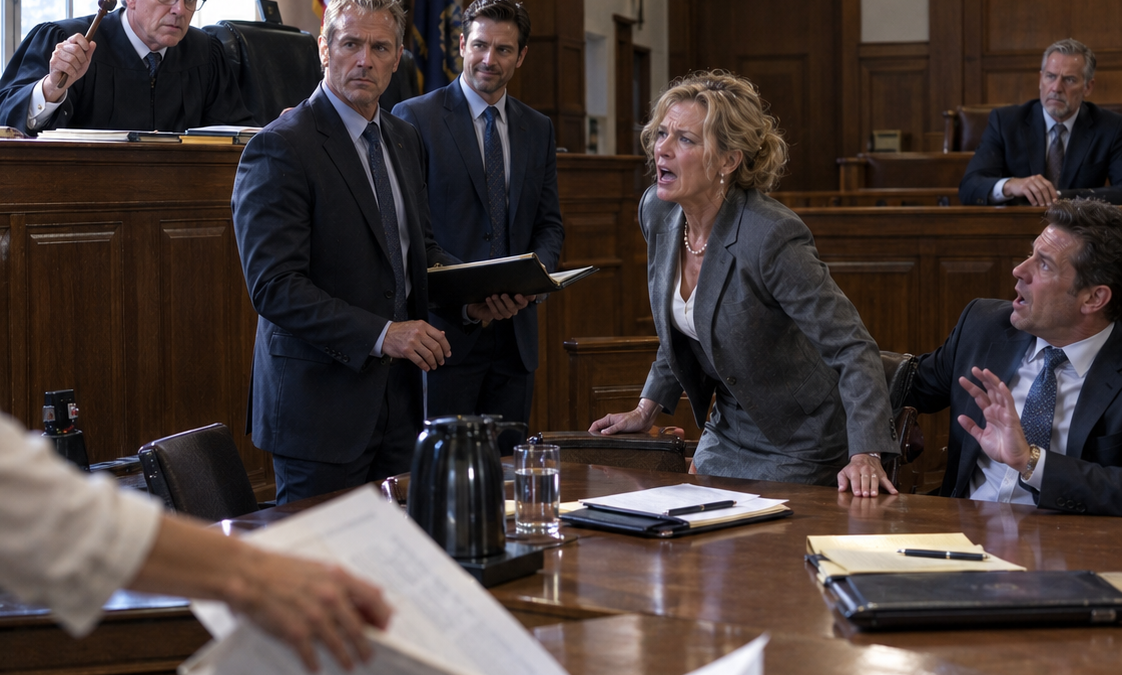
The courthouse was in Arlington. A gray building. Glass doors. Metal detectors.
I met Richard in the hallway. He was wearing the same dark suit from the ceremony. His tie was straight. His shoes were polished.
“You look good,” I said.
“Thanks.”
Marcus Webb was with him. He shook my hand.
“Mac. Good to see you.”
“You too.”
“Ready for this?”
“As ready as I’ll ever be.”
We walked into the courtroom.
Patricia was already there. She was sitting at a table with her lawyer. A woman in a dark suit. Sharp eyes. A folder in front of her.
Tyler was sitting in the back row. He looked up when we walked in. He nodded at his father.
Richard nodded back.
We sat down.
The judge came in. An older man. Gray hair. Glasses.
“Be seated.”
We sat.
The hearing started.
Patricia’s lawyer went first.
“Your Honor. My client is seeking full custody of the minor child, Tyler Hollister. She believes that Mr. Hollister’s military background and his history of classified operations make him unsuitable for custody.”
I felt my jaw tighten.
“Specifically, my client is concerned about Mr. Hollister’s mental health. He has a history of nightmares. He has been diagnosed with post-traumatic stress disorder. And he has been hiding classified information from his family for over twenty years.”
Marcus Webb stood up.
“Objection, Your Honor. Mr. Hollister’s military service is not a relevant factor in a custody determination. The law is clear on this.”
The judge looked at him.
“Sustained. Counsel, stick to the facts.”
Patricia’s lawyer nodded.
“Very well. My client is also concerned about Mr. Hollister’s financial stability. He has recently moved out of the family home and is currently living in a one-bedroom apartment in Clarendon. He does not have a stable living environment for the child.”
Marcus Webb stood up again.
“Your Honor. Mr. Hollister has a stable living environment. He has a full-time job. He has a support network. And the child in question has expressed a clear preference to live with his father.”
The judge looked at Tyler.
“Is that true, young man?”
Tyler stood up.
“Yes, Your Honor.”
“Why do you want to live with your father?”
Tyler looked at his mother. Then at his father.
“Because he’s my dad. And because I love him.”
Patricia’s face tightened.
“Thank you,” the judge said. “You may sit down.”
Tyler sat.
Patricia’s lawyer called her first witness. A psychologist. Dr. Elaine Foster.
She testified that Richard had symptoms consistent with PTSD. That he had difficulty with emotional regulation. That he might be a risk to a child in his care.
Marcus Webb cross-examined.
“Dr. Foster. Have you ever treated Mr. Hollister?”
“No.”
“Have you ever met him?”
“No.”
“So your testimony is based entirely on documents provided by opposing counsel?”
“Yes.”
“Documents that you did not independently verify?”
“I reviewed them.”
“But you didn’t verify them.”
“I assumed they were accurate.”
“And you’re being paid by Mrs. Hollister’s legal team?”
“Yes.”
“For how much?”
“Objection,” Patricia’s lawyer said.
“Overruled,” the judge said.
“For how much?” Marcus repeated.
“Five hundred dollars an hour.”
“Thank you. No further questions.”
Dr. Foster stepped down.
Patricia’s lawyer called Richard.
“Mr. Hollister. You served in the United States Navy, correct?”
“Yes.”
“In a classified unit?”
“Yes.”
“And you participated in combat operations?”
“Yes.”
“And you killed people?”
Richard paused.
“Yes.”
“How many?”
“I don’t know.”
“You don’t know?”
“I don’t know.”
“You expect this court to believe that you don’t know how many people you killed?”
“I didn’t count.”
“Did you enjoy it?”
“Objection,” Marcus said.
“Sustained.”
Patricia’s lawyer smiled.
“Let me rephrase. Did you feel anything when you killed people?”
Richard looked at her.
“I felt everything.”
“What do you mean?”
“I felt scared. I felt angry. I felt sad. I felt like I was going to throw up.”
“So you didn’t enjoy it?”
“No.”
“Then why did you do it?”
“Because I had to. Because if I didn’t, I would have died. And my team would have died.”
“But your team did die. Most of them.”
Richard didn’t answer.
“Didn’t they?”
“Yes.”
“Four men died. And you survived.”
“Yes.”
“Why?”
“I don’t know.”
“You don’t know?”
“No.”
“Do you think you deserve to be alive?”
Richard looked at her.
“I think about it every day.”
“No further questions.”
Marcus stood up.
“Mr. Hollister. I want to ask you about your son.”
“Okay.”
“Do you love him?”
“More than anything.”
“Do you want what’s best for him?”
“Yes.”
“Do you think living with you is what’s best for him?”
“Yes.”
“Why?”
Richard looked at Tyler.
“Because I know what it’s like to grow up without a father. I don’t want him to go through that.”
“Your father left when you were young?”
“He died. When I was twelve.”
“I’m sorry.”
“Thank you.”
“Mr. Hollister. Have you ever been violent toward your son?”
“No.”
“Have you ever been violent toward your wife?”
“No.”
“Have you ever been arrested?”
“No.”
“Have you ever been accused of a crime?”
“No.”
“Do you have a stable job?”
“Yes.”
“Do you have a stable home?”
“Yes.”
“Thank you. No further questions.”
The hearing broke for lunch.
Richard, Marcus, and I went to a diner down the street. Tyler came with us.
“Dad. You did good.”
“I don’t know about that.”
“You did. I saw the judge. He was listening.”
“Maybe.”
Marcus looked at me.
“What do you think?”
“I think the psychologist was weak. And I think Patricia’s lawyer overplayed her hand. She made Richard sound like a monster. But he didn’t come off that way.”
“I agree.”
Tyler looked at me.
“Mr. McKenna. Do you think we’ll win?”
I looked at him.
“I don’t know. But your dad did everything right. That’s all you can do.”
He nodded.
“I’m proud of him.”
Richard looked at his son.
“Thanks, Ty.”
Tyler smiled.
“Anytime.”
The hearing resumed at one.
Patricia’s lawyer called her last witness. A man I didn’t recognize. Tall. Gray hair. A suit that cost more than my truck.
“State your name.”
“Gregory Stanton.”
“And what is your relationship to the Hollister family?”
“I’m a friend of Patricia’s. We’ve known each other for years.”
“And what do you do for a living?”
“I’m a former Navy SEAL. I served for twenty years.”
I felt my stomach tighten.
“Mr. Stanton. Based on your experience, would you say that Richard Hollister’s military background makes him unsuitable for custody?”
“Objection,” Marcus said. “This witness is not qualified to offer a psychological opinion.”
“Sustained.”
Patricia’s lawyer rephrased.
“Mr. Stanton. In your experience, do men who have served in classified units often have difficulty reintegrating into civilian life?”
“Some do.”
“Is it common for them to have PTSD?”
“Yes.”
“Is it common for them to have trouble controlling their emotions?”
“Sometimes.”
“Would you trust a man like that around a child?”
Richard flinched.
Marcus stood up.
“Objection. The witness is speculating.”
“Sustained.”
The judge looked at Patricia’s lawyer.
“Counsel. Do you have a point?”
“Yes, Your Honor. My point is that Mr. Hollister’s military background is a relevant factor in this case. And I believe the court should consider it.”
The judge nodded.
“Noted. But the court will also consider the testimony of the child, who has clearly expressed a preference to live with his father.”
Patricia’s lawyer frowned.
“No further questions.”
Marcus stood up.
“Mr. Stanton. You said you’re a former Navy SEAL?”
“Yes.”
“How many years?”
“Twenty.”
“Did you serve in combat?”
“Yes.”
“Did you kill anyone?”
Stanton paused.
“Yes.”
“How many?”
“I don’t know.”
“You don’t know?”
“I didn’t count.”
“Did you enjoy it?”
“No.”
“Do you have PTSD?”
Stanton was quiet.
“I have some symptoms.”
“Have you ever been treated for them?”
“Yes.”
“Have you ever been hospitalized?”
“No.”
“Do you have children?”
“Yes.”
“Do you trust yourself around them?”
Stanton didn’t answer.
“Mr. Stanton. Do you trust yourself around your children?”
“Yes.”
“So it’s possible for a combat veteran to be a good parent?”
“Yes.”
“Thank you. No further questions.”
Stanton stepped down.
The judge looked at both sides.
“I’ve heard enough. I’ll take this under advisement. We’ll reconvene tomorrow at nine for my ruling.”
He stood up and left.
Richard sat at the table. His hands were shaking.
“You okay?” I asked.
“I don’t know.”
“You did good.”
“I don’t feel like it.”
“You did. Trust me.”
Marcus put a hand on his shoulder.
“He’s right. You did everything you could.”
Richard nodded.
“Okay.”
We walked out of the courtroom.
Tyler was waiting in the hallway.
“Dad.”
Richard stopped.
Tyler ran to him and hugged him.
“You did good, Dad. You did really good.”
Richard held his son.
“Thanks, Ty.”
Patricia walked past us. She didn’t look at Richard. She didn’t look at Tyler. She just kept walking.
Tyler watched her go.
“She’s not going to forgive him, is she?”
I looked at him.
“Maybe not. But that’s not your problem.”
“What is my problem?”
“Being a good kid. And loving both of your parents. That’s all you can do.”
He nodded.
“Okay.”
That night, I couldn’t sleep.
I sat on the porch. Thinking about the hearing. Thinking about Patricia’s lawyer. Thinking about the SEAL they’d brought in to testify.
Something didn’t add up.
I called my friend. The one who worked for the agency.
“You still awake?”
“It’s midnight.”
“I know. I need a favor.”
“What?”
“Gregory Stanton. Former Navy SEAL. I want to know everything about him.”
“Why?”
“Because he testified against a friend of mine today. And I want to know why.”
“Give me twenty-four hours.”
“Thanks.”
I hung up.
The phone rang ten minutes later.
“Mac. It’s Richard.”
“What’s wrong?”
“Nothing. I just… I wanted to say thank you.”
“For what?”
“For being there today. For being there this whole time. For being my friend.”
“You don’t have to thank me.”
“I know. But I wanted to.”
“Okay.”
“Mac.”
“Yeah.”
“I don’t know what’s going to happen tomorrow. But whatever it is, I’m glad I met you. I’m glad you’re in my life.”
I felt something in my chest.
“Me too.”
He hung up.
I sat there for a long time. Thinking about tomorrow. Thinking about the judge’s ruling. Thinking about Tyler.
And thinking about Gregory Stanton. The SEAL who testified against his own kind.
Something was wrong there.
I just didn’t know what.
 [Tap here for the Next Part ]


