MILITARY K9 Blocked Everyone From the SEAL Captain’s Son — Until the NURSE Spoke Two Words (part 3)
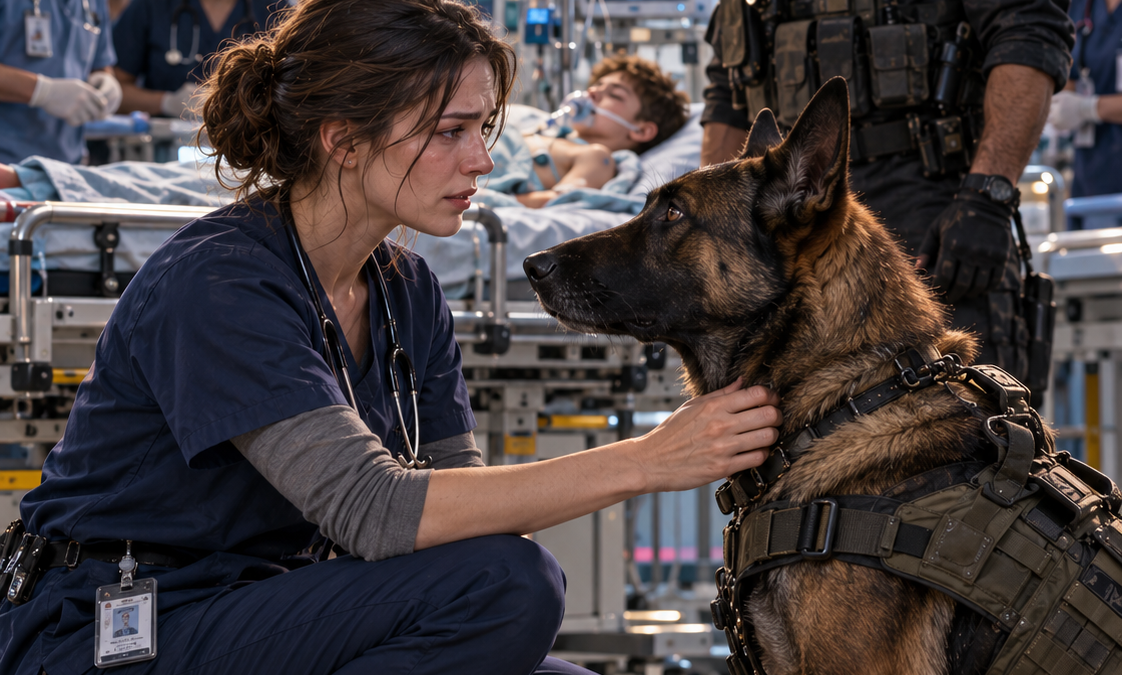
Part 3
Bastion nodded.
We’ll need you available for the next 72 hours.
I’m available, she said.
I work here, she paused. Or I did.
Something crossed Bastion’s face that was almost a smile.
I think that may be a situation that resolves itself, she said. It was 8:30 p.m.when Evelyn walked back into the hospital, and the ER was doing what the ER always did, which was managing the specific and relentless need of a population that had no other place to go. She stood at the edge of the waiting area for a moment, watching the intake desk, watching Priya running triage with the efficient calm of someone who was very good at her job, watching a paramedic crew hand off a patient with the practiced shortorthhand of people who had worked the same corridor for years.
She went to the nurse’s station and picked up a chart.
“What are you doing?”
Priya said.
“Mrs.Almida in bay 4 needs her discharge instructions and someone needs to check on the guy in bay 7 who’s been waiting on a blood draw for 40 minutes.
Priya stared at her. You were literally just there were federal agents.
Priya. Evelyn looked at her.
Bay 4. Priya looked at her for another second. Then she handed her a second chart.
Bay 7’s name is Mr.Toiver and he’s been very patient but he’s starting to ask questions.
I’ll talk to him.
Evelyn said. She did.
She went to Bay 7 and she talked to Mr.Toiver, who was 63 and had driven himself to the ER with chest discomfort that had turned out to be muscularkeeletal and not cardiac, and who was, as Priya had said, very patient and also quite interested in the dog that was sitting outside the bay entrance and watching through the
curtain gap. She explained his discharge care, answered his questions, and drew the overdue blood sample herself.
She went to bay 4 and walked Mrs.Almeida through her discharge instructions in the patient unhurried way she’d always done it not because she was performing normaly but because this was what she did and it mattered and it was still the thing she had to do right now.
She was coming out of bay four when Hol appeared. He was still in his white coat.
He looked like someone who had been having a very long internal conversation and had finally arrived at a destination. He stopped when he saw her and she stopped and the corridor between them was 10 ft of institutional tile.
He said, “The administrator tells me you managed the security situation tonight.”
“The security team managed it.”
She said, “I helped coordinate.”
He looked at her.
“Something was moving behind his eyes that she couldn’t fully read, which was unusual.
She’d become good at reading Randall Hol over 3 years.”
“The way you handled the boy this afternoon,” he said, “in the trauma bay.”
She waited.
I’ve been doing trauma medicine for 19 years.
He said it didn’t come out the way his statements usually did.
It came out like something he was saying because it was accurate, not because it established anything.
What you did in there, the decompression call, the hemorrhage sequence, the way you ran the room, that wasn’t floor nursing.
No, she said.
It wasn’t.
What was it? She looked at him for a moment. It was what I knew how to do, she said.
The same as you.
His jaw tightened slightly, not with anger, with the specific discomfort of a person who is encountering something they don’t have a category for and whose instinct is to find the category rather than to sit with the discomfort.
He said, “I may have the Tully situation and other situations.”
He stopped. She said nothing.
“I’ve been unfair,” he said.
The words came out like they had weight that had been building for a while, and he was not a man who found them easy, and she could see that, and she did not enjoy it as much as she had thought she might.
“I want to be direct about that.
” “Okay,” she said.
“The termination,” he said.
“I’ll reverse it if you want it reversed.”
She looked at him for a long moment.
“I’ll think about it,” she said.
He blinked. That had not been the response he expected.
“I don’t say that to be difficult,” she said.
I genuinely don’t know yet what I want.
I’ll think about it.
She looked at the chart still in her hands. Bay7 needs his blood draw results reviewed when they come back.
Can you make sure someone picks that up?
He said, “Yes.”
She handed him the chart and walked back to the nurse’s station.
Atlas was still outside bay 7.
She crouched beside him in the corridor and ran her hand along his harness in the checking motion, familiar, automatic, and he leaned into it and made the low sound in his chest that wasn’t a growl but was adjacent to one, the sound he made when something was right.
I know,
she said. Long day. He put his head against her shoulder for a moment.
She stayed there for a while, crouched in the hospital corridor with the fluorescent lights and the monitor sounds and the smell of antiseptic and let herself be still and didn’t think about what came next.
Bastion called at 10:15 p.m.Evelyn was in the break room with a cup of bad coffee, which was the coffee that Haverfield General’s breakroom had always produced and which she had never complained about when her phone, her personal phone, not the hospital radio, rang with a number she’d entered an hour ago.
We ran the panel van’s contents remotely through the communication specialists.
Bastion said, “The communication equipment in it was linked to a routing system.”
She paused.
The routing system traces to a secure server address that we’ve been trying to locate for 8 months.
Evelyn put the coffee down. One of the names in your report, Bastion said.
Deputy Director Lawrence Marin, Joint Intelligence Liaison.
We ran the server’s access logs against his credential history.
Another pause. Evelyn, he accessed that server 11 days before the operation that compromised the route. She had known.
She had written it in the report four years ago. And she had known.
And the knowing had been a cold and specific thing living in her chest for a very long time. But hearing it confirmed had a different texture than knowing it.
The way a verdict is different from a verdict you expected. The way the thing becoming real is always different from the anticipation of it. What happens now?
She said. Now we move. Bastion said.
Tonight we have enough for an emergency warrant on the server and enough for a material witness hold on Marin pending the full evidentiary review and the other two names in the report.
She said we’re building.
Bastion said this is the thread now we pull it. Evelyn looked at the wall of the breakroom. It had a motivational poster on it.
The kind that medical facilities put up because someone believes they help and nobody takes them down because it’s never the highest priority.
This one said something about strength in uncertain times in a font designed to be calming. She looked at it for a moment.
One more thing, Bastion said. Your file, the resignation of commission, the redaction of your operational record.
I can initiate a review of the circumstances.
If the record supports it, and from what I’m looking at it will, we can restore your status.
I resigned. Evelyn said that was real. The resignation was real.
Bastion said, “The circumstances that led to it weren’t what they should have been.
There’s a difference.”
Evelyn didn’t say anything for a moment.
“Think about it,” Bastion said.
“You’ve got time now.”
She ended the call. She sat with the bad coffee in the break room with the motivational poster and she thought about Lawrence Marin sitting in whatever office he was sitting in right now.
Unaware that tonight had happened, unaware that the server had been traced, unaware that the report he’d buried 4 years ago, had been sitting in a waterproof case in a storage unit 30 minutes from this hospital and was now in the hands of a federal agent who was already moving.
She thought about Joel Maris, 26. She thought about his face.
Not the last time she’d seen it, which was a memory she had spent four years putting careful walls around, but his face in the ordinary moments, the in between moments, the moments that made a person instead of a tragedy.
She
finished the coffee. She was rinsing the cup in the breakroom sink when Wilder appeared in the doorway.
He looked like someone who had been through a very long and specific kind of day and was still upright through something other than energy.
Kevin’s asking for the dog, he said.
Atlas, she said. His name is Atlas.
He knows that. Wilder said.
He’s been saying it for 20 minutes.
Atlas. Atlas. Atlas.
Like he’s worried I won’t remember.
A pause.
He’s 12.
He’s dramatic.
Something moved through her face. He sounds fine, she said. He is fine, Wilder said.
Surgeon says he’ll be cleared for discharge in 3 days.
He looked at her. You knew that from the trauma bay.
I suspected it, she said.
I didn’t want to tell you I suspected it and be wrong.
That’s He stopped.
That’s unusually considerate for someone who was running a multi-building security containment at the same time.
I can do two things, she said. He almost smiled.
It was the same complicated almost smile as before, but it had shifted slightly, something lighter in it than earlier. Bastion called you?
He said, “Yes, Marin,” he said.
“Yes.”
The words sat in the breakroom between them, and all the weight of what that name meant to both of them.
The three people who hadn’t come home, the eight months of looking for Evelyn, the four years of a network operating on a compromised silence, sat in the room with it.
Good, Wilder said. Not triumphant, just flat and certain, the way good is when it means something real and not performative. He pushed off the door frame.
Come see Kevin, he said. You can bring Atlas.
She dried her hands.
She reached down and found the dog’s harness without looking.
the way you find something familiar in the dark. They walked toward the elevator and the hospital moved around them doing what it always did.
And Evelyn Marsh, which was her name, the name she’d built something real under, walked with a captain and a dog down a fluorescent corridor in Morfield, Virginia.
And something in her chest was different than it had been that morning. Not resolved, not fixed, but different.
She did not know yet that in 16 hours, Deputy Director Lawrence Marin would be detained at Dulles airport with his go bag in hand in a one-way booking to Zurich on his phone, or that the warrant for the server would pull financial records linking the other two names in her report to the network’s operational funding in a chain of evidence so clean that three different federal attorneys would later describe it as one of the strongest cases they’d processed in a decade.
or that the story would break publicly 48 hours later in a way that would make every redaction in that buried report visible to anyone with a new subscription.
She did not know that Holt’s formal complaint filed 3 weeks later by two residents, Voss among them, would result in a departmental review that would quietly end his tenure as trauma chief.
She only knew that the elevator was coming and Atlas was at her left side.
And somewhere on the seventh floor, a 12-year-old was saying the dog’s name, like a person who has decided something belongs to them.
The elevator opened, and on the floor of it, propped against the back wall with its legs extended and its shoes still dirty from wherever it had been that day, was a stuffed animal of some kind. A bear maybe, or something bear adjacent that someone had left behind. And Evelyn stepped over it without thinking.
the automatic navigation of a person who has always moved through hospital corridors making small adjustments and the doors closed behind them.
She did not know that the man who had called himself her federal contact via the compromised radio, the voice she’d negotiated with in the stairwell, was not one of the five in custody.
She did not know that he was still in the building. The elevator opened on the seventh floor and Evelyn stepped out and the first thing she registered was that the corridor was wrong. Not dramatically wrong.
Not the kind of wrong that announces itself. The kind of wrong that you feel before you name it. A texture in the air.
An arrangement of things that doesn’t match the map you’ve built of a space.
Delart was at the nursing station at the far end of the corridor rather than outside Kevin’s recovery bay.
And he was on his radio and he was standing in the particular way that people stand when they are trying to project calm and are not fully succeeding at it. Wilder saw it a half second after she did.
Delart,” he said, already moving.
Delart looked up.
“Sir, we’ve got a there’s a staff member on the floor who doesn’t match the shift roster.
Female 50s gray scrubs.
She was at the medication dispensary 20 minutes ago, and I didn’t flag it because her badge scanned clean, but I just ran the employee number, and it belongs to a nurse who retired 8 months ago.
” Evelyn was already past him, moving toward the recovery bay at the end of the hall.
“Which way did she go?”
she said without stopping. Toward the patient rooms, Delard said.
3 minutes ago. 3 minutes was a long time in a recovery bay with a sedated 12-year-old.
She hit the door to the recovery corridor at speed and Atlas was with her.
And she did the thing she’d been trained to do in a space she didn’t know well enough.
Swept it with her eyes in the first half second, cataloged what she saw, moved on what mattered.
Four recovery bays curtained, a medication cart, a supply closet with a closed door that should have been open, a window at the far end showing the hospital’s roof across the atrium gap.
The supply closet. Kevin, she said loud enough to carry through the curtain bay on the left where Delard had pointed.
“Can you hear me?”
a pause. A groggy voice.
“Yeah, don’t move,” she said.
“Stay exactly where you are.”
She went to the supply closet and stood to the side of it, not in front of it, and said, “I know you’re in there.
The building exits have been federal controlled for the last 2 hours.
There is no road out that doesn’t go through people who are waiting for you.
I need you to open this door.”
Silence. Atlas was at her side with every muscle in his body doing the thing that Atlas did when he had found the thing he was looking for. A quality of absolute focus stillness that was more information than noise.
I’m the one you were talking to, the voice said from the other side of the door.
The same voice from the radio. Managed flat on the frequency. I know, she said.
You knew I wasn’t in custody.
I knew you were running the operation from outside the contact points.
She said, “The people you sent in were a screen.
You weren’t going to expose yourself to the building until the screen reported back.”
A pause. and the child was never your real objective, she said.
Same as the dock was a distraction to surface me.
You’re smart, he said.
It wasn’t flattery, it was an assessment.
Open the door, she said. Another silence. Then slowly the supply closet door opened.
The man who stepped out was not what the voice had suggested. She had built a picture of someone younger, leaner. The voice had that quality.
He was perhaps 60 with gray at his temples and the kind of ordinary face that she’d clocked on the stairwell man and recognized as professional.
He was not holding anything. His hands were visible and they were empty and he stood in the recovery corridor with the particular stillness of someone who has run the options and arrived at the only remaining one. He looked at her for a long moment.
Then he looked at the dog. Sentinel, he said. You can stop using that.
She said, “It’s been a long night.”
Something moved through his face. Not quite a smile.
“My name is Gerald Foss,” he said.
“I’m not going to run.”
“I know,” she said.
Atlas would find that very entertaining, and you wouldn’t.
Wilder came through the recovery corridor door with Delart behind him and assessed the situation in one look.
He positioned himself to Foss’s right without being asked.
Foss looked at Wilder, then back at Evelyn. the report.
He said, “You told the man in the stairwell you burned it.
I told the man on the radio I burned it.
” She said, “The man in the stairwell figured out I hadn’t.”
“But you’d already given it to the federal agent by then.”
“Yes,” he was quiet.
“The way the closet light fell across his face made him look tired, which he probably was.
Running an operation in a locked down hospital with your contact points in federal custody would tire anyone.
I’ve been trying to close this for 4 years, he said.
Not for Marin, for myself. I was the one who approved the route that was compromised. She went still.
I didn’t know it was compromised when I approved it, he said.
I found out afterward. When your report came in the first time, I was the one who made it disappear because my signature was on the authorization and I thought he stopped, started again. I thought I could contain it, find the actual source internally, fix it without the report going public.
You couldn’t, she said.
No, he said. Marin was three levels above where I was looking. He looked at the floor.
The second time you filed it, I didn’t bury it.
I forwarded it up to people I thought were clean. Marin intercepted it.
She looked at him and felt something complicated. He was not the villain she had spent 4 years drawing in her head. He was a man who had made a bad decision under fear and spent four years building a worse and worse situation trying to contain the damage of it.
And now he was standing in a hospital supply corridor at 10:30 at night with a Belgian Malininoa 4 ft away and a federal net around the building and she did not feel triumphant about it. She felt tired. Tell that to Bastion, she said.
All of it in detail tonight. He nodded once. It had the weight of someone who has finally put something down.
Delard cuffed him, which was protocol, and led him toward the elevator, and Wilder watched them go with an expression that was difficult to categorize.
He looked like a man who has been handed a truth he’d been looking for, and found that truth is more complicated than the finding of it.
Maris, he said, “I know,” she said.
The authorization that killed him was a man who panicked, Wilder said, not excusing it, just naming it. Yes, she said. Does that change anything for you?
She thought about it honestly, which was the only way she knew how to think about things like this. It changes the shape of it, she said.
Not the size. He looked at her. He nodded once.
She went to check on Kevin. He was 12, as Wilder had said, and he was postsurgical, and he was lying in the recovery bay with the specific flatness of a child who has been through something large and is now running on the fumes of it.
He had brown hair and his father’s eyes.
And when she came around the curtain, he looked at her and then at Atlas, and the expression on his face shifted into something that was not quite energy, but was adjacent to it.
“Atlas,” he said.
The dog moved to the bed rail and put his head over it, which was not a trained behavior. It was just what he did.
And Kevin put his hand on the dog’s head with the automatic trust of a kid who has decided the dog is safe.
And Atlas stood there and let it happen.
I’m nurse Marsh, she said.
How’s your pain level?
Like a five, he said. Maybe six.
He looked at her with the directness that 12year-olds have when they’re past being polite.
Are you the one who fixed me in the ER? I helped, she said. My dad says you ran the building.
Your dad is generous, she said. She checked his IV line, checked the monitor values, looked at the surgical dressing, all intact, vital stable, color good.
He would have a significant scar on his right lateral abdomen, and he would be on restricted activity for 6 weeks. And he would from everything the number said, be entirely and completely fine. Atlas knows you, Kevin said.
He does. She said like knows you knows you. Not just as being nice.
Yes. He thought about this with the seriousness of someone who takes dogs seriously.
Were you his handler for a while? She said. He looked at the dog.
He kept trying to get to you, he said during the transport.
I think that’s why he was upset.
He could smell you. She looked at the dog.
Atlas had not moved from the rail. His tail was doing the slow movement that meant something was right.
“That sounds like him,” she said.
She straightened Kevin’s blanket, not because it needed straightening, but because it was the gesture her hands knew how to make, and told him she’d check back in 2 hours, and she went out.
Wilder was in the corridor. He had his phone to his ear and was listening with the expression of someone receiving news.
And she watched his face as the listening went on and she saw the moment when the news became real for him. A settling something releasing in the muscles around his jaw. He ended the call.
Marin is in custody, he said. Dulles, they got him at the gate.
She leaned against the corridor wall. His go bag had a second passport and €40,000. Wilder said he had people watching the hospital network tonight.
And when the communication went dark, when Bastion’s team took over the security frequency, he knew he ran.
And the other two names, she said. Bastion says the financial records from the server are she used the word comprehensive.
He looked at her.
Her word was that it was the cleanest chain she’d seen in a decade.
She had sat with those names for 4 years.
She had written them down and watched them disappear and then kept them inside her like something she was holding in trust for the people who’ deserved better.
She thought about Joel Maris again, and she let herself think about him directly instead of around him, which was something she had not done in a long time. She thought about his laugh, which had been too loud for enclosed spaces.
She thought about the way he’d handled Atlas in the first weeks, clumsy and earnest and determined to get it right.
coming to her after every session with the same question. What am I doing wrong?
She thought about the last time she’d seen him, which had been in a vehicle on a route that had been sold, and she thought about what had happened on that route, and she let herself think about it fully for the first time in years, because she was done carrying it in the peripheral, and it was time to
carry it directly.
She stood in the seventh floor corridor of Haverfield General and let it be real and heavy and hers, and she did not try to make it lighter than it was. Then she breathed.
Then she pushed off the wall and walked to the elevator. The next 72 hours were the specific kind of exhausting that has nothing to do with sleep.
Bastion’s team needed her for a combined total of 11 hours of documentation and interview across three sessions.
The federal warrants moved through the system with the momentum of something that had been building for months and had finally found the hill to run down. The server records produced a financial map that was more complete than anyone had expected.
The network had been operational for 7 years and in 7 years it had generated records and records were the most reliable kind of witness. Deputy Director Lawrence Marin was formally charged on the third day.
The charges were substantial enough that three different news organizations ran the story simultaneously, which meant it could not be quietly managed, which meant it ran. It ran nationally. It ran with enough detail that anyone reading it could understand the shape of what had been done and the shape of what had been buried and the shape of what had finally, after 4 years, surfaced.
Evelyn read the coverage on her phone in the hospital break room on the morning of the fourth day with the same bad coffee she had always drunk. She read it once.
She put her phone down. She drank the coffee.
Gerald Foss, who had made a bad decision out of fear and spent four years compounding it, cooperated fully with the investigation in the way that people cooperate when they have run completely out of other options.
His cooperation was significant enough that Bastion told Evelyn on the third day that it was Foss’s detailed accounting of Marin’s network structure that had turned a strong case into an airtight one.
She said this without indicating what Evelyn was supposed to feel about it. Evelyn appreciated that what she felt about it was complicated and she was not going to simplify it.
Holt’s departmental review was initiated on the fifth day.
It had not been initiated by the hospital administrator. It had been initiated by Dr.Voss, who had written a formal complaint that was specific and documented and took evident care to be accurate rather than vindictive.
Three other residents and one attending physician had added their own accounts within 24 hours. The review board was an external panel which was the correct call and it moved with the deliberate pace of institutional processes that are trying to be thorough rather than fast. Evelyn was not part of the review.
She was asked once if she wanted to contribute a statement and she said she would think about it and then she wrote three paragraphs that were factual and precise and free of the emotion she had every right to include and she submitted them and she moved on. She was not present when Hol was formally removed from his position as trauma chief.
She found out from Priya who told her in the breakroom who told her with the careful neutrality of someone who is reporting a fact and giving the other person space to respond to it however they need to. Okay.
Evelyn said that’s it.
Priya said what else should it be? Priya thought about it.
I thought you’d feel more I feel plenty.
Evelyn said I’m just not going to perform it.
Priya looked at her for a moment and then she nodded and that was the end of it. On the seventh day, Bastion called. The formal review of your service record is complete.
She said, “The board found that the circumstances of your resignation were materially influenced by the suppression of your reports and the hostile chain of command environment created by Marin’s network.
The resignation stands.
You made that choice and it was real, but your operational record has been fully restored and the classified citations from your service have been reinstated.”
A pause. including the one from the operation. Evelyn sat with that for a moment.
The one from the operation had been put in by Joel Maris’s unit commander in the 24 hours before the report was buried, and the record was quietly managed.
She had never seen it. She had not known it existed until right now.
“What does it say?”
she said. Bastion read it.
She read it in the flat voice of someone reading official language. And the official language said in the careful phrasing of military commenation that Lieutenant Commander Evelyn Harper had under direct threat maintained casualty care for an entire extraction team while coordinating a retrograde movement that saved six lives and had done this after sustaining injury and had done this after the loss of a teammate and had done it without being asked because it was what the situation required and she was the person present
who could do it.
She listened to Bastion read it. She did not cry, which she would have expected of herself, and which slightly surprised her in its absence. What she felt instead was quieter than crying, something that settled rather than released, like a weight being placed carefully down rather than dropped.
There’s also, Bastion said, the matter of an invitation from Captain Wilder.
He mentioned returning to service.
Evelyn said, “I’ve thought about it.”
and she looked out the breakroom window at the hospital’s east parking structure.
She looked at the concrete and the cars and the ordinary Tuesday afternoon of a midsized Virginia city that had one trauma center for four counties. No, she said.
Bastion was quiet.
This is where I’m needed, Evelyn said.
Not in the abstract. Specifically here.
This building, these people, the four counties that don’t have anywhere else to go.
She thought about Mister Toiver and his chest pain and his patience and the blood draw.
She’d done herself at the end of a night that had included military contractors and federal warrants.
She thought about Mrs.Almida and her discharge instructions. She thought about a hundred other patients across 3 years whose names she still knew and whose faces she could still locate precisely in her memory.
I left one life to build this one, she said.
I’m not going to leave it.
the paygrade differential alone. Bastion started. I know, Evelyn said.
No. A pause. Then in a different register, something warmer underneath the professional surface.
For what it’s worth, Bastion said, “The work you did that night running that building the way you managed it.
I’ve worked with trained tactical personnel who would have handled it worse.”
The hospital security team, Evelyn, Bastion said. She stopped. Take the compliment, Bastion said.
She was quiet for a moment. Thank you, she said. She meant it.
Wilder came back to Havfield General on the 10th day to pick up Kevin. The boy had been cleared for discharge that morning and he came out of the elevator in a wheelchair, hospital policy, that he was visibly impatient with because 12-year-olds who have been told they are fine find wheelchairs philosophically objectionable. He had color in his face and a surgical dressing under his shirt and the expression of someone who has been in a hospital for 9 days and has strong feelings about leaving.
Atlas was at the nurse’s station.
He had been at the nurses station in intermittent rotation for most of the past 10 days because his handler paperwork was being reprocessed through the JAG office and until it resolved he was technically unassigned and Wilder had made a practical decision about where the dog would be least trouble. The nursing staff had adapted to this with the resilience of people who have learned to adapt to most things.
And Priya had taken to leaving a water bowl under the desk that she did not acknowledge when anyone asked about it. When the elevator opened and Kevin came out in the wheelchair, Atlas stood up from beside the desk. His tail started moving before the wheelchair was fully in the corridor.
“Atlas,” Kevin said with the exact same intonation he had used in the recovery bay.
“Not a greeting, a confirmation, the sound of someone who has been separated from something important and is now verifying its return.”
The dog went to him.
Evelyn watched from the nurse’s station with her hands wrapped around the bad coffee and something in her chest doing a complicated thing that she was not going to try to name right now.
Wilder stopped beside her.
He looked at his son and the dog and he said without looking at her, “He wants the dog.”
“I know.”
The Jag reprocessing is going to flag Atlas for retirement evaluation given the handler transition history.
“I know,” she said.
“He’s a good dog.
He’s an exceptional dog, she said.
He’d be wasted in retirement.
Wilder looked at her then.
I’m going to submit a petition for civilian handler transfer, he said.
There’s precedent for it in cases where the dog has already formed a primary bond outside the service structure.
He paused. It would require a named civilian handler.
She looked at Atlas.
Atlas was sitting beside Kevin’s wheelchair with his head level with the boy’s hand.
And Kevin was talking to him in the low continuous murmur of someone who has a lot to say to a dog and believes the dog is interested, which Atlas was. He bonded with you, Wilder said.
Not with Kevin. Kevin is Kevin is someone he likes.
You’re someone he trusts.
He paused. Those are different things. I know, she said.
The petition would need your agreement. She looked at the dog for a long moment.
She thought about 3 years of a life she’d built carefully and quietly.
And she thought about the fact that she had for the past 10 days been navigating the hospital with a Belgian Malininoa at her left side and that the staff had adapted to this and that three patients had commented that the dog was calming and that Priya had put a water bowl under the desk and was not discussing it.
“Submit it,” she said.
Something in Wilders’s expression settled.
There’s one more thing,” he said.
He reached into the inside pocket of his jacket and came out with a small item, flat metal, attached to a short piece of dark cord. He held it out.
She looked at it. It was a memorial tag, the kind that units make for their dead, the kind that is not regulation and is not official and is absolutely everywhere in the communities that make it because some forms of memory require a physical object and no official process has ever
fully understood this. The name on it was Joel Maris.
His unit commander sent it.
Wilder said, “When the record restoration went through and the citation got reinstated, they found out it had never been delivered to you.”
He kept his hand extended. It was made 4 years ago.
It’s been sitting in a box in a JAG office waiting for an address.
She looked at it for a long moment. She took it.
The metal was cool, and the cord was slightly frayed at one end, and it was exactly the kind of object that is worth nothing and worth everything simultaneously. the kind that carries a weight entirely disproportionate to its size. She closed her fingers around it and held it, and she let it be real.
“Thank you,” she said.
She said it to Wilder, but she also said it to something larger than him, to the fact of the thing being returned, to the restoration of a name to the record where it had always belonged, to the long and imperfect and finally completed ark of a truth that had been buried and had waited and had surfaced. the way these things surface when enough people refused to let them stay down.
Kevin was discharged at 1:15 p.m.He stood up from the wheelchair at the hospital entrance with the specific ceremony of someone reclaiming their legs, and he was unsteady for a moment, and Wilder put a hand on his shoulder, not dramatically, just steadily, the way fathers do when they are trying to not show how glad they are. Thank you, Kevin said to Evelyn.
He said it with the directness of someone who has been taught to mean what they say. for the ER and the building and Atlas.
Atlas did most of the building part, she said. Yeah, but you told him to, he said. She looked at him.
Get better, she said. Come back in 6 weeks and let someone check that dressing.
Can we bring Atlas? She looked at Wilder.
We’ll be in touch about the paperwork, Wilder said.
They left through the entrance and she stood inside the glass doors and watched them go.
Wilder with his hand still on his son’s shoulder and the boy moving carefully in the afternoon light of Morfield doing what afternoon light does in Virginia in the fall going golden and long making everything look more significant than it has any right to.
She went back to work. There was a patient in bay 2 who needed a line check and a patient in bay 5 whose labs had come back and needed to be interpreted and a patient in bay 8 who had been waiting for 40 minutes and whose chart she had not yet looked at and she went to all of them in sequence working through the afternoon shift the way she had worked through every afternoon shift for 3 years methodically attentively without theater. Priya handed her a chart at the end of the shift and said without looking up from her own documentation.
Administrator Fels wants to talk to you tomorrow morning about your contract. Okay, she said. Also, Voss asked if she could buy you coffee sometime.
She thought about Voss. She thought about the three paragraphs in the review and the apology and the service corridor and the moment in the trauma bay when Voss had heard the right call and made it regardless of who it came from.
Sure, she said. She finished her documentation, which took longer than it should have because her third to last patient had a complex medication interaction that required careful charting, and she did not rush it.
She signed off at 6:47 p.m., and collected her things from her locker and walked out through the ER waiting room, which was full in the ordinary way it was always full. People with ordinary suffering sitting in plastic chairs, waiting for their turn. Some of them patient and some of them not.
all of them there because they needed something and this was the place that provided it. She had a memorial tag in her pocket. She had a dog whose paperwork was being processed.
She had a restored record that she was not going to show to anyone, but that was real in the way that things are real when they have been undone and redone correctly. More real sometimes for the undoing. She walked out of Havfield General into the parking lot into the fall evening of Morfield, Virginia, and she stood for a moment on the concrete and let herself be exactly where she was.
She was not a forgotten employee. She was not a quiet woman absorbing friction for the sake of a life that fit inside the lines.
She was not hiding. Not anymore.
Not in any version of the word. She was a nurse and a former lieutenant commander and a person who had built something real in the years when building real things was all she had.
and the building had held, and the things she had put into it had held. And here she was on the other side of a week that had asked everything of her, and she was standing up straight in a parking lot in the evening light.
She thought about the people who look at someone like her and see nothing. She thought about the hundred small moments of contempt over 3 years that had accumulated into something that was supposed to erase her.
And she thought about the fact that none of it had, not because she was exceptional in the way stories want their protagonists to be exceptional. Not because she had some gift that set her apart, but because she had kept showing up, kept charting accurately, kept flagging the thing that needed flagging, kept doing the job correctly, even when the job was being used as a way to diminish her.
You do not have to be invisible to survive. You do not have to make yourself small to stay safe.
The thing that kept her was not her training or her record or the report in the waterproof case. It was the same thing she had been doing in that ER for 3 years. She kept being correct.
She kept being present. She kept doing the work until the work spoke for itself. Not every story ends with a stairwell and a federal warrant and a dog that recognizes you after 4 years.
Most of them end much more quietly with a chart completed and a patient discharged and a shift finished and a life that is yours, unremarkable and entirely sufficient. But this one tonight ended with her standing in a parking lot in the fall evening with a memorial tag in her hand and a sense of the ground under her feet that she had not felt in a long time.
The specific solidity of someone who knows exactly where they are and has decided to stay. She put the memorial tag against her palm. She let herself feel its weight.
She walked to her car. She drove home through Morfield.
She made dinner that was nothing special.
pasta from a box with sauce from a jar, the same dinner she’d made on a 100 Tuesday evenings.
And she ate it at the kitchen table. And she was not thinking about four years ago or 4 days ago.
She was thinking about Bay 8, the patient she’d seen at the end of shift, a woman of 51 with a presentation she wanted to follow up on in the morning, a thing she had flagged in the chart and would check on first thing.
There was always a next thing to check on. That was not a burden.
That was the point. She washed her dish.
She stood at the kitchen sink, looking out the window at the ordinary dark of an ordinary neighborhood in a city that nobody was watching tonight.
And she thought, “This is mine.”
All of it. The bad coffee and the difficult patients and the colleague she was going to have coffee with and the contract meeting in the morning and the dog whose paperwork was pending and the memorial tag she was going to find the right place for. A place where she could see it without it being a wound.
This is mine. And that was enough.
—END—

