They Called Her a “PROBLEM PASSENGER” — Until a NAVY SEAL’s K9 Exposed Her HIDDEN MISSION (part 2)
Part 2
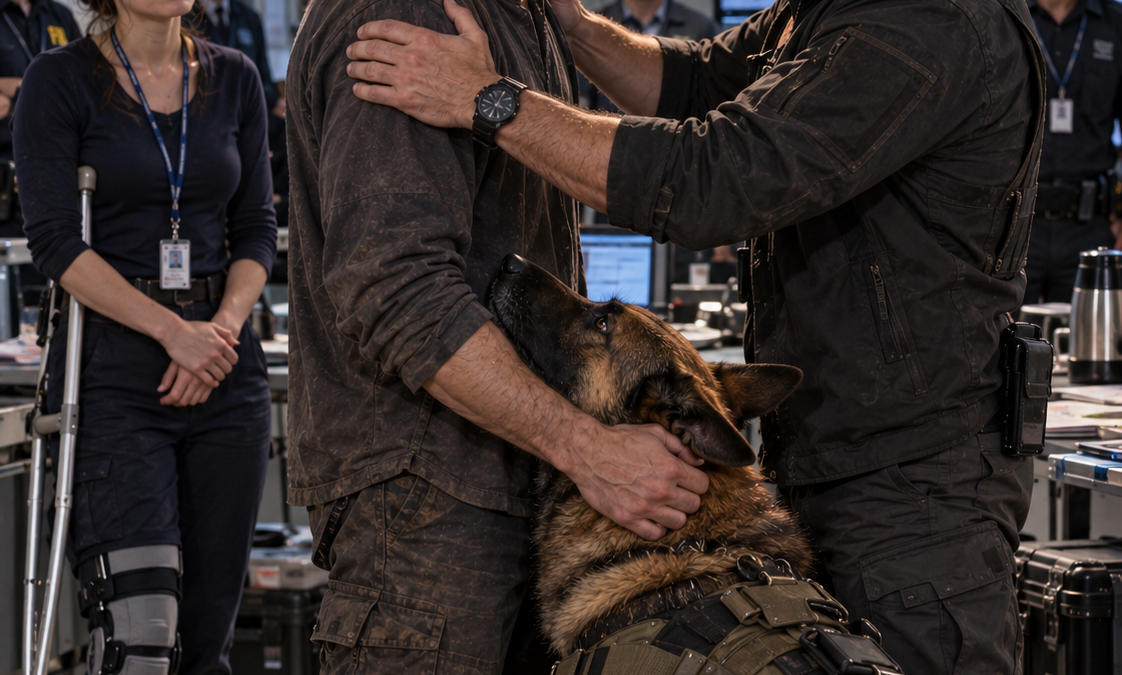
Atlas pressed his flank against Elena’s left leg, steady, warm, immovable.
“Can you walk?”
Mason said. Elena gripped her crutch and stood on one leg and one locked brace.
And whatever was living in her chest in that moment, the anger, the exhaustion, the cold clarity of realizing exactly how deep this went, she filed it into the back of her mind with the same efficiency she used to file everything
that couldn’t be dealt with until the patient was stabilized.
“Yes,” she said.
she walked. The airport operations room was not designed for the kind of meeting that was now taking place inside it. It was a functional space, two folding tables pushed together, a wall of monitors showing terminal camera feeds, a whiteboard with flight status annotations in three colors of marker, and chairs that had been purchased for utility rather than comfort.
The overhead lighting was fluorescent and unforgiving. A half empty coffee pot sat on a filing cabinet in the corner, and the smell of it had been burning for long enough that it had stopped smelling like coffee and started smelling like something else entirely.
Elellena sat at one end of the table with her left leg extended, the brace still locked, and a rolled jacket that one of the federal agents had offered without being asked positioned under her knee to reduce the compression angle. It was a small thing.
She noted
it. The federal agent who had done it was named Harg Grove specialist Lena Hargrove, NCIS, who had arrived through the airport operations corridor with two colleagues in a hard-sided equipment case that she handled with the specific care of someone transporting something that mattered.
She was compact and precise with the kind of stillness in her movements that came from spending time in situations where unnecessary motion was a liability. The other two agents, a man named Destin Okafor and another who had introduced himself only as Price, had positioned themselves near the door and the window respectively with the instinctive geometry of people who thought in terms of exit vectors. Mason stood at the end of the table opposite Elena.
Atlas had been directed to a corner where he sat with the patience of a dog who understood that his current assignment was to stay out of the way and wait. He was managing it imperfectly. His eyes kept returning to the brace.
“We have two problems,” Hargrove said, setting the equipment case on the table.
“The first is extracting the data from the transmitter without destroying it, which requires a non-invasive approach, and about 30 minutes, I’m not sure we have.
The second is the man from the gate area who walked away.
He’s being tracked,” Mason said.
“We have eyes on him until he exits the terminal.
After that, we’re relying on the airport’s external camera coverage, which has gaps.”
Hargrove looked at Elena. You said the gate agent, Darby, filed a complaint acknowledgement before your fall.
Is that accurate?
She said she’d noted in the system, whether she did is a different question.
We need that documentation.
If Silver Meridian’s people are in this airport, and given the surveillance response to your position, that’s no longer a question.
They may have access to the airlines complaint system.
If there’s a flag on your name from this morning’s incident, they know you’re in the building.
Elena looked at her.
They already know I’m in the building.
That man at the gate was looking directly at me. Right.
But there’s a difference between someone spotted you and your name is in a searchable database with your flight record attached.
Hargrove paused. Your flight record includes your home address. The room was quiet for a moment.
Then we have three problems, Elena said. Hargrove opened the equipment case. Inside, nested in foam, was a device that Elena recognized as an electromagnetic scanning unit, a more sophisticated version of the equipment used in hospitals to locate embedded metallic components without invasive procedures.
Beside it was a secondary unit she didn’t recognize, smaller and sealed in its own housing.
The transmitter is running on a frequency Atlas was conditioned to detect, Harrove said, looking at Mason. Do you have the original conditioning protocol documentation? in my kit at the base.
I can have it transmitted to your secure system in too slow. What do you remember about the frequency band?
Mason gave her a number. Harrove typed it, looked at the screen on the scanning unit, typed a second number and a parameter adjustment.
It’s running a compressed burst transmission, she said after a moment.
15-second intervals, which means the data isn’t a continuous signal.
It’s packaged.
Whoever Adrian used to build this knew how to avoid standard detection sweeps. She looked at the brace.
The burst pattern is designed to look like microprocessor noise from the medical device itself. Even a targeted scan would likely miss it. Which is why it passed security for 8 months, Elena said.
Which is why it passed security for 8 months, Hargrove confirmed. And why the joint locked?
I think the locking mechanism wasn’t a malfunction.
I think it was an activation sequence. The transmitter intensifying its signal to draw attention when it detected something in its environment. Elena stared at her.
Atlas’s conditioning frequency.
The dog’s presence triggered an escalation in the transmitter output, which caused the microprocessor to receive conflicting signals, which locked the joint.
Hargrove met Elena’s eyes with something that was almost an apology.
Your brace functioned exactly the way it was supposed to. Adrien Salt engineered it to fail in a way that would force someone to pay attention.
The understanding of it settled over Elena in layers. had not been an accident.
The pain in her hip and her elbow, the floor of the boarding lane, the passengers who had walked around her, all of it had been, in a clinical sense, intentional. A disabled woman falling in an airport was not something that drew immediate serious response. It was something that people looked away from or stepped around or filed paperwork about.
Adrienne had known that. He had known that a locked brace would ground her in one place long enough for the right person to find her.
He had known because he had been inside the system long enough to understand exactly how it worked. I want to be angry about this, Elena said.
I’ll deal with that later.
Right now, how do we get the data out?
Harrove was already positioning the scanning unit near Elena’s leg.
I can extract the burst packet without opening the housing. The secondary device, she indicated the smaller sealed unit will capture and decode the transmission, but I need silence in about 20 minutes of stability.
Define stability.
Don’t move the leg.
Elena settled her hands in her lap and did not move the leg. The scanning process was not dramatic. Hardgrove worked with quiet concentration, adjusting parameters and watching readouts, occasionally typing a command and waiting.
The room held the particular silence of people who understood that the wrong kind of noise at the wrong moment had consequences. Price, near the window, had his eyes on the external camera feed on a tablet. Okapor had stepped into the corridor and was talking quietly into his phone.
Mason came and sat in the chair beside Elena. Not close, just in proximity. The way people sit when they are performing the opposite of abandonment.
Your brother, he said quietly. Dominic, you were going to him.
Yes.
We’ll need to notify him that your travel plans have changed.
I know. She paused.
He’ll be fine.
He’s had one surgery before.
He knows what he’s doing.
She paused again.
He’ll also be furious on my behalf about the airline thing, which will give him something to focus on besides the pain.
So, in a way, this is fine. Mason looked at her sideways.
Something in his expression shifted in a way she hadn’t seen before.
Brief and unguarded, like a door opening and closing. You do that a lot, he said. Do what?
Find the functional angle on something bad occupational habit. She looked at the scanning unit.
“You do it, too?”
“Yeah,” he said.
“I do.”
Harrove said, “I’ve got the packet.”
Everyone in the room reoriented toward her. Hargrove was watching the secondary devices screen with the intense focus of someone reading something important fast.
“Give me 60 seconds,” she said.
The 60 seconds were long. Elena counted them without meaning to, the way she counted seconds during a code when she needed to track CPR intervals without looking at a clock.
Old reflex. Okay. Harrove sat back.
Her face was controlled, but something in it had shifted. The specific quality of someone who has just read something larger than they expected. There are three files.
The first is a patient record database. Looks like it contains documentation of equipment allocations for veterans in the silver meridian program going back at least four years. Partial records enough to show the pattern of items logged as issued that were never actually in patient use.
How many patients? Mason said. Hargrove looked at the number.
At minimum 212 documented cases. The room absorbed that. The second file is financial.
She continued, “Transfer records, equipment serial numbers matched against private resale documentation.
The devices were being sold, not scrapped, not redirected to another program.
Sold through a secondary market broker operating under a Shell company.”
She looked up.
“The Shell Company’s registration traces back to a holding entity in Delwick County.
Price from the window said, “Delwick County is where Silver Meridian’s regional headquarters is.”
“Yes,” Harg Grove said.
And the third file, Mason said. Hargrove paused in a way that was not hesitation.
It was preparation. The third file is a list of names, she said. 14 names.
Federal employees, VA program officers, one active duty officer in the inspector general’s office.
And she stopped.
And Darren Quill, the inspector whose credentials were used to close Adrienne’s complaint.
Elena said his credentials weren’t stolen.
Hargrove said his name is in the file as a co-signer, a participant.
He didn’t retire and then have his credentials used without his knowledge.
He retired and then continued to provide sign off on compliance reviews through an informal arrangement that kept him off the official payroll while keeping him useful. She set the device down. He knew he was part of it.
Mason was very still. 14 names, he said.
14, Argrove said, and the list includes the NCIS case officer who closed Adrienne’s original wellness report.
Nobody spoke for a moment.
Elena could hear the HVAC system cycling, the faint sound of a gate announcement from somewhere in the terminal, and a noise from the corridor that made Okaphor’s voice cut off.
Then Okaphor opened the door.
“We have a problem,” he said.
His face had the specific tightness of someone who had just received information that made the current situation significantly more complicated. The man from the gate one in his Navy jacket.
He didn’t leave the airport.
He went to the airlines customer service counter.
Harrove said he’s accessing her travel record.
He accessed it. Okafor said past tense.
And then he made a phone call 22nd call.
And then the airport’s external camera feed on the north access road went offline.
The room’s atmosphere changed in the way that rooms change when people who are trained to recognize escalation recognize escalation simultaneously.
They’re calling in assets.
Mason said it was not a question. Someone cut the camera feed.
That’s not a solo operation.
Okapor looked at Elena. Your address is in the travel record.
If they have people mobile, my brother, Elena said. The word came out flat.
She had already done the calculation before Okafor had finished the sentence.
The address in the travel record was her home address in Harlo City, not Dominic’s address, but Silver Meridian had patient records.
They had a rehabilitation file.
They had the program intake documentation, which included emergency contact information, Dominic’s name, Dominic’s address.
I need a phone, she said. Mason had his in her hand before she finished the sentence.
She dialed. It rang four times and went to voicemail.
She tried again. Three rings.
Voicemail. He may be sleeping, she said. Her voice was steady.
Her hands were not. He had surgery 6 days ago.
He sleeps heavily because of the pain medication.
He doesn’t always hear his phone.
She looked at Mason. I need someone at his address. Harlo City is 40 minutes from here.
Ahor said. Harlo City PD can be there and no. Harrove said and her voice was precise.
If Silver Meridian has contacts in federal systems, we don’t know the extent of it.
Running a local police call through dispatch creates a record.
We don’t know who’s reading those records.
Elena looked at Harrove.
You’re saying we can’t trust local police.
I’m saying we don’t know the boundaries of the network yet.
Until we do, every official channel is a potential leak. The understanding was ugly.
The data on the secondary devices screen represented 14 names in federal and military roles, the visible ones, the ones Adrian had been able to document. The actual network could be larger.
It could reach into local enforcement. It could reach into hospital systems. It could reach into the rehabilitation infrastructure that had fitted this brace and sent Elena Voss through airports for 8 months without her knowledge.
The scope of it was large enough to be disorienting if she let it be. She did not let it be. options.
She said, “I have a contact in the Marshall Service who is not on this list and who I would trust with my life.”
Argrove said, “I can have him dispatched to your brother’s location with a cover reason that doesn’t require running it through standard channels.
15 minutes.
” “Make the call,” Elena said.
Hargrove was already on it. Mason moved to the window beside Price and looked at the tablet showing the external camera feeds, the ones that were still functioning.
Elena watched his profile and saw the things she recognized from the ward, the things she had seen on the faces of experienced people in critical moments. The simultaneous management of multiple timelines, present and projected, running parallel calculations and prioritizing actions by consequence rather than urgency.
The man who walked away from the gate is still in the building, she said. Probably, Mason said.
And he knows we’re in this room.
He knows we went to operations.
He doesn’t know which room.
How long before they narrow it down? Mason looked at the door at the single camera mounted above it showing the corridor.
At the airport badge hanging from Aquafor’s lanyard, which was a visitor credential and not a staff credential and would not open every door in this building.
They won’t come through the front, he said.
Too visible. Too many cameras still running in the main terminal.
They’ll find a service access point.
He looked at Price. The north camera feed that went down. What does that corridor access?
Price checked the tablet. His expression told Elena the answer before he spoke. Loading dock, he said.
And the service corridor that runs behind the operations wing. The door at the far end of the room, the one Elena had assumed led to a utility closet, was a service access door.
She looked at it at the gap under it, at the fact that it had a different lock mechanism than the main door, older with a key cylinder rather than a keypad. That door, she said. Everyone looked.
The gap under the service door showed light on the other side. It had been showing light since they entered the room. Elena had registered it automatically and filed it as ambient, a corridor light left on.
She registered it now differently as a corridor light that had not been on when they first entered, that had come on at some point in the last 40 minutes while they had been focused on the scanning unit and the data files in the phone call to Dominic that had not been answered.
Someone’s in the service corridor, she said.
Atlas stood up from his corner.
The dog’s posture had changed in the way that working dogs change when a threat graduates from potential to present.
Not aggressive, not loud, but dense with attention. every line of his body oriented toward the service door with the focused certainty of an animal whose senses had resolved a question the humans in the room were still asking.
“Ryker,” Price said, “I see it.”
Harrove ended her call and had her weapon out in a movement that was entirely unremarkable in its speed. Not theatrical, just fast, the way practice things are fast. Okafor had moved to a position beside the main door.
Price was backing away from the window. Mason looked at Elena.
She was already moving, pushing her chair back, getting the crutch positioned, rising on her right leg. The locked brace was a problem, but not a stopping problem. She had managed it for 40 minutes.
She could manage it for whatever came next.
Behind the table, Mason said, “I’m not I know you’re not.
I’m asking you to be harder to reach, not to hide.
” His voice was level.
Behind the table. And if that door opens, you go through the main door with Okaphor.
She moved behind the table. Atlas did not move.
He stayed between Elena and the service door with an unbroken focus that made the hair on the back of Elena’s neck respond to something older than thought.
The light under the service door shifted. A shadow moved across it.
Brief, deliberate. Someone on the other side of the door who was not moving casually. Then a knock.
Not a forced entry, not a handle being tested. A knock.
three measured impacts spaced like a code and Okaphor said very quietly, “That’s a marshall’s contact signal.”
The tension in the room did not entirely release. It reorganized.
Hargrove looked at Okaphor.
“You’re certain?”
If Castile is your Marshall contact, that’s his pattern.
“We worked a protection detail in 21.”
Hargrove crossed to the service door, weapons still out, and said through it, “Who authorized your presence?”
A voice came through, muffled by the door.
Hargrove, it’s Castilla.
I’m not alone.
I have something you need to hear. Hargrove looked at Mason. Mason looked at Okaphor.
Okapor nodded once. She opened the door.
The man who came through first was broad, mid-40s, in civilian clothes with a marshall’s credential case already open and visible.
He moved the way Hargrove moved, contained, deliberate, accounting for the room’s geometry before accounting for anything else.
He looked at Elena and looked at the brace and looked at Atlas and then looked at Mason.
“We found your missing captain,” he said.
The room went entirely still.
“Where,” Mason said.
Silver Meridian’s residential facility outside Dunore.
“It’s a locked ward.
They’re operating under a psychiatric hold designation.
He’s been held there for 8 months under a name that isn’t his.
” Castile’s voice was flat with the particular flatness of controlled anger.
“He’s alive.
He’s not well.
They’ve been medicating him to suppress the TBI symptom documentation using the TBI diagnosis he came in with as cover for a treatment protocol that wasn’t treating anything.
Elena heard the words and understood them immediately and medically in a way that the others in the room took a moment longer to process. Suppressing TBI symptoms through medication was not treatment. It was management.
keeping a patient non-functional enough to be non-threatening while maintaining the medical paper fiction that they were receiving appropriate care. It required a physician, a licensed physician who was willing to sign off on a treatment protocol they knew was punitive rather than therapeutic.
There’s a doctor involved, she said.
Castilla looked at her. A psychiatrist named Fenwick.
His name isn’t on the list in your file.
He came into the arrangement separately. He paused. He was not hard to find once we knew where Adrienne was.
His signature is on every treatment order for the past 8 months.
“Is Adrien stable?”
Mason said. His voice had an edge in it now that had not been there before. Not loud, not ragged, just present in a way that made the word stable carry more weight than it normally would.
He’s conscious.
He’s oriented.
The medication they’ve been using has a relatively short clearance time, 48 hours off it, and he’ll be significantly clearer.
Castile met Mason’s eyes.
But there’s a problem.
Tell me.
The facility knows we’ve located him.
Not us specifically, but the surveillance response here at the airport triggered something. Someone in the network sent an alert. When my people arrived at the Dunore facility 20 minutes ago to make contact, the front desk was in the process of generating a transfer order.
They were going to move him. Did they move him? No.
My people are on site, but there are four agents against a residential facility with security staff and a medical director who believes he has legal authorization to move a patient.
Castila’s jaw tightened.
What I need from you right now is the federal authorization to place that facility under immediate review and halt any patient transfers.
And to get that, I need the data from the transmitter in an official submission to the inspector general’s office.
One that bypasses the compromised case officer. Hardgrove said the data is extracted. I can have it in a verified submission in 30 minutes is too long.
Castillo said they’re running the transfer paperwork right now.
If they move him before the review halt is issued, we lose him.
They’ll put him somewhere we can’t find in 48 hours.
The room went quiet in the way rooms go quiet when a situation has reached the point where someone has to make a decision that can’t be walked back.
Mason looked at Elena.
She didn’t know why he looked at her.
She was not NCIS, not a federal agent, not part of this command structure in any meaningful way. She was a disabled civilian nurse who had come to an airport to catch a flight to see her brother and had ended up in an operations room with a locked brace and a transmitter and a data file that was apparently the key to finding a missing Navy captain.
But Mason was looking at her and she understood after a moment that he was not looking to her for a decision. He was looking at her because she was the center of this. not instrumentally, not as an asset, but as the person who had been used and fallen and ignored and was still in the room, still upright, still functional, still here.
Whatever happened in the next 30 minutes would happen because she had not gotten on that plane. What do you need from me?
She said. Castilla looked at her.
Your sworn statement about how you received this device and what you’ve observed this morning goes into the submission as a civilian witness declaration.
It elevates the evidentiary status and allows the IG’s office to issue an emergency review halt on statutory authority rather than waiting for a full investigation trigger.
Then let’s write the statement.
She said it needs to be done in the next 12 minutes.
Elellena looked at the notebook in her jacket pocket at the documentation she had begun making that morning, standing at the gate desk with Darby’s name and the time and the sequence of events.
documentation that now contained a great deal more than an accessibility complaint.
“I’ve been taking notes since 6:15 this morning,” she said.
“Give me a pen and something to write on.”
Harrove had both in front of her before the sentence finished. Elena Voss, former United States Navy trauma nurse, began writing her statement at 7:43 in the morning in an airport operations room with a locked brace on her left leg, a bruised hip, and the particular clarity of someone who has passed the point where being afraid was a useful response to anything. She wrote quickly.
The words came in the ordered, precise sequence of a clinical documentation. dates, times, direct observations, the exact words people had used, the exact sequence of events without editorializing or interpretation. It was the same skill she had used for 8 years in nursing notes.
The discipline of recording what happened as it happened without the distortion of emotion or the softening of hindsight. She finished in 9 minutes. Harrow photographed each page, transmitted the file, and made the call.
The room waited. Outside the terminal windows, visible on the monitor feed from a camera that had not been cut, a car was pulling into the loading dock access.
Not a silver meridian vehicle, a black sedan with federal plates, but beside it, getting out of the passenger side with the deliberate movement of someone who had been given enough medication in the past 8 months to slow every physical process, but whose eyes were entirely, unmistakably
alert, was a man Elena did not recognize, but Mason clearly did. Because the sound that came out of Mason Riker in that moment was not a word and not entirely controlled. And Atlas immediately stood and turned toward his handler with the attention of a dog responding to something real.
“That’s Adrien,” Mason said.
His voice had a crack in it that he did not try to hide and did not seem to notice. The car had not come from Dunore.
Castila’s phone rang and he answered it and listened and said, “Copy!”
and hung up and looked at the room. The facility tried to move him through the service exit.
He said, “My people intercepted the transfer vehicle two blocks from the Dunore facility.
He’s been in federal protective custody for the last 11 minutes.
He paused.
And the facility’s medical director just attempted to delete 8 months of patient records from the internal server.
Hargrove was already typing. Too late. She said the data package from the transmitter included a mirrored copy of the server backup.
Adrienne built in a redundancy. She looked up.
He mirrored their records 8 months ago before they discharged him.
Everything they’ve tried to delete in the last 11 minutes was already in federal custody before they started.
The car outside moved to the operations entrance.
In 4 minutes, the door was going to open and the missing captain who had hidden a transmitter inside a nurse’s brace and trusted that probability and a Belgian Malininoa in 8 months of time would eventually create the right moment.
That man was going to walk into this room.
And in the corridor on the other side of the main door, footsteps were approaching that did not belong to Castillia’s people.
The camera feed above the door showed the man in the Navy jacket, no longer alone, two additional figures moving with the specific body language of people who had stopped being cautious and started being desperate. They were 60 seconds away.
The federal review halt was either in the Inspector General’s system or it wasn’t.
Harrove’s phone rang.
Hargrove answered on the first ring. She listened for 11 seconds. Elena counted.
Then Hargrove said, “Confirmed.”
And lowered the phone. And the expression on her face was not relief exactly.
It was the specific look of someone who had been holding a structure together by hand and had just felt it click into place on its own.
“The halt is issued,” she said.
Emergency review authorization under Inspector General’s statute.
All Silver Meridian facilities are frozen. No patient transfers, no record modifications, no personnel departures.
Federal marshals are on route to their Dunore location and their regional headquarters in Delwick County. She paused.
And a warrant package for 14 individuals is being processed as of 4 minutes ago. The main door opened at the same moment.
Not the men from the corridor. Those footsteps had stopped 20 ft short of the operations room with the specific hesitation of people who had received information mid- approach that changed their calculation.
The door that opened was the one Castila’s people controlled, and through it came two of his agents, and between them a man who moved with the careful, deliberate pace of someone relearning how to trust his own body.
Adrien Sultt was tall, or had been tall. The eight months had taken something from his posture that would come back eventually, but was not back yet.
He was in his mid30s with the broad-shouldered frame of someone built for physical work and the specific quality of por that came from extended indoor confinement and a medication load that suppressed more than it treated. His eyes, though, were the contradiction in all of it.
They were entirely present.
Whatever Fenwick’s protocol had done to his body, it had not reached what was behind those eyes.
He came into the room and looked at Mason and stopped. Mason crossed to him in four steps.
He put both hands on Adrienne’s shoulders.
Not an embrace, not immediately, just contact. The grip of someone confirming with their hands what their eyes were telling them. Adrien closed his eyes for 3 seconds and then opened them.
“You got the signal,” Adrien said.
His voice was rough from disuse.
“Atlas got the signal,” Mason said.
Adrien looked past Mason to where Atlas was standing, and the dog moved to him immediately.
not frantic, not jumping, just direct and certain, pushing his head against Adrienne’s hand with the uncomplicated intensity of an animal that had been searching for something and found it.
Adrienne’s hand moved over the dog’s head with the automatic ease of long familiarity, and something in the set of his face changed.
“Good boy,” he said quietly.
“Good boy.”
Then he looked at Elena. She was still behind the table, still with the crutch positioned and the locked brace extended. He looked at the brace.
The way someone looks at a thing they built and sent into the world and were not certain would survive the journey.
I’m sorry, he said for the fall.
I didn’t I didn’t know who would end up with the device.
I couldn’t control that part of it.
I know, Elena said.
I designed the lock sequence to activate in proximity to Atlas’s conditioning frequency.
I knew Mason would come through this airport. I knew if I could get the brace to someone who traveled.
I understand the logic, Elena said.
I’m not asking for an explanation right now.
I’m asking if you’re medically stable enough to give a statement.
Adrien blinked. Then something crossed his face that was close to startled and then close to something else. Yes, he said.
Then sit down. Harrove needs you.
He sat. Hargrove was already moving toward him with documentation. And the footsteps in the corridor, the ones that had stopped 20 ft short, began again, but differently this time, slower.
And then there was a different sound, voices, and the specific cadence of someone being told to put their hands where they could be seen.
Castila’s people had met the men from the corridor outside the door.
Elena exhaled through her nose and looked at the ceiling for exactly 2 seconds. Then she looked back at the room and at the work still in front of them.
The next 3 hours were not cinematic. They were procedural and exhausting and marked by the particular unglamor of real consequence.
Statements taken and retaken, documentation cross-referenced, calls made to offices that needed to be convinced before they would authorize the next step in a chain that required every step to hold. Hardgrove ran the room with the focused efficiency of someone who had managed complex multi- agency operations before and knew that the critical window after a major move was the time when everything could still unravel if someone let their attention slip.
Elena gave her statement twice, once verbally, once in a formal recorded session. Her notebook had become an evidentiary document, photographed page by page, and logged into the federal case file.
The entries she had made that morning, Darby’s name, the times, the sequence of events at gate 14B, were now part of a record that existed in a federal system and could not be deleted by anyone with access to the airlines complaint database.
She thought about that while a federal document specialist photographed the last page.
She had taken those notes out of habit, out of the reflex of a woman who had spent years learning that the people most likely to have their experiences dismissed were the ones who didn’t write things down.
She had not known it would matter to anything beyond her own complaint. It mattered to considerably more.
The man in the Navy jacket, whose name turned out to be Croft, a former program security consultant for Silver Meridian with no formal law enforcement background and a contractor arrangement that had given him access to VA adjacent databases, was processed by Castillia’s agents in the corridor and transported to a federal holding facility.
His colleague from the food kiosk had made it to the airport’s north parking structure before being intercepted by a local marshall who was not connected to the compromised network and who seemed from Castile’s brief account of it to have been entirely willing to help once the federal authorization was confirmed.
The medical director at the Dunore facility, a man named Harstad, who had signed off on 8 months of Adrienne’s confinement without ever appearing in any of the Silver Meridian promotional materials or public-f facing documents, attempting to
access the facility’s server remotely from a personal device at 9:41 that morning.
The attempt was logged, flagged, and used to add an obstruction count to what was already a significant charge list. Harrove received the notification on her phone and said nothing, just made a mark in her notes with the expression of someone adding a final item to a list they had been keeping for a long time.
Fenwick, the psychiatrist, had not reported to work that morning. His residential address was under observation. He had not traveled.
The hold extended to transportation, and his name had been added to the relevant watch systems within 20 minutes of the halt authorization. He was contained, even if not yet in custody.
contained was enough for now.
Elena’s brace was unlocked by the technical agent Hargrove had brought, a man named Voss, which she noted with flat amusement was her own last name, who used the scanning equipment to manually override the lock joint without disturbing the transmitter housing.
The release was not elegant. It involved a specific tool applied to the side panel, three precise pressure points, and a reset sequence that took 8 minutes because the first two attempts partially cycled and stopped.
When the joint finally released, the sensation of the brace returning to its normal compression was significant enough that she had to breathe through it for a moment. The technical agent looked at her with professional concern. Pain level manageable, she said.
Don’t stop.
He finished the reset. The microprocessor cycled correctly.
She stood carefully, tested the brace through its range of motion, and identified a compensation pattern in her right hip that had developed during the locked hours and would need attention. She filed it.
Then she walked to the window and looked at the tarmac and thought about Dominic. Hargrove had dispatched a contact to his address within the 12-minute window.
The contact had confirmed he was home, unharmed, bewildered, and Harrove’s word, vocal.
Elena had spoken to him briefly during a break in her statement, and the conversation had been exactly what she’d predicted.
He was fine. He was angry on her behalf about the airline, and he told her to stay and deal with it and come when she could.
He had his neighbor’s number.
He was not helpless. She had told him she knew and she would come soon.
She had not told him everything else that could wait. She was still at the window when Mason came to stand beside her.

