Part 3: “He’s my father. Not yours.” / “He’s the only father who ever treated me like a son.”
PART 7 — THE PERMANENT HEARING
The sixty days passed faster than I expected.
Edward settled into the house. He had more good days than bad ones now. The routine helped — breakfast at seven, medication at eight, a walk around the garden at ten. Sarah read to him in the afternoons. I told him stories in the evenings. He started remembering things. Little things. The name of his first dog. The address of the house he’d grown up in. The way Margaret used to laugh when he told bad jokes.
“You’re bringing him back,” Sarah said one night. “I don’t know how, but you’re bringing him back.”
“I’m not doing anything. He’s just… relaxing. He feels safe here.”
“He feels loved. That’s the difference.”
She was right. I could see it in his eyes. The fear was gone. The confusion was still there, but it came and went like weather. On the good days, he was present. Engaged. Alive.
On the bad days, I sat with him and waited for the storm to pass.
The permanent guardianship hearing was scheduled for a Tuesday in early November.
Patricia called me the week before. “We need to talk about strategy.”
“What’s the issue?”
“Roy is contesting the guardianship. He’s hired a new lawyer. Someone from the city. A guy named Victor Sandoval. He’s known for being aggressive.”
“Aggressive how?”
“He goes after witnesses. He tries to discredit them. He’ll probably try to paint you as a vigilante who overstepped his bounds.”
“Can he do that?”
“He can try. But we have the evidence on our side. And we have something else.”
“What?”
“Harold Grayson. The state inspector. I’ve been digging into his records. He’s signed off on every inspection at Evergreen facilities for the past five years. And there’s a pattern.”
“What kind of pattern?”
“Every inspection he did was scheduled in advance. The facilities knew he was coming. They had time to clean up, hide the problems, make everything look good. And then he’d file a report saying there were no issues.”
“That’s not illegal.”
“No. But what is illegal is the money. He’s been receiving payments from Evergreen Holdings. Deposited into an account in his wife’s name. Fifty thousand dollars over five years.”
“Bribes.”
“Bribes. I have the bank records. I have the invoices. I have everything we need.”
I closed my eyes. Took a breath.
“So we can go after him.”
“We can. But it’s risky. If we present this at the guardianship hearing, it could turn into a criminal case. That would take time. And it might distract from the main issue.”
“The main issue being Edward’s care.”
“Exactly. The judge needs to decide who should be his guardian. The Grayson stuff is separate.”
“But it’s related. Grayson covered up the deaths. The deaths happened because of the reduced supervision. Roy authorized the reduced supervision.”
“It’s all connected. But we need to be strategic about how we present it.”
I thought about it. About Edward. About Eleanor Reeves. About the other residents still at Willow Creek.
“Present it,” I said. “All of it. Let the judge see the whole picture.”
“Are you sure?”
“I’m sure. If we hide it, we’re no better than they are.”
Patricia was quiet for a moment. “Okay. I’ll prepare the evidence. But I want you to be ready. Sandoval is going to come after you. He’s going to try to make you look like the bad guy.”
“I’ve been called worse.”
“I know. But this is different. This is a courtroom. Everything you say can be used against you.”
“I understand.”
“Okay. I’ll see you Tuesday.”
Tuesday morning was cold and gray.
Sarah drove Edward to the courthouse in the van. He’d insisted on coming. “I want to see it,” he said. “I want to see the judge decide.”
“You don’t have to, Dad. You can stay home.”
“No. I want to be there. For Daniel.”
So we brought him. He sat in the gallery, in his wheelchair, with Sarah beside him. He looked small and frail, but his eyes were clear.
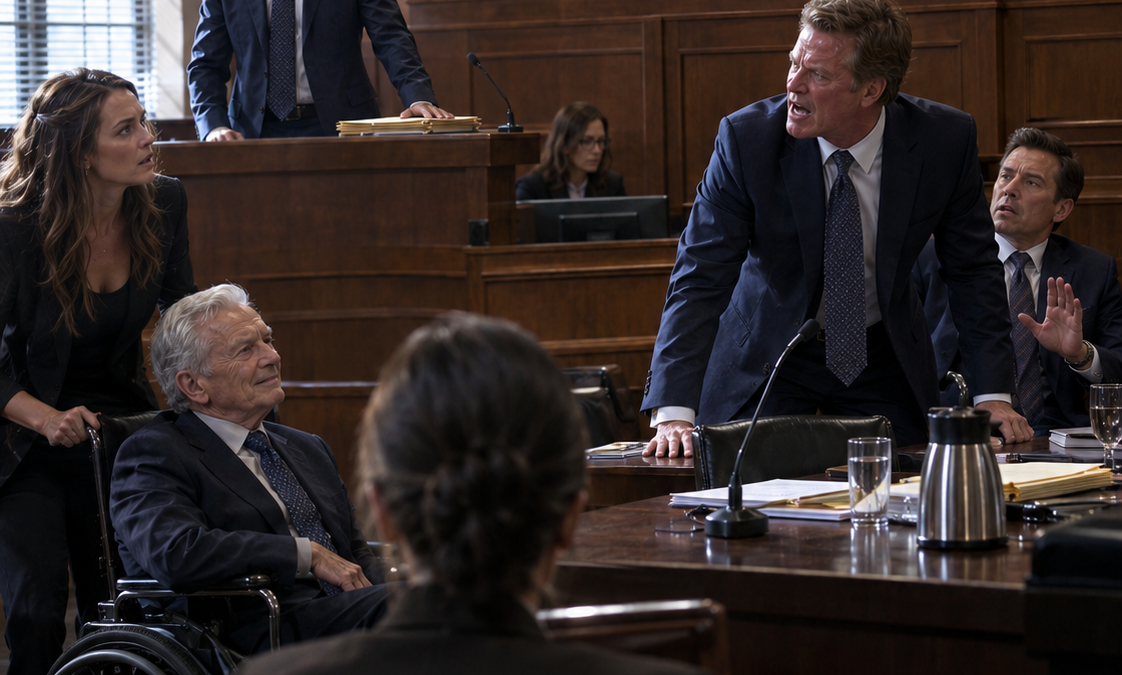
Roy was already there. He was sitting at a table with his new lawyer — Victor Sandoval, a tall man with slicked-back hair and a smile that didn’t reach his eyes. Veronica was beside him. She was wearing a dark suit and no jewelry. She looked like she was attending a funeral.
The bailiff called the court to order. Judge Park entered. She looked at the packed gallery and frowned.
“This is a guardianship hearing, not a circus,” she said. “I expect everyone to conduct themselves accordingly.”
We sat.
Patricia presented first. She walked the judge through the evidence — the chart, the medication gaps, the supervision levels, the emails. She called Delia, Carla, and Marcus as witnesses. Each of them testified to what they’d seen.
Then she called me.
I walked to the witness stand. The same stand I’d sat in two months ago. The same chair.
“Mr. Vance,” Patricia said. “Can you update the court on Edward’s condition since he’s been in your care?”
“He’s improved significantly. He’s eating better. He’s sleeping better. He’s more alert and engaged. His doctor says he’s making progress.”
“Progress that wasn’t happening at Willow Creek?”
“No. It wasn’t.”
“Why do you think that is?”
“Because he was being neglected. He wasn’t getting the supervision he needed. He wasn’t getting his medications on time. He wasn’t getting the human interaction that keeps people with Alzheimer’s engaged.”
“And now?”
“Now he’s getting all of those things. And he’s thriving.”
Sandoval stood for cross-examination.
“Mr. Vance, you’re not a doctor, are you?”
“No.”
“You’re not a nurse.”
“No.”
“You’re not a trained caregiver.”
“I’ve been trained in emergency medicine. As a Pararescueman, I was required to maintain advanced medical certifications.”
“But you’re not currently licensed to practice medicine.”
“No.”
“So your assessment of Edward’s condition is… subjective. Wouldn’t you agree?”
“It’s based on observation. And on the reports from his actual doctors.”
“But you’re not a medical professional.”
“I’m the person who’s been with him every day for two months. I’m the person who knows his routines, his moods, his needs. I’m the person who’s been keeping him alive.”
Sandoval smiled. “That’s very emotional. But it’s not evidence.”
“It’s the truth.”
“Objection,” Patricia said. “Counsel is badgering the witness.”
“Sustained. Mr. Sandoval, stick to the facts.”
Sandoval changed tactics. “Mr. Vance, you served in the military. Is that correct?”
“Yes.”
“For twenty-two years.”
“Yes.”
“And you were involved in combat operations.”
“I was involved in rescue operations. Some of them took place in combat zones.”
“How many people did you kill?”
The courtroom went silent.
“Objection,” Patricia said. “Relevance.”
“I’ll allow it,” Judge Park said. “Answer the question, Mr. Vance.”
I looked at Sandoval. He was trying to rattle me. Trying to make me look like a killer. Trying to paint me as dangerous.
“I don’t know,” I said.
“You don’t know?”
“I was a Pararescueman. My job was to save lives, not take them. I never counted the people I killed because I never killed anyone. I was too busy saving them.”
“But you were in combat.”
“I was in rescue. There’s a difference.”
“Were you ever shot at?”
“Yes.”
“Did you ever shoot back?”
“Only when necessary to protect the people I was rescuing.”
“So you did kill people.”
“I defended myself and others. That’s not the same as killing.”
Sandoval smirked. “I think the court can decide that for itself.”
Patricia stood. “Your Honor, I’d like to submit additional evidence. Evidence that Mr. Sandoval’s client has been involved in a conspiracy to defraud the state and endanger the lives of elderly residents.”
The courtroom stirred. Roy’s face went pale.
“Approach the bench,” Judge Park said.
Patricia and Sandoval walked to the judge’s bench. They spoke in low voices for several minutes. Then Judge Park nodded.
“Mr. Sandoval, your objection is noted. But I’m going to allow the evidence. The court has a right to know the full scope of the situation.”
Patricia presented the evidence. The bank records. The invoices. The payments from Evergreen Holdings to Harold Grayson’s wife. The pattern of inspections that always came back clean. The deaths that were never properly investigated.
“This is not just about Edward Ashford,” Patricia said. “This is about a system that has been failing elderly people for years. A system that Mr. Ashford’s son was complicit in. A system that killed at least one person — Eleanor Reeves — and nearly killed Edward.”
Judge Park read the documents. Her face was stone.
“Mr. Sandoval,” she said. “Do you have anything to say?”
Sandoval stood. His confidence was gone. “Your Honor, this evidence is… new. I wasn’t aware of it. I’d like time to review it.”
“You can review it after the hearing. But the evidence is admitted. And I’ve heard enough.” Judge Park looked at Roy. “Mr. Ashford, did you know that your girlfriend was billing the facility for services she never provided?”
Roy’s voice was barely a whisper. “I… I knew she was on the board.”
“That’s not what I asked.”
“I knew she had a role. I didn’t know the details.”
“You signed the invoices.”
“I signed a lot of things. I didn’t read every one.”
Judge Park leaned forward. “Mr. Ashford, you are the reason your father was neglected. You are the reason he was on the floor for two hours. You are the reason he almost died. And now I find out that you were benefiting financially from his suffering.”
“That’s not true.”
“It is true. The evidence says so.” She turned to the bailiff. “I’m calling a recess. I need to review this further. I’ll have a ruling in one hour.”
The gallery emptied. I stayed in the courtroom with Patricia. Sarah pushed Edward’s wheelchair over to me.
“You did good,” Edward said. “You told them the truth.”
“I tried.”
“You did more than try. You won.”
“We don’t know that yet.”
“I know.” He smiled. “I know you won.”
I knelt down beside his wheelchair. “How do you know?”
“Because you’re still here. You didn’t give up. That’s how I know.”
I squeezed his hand. “Thanks, Edward.”
“Thank you, Daniel. For everything.”
The hour passed slowly.
I sat in the hallway with Sarah. Patricia was in a side room, reviewing her notes. Roy was nowhere to be seen. Sandoval had disappeared. Veronica was gone.
At 2:00 P.M., the bailiff called us back in.
Judge Park was already at the bench. Her face was tired but determined.
“I’ve reviewed the evidence,” she said. “And I’ve made my decision.”
I held my breath.
“The permanent guardianship of Edward Ashford is granted to Daniel Vance. Mr. Ashford’s son, Roy Ashford, is permanently removed as guardian. He is also ordered to pay restitution for the funds he misappropriated from his father’s estate.”
Roy made a sound — a choked gasp.
“Furthermore,” Judge Park continued, “the evidence presented today regarding Evergreen Holdings and Harold Grayson has been referred to the state attorney general’s office for investigation. Criminal charges may follow.”
She looked at Roy.
“Mr. Ashford, you are a disgrace. You neglected your father. You put him in danger. You tried to profit from his suffering. And you tried to silence the one person who was actually trying to help him. I hope you understand the gravity of what you’ve done.”
Roy said nothing. His face was white.
“This court is adjourned.”
We walked out of the courthouse into the cold November air.
Sarah was crying. Edward was smiling. Patricia was shaking my hand, telling me we’d done good work.
I just stood there. I’d been in a lot of situations. A lot of moments where the outcome was uncertain until the very end. But this was different. This wasn’t a mission. This was someone’s life. Someone I loved.
“You did it,” Sarah said. “You actually did it.”
“We did it,” I said. “We all did it.”
Edward reached out and took my hand. His grip was weak, but it was there.
“Daniel,” he said. “I want to go home.”
“Okay,” I said. “Let’s go home.”
We drove back to the house in silence. The sun was setting behind us. The streets were empty. The world was quiet.
When we got home, I helped Edward into his chair. Sarah made tea. We sat in the living room, watching the light fade.
“I’m proud of you,” Edward said. “I’m proud of both of you.”
“We’re proud of you too, Dad,” Sarah said. “You fought hard.”
“I didn’t fight. Daniel fought. I just… held on.”
“That’s fighting,” I said. “That’s the hardest kind.”
He nodded. Then he closed his eyes and fell asleep.
Sarah and I sat there for a while, watching him breathe. The house was warm. The night was still.
“We did it,” she said.
“We did.”
“What happens now?”
I thought about it. About the attorney general’s investigation. About Harold Grayson. About the other residents still at Willow Creek.
“I don’t know,” I said. “But we’ll figure it out.”
She leaned into me. “Together.”
“Together.”
We sat there in the quiet, watching the man we’d saved sleep peacefully in his chair. And for the first time in a long time, I felt like everything was going to be okay.
PART 8 — THE RECKONING
The attorney general’s investigation moved faster than I expected.
Patricia had warned me it could take months. Years, even. But the evidence we’d presented at the guardianship hearing was too detailed, too organized, too damning to ignore. Within three weeks, Harold Grayson was placed on administrative leave. Within six, he was indicted on charges of bribery, official misconduct, and criminal negligence.
The newspaper picked up the story. A regional reporter named Denise Alvarado had been investigating Evergreen Holdings for months, waiting for someone to come forward. When she heard about our case, she called me.
“I want to tell your story,” she said. “The whole thing. The neglect. The cover-up. The rescue.”
“I’m not looking for attention.”
“I know. That’s why I want to tell it. People need to know what happened. They need to know that someone fought back.”
I thought about Edward. About Eleanor Reeves. About the other residents still at Willow Creek.
“Okay,” I said. “But I have conditions.”
“What conditions?”
“You don’t make me the hero. You make the story about the people who were hurt. The people who died. The people who are still waiting for justice.”
Denise was quiet for a moment. “That’s not how these stories usually go.”
“I know. But this isn’t a usual story.”
“Okay. I’ll do my best.”
The article ran two weeks later. It was four pages long, with photographs of Willow Creek and a sidebar about the mortality rates at Evergreen facilities. It quoted Delia, Carla, and Marcus. It quoted Patricia. It quoted me, but not much.
The headline was simple: “The Man Who Wouldn’t Give Up.”
Sarah read it at the kitchen table. When she finished, she looked at me with tears in her eyes.
“You’re in the paper,” she said.
“I know.”
“You’re a hero.”
“I’m not a hero. I just did what needed to be done.”
“That’s what heroes say.”
I didn’t know what to say to that. So I just kissed her forehead and went to check on Edward.
The fallout was swift.
Evergreen Holdings was placed under investigation by the state. Their facilities were audited. Their licenses were suspended pending review. Vincent Marchetti, the man at the top, was arrested on charges of fraud and criminal negligence. Veronica Cross was indicted as a co-conspirator. Roy was named as an unindicted co-conspirator — he wasn’t charged with a crime, but he was forced to testify before a grand jury.
The day Roy testified, I sat in the gallery and watched.
He looked smaller than I remembered. His suit was still expensive, but it didn’t fit as well. His hair was still perfectly arranged, but there were new lines on his face. He looked like a man who’d spent the last two months being questioned, investigated, and judged.
He didn’t look at me. Not once.
When it was over, he walked out of the courtroom without a word. His lawyer followed. Veronica was already gone — she’d fled to her family’s home in another state, according to the papers.
I stayed in the gallery for a while after everyone left. The room was empty. The lights were dim. I thought about Edward. About the two years of Saturdays. About the promise I’d made.
I won’t let that happen.
I’d kept that promise. Not perfectly. Not without cost. But I’d kept it.
The nursing home closed three months later.
The residents were transferred to other facilities — better facilities, ones that weren’t owned by Evergreen. Delia was hired as a patient advocate at one of them. She called me to tell me the news.
“I’m going to make sure this doesn’t happen again,” she said. “To anyone.”
“I know you will.”
“And Mr. Vance?”
“Yeah?”
“Thank you. For everything.”
“You don’t have to thank me.”
“I do. You saved those people. You saved Edward. You saved all of them.”
“I just did what was right.”
“That’s what heroes do.”
I hung up and sat in my garage. The challenge coins caught the afternoon light. That Others May Live.
I thought about the men I’d served with. The ones who were still alive. The ones who weren’t. The ones who’d come home and struggled. The ones who’d never come home at all.
I’d spent my whole career saving people. Strangers. People I’d never met. People who would never know my name.
But this was different. This was personal. This was family.
Maybe that was the point. Maybe the real mission was always about the people you loved. The people you chose to protect. The people who needed you most.
Edward had a good winter.
He celebrated Thanksgiving with us. Christmas too. He ate too much turkey and told bad jokes and laughed at Sarah’s attempts to bake cookies. He remembered Margaret’s birthday and cried a little, but not for long. He held my hand during the fireworks on New Year’s Eve and said, “This is the best year I’ve had in a long time.”
In January, his doctor told us his condition had stabilized. The Alzheimer’s was still progressing, but it was progressing more slowly than expected. The human interaction, the routine, the love — it was making a difference.
“You’re doing everything right,” the doctor said. “Keep doing it.”
We kept doing it.
In February, Edward asked me to take him to the cemetery. He wanted to visit Margaret’s grave.
“I need to tell her something,” he said.
We drove there in the van. The sky was gray. The ground was cold. Edward sat in his wheelchair, staring at the headstone.
“Margaret,” he said. “I’m okay. Daniel’s taking care of me. Sarah too. They’re good people. The best.”
He paused. His hands were shaking.
“I miss you. I miss you every day. But I’m not alone. I’m not alone.”
I stood behind him and put a hand on his shoulder. He reached up and covered it with his own.
“Thank you, Daniel,” he said. “For bringing me here.”
“Of course.”
“I’m ready to go home now.”
We drove back in silence. The sky cleared. The sun came out. By the time we got home, Edward was smiling.
Spring came slowly.
The garden bloomed. The days got longer. Edward spent more time outside, sitting on the porch, watching the birds. He told me stories about his childhood. About his father. About the day he met Margaret.
“She was the most beautiful woman I’d ever seen,” he said. “I knew the moment I saw her that I was going to marry her.”
“Did you tell her that?”
“I told her three days later. She laughed at me. But she said yes.”
“That’s a good story.”
“It’s a true story. The best kind.”
He looked at me. His eyes were clear.
“You and Sarah,” he said. “You remind me of us. The way you look at each other. The way you take care of each other.”
“We try.”
“You do more than try. You succeed.” He paused. “I’m glad she found you. I’m glad you’re part of this family.”
“Thank you, Edward.”
“You’re a good man, Daniel. The best man I know.”
I didn’t know what to say to that. So I just sat beside him and watched the sun go down.
The permanent hearing had been in November. The investigation had wrapped up in March. By April, everything was settled.
Roy had moved to another state. He’d sold his house and left without saying goodbye. Sarah got a letter from him a few weeks after he left. It was short. Just a few lines.
“I’m sorry. I know that doesn’t fix anything. But I’m sorry.”
Sarah read it and put it in a drawer. She didn’t respond. She didn’t need to.
“I don’t hate him,” she told me one night. “I just… don’t feel anything anymore. He’s not my brother. Not really. Not the way you’re my family.”
I held her. “You’re my family too.”
“I know. That’s what matters.”
We sat there in the quiet, listening to the house settle. Edward was asleep. The night was still.
“I love you,” she said.
“I love you too.”
The newspaper article won an award.
Denise called me to tell me. “It’s a big deal,” she said. “It’s going to bring more attention to elder abuse. To the system. To everything.”
“That’s good.”
“I wanted to thank you. For trusting me. For letting me tell the story.”
“You told it right.”
“I tried.”
“You succeeded.”
She paused. “Are you still in touch with the families? The other residents?”
“I try. Some of them don’t want to talk. Some of them are still angry. But I keep reaching out.”
“That’s good. That’s important.”
“I know.”
“Mr. Vance?”
“Yeah?”
“You’re a good man.”
“I keep hearing that.”
“That’s because it’s true.”
I hung up and sat in my garage. The challenge coins caught the afternoon light. That Others May Live.
I’d spent my whole life trying to live up to that motto. Trying to be the person who went in when everyone else ran out. Trying to save people who couldn’t save themselves.
I wasn’t perfect. I’d made mistakes. I’d lost people I should have saved. I’d carried guilt that would never fully go away.
But I’d done something good. Something that mattered. Something that changed lives.
And that was enough.
Edward died in his sleep on a Tuesday morning in June.
He’d been fine the night before. He’d eaten dinner, watched a movie with Sarah, told me a story about the time he’d gotten lost in Chicago and ended up at a Cubs game. He’d laughed. He’d hugged us both. He’d said, “I love you. Both of you.”
Then he went to bed.
And didn’t wake up.
Sarah found him in the morning. She called me at work — I was at the hardware store, picking up supplies for a project — and her voice was shaking.
“Daniel. Come home. Please.”
I knew before she said the words. I could hear it in her voice.
I drove home in silence. The sky was blue. The sun was shining. The world was beautiful and indifferent.
Edward was in his bed. His eyes were closed. His face was peaceful.
I sat beside him for a long time. Held his hand. Told him stories about my missions. The time I’d rescued a pilot from a crashed helicopter. The time I’d jumped into a frozen lake. The time I’d spent three days in the mountains.
“You’re home now,” I said. “You’re with Margaret. You’re not alone.”
I kissed his forehead. Then I called the funeral home.
The funeral was small.
Sarah and I. Delia. Mike. Patricia. A few of the staff from Willow Creek who’d become friends. A few of Edward’s old colleagues from the insurance company.
The sun was shining. The sky was blue. The birds were singing.
I stood by the grave and said a few words.
“Edward Ashford was a good man. He was a father to me when I didn’t have one. He was kind. He was generous. He was funny. And he was loved.”
I paused. Looked at the casket.
“He taught me something. He taught me that family isn’t about blood. It’s about showing up. It’s about being there. It’s about love.”
I paused again.
“I showed up for him. And he showed up for me. That’s what family is.”
I stepped back. Sarah took my hand.
“Thank you,” she said. “For everything.”
“I didn’t do anything.”
“You did everything.”
We stood there in the sunlight, holding hands, saying goodbye.
That night, I sat in my garage.
The challenge coins caught the moonlight. The shadow box was open. The medals were there. The photograph of my old team.
I thought about Edward. About the two years of Saturdays. About the promise I’d made.
I won’t let that happen.
I’d kept that promise. He’d died at home, in his bed, surrounded by people who loved him. Not alone in a nursing home. Not neglected. Not forgotten.
He’d died with dignity. He’d died with love.
That was the mission. That was always the mission.
I closed the shadow box. Stood up. Walked to the door.
Sarah was waiting for me inside. She was sitting on the couch, holding a photo of her father. She looked up when I walked in.
“I miss him,” she said.
“I know. Me too.”
“He was the best man I ever knew.”
“He was.”
She paused. “Except for you.”
I sat down beside her. Took her hand.
“I’m not the best man,” I said. “I just try to do what’s right.”
“That’s what makes you the best.”
We sat there in the quiet, holding hands, remembering.
The house was still. The night was calm. The world was at peace.
And for the first time in a long time, so was I.
Six months later, I got a call from Denise Alvarado.
“Harold Grayson was convicted,” she said. “Three years in prison. He’s going to appeal, but the evidence is overwhelming.”
“Good.”
“Veronica Cross took a plea deal. She testified against Vincent Marchetti. She got probation and a fine.”
“That’s less than she deserved.”
“I know. But it’s something.”
“And Marchetti?”
“Five years. Plus restitution. He’ll be in prison for a while.”
I closed my eyes. Took a breath.
“It’s not enough,” I said. “But it’s something.”
“It’s more than most people get. You made a difference, Mr. Vance.”
“I know.”
“The article is going to be used in a training program. For nursing home staff. To help them recognize the signs of neglect.”
“That’s good.”
“And the state is changing its inspection protocols. No more scheduled visits. No more warnings.”
“Good.”
“I wanted you to know. Your fight — it mattered.”
I thought about Edward. About Eleanor Reeves. About the other residents who’d suffered and died.
“Thank you,” I said. “For telling me.”
“You’re welcome.”
I hung up and sat in my garage. The challenge coins caught the evening light. That Others May Live.
I’d lived by that motto for twenty-two years. I’d risked my life for strangers. I’d saved people I’d never met.
But the most important mission of my life had been saving one man. One man who’d treated me like a son. One man who’d believed in me when no one else did.
Edward Ashford.
I’d saved him. And in saving him, I’d found something I’d been looking for my whole life.
A family. A purpose. A home.
I closed the shadow box. Stood up. Walked inside.
Sarah was in the kitchen, making dinner. She looked up when I walked in.
“How was your day?”
“Good. How was yours?”
“Good. I planted new flowers in the garden. Dad’s favorite.”
“He would have liked that.”
She smiled. “I know.”
I walked over and kissed her.
“I love you,” I said.
“I love you too.”
We stood there in the kitchen, holding each other, as the sun went down outside.
The world was quiet. The night was calm.
And for the first time in a long time, everything felt right.

