She Brought a Fake Fiancé to Her Ex’s Wedding — Then Shocked Everyone With a Single Dad Kiss (Part 2)
She Brought a Fake Fiancé to Her Ex’s Wedding — Then Shocked Everyone With a Single Dad Kiss (Part 2)
PART 2
And Clare laughed, surprised it out of herself. A real laugh, in the terrible, echoing entrance of the worst room of her life. And Ryan watched the fear loosen its grip on her, just enough.
“Okay,” she said.
“Okay. Table nine. Let’s go.”
The ceremony was mercifully short.
Clare sat with her spine straight and Ryan’s hand in hers and watched the man she’d been engaged to for four years marry the woman who’d been her closest friend.
And she waited for it to gut her, the way she’d been dreading for nine days.
And it didn’t.
That was the strange thing.
She kept waiting for the grief, and it didn’t come.
She watched Adrien slide a ring onto Vanessa’s finger.
She watched Vanessa’s practiced, radiant smile.
And she felt nothing. Or almost nothing.
A distant ache, like pressing on a bruise that’s finally started to heal.
She looked down at her own hand, at the old, worn ring that had belonged to a woman she’d never met.
A woman who’d had no patience for men who traded up.
And she thought, This ring is more real than that whole ceremony. And she almost laughed at the strangeness of it—that a fake engagement had more truth in it than the real wedding happening twenty feet away.
“You okay?”
Ryan murmured.
“I’m okay,” Clare whispered back, and was surprised to find it was true.
“I thought this would destroy me, and I’m just—I’m okay.”
“That’s because you’re not the same person who got the invitation,” Ryan said.
“That person would have been destroyed.
You’re somebody else now.”
Clare didn’t answer, but she leaned into him, just slightly, and rested her shoulder against his, and they watched the rest of the wedding like that.
The reception was where it got dangerous. The reception was where two hundred people with two hundred drinks were released into a beautiful room to gossip, and Clare and Ryan were the fresh gossip, and the vultures came in waves. But they were ready.
They’d built their story for nine days, and they told it flawlessly.
And more than that—and this was the thing Clare kept noticing, the thing that kept catching her off guard—they didn’t have to work at it.
When a woman asked how Ryan had proposed, Clare told the story they’d built—the quiet proposal, the family ring.
And Ryan added a detail she hadn’t heard him say before, something about how he’d been so nervous he’d forgotten the whole speech he’d planned.
And Clare laughed and said, “You did.
You completely blanked,” playing along, and only realized halfway through that she was laughing at something that had never happened, as though she remembered it.
Because at some point, the line between the story they’d built and the thing that was actually happening between them had dissolved completely.
They were good. They were so good that Clare started, dangerously, to relax.
And that was when Adrien made his move.
He’d been watching them all night.
Clare had felt it.
Adrien’s attention was a thing she’d learned to track over four years, the way prey learns to track a predator, and she’d felt it on the back of her neck all through the reception.
He’d watched Ryan charm the old crowd.
He’d watched Priscilla, who’d apparently decided Ryan was delightful, drag him into a conversation with her husband.
He’d watched Clare glow in a way she had never once glowed in four years with him.
And Adrien Cole, who could not stand to lose, who had traded Clare away precisely because he’d stopped seeing her value and could not bear that someone else had found it, decided he could not let the evening end with Clare happy.
He tapped a glass.
It was during the lull between dinner and dancing, that quiet stretch where the room’s attention floats, looking for something to land on.
Adrien stood up at the head table, the groom, glass in hand, and tapped it with a knife until the room quieted and people smiled, expecting a toast. And Clare felt the bottom drop out of her stomach, because she knew—she knew instantly, in her body, before her mind caught up—that this was not going to be a toast.
“I want to thank everyone for being here,” Adrien began, smooth and warm, the practiced charm that had fooled Clare for four years.
“It means the world to Vanessa and me.
Really.”
He let the room murmur its appreciation.
“And I want to take a moment to recognize some of the special people here tonight.
Because a wedding isn’t just about the two people getting married.
It’s about everyone who helped us get here.
Everyone who’s been part of our story.”
His eyes moved across the room, and Clare watched them coming—watched them travel toward table nine like a spotlight she couldn’t escape.
“And I’d be remiss if I didn’t acknowledge someone very special who’s here tonight.
Someone who was, once upon a time, a very important part of my life.”
No, Clare thought.
No, no, don’t.
“Clare,” Adrien said, and two hundred heads turned toward table nine.
“Clare Whitmore.
My ex-fiancée.”
The room went silent in that particular way a room goes silent when everyone in it senses blood in the water.
Ryan’s hand found Clare’s under the table and gripped it.
“Now, I know that’s a little unusual,” Adrien went on, and he was smiling.
He was the picture of gracious magnanimity, and only Clare could see the cruelty underneath it, because only Clare had spent four years learning to read it.
“Inviting your ex to your wedding.
Some people thought it was strange. But Clare and I, we go back a long way.
And there’s no bad blood, is there, Clare?”
He didn’t wait for an answer.
“And I’m so genuinely happy to see her here tonight.
Especially—” He paused, and his smile sharpened.
And here it came.
“Especially because she’s found someone new.
And so fast.
Isn’t that wonderful, everyone?
Let’s—let’s hear it for Clare and her new fiancé.
Ryan, is it?”
The room applauded uncertainly, sensing the trap but not yet seeing it.
“Ryan Parker,” Adrien said, savoring it.
“The baker.
Now, I have to be honest—and Clare, forgive me, this is all in good fun—some of us have just found the whole thing a little bit remarkable.
Because I’ve known Clare for a very long time.
And nine days ago, none of us—not one person in this room, and I’ve asked around—none of us had ever heard this man’s name.
And then suddenly, right in time for my wedding, an engagement, a ring, a whole love story.”
He spread his hands, playing to the room, the reasonable man merely pointing out an oddity.
“And you can’t blame us for wondering.
Nine days.
A ring nobody’s ever seen.
A fiancé nobody’s ever met.
It almost seems—” he laughed, warm and lethal— “well, it almost seems like our Clare needed a date to my wedding and found herself one.
Which, hey, no shame in that.
We’ve all been there.
But let’s not pretend it’s the romance of the century.
Let’s just be honest.
That’s all I’m asking.
Honesty.
On my wedding day.”
He raised his glass, and his eyes locked on Clare’s, triumphant.
“So.
To honesty.”
The silence that followed was the worst silence of Clare’s life.
Two hundred people looked at her. She could feel every eye.
She could feel Priscilla’s sympathy and the old crowd’s hunger and Vanessa’s cool satisfaction from her seat beside her new husband.
And she could feel two years of humiliation crashing back down all at once. And worse—so much worse—she could feel the truth of it. Because the horrible thing, the unbearable thing, was that Adrien was right.
That was how it started. He described it exactly.
She had needed a date and she had found one and she had offered him five hundred dollars. And now this good, kind man was sitting beside her, about to be exposed as a hired prop in front of two hundred people. And it was her fault.
She’d done this to him.
She’d dragged him into her mess.
And now she started to stand.
She didn’t know what she was going to say.
She only knew she had to say something. Take the blame. Protect Ryan.
Get him out of the line of fire.
But Ryan’s hand tightened on hers and held her down, gently, and he stood up instead.
“You know what, Adrien?”
Ryan said.
“You’re right.”
The room inhaled.
Clare’s head snapped up.
No. Ryan.
No.
Ryan was standing at table nine, and he wasn’t nervous.
That was the strange thing. Clare, who had learned to read fear in a person the way Ryan read the moods of his ovens, looked up at him and saw no fear at all. He was perfectly, terribly calm, and he had a small, sad smile on his face, and he was looking at Adrien like a man looks at something he almost feels sorry for.
“You’re exactly right,” Ryan said, and his voice carried easily across the silent room, because he wasn’t shouting.
He didn’t need to shout.
Everyone was already hanging on every word.
“Nine days ago, none of you had heard my name.
Because nine days ago, I was nobody to any of you.
I’m a baker.
I own a little shop that barely breaks even. My father ran it before me, and his father before him.
I’ve got a seven-year-old daughter and a car that pulls left.
And I have never in my life been invited to a place like this.”
He looked around the room, unhurried, meeting eyes.
“So you’re right to wonder about me.
I’d wonder about me, too.”
Adrien’s smile had frozen.
This was not how the trap was supposed to spring.
“And you’re right about something else, too,” Ryan went on, and now he turned and looked down at Clare, and Clare looked up at him with her heart in her throat.
“Nine days ago, Clare Whitmore walked into my bakery in the rain.
And she was a wreck. And she asked me to do exactly what you said.
She needed to come to this wedding, and she didn’t want to come alone, and she asked me to stand next to her.
You want honesty, Adrien? There it is.
That’s the honest truth.
It started exactly the way you said it started.”
The room was electric now. Vanessa had sat forward.
Priscilla had a hand over her mouth. And Clare—Clare was frozen, because Ryan was telling them. He was actually telling them the truth.
And she couldn’t understand why.
Couldn’t understand what he was doing.
Until he kept going.
“But here’s the part you got wrong, Adrien,” Ryan said.
“And it’s the only part that matters.
See, you think you caught us in a lie. You think you stood up here and exposed some scheme.
But you didn’t.
Because somewhere in those nine days—” his voice caught, just slightly, and Clare realized with a jolt that he wasn’t performing, that this was costing him something, that this was real— “somewhere in those nine days, I stopped pretending.
I don’t know when it happened.
Maybe it was the first night, when she cried at my counter and then apologized for getting my floor wet. Maybe it was watching her lie on my kitchen floor coloring with my daughter.
Maybe it was the tenth time she told me the reason she’s so good at her job is she understands what people are really buying, and never once realized she was describing exactly the thing she’d been denied her whole life.”
He shook his head.
“I don’t know when it happened.
I just know that somewhere in there, it stopped being a favor, and it started being the truest thing in my life.”
He turned to face the whole room now.
“You all had this woman for years,” Ryan said, and there was something fierce in it now.
Something protective, that made the room go very still.
“You were her friends.
Some of you were at her engagement party. Her real one.
The one that didn’t happen.
And when it fell apart, how many of you called her? How many of you checked on her? Because from what I can tell, the answer is just about none of you.
You closed ranks around him—” he nodded at Adrien— “because he throws the better parties and he’s got the better house.
And you let her walk out of your lives, and then you have the nerve to sit here tonight and wonder whether she’s worth loving.
Whether her engagement’s real enough for you.
Whether the baker’s good enough.”
He laughed, low and disbelieving.
“You’ve got it exactly backwards.
The question was never whether I’m worthy of her.
The question is whether any of you ever were.”
Somebody at a far table said, “Damn,” out loud, and it broke something in the room.
“Adrien,” Ryan said, turning back to the head table.
“You stood up at your own wedding—your own wedding, with your bride sitting right there—to take a shot at a woman you threw away two years ago.
You want to talk about honesty? Then be honest about that.
You didn’t do this because you care about the truth.
You did it because you looked across this room and you saw her happy. Actually happy. For the first time since you knew her.
And you couldn’t stand it.
Because it meant she didn’t need you.
It meant she was fine without you.
It meant that the worst thing you ever did to her turned out to be the best thing that ever happened to her.”
Ryan’s voice dropped, almost gentle now, almost pitying.
“And that’s the thing you’ll never be able to live with.
Not that you lost her.
That she won.”
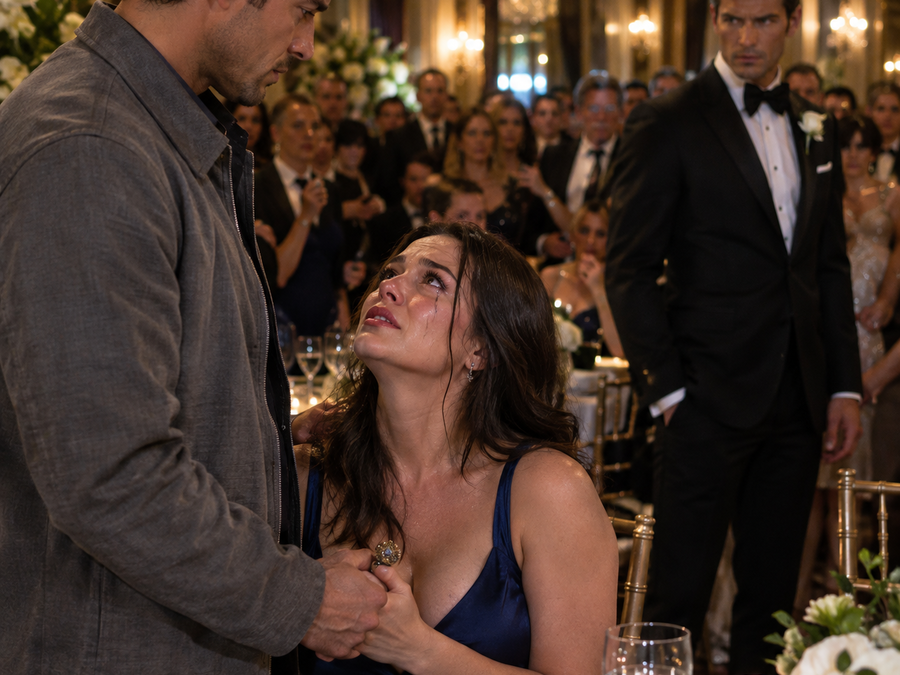
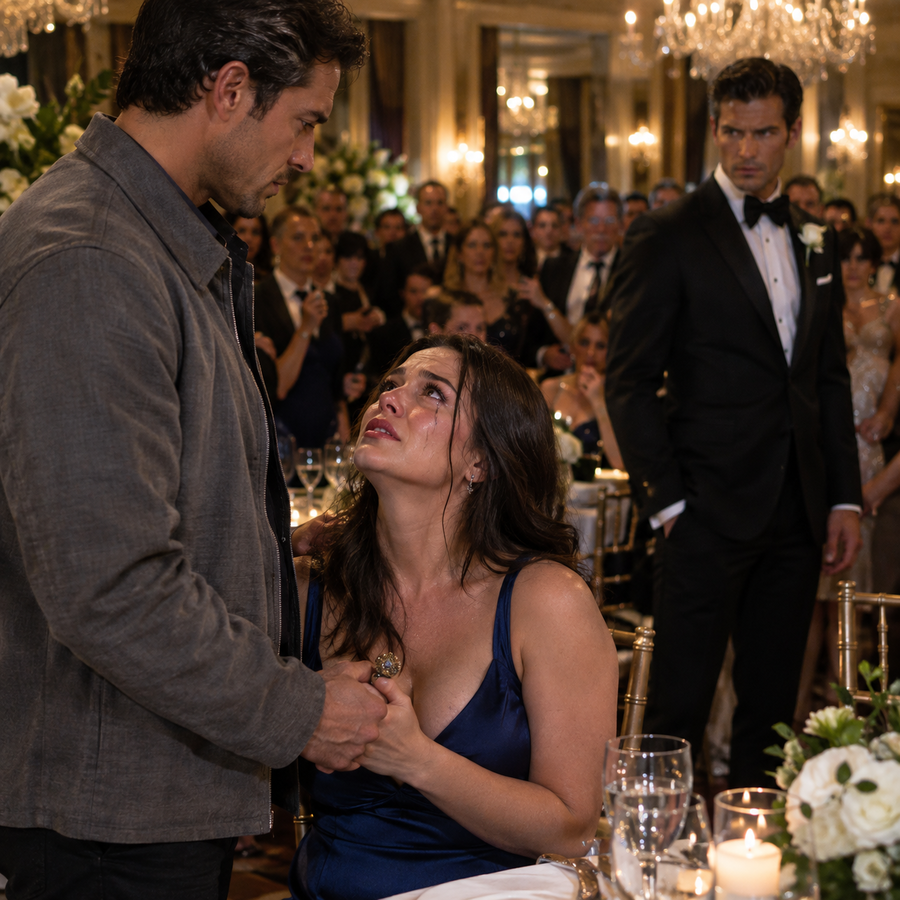
The silence was absolute. And then Ryan did the thing that Clare would replay for the rest of her life.
He turned away from Adrien entirely, like the man had simply ceased to exist, and he crouched down beside Clare’s chair, so they were eye to eye, and he took both her hands in his, and he lowered his voice.
But the room was so silent that everyone heard it anyway, and that was the point.
He wasn’t performing for them anymore.
He’d forgotten they were there.
He was only talking to her.
“Clare,” he said.
“The deal was supposed to end at midnight.
You remember the Cinderella rule?
When the clock hits twelve, the ring comes off, and we go back to being strangers who wave through a window.”
His thumbs moved over the backs of her hands.
“And I’ve been dreading midnight for about six days.
Because I don’t want it to end.
I don’t want the ring to come off.
I don’t want to drive home to my bakery and leave you in your glass apartment and go back to making your coffee slow and pretending I don’t count the minutes till six o’clock when you walk in the door.”
His eyes were bright now.
“I fell in love with you somewhere in the last nine days.
And I know it’s fast, and I know Adrien’s right that it’s fast, and I don’t care.
Because I spent four years being married to somebody who never loved me. And it was the slowest, emptiest thing in the world.
And I’d trade all four of those years for nine real days with you.
So I’m not going to wait for midnight.
I’m asking you now, in front of everybody.
And it’s real this time.
Clare Eleanor Whitmore. Not for the story. Not for the favor.
For real.
Will you?”
“Yes.”
Clare said.
She didn’t let him finish.
She couldn’t.
The word came out of her before he’d gotten the question all the way out, and it came out wet and cracked and certain.
And then she was laughing and crying at the same time and grabbing his face in both her hands.
“Yes,” she said again.
“Yes, God, yes, you idiot.
Of course.
Yes.”
And Clare Whitmore, in a room full of two hundred people who had spent two years telling the wrong story about her life—in front of her ex-fiancé and the friend who’d betrayed her and every single person who’d watched her get replaced and whispered, “Poor Clare.
He traded up”—Clare pulled Ryan Parker to his feet by the front of his one good jacket and she kissed him.
She kissed him like she was answering every question she’d been afraid to answer.
She kissed him like she was two years and nine days and a whole lifetime overdue.
And it wasn’t for revenge, though a room full of people would tell the story that way for years.
It wasn’t for Adrien, or Vanessa, or any of them.
She’d stopped seeing them the moment Ryan crouched down beside her chair.
She kissed him because he was the first person who had ever looked at her and found her worth staying for. Worth fighting for.
Worth standing up in a room full of hostile strangers for.
And because she had finally, finally understood that the thing she’d been too scared to trust for nine days wasn’t too good to be true.
It was just true. When they finally broke apart, the room erupted.
And not the way Adrien had wanted. Not in scandal.
In applause. Real applause.
Because even a room full of people who’d abandoned her could recognize the real thing when it detonated right in front of them.
Priscilla was on her feet, clapping with tears in her eyes. Half of table nine was standing.
Somebody was whistling. And at the head table, Adrien Cole stood alone in his ruin, holding a champagne glass at a wedding that everyone would remember for entirely the wrong reason.
Watching the woman he’d thrown away get everything.
Watching his own cruelty curdle into the best moment of her life.
He’d stood up to expose a fake engagement.
He’d ended up officiating a real one.
Vanessa was staring at him, and it was not a loving stare, because Vanessa had just watched her brand-new husband stand up at their wedding to torment his ex and get publicly, spectacularly destroyed for it.
And some part of Vanessa—the part that had once been Clare’s friend—was doing math about what kind of man she’d actually married.
Clare didn’t see any of it.
Clare had her forehead pressed to Ryan’s.
Both of them breathing hard. Both of them laughing.
The old, worn ring pressed between their joined hands.
“You said you weren’t going to wait for midnight,” she whispered.
“I lied,” Ryan whispered back.
“Turns out I’m a much better liar than either of us thought.
Nine days of practice.”
“We should go,” Clare said, still laughing, still crying.
“We should leave.
I want to leave.
I don’t want to spend one more minute in this room.
I want—” She pulled back and looked at him.
And her whole face was open in a way he’d never seen it.
Every wall down.
“Take me home, Ryan.
To the bakery. To the apartment.
I want to tell Lily.
I want to sit on your floor and color, and I want to be somewhere real.”
She laughed again, disbelieving.
“God, I’ve never wanted anything so much in my life, and it’s a walk-up apartment over a bakery that pulls left.”
“The car pulls left,” Ryan corrected.
“The apartment stays put.”
“I don’t care,” Clare said.
“Take me to the thing that stays put.”
And Ryan Parker took the hand of the woman he’d agreed to fake love for nine days—the woman who was never fake—and he led her out of the Ashford estate, past the head table where a marriage was quietly cracking, past two hundred stunned guests, past the valet, who grinned and brought around the car that pulled left, and out into the clean night, toward a small, warm apartment where a seven-year-old was asleep with a one-eared rabbit, dreaming of forty-one animals and the room she’d already decided would be Clare’s.
They drove home in a silence that wasn’t empty.
It was the fullest silence Clare had ever sat inside. The kind where two people have said the biggest thing there is to say, and now the words have to settle, like flour after you shake the bag.
Ryan drove with one hand on the wheel and the other holding hers across the console. And every few minutes, one of them would start laughing again, for no reason, just because it was all still too much.
And the other would catch it.
And they’d sit there in the dark, laughing like a couple of people who’d gotten away with something.
“I keep waiting to feel embarrassed,” Clare said somewhere on the highway.
“I just kissed a man in front of two hundred people at my ex-fiancé’s wedding.
That’s—that is objectively the most dramatic thing I’ve ever done in my life.
I plan weddings, Ryan.
I’m the person who tells the bride to keep it classy.
And I just—” She started laughing again.
“I just hijacked a man’s entire reception.”
“You didn’t hijack it,” Ryan said.
“Adrien hijacked it.
You just repossessed it.”
“Repossessed it?”
She wiped her eyes.
“God, did you see Vanessa’s face?”
“I saw Adrien’s face,” Ryan said.
And there was no cruelty in it, just a kind of quiet wonder.
“You know what the strangest part is?
Right at the end there, when I was talking to him, I stopped being angry.
I thought I’d be angry.
I’ve heard about this guy for a year, what he did to you, and I walked into that room ready to hate him.
And then he stood up and did that.
And I looked at him and I just felt—” Ryan searched for the word.
“Sorry for him.
That’s it.
He had you. He actually had you. The real thing.
And he was too small to know what he was holding.
And now he’s going to spend the rest of his life at dinner parties telling a story where he’s the villain, and everybody’s going to nod along and think, ‘What a jerk.’
And he’s never going to understand why.
That’s not a win, Clare.
That’s just sad.”
Clare was quiet for a moment.
“When did you get so wise?”
“I bake bread at four in the morning by myself,” Ryan said.
“You do a lot of thinking.
It’s either wisdom or the flour fumes.
Hard to say.”
She laughed and squeezed his hand and looked out at the dark road rolling toward the only place she wanted to be.
“Ryan,” she said.
“Can I say something serious for a second?”
“Of course.”
“What you did back there.”
She turned to look at him.
“You stood up in a room full of people who had every reason to look down on you, and you didn’t defend yourself.
That’s the thing I keep—you didn’t say, ‘No, it’s real, how dare you?’
You said, ‘You’re right.
It started fake.’
You told them the worst version of the truth first. You let them think, for one second, that Adrien had won.
And I don’t understand how you had the nerve to do that.”
Ryan drove for a moment.
“Because the truth’s only dangerous if you’re scared of it,” he said finally.
“Adrien thought he had a weapon—the fake engagement.
And the only reason it was a weapon is that we were hiding it. So I took it away from him.
I said it out loud myself, first, before he could.
You can’t expose a thing a man’s already confessed to.”
He glanced at her.
“My mother taught me that.
She used to say, ‘The truth’s like a dog.
It’ll either walk beside you or it’ll chase you.
And it’s the same dog either way, so you might as well make friends with it.’
Adrien was trying to make the truth chase us.
I just turned around and petted it.”
Clare looked at this man—this baker, with his four-in-the-morning wisdom and his dog metaphors and his dead mother who had opinions about honesty—and she felt the last little piece of her fear, the piece that had been whispering, What if it’s not real?
What if it’s gratitude?
What if you made him up?
—go quiet at last.
“I didn’t make you up,” she said softly, mostly to herself.
“What?”
“Nothing.
Something I was scared of.
It’s gone now.”
She settled back into the seat.
“Drive faster.
I want to see Lily.”
Lily, as it turned out, was not asleep. Lily was supposed to be asleep.
Mrs. Alvarez from the apartment downstairs had come up to watch her and had reported by text at nine that the child was down for the count.
But when Ryan’s key turned in the door of the apartment above the bakery, there was a scrambling sound and a thump.
And by the time Ryan and Clare got inside, Lily was standing in the middle of the living room in her dinosaur pajamas, one-eared rabbit in hand, wide awake, and clearly having leapt back into a pose of casual innocence about four seconds too late.
“I was asleep,” Lily announced.
“I was totally asleep, and I just woke up right now.”
“You were not asleep,” Ryan said.
“You were sitting up waiting.”
“Mrs.Alvarez let me stay up a little,” Lily admitted, abandoning the lie instantly, the way children do.
Then she looked past her father, and she saw Clare standing in the doorway in the deep blue dress, and her whole face changed.
“Miss Clare’s here.”
She looked at Ryan.
“Miss Clare’s here.
It’s the middle of the night and Miss Clare’s here.”
“Yeah,” Ryan said.
“She is.”
“Is she—” Lily’s voice went small and careful, and she looked at Clare and then back at her father.
And Clare watched the little girl try to work out whether she was allowed to hope for the thing she was hoping for.
“Is she just visiting, or is she—”
Clare crossed the room.
She got down on her knees on the floor in the middle of the living room, in her expensive dress, so she was eye to eye with the seven-year-old in the dinosaur pajamas, and she found that her voice didn’t want to work.
“Lily,” she said.
“Your dad and I have something to tell you.”
“Are you going to keep coming over?”
Lily blurted, unable to wait, gripping the rabbit hard.
“Because Daddy made too much bread today, which means he was nervous, and he only gets nervous about important stuff.
And I said he should tell you that you can keep coming over.
And he said—” “Lily,” Ryan said gently, coming to kneel beside Clare.
“Let me and Miss Clare say it.”
“Okay.”
Lily pressed her lips together and nodded, vibrating with the effort of staying quiet.
“I’m not just visiting,” Clare said.
“If—if it’s okay with you.
Because it has to be okay with you.
That’s the most important part.
More important than anything.”
She swallowed hard.
“Your dad asked me tonight if I wanted to be part of your family.
And I said yes. But I need to ask you the same thing.
Because a family isn’t just the grown-ups.
So I’m asking you, Lily.
Is it okay if I stick around? Not as the coffee lady. As—as something more than that.
Somebody who helps with homework and colors on the floor and is here. Really here.
The kind that stays put.”
For a second, Lily didn’t say anything.
She looked at Clare with those serious dark eyes—the eyes that missed nothing. And Clare realized she was more nervous about this answer than she had been about anything at the wedding. Because a room full of hostile adults she could survive.
But a no from this child would break something in her she didn’t think she could fix.
“You mean forever?”
Lily asked.
“Or just for a while?
Because people say they’ll stay.
And then—” The little girl’s voice wobbled, just slightly, and Ryan’s jaw tightened, because he knew exactly which absence had put that wobble there.
“—then sometimes they don’t.”
The room went quiet. Clare understood in that moment that she was not the only person at this address who had learned to distrust the good things.
That the little girl in front of her carried her own version of the voice. Planted young.
People who are supposed to stay sometimes leave.
So don’t believe it.
Don’t get attached.
Don’t let it in.
And Clare understood that whatever she said next mattered more than any promise she’d ever made.
So she didn’t make a big one.
She’d learned from nine days with these two that the big promises weren’t the real ones.
“I can’t tell you forever,” Clare said honestly.
And she felt Ryan go still beside her, surprised.
“That’s a really big word, and anybody who throws it around too easy is somebody you shouldn’t trust.
So I won’t lie to you and say ‘forever’ like it’s nothing.”
She reached out and took Lily’s small hand, the one not holding the rabbit.
“Here’s what I can tell you.
I can tell you tomorrow.
I’m going to be here tomorrow.
And then I’m going to be here the day after that.
And I’m going to keep being here, one day at a time.
And I’m going to keep choosing it.
Every single day. On purpose.
And that’s better than forever, Lily.
Because forever is just a word people say.
But showing up tomorrow, and then the next day, and meaning it—that’s a thing people actually do.”
She squeezed the little hand.
“I’m going to do the thing.
Not just say the word.
Okay?”
Lily stared at her.
And then the little girl let go of Clare’s hand.
And for one terrible second, Clare thought she’d gotten it wrong.
And then Lily flung both arms around Clare’s neck so hard she nearly knocked her over, rabbit and all, and buried her face in Clare’s shoulder.
And Clare felt the small body shaking and realized the child was crying. The quiet, overwhelmed crying of a kid who has just been handed the exact thing she was too scared to ask for.
“Okay,” Lily said, muffled into Clare’s neck.
“Okay.
Tomorrow and the next day.”
“And the next day,” Clare whispered, holding on, her own eyes streaming, her expensive wedding makeup finally completely done for.
“And you can have the capybara room,” Lily added, pulling back, wiping her nose on the back of her hand.
Suddenly all business now that the crying was done.
“I already decided.
It’s the nicest room.
It gets the morning light.”
“We don’t have a capybara room, Lily,” Ryan said, his voice thick.
“We will,” Lily said, with the absolute confidence of a child who had just watched the impossible happen in her own living room and had therefore concluded that anything was now on the table.
“Miss Clare’s here.
Anything can happen now.”
She looked at Clare with total seriousness.
“Can we get a capybara?”
“Let’s start with tomorrow,” Clare laughed, wiping her eyes.
“We’ll work up to capybaras.”
“That’s a yes,” Lily informed her father.
“When grown-ups say ‘let’s start small,’ it means yes eventually.
That’s the rule.”
And Ryan Parker sat on the floor of his small apartment above his failing bakery, watching the woman he loved cry with his daughter in her arms over a capybara room that didn’t exist, and thought that he had never in his life been so completely, so undeservedly, so impossibly rich.
They put Lily to bed together. It took a while, because Lily was now far too wired to sleep and kept thinking of urgent questions.
Does this mean Miss Clare will be here for my birthday? Does this mean Miss Clare can teach me to do the frosting swirls?
Does this mean I can tell Emma at school?
And each one had to be answered before she’d consider closing her eyes.
But eventually, she wound down, the way kids do—all at once, dropping from wide awake to nearly asleep in the space of a sentence. Clare tucked the blanket up around her, and Lily caught her hand one more time, sleepy now, her eyes already closed.
“Miss Clare.”
“Yeah, sweetheart.”
“I’m glad you were sad that night,” Lily murmured.
“The rainy night when you came in the bakery all wet and crying.
Because if you weren’t sad, you wouldn’t have asked Daddy for help, and then you wouldn’t be here.”
She yawned enormously.
“So I’m glad you were sad.
Is that mean?”
Clare had to press her free hand over her mouth for a second.
“No, baby,” she managed.
“That’s not mean.
That’s the least mean thing anybody’s ever said to me.”
But Lily was already asleep. Clare sat on the edge of the bed a moment longer, holding the small sleeping hand, and thought about how nine days ago she had walked into a bakery, convinced that the worst night of her life was coming, and how that walk in the rain, that humiliation, that desperation, that terrible invitation with her name in gold letters, had turned out to be the doorway to this.
To a sleeping child who was glad she’d been sad.
To the room with the morning light.
She thought about all the years she’d spent believing that if she could just be perfect enough, nothing bad would ever happen to her.
And how it turned out the best thing in her life had come riding in on the very worst.
That she’d had to walk in soaked and broken and asking for help before she could find the one place that would never make her earn it.
She turned off the lamp and went to find Ryan. He was in the kitchen, standing at the counter in the dark, not doing anything, just standing there. And Clare stopped in the doorway and looked at him.
This man she’d hired nine days ago.
This man who’d refused her money and asked for a favor instead.
This man who’d handed her his dead mother’s ring so she wouldn’t have to walk into a room alone.
“The favor?”
she said. Ryan turned.
“What?”
“That first night.
You wouldn’t take the money.
You said I owed you a favor instead. Your choice.
Anytime.
Doesn’t expire.”
She crossed the kitchen slowly.
“You never called it in.
Nine days, and you never once asked me for your favor.”
“No,” Ryan said.
“I didn’t.”
“Why not?”
Ryan leaned back against the counter and looked at her. And there was something soft and a little sheepish in his face.
“Because I figured out what I wanted to ask for pretty early,” he said.
“Like day three.
Day four. And it was too big to ask for. So I just held on to it.
Kept it in my pocket.
Figured I’d never actually have the nerve.”
“What was it?”
Clare came closer.
“What were you going to ask for?”
“This,” Ryan said simply.
“You.
Here. The kitchen. The kid asleep down the hall.
The whole thing. That was the favor.
I just didn’t think I’d ever get to ask, because it’s not the kind of thing you can ask somebody for.
You can’t call in a favor and have it be a person choosing to love you back.
That’s the one thing that doesn’t work if you demand it.”
He shook his head.
“So I held on to the favor, because I didn’t want to waste it on something smaller, and I didn’t have the guts to spend it on the real thing.
And then tonight, Adrien stood up and did that whole thing.
And I realized I didn’t need the favor anymore.
Because you weren’t going to give it to me.
You were going to choose it.
And that’s about a thousand times better than any favor I could have called in.”
Clare stopped in front of him. She reached up and put her hand flat against his chest, and she could feel his heart going fast and hard under her palm.
This steady man, this calm man who’d faced down two hundred hostile strangers without a flicker, and his heart was pounding like a boy’s.
“Call it in anyway,” she said quietly.
“What?
The favor?”
“Call it in.
I want you to.”
She looked up at him.
“I’ve spent my whole life with people who kept score.
Ryan. Adrien kept score.
My mother kept score.
Everybody I’ve ever—everything was always a transaction.
Everything had to be earned.
And I’m so tired of it.
So I want to start this—us—with a clean ledger.
You’ve got a favor.
It’s real.
I agreed to it. I owe it. So call it in.
Ask me for the thing. Let me give you something on purpose, freely, because you asked and I want to.
And then we’re even, and we start from zero.
And from here on out, nobody in this family owes anybody anything ever again. We just choose each other every day.
Like I told Lily.”
Her voice caught.
“So, Ryan Parker.
What’s your favor?”
Ryan looked at her for a long moment. Then he reached out and took her hand off his chest and held it in both of his.
And Clare felt him tremble, just slightly, and he said, “Stay.”
Just the one word.
“That’s my favor,” Ryan said.
“Not for the wedding.
Not for nine days. Not until midnight.
Just stay. Tomorrow and the next day and the day after that.
Exactly the way you told Lily.
Don’t do the forever thing.
I don’t believe in the forever thing either.
Just do the thing where you keep choosing to stay, one day at a time.
And I’ll keep choosing it, too.
And we’ll see how far we get.”
That’s the whole favor.
That’s everything I want.”
His voice broke.
“Stay, Clare.”
And Clare Whitmore—who had walked into a bakery nine days ago to rent a man to save her dignity, who had spent four years shrinking herself to fit beside someone who was always halfway out the door, who had believed, in the deepest part of herself, that she was the kind of thing a person trades away when something better comes along—looked up at the man who was asking her to stay like it was the biggest favor in the world. Like she was the prize and not the problem. And she understood that she had finally, after all these years, found the one place that had gotten it exactly backwards from everywhere else.
Everywhere else, she’d had to earn the right to stay.
Here, they were asking her to stay like it was a gift she was giving them.
“That’s the easiest favor anybody’s ever asked me for,” Clare whispered.
And she stayed. They stood in the dark kitchen a long time, not talking, just holding on. The old, worn ring pressed between their joined hands.
His mother’s ring.
The ring meant for a woman who was scared and holding her head up anyway, sitting exactly where it was supposed to be at last. Down the hall, a seven-year-old slept with a one-eared rabbit and dreamed of a room with morning light.
And outside, past the window, the city went on the way it always did—indifferent and enormous, having no idea that in one small, warm apartment above one small, failing bakery, three broken people had just quietly stopped being broken.
Had looked at the wreckage of everything that had hurt them and built out of the ruins the one thing none of them had ever believed they’d get to keep.
A family.
Not the kind you’re born into.
Not the kind that comes easy. The kind you choose on purpose.
In the dark. One ordinary day at a time. And then keep choosing, long after the music stops and the guests go home and the clock runs all the way past midnight without anything ending at all.
The first morning was the one Clare remembered best, years later, when people asked how it all began.
She woke up on the pullout couch in the living room, because they were not the kind of people to rush past a seven-year-old’s understanding of things, and Ryan had said quietly in the kitchen the night before, “Slow, okay?
For Lily.
Let her see us build it careful.”
And Clare had loved him a little more for it. And she woke to the smell of bread and the sound of a child trying very hard to be quiet and failing completely.
“She’s still here.”
Lily was whispering somewhere near the kitchen.
“Daddy, Daddy, she’s still here.
She stayed.”
“I know, Lilybug,” Ryan whispered back.
“I told you she would.”
“But she’s actually still here.
In the morning.
People don’t usually—” And there it was again.
That small wobble. The leftover from an old wound.
People don’t usually still be here in the morning.
There was a pause.
And then Clare heard Ryan set something down and crouch, the way he did, and say, “This one does.
This one’s the kind that stays put.
Remember? Not the car. The car pulls left.
Miss Clare stays put.”
And Clare lay on the pullout couch with her eyes still closed and cried silently into the pillow. But they were the good kind now.
The kind that don’t hurt.
The kind that come when something inside you that’s been clenched for years finally, finally lets go.
Then she sat up, and she wiped her face, and she said, “Is somebody making coffee out there, or do I have to do everything myself?”
And Lily came flying across the living room and landed on the couch on top of her, and the day began.
The thing about Adrien’s wedding was that it did exactly the opposite of what Adrien had intended, and it did it for months.
He’d stood up to expose Clare as a fraud.
And instead, he’d given two hundred witnesses the single most romantic thing any of them had seen in years.
And people talk. God, do people talk.
By Monday, the story had gone around the whole old crowd, and it had not gone around the way Adrien would have wanted. In the version everyone told, Adrien was the villain who stood up at his own wedding to humiliate his ex.
And the baker was the hero who’d taken him apart with nothing but the truth.
And Clare—Clare was the woman who’d finally, finally chosen right.
Priscilla called on Tuesday.
Clare almost didn’t answer.
“I owe you an apology,” Priscilla said, before Clare could even say hello.
“A big one.
Two years’ worth.
When it fell apart with Adrien, I—we all just—I’m so sorry, Clare.
We picked the wrong side. We picked the side with the better parties.
And we told ourselves you’d landed on your feet.
And the truth is, none of us called because we were embarrassed, and it was cowardly.
And I’m sorry.”
A pause.
“Your baker is the best man I’ve met in a decade.
And he made every single one of us look like exactly what we are. And we deserved it.
I just wanted to say that.
And to ask—is there any chance you’d let me buy you a coffee?
I know a place.”
A small, watery laugh.
“I hear the guy who runs it is a real catch.”
And Clare, who had spent two years believing these people had written her off forever, found that she had room in her to forgive at least some of them. Not all. Vanessa she never spoke to again and never needed to.
But Priscilla came by the bakery that Friday and cried and apologized properly and became—slowly, carefully, the way the good things always came—a real friend again. The kind who showed up. The kind who stayed put.
As for Adrien, Clare heard about him the way you hear about weather in a country you’ve left—secondhand and without much feeling.
She heard that the marriage to Vanessa was strained from the start.
That Vanessa had watched her new husband torch his own reception to wound a woman he’d claimed not to care about, and had drawn the obvious conclusion about what kind of man does that.
Clare heard, about a year later, that they’d separated.
She felt nothing when she heard it. Not satisfaction, not vindication, not even the small, mean pleasure she might once have expected.
She’d been telling the truth that night in the car when she’d said the grief was gone.
It was just gone. Adrien had become a man she used to know.
A name attached to a version of herself she barely recognized anymore.
A woman who’d believed love was a thing you earned by disappearing.
“Do you ever think about it?”
Ryan asked her once, months later, the two of them closing up the bakery together the way they did now—her counting the register while he cleaned the machine.
“Him.
That whole life. The glass apartment, the six-figure weddings, all of it. You gave up a lot, Clare.
You went from that to—” He gestured around at the small shop, the old ovens, the flour that never fully came off anything.
“This.”
Clare looked up from the register.
“Ryan Parker,” she said, “did you just ask me if I miss being miserable in a nicer apartment?”
“I’m asking if you ever miss the—the size of it.
The money.
You were somebody in that world.”
“I was nobody in that world,” Clare said.
“That’s the whole thing you never understood, because you’ve never been in a room like that.
In that world, I was an accessory.
A well-dressed accessory to Adrien’s life.
And when he found a better accessory, he swapped me out.
And everybody agreed that was reasonable, because that’s how that world works.
Nobody in that entire world ever once looked at me the way your daughter looked at me the first morning she found me still here.”
She closed the register drawer.
“I didn’t give up a lot, Ryan.
I gave up a beautiful cage.
And I did not, for one single second, ever miss the cage.”
Ryan came around the counter and kissed her.
And she still wasn’t used to it.
The ordinariness of it. The way a good thing could just happen on a Tuesday, for no reason, and nobody kept score afterward.
“For the record,” he murmured, “the bakery still barely breaks even.
I’m not exactly your upgrade in the money department.”
“You’re the richest poor man I’ve ever met,” Clare said.
“You told me that yourself, first night, at the rehearsal dinner.
‘The richest poor job I can think of.’
I married you for your business philosophy.”
“You haven’t married me yet.”
“Details,” Clare said, and kissed him again.
They did marry, eventually.
Not for over a year, because they were both of them people who’d learned the hard way not to trust the fast version of things.
And because they decided, together, that they’d take it one day at a time—exactly the way Clare had promised Lily on that first night—and let the forever thing prove itself slowly, instead of announcing it.
But the days added up, the way days do when you keep choosing them. And about fourteen months after the rainy night in the bakery, Ryan Parker asked Clare Whitmore to marry him.
For real. For the second time.
For the last time.
He didn’t do it in front of two hundred people.
He did it in the kitchen at four in the morning, while the first batch of the day was in the oven, because that was where they’d fallen in love and it seemed right.
He didn’t have a new ring, because Clare had never taken the old one off—his mother’s ring, the worn band that had been meant for a woman who was scared and holding her head up anyway, and had found her.
“I know you’ve already got the ring,” Ryan said, down on one knee on the flour-dusted floor.
“So this isn’t about the ring.
This is about the word. The big one.
The one you told Lily not to trust.”
He took her hand.
“I’ve been showing up every day for fourteen months.
And you’ve been showing up every day for fourteen months.
And I think we’ve earned it now.
I think we get to say the big word and mean it. So—Clare.
Will you?”
“Yes,” Clare said.
“You’ve got to stop doing that.
You did the exact same thing at the wedding.
You never let me finish.”
“Because I always know the answer before you’re done,” Clare said, pulling him up off the floor.
“That’s how you know it’s right, Ryan.
You don’t have to hear the whole question.
Yes. Forever.
The big word.
I’ll say it now.
I’ve earned the right to trust it.”
She grabbed his flour-covered face in both hands.
“Forever, you idiot.
Yes.”
Lily, who was supposed to be asleep, and who was of course not asleep, and who had in fact been sitting on the stairs listening the entire time—exactly as she had that first rainy night—came thundering down into the kitchen in her pajamas.
Pajamas with capybaras on them, now, because she’d gotten them for her birthday from Clare.
And threw herself between the two of them. And the three of them stood in the four a.m. kitchen, laughing and crying and holding on, while the bread burned in the oven because nobody remembered the bread.
“You burned the bread,” Clare said, when they finally noticed.
“First batch I’ve burned in three years,” Ryan said, not letting go of either of them.
“Worth it.”
The wedding, when it came, was small.
Clare Whitmore, who planned six-figure weddings for a living, who could have called in every favor in the city and thrown a spectacle that would have made Adrien and Vanessa’s look like a backyard barbecue, planned herself the smallest, plainest, most joyful wedding anyone in that whole old crowd had ever seen.
It was in the bakery. They cleared out the tables and strung up lights, and Ryan baked the cake himself. And there were maybe forty people, and every single one of them was someone who had actually shown up.
Priscilla, and a handful of the old crowd who’d earned their way back.
Mrs. Alvarez from downstairs.
Ryan’s regulars, the families he’d quietly helped over the years, who came to quietly help him back.
No spectacle. No proving anything to anyone. Nobody keeping score.
Lily was the flower girl, and she took the job with deadly seriousness, and she’d made an announcement beforehand that she would be scattering not flower petals but a mix of petals and also a little bit of flour, because it’s a bakery wedding and flour is basically bakery flowers, and nobody could talk her out of it.
So she walked down the aisle of the bakery throwing handfuls of rose petals and self-rising flour with equal ceremony. And by the time she reached the front, she looked like a small ghost, and the whole room was laughing, and it was perfect. When it came time for the vows, Ryan spoke first.
“Clare,” he said, holding both her hands, the old ring between them.
“The first time I stood up in a room and talked about you, it was at Adrienne’s wedding.
And I told two hundred people the truth.
And I said the thing I’d figured out in nine days that he couldn’t figure out in four years.
And I’ve had a lot longer now, so I figured out some more things I want to say.”
He took a breath.
“You walked into my bakery on the worst night of your life and asked me to help you save your dignity.
And the thing I never told you—the thing I only understood later—is that you saved mine.
Because before you walked in, I was a man who’d decided he was only good for one thing.
Providing. Being needed. Being useful.
I’d stopped believing anybody could want me instead of just need me.
And then this woman walked in. This beautiful, terrified, put-together woman who could have had anybody. And out of everybody in the whole city, she chose me.
Not because I could provide anything—God knows I can’t.
She chose me because—” his voice broke.
“I still don’t totally know why.
But you did. And you keep doing it. Every day.
On purpose.
And every single morning I wake up and you’re still here, I think the same thing Lily thought the first morning she stayed.
She actually stayed.”
He steadied himself.
“So my vow is simple.
I’m going to spend the rest of my life making sure you never regret staying.
That’s it.
That’s the whole vow.
Every day. One day at a time.
Forever.
I’m going to make sure this is a place worth staying in.
I promise.”
And then it was Clare’s turn, and she’d written something, and she’d practiced it, and she got about four words in before she gave up on the paper entirely.
“I had this whole thing written,” she said, and the room laughed gently.
“But it’s not—none of it’s as true as the thing I actually want to say.
So I’m just going to say the true thing.”
She looked at him.
“Ryan, for thirty years, I believed that I was the kind of person people leave.
That was just a fact about me. The way my eyes are brown.
Something was wrong with me. Something that made me easy to trade away.
And my whole life was one long project of trying to be perfect enough that maybe, if I never made a mistake, somebody would stay anyway.”
She shook her head.
“And then I walked into your bakery, and I was the furthest thing from perfect.
I was soaked and hysterical. And I offered a stranger money to fake love me, which is possibly the least dignified thing a human being has ever done.
And you looked at me at my absolute worst. At rock bottom. At my most pathetic.
And you didn’t just tolerate it.
You stayed. When I had nothing to offer.
When I was nothing but a mess on your clean floor.
That’s when you decided.”
Her voice cracked wide open now.
“You loved me before I earned it.
You loved me when I was earning nothing. And that broke the whole thing, Ryan.
That broke the lie I’d believed my whole life.
Because it turns out I was never the kind of person people leave. I was just, for thirty years, standing next to the wrong people.
And the second I stood next to the right one—” She was crying now, openly, and so was half the room.
“He stayed.
So here’s my vow.
You gave me a favor that first night. You said I owed you one, your choice, anytime.
And you called it in, in your kitchen, months ago. And you asked me for one word.
You asked me to stay.”
She squeezed his hands.
“I’m going to keep paying that favor for the rest of my life.
Every single day.
I’m going to stay.
And stay. And stay. On purpose.
Forever. And it will never once feel like a favor. Because staying next to you is the easiest thing I have ever done.
I love you.
I’m not going anywhere.
That’s my vow.
I stay.”
And when they kissed this time, there was no room full of hostile strangers. No ex-fiancé to defeat. No story to sell.
And no clock running toward a midnight when it all had to end.
There was just a small bakery full of people who’d actually shown up.
And a seven-year-old, now covered in flour and rose petals, clapping the hardest of anyone. And the smell of bread.
And the old, worn ring.
And two people who had learned the hardest possible way that love isn’t the thing you earn by being perfect.
It’s the thing that stays when you’re not.
They framed the five hundred dollars. Clare had tried to give it back that first week, and Ryan had refused it.
And she’d tried to spend it on the bakery, and he’d refused that, too.
And finally, they’d agreed on what to do with it.
They put the folded stack of bills, still held with the same paper clip, in a small frame, and they hung it behind the counter, where Ryan made the coffee. Where Clare had sat a hundred evenings pretending to answer emails. Where a woman had once slid an impossible request across the counter on the worst night of her life.
Underneath it, on a little card in Lily’s careful eight-year-old handwriting, it said: “The night Mom tried to buy Dad.
It didn’t work.
He was free.”
Customers asked about it sometimes.
New ones, who didn’t know the story.
And Ryan or Clare would tell it. The whole thing. The rainy night, the fake fiancé, the nine days, the wedding, the kiss, the favor that turned out to be a single word.
And the customers would listen with their coffee going cold.
And at the end, they’d always say some version of the same thing.
That can’t be a real story.
And Clare would smile and touch the old ring on her finger and look over at the man cleaning the espresso machine and the girl doing her homework at the corner table—the corner table, the same one.
And she’d say the truest thing she knew.
“It started fake,” she’d say.
“Everybody always focuses on that part.
She hired him.
It was fake.”
Then she’d lean across the counter, the way she had the night that changed everything, and she’d finish it.
“But you want to know the secret?
The fake part lasted about a day.
The real part is still going.”
And the real part is the only part that was ever true. Because that was the thing about the whole impossible story. The thing Adrien never understood.
The thing the old crowd learned too late. The thing a seven-year-old had known before any of the adults.
Love isn’t the perfect plan you make.
It isn’t the beautiful wedding or the six-figure spectacle or the man who checks all the boxes.
It’s what’s left standing after all of that burns down.
It’s the person who’s still there in the morning.
It’s the one who stays.
Clare Whitmore had walked into a bakery to rent a stranger for nine days, and she’d walked out with a family for the rest of her life.
And she never, not for one single day, ever wanted to give it back.

