“He’s Coming!” A Little Girl Cried—11 Bikers Raced Into the Blizzard
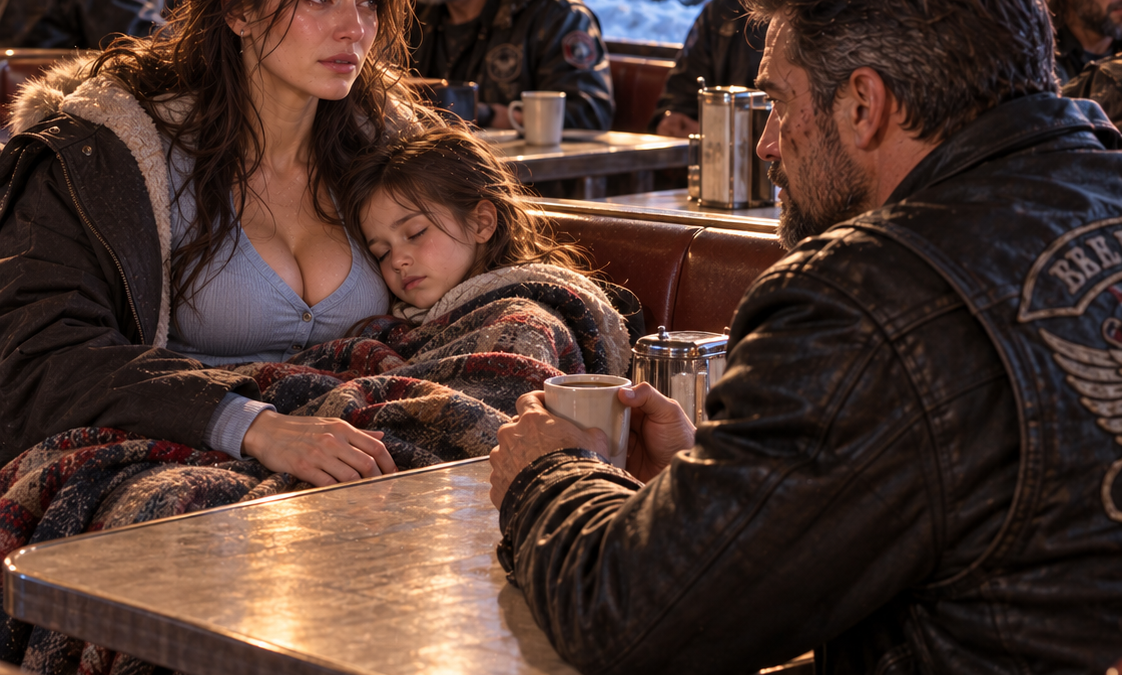
“He’s Coming!” A Little Girl Cried—11 Bikers Raced Into the Blizzard
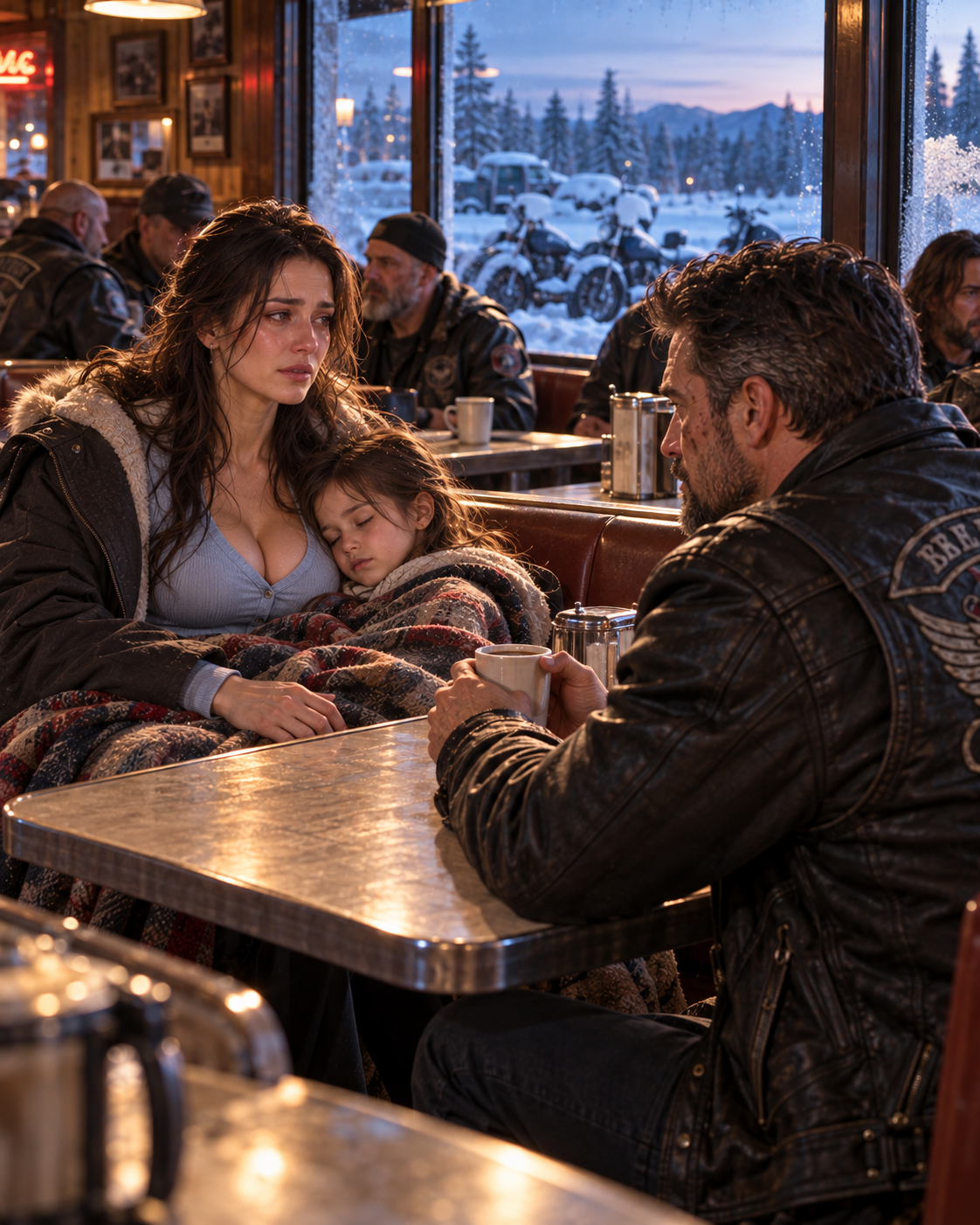
On the coldest night of the year, a 6-year-old girl ran through a blizzard alone. No coat, no shoes, just bare feet on frozen asphalt and a name on her lips she had been told never to say out loud.
She pushed open the door of an old biker diner at the edge of town and every sound died. Forks stopped. Glasses froze midair.
40 pairs of eyes watched a tiny child cross the room past scarred men and cigarette smoke and the smell of engine grease until she grabbed the leather jacket of the most dangerous man in the county and looked up at him with eyes full of a terror no child should ever know. She whispered one name and Rider Vance went pale.
The wind came down from the mountains that December like something personal.
It didn’t drift or gust the way normal winter wind did.
It pressed. It pushed through the gaps in window frames and under door seams and into the collars of anyone unlucky enough to be standing outside after dark.
By 7:00 in the evening, the thermometer outside Harlo’s Diner had dropped below 12° and was still falling and the three truckers who’d pulled off Route 9 to eat were already talking about sleeping in their cabs rather than risk the highway.
Nobody expected the door to open at 8:43. Nobody expected what walked through it.
The diner was the kind of place that hadn’t changed in 30 years.
Cracked vinyl stools, fluorescent lights with a slow flicker on the far end, a laminated menu that still listed a 50-cent coffee as though the decade hadn’t moved on.
The smell was burnt grease and old coffee and something underneath both of those things, something that belonged specifically to rooms where working men sat in silence and didn’t ask each other questions.
The booths along the window were filled with bikers, not the kind people romanticized in magazines, the real kind. The kind with dirt under their fingernails and old injuries that never healed right, and eyes that had learned to check every room for exits before they sat down.
They wore the cut of the Iron Covenant, a patch-heavy vest that the county sheriff’s department had a file on and no actual leverage over.
Seven men, ranging in age from late 20s to past 50, all of them carrying the particular stillness of people who had stopped being surprised by the world a long time ago. Ryder Vance sat at the far end of the last booth, back to the wall, facing the door. That was always how he sat.
It wasn’t paranoia.
It was a habit built from years when not watching the door had cost people he loved. He was 44 years old and looked every single day of it.
The kind of face that had been broken and rebuilt more than once. A crooked nose from a fight in his 20s that a field medic had reset badly.
A scar along his jaw from something he didn’t talk about.
Eyes the color of creek water in November that had been described as cold by people who didn’t know him, and as careful by the few people who did.
He was big without being obvious about it. The kind of big that only showed itself when something required it. His leather jacket had the Iron Covenant patch on the back and a name tag that said Vance above the left chest pocket, and it was so worn into his body that it looked less like clothing and more like skin.
He was halfway through a cup of black coffee when the door opened. The cold hit first, a wall of it, violent and immediate, strong enough to make the candles on the nearest tables bow sideways. Then the sound of the wind filled the room, and then inside the wind there was something else, the sound of small, fast footsteps on the frozen wooden steps outside.
The door swung fully open and she came in like something the storm had been carrying. She was small, too small for the size of the fear on her face.
Six years old maybe with dark hair plastered wet to her forehead and cheeks so red from cold they looked like they’d been scraped raw.
She was wearing a yellow pajama top with a cartoon sun on it and a pair of thin cotton pants and nothing else. No jacket, no shoes. Her feet were bare and dirty and bleeding slightly at the heels from the road.
She stood in the doorway for 1 second with the blizzard howling behind her and then she started moving.
She didn’t hesitate.
She didn’t look around the room the way lost children usually did.
Searching for a friendly face, for someone who looked safe. She moved like she knew exactly where she was going, like she had made a decision before she ever touched that door handle and she was committed to it past the point of second thoughts.
She walked past the truckers, past the counter, past the waitress, Mary, who had already pushed back her stool and was opening her mouth to say something. Past the first two booths of bikers who had gone completely still, eight large men suddenly motionless in the way that only happened when something unexpected entered a space they controlled.
She stopped at Ryder’s booth.
She looked up at him with brown eyes that were doing two things at once, crying and refusing to fall apart completely. Her chin was shaking. Her hands were balled at her sides.
She was soaked through and hypothermic and probably half a mile of frozen road from wherever she’d started and she was holding herself together with the particular determination that only showed up in people who had already decided that falling apart wasn’t an option.
She reached out and grabbed the lapel of his jacket and then she leaned up toward him and said a name. Quiet. So quiet that only Ryder could hear it.
Every single man at the table went still because they didn’t hear the word.
But they saw what it did to Ryder’s face.
He set down his coffee mug slowly, the way a person moved when they needed something to do with their hands to stop them from doing anything else. His jaw tightened. Something moved behind his eyes.
Not quite anger, not quite grief, something that lived in the territory between the two and had never found its own name.
“Say that again,” he said.
His voice came out lower than he intended. The girl said it again.
“Carter Vale.”
The name sat in the air of the diner like smoke from a fire that hadn’t been put out right, the kind that looked like it was done but was still burning underground, still eating toward the surface.
Ryder looked at her for a long moment. Then he looked at the man across from him, Dex Holloway, his second, a former army combat medic with a damaged knee and a talent for reading situations that had saved the crew more than once.
Dex was already watching the girl with his medical eyes, cataloging her, doing the fast triage that never fully switched off.
“She’s cold,” Dex said.
Not urgently, just as fact.
“I can see that.”
Ryder slid out of the booth.
He pulled off his jacket without ceremony, not dramatically, not slowly, just a practical action of someone who had already made a decision and wrapped it around the girl’s shoulders.
It was comically too large for her. It swallowed her.
She grabbed the front of it with both hands and held it closed, and something in that gesture, that small fierce grip, made something in Ryder’s chest tighten in a way he hadn’t felt in a long time.
“Mary,” he said toward the counter without raising his voice.
The waitress, who had been standing frozen for the last 30 seconds, snapped back.
“Yeah?”
“Hot chocolate, real kind, and a blanket if you’ve got one in the back.”
“I’ve got one.”
“Good.”
He looked down at the girl.
“You walk here?”
She nodded. How far? She held up three fingers, then seemed uncertain, then held up four.
Ryder looked at Dex. Dex was already pulling out his phone.
“I’m going to ask you some questions,” Ryder said to the girl, and his voice had changed slightly.
Not softer, exactly, but slower, the way a person adjusted their pace when they realized the road ahead required it.
“And you’re going to tell me everything, but first you’re going to sit down and get warm, okay?”
She looked at him.
She was still shaking, but underneath the shaking there was something else, something Ryder recognized from men he’d pulled out of bad situations over the years.
The specific look of someone who had gambled everything on one last move and was waiting to find out if they’d bet right.
She nodded. He moved.
She sat in the booth across from where he’d been sitting.
He sat back down. Mary appeared with a mug and a wool blanket that smelled like the cedar chest it had been stored in, and the girl accepted both with a seriousness that made her look like a small, exhausted adult.
She wrapped the blanket around herself over Ryder’s jacket and curled her hands around the mug, and finally, for the first time since she’d walked through the door, seemed to breathe.
The other bikers had shifted in their seats. Nobody spoke.
But the whole room had rearranged itself around this moment without anyone explicitly deciding to do that, the way rooms sometimes did when something happened that was bigger than the normal current of the day.
“What’s your name?”
Ryder asked.
“Lila,” she said.
“Lila Monroe.”
“Where’s your mom, Lila?”
Something crossed the girl’s face, something old and complicated for a 6-year-old.
“Home,” she said.
“She doesn’t know I left.”
“Why did you leave?”
Lila looked down at the mug. Her small fingers tightened around it.
“Because he came back,” she said, “and I knew where to go.
” Ryder said nothing for a moment.
“How did you know where to come?”
Mrs.Hargrove, she said, on our street. She told me once.
She said if something bad ever happened and there was no one else to find the Iron Covenant. She said you helped her.
When Mr.Hargrove used to She stopped. Seemed to decide something. She said you helped her.
Ryder remembered Helen Hargrove, remembered the particular night she was referring to two winters ago when a situation had required the kind of intervention that didn’t appear in police reports.
You didn’t say anything about that.
Who is Carter Vail to you? He asked instead.
Lila looked up at him then and for the first time the controlled expression she’d been wearing cracked slightly at the edges.
He watches me, she said quietly. He started coming around our street, standing outside, looking at our house.
And my mom, she got scared, but she said it was probably nothing, but it wasn’t nothing because I’ve seen him before.
In pictures. My mom hid the pictures, but I found them once and I asked her who that man was and she said nobody and then she cried for a long time when she thought I was asleep. Ryder kept his face neutral.
But under the table he had pressed his thumb into the scar on his palm. An old habit, a way of grounding himself when something inside him started moving too fast.
She didn’t call the police?
He asked. Lila shook her head. She did once before.
They came and said there was nothing they could do because he hadn’t done anything yet.
Something in the way she said yet made it clear she was repeating a word someone else had used. And the man at the police station knew his name.
And he didn’t look scared.
He looked like he was being careful. The table got very quiet. Dex looked at Ryder.
Ryder looked at the table. There were things a six-year-old could notice that adults talked themselves out of noticing.
The way a cop’s face changed when a name came up.
The way a phone call ended too quickly. The way people chose their words around certain subjects.
Children paid attention to these things before they learned that paying attention to them was supposed to be someone else’s job.
Lila, said another voice from down the booth.
Mac, the oldest of the crew, 53, gray-bearded with a purple heart tattoo on his left forearm and a granddaughter about Lila’s age.
His voice was careful, gentle in the particular way of men who had learned gentleness the hard way by discovering too late what the lack of it cost. Did Carter Vail ever come close to you?
Did he ever try to talk to you? Lila thought about it. He left something, she said.
On our porch. Two nights ago. My mom found it in the morning and she threw it away, but I saw it first.
She paused. It was a drawing.
Of our house.
But from outside, from far away, like he’d been watching from across the street.
Mac sat back in his seat. Ryder picked up his coffee mug, found it empty, set it back down.
Carter Vail. The name had been dormant for how long?
Eight years? Nine? Long enough that it had started to feel like a closed chapter in a book Ryder had managed to mostly stop reading.
Carter Vail had been connected to a network of predatory activity that spanned four counties and had never fully been brought to account because the people who should have brought it to account had reasons not to. Some of those reasons were financial. Some were the kind that lived in locked filing cabinets.
Some were the kind that explained why a cop’s face went careful when a name came up.
Ryder had been 17 the last time Carter Vail’s actions had directly touched his life.
He had not been the same after. None of that was something he was going to explain to a six-year-old in a diner.
I need to make a call, he said to Dex. Dex nodded.
I’ll stay with her.
Ryder pushed out of the booth. He pulled on the spare jacket that Dex passed from the hooks by the wall.
An old worn thing, not as broken in as his own, but functional. And walked to the back hallway past the restrooms and the fire exit to the cold corridor where the owner stored extra cooking oil and nobody could hear the conversation he needed to have.
He leaned against the wall and pulled out his phone and called a number he hadn’t dialed in 4 months.
It rang twice. Then, Vance. The voice on the other end belonged to a woman named Petra Cross.
Former county social services investigator, currently running an unofficial network that existed in the space between what institutions could do and what needed to be done anyway. She and Ryder had a complicated history with a workable present.
She didn’t trust him completely.
He didn’t trust anyone completely.
It was a functional arrangement.
“I have a situation,” Ryder said.
“I assumed,” she said, “you don’t call for small talk.”
Carter Vail. Silence.
Not the silence of someone who didn’t know the name.
The silence of someone who did.
“Where did that name come from?”
Petra’s voice had shifted.
The professional tone was still there, but something underneath it had changed, tightened, the way wire did when tension was applied.
“A 6-year-old girl walked into my diner in a blizzard with no shoes on,” Ryder said.
“Barefoot, bleeding.
She says Vail’s been watching her house, left a surveillance drawing on her porch.
Her mother called the police a while back and got nothing.
The cop she spoke to apparently recognized the name and chose his face carefully.”
Another silence. Longer.
“Ryder.”
Petra’s voice was lower now.
“I need to tell you something, something I’ve been sitting on because I wasn’t certain.
There’ve been There’ve been three families in the county that I know of who’ve reported similar things in the last 8 weeks.
Similar patterns. External surveillance, known routines disrupted.
One family moved, two stayed but stopped reporting after the first time. She stopped.
I’ve been trying to confirm whether they were connected.
I didn’t have a name.
Now you do, Ryder thought.
He didn’t say it.
The girl is here with me, he said.
She’s safe right now.
But her mother doesn’t know she left.
I need you to run a quiet check on the Monroe family on Alderman Street.
I need to know what Vail’s current status is, whether he’s got any paper, any warrants, anything that gives us something to move with.
And I need to know how many other families we’re actually talking about.
I’ll make calls, Petra said.
Give me Give me 2 hours. Make it one.
She said nothing for a moment, then Ryder, if Vail is back and he’s operational, this isn’t just one family.
I know.
And if there’s corruption in the department protecting him, Petra.
What? I know.
He let that sit. 1 hour.
He hung up and stood in the cold hallway for a moment, looking at the wall in front of him. There was a faded poster for a fishing tournament from 6 years ago, and a phone number written in marker on the paint, the area code partially scratched out. None of it meant anything.
He looked at it anyway, the way a person looked at something neutral when they needed their mind to run through something without interference. Carter Vail.
The last time that man’s existence had touched Ryder Vance’s life, Ryder had been 17 and carrying a grief so large it had no shape.
He had survived it by building walls, not the metaphorical kind, but structural, internal, load-bearing ones that kept everything he couldn’t afford to feel in a compartment where it couldn’t affect his functioning.
27 years of construction, 27 years of maintenance, and a 6-year-old with bare feet and a death grip on his lapel had walked through the door and those walls had registered a tremor. He pressed his thumb into the palm scar again.
Then he walked back to the diner. Lila had finished most of the hot chocolate.
She was sitting very straight, both hands still on the mug, watching the door with eyes that checked it every few seconds in a pattern so regular it looked like a countdown. Dex had moved to the seat beside her.
Not close, giving her space, but present in the way of someone trained to make presence feel like shelter rather than pressure. Mac was across from them, talking quietly about nothing in particular. The cold, the weather system moving through.
An ordinary low-stakes stream of words designed to give a frightened child something to anchor to. Ryder sat back down.
“Your mom’s name?”
he asked Lila.
“Claire.”
She said.
“Claire Monroe.”
“Does she have a car?”
“Yes, but she works nights.
She’ll be home at” Lila frowned.
“I don’t know.
I don’t know what time it is.”
Ryder checked his watch.
“Almost 9:00.”
“Then she’ll be home at 10:00.”
Lila looked up at him again with those eyes that were still doing the two-thing trick, contained and terrified at once.
“She’s going to be really scared when she sees I’m gone.”
“We’re going to call her.”
Ryder said.
“Can you tell me her number?”
Lila recited it from memory without hesitation, the way children who’d been drilled on emergency numbers did, fast and flat and automatic.
The number detached from the act of reciting it. Ryder wrote it down. He looked at Dex.
Dex said, “I’ll step out.”
He took the number and moved toward the door. Ryder watched him go, then looked back at Lila.
She was watching him.
There was a question in her expression that she hadn’t asked yet, the way children held questions sometimes when they weren’t sure the answer would be something they could handle.
“Are you going to help?”
she finally said. Ryder held her gaze.
He didn’t answer immediately because he had learned a long time ago not to make promises before he understood what they required.
But But also understood what it cost a child to walk barefoot through a blizzard and grab a stranger’s jacket and say the name of the person they were most afraid of.
He understood what that kind of courage cost.
“I’m going to find out what’s happening,” he said, “and then I’m going to handle it.”
It wasn’t the answer she’d asked for.
She heard the difference. She looked at him for another moment, measuring something, then she nodded, like that was enough. Outside, through the frost-clouded windows of the diner, the blizzard was building into something serious.
The parking lot was white. The road beyond it was nearly invisible. And somewhere in that white static, in the town beyond the tree line, in the neighborhood on Alderman Street, something was waiting.
Ryder wrapped both hands around his empty mug and stared at the table.
Carter Vale was back, and the worst thing about that wasn’t the danger.
The worst thing was the way the name had landed inside him. Not like a threat, not like a problem to solve.
Like a door being opened. A door he had spent 27 years welding shut. He looked up through the window, into the white.
He didn’t notice Mack watching him from across the table until the older man spoke, so quiet it barely carried over the ambient noise.
“You know something about this man,” Mack said.
Not a question. Ryder looked at him. Something passed between them.
The specific communication of men who had shared enough ground to read what was underneath words.
“Yeah,” Ryder said.
“Old.”
“Old.”
Mack was quiet for a moment.
“How bad?”
Ryder looked back at the window.
“Bad enough,” he said, “that I need to be careful about what I do with it.”
The door opened. Dex came back in, bringing a wall of cold with him.
He caught Ryder’s eye from across the room, and his expression, steady, measured Dex, who had treated arterial bleeds in a field without blinking, did something Ryder almost never saw it do.
It went tight. Ryder was already standing up before Dex reached the table.
“I reached Claire Monroe.”
Dex said quietly.
“She’s not at work.”
“She never made it to work.”
He stopped. Looked at Layla, then back at Ryder.
And in that fraction of a second, Ryder understood that the next words were going to be careful ones, chosen specifically to say enough without saying too much in front of a child.
“Her car’s in the driveway.”
Dex said.
“A neighbor saw the lights go out in the house around 8:00.
Nobody’s answering the phone.”
He held Ryder’s gaze.
“Neighbor heard something around 7:30 that they thought was a door slamming repeatedly.”
He paused, hard. The diner was very quiet. Layla had gone completely still.
Her hands were frozen on her mug. Her eyes were on Dex.
She was 6 years old and she understood every word that hadn’t been said.
Ryder looked at her. She looked back at him. And now the two things in her eyes had collapsed into one thing.
Something raw and terrified and asking a question she couldn’t form into words.
Ryder made a decision.
“Mac.”
He said.
“Stay with her.”
He pulled his phone out and was already dialing Petra as he moved toward the door, Dex a half step behind him. And the cold outside was the same wall of violence it had been all night. And the motorcycles in the parking lot sat under a skin of snow.
And somewhere across town on Alderman Street, the lights in a house were out and a phone wasn’t being answered.
And Carter Vale had a 20-minute head start.
The motorcycles didn’t start the way they did in movies.
There was no single dramatic roar, no choreographed thunder. There was just Ryder pulling his spare key from his jacket pocket with hands that were steadier than they had any right to be. And Dex moving toward his own bike without needing to be told.
And the sound of two Harleys coughing to life in a parking lot buried under 3 inches of fresh snow. A rough, industrial sound, mechanical and cold.
the sound of machines being asked to work in conditions they were not built for. Ryder pulled out of the lot first. The road was nearly invisible.
The plows hadn’t come through yet, and the white was unbroken in every direction.
The yellow center line, somewhere underneath it, doing nothing for navigation. He drove by memory.
Seven years of knowing this county’s roads in every condition, every season.
The particular way this stretch of Route 9 curved left at the old grain elevator before it straightened out toward the residential streets. He kept his speed down.
Not from caution about the road, from caution about arriving at something he wasn’t fully prepared for.
Dex rode behind him, close enough to track, but far enough to give room. Neither of them spoke through their earpieces for the first 4 minutes.
There was nothing to say that the situation hadn’t already said.
Alderman Street was a quiet road by any standard, the kind of working-class residential block that existed in the gap between neglect and effort, where some houses had fresh paint, and some hadn’t seen a ladder in a decade, where the streetlights worked on alternate poles, and the sidewalks buckled from tree roots nobody had the budget to fix.
The Monroe house was the fourth from the corner. Ryder knew it by the silver mailbox with the reflective stripe, visible even under the snow.
He cut the engine half a block away and coasted to a stop. Dex did the same.
They sat in the cold for 10 seconds, just looking. The house was dark.
Not the dark of people asleep. Every house on the block had at least one window lit, the ambient glow of a kitchen light or a television, the natural light residue of people living their evening. The Monroe house had nothing.
It was the particular darkness of a place that had been made dark deliberately, which was a different quality entirely, and both men registered it without discussing it. Ryder got off the bike. The snow compacted under his boots with a sound like broken glass.
He motioned to Dex with two fingers. Flank, go wide. And Dex moved without sound toward the side of the house while Ryder went straight up the front walk.
The porch steps creaked under his weight. He stopped.
Listened. Nothing. The storm provided its own continuous white noise, a pressure against all the senses.
And under it the house was a sealed silence that told him nothing and everything at once. The front door was not latched.
It wasn’t open, not visibly, but when Ryder touched the handle with the back of his knuckles, it moved.
A millimeter. The latch had not caught.
Either someone had left in a hurry and hadn’t pulled it fully shut behind them, or someone had come in and hadn’t cared about closing it because they planned to leave quickly.
He pushed it open. The smell hit him before anything visual did.
The specific smell of a struggle, which was not blood necessarily, but the particular combination of overturned domestic order. Something broken, something chemical from a knocked-over cleaning product, the ozone and sweat residue of bodies under adrenaline.
It was a smell Ryder had encountered enough times in enough bad situations to know it before he could name it. He found Claire Monroe in the kitchen. She was on the floor, her back against the cabinet under the sink, knees pulled up, arms wrapped around them.
She was alive. She was looking at him. Had heard him come in and was watching the doorway with eyes that had gone past fear into the particular flatness that followed it.
The place the mind went when it had processed more than it could hold. She was in her work clothes. Scrubs.
The kind nurses or home health aids wore, pale blue with a name tag still clipped to the pocket. There was a cut on her forehead, not deep, but the kind that bled extravagantly because foreheads always did, and dried blood had tracked down the side of her face in a path that followed her jawline.
Her left hand was cradling her right wrist in her lap. Ryder crossed the kitchen in four steps and crouched in front of her.
“Claire Monroe,” he said.
Not a question. Just establishment.
“I know who you are.
I’m not random.
I’m not a threat.”
She looked at him, his jacket, his patches. Something worked through her expression.
Not recognition exactly, but the same calculation he’d seen in Layla’s face.
The gamble of someone with no remaining good options deciding whether a bad option was still an option.
“Where’s Layla?”
she said. Her voice was flat, contained. The voice of someone who had decided that holding together was more important than anything else right now.
“Safe,” Ryder said.
“She’s with my people at Harlow’s.
She’s warm and she’s okay.”
He held her gaze.
“She came to us.
She knew where to come.”
Something went through Claire’s face then.
Not relief, because relief required relaxation, and she wasn’t capable of that yet.
But something that was the precursor to relief, the sensation of one specific terror being removed from a stack of terrors that still remained. Her eyes closed for 1 second and then opened again.
“I couldn’t stop him,” she said.
Her voice was the same, flat, contained. But the words were doing something different from the tone, something raw underneath.
“He came in through the back.
I didn’t even I didn’t hear him until he was already inside.”
“How long ago?”
“I don’t know.
I lost time.
My phone.”
She looked around the kitchen.
“He took my phone.”
“It’s okay.”
“Does he know about Layla?”
“Does he know where she was?”
“She was at the neighbors.
” Claire stopped, swallowed.
“I called her from work earlier and told her to go to Mrs.Hargrove’s next door if I wasn’t home by 8:00.
He didn’t He asked about her, about where she was.”
The flatness in her voice developed a fracture.
I told him I didn’t know.
Did he believe you? A beat.
I don’t know, she said again.
Dex came in through the back door then, the one that had presumably been Carter’s point of entry, which Dex had found unlocked and checked.
He came into the kitchen, took one look at Claire Monroe, and shifted immediately into the medical register, crouching beside Ryder, hands already moving toward his jacket’s inner pocket, where he kept the basic kit.
Wrist, he said to Claire. Not invasive, just identifying. I fell, she said, when he She stopped.
Can you move the fingers? She moved them, slowly.
Fully. Yeah.
Probably a sprain, maybe a hairline.
We’ll stabilize it.
He was already doing it as he spoke, pulling a compression wrap from his kit with the practiced economy of someone for whom this was genuinely ordinary.
The cut on your forehead isn’t deep.
Looks worse than it is. They usually do, she said, and there was something almost dry in it.
Not a joke, exactly, but the reflexive response of someone who had been told that before. Ryder stood up and looked at the kitchen.
The overturned chair, the cleaning product, a spray bottle of something knocked off the counter, the chemical smell stronger near the stove, a broken glass near the sink, a phone charger still plugged into the outlet near the refrigerator, the phone itself gone. He looked at the back door. Dex had left it open a crack, and the cold was moving through it, and in the snow on the back steps, there were footprints.
Two sets going out, one set coming in.
The outgoing ones close together in a pattern that told a story Ryder didn’t need to read in full to understand.
He took a breath. Let it out slowly.
Carter Vale had been in this house, had stood in this kitchen, had taken a woman’s phone and hurt her wrist, and asked where her daughter was.
And then he had left. The question was why he had left.
Whether he’d found what he came for, whether leaving meant he was done, or whether it meant he had somewhere else to be.
Ryder pulled out his phone and called Mac. The phone rang once.
Mac’s voice came through with the diner background noise behind it.
The low murmur of the room, the particular acoustic of the place.
“She’s good.”
Mac said before Ryder could speak.
“Drinking her second hot chocolate, she asked me about my tattoos.”
“Keep the doors locked.
Back door, too.”
Ryder looked at the open back door of the Monroe house.
“Don’t let anyone in who isn’t crew.
Anyone asks questions about the child, say nothing.”
“Understood.”
A pause.
“How bad?”
“Not good.”
Ryder said.
“But contained for now.”
He thought for a second.
“Mac.”
“The name we discussed.”
“Have you heard anything in the last year?
Any movement, activity?”
Mac was quiet for a moment that lasted just a half second too long.
“There were whispers about eight months ago.”
he said carefully.
“From the Ridgecrest chapter.”
“I didn’t follow up because I thought it was noise.”
“It wasn’t noise.”
“No.”
Mac said.
“I’m starting to understand that.”
“I’ll call you.”
Ryder ended the call.
He looked at Dex, who had finished with Claire’s wrist and was helping her into the overturned chair, setting it back on its legs, guiding her into it with the specific careful efficiency of someone who had moved injured people under worse conditions.
“She should go to the diner.”
Ryder said. Dex looked at him.
“You’re staying.”
“I need 5 minutes in this house first.”
Claire looked up.
“What are you looking for?”
Ryder met her eyes.
“Anything he left behind, anything he was looking at, anything that tells me what he was really here for.”
She held his gaze for a moment. Something in her expression was trying to make a decision about him.
The same calculation as before, now with more data, running through it again.
“There’s a box,” she said finally, “in the closet in my bedroom, top shelf, behind the winter coats.”
“He went in there.”
“I heard him.”
“He came back out and I couldn’t tell if he’d taken anything or not because he because I wasn’t” She stopped.
Her jaw tightened.
“Because I was occupied.”
“Okay,” Rider said.
He kept his voice flat. Not cold, flat. The distinction mattered.
Cold meant he didn’t register what she was telling him.
Flat meant he was registering it and choosing to process it later, which was what the situation required. He walked down the hallway.
The bedroom was at the back. Small, clean, the specific tidiness of a person who controlled what they could because other things were outside their control. A quilt on the bed.
A small photograph on the nightstand. Lila, maybe 3 years old, laughing at something outside the frame.
The closet was open. The winter coats had been shoved to one side. On the top shelf, pushed to the back, there was a box.
Cardboard. The kind liquor stores gave away for moving. The lid was off and sitting at an angle.
Someone had been through it. Rider stood on his toes and brought it down.
Inside, documents, paper records, the kind people kept when they understood that digital could be deleted and paper, for all its vulnerability, left a physical trail.
He didn’t read everything, not here, not now.
But he scanned. His eyes caught specific things.
A restraining order from 11 years ago, expired. A copy of a police report, the incident number partially redacted.
A photograph. He picked up the photograph. It was Carter Vale.
Younger. Early 40s, probably, which put it at a decade or more ago. He was standing in front of a building.
An ordinary building. But in the corner of the photograph, barely visible, there was a child.
Small. Turned away from the camera.
Ryder could not see the child’s face.
He did not know if the child in the photograph was Layla. He turned the photograph over.
On the back, in handwriting he didn’t recognize, he knows we kept the evidence.
Ryder stood in the bedroom for a moment. Cold from the window frame, the sound of the storm, the photograph in his hand. He put the photograph in his inside jacket pocket.
He put the box back on the shelf, lid replaced, pushed to the approximate position it had been in.
He didn’t know if Carter had taken anything from it.
He didn’t know yet what that would mean if he had.
He knew only that the photograph on the back of that image implied something specific, that Claire Monroe had been holding on to documentation of Carter Vale’s activities for years, that Carter Vale knew it, and that tonight’s visit had not been random or impulsive.
It had been an audit. He came back to the kitchen. Dexter looked at him.
Ryder gave him one small shake of the head. Not here.
Later.
We’re going to move you, Ryder told Claire Monroe.
Tonight. You and Layla both.
There’s a place that’s safe and private, and he won’t know about it.
Claire looked at him with those same calculating eyes.
I don’t know you, she said.
I know what Mrs.Hargrove said about you, but I don’t know you.
That’s correct, Ryder said.
Why are you doing this? The question sat in the kitchen for a moment.
It was a fair question. It was the only question that mattered, in a way.
And Ryder knew that whatever answer he gave needed to be true, because this woman had already had enough people lie to her face to make the calculation second nature. Because your daughter came and asked, he said.
And because the man who’s doing this has been doing it for a long time, and the people who should have stopped him chose not to.
He looked at her. And because I have reasons of of own that are my business.
But they don’t change the answer.
Another pause. Longer.
“Okay.”
Claire Monroe said. They got her out of the house 10 minutes later. Dex took her on his bike, slow and careful, the compression wrap stabilizing her wrist enough for the ride.
Ryder followed, checking the mirrors the whole way back.
He didn’t see anyone behind them.
He wasn’t reassured by that.
The diner was fuller by the time they returned. Not because more customers had come in, the storm had seen to that, but because Ryder had made two calls on the road back, and the Iron Covenant had gathered itself in the way it did when something required it.
Quietly, without announcement, like water finding its level.
Four more bikes were in the lot when he pulled in, the snow on their tanks suggesting they’d ridden hard from different directions.
Inside the crew had spread out to fill the space. The truckers had migrated to the counter, sitting close and speaking low. The particular recalibration of civilians who had stumbled into something outside their experience and were unsure of their role.
Mary the waitress was moving steadily, refilling cups, her face arranged in the professional calm of someone who had worked this diner through enough unusual nights to have developed a protocol for them. Lila was in the same booth.
When Claire came through the door, something happened in the room that was not loud and not dramatic. Claire made a sound, one syllable, and crossed the room.
And the girl launched herself from the booth with the velocity of a six-year-old who had been holding herself together for 2 hours on the specific fuel of believing her mother was alive. And the holding together ended in the way it needed to end, completely. Ryder watched from the doorway for 3 seconds.
Then he looked away. He moved to the back of the room where the crew was assembled.
Seven men, now 11. Faces he knew the way he knew the roads. Intimately, from long acquaintance, every scar and variation memorized.
He looked at them and they looked at him, and the room between them was dense with things that hadn’t been said yet.
“All right,” he said, low, directed.
“Here’s what we know.”
He told them methodically, without editorializing, the way he’d learned to brief from years of situations that went wrong when people operated on partial information.
“Carter Vale, the pattern, three families minimum, probably more, the Monroe house, the box, the photograph and what was written on its back, the police station visit Claire had described and the officer’s careful face when the name came up.
When he finished, the silence was the kind that had weight. Cole Briggs spoke first.
He was 31, the youngest of the inner crew, former wildland firefighter, with a scar on his neck from a burn that had healed badly, and a temper that he’d spent three years learning to manage with moderate success.
“So, we’ve got a guy who’s been invisible for eight or nine years, and now he’s back, and he’s running some kind of organized” He stopped.
His jaw moved.
“What exactly are we calling it?”
“Predatory network,” Deck said, without inflection.
“Right.”
Cole’s hand was flat on the table, “And the people who should be dealing with it are either bought or scared, and a six-year-old walked barefoot through a blizzard to find us because she had literally no one else.
” Nobody argued with the summary.
“So, what’s the play?”
said Garrett Finn. He was 41, ex-Navy, the quietest member of the crew in terms of volume, and among the most dangerous in terms of capability.
He had a stillness about him that was different from the stillness of indifference. It was the stillness of someone who had learned that movement cost energy, and energy should be conserved until the moment it was required. Ryder looked at him.
“First, we get safe houses established for both of them.
Second, Petra Cross is running an investigation of her own into the broader pattern. I want someone coordinating with her directly. Third, we need a location for Veil.
He’s active and he was in that house tonight, which means he’s not operating from a distance anymore.
He’s close.
“Close meaning the county,” Garrett said.
“Close meaning he was in that kitchen 2 hours ago with no more than a mile of road between him and here,” Ryder said.
“So, yes, close.”
Garrett nodded once. The kind of nod that meant the information had been filed and would be acted on.
Mack was sitting slightly apart from the others, which was not unusual. Mack often positioned himself at a slight remove in group settings.
Observational, the way men did who had spent years in roles that required watching more than participating. He had been quiet since Ryder started talking. He was quiet still.
But Ryder caught his eye and the older man’s expression said something that his voice hadn’t offered yet.
“Mack,” Ryder said, “you’ve got something.”
Mack looked at his hands on the table.
“The whispers from Ridgecrest,” he said, “8 months ago.
I told you I didn’t follow up.”
He stopped. His thumb moved against the edge of the table.
“That’s not quite right.
I started to. I made one call.
The person I called told me the name I was asking about was old news. That it had been handled.
” “Who told you that?”
Ryder asked.
“Someone I trusted.”
Mack’s voice was steady, but there was something underneath it.
Not shame exactly, but it’s first cousin.
“Someone in the county network, a contact we’ve used for information for years.
Someone who has never, in my experience, been wrong.”
The room heard what that meant. Ryder heard what that meant.
“So, either they were deceived,” Ryder said slowly, “or they lied to you.”
Mack looked at him.
“Yes.”
“Which do you think?”
A pause that lasted exactly long enough to be uncomfortable.
“I don’t know,” Mack said, “and I’ve been sitting here for the last hour trying to figure out which one I can afford to believe.
” The crew processed this in the particular silence of people who understood what it meant when someone inside your information network fed you false data.
Whether by deception or design, the result was the same.
They had been blind to Carter Vales’ return for 8 months, during which time, based on what Petra had described, at least three families had been targeted.
During which time the groundwork for whatever Vale was building had been constructed without interference. 8 months.
Cole’s hand was still flat on the table.
It pressed harder. Ryder looked around the room, at each face, at the specific geography of damage each man carried.
Cole’s burn scar, Garrett’s too composed stillness, Dex’s knee that he never mentioned but which cost him three times the effort to climb stairs.
Max’s purple heart that he never spoke about but which represented a story that had cost him a marriage and four years of insomnia.
Men who had themselves into something functional from materials that should not have produced functional. Men who had gathered around a table in a diner because a child had run through a blizzard.
“I need everyone clear headed.”
Ryder said, “That means I need everyone who has a personal stake in this to tell me now.
Not later. Now. Because if this goes sideways because someone acted on emotion instead of judgement, we lose.
And losing means that little girl doesn’t go home.”
Nobody spoke for a moment.
Then Cole said, “I had a sister.”
His voice was flat. The tone of someone who had decided to say a thing rather than the tone of someone who wanted to say it.
“She was nine.
The situation was it was handled late.
Too late.”
He stopped.
“I’m good.
I know the difference between the past and the present.
I’m telling you so you know where I’m standing and you can make your own call about how to use me.”
Another silence.
Burt said, without looking up from the table, “My daughter is seven.”
Just that. Nothing else. Deck said nothing.
But he touched the medical kit in his jacket pocket, a small unconscious gesture, the way a soldier checked their equipment before movement. Inventory.
Readiness assessment. Ryder let the silence hold for three full seconds.
“Okay.”
he said. He picked up his phone.
Petra had called twice while he was in the Monroe house and he hadn’t answered.
He called her back now, stepping slightly away from the table, but staying in the room. Close enough that the crew could hear the shape of the conversation, if not every word. Petra answered on the first ring.
“I’ve been running for the last hour.”
she said without preamble.
“I need to tell you several things in a specific order.
Go.
The three families I mentioned, I’ve now confirmed five.
Five separate families over eight weeks, all in the county, all with minor children between the ages of five and 10, all experiencing the same pattern of external surveillance and behavioral disruption. Two of the families have connections to each other through the county school system. One family, the Kellermans on Birchwood Drive, filed a police report six weeks ago.
The responding officer was a man named Deputy Tate Jarvis.”
She stopped for exactly 1 second.
“Jarvis has been with the department for 11 years.
He is, by every formal metric, an unremarkable officer.
His sergeant’s commendations are routine.
His case closure rate is average. But in the last 14 months, every complaint or report connected to surveillance or behavioral targeting of minor children that came through the East County stations was routed through Jarvis and subsequently closed without investigation.
” Ryder kept his voice even.
“Every complaint.
Every single one.
I had to go through informal channels to get this because the formal records are there’s been editing, professional editing.
Someone who knows how to make a case file look complete when it isn’t.
She paused. Paused.
Ryder, this isn’t a rogue actor with a complicit cop.
The pattern is too consistent for that. Someone has been actively managing the information environment in this county for at least a year, maybe longer.
The kitchen of the Monroe house came back to him. The photograph.
The handwriting on the back. He knows we kept the evidence. Carter Vail kept this county specifically, Ryder said.
Not a question working through it allowed. It looks that way.
I don’t know why yet.
But I have a theory. Another pause.
Longer this time.
The kind she took when she was about to say something she wasn’t certain of and was accounting for that uncertainty.
Vail had a legal situation 12 years ago.
It didn’t go to trial because a key witness recanted.
The recantation was I’ve seen the original deposition and I’ve seen the recantation and they’re written differently in ways that matter.
The language patterns are different. Someone coached that recantation or wrote it outright. She stopped.
Stopped. The original witness was a woman named Claire Monroe.
The room went completely still. Ryder turned around.
Claire was at the far end of the diner sitting in the booth with Layla now, one arm around her daughter, her face turned slightly away. Not hearing this. Not in range.
She was the witness, Ryder said. She was the primary witness.
And she recanted under The file notes say duress, but it’s annotated in a way that suggests the annotation was added later by someone trying to protect the record.
Petra’s voice was careful.
Each word placed deliberately. If she actually has documentation, original evidence from that case that predates the recantation, then the case can be reopened, Ryder said.
Then more than that. Then whoever managed the recantation is also exposed.
And if that person is inside the county system She didn’t finish the sentence.
She didn’t need to.
Ryder looked at the crew. They were all watching him. They had heard enough of his side of the conversation to understand the shape of what Petra was saying even without her words.
He could see it moving through them.
Not panic, not outrage, but the particular calibration of people integrating new information that was worse than they’d expected and adjusting accordingly.
Cole’s hand had moved from flat on the table to fisted beside his coffee cup.
Garrett had become very still. Dex was looking at Claire Monroe. Mac was looking at his own hands again, and Ryder could see what was working through him.
The name he’d called 8 months ago, the person who had told him it was handled, and the new calculation of who that person might be and what they’re telling him had actually been designed to accomplish.
“Petra,” Ryder said.
“The box in the Monroe house.
She’s been keeping documentation, physical copies.
Vale was in her house tonight. He went through the closet.
Did he take anything?”
“I don’t know.
I couldn’t determine what was missing because I don’t know what was there.”
“Ryder.
” Petra’s voice changed again, the professional flatness shifting into something more direct, something that said she was stepping slightly outside her usual register.
“If he took what I think he was there for the original evidence, the deposition, the documentation Claire Monroe kept then he has removed the only thing that could be used to prove what he’s been doing and who’s been helping him.
And if he didn’t take it then he knows she still has it and he’ll come back for it.”
She paused.
“Or he’ll make sure she can’t use it.”
Ryder closed his eyes for 1 second, opened them.
“I need the safe house tonight,” he said.
“I have one.
I can have it ready in 40 minutes.”
“Make it 30.”
He hung up. He turned to face the crew.
Outside the diner, the blizzard was at its full force now. The parking lot invisible beyond the first row of bikes, the road a theoretical concept under 3 in of white. The Harleys sat in the lot like dark monuments, patient and cold, snow collecting on every horizontal surface.
The room was quiet.
The only sounds were the diner’s ambient hum, the distant sound of the storm, and somewhere across the room, barely audible, Lila Monroe telling Max something about a drawing she had made at school.
Ryder looked at the crew at Cole’s fist at Garrett’s stillness at Dex’s hand near his kit at Max’s face, which had resolved from its internal conflict into something harder and more specific, the face of a man who had decided something.
“Here’s where we are,” Ryder said.
He kept his voice low enough that it didn’t carry to the other side of the room.
“The man we’re looking for has been operating under protection in this county for a minimum of a year.
The protection comes from inside the department, at least one officer, possibly more.
The only existing physical evidence of what he’s been doing may or may not still be in Claire Monroe’s possession.
He was in her house tonight, which means he’s not careful about exposure anymore.
That tells me one of two things.”
He paused.
“Either he’s getting ready to leave or he’s getting ready to finish.”
Cole made a sound. Not a word.
Just a sound.
“Which do you think?”
Garrett said.
The same way he’d asked it before, low, precise.

