Everyone Avoided the Former Navy SEAL at the End of the Road—Until a Woman Knocked on His Door – Part 4
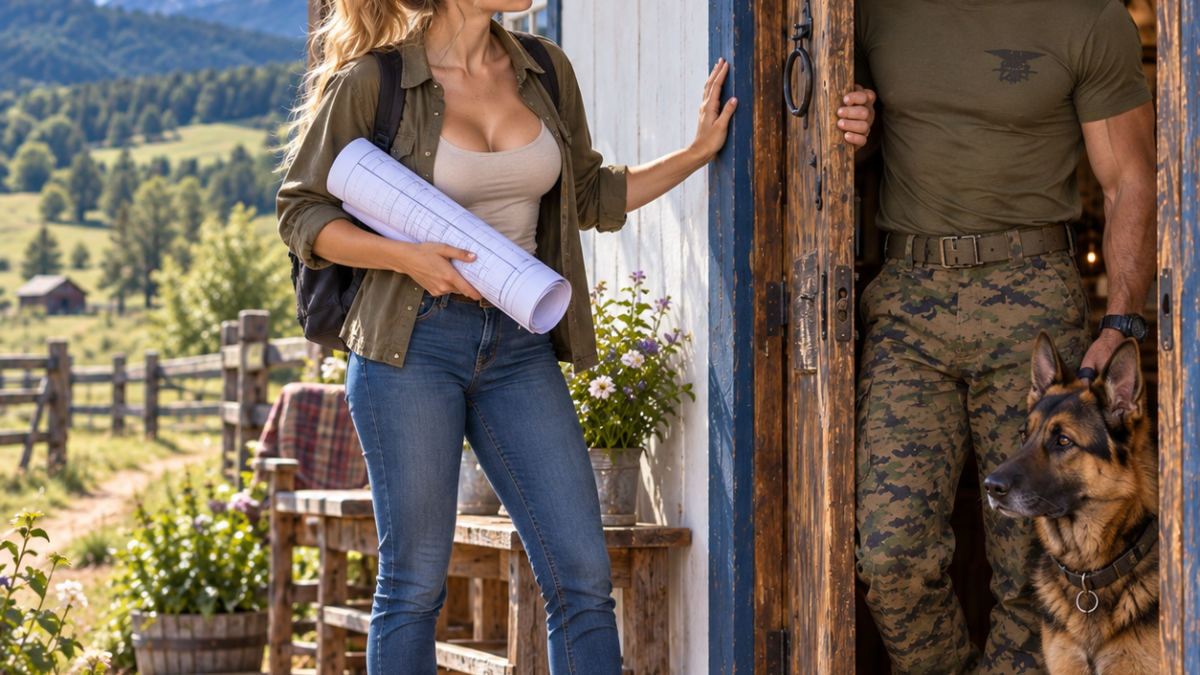
The updated one. A small smile almost reached her face, but she left it alone.
I’ll tell Ben, Dylan nodded.
And I’m reading it before I sign.
That mattered more than either of them said. He was not pretending the things that had happened to him no longer mattered. He was not throwing the gate open and calling suspicion a mistake.
He was choosing to protect the ranch with rules he could explain instead of shutting everyone out before they had the chance to follow them. The work resumed the next morning. Cody accepted the restriction without complaint.
Materials were left outside the equipment gate and Ben adjusted the schedule around Dylan’s conditions.
Nobody treated the new rules like punishment because nobody needed them, explained twice. The atmosphere on Hartwell Ranch changed less dramatically than Rachel expected.
That was probably why the change lasted. Dylan still checked every vehicle that came in. He still wanted to know who was working where.
He still read Ben’s notes before approving anything that affected the property, but he stopped standing over every movement.
He began working beside the crew instead. There were places on the lateral where that mattered.
Dylan knew where the soil softened after runoff, where old cattle paths crossed beneath weeds, and where Thomas had once reinforced the bank with stone because spring water pushed harder there than the grade suggested. Rachel no longer treated those observations as inconvenient exceptions to the plan. She added them.
In return, Dylan stopped treating her measurements like theory that needed to prove itself before earning respect. When Rachel marked a section for correction, he asked why. When Dylan questioned a cut, she checked it before defending it.
The work became faster because neither of them spent as much time trying to be right first. 3 days after the project restarted.
The crew uncovered the old headgate. Most of it was buried beneath compacted soil and roots. Ben cleared enough to expose the steel frame, then brushed away rust and dirt from one side.
A set of handstamped letters appeared near the hinge. T heartwell.
Dylan stood still when he saw them. Rachel did not ask what he was thinking.
Ben examined the old structure, then walked the channel above it twice. At some point in the past, someone had changed the way water divided there. The current shape did not match the older map.
He needed to know whether Thomas had modified it intentionally. Dylan knew where the answer might be.
After Thomas died, some of his papers had been divided between the family. Dylan kept most of the ranch records, but Aaron had taken several boxes containing old photographs, notebooks, tax documents, and personal files. the kind of things nobody wanted to sort at the time.
Dylan looked at the stamped name again. Then he took out his phone. Rachel moved farther down the channel with Ben while Dylan made the call.
She could hear only pieces of it.
Aaron’s name, their father, an old box.
A pause long enough to make Rachel glance back once. Dylan was standing beside the headgate, facing away from everyone.
The call ended in less than 4 minutes. He put the phone away and went back to work.
Aaron Hartwell arrived the following afternoon. Rachel recognized him before anyone introduced them.
He and Dylan did not look identical, but there was enough resemblance around the eyes and jaw to make the relationship obvious. Aaron carried a cardboard box against his chest.
Dylan met him near the barn. There was no hug, no handshake either.
Aaron set the box on the tailgate of his truck and opened it. Inside were photographs, notebooks, several old envelopes, and a spiralbound fieldbook Thomas had used for years. The information Ben needed took less than 10 minutes to find.
Thomas had altered the diversion point after a wash out long before Dylan returned home. A rough sketch showed the old channel line, the replacement path, and a note about keeping the lower gate partially restricted during higher flow. Ben photographed the page.
Rachel copied the measurements. The technical problem was solved.
Aaron could have left. Then he closed the fieldbook, but kept one hand on the cover.
I heard you’re putting the lateral back in.
Dylan looked toward the work site. Part of it.
Dad would have liked that. Dylan did not answer.
The silence stretched without becoming hostile. Aaron looked down at the box.
When he got sick, I always had a reason.
Dylan’s face remained still.
Aaron continued anyway. Work was bad. The drive was long.
The kids were little. There was always something that sounded important enough. Rachel had moved far enough away to give them privacy, but not so far that the words disappeared completely.
Aaron rubbed a thumb along the edge of the notebook. At the time, I told myself you were better at handling it. Dylan finally looked at him.
You told yourself a lot of things. Aaron accepted that. Yeah.
For a moment, it seemed the conversation might end there. Then Aaron said the part he had probably come intending to say.
After Dad died, it was easier to be angry at you than admit I hadn’t been here.
Dylan’s expression changed very little.
You didn’t just get angry.
I know you told people I stayed because I wanted the ranch. Aaron lowered his eyes.
I know. You said I used dad being sick. I know that, too.
There was no defense. That seemed to leave Dylan with less to push against.
He looked toward the headgate bearing their father’s name, then back at his brother.
I needed you to know better. Aaron swallowed.
I should have. Dylan shook his head once.
I needed you to say it then. Aaron stood quietly.
I know. Nothing was fixed.
Years did not disappear because one man finally named what he had done. Aaron closed the box and placed it back in his truck.
Before leaving, he asked whether Dylan wanted the field notebook. Dylan hesitated. Then he took it.
That was all. Rachel did not ask about the conversation afterward. Neither did Ben.
Work continued. Four days later, the restored section was ready for its first full test. By then, nearly everyone involved knew the time, though Dylan had approved each person who came onto the property.
Sam Whitaker arrived early. Martha Jensen brought coffee in a cardboard carrier and acted as though she had simply purchased too much.
Cody remained outside the gate exactly as agreed. Ben opened the headgate gradually.
For several seconds, nothing happened. Then a thin line of water appeared around the bend. It moved unevenly at first, catching in shallow spots and darkening soil that had been dry for years.
Rachel walked beside it, checking the grade markers. Dylan stayed near the reinforced bank, watching the section beneath the cottonwoods.
Ben adjusted the gate. The flow increased.
Not much enough. The water moved through the repaired channel without spilling over the weak bank, then continued down toward the lower properties.
Bod approached the edge and lowered his head.
“Leave it,” Dylan said.
The dog stopped. Rachel looked over.
“Technically, I don’t think he has an allocation.”
Dylan glanced at Bodie.
“You explained Colorado water rights to him.”
Bod sat down beside Rachel as if waiting for clarification. She looked at the dog.
We’ll discuss your application later.
Sam laughed under his breath. The tension around the channel eased. Nobody cheered.
There was no reason to. The lateral would not replace their wells. It would need regular maintenance.
Water schedules would still matter, and nobody suddenly had more than the land could reasonably use. What they had was another source, a little more margin for farms operating close to the edge of what their wells could comfortably supply. that mattered.
Sam walked over to Dylan and shook his hand. Martha thanked him once, then immediately asked Ben, who was responsible for checking the upper gate after the first week, sparing Dylan from having to stand through a longer expression of gratitude. Outside the gate, Cody waited beside his pickup.
When Dylan looked in his direction, Cody lifted one hand. Dylan considered him for a moment. Then he returned the gesture.
Not forgiveness, not rejection either. Rachel stood near the channel with Bod beside her and watched Dylan move among people he would once have kept at the road. He was still quiet, still particular, still the man who wanted to know who entered his land and why.
But the gate behind them was open. Rachel noticed it. She did not say a word.
By the first week of October, Rachel had almost finished the work she had come home to do. The irrigation schedule at Donnelly Orchard no longer depended on Michael remembering which field had been watered last and which valve had been adjusted by hand.
The new soil moisture sensors had survived long enough for him to stop referring to them as Rachel’s little experiments, and the production records were finally organized in a way someone besides Michael could understand.
He still checked the soil with his fingers. Rachel had stopped trying to cure him of that. Old Red Mesa lateral had settled into routine maintenance, too.
Ben checked the upper section twice during the first weeks, and Dylan took responsibility for the portion crossing Hartwell Ranch. The other growers agreed on a schedule that was practical enough to survive after the excitement of restoring it wore off.
Rachel no longer had many reasons to drive to the end of Dylan’s road.
She kept finding them anyway. Sometimes she brought updated flow numbers.
Once she returned a wrench that was not Dylan’s in the first place.
Another afternoon, she drove up to ask whether the repaired bank had held after a brief shower. Though Ben had already sent her a photograph showing that it had, Dylan never pointed these things out.
One afternoon, Rachel found two mugs of coffee waiting on the porch before she had even turned off the engine. Bod was lying beneath the railing. He lifted his head when she came up the steps, thumped his tail once against the boards, then returned to watching the yard.
Rachel sat across from Dylan for several minutes. They talked about ordinary things.
The lower orchard was being prepared for colder nights. Martha wanted another irrigation meeting before winter. Michael had decided the sensors were useful after spending most of September insisting that he had not yet formed an opinion.
Rachel smiled at that. Then she reached into her bag. The printed offer letter was folded once.
I heard back from Front Range.
Dylan’s hand stopped near his coffee.
Rachel laid the paper on the table without pushing it toward him. Front Range A Systems was a precision agriculture company in Denver. She had applied months earlier before returning home.

